Ground or Air or Ought

If you need a poem to help you cope with death, Emily Dickinson is your gal. I’ve read Richard Sewell’s 2 volume biography, and she was, as Robert Frost famously put it, “acquainted with the night,” or as my now-over-a-decade-dead friend Tommy Evatt used to say, “no stranger to heartache.”

During Emily Dickinson’s 56 years, lots and lots of people she dearly loved died.

She spoke from experience:


After great pain, a formal feeling comes –

The Nerves sit ceremonious, like Tombs –

The stiff Heart questions ‘was it He, that bore,’

And ‘Yesterday, or Centuries before’?


The Feet, mechanical, go round –

A Wooden way

Of Ground, or Air, or Ought –

Regardless grown,

A Quartz contentment, like a stone –


This is the Hour of Lead –

Remembered, if outlived,

As Freezing persons, recollect the Snow –

First – Chill – then Stupor – then the letting go –


In my case, I’m not at the “formal feeling” stage yet, probably somewhere between “Chill” and “Stupor,” but by having read Tennyson and having read Dickinson, I know someday I can look forward to “the letting go.”

I can’t stress vigorously enough to my former students how the best poetry can prepare you for (in my case, the second worse thing I can imagine happening to me) by vividly making concrete the pain of loss before it actually happens and by underscoring the universality suffering.

Metaphors fail me – dress rehearsal, inoculation?

Anyway, Miss Emily, please accept this thank you note.

Good Night, Sweet Judy


Judy Birdsong

Maybe at last being but a broken man

I must be satisfied with my heart . . .

WB Yeats “The Circus Animal’s Desertion”


Since my wife Judy Birdsong’s death last Sunday, I have been unable to write anything but clichés. Courageous battle. Unending love. Flights of angels.

Fortunately, my friend Aaron Lipka was able to express what I am feeling in an email he sent to my friends and colleagues at the school where I teach. I’d like to present it as a prelude to the slideshow I made for the funeral home visitation.

I can’t express in strong enough terms the gratitude for all of you who have sent love, thoughts, prayers, solace. Now that my Judy’s gone, I don’t have a guide to steer me within the bounds of good taste, so please bear with me when I stray, which I’m sure I will.  As they say, the past is prologue.

Here’s Aaron’s message:

One and all,

I have been thinking about what to say in this email.  Sometimes, words are not what we need, and electronic consolation can seem cold and impersonal. Whatever I can say here today will risk falling sadly short of what is useful or necessary.

And yet words are all I have to give.

Death is sad, and scary.  In the face of loss, I have listened to our school community reach out with compassion to Wesley, and I have heard others tell of the benevolent and graceful individual whom we knew as Judy Birdsong.  The cumulative message I have received this week, however, is neither sad, not scary at all.

It has been a celebration of a life lived, full of love.  It is a story that has refused to be marred in the face of hardship or sorrow.  In the sharing of the story of her life, I feel her presence with us.  Her memory is very much alive, and it is radiantly beautiful.

I consider myself fortunate to have known her, in my small way.  And I judge Wesley to be a lucky man; not for his loss, but for the many years he had to spend with Judy.  We should all hope to share such love in our lives.

I hope to see many of you at Chico Feo on Folly Beach this afternoon, 4 pm, and together lift a glass to commemorate the life and love of Judy Birdsong.  In our shared words, she will be among us.

Penitus ex animo,

Aaron


Trump, Shakespeare, and Willy Loman

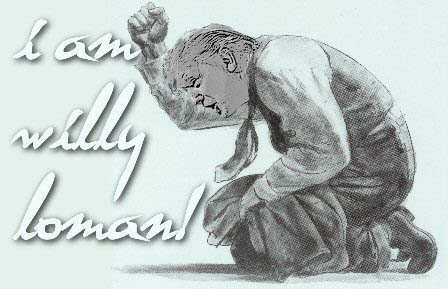
Shakespeare would begin his Trump play with the inauguration speech. We’re now in Act 2, and the Comey sacking is a very important complication in the plot. Although the chaos of the firing and its aftermath is not what Aristotle called the peripetia, the turning point of a tragedy, it is the equivalent of the murder of Banquo in Macbeth, a brazen act that deepens suspicion.

Now, no one but a Kool-Aid swilling soul-selling Party Person (e.g., Jeffrey Lord) can dismiss that Trump has obstructed justice in the canning of Comey. After all, Trump has admitted as much on national television.

Speaking to NBC’s Lester Holt, Trump contradicted the farcical original rationale that he was just following the suggestion of the deputy attorney general who saw impropriety in Comey’s handling of the Clinton email scandal. No, Trump admitted that he had wanted to fire Comey all along: “When I decided to [fire Comey], I said to myself, you know, this Russia thing with Trump and Russia is a made up story.” In other words, he canned Comey because of the investigation. Comey’s people have subsequently claimed that Trump demanded from Comey an oath of loyalty when he summoned him to dinner at the White House in the first week of the Presidency. Makes the conversation Bill Clinton had with Loretta Lynch on the tarmac seem way too much ado over nothing.

As one of my Twitter pundits put it, there’s a reason lawyers instruct their clients to keep their mouths shut.

The problem with this Shakespeare analogy, though, is that Trump lacks the stature to be a tragic figure. He’s more like Pantalone from commedia dell’arte than Macbeth or Julius Caesar. There is, however, something about him that evokes, at least in me, pity. He betrays a sort of childish vulnerability that suggests a boyhood devoid of love or attention. Like Willy Loman, he’s pathetic, not tragic. When he’s sitting down in an interview, I sense his insecurity in the shifting of his eyes and the movement of his hands.* He’s dying to be loved. Approval is his crack. He might be bigger than life, but then again he is so much less a man or woman than your average sympathetic bartender.

I suspect the peripetia is just around the corner in Act 3 when his taxes come to light.

Republicans will commence their ratlike run from Trump’s sinking ship, Spicer will continue play the role of the comic butt, and Bannon will eventually land a spot on Fox News.

In a tragedy, Bannon would hang himself.

We’re talking farce, not tragedy.


*Don’t get me wrong.  Trump is a buffoon whose brain resembles a pinball machine.  I’d love to see the above-mentioned pussy-grabbing hands stymied by a pair of handcuffs.

The Long View

Stefano Vita

Note: Last week, and a very difficult week it was, our guidance counselor asked me to “offer some words of wisdom” for the upcoming senior milestone dinner, and I agreed, though it’s a difficult task if you don’t like trafficking in clichés.

So what follows is a sort of rough draft, which I’ll more or less memorize, and then deliver it to the seniors, their parents, my colleagues, and whoever else shows up.


Good evening and first I’d like to congratulate the class of 2017, and all of the people who have helped you reach this point: your grandparents, parents, siblings, friends, teachers, the obstetricians/midwives who brought you into the world, everybody — because no one who has ever made a speech like this has failed to mention that you had a lot of help along the way, and you did.

Mrs. Kimberly has asked me if I might convey some “words of wisdom” as you prepare to leave this familiar place, so I’m going to give it a shot, and at the very least end this talk with the best advice about succeeding in college there is. So stay tuned.

Here goes.

One of life’s biggest challenges is staying awake – and I don’t mean that in the literal sense of not dozing off as you’re tooling down the Crosstown but staying awake to the wonders of the world.

Wordsworth has a sonnet that starts

The world is too much with us, late and soon,

Getting and spending, we lay waste our powers,

Little we see in nature that is ours,

We have given our hearts away, a sordid boon.

What Wordsworth means, I think, is that the day-to-day grind blinds us to the miracles of being. Focused on the upcoming chemistry exam or speeding ticket court date, we don’t notice the wren perched on branch above singing its heart out or the glint of sunlight on the distant river or maybe even the river itself.

We forget [acid head voice] that, like, hey, man, we’re on the third planet from the sun swirling in concert with a spiral galaxy spinning like a Frisbee through interstellar space.

A had a jolt a couple of months that reminded me of my own place in nature. My son Harrison and his wife Taryn gave Judy and me a DNA test kit so we could check out our ancestry. When the results came in and I logged on to discover my makeup, the first thing I noticed was the drawing of a cave man and the message “You have 58% more Neanderthal DNA than the general population.”

illustration source: The New Yorker

“Ah ha. That explains a lot. My deep-set eyes, prominent brow, inability to factor quadratic equations.”

Now, Neanderthals went extinct 40,000 years ago. Let’s for the sake of argument say a generation is 30 years. That means, in my case, it took 1,333 successful matings to come up with me. If my Neanderthal Mema had died in childbirth from an older sibling, I wouldn’t be here. Ditto if my sub-Saharan ancestor had stepped on a snake or my Norse ancestor hadn’t raped and pillaged that Irish village. You get the picture. It’s the same with everyone everywhere. That we exist at all is truly miraculous. We’ve all had miraculous births.

One of the most universal human myths – it extends from Borneo the Hebrides – is the hero’s journey. The hero, like you, has had a miraculous birth, and, like you, is called to leave his home on a quest of discovery. You’re at the part of the journey called “crossing the threshold.” Having mastered crawling, walking, riding a bike, reading, writing, calculating, solving equations, understanding the rise and fall of empires, conjugating another language’s verbs, it’s time to go.

You’re leaving the familiarity of your home to encounter new and strange beings, and, of course, it’s not going to be all smooth sailing. You’re going to be tested in more ways than one.

The good news is that you’ve been equipped with an excellent education, not only academically but also in the realm of ethics. My charge to you is not only to stay awake to the miracles surrounding you but to also strive to be a good person because I sincerely believe that if you don’t live a life of integrity you won’t be truly happy. I say this not only in the context of my own experience but also in what great literature tells us about the human condition.

Each night we go to sleep assured that the sun will rise again in the morning; however, of course, one morning it won’t, at least for us. Keep in mind the immense unlikelihood of your existence, your miraculous birth, the beauty of the world.  Look up more than occasionally at that night sky Hamlet calls a “majestic roof fretted with golden fire.”  Step boldly over that threshold into adulthood with your eyes and ears wide open.  In other words, wide awake.

How great, how exciting to be just now venturing forth.

Oh yeah, that surefire advice about succeeding in college. I promise each and every one of you will be successful if you follow this one instruction:

GO TO CLASS!

It’s harder than you might think.

To all my former students, it’s been an honor teaching you, and certainly an honor addressing all of you tonight. I wish you all the very best.

Fun with Grammar Nazis

A few posts back, I mentioned Practically Painless English, a grammar primer by Sally Foster Wallace, mother of the famous David Foster Wallace, the brilliant novelist and essayist who gave us Infinite Jest and “A Supposedly Fun Thing I’ll Never Do Again.”

Here’s a riff from one of David Foster Wallace’s infamous footnotes, a description of his favorite “tablemate” on a luxury cruise that Harper’s sent him on, despite his being more than a touch agoraphobic:

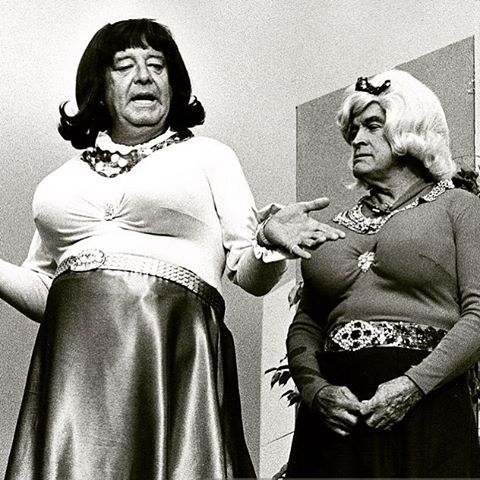
Trudy was 56, the same age as my own dear personal Mom, and looked – Trudy did, and I mean this in the nicest way possible – like Jackie Gleason in drag, and had a particularly loud pre-laugh scream that was a real arrhythmia-producer, and was the one who coerced me into Wednesday night’s Conga Line, and got me strung out on Snowball Jackpot Bingo, and was also an incredible lay authority on 7NC Luxury Cruises, this being her sixth in a decade – she and her friend Esther (thin-faced, subtly ravaged-looking, the distaff part of the couple from Miami) had tales to tell about Carnival, Princess, Crystal, and Cunard too fraught with libel-potential to produce here, and one long review of what was apparently the worst cruise in 7NC history – one “American Family Cruises,” which folded after just sixteen months – involving outrages too literally incredible to be believed from any duo less knowledgeable and discerning than Trudy and Esther.

Look what I found: Jackie Gleason in drag!

In the above-mentioned post, I mentioned that I actually taught from Practically Painless English in the ‘80’s but that now copies were going for $138, but lo and behold, I have scored a copy of the second edition for pittance — $34.

What a hoot. Sally Foster Wallace is brilliantly subversive. Dig this explanation of the capitalization of pronouns:

Remember that I is the only pronoun that is always capitalized, no matter where it appears in the sentence. Capitalize a pronoun referring to God, too:

God’s eye is on the sparrow, but I know He watches me.[1]

Here’s an example with the polite instruction to “please circle each pronoun you find in these sentences”:

Lassie is teaching her pups to chew with their mouths open.

Another treat is that she creates a cast of idiosyncratic characters who sort of evolve – or at least provide behavioral motifs — as we travel from “Parts of Speech” through “Paragraphs.”

These include Peony McAllister, Rambo and Rambette, Inertia and Aphasia. Grandma and Grandpa Pringle, and Chively Sneed. Fedonia Krump and Mongo.

Here are a few of my favorite examples:

Please circle the adverbs in the following paragraph:

Peony McAllister was so excited about her extremely interesting Japanese flower-arranging class that she completely ignored the bright red stop signs randomly placed here and there on her route to school. Suddenly, her very cold ears picked up the hauntingly familiar sound of a skull-shattering loud siren, and she saw dazzling lights in her rearview mirror. Frantically, she began to create convincingly pathetic excuses for going too fast. As she slowly pulled over to the side of the road, she patted her motorcycle gently and smiled bravely at the very large person who was slowly approaching.

Brava!

Identify the part of speech of the italicized words.

Ezra pounded the steak and then smothered it in onions.

If you call your sister a dweebazoid again, I’ll be forced to turn you into a toad.

Obviously, no remedial student is going to pick up that allusion.

Identify the subject and verb.

Rambette took her parakeet for a walk.

Wild horses dragged the tall leprechauns to a boring movie.

Here’s one from a punctuation exercise.

Fedonia’s pet lion fell into the paving machine so she calls him Leotarred.

You catch the drift – DFW didn’t fall far from the maternal tree, at least as far as surrealism and an obsession with English usage (go, goes).

It’s interesting to note that when he taught college, he was, by his own admission, fanatical about correct grammar and mechanics. Here he is in another footnote, this one from the essay: “Authority and American usage” describing what happened every semester when he taught lit.

Once I’ve had to read my students’ first set of papers, we immediately abandon the regular Lit syllabus and have a three-week Emergency Remedial Usage and Grammar Unit, during which my demeanor is basically that of teaching HIV prevention to intravenous drug users. When it emerges (as it does every term) that 95 percent of these intelligent upscale college students have never been taught, e.g., what a clause is or why a misplaced only can make a sentence confusing or why you don’t just stick in a comma after a noun phrase, I all but pound my head on the blackboard; I get angry and self-righteous; I tell them they should sue their hometown school boards, and I mean it. Every August I vow silently to chill about usage this year, and then by Labor Day there’s foam on my chin. I can’t seem to help it. The truth is that I’m not even an especially good or dedicated teacher; I don’t have this fervor in class about anything else, and I know it’s not a very productive fervor, not a healthy one – it’s got elements of fanaticism and rage to it, plus a snobbishness that I know I’d be mortified to display about anything else.

Good God, how I miss DFW. What a loss to literature.

David Foster Wallace
world copyright Giovanni Giovannetti/effigie


[1] Aren’t two sparrows sold for a penny? Yet not one of them falls to the ground without your Father’s consent.  Matthew 10:29, Holman Christian Standard Bible

On Literary Fiction, Fantasy, Sex, and Death

It’s that time in the academic year when we select books for summer reading, and, of course, one of the many considerations our department weighs is the suitability of the book for the age of the reader.  Not surprisingly, puritanical parents tend to be especially frightened of fiction’s potential to somehow harm their children. Even if a novel doesn’t contain, as the movie people put it, sexual situations, it might very well deal with death.  Sex and death are the yin and yang of possible parental complaints.

Actually, I think perhaps the greatest danger that novel reading might pose lies not in the depiction of sex and death but in the extremely slim possibility that novels’  heightened realities might, like the speaker in Yeats’s “The Stolen Child,” lure impressionable readers into magical worlds that seem so much more alluring than the soulless six-lane highways and cell towers of the real world.  In other words, the danger is that the child might become a bookworm, bury himself between the covers, and withdraw from the realm of people, places. and things.

Away with us he’s going,

The solemn-eyed:

He’ll hear no more the lowing

Of the calves on the warm hillside

Or the kettle on the hob

Sing peace into his breast,

Or see the brown mice bob

Round and round the oatmeal chest.

For he comes, the human child,

To the waters and the wild

With a faery, hand in hand,

For the world’s more full of weeping than he can understand.

Yeats, “The Stolen Child”
Arthur Rackham

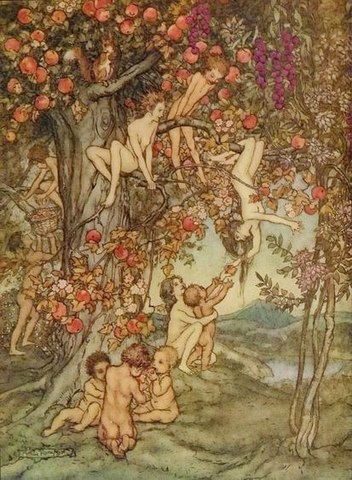
However, the problem with fairyland is that like Eden/Paradise it ultimately bores predatory primates unless, like buddhas, we can dismantle our egos and embrace the sheer bliss of existence, and if we can do that, to turn a phrase of Milton’s Satan, then “we ourselves are paradise”  – or, if you prefer Hamlet, “[we] could be bound in a nutshell and consider [ourselves] king[s] of infinite space.”

The scene depicted above, for example, looks like fun, except when you start considering the question of the aging process, estrogen and testosterone.  As Wallace Stevens wrote, “Death is the mother of beauty,” and without Death’s majesty, we’re back in the undifferentiated sexless world of amoebas.

Unlike the magical world of Yeats’s poem, the fairyland of most children’s books is fraught with conflict, which is the very stuff of fiction, as Bruno Bettelheim expounded in The Uses of Enchantment.  According to him, fairy tales with their wicked stepmothers, ogres, crones, and abandonment provide a roadmap of sorts to help children negotiate the treacherous ascent to adulthood as the tales shed a flickering light on their subterranean  unconscious sexuality.  For example, according to Bettelheim, the familiar beginning of the “Snow White” introduces children to not only the concept of death, but also to the blood link of menstruation and procreation.

As she sewed she looked up at the snow and pricked her finger with her needle.  Three drops of blood fell into the snow.  The reed on the white looked so beautiful that she thought to herself, “If only I had a child as white as snow, as red as blood, and as black as the wood in this frame.”

Soon afterward she had a little daughter who was as white as snow, as red as blood, and as black as ebony wood, and therefore they called her Little Snow-White.  And as soon as the child was born, the queen died.

There you have them both– sex and death.

Several years ago I was congratulating an acquaintance on her daughter’s well-received first novel, and the mother said wistfully that she wished her daughter had written something less controversial, something more like, and she specifically cited this title, “Hansel and Gretel.”   In other words, a narrative about childhood abandonment and cannibalism is less horrible than a narrative about the various sexual encounters one experiences coming of age in a late empire.

Snow White, as we switch from Freud to Friedan, agrees to become a chaste hausfrau rather than take her chances wandering the wolf-prowled woods.  Yet, like her tower-incarcerated cousin Repuntzel, the pull of a sexual partner will liberate her from the narrow confines of chastity, in Snow White’s case, a glass coffin. Repuntzel, interesting enough, is the rescuer rather than the rescued as her tears of compassion restore the eyesight of the feral prince who has been wandering Oedipus-like in a barren desert.

Essentially Repuntzel is the story of how two become one and then three.

Ernst Liebermann

Of course, it’s not fairy tales that’s making the top-ten challenged books lists in high school but less subliminal fare like Love in the Time of Cholera, The Color Purple, and A Clockwork Orange. Actually, excellent literary novels tend by their very nature to be moral because they portray life realistically – promiscuity doesn’t bring happiness, avarice creates misery, and honor ennobles.  Also, good books, whether they contain sexual situations or violence, provide vicarious experience for the uninitiated.

In our discussion about summer reading last Wednesday, our department chair wanted to have his seniors read Margaret Atwood’s The Hand Maid’s Tale.  I lauded the novel but warned him that when I had been chair, I eventually removed the novel because of constant complaints from parents in consecutive years. One mother complained bitterly about how depressing the novel was and thought it dangerous for adolescents to be exposed to so much negativity.

Here’s a snippet from the letter I wrote her:

It is a legitimate question to ask why so much contemporary literature is so negative.  After all, looking towards Hollywood one rarely ever encounters an unhappy ending. However, unlike most movies, great literature provides students with a realistic portrait of the world and endows them with the vicarious experience that comes with experiencing the struggle, triumphs, and, yes, defeats of its characters.  For example, Hamlet — about as tragic a work of literature as you’ll ever encounter — provides a realistic portrait of a fallen father, a mother’s obscenely hasty remarriage, the dissolution of a love affair, and about as many corpses as will fit on a stage.  Yet, when we finish reading (or seeing) the play, we’re not depressed but can share in the nobility of a person’s battle against “a seas of troubles” and say with Hamlet “what a piece of work is a man, how noble in reason.”  Moreover, we can perhaps learn from Hamlet’s mistakes.  They have become a part of our experience because Hamlet is to us a fellow human being.

As far as The Hand Maid’s Tale is concerned, Margaret Atwood has said she wrote the novel in light of the subjugation of women in Iran and Afghanistan.  She does, I think, a masterful job of recreating that experience for American and European readers.  It’s much easier to emphasize with Offred, the protagonist, because she is of our world. We experience her shame and helplessness with her.  In addition, the central of the novel is a positive one: human love is unconquerable and very much worth dying for.

Ah, there it is again, that word dying.

She says, ‘But in contentment I still feel

The need of some imperishable bliss.’

Death is the mother of beauty; hence from her,

Alone, shall come fulfillment to our dreams

And our desires. Although she strews the leaves

Of sure obliteration on our paths,

The path sick sorrow took, the many paths

Where triumph rang its brassy phrase, or love

Whispered a little out of tenderness,

She makes the willow shiver in the sun

For maidens who were wont to sit and gaze

Upon the grass, relinquished to their feet.

She causes boys to pile new plums and pears

On disregarded plate. The maidens taste

And stray impassioned in the littering leaves.

I would also add that a life of reading great literature helps in a way to face death’s awful but necessary reality because as Hamlet himself says, “If it be now, ’tis not to come. If it be not to come, it will be now. If it be not now, yet it will come—the readiness is all.”

By the way, we are going with The Hand Maid’s Tale.

Language, Thinking and the Oratorical Donald

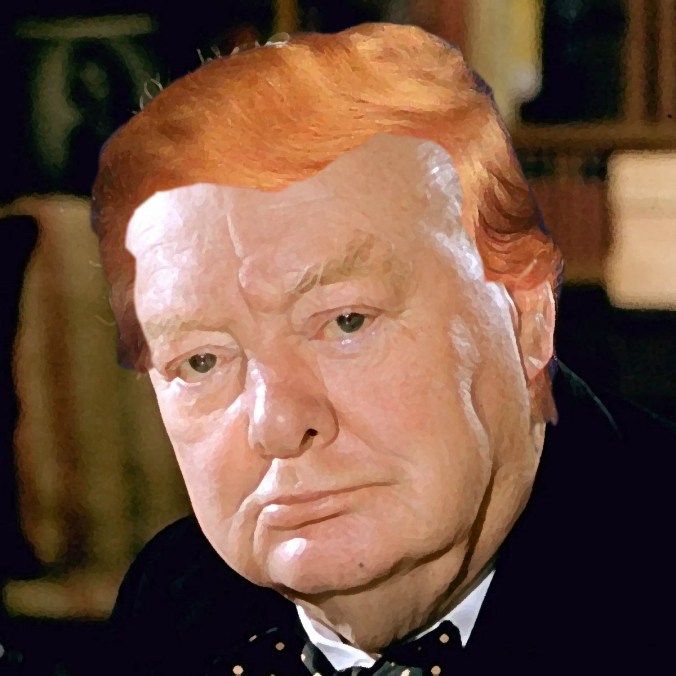
Sir Winston Trump

Can we at least all agree on this: when it comes to verbal expression, Donald Trump is no Winston Churchill?

Yeah? But is he as bad as the critics claim?

Sarah Sloat thinks not. On the website Inverse, she argues that rather than being an indication of stupidity, Donald’s Trump limited vocabulary “exemplifies sly intelligence.”

She takes issue with Philip Roth’s contention in the 30 January issue of the New Yorker that Trump is essentially a fucking imbecile, both intellectually and morally.[1]

Take it away Mr. Roth:

I found much that was alarming about being a citizen during the tenures of Richard Nixon and George W. Bush. But, whatever I may have seen as their limitations of character or intellect, neither was anything like as humanly impoverished as Trump is: ignorant of government, of history, of science, of philosophy, of art, incapable of expressing or recognizing subtlety or nuance, destitute of all decency, and wielding a vocabulary of seventy-seven words that is better called Jerkish than English.”

Because Trump has “a small vocabulary size,” Sloat argues, doesn’t mean “that the President is dumb.” I more or less agree with her on this point. A limited vocabulary doesn’t necessarily mean that a person can’t solve intricate quadratic equations or intelligently assess a potential business rival’s weaknesses. What I do disagree with, however, is that Trump’s use of an impoverished vocabulary is “the hallmark of a person sly enough to hook his listeners and persuade them using only a few words.” In other words, I don’t think Trump’s use of a small number of words in his speeches is a conscious action aimed at endearing him to downhome folk. I think he talks that way all the time.

For example, here he is discussing history with an interviewer on satellite radio:

They said my campaign is most like, my campaign and win was most like Andrew Jackson with his campaign. And I said, “When was Andrew Jackson?” It was 1828. That’s a long time ago. That’s Andrew Jackson. And he had a very, very mean and nasty campaign. Because they said this was the meanest and the nastiest. And unfortunately it continues.  His wife died. They destroyed his wife and she died. And, you know, he was a swashbuckler. But when his wife died, you know, he visited her grave every day. I visited her grave actually, because I was in Tennessee. And it was amazing. The people of Tennessee are amazing people. Well, they love Andrew Jackson. They love Andrew Jackson in Tennessee. I mean, had Andrew Jackson been a little later, you wouldn’t have had the Civil War. He was a very tough person, but he had a big heart, and he was really angry that he saw what was happening with regard to the Civil War. He said, “There’s no reason for this.” People don’t realize, you know, the Civil War, you think about it, why?

Trump isn’t shy about expressing his dislike of reading, which shows not only in the content of what he says but also in its expression.   The mind that produced the above is a mind not shaped by reading, a mind lacking the syntactical structures necessary for clear thinking, a mind with a threadbare vocabulary that limits the ability to detect and therefore articulate nuance.

It’s almost as if he’s invented his own brand of sub-literate Newspeak. Everything is either “bad” or “evil” or “great” and” tremendous.” Hence, the flip-flops. He doesn’t merely moderate his stances but completely reverses them. He rushes to judgement, proclaims something “tremendous” or “bad” but then after a discussion with a cabinet member pulls a 180.

Take his reversal on NATO, for example: “The secretary general and I had a productive discussion about what more NATO can do in the fight against terrorism. I complained about that a long time ago, and they made a change, and now they do fight terrorism. I said it was obsolete. It’s no longer obsolete.”

The implication is that NATO has just recently changed their posture towards terrorism because of Trump’s complaints, and now that NATO has changed, it’s no longer obsolete. This may be a clever strategy for hoodwinking his ardent followers but probably not all that an effective approach when it comes to our allies.

At any rate, what I most disagree with is Sloat’s conflating intelligence with ignorance. She writes, “Roth equates Trump’s small vocabulary with ignorance, [my emphasis] which is in line with the old-school view of verbal fluency.” But ignorance and intelligence are two very different matters. Unlike me, I suspect that Stephen Hawkins is ignorant of the various interpretations of David Lynch’s Mulholland Drive floating around the Internet; however, I dare say that he would beat me on an IQ test.

At any rate, Roth’s charge of Trump’s ignorance “of government, of history, of science, of philosophy, of art” seems to me indisputable. Trump’s vocabulary is beside the point here. The idea of Andrew Jackson’s preventing the Civil War is about as credible as Noah’s releasing two penguins on Mount Ararat. It’s grossly ignorant and would be just as ignorant if Churchill had expressed it in all of his sonorous eloquence.

Skillful orators alter their vocabularies depending on their audiences. Trump uses the same impoverished vocabulary whether he’s making a speech to a stadium of his supporters, answering policy questions from an interviewer, or hitting on a model.

He’s tripleplusinarticulate.


[1] Quoting Sloat quoting researchers, “A voluminous taboo lexicon may better be considered an indicator of healthy verbal abilities rather than a cover for their deficiencies.”  Oh fuck yeah!


Dr Seuss on the Juice (as performed by Dr. John)


When I read Kafka

I get wasted on Vodka,


Though Mr. William Faulkner

Go better with Johnnie Walker.


Can’t do Proust

With no gin in my juice.


Obviously, Guinness be the choice

When I open up my Joyce.


(Finnegan’s Wake sober

Mean a walloping hangover).


Never do Virginia Woolf

Unless the bottle say 100 proof.


Nobel Laureate TS Eliot

Requires an even stronger inebriant.


And remember,

if you want to stay alive,

Don’t read and drive.


Late and Soon: Falling out of Lockstep from the Ranks of the Conventional, Sighing, TGIF Zombie Corps

The world is too much with us; late and soon,

Getting and spending, we lay waste our powers . . .

                                                                    Wm. Wordsworth

In his long life, Richard Wilbur has never lost his Wordsworthian sense of childlike wonder. Wilbur’s heart leaps up, not only when he behold[s] a rainbow in the sky, but also at such overlooked mundane wonders like the turbine-vent [that] natural law/ Spins on the grill-end of the diner’s roof.

Many of his poems grapple with the relationship between metaphor and perception, suggesting that poetry works its magic in casting the commonplace (by the way, that diner is located on a planet swirling around a star hurtling in concert within a galaxy spinning into the vast abyss of space/time) – [ahem] casting the commonplace in strange ways that paradoxically help us to shake off the staleness of familiarity so that we suddenly can perceive the spectacular it-ness of the whatever.

Here Wilbur in an English sonnet called “In Praise of Summer” wonders why we need the distortions of jazzy description to jar into seeing:

Obscurely yet most surely called to praise,
As sometimes summer calls us all, I said
The hills are heavens full of branching ways
Where star-nosed moles fly overhead the dead;
I said the trees are mines in air, I said
See how the sparrow burrows in the sky!
And then I wondered why this mad instead
Perverts our praise to uncreation, why
Such savour’s in this wrenching things awry.
Does sense so stale that it must needs derange
The world to know it? To a praiseful eye
Should it not be enough of fresh and strange
That trees grow green, and moles can course in clay,
And sparrows sweep the ceiling of our day?

Wilbur, as it were, offers poetic language as a sort of perceptual slap in the face, awakening us to the unseen wonder right there before us while at the same time lamenting our inability to see freshly in the first place..

Closer to making than the deftest fraud
Is seeing how the catbird’s tail was made
To counterpoise, on the mock-orange spray . . .
Richard Wilbur, “Lying”

Seeing is half-creating, as Wordsworth himself puts it in “Tintern Abbey.”

Nevertheless, in Wilbur, our consciousness is both a wonder and a curse – sometimes in the same poem.  For example, in “A Question from Milton,” the poetic speaker dismisses prelapsarian consciousness as boringly 2-D:

In Eden palm and open-handed pine
Displayed to God and man their flat perfection.
Carefully coiled, the regulation vine
Submitted to our general sire’s inspection.

Yet in the very last stanza of the same poem he suggests that Adam should

Envy the gorgeous gallops of the sea,
Whose horses never know their lunar reins.

Obscurely yet most surely called to praise, As sometimes summer calls us all, I said The hills are heavens full of branching ways Where star-nosed moles fly overhead the dead; I said the trees are mines in air, I said See how the sparrow burrows in the sky! And then I wondered why this mad instead Perverts our praise to uncreation, why Such savour's in this wrenching things awry. Does sense so stale that it must needs derange The world to know it? To a praiseful eye Should it not be enough of fresh and strange That trees grow green, and moles can course in clay, And sparrows sweep the ceiling of our day?

Wilbur as a young man studied under the mighty Robert Frost, who echoes this post’s epigraph in the first line of his poem “Directive:”

Back out of all this now too much for us,
Back in a time made simple by the loss
Of detail, burned, dissolved, and broken off
Like graveyard marble sculpture in the weather . . .

The past, a simpler time, childhood.

All three poets – Wordsworth, Frost, and Wilbur wish we could chill, notice the glint of sunlight on that discarded aluminum soda can up ahead (rather than focusing our life force somewhere deep down in the mine shaft of self-absorbed work-based anxiety), that is, to have our childlike vision and sense of wonder restored.

However, if the office below is your workspace, good luck with those mind-forged manacles.

Chances are after 40-hour week cooped in your cubicle, you’re probably looking for something a little stronger than a shot of chiasmus and splash of synecdoche to get away from it all.  It’s going to take something stronger than Wilbur or Wordsworth to appreciate the it-ness of the StickyNote slapped on the particle board next to your computer.  But you gotta eat, right; the kids need braces; it’s the price we pay.

As one highly successful minstrel put it: They dope you with religion and sex and TV.   To evoke a cliche that the cubicles pictured in the above office suggest, contemporary corporate life is a competitive and repetitive rat maze where functionaries (what Marx called workers) glance repeatedly at digital clocks’ counting down the hours and minutes until 5 o-clock liberation and the slow creep of gridlock home.

Day after day, each missed sunset and rising moon are subtracted from the finite number of future possibilities.

I have measured out my life with coffee spoons.

And, of course, the soulless dissatisfaction with getting and spending isn’t limited to the corporate world.  Stroll down the halls of any Monday-thru-Friday workplace on the fifth day PM, and you’ll hear folks murmuring psalms of praise, not to Jesus, Yahweh, or Allah, but to Odin’s wife Freya/Frigg.

Day by day our world becomes more complex, and it sometimes seems that somehow there must be some diabolical conspiracy among the top 1% – the they in Lennon’s song – who have hypnotized us and led us onto this dizzying not-so-merry-go-round of consumption.  Even in rather seemingly slow paced professions like teaching, the proliferation of voicemails, emails, committee meetings, etc. means longer school days and school years.

Yet, truth be told.  We have only ourselves to blame for falling lockstep into the ranks of the conventional, sighing TGIF zombie corps.  A brave few souls, sons and daughters of Blake, refuse to conform.

Take my former student and now friend, David Connor Jones, who for the last few years has been living out of his car roaming the North American west “like Caine in Kung Fu. meet[ing] people, get[ting] in adventures” and encountering gorgeous vistas that would raise the hair of Richard Wilbur “[l]ike quills upon the fretful porcupine.”

photo by David Connor Jones

It, of course, takes great courage to be free.  When I was in the USSR in ’89, the citizenry wasn’t digging perestroika, preferring the safe status quo.

At any rate, we should at least try to take Wilbur’s advice, to remember always the miracle of our being, to savor this very second, no matter in a cubicle, a jail cell, or worse.  We should strive to attain Buddha-consciousness in this here very life now, so as Wilbur puts it a bit more eloquently, we can find ourselves

In the same clearing where, in the old story,
A holy man discovered Vishnu sleeping,
Wrapped in his maya, dreaming by a pool
On whose calm face all images whatever
Lay clear, unfathomed, taken as they came.
Richard Wilbur, “Walking to Sleep”

David Conor Jones

Wordly Wise Succumbs to Political Correctness

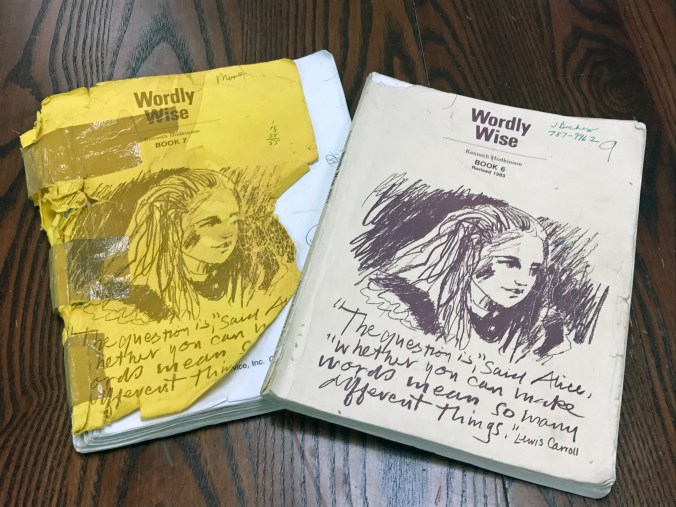
Note James Dickey’s phone number on the cover; he’d let students call him and interview him for research papers on Deliverance.

Years ago, in a less sensitive century, I taught a course in Remedial English Developmental English at a community college. Of all the various workbooks we tried during my stint there, my favorite was Practically Painless English by Sally Foster Wallace, who happens to be the mother of David Foster Wallace. David would have been a late teen when I was teaching from his mom’s workbook, and I was only in my late twenties myself.

Alas, a couple of years ago, I gave my only copy to DFW aficionado and kickass essayist John Jeremiah Sullivan. As of this morning, surviving copies are going for $138 a pop on Amazon.

However, thanks of an internet recovery site, I was able to cop these exemplary snippets from Sally Wallace’s book:

Orlanda McGurk and Chively Sneed drink kerosene.
I went to the grocery store. I bought some soap. I bought some dynamite.
His eyes sparkled as he sprinkled poison on the cupcakes.
The bright pink sports car crashed on the icy winding road.
Until the killer confesses, we are all under suspicion.
The murderer himself was in the funeral procession.

Delightful but dangerous in this trigger-unhappy era. It’s possible one of your students’ mothers died when her pink Porsche skidded off an icy, winding road and smacked into an aspen. Although unlikely, Mrs. Wallace’s macabre example could cause legitimate heartache. Believe me, it happens. I’ve hurt people alluding to a much more unlikely death scenario.

So it’s not surprising that editors of long running series like Wordly Wise occasionally revise sentences to better reflect contemporary sensibilities. In fact, several new editions have come out in the 32 years I’ve been teaching Wordly Wise; however, because I’m lazy, I still use the very same workbooks issued to me in 1985. (see illustration above) Just because the word buxom[1] has been removed from Book 7, doesn’t make it worth the trouble of re-doing the exercises of the latest iteration to accommodate such a minor change.[2]

These changes usually take place in Section B, where students have to select sentences in which italicized words have been used incorrectly (see footnote 1 below).

Many of the emendations reflect skittishness about religious references.

Exercise A

a heathen tribe

(a) living in the jungle (b) living on islands (c) converted to Christianity (d) without Biblical religious belief

Exercise B

16 (a) Any person not a Christian, a Jew, or a Moslem was considered a heathen. (b) Missionaries went abroad in great numbers to convert the heathen to Christianity. (c) The people in the jungle are best left alone to worship their heathen gods. (d) The natives continued to heathen their own gods despite the efforts of the missionaries.

So when students hear Bob Marley sing “Heathen back against the wall,” they won’t have a clue.

Examples of violence are also targets for replacement.

From the same world list, one example of recoil has been softened. The 1983 edition includes the sentence, “He recoiled in horror when his gaze fell on the murdered man,” which in the 1998 version reads, “He recoiled in disgust when he saw the slugs in his driveway.”

My favorite changes occur in Book 6, Word List 6 where the sentence “Following their defeat in battle, the tribesmen were ruthlessly massacred” has been changed to “Some people see meat-eating as the massacre of animals.” Also, the strange “The animals were driven into the ravine and massacred by men with high-powered rifles” has given way to the metaphoric “The visitors massacred the home team; the score was 57 – 0.[3]

Apparently, George Custer remains fair game. The 1983 sentence “The massacre of General Custer’s men at Little Big Horn occurred in 1876″ survives in the 1998 edition.

Sex is not so much a problem because the editors ignore any sexual connotations a word may have. For example, orgy is defined as “wild, abandoned merrymaking.”

Hi, Emerson how was school today?

It was a blast, mom. The pep rally turned into an orgy!”

I’ll leave you with one last example, another sentence that has withstood the [tautology alert] censorious eye of the Wordly Wise censor:

“He led a chaste and ordered life with his uncles.”

WTF?


[1] It’s defined as “plump.” See if you can guess which usage is incorrect: A. She was a healthy, buxom woman in the prime of life or B. She offered to buxom the pillow to make it more comfortable.

[2] Our department eschews teacher manuals.

[3] What offends me more than religious references or allusions to violence is the examples’ unnecessary use of passive voice and their lack of specificity. How about “A band of hunchbacked Lithuanian dwarves drove the bison into the ravine where their Russian overlords massacred them with AK 47s” or “The visitors massacred the home team 57-0?