A Thing Called Perception: A Review of “Portraits of a Marriage” by Sándor Márai

[…] all that we behold

From this green earth; of all the mighty world

Of eye, and ear,—both what they half create,

And what perceive.

Wordsworth, “Tintern Abbey”


Whether your sunglasses are off or on

You only see the world you make.

John Hiatt, “A Thing Called Love”


I’ve just finished at a former student’s strident insistence the Hungarian novelist Sándor Márai’s last work, Portraits of a Marriage. I don’t know if we lose something in the translation of the title, but the narrative might more accurately be dubbed: Satellites of Love or Chain, Chain, Chain of Partners or A Sociological Study of Class Relationships in Hungary from 1930 – 1950.[1]

The thing is that no title can do justice to the mighty compression of meaning that the novel holds. Divided into four parts, the narrative unfolds in the style of a Robert Browning dramatic monologue, with each section narrated by a different character. We are in a concrete setting, a bar or bed, and along with us there is someone listening to a monologue, but we never hear that person speak. Instead, we get remarks like: “Sorry . . . What did you say? Why I started weeping when I saw him just now?”

This auditory technique may be off-putting in a culture dominated by visual imagery where we expect cinematic quick cutting, and I admit the conceit does add a bit too much ballast to suspension of disbelief; however, the articulation of the perceptions of the first three monologists is at once meaningful and conversational.[2]

It begins in Budapest between the wars. Here is Ilonka, the first wife of Peter, an industrialist, describing to a female companion her reaction to finding a decades-old love token in her husband’s wallet, a token that predates her relationship with him:

And now I knew that whatever wonderful or terrible things were happening in the world, it was pointless to accuse myself of selfishness, lack of faith, lack of humility, pointless comparing my problems to those of the world of nations, the problems of millions suffering their various tragedies, because there was nothing I could do – selfish and petty as I was, obsessed and blind as I was – except to get out on the street and search out the woman I had to confront face-to-face, the woman I had to talk to. I had to see her, to hear her voice, look in her eyes, examine her skin, her brow, her hands.

We can’t blame Peter for fleeing such suffocating obsession, and in the second section he tells a colleague what that first marriage was like and how he fared in his second marriage to a servant girl of his household named Judit, the girl who had given him that token, a peasant who literally grew up in a ditch. In England, after she leaves the household, she transforms herself into a highly credible Pygmalion-like creature who knows which fork to pick up. Upon her return, Peter defies social convention and marries this underclassling.[3]

Here is Peter describing the object of his obsession:

It wasn’t a “lady” or a glittering socialite I yearned for. I hoped for a woman with whom I could share a lonely life. But she was terrifying ambitious [. . .] wanting to conquer and take occupation of the world.

The only things she fears is

[h]er own hypersensitivity to offense, some mortal wound to the pride glowing in the depths of her life, her very being. That was what she was afraid of, and everything she did by word, silence, and deed was a form of defense against it. It was something I could never understand.

So what we have here is the Rashomon effect, contradictory accounts of the same event. In the course of these dialogues a quarter of a century passes; we see the class stratification of Hungary before the war, Budapest’s leveling during the war, and its Soviet occupation after the war. All of our principals but Ilonka become ex-pats.

It’s Judit who devours the narrative scenery, talking to her latest lover, a jazz drummer whose stage name is Ede. They’re in Rome in a hotel bed after one of his gigs.  Judit possesses the most experience, having risen from abject poverty to enormous wealth. She’s the least socially conditioned one, and she is able to look upon the events of her life with a sort of anthropological detachment:

High culture, it seems, is not just a matter of museums but something you find in people’s bathrooms and kitchens where others cook for them. Their way of life did not change, not a bit, not even during the siege, would you believe it? While everyone was eating beans or peas, they were still opening tins of delicacies from abroad, goose liver from Strasbourg and such things. There was a woman in the cellar, who spent three weeks there […] on a diet, a diet she maintained even when the bombs were falling. She was looking after her figure, cooking some tasty something on a spirit flame using only olive oil because she feared that the fat in the beans and gristle everyone else stuffed themselves with out of fear and anxiety might lead her to put on weight! Whenever I get to thinking about it, I marvel what a strange thing this thing called culture is.

There is one other character, Lazar, who doesn’t get his own monologue but who appears in every section. He’s a writer, perhaps Márai’s alter ego. Of course, I identify with him because, not only is he bald, but he’s also a pessimist (and who wouldn’t be scrounging around a bombed out city).  He has several quotable passages throughout, but I’m going to have Judit describe him instead of having him speak for himself:

What’s that? Was he a snob? Of course, he was, among other things, a snob. He couldn’t stand being helped because he was solitary and a snob. Later I understood that there was something under this snobbish manner of his. He was protecting something, trying to preserve a culture. It’s not funny. I expect you’re thinking of those olives. That’s why you laughing? We proles, we don’t really get the idea of “culture,” sweetheart. We think it’s a matter of being able to quote things, of being fussy, of not spitting on the floor or belching when we’re eating, that kind of thing. But that’s not culture; it’s not a matter of reading and learning facts. It’s not even learning to behave. It’s something else. It was the other idea of culture he was wanting to protect. He didn’t want me to help him because he no longer believed in people.

As I was reading through the individual sections, I found myself put off by these people’s egocentricities, their obsessiveness, but once I got halfway through Judit’s monologue, the cumulative effect suddenly came upon me like revelation. What we have here is a deep meditation on love, loneliness, obsession, culture, family, and perhaps most profoundly, the limitations of personal observation.  The gulf between these people’s perceptions of themselves and others’ perceptions of them is an unbridgeable breach.

This might not be a great novel – I won’t judge until a second reading – but if you’ve reached this final sentence, you’re likely to find it worth your while.


[1] In Spanish the title translates into “The Righteous Woman”

[2] The 4th narrator Ede, a jazz drummer-cum-bartender, lives in “a pad.”

[3] Let’s not forget that Hunagry in the early part of the previous century was not L.A. I can’t come up with a good analogy. Prince Phillip marrying Billie Holiday?

Sándor Márai as a child

Hank, Cormac, and Daddy

from left to right, Cormac McCarthy, Hank Williams, Sr., Wesley Moore, Jr.

“Scars have the strange power to remind us that our past is real.”

Cormac McCarthy, All the Pretty Horses


I want some old school raspy voiced chain-smoking musician from Alabama or Mississippi to write me a song called “Crushed Out Cigarette in Hank Williams’ Ashtray.”

Hank was high-strung, jittery, an ADD-riddled Cormac McCarthy. The glass ain’t half full with them two, and their assessment of the glass ain’t even as positive as half empty. The glass is half-empty and carcinogenic. [1]

I remember being a kid at The North-52 Drive-in with my parents and seeing the trailer for Your Cheating Heart, a biopic of Hank’s life starring George Hamilton with Hank Jr. providing the soundtrack vocals.[2] In the olden days, I’d have to describe the trailer for you based on my short-circuiting memory, but now you can see for yourself.


At the drive-in some of these scenes hit home a little too familiarly. In other words, I could relate. Like Hank, my daddy could be sweet and generous, but, like Hank, he had a fuse so short static electricity could set him off, especially if he’d been drinking, Nor was my daddy what you would call a feminist.

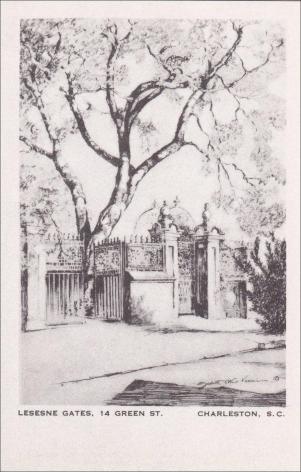
Like Hank, Daddy felt the urge to create. He rendered in shoe polish on our dining room wall a credible copy of the Elizabeth O’Neill Verner’s The Lesesne Gates, 14 Greene Street. Late in life, he sculpted gnomes, which weren’t nearly as good as the mural. Not only was he creative in the visual arts, he was also scientifically inventive. He received a patent for a sonar-operated weir for sewer treatment plants, but rather than selling the patent, he tried to manufacture the product himself and went broke.

I wish I had a photo of the wall, but I don’t think we ever owned a camera. The wall’s been painted over three or four times. I do have half of a gnome, though, which I keep hidden in the closet of my classroom. Because they were never baked, they eventually fell apart.

Hank’s works, however, survive and will as long as humans are around to strum guitars. His pain lives on in a meaningful way. Listen to Lucinda pass it along to us.


I raise my glass to dissonance, to sweet songs of sorrow, to Hank and Cormac and Daddy.

Wesley Edward Moore, Jr.


[1] To my ear “ain’t” is a lovely word with that mournful diphthong.

[2] Actually Hamilton looks more like Townes Van Zandt than he does Hank.

Trafficking In Mockery

illustration by Pawel Kucynski

Constant change, or anicca, is a central concept of Buddhism, one of the three marks of existence, along with dukkha (suffering) and anatta (non-self). The Gautama Buddha (c. 567- 487 BCE) taught that attaching to impermanence (e.g., your childhood goldfish, your adolescent puppy love, your undergraduate hairline, your spouse, your existence) ultimately results in sorrow. To escape the natural inclination to become attached to objects of desire, Gautama Buddha points out a pathway that enables one to transcend ego, i.e., to enter a state of anatta, in which one becomes not even zero but this [1] [                    ].

The concept of constant change is inherent in quantum mechanics, cellular division, and, more obviously, in the shifting shapes of the clouds above. Everything is always in a state of flux. Not only did Eastern sages like Gautama come upon this concept of constant change, but also so did the Greek pre-Socratic philosopher — a contemporary of Gautama — Heraclitus, whose dates are c. 535 BCE – 475 BCE.

It’s easy to imagine Heraclitus’s most famous saying “No man ever steps into the same river twice” coming come from one of Gautama’s sermons. Unlike serene Gautama who suggested “a middle way,” Heraclitus, known as “the weeping philosopher,” was profoundly pessimistic. No doubt his pessimism contributed to what I hope are apocryphal accounts of his death.

According to Neanthes of Cyzicus, Heraclitus, suffering from dropsy, attempted to cure himself by covering his body with manure and lying out in the sun to dry, but he was made unrecognizable by the dung covering and was finally eaten by dogs. [2]

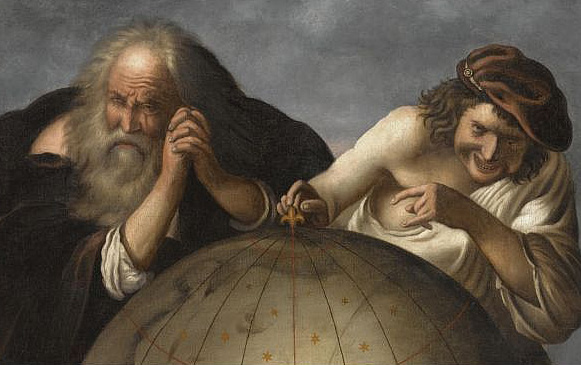
Heraclitus and Democritus
Johanness Moreelse

Not surprisingly, impermanence has been the theme of many a poet, and my main man WB Yeats is no exception. Take his masterpiece “Nineteen Hundred and Nineteen.”

Many ingenious lovely things are gone

That seemed sheer miracle to the multitude.

He offers examples of ancient art that has been lost:

[ . . .] There stood

Amid the ornamental bronze and stone

An ancient image made of olive wood –

And gone are Phidias’ famous ivories

And all the golden grasshoppers and bees.

Or as the latin poet Aaron Lipka puts it:

Vita brevis, ars longa,
tamen non est sempiterna.

Yeats goes on to lament the end of the pax Victoria when “a great army [was] but a showy thing.” However, in 1919 the “days are dragon-ridden,” and “[t}he night can sweat with terror as before/ We pieced our thoughts into philosophy.”

He adds that he (or she) “who knows no work can stand [. . .] has but one comfort left: all triumph would/But break upon his ghostly solitude.”

He ends the first section of the poem with this stanza:

But is there any comfort to be found?

Man is in love and loves what vanishes,

What more is there to say? That country round

None dared admit, if such a thought were his,

Incendiary or bigot could be found

To burn that stump on the Acropolis,

Or break in bits the famous ivories

Or traffic in the grasshoppers or bees.

(Or, in the case of Hobby Lobby, traffic in stolen ancient Mesopotamian clay cuneiform tablets, perhaps looted by ISIS.)

Is what Yeats calls “ghostly solitude” anatta?

Probably not. In Section 3, he refers to a Platonic theory of an afterlife. This theory holds that the greater a person’s accomplishments, the more likely those accomplishments will encumber her in her passage to the next world. Therefore, “if our works/Could vanish with our breath/That were a lucky death/For triumph can but mar our solitude.”

From the Cambridge Introduction to WB Yeats:

Before the poet can take comfort in his conclusions, it dawns on him that the evanescence of mortal triumphs is precisely what makes us love them. The fact that great works vanish does not make it easier to cast off our attachment to them. Indeed it makes it harder.

Andrew Wyeth

Today marks the 8th Sunday since my Judy died. The Buddhist ideal of total detachment, although wise, is better suited for one with a monastic temperament. If you are a husband or wife, a father or mother, a pet owner, a lover of Billie Holiday or the Marx Brothers, detachment is inexcusable. That doesn’t mean, however, you should embrace Heraclitus’ model and wallow in melancholy.

Weep when you must; party when you can.

Also, cynicism, though not ideal, can offer some satisfaction:

Come let us mock at the great

That had such burdens on the mind

And toiled so hard and late

To leave some monument behind,

Nor thought of the levelling wind.

Come let us mock at the wise;

With all those calendars whereon

They fixed old aching eyes,

They never saw how seasons run,

And now but gape at the sun.

Come let us mock at the good

That fancied goodness might be gay,

And sick of solitude

Might proclaim a holiday:

Wind shrieked — and where are they?

Mock mockers after that

That would not lift a hand maybe

To help good, wise or great

To bar that foul storm out, for we

Traffic in mockery.


[1] Insert “the sound of one hand clapping? The formula “form = emptiness; emptiness = form? The inexpressible mental concept of non-concept? Your original face before you were created?

[2] Janet Fairweather.“The Death of Heraclitus,” Greek, Roman, and Byzantine Studies.

In the Days Before Digitalization

In the days before digitalization, people looked straight ahead when they walked, sometimes making eye contact. In the summers, it was hot at night (earth air temperature has risen only .5 degrees since Eisenhower), so people without air-conditioners sat on stoops or porches and conversed with passersby and neighbors.

If a disagreement arose, say, over how many strikeouts Lefty Gomez amassed in his career, precise information was difficult to come by. Unless someone could produce an almanac or up-to-date encyclopedia, the disagreement couldn’t be settled until later. Sometimes people called librarians to look up the answers to their questions, though, of course, libraries weren’t open at night. On some nights you might hear people raising their voices in disagreement over Gomez’s strikeouts or the name of the last Triple Crown winner.

However, in the daytime, most librarians would cheerfully agree to research your questions. In those days, most white workingwomen wore flesh-colored hose, which they attached to undergarments called garter belts, elastic contraptions worn around the waist that had metal clasps dangling around the garter belts’ circumferences. Women (and a few men known as transvestites) attached the top of their hose (also called stockings) to the clasps of the garter belts.

Most librarians were female in the days before digitalization. To find the answer to the riddle of the number of strikeouts, they left their stations behind a desk and walked to retrieve the information from a reference volume classified by the Dewey Decimal System. If the librarian were plump, the chafing of her hose would produce a swish-swish sound.

When she called to inform the questioner that Lefty Gomez had struck out 1,468 in his major league career, she had to dial the questioner’s number, each digit clicking clockwise downward to engage. Depending on the size of the community, telephone numbers might consist of as few as four digits. However, it took longer to dial four digits then than it does to punch in ten digits today. Before the 1960’s, all telephones were black.

In the days before digitalization, people were thinner (average female waist circumference 1950: 71.2 cm; circumference today: 91.44 cm). Rather than dieting or joining a gym, a librarian might wear a girdle, a constricting undergarment creating the illusion of a flat abdomen. These armor-like undergarments restricted movement. When a girdled librarian approached a talker with her forefinger pressed to her lips to issue a shushing sibilant, she could appear militaristic in her carriage.  Libraries were as quiet as mausoleums. They housed only books, magazines, and phonographic records.

In those days, dairies delivered milk to people’s porches on weekdays. Virtually all milk delivers were male.  Milkmen worked early hours and drove UPS-like trucks with open doors. They had daily routes, like paperboys, who rode bicycles.  Because of their recurrent journeys around the grids of city streets, milkmen got the reputation of producing children out-of-wedlock. In the days before digitalization, condoms were about the only mechanical means of birth control.

While he was at work using company time to call a librarian regarding Gomez’s strikeouts, a man’s wife could be going through the time-consuming activity of undressing in preparation for a tryst with a milkman. For each digit her husband dialed, she could unclasp on average two garter connections, completely disengaging the hose before the first grating sound simulating the distant phone’s ringing.

In movies, women called this process “slipping into something more comfortable.” Because of the conspicuousness of a milk truck parked on the curb outside a house, these sexual unions were completed rapidly. They took place in less time than it took the librarian to receive the call, research the question, and return the cuckold’s call.

If someone’s child had red hair in an otherwise dark-haired family, the jovial answer to the question “where did you get that red-hair” was “from the milkman.”

In fact, people still us this phrase even though milkmen have gone the way of hardbound encyclopedias, ink stamps, and ox ploughs.


Perry Mason and the Hardy Boys in Erle Stanley Gardner’s/Franklin W Dixon’s “The Case of the Oedipal Parricide”

Chapter 1 – It’s a Small World After All

It’s a typical sunsplashed Tuesday in Southern California where Perry Mason sits in his spacious walnut paneled office admiring his brand new state-of-the art intercom system. This is the age of rotary pay telephones, automobiles with tailfins that stretch out like prison sentences, an age when administrative assistants are known as secretaries.

Mason’s secretary, Della Street, shares the office with him. She’s an extremely attractive dark-haired woman in late twenties, buxom but wasp-waisted, slender, long-legged. Although the median marriage age for women is 20.6, Miss Street is single, and her desire for Mr. Mason is palatable. They frequently socialize, and his demeanor towards her is paradoxically solicitous yet aloof. Even though he often places his hand on her shoulder or waist as they walk together, there’s a distant formality in those gestures. Somehow she hasn’t intuited he’s as gay as a rhinestone-studded cummerbund.

As she leans over to place some papers on his desk, there’s a brisk knock on the door, and in strides Paul Drake, Mason’s private detective of choice. Drake is a strapping 6’2,” with sharp features and an abundant amount of blonde hair combed back from his forehead. He’s sporting a soon-to-be out-of-style checkered blazer and a skinny black tie.

He gives Della the once over and says, “Hello, beautiful.”

“Hello, Paul,” Mason replies.

Drake places his hands on his hips and frowns. “Look, Perry. I’ve asked you more than once to desist with these playful innuendos. I know you’re joking, but it makes me feel uncomfortable. I could claim harassment.”

Mason looks up an offers a slight, quizzical smile. “First of all, Paul. It’s 1957. There are no harassment laws. Second, I was looking down at these papers on my desk. You didn’t say, ‘Hello, Della. You look beautiful.’ You said, ‘Hello, beautiful.’ I assumed you were referring to my soulful protuberant eyes and the feline grace with which I move my broad-shouldered frame, my girth always well disguised beneath the impeccable tailoring of my Brooks Brothers suits. But, look, I didn’t call you here to match lawyerly wits but to get you working on a case.”

“Okay, Okay,” Drake says, surrendering.

Drake, Perry (seated), Della

“Ever heard of Fenton Hardy?”

“You mean the private detective who works out of Bayport, that small but thriving city of fifty-thousand inhabitants, located on Barmet Bay, three miles inland from the Pacific Ocean?”

“That’s the one.”

Della pipes in, “He has two sons. I read about them recently solving a case for their father.”

“That’s right,” Mason says. “One boy is dark, and the other fair, but there’s a marked resemblance between the two brothers, Eighteen-year-old Frank is tall and dark. Joe, a year younger, is blonde with blue eyes.   By the way, their father, Fenton is dead.“

Della and Paul, as if in a duet, simultaneously gasp, “Dead?”

“Murdered,” Mason says, holding up his palm, traffic-cop-style to prevent their gasping “Murdered?”

“Well,” Paul says, pulling a pack of cigarettes from his breast pocket, “There certainly are a slew of thugs, gangsters, insurance fraudsters who would have a motive. “

Mason, calmly, “Oh, they’ve already arrested a suspect.”

In unison, “They have?”

“Yeah, the older boy Frank, the darker one, has been arrested and booked for murder.”

“Back in Bayport?” Stella asks.

“No,” Mason replies matter-of-factly. “In Anaheim. The family was vacationing at Disneyland. Laura, the mother, and Joe had gone out to run some errands. Frank was back in his room recuperating from sprained back from a fall he’d suffered in Frontierland, and the father was napping. When Laura returned she found her husband dead in bed, gunned down by his own pistol, which was lying on the floor. The gun is covered in the older boy’s prints.”

“That’s Frank,” Drake asks, “the older one, the dark one?”

“Correct. Paul, I want you to drive to Anaheim to the Clearview Motel, Rooms 17 and 19 and to see if there’s anything Tragg has overlooked. I’m headed to the jail to interview Frank.”

“Okay, boss.”

“Della, I want you to come with me.”

As Della grabs her purse, Drake exits in a hurry, leaving the door open. Mason waits, places his hand gently on Della’s back ushering her out. He turns around and carefully closes the door.

[cue the ominous distinctive theme song]

Unanswered Prayers

Mr. Bigshot, who do you think you are?

By the way, I don’t pray, despite the miraculous anecdotal evidence. If I did, I’d probably limit my beseeching to “Thy will be done,” which in fact seems to me like a sort of silly request to make of an omniscient, omnipotent deity. “Damn straight,” might be the thunderous response in whatever is Heaven’s native language – Hebrew, Aramaic, Greek, Latin?

People who knew about our agnosticism would sometimes half-apologetically say during my wife Judy’s illness, “I know you’re not a believer, but I’m praying for you,” and she’d reply, “We welcome thoughts, prayers, and small animal sacrifices. “ I would assure them that I too welcomed their prayers and insisted I could very well be wrong in my metaphysical musings. After all, when Judy was studying to be a school psychologist and giving me a practice IQ test, I missed the question, “Why do people bathe?”[1]

Nor do I hold the belief that “things work out for the best” as if the challenges life splatters upon us are steps in some sort of divine plan that leads to a more favorable outcome.[2] Of course, horrible events can sometimes precipitate peripheral favorable outcomes. For example, if my maternal grandmother had not gotten cancer of the larynx, her son would not have met the red-haired student nurse who became my mother. I need to add that I don’t think my existence is a fair trade for my grandmother’s death in her forties. My non-existence would be no tragedy. Judy would have married someone who might not have gone bald. My son Harrison would not be spending this holiday weekend at Ocean Beach nor my younger son Ned headed to Iceland, but quite literally they would be “none the wiser.”

my maternal grandmother

One of Judy’s pet phrases was “it is what it is,” and I might add, “it isn’t what it isn’t.” However, whatever the antecedent of “it” might be, it’s a mighty bountiful gift/accident to exist on the jewel of a planet moving in accordance with its kin folk of the Milky Way wherever we’re heading.

I thank my lucky stars (or God or karma) for affording me this opportunity to contact you, to look up from the computer screen to see outside my study’s window the soft sway of magnolia branches, to embrace the “wounded epicureanism” that has been my lot in life.”[3].

I’m not complaining.


[1] To conform to societal expectations was my answer.

[2] Exhibit A: the Holocaust

[3] “Hemingway was a master not of a realized stoicism but of a wounded epicureanism. Have fun while you can, and then endure the bad stuff when it happens. It doesn’t sound high-minded when you say it, but it was saner than most anything else on offer.” Adam Gopnik in the 3 July 2017 edition of The New Yorker.

Drowned Out Crickets

That our cellular devices have bastardized communication is a commonplace complaint among my fellow babyboomers. Recently, I’ve seen (on my iPhone 7) photographs of signs outside coffeeshops and bars proudly announcing no Wi-Fi and exhorting their patrons to talk to one another. [cue Jesse Colin Young]:

Come on people now
Smile on your brother
Everybody get together
And try to love one another right now.

On the other hand, what if you aren’t in the mood to talk to the person on the barstool next to you? A week or so ago, a fellow with a radio announcer’s voice engaged me in a conversation I would have rather avoided. He started quizzing me about my life, what I did for a living, if I were single. This led to the unpleasant admission that I was a recent widower, which triggered condolences and metaphysical observations that I found not very convincing. But instead of countering his suppositions with logical objections, I merely nodded my head, as if it were possible that the afterlife amounted to mere anthropomorphic wish-fulfillment, a skating park or golf course or multiplex theater based on the individual predilections of the deceased.

No, I would rather have been on Twitter chuckling over one of Matt Yglesias sardonic tweets or reading an article from The Times or The New Yorker.

That said, I do agree that beyond the utilitarian function of coordinating when and where to meet, texting is a taxing, inexact way to communicate. Obviously, it’s not an effective platform for debating whether Eliot’s The Waste Land is a satire of Eastern and Western Civilizations or a sincere cri de coeur from a tortured soul. Still, I can’t tell you how I enjoyed those simple texts from Judy like On the way home [heart emoji].

All in all, if used properly, cell phones enhance life.  (Yeah, I realize you can say the same thing about alcohol or morphine).

I think a greater danger than its debasing communication is a cellular device’s ability to pump music into the heads of adolescents. Students-on-the-spectrum seem particularly prone to further shutting off the world around them by inserting an ear-bud and saturating their brains with whatever dystopian bands warm the synapses of their alienation. Many of their more outgoing peers also seem to be addicted. In my study halls, I allow students to listen to music on their phones, and virtually everyone does, males sometimes thrashing back and forth as they unravel those quadratic equations.

However, in my academic classes, I have my students place their cell phones in a basket at the beginning of the period, and if we’re working on a writing project, I ignore their pleas to return them because they “work so much better” when they’re listening to music. I offer a little experiment. I have them write as I sing the Stones’ “Satisfaction” into their ears. Sometimes they whine that they listen to classical music, and I tell them that they’re not really listening to the music, that they’re demeaning music that deserves their attention if it’s merely a sonic backdrop for their thinking. Plus, words create sounds. They should be paying attention to what their prose sounds like. Yes, I embrace my role as curmudgeon.

Recently my son Ned and I watched the movie Arrival, and I picked up on a sonic motif: throughout the movie blaring harsh industrial sounds puncture certain scenes of chaos. IMHO, the constant barrage of beeping backhoes, horn honks, thumping pimpmobile basses, leaf blowers, and sirens blaring in constant cacophony overloads our mental circuitry, which evolved over the millennia in the relative quiet of savannahs.  This overload jangles nerves, shortens attention spans, invites chaos.

In fact, I find myself often craving silence. I turn the radio or stereo in my car off.  I drive in silence.  Perhaps when I retire I’ll abandon Charleston for

The Lake Isle of Innisfree

I will arise and go now, and go to Innisfree,

And a small cabin build there, of clay and wattles made;

Nine bean-rows will I have there, a hive for the honey-bee,

And live alone in the bee-loud glade.


And I shall have some peace there, for peace comes dropping slow,

Dropping from the veils of the morning to where the cricket sings;

There midnight’s all a glimmer, and noon a purple glow,

And evening full of the linnet’s wings.


I will arise and go now, for always night and day

I hear lake water lapping with low sounds by the shore;

While I stand on the roadway, or on the pavements grey,

I hear it in the deep heart’s core.


WB Yeats


The Reluctant Juror, the Dowager, and Dr. Betty

This week I have been summoned to jury duty.
I arrived at the courthouse yesterday with my wife’s death certificate in hand figuring I’d play the grief card to attempt to weasel out of my civic obligation. Once through security and ushered by a bailiff to the seat next to the man in front of me, I looked around the room, which was nicely appointed, official-looking but not ominous. There were four rows of benches holding five potential jurors per bench. I’d say maybe 200 people had been summoned.

Eventually (it seems a traffic incident on the Ravenel Bridge delayed the start), an assistant clerk, a tall, slender man who appeared around 30, welcomed us and made a few opening remarks. I had seen him milling around with his buzzcut temples, spiky crown, and angular beard, all of which created a sort of villainous vibe, like he could have been cast as an undercover Stasi agent in a coldwar movie. However, his voice was warm, friendly. He thanked us for our service, acknowledged the inconvenience. He mentioned that this was a propitious week to have been chosen (randomly from voter registration and DMV data bases) because there were only two trials on the docket, both civil litigation cases, whereas a typical week would feature 3 criminal and 3 civil cases.

Once the judge arrived, each of us had to stand when called and give our juror number, age, occupation, marital status, and if married, the occupation of our spouse.

This procedure seemed somewhat intrusive. Age, I can see, occupation okay, but why marital status?

Juror 147.   My name’s Bottom. I’m 25 years old, a weaver. My wife is a charwoman.

This occasion marked the first time I had to officially acknowledge that now I’m single, and I hated it. Although many proudly shared specifics about where they worked – “I’m a third grade teacher for Berkeley County Schools and my husband an electrical engineer at Folsom Manufacturing” – I decided to give as little info as possible.

“Juror 238. Wesley Moore, 64, a teacher, a widower.” [1]

As the preliminaries moved slowly along, it became apparent even if I could be excused this go around, I’d be transferred to a future term. The last time I had served on a jury was in 1978 when Judy and I were newlyweds and I could walk from our apartment on Limehouse Street to the Courthouse on Broad.  Even though I had brought along Kaufman’s translation of The Portable Nietzsche to give the false impression to lawyers that I believed “[i]n the last analysis, even the best man is evil: in the last analysis, even the best woman is bad,” I was chosen for 3 trials, the last right out Flannery O’Connor.

***

As it turned out, I served as the foreman of that jury, the only non-African American
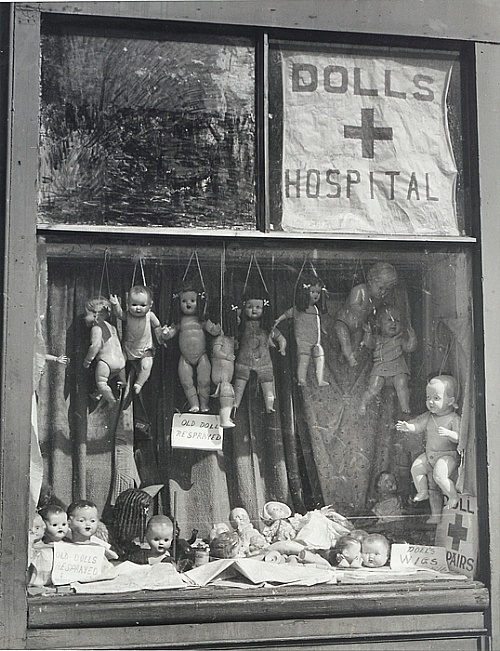
represented. I don’t remember the official name of the case, but it might have well be dubbed Rich Dowager Whose Address Contains the Word Plantation vs. Dr. Betty, doll surgeon.

The Dowager was represented by her son-in-law whose day job was assisting Senator Strom Thurmond in Washington DC, and Dr. Betty’s counsel was a public defender, a young dark-haired woman who looked as if she might have been Joyce Carol Oates’s first cousin.

Here’s the gist: The Dowager had brought an 18th century doll that had been in the family since – um – the 18th century.  Somehow the doll’s nose had been knocked off, and Dr. Betty was to replace the nose so no one would know the difference.

Dr. Betty, who referred herself in the third person (“Dr. Betty would never do a thing like that”) was probably in her 60’s with poorly dyed unkempt blonde hair. She wore a thin dress with a white cardigan even though it was in the summer. Essentially she looked like the type who might take care of thirty cats roaming around a yard strewn with inoperable automobiles and cast away washing machines.

The Dowager was seeking $5,000 in real damages and $5,000 in punitive damages because, as it turned out, when the Dowager had come 2 years later to retrieve the doll, it was gone, allegedly sold by Dr. Betty to someone in a town near Columbia for what she claimed was $5.

Judge Stoney: So you don’t remember the name of the town. Could it have been Cayce?

Dr. Betty: Yes, yes, that was the name of the man I sold it to. His name was Casey.

Oh, if I only could create a gif of Judge Stoney’s expression.

Through the course of the trial it came to light that an 18th century doll who has had a nose job possesses only sentimental value, that Dr. Betty’s phone records showed she had called So-and-So Plantation in Beaufort trying to get the Dowager to pick up the doll, which Dr. Betty had repaired.  It had been two years, and she had not received any remuneration.   However, in South Carolina you can’t lawfully sell another’s unclaimed property unless you announce that intention in the newspaper.

At one point the Dowager told of visiting Dr. Betty’s shop, peeking in one of the windows,  and described its squalor in tones of obvious disgust.

Dr. Betty: That’s not my shop. That’s where I live.

Dowager: My God, you poor woman!

I swear, I’m not making this up.

Once we went into our deliberations, my colleagues, who had taken to calling me “Professor” [2] unanimously wanted to find Dr. Betty innocent, but I explained to them we shouldn’t do that because according to the law she was guilty because she hadn’t published her intent to sell the Dowager’s unclaimed property.

“Look, I said, “we can award her one penny in real damages and nothing in punitive damages,” but we have to find her guilty.”

“No, 5 dollars,” one of the jurors said, “that’s what she sold it for.”

We all agreed. The deliberations may have taken ten minutes.

When I had to stand and deliver our verdict, the Dowager smiled, and Dr. Betty looked incensed, the opposite reactions of what I would have imagined.

***

A clerk’s announcement of who were being selected for the pool ended my reverie of long dead Dr. Betty and the Dowager, and sure enough I was selected to join the pool of potential jurors.

Several of the chosen got out of it by approaching the judge and telling her their sad stories, but I didn’t try.

Charleston  County Courtroom

The Bailiff ushered us upstairs to the courtroom pictured above where a different judge, an older bald-pated white-haired fellow from Edisto Beach presided. He announced the case and asked a series of questions: for example, were we kin to any of these people, had we ever received their professional services, etc.

Finally, the judge asked if there were any other issues that might prejudice us, and I approached the bench.

Huddled there with the judge and the attorneys, I disclosed that I had taught one of the parties’ son and daughter. The judge asked me if he thought this might prejudice me. I said in a perfect, rational, Euclidian world it would not but that in this messier world I had a great deal of affection for both of this person’s children. The judge seemed sympathetic.

Of course, I was struck and set free, and here I sit hoping against hope that when I call in this evening at six, the message will be to call in Wednesday at 6.  At the very worst, I’ll only be involved in one trial.


[1] As it turned out, I was the oldest person there; the youngest was 18 but looked all of 12.

[2] I was an adjunct at Trident Technical College at the time teaching composition, Business English, and Technical Report Writing.

A Failson, Trustafarian, and Jared Kushner Walk into a Bar

I approve of the way James Joyce combined English words as if he were writing in German.

He especially liked fusing adjectives as in “snotgreen” or “chalkscrawled” or “sanguineflowered.”

Dig this: “bluesilver razorshells.”

Unfortunately, if you’re dumbassspeller like me and need your spellchecker to autocorrect, you’re not likely to follow Joyce’s lead because of those goddamn redunderlinings. Undoing them by doublechecking every possible error results in tedious timewasting.

Anyway, sometimes a fusedword will sneak into the language. Today, I learned a new one: failson.

Here’s the Urban Dictionary’s ungrammatical definition:

White, middle-class, male, useless people—who have just enough family context to not be crushed by poverty.

Felix, the failson of the family, goes downstairs at Thanksgiving, briefly mumbles, ‘Hi,’ everyone asks him how community college is going, he mumbles something about a 2.0 average, goes back upstairs with a loaf of bread and some peanut butter, and gets back to gaming and masturbating.

 A failson is not to be confused with a trustafarian, which is gender neutral:

Privileged white kids who subscribe to the hippie lifestyle (because they can) since they have no worries about money, a job etc. They can then devote their lives to eating organic, following Phish, and wearing dreadlocks (no need for job interviews).

 Sarah is a trustafarian. It’s totally evidenced by the combination of her brand new car[1] and nice digs with her “earthy” clothes and dreadlocks.

I suspect failsons tend to hole themselves up in their rooms and suffer from an EmilyDickinsonian/EdgarAllanPoeish pallor whereas the tanned Trustafarian I know who lives on Folly Beach frequently appears in public and is a ubiquitous source of putoff. When he’s not tripping on shrooms, he’s smugly pontificating in a hauterladen voice.

Him, me no dig.

But what about Jared Kushner? What’s the word for him?

How about nepotistickleptocrat?


In English, a hybrid language, there’s almost a word for everything.


[1] Or, as Joyce would put it brandnewcar.


Multiple Guess, the Carpe Diem Solution in Test Construction


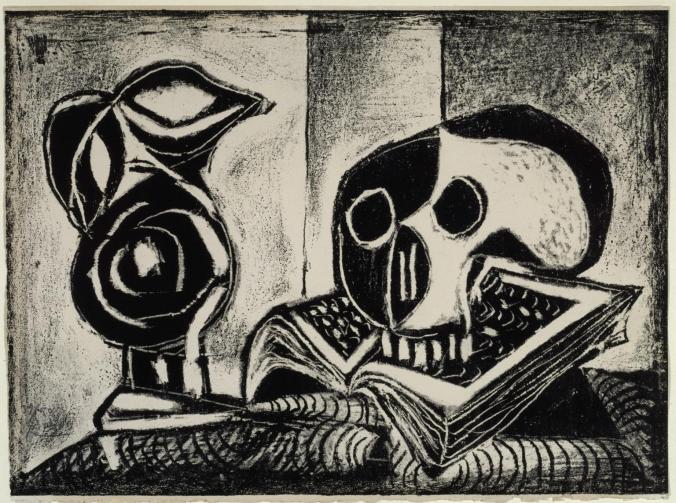
Black Jug and Skull 1946 Pablo Picasso 1881-1973

Occasionally, when I head up to the science office to run my Scantron multiple choice sheets through the automatic grading machine, I detect among my colleagues looks of subtle disapproval, the facial equivalents of “tsk-tsk,” as if English teachers should use only short answer or essay questions to test their students.

Of course, any teacher worth the magnificent salary she receives knows that well-crafted multiple choice questions can test, not only factual information, but also provide a chance for students to employ critical thinking skills.

For example, there are 4 types of irony.

Verbal: Words convey the opposite of their literal meaning. E.g., “I can’t think of a mentor better suited to instill integrity than Roy Cohn.”

Dramatic: The reader knows more than the characters. E.g., “Darling, I have a wonderful surprise. I’ve just booked passage for two on the maiden voyage of the Titanic!”

Situational: Matters turn out the opposite of what one would imagine. E.g., You get fired from your teaching position and on the way home buy your very first lottery ticket that ends up being the Super Jackpot Powerball winner.

Morrisettean: (named for pop singer Alanis Morrisette) E.g., It rains on your wedding day. In other words, it isn’t ironic, any more ironic than a “fly in your chardonnay” or discovering the “man of your dreams,” whom you’ve just met, is already married.

Okay, I concede that if I constructed a multiple-choice test and merely provided those definitions of irony with the possible answers A. verbal, B. dramatic, etc., it would be pretty lame.

What you want is your students to recognize irony when they encounter it, not merely to be able to define it.

Here’s how I’d tackle a multiple-choice question on irony.

Rising junior Bennington has been obsessed with WWI aviation since he was ten. It’s always been his dream to see a Sopwith Camel in flight. For his 16th birthday, his father takes Bennington to the prestigious Paris Air Show.

Guess what?

Bennington actually sees a Sopwith Camel take off and land!

What type of irony does this example represent?

A. Verbal   B.   Dramatic     C. Situational         D. Morrisettean

The answer, of course, is D. There’s nothing unusual about seeing an antique airplane at a prestigious airshow.

You do, however, have to be careful and not have any shaded areas in the Venn diagram of your answers.

For example, which of these artists most obviously doesn’t fit.

A. Gertrude Stein

B. Hemingway

C. James Joyce

D. Picasso

Now this question is fraught with problems. All four were expatriates who hung out together in Paris during the Twenties. So who doesn’t most obviously fit?

Student (thinking): Stein was a novelist, Hemingway was a novelist, Joyce was a novelist, but Picasso was a painter, so it must be Picasso, but wait a minute, Dr. Crabapple might be trying to trick me because he’s led a barren, lonely existence.

Okay, Stein was an American, Hemingway was an American, Joyce was Irish, and Picasso Spanish, so that doesn’t work. Hey, English was the native language for all but Picasso. That seals it – D. Picasso!

[cue jarring game show buzzer]

Teacher: Dammit, fool. It’s Gertrude Stein. She’s a woman, the most obvious difference among the four is gender, not genre or nationality or language.

Student: She doesn’t look like a woman. Obviously, she identifies as a man! That’s not fair! That’s tricky!

Teacher: It might be unreasonable, but it’s not unfair. Every student got the identical question. If you had been the only person to get it, it would have been unfair.

Student (bursting into tears): Now I’ll never get into Harvard!

This absurd situation could have been avoided with a simple introductory phrase:

As far as genres go, which of these artists most obviously doesn’t fit.

As far as language goes, which of these artists most obviously doesn’t fit.

As far as gender sex goes, which of these artists most obviously doesn’t fit.

So don’t let your colleagues guilt you into punishing yourself by assessing long, rambling incoherent paragraphs that attempt to present the jumble of facts students remember about a topic.

Gather ye rosebuds, time’s winged chariot, down their carved names the raindrop plows, etc.

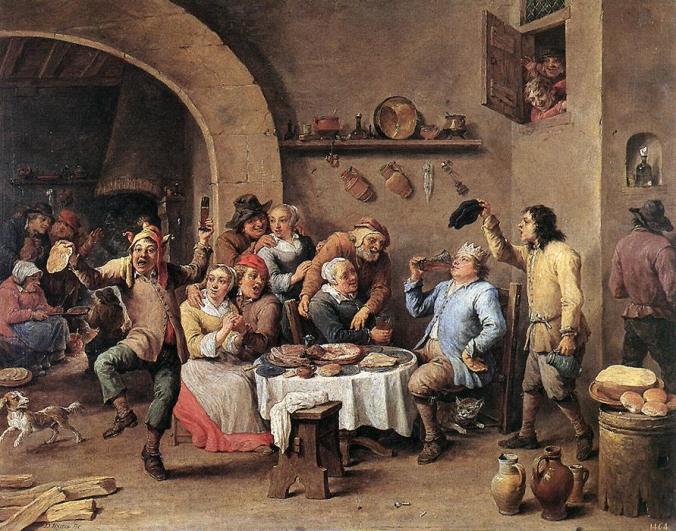
“Twelfth-Night (The King Drinks)” 1634-40 by David the Younger Teniers