. . . weeds, in wheels shoot long and lovely and lush


                      		Hot springs’ vented vapors spew skyward
                   		in cloudy swirling images to be carved in wood
								chiseled in stone,
			personified.


				First Gaia,
				then Maia,

Oh God,
	Zeus is on the loose,
		Isis is in crisis,
                                						Noah drunk and Jonah swallowed,
				Jesus, Vishnu, Jah-Jah


				JAH-CHOO!

				Gesundheit!
Note: Words in bold provide passageways to complete texts alluded to in the poem, which was also influenced by the John Prine song “Hello, in There.” By clicking on the audio file at the very bottom of the post, you can listen to the song in its entirety.
I’ve always been disdainful of anthropological depictions of heaven as wish-fulfillment, so in the poem “After All,” I take the concept to a ridiculous extreme.
After All
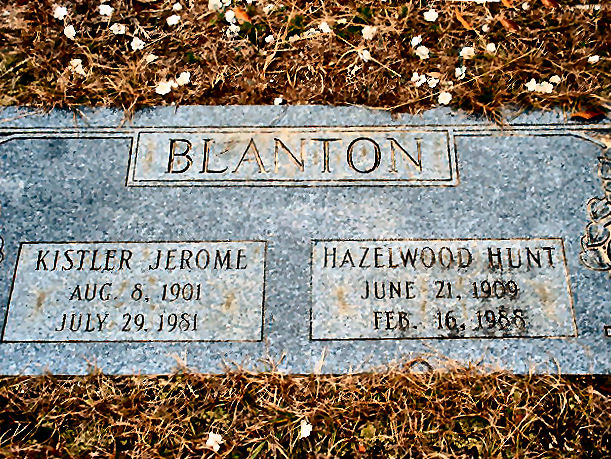
What has Ursula Hazelwood Hunt Blanton been up to in Heaven all this time?
Shelling beans, watching soaps, cackling among gossiping seraphs and cherubim?
I’d like to think so, along with her sisters, Ruby and Pearl, up there over yonder in Heaven’s Baptist wing doing what they loved most doing but without life’s worries gnawing away at the back of their heads.
And what about their husbands, where are they? Certainly, not with them, but outside behind some cloudy bank sneaking a drink, enjoying the fiddle music of some winged, yodeling hillbilly gone to his reward.
Mama’s up there now as well, maybe with daddy, his restlessness abated. Curled up on a sofa, they smoke cigarettes that can’t kill them, chuckling about how, after all, it all turned out all right.
Because as a toddler I couldn’t pronounce Kistler,
my grandfather became known as Kiki –
as opposed to Grandpa, Peepaw, Pawpaw, or Pops.
Scots Irish, raw-boned, ruddy red, he stood five-foot-five, a bantam rooster of a man.
He owned and operated the Nation Station just outside of Summerville, and he’d pump your gas and check your oil and wipe your windshield, making sure you were good to go in those days of yore before self-service and debit cards.
When it was his time to go, at the hospital overnight we took turns sitting vigil so he wouldn’t have to die alone.
On one of my nights, he commenced, as he might say, to hallucinatin’, being chauffeured by long-dead second cousins once twice, but now, forever removed.
I tried to talk him down as if he were tripping, not knowing that it’s not uncommon for the dying to seek refuge in the ether.
Kiki didn’t believe in God, so at the funeral the rent-a-preacher didn’t know him, spoke in generalities, blandishments, insuring that Kiki would not come back alive.
No mention of the sun’s having baked his bald head and exposed neck into a permanent ripe tomato red.
No mention of the angry invectives That spewed like lava when he was angry “That goddamn psalm-singing son-of-a-bitch!”
No mention of the ukulele, the yodeling, his tenor voice,
No mention of the radio, Paul Harvey, the Atlanta Braves.
No mention of the half-pints of Old Crow hidden in his shoes in the closet so his wife, my grandmother,
[1] Prosaic titles used to be a thing, and Yeats was a master. e.g.:
To A Poet, Who Would Have Me Praise Certain Bad Poets, Imitators of His and Mine
You say, as I have often given tongue In praise of what another’s said or sung, ‘Twere politic to do the like by these; But was there ever dog that praised his fleas?
2] To me, it sounds like the boot noise of doomed soldiers marching.
But weigh this song with the great and their pride;
I made it out of a mouthful of air,
Their children’s children shall say they have lied.
WB Yeats “He Thinks of Those Who Have Spoken Evil of His Beloved”
A by-product of breathing, that mouthful of air, exhalation tracking up through the trachea, plucking the vocal c[h]ords: vowels, consonants, words, words, words. Say outloud the title of this post – the sounds of words. Dissonant, sharp, as unlovely as the scraping of a rake on gravel, echoing Juliet’s lament as Romeo vacates their marriage bed:
It is the lark that sings so out of tune, Straining harsh discords and unpleasing sharps.
Romeo and Juliet by Todd Peterson
Perhaps even more discordant is Gerard Manly Hopkins postlapsarian description of industrialization:
And all is seared with trade; bleared, smeared with toil;
And wears man’s smudge and shares man’s smell: the soil
Is bare now, nor can foot feel, being shod.
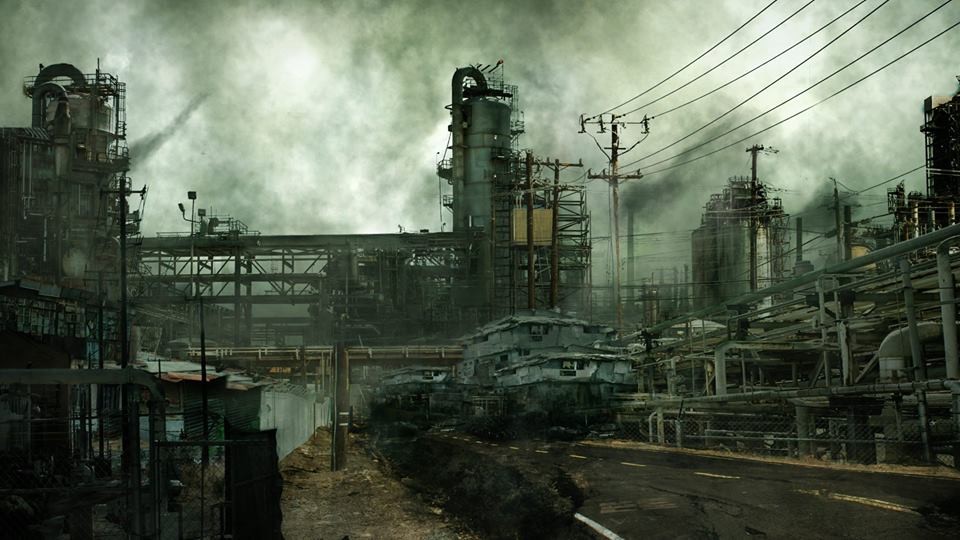
Industrial wasteland matte by Ryan Morgan
Who sez that poetry’s supposed to sound pretty?
Not Alexander Pope:
But when loud surges lash the sounding shore,
The hoarse, rough verse should like the torrent roar
Nor that barbaric yawper Walt Whitman:
Nor him in the poor house tubercled by rum and the bad disorder.
Nor Ol’ Ez in St. Elizabeth’s ranting:
the drift of lice, teething,
and above it the mouthing of orators,
the arse-belching of preachers.
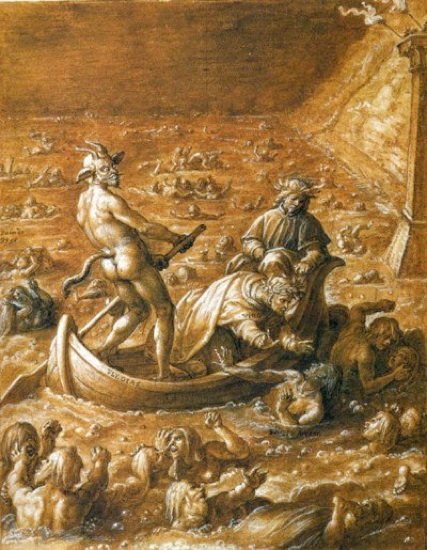
Inferno, Canto 8 by Giovanni Stradano
Thanks to its Anglo-Saxon roots, English is well-suited to screech. However, thanks to its French invaders, our language can also coo. And don’t forget the ess-cee (sc) words of the Vikings with their skalds singing of skulls and skies and scales.
English-speaking poets possess quite a synthesizer through which to sample sounds, orchestrating Anglo-Saxon, Norse, and French symphonically (Milton) or piping a simple Saxon tune in tetrameter (Anonymous).
Given global warmification/climatic alternation, the following worry may seem as trivial as the date of Alfred Tennyson’s death, but I wonder, given our beeping visual small screen secondhand exposure to actual sights and sounds, if off-the-cuff eloquence might become as rare as first edition Kafkas.
In my youth, among my compatriots, having a way with words held sway. I think of Jake the Snake Williams politely stringing together sentences to a Jehovah’s Witness in Richland Mall, and the fellow smiling, nodding his head, and saying, “Brother, you got you an excellent rap.” Or Furman Langley lamenting in a Lowcountry gumbo of gullah-echo the pain he be suffering from the “Hurry Curry Casserole Blues.”
The “like-like” syncopatations of youthful inarticulation and the ubiquitous interrogative lilt of a nation of valley girls’ declarative sentences gives me pause?
On a clear March afternoon in 1977 after we had decided to get married, I remember riding shotgun in Judy Birdsong’s gold-flecked Camaro headed over the Gervais Street Bridge in Columbia, South Carolina, and thinking to myself as I watched her hair fluttering in the open window wind, “Oh no, in twenty-five years she very well may be dead.”[1]
A fairly morbid thought for a twenty-four-year-old, but it runs in the family.
And, um, duh, every organism, whether it be goldfish, hamster, kitty cat, or puppy dog– not to mention house plants and patches of Saint Augustine – is doomed to die. Healthy people repress the thought or look forward to an afterlife or rationalize that there could be no genetic diversity without death or like Wallace Stevens hail death “the mother of beauty.”
Not Thomas Hardy. For him, death is ever-present, lurking in even the most pleasant of settings. Here’s a poem he wrote shortly after his first wife Emma’s death.
During Wind and Rain
They sing their dearest songs—
He, she, all of them—yea,
Treble and tenor and bass,
And one to play;
With the candles mooning each face. . . .
Ah, no; the years O!
How the sick leaves reel down in throngs!
They clear the creeping moss—
Elders and juniors—aye,
Making the pathways neat
And the garden gay;
And they build a shady seat. . . .
Ah, no; the years, the years,
See, the white storm-birds wing across.
They are blithely breakfasting all—
Men and maidens—yea,
Under the summer tree,
With a glimpse of the bay,
While pet fowl come to the knee. . . .
Ah, no; the years O!
And the rotten rose is ript from the wall.
They change to a high new house,
He, she, all of them—aye,
Clocks and carpets and chairs
On the lawn all day,
And brightest things that are theirs. . . .
Ah, no; the years, the years;
Down their carved names the rain-drop ploughs.
These lives aren’t “solitary, nasty, brutish and short” but rather pleasant. In fact, the first five lines of each stanza are positive, describe harmonious family gatherings. However, each stanza ends in a refrain that foreshadows what Andrew Marvel called “deserts of vast eternity.”
The critic John Foy describes the poem’s structure as “double-looking,” pointing “to both life and oblivion.”
“This rhetorical pattern, replicated in all four stanzas, contains two thematic perspectives, where the first five lines point one way and the last two point another. It acknowledges Hardy’s understanding of the terrible duality inherent in the nature of things. We are here for a while, and then we are gone. In his stanza, the heedlessness and the impending dissolution don’t cancel each other out. They exist together in tragic equipoise, five lines to life, two lines to dissolution, bound together by the structure”.
John Foy, “Form as Moral Content in Thomas Hardy’s ‘During Wind and Rain’”
To love a poem doesn’t mean you have to embrace the poem’s theme. For example, although I’m not a Christian, I’d haul Paradise Lost with me to the proverbial desert island (or on a spacecraft headed to Mars). Despite that sudden morbid thought in 1977, I haven’t spent my life brooding over its inevitable end. In fact, I’m fine with oblivion, didn’t mind at all my pre-existence, yet I really love Hardy’s poem, especially its last line, the music of it, the three accented final words and the image of a raindrop like a tear running down a name carved in stone.
And, as it turned out, Hardy remarried a woman named Florence Dugdale who wrote to a friend, “Perhaps you have read, if you have the English papers, that I am now the proud and very happy wife of the greatest living English writer – Thomas Hardy. Although he is much older than myself it is a genuine love match – on my part, at least, for I suppose I ought not to speak for him. At any rate I know I have for a husband one of the kindest, most humane men in the world.”
A happy ending of sorts for Hardy, a rarity in his works.
[1] Actually, it was 40 years later that she died.









 You Do Hoodoo