The Struggle Itself

Each weekday morning when Judy’s getting her 96-straight hours of EPOCH at Roper, I pull into the Doughty Street Parking Lot around 7,  just when the hospital staff switches from day to night shift. As I cross Doughty on foot, Judy’s morning paper in hand, I work against the oncoming pedestrian traffic of off-duty nurses, technicians, engineers, many in their uniforms. Nurses in their navy blue combinations and high-priced athletic shoes seem especially happy.  I see them walking in groups of three, smiling, chatting, heading to their cars. They work 3 day-12 hour shifts in a fulfilling profession; nevertheless they’re delighted at the moment to be free.

(Now, what do they do? Devour a delicious breakfast and slurp down a bloody mary before drifting off in front of the Today Show?)

Going with my flow, the on-coming staff marches in, but, even though they seem relatively eager to start work, their affect isn’t nearly as upbeat as their departing colleagues. Then again, we aint talking all doctors and nurses here. Some of these people’s jobs don’t seem fulfilling at all, like those men awkwardly manipulating box-stacked carts into narrow elevators, like those cafeteria workers breathing for hours the odor of hospital food, like the crew out front dealing with valet parking.

Their minutes probably crawl by.

MC Escher: Convex and Concave

MC Escher: Convex and Concave

Of course, I’m on the way to work myself to shift through dozens of emails before advisory, and if I’m brave enough, to peek at the day’s school calendar, an absurd, way-too-busy color-coded chart of lines and rectangles that look as if they could be the work of MC Escher. We ride a rotating schedule – either Week A or Week B — and when I arrive at work on a Friday morning, people often greet me with the salutation “Happy Friday” or comment sunnily “it’s Friday.” Some time during the day I’ll receive an email inviting me to a “happy hour” in some conveniently located spirit-stocked decompression chamber.

TGIF!

Mythically speaking, labor is one of Adam’s curses, punishment for his uxoriousness, his casting his lot with Eve instead of Yahweh, which brought death into the world and all our woe, e.g. work — in Adam’s case tilling “cursed ground” that produces “thorns and thistles” — in my case dealing with an educational agenda that might be likened to a jewel box of tangled necklaces — academics, sports, service, chapels, assemblies, advisories, peer reviews, study halls. Or think of circus clowns, not leaving a car one after another after another, but entering a car one after another after another.

Actually, I interpret the Eden myth as a story about the shift from hunting/gathering to agriculture, the shift from running around half naked to the natural pulse of the earth’s heartbeat to our settling down to the soul-crushing repetitiveness of the punch clock.  Thus, the knowledge of good and evil becomes the knowledge of how to cultivate plants from seeds, which many scholars believe was a discovery made by women, the gatherers of edible plants. And, of course, settled communities brought us the establishment of property and its evil twin poverty.  I maintain that Amazonian tribespeople untouched by Western civilization live more meaningful lives than the average American who watches five hours of TV a day.

There’s a cool Philip Larkin poem about what a bitch work is called “Toads.” It goes like this:

Toads

Why should I let the toad work

Squat on my life?

Can’t I use my wit as a pitchfork

and drive the brute off?


Six days of the week it soils

With its sickening poison-

Just for paying a few bills!

That’s out of proportion.


Lots of folk live on their wits:

Lecturers, lispers,

Losels, loblolly-men, louts-

They don’t end as paupers;


Lots of folk live up lanes

With fires in a bucket,

Eat windfalls and tinned sardines-

They seem to like it.


Their nippers have got bare feet,

Their unspeakable wives

Are skinny as whippets-and yet

No one actually starves.


Ah, were I courageous enough

To shout Stuff your pension!

But I know, all too well, that’s the stuff

That dreams are made on:


For something sufficiently toad-like

Squats in me, too;

Its hunkers are heavy as hard luck,

And cold as snow,


And will never allow me to blarney

My way to getting

The fame and the girl and the money

All at one sitting.


I don’t say, one bodies the other

One’s spiritual truth;

But I do say it’s hard to lose either,

When you have both.


I’m with you, Philip. After listening to my litany yesterday about how frustrating teaching has become in the age of technology,  a colleague asked me why didn’t I retire.  A reasonable question given the frustrations I had just catalogued – parents having access to the grades I post on the website, shooting me emails that proliferate like mushrooms while I’m bouncing from meetings to covering detentions or contacting the help desk because the projection wire in one of the rooms where I teach doesn’t work.

Why don’t I retire?  Because I don’t want to. I eventually get bored in the summers if I’m not traveling or working on a project. I like interacting with students, instructing them about the bane of unnecessary linking verbs and the sloppiness of the “naked this” — not to mention the fun introducing them to the Wife of Bath or riding with them up the Congo with Marlow as we steam towards Mistah Kurtz.

It’s like what Camus says in “The Myth of Sisyphus.” –

I leave Sisyphus at the foot of the mountain! One always finds one’s burden again. But Sisyphus teaches the higher fidelity that negates the gods and raises rocks. He too concludes that all is well. This universe henceforth without a master seems to him neither sterile nor futile. Each atom of that stone, each mineral flake of that night filled mountain, in itself forms a world. The struggle itself toward the heights is enough to fill a man’s heart. One must imagine Sisyphus happy.

Sisyphus-e1298413740742

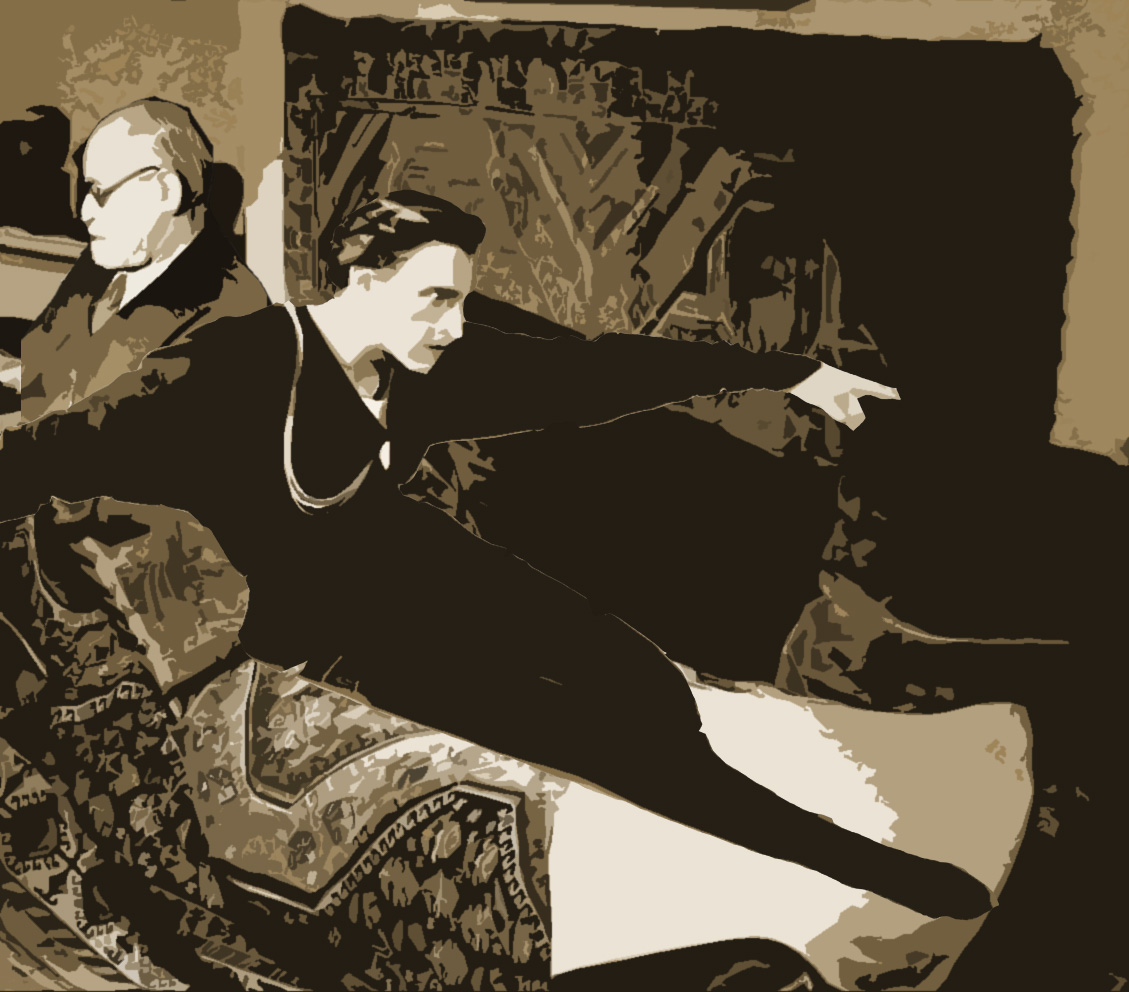
Freud, Jung, Hamlet, and Joyce

A Finger Puppet Play in One Act

freud pyschoanalyzes Hamlet


Scene One : The castle at Elsinore.

Enter Hamlet moping

Hamlet: O, would this too, too solid flesh melt

and resolve itself into a dew.

O, how weary stale and flat seem to me

All the uses of this world. Fie on it. Fie!


Goddamn it! What a rogue and peasant slave am I!


The night sky that wheels above us,

That brave o’er hanging firmament,

That majestic roof fretted with golden fire,

Why it appearth no other thing to me

than a foul and pestilent congregation of vapors.


O, to be or not to be that is the question.

O, to sweat and groan under a weary life.


Fie on it. Fie.

But soft! Methinks

I hear that most pernicious woman

whose name is frailty.


Enter Gertrude:


Gertrude: Hamlet, O Hamlet.

Hamlet: Yes, mother.

Gertrude. O Hamlet, cast thy nighted color off and

let me giveth thee a sponge bath.

Hamlet: O mother, you know I have that appointment

Today with Dr. Freud.

Gertrude: I had forgot. Cancel it, love.

Hamlet: You knoweth what a procrastinator

I be. I shall go to the appointment.

Gertrude: Well giveth your mother a little kiss,

my love, before thou leavest.


Scene Two: Dr. Freud’s Offices.

Freud and James Joyce engaging in “the talking cure.”

Freud: Keep Going, Mr. Joyce. Get it Out

Joyce: Well, you know or don’t you kennet or haven’t I told you every telling has a taling and that’s the he and the she of it. Look, look, the dusk is growing!

Freud: Very well then, Mr. Joyce I’ll see you next time.

Joyce: By the way, Doc, to say that a great genius is half-mad, while recognizing his artistic prowess, is worth as much as saying that he was rheumatic, or that he suffered from diabetes. Madness, in fact, is a medical expression to which a balanced critic should pay no more heed than he would to the accusation of heresy brought by the theologian, or to the accusation of immorality brought by the public prosecutor. Good Day

exit Joyce

Freud: His Inflated ego is furthered pathologized by anal expulsiveness. What is that last book of his Finnegan’s Wake by a vast shit explosion? Anna!

Enter Anna Freud.

Anna: Yes, Father?

Freud: Whose next?

Anna. He calls himself Hamlet, Hamlet the Dane.


Scene Three: Hamlet and Freud’s session

(Hamlet lying on the psychiatric couch)

Freud: Enough about your mother. Tell me about this step father of yours.

Hamlet: O villain, villain, smiling, damned villain! Bloody, bawdy villain!

Remorseless, treacherous, lecherous, kindless villain!

Freud: So I take it you do not like this man.

Hamlet: I should have fatted all the region kites

With this slave’s offal.

Freud: My son, it’s quite clear that you suffer from an Oedipal complex, that you are fixated in the phallic stage.   Our work is done here. That will be 500 marks.

Hamlet: You joketh. That’s it? I want another opinion.

Freud: Very well. Anna!  Bring in Dr. Jung

Enter Jung.

Freud: Dr. Jung, this young man wants to kill his father.

Hamlet: Stepfather!

Freud: To kill his father so he can be with alone with his mother, which obviously denotes the Oedipal complex.

Jung: I’ve been thinking, Herr Mentor, that you over-emphasize the sexual component in mental illness. I have a slightly different take.

Freud: I dare you! How dare you! Contradict me!

They fight.

Scene Four: Hamlet alone on the Battlement.

Hamlet:

I have heard the mermaids singing, each to each.

I do not think that they will sing to me.

I have seen them riding seaward on the waves

Combing the white hair of the waves blown back

When the wind blows the water white and black.


We have lingered in the chambers of the sea

By sea-girls wreathed with seaweed red and brown

Till human voices wake us, and we drown.

The rest is silence.

Enter Joyce doing a jig

Joyce: If others have their will Ann hath a way. By cock, she was to blame. She put the comether on him, sweet and twentysix. The greyeyed goddess who bends over the boy Adonis, stooping to conquer, as prologue to the swelling act, is a boldfaced Stratford wench who tumbles in a cornfield a lover younger than herself.

End here. Us then. Finn, again! Take. Bussoftlhee, mememormee! Till thousandsthee. Lps. The keys to. Given! A way a lone a last a loved a long the

Exeunt.

The End.

The Post Labor Day Wardrobe Blues


Labor Day, brother,

put them white pants away.

I reiterate: Labor Day;

put them white shoes away.

Nobody told that blazing sun up there,

but the etiquette polices get the final say.


Way past Labor Day,

shred that seersucker, fool.

The calendar say September,

so ditch them white bucks, too.

No matter what the thermometer say,

We talking ’bout society rules!


Science book say white jacket repel the heat

help to keep your arm pit dry.

Science book say dark clothes sorbs the heat

and make your poor body fry.

But the science also say they ain’t

no heaven to go to when you die.


Up in heaven, it always the month of May

Up in heaven it always the month of May

You can wear that white robe without no snooty dismay.


Gots to get to heaven to ‘scape global warmin’

Needs to get to heaven to ‘scape global warmin’

It be almost Christmas and the skeeters still be swarmin’


Oh, do Lawd, it Labor Day,

time to put them white clothes away.

Done be Labor Day,


gotta put them white clothes away.

Time to don you some wool

and pray for the Judgment Day

Yo dub poet hisself

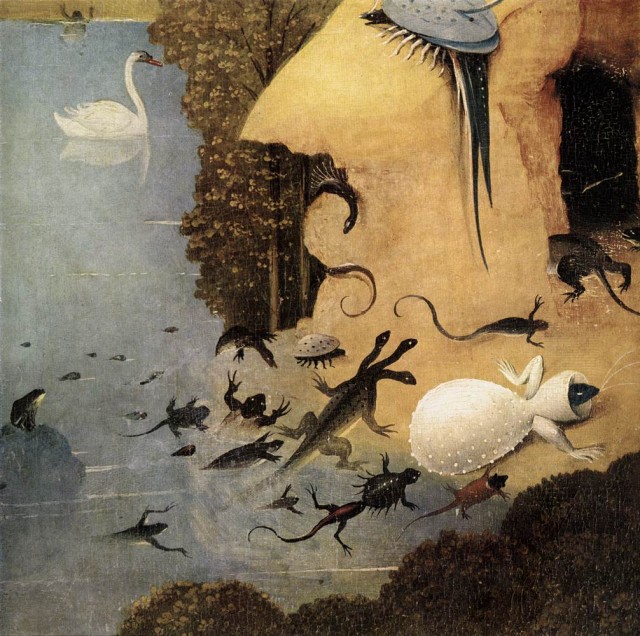
Hieronymus Bosch Deals with Cancer


Hieronymus Bosch - Triptych of Garden of Earthly Delights _detail 13_


Which cell first rebelled,

fueled the insurrection

taking over the town?

Bosch-born monsters breed,

ruttish rumpfed bladders on legs

scurrying across the canvas,

an obscene carnival, clots of chaos everywhere.

Dey run amok fuck-up go cruzy clump

disrupt – sisrupt – pile-up

piles of corpses

mangled tangled

elbows, torsos,

heads, mouths

frozen open, rictus,

Dachau, Austerlitz

anus world, a world of shit.

* * *

But here comes the chemo,

scouring, healing poison –

not no cavalry, not no Marines,

but bleach, lye,

molten lava pumping,

spreading o’er the obscene canvas

obliterating blight,

like hell fire, consuming those

misbegotten cankered creatures,

restoring order, an earlier order,

purging, drowning,

cooling,

covering,

creating rich soil

for fresh garden growth

a world of . . .

Pep Talk for Brazil

At the beginning of Budding Prospects, TC Boyle’s protagonist Felix Nasmyth confesses

I’ve always been a quitter.  I quit the Boy Scouts, the glee club, the marching band.  Gave up my paper route, turned my back on the church, stuffed the basketball team.  I dropped out of college, sidestepped the army with a 4-F on the grounds of mental instability, went back to school, made a go of it, entered a Ph.D. program in nineteenth-century British literature, sat in the front row, took notes assiduously, bought a pair of horn-rims, and quit on the eve of my comprehensive exams.  I got married, separated, divorced.  Quit smoking, quit jogging, quit eating red meat.  I quit jobs: digging graves, pumping gas, selling insurance, showing pornographic films in an art theater in Boston.  When I was nineteen I made frantic love to a pinch-faced, sack-bosomed girl I’d known from high school.  She got pregnant.  I quit town.


Pep Talk

[. . .] nor can foot feel, being shod.

Gerard Manley Hopkins

I know what it feels like to give up,
to say ‘that’s it — fuck it — I quit’.

No one over thirty can stand
blowhard braggarts like
William Ernest Henley
who bellowed

“It matters not how strait the gate,
How charged with punishments the scroll,
I am the master of my fate,
I am the captain of my soul”

but who lost his eleven-year-old daughter
and died of tuberculosis at fifty-three.

No, give me unromantics like Philip Larkin
who “work all day” and “get half-drunk at night,”
who lie in bed in the mornings
squandering precious existence dreading death,
contemplating what it will be like
“Not to be anywhere,
And soon.”

“Nothing more terrible, nothing more true.”

Or tortured souls like Gerard Manley Hopkins
who “pitched past pitch of grief”
birthed dissonant poems that screech like talons
scratching across blackboard slate.

* * *

That’s right, Brazil, down by seven,
quit playing defense, get the goddamn thing over,
drive past the favelas to your sturdy houses afterwards,
get into to your beds, pull the covers up over your heads,
and with a flashlight read “Terrence, This Is Stupid Stuff:”

“Therefore, since the world has still

Much good, but much less good than ill,

And while the sun and moon endure

Luck’s a chance, but trouble’s sure,

I’d face it as a wise man would,

And train for ill and not for good.

’Tis true, the stuff I bring for sale

Is not so brisk a brew as ale:

“Out of a stem that scored the hand

I wrung it in a weary land.

But take it: if the smack is sour,

The better for the embittered hour;

It should do good to heart and head

When your soul is in my soul’s stead;

And I will friend you, if I may,

In the dark and cloudy day.

Amém!

yours truly running down a street in Rio

yours truly running down a street in Rio


A Pat Conroy Family Reunion of Sorts

An acquaintance, the poet Cathy Smith Bowers, once told me something that should be obvious but had never occurred to me: The adrenal glands of children who grow up in chaotic households pump Vesuvian eruptions of the hormone epinephrine when their parents (or their parents’ boyfriends/girlfriends) hurl invectives and/or furniture at each other.

In plainer English, growing up in fucked-up households tends to fuck you up, not only mentally, but physically as well — as if there is a difference anyway.

Cathy Smith Bowers

Cathy Smith Bowers

Cathy went on to say that once these children leave the war zones of their childhoods, they often develop a need for high levels of adrenaline and a hankering for jangled nerves, for that elevated heart rate, that feeling of excitement, and, of course, there’s nothing like a little snort of cocaine to replicate that bodily high, and nothing like a drug habit to create chaos, and thus, to bring the family melodrama back full circle.

Cathy, like many of us, is no stranger to the toll of growing up in an unhappy home. Here’s her poem “The Boxers” that makes manifest her point:

When my father, after twenty years, came home

to die, circling, circling, like an animal

we believed extinct, it was my crazy aunt

who took him in, who told later

how the taxi had dumped him

bleached and whimpering on her porch.

And she who had not lived with him

thought his sons and daughters cruel

not to come when he began to call our names.

He died, and soon after, a package in brown wrapping

arrived at my address. My sister, who did not

attend the funeral, kept urging me to open it

and I kept saying I would, soon. Every day

when I came home from work, there it was

sitting at my back door, the remnants

of my father’s life—years in the mill

spinning and doffing, then drinking into morning

as he railed at the walls, the cotton

still clinging to his fists. Weeks had passed

when finally my sister and I, after two stiff bourbons,

began to rip the paper, slowly in strips

like archaeologists unclothing a mummy.

And all that was there were a few plaid flannels,

the jacket to a leisure suit, and a pair of boxers,

white and baggy, Rorschached in urine—a smaller size,

my sister said, than the way she remembered him.

Then she offered to drop the things at the Salvation Army

store she passed on her way home. In July

we went shopping for swim suits and I could

see her in the curtained stall across from mine.

She was pulling her slip over her head when I saw

she was wearing them, her thighs like the pale stems

of mushrooms emerging from the boxers’ billowy

legs, whiter, softer now, washed clean. I still

can’t say why my sister, that day in the Salvation

Army store, glanced up, as I’ve imagined,

to see if anyone was watching

before she slipped those boxers from the soiled heap

of our father’s clothes. Nor why

I took so long to open that package, both wanting

and fearing whatever lay inside. Like a child

huddled by the campfire who cries out in terror

at the story someone just told

and, still weeping, begs for it again.

“The Boxers” by Cathy Smith Bowers, from The Love that Ended Yesterday in Texas. © Texas Tech University Press, 1992. Reprinted with permission. (buy now)

* * *

When we look to literature for examples of dysfunctional American families, we immediately think of Faulkner’s Compsons, any number of Tennessee Williams’ people, the Tyrones of Eugene O’Neill’s A Long Day’s Journey into the Night, and the tortured families who inhabit the pages of Pat Conroy’s novels.

Our friend Megan Conroy sometimes stays with us for a few days in July when she travels from California to visit her famous father, stepmother, and aunts and uncles at Fripp Island. Unfortunately, this year she couldn’t make it up to Charleston, so she invited us down to Fripp to her father’s beach house.

back yard

back yard

Situated on a lagoon, the Conroy beach house is the antithesis of gothic — open and airy and looking out onto a backyard where practically tame deer feed. When we arrived, Megan greeted us and introduced her uncle Mike, who bears a remarkable resemblance to his older brother and who can give him a run for his money as a raconteur. Also there were Mike’s wife Jeannie, his sister Kathy, Megan’s sisters Jessica and Melissa, their husbands, and a host of grandchildren too numerous to name.

Pat and his wife the novelist Cassandra King arrived after a midday dinner of fired chicken, macaroni and cheese, red rice, cantaloupe, and coleslaw. The older folk traded stories in typical Southern fashion in the open family room while younger members of the clan watched Germany battle Algeria in another space.

Rather than what you might expect, hanging out with Pat Conroy on that day was more like hanging out with Sam Clemens than Eugene O’Neill.

A few excerpts:

Pat: [My arch-conservative ex-father-in-law] makes Rush Limbaugh look like Chairman Mao.

Megan: I didn’t want a fancy wedding dress until I tried one on.   I didn’t want a veil until I tried one on. When they told me don’t you want to take off your veil after the ceremony, I said, “No, when do you ever get to wear a veil?”

Pat: That dress cost a million dollars. Cassandra, remember when you opened the closet door and found it standing up by itself? Horrifying!

***

In other words, the Conroys seemed like one big happy family and that at least the youngest have broken the dysfunctional cycle of self-generated misery that dysfunction tends to generate, which is remarkable given the scorched earth of the Great Santini’s children’s childhoods. To wit an excerpt from Pat’s memoir The Death of Santini:

When I was thirty years old, my novel The Great Santini was published, and there were many things in that book I was afraid to write or feared that no one would believe. But this year I turned sixty-five, the official starting date of old age and the beginning count down to my inevitable death. I’ve come to realize that I still carry the bruised freight of that childhood every day. I can’t run away, hide, or pretend it never happened. I wear it on my back like the carapace of a tortoise, except my shell burdens and does not protect. It weighs me down and fills me with dread.

The Conroy children were all casualties of war, conscripts in a battle we didn’t sign up for on the bloodied envelope of our birth certificates. I grew up to become the family evangelist; Michael, the vessel of anxiety; Kathy, who missed her childhood by going to sleep at six every night; Jim, who is called the dark one; Tim, the sweetest one – and can barely stand to be around any of us; and Tom, our lost and never-to-be found brother. My personal tragedy lies with my sister, Carol Ann, the poet I grew up with and adored…

I’ve got to try and make sense of it one last time, a final circling of the block, a reckoning, another dive into the caves of the coral reef where the morays wait in ambush, one more night flight into the immortal darkness to study that house of pain one final time. Then I’ll be finished with you, Mom and Dad. I’ll leave you in peace and not bother you again. And I’ll pray that your stormy spirits find peace in the house of the Lord. But I must examine the wreckage one last time.

Yet they appeared to me one big happy family!

from left to right Pat's feet, his sister Kathy, wife Cassandra, brother Mike and sister-i-law Jeannie

from left to right Pat’s feet, his sister Kathy, Cassandra King, brother Mike and sister-in-law Jeannie


Sound, Sense, Shakespeare, and Arts Education

Last Monday night I attended a rehearsal of Romeo and Juliet at the Threshold Repertory Theater. My friend Paul O’Brien, chairman of the Threshold’s board, invited me to the rehearsal to hear Chris Marino, a director and Shakespeare expert from Chicago, give a workshop on playing Shakespeare. Paul had worked with Chris before on a production of Hamlet, so I jumped at the chance.

Christopher Marino

Christopher Marino

When I arrived, the rehearsal was already underway. Romeo, Mercutio, and Benvolio were sitting in folding chairs with highlighted scripts in their hands as Chris Marino stood before them looking the part of director.   A tall man in his forties, he wears his almost shoulder-long dark-hair parted in the middle, Oscar Wilde style, and also sports an Elizabethan-worthy goatee.

The three actors were working on 1.4, the scene after the masquerade ball when drunken Mercutio gives his famous Queen Mab speech. Chris stopped the scene and provided a quick ten-or-so-minute lecture on blank verse. It occurred to not-so-perceptive me that some — if not most — of the cast may not have performed Shakespeare before or even know what blank verse is. They’re actors, after all, not academics.

Chris explained that blank verse is unrhymed iambic pentameter – in other words, each line contains five iambs, a succession of alternating unaccented and accented syllables as in “the CAT will MEW and DOG will HAVE his DAY.” He explained that English is essentially iambic and meter provides help in memorizing lines, especially for those Elizabethan actors who put on “eleven performances of ten different plays in two weeks.”

Then Chris said something I’d never considered: when Shakespeare violates the iambic scheme, the offbeat signals something amiss, and the actors should take heed and ponder what’s the matter. For example, in the opening prologue, the line “From AN | cient GRUDGE | BREAK to | NEW MUT | ti NY” violates the unstressed stressed pattern as it describes and echoes the breakdown of law and order that Verona suffers because of the Montagues’ and Capulets’ on-going feud. This echoing of sound and sense is what makes poetry poetry — it creates the magic that renders airy words into palatable images.

Chris was brilliant in his explication of how the sounds of words contribute to their meaning. Throughout the session, he constantly prodded the actors and actresses to reach deep into their psyches to mine emotions that corresponded to their characters’ situations, using the words of the text as guideposts.

For example, in this particular production, the director has decided to use the often cut prologue that begins 2.1

Now old desire doth in his deathbed lie,

And young affection gapes to be his heir.

That fair for which love groaned for and would die

With tender Juliet matched, is now not fair.

Now Romeo is beloved and loves again,

Alike bewitchèd by the charm of looks,

But to his foe supposed he must complain,

And she steal love’s sweet bait from fearful hooks.

Being held a foe, he may not have access

To breathe such vows as lovers use to swear.

And she as much in love, her means much less

To meet her new beloved anywhere.

But passion lends them power, time means, to meet,

Tempering extremities with extreme sweet.

After musing why Shakespeare might have added this seemingly unnecessary plot summary, Chris prompted the actress who was to speak the lines in the play to consider who might say something like this, in other words, prompted her to think of the sonnet not as a mere public service announcement but as the words of a flesh-and-blood human being with ideas and prejudices. Through Socratic questioning, he prompted her to analyze the speech’s diction, which prompted the actress to detect some bias in favor of Juliet’s family, the Capulets. Juliet is called “tender,” and the speaker subtly points out Romeo’s fickleness with the phrase “and loves again” — after all just a few hours ago he had considered himself hopelessly in love with Rosaline. Thus, the actress was transformed from a spokesperson into a character, a cousin of Juliet’s perhaps.

This delving into what it means to be human is a hallmark of the art of acting and one of the reasons art education is crucial for our schools.   Yes, we need to know how to read and write and to add and subtract, and, of course, science, especially when even at this late date, our state legislators demand that South Carolina’s citizenry be reminded that our state fossil, the wooly mammoth, was created on the 6th day.

Nevertheless, in this age of materialism, the arts are absolutely crucial as well. Music, painting, sculpture, and acting provide us with insights into what it means to be human and vehicles for expression that bring to light and air the communal essence of our very own beings.

I envy those actors in Romeo and Juliet who must channel their individual souls to breathe life into words printed on a page, who help us see the old and young playing out the age old drama of life as we live it.

So I raise my bloody mary to the arts.

45


The Grill

Hit arrow for sound.

In memory of Paul Yost 1955-2014


I’m tearing apart paper,

newsprint, the obituary page,

shredding descriptions of lives:

of fathers, mothers, sisters, brothers,

bachelors, partners, husbands, wives,

shredding their black-and-white

faces, their smiles, their stares,

ripping also the memorial verses

loved ones have left,

wadding it all up

to fuel my charcoal chimney.


Yet not enough.


So here comes the sports page,

the World Cup, accounts of pop flies

dropped, ripe for ripping,

ripped, balled, stuffed, ready

for the match’s fiery effacement.


And that poor chicken! hatched, harried,

pecking its food among hordes,

pulled from transport crates,

shocked for the throat cutter’s convenience,

plucked, eviscerated.


This one’s also been

deboned, yet not sold soon enough,

skewered by butchers along with

aging onions and overly ripe peppers.


After its scraping, red and black,

slightly rusted, the grill stands ready,

top open, at attention.


I place the chimney

upon the barred metal, pour in

the briquettes, and torch the

shredded lives of others,

their wins and losses,

and watch the smoke

rising into the dissipation

of the silent, cloud-shifting sky.


Invisible Friendships: Voices

Over the years, my friend (and one-time collaborator) Dr. Paul O’Brien has guest-lectured for my classes in various capacities, e.g., to introduce Beowulf or Hamlet or the genre of poetry. In the poetry intro, he begins by reciting “Who Goes with Fergus” in his rich baritone but then admits he doesn’t exactly know what it means:

 Who will go drive with Fergus now,

And pierce the deep wood’s woven shade,

And dance upon the level shore?

Young man, lift up your russet brow,

And lift your tender eyelids, maid,

And brood on hopes and fear no more.


And no more turn aside and brood

Upon love’s bitter mystery;

For Fergus rules the brazen cars,

And rules the shadows of the wood,

And the white breast of the dim sea

And all disheveled wandering stars.

But he does know that he loves the way it sounds, its imagery.

He goes on to tell the students that poetry can be “your companion, your friend.”

In this context, I’ve found Yeats’ “To a Friend’s Whose Work Has Come to Nothing” a comfort on days like today when I’m down:

 Now all the truth is out,

Be secret and take defeat

From any brazen throat,

For how can you compete,

Being honor bred, with one

Who were it proved he lies

Were neither shamed in his own

Nor in his neighbors’ eyes;

Bred to a harder thing

Than Triumph, turn away

And like a laughing string

Whereon mad fingers play

Amid a place of stone,

Be secret and exult,

Because of all things known

That is most difficult.

However, this phenomenon of literary friendship is not only limited to poetry; I count Frank Bascombe, the narrator of Richard Ford’s trilogy, a pal, and every time I finish one of the Bascombe novels it’s like saying good-bye to someone I’ll miss hanging out with. I’ll miss Frank’s voice. (Though rumor has it Frank survived Hurricane Sandy and will tell us about it in a new short story).

I’ve recently run across a new companion, J.I.M. Stewart, whose Eight Modern Writers is the final volume of The Oxford History of English Literature, published in 1963.   Now you might expect – or should I say one might expect – a critical volume sporting such a title to be as dry as unbuttered melba toast; however, reading Stewart is like listening to an erudite uncle with a whiskey in his hand and a barb in his throat.

Here he is one Yeats, the featured poet above:

Yeats has too vigorous a dramatic sense to make any kind of grateful stroll out of old age’s necessary descent from Helicon to the Academy, or to accompany it with pleasant murmuring of years that bring the philosophic mind. Rather he is going to be carried down kicking, and his masters are going to find a rebellious pupil:

I mock Plotinus’ thought

And cry in Plato’s teeth

And here is Stewart chiding the master:

 [In “Under Ben Bulben”] there are no such things, we want to tell him, as “Base-born products of base beds.”

And one more on reading the first part of Joyce’s Ulysses:

Indeed, it’s as if we’re locked inside of Dedalus’s mind, and although an interesting place, we sometimes find ourselves beating our fists wishing to get out.

As it turns out, Stewart (1906- 1994) was a novelist himself, and in a less serious pursuit wrote over 50 detective novels under the pseudonym Michael Innes.

At any rate, I’m very happy to be spending this week in his company.


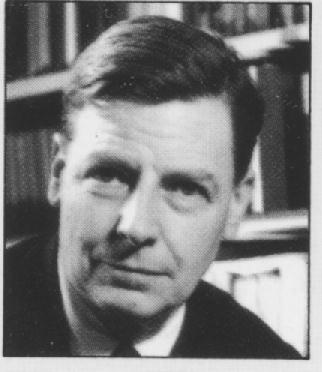
James Innes Michael Stewart

James Innes Michael Stewart