Dealing with Cancer: Oy versus Om

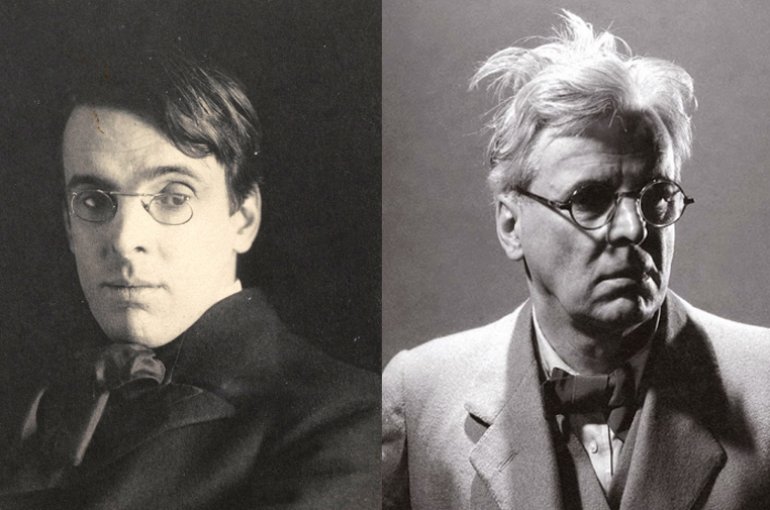
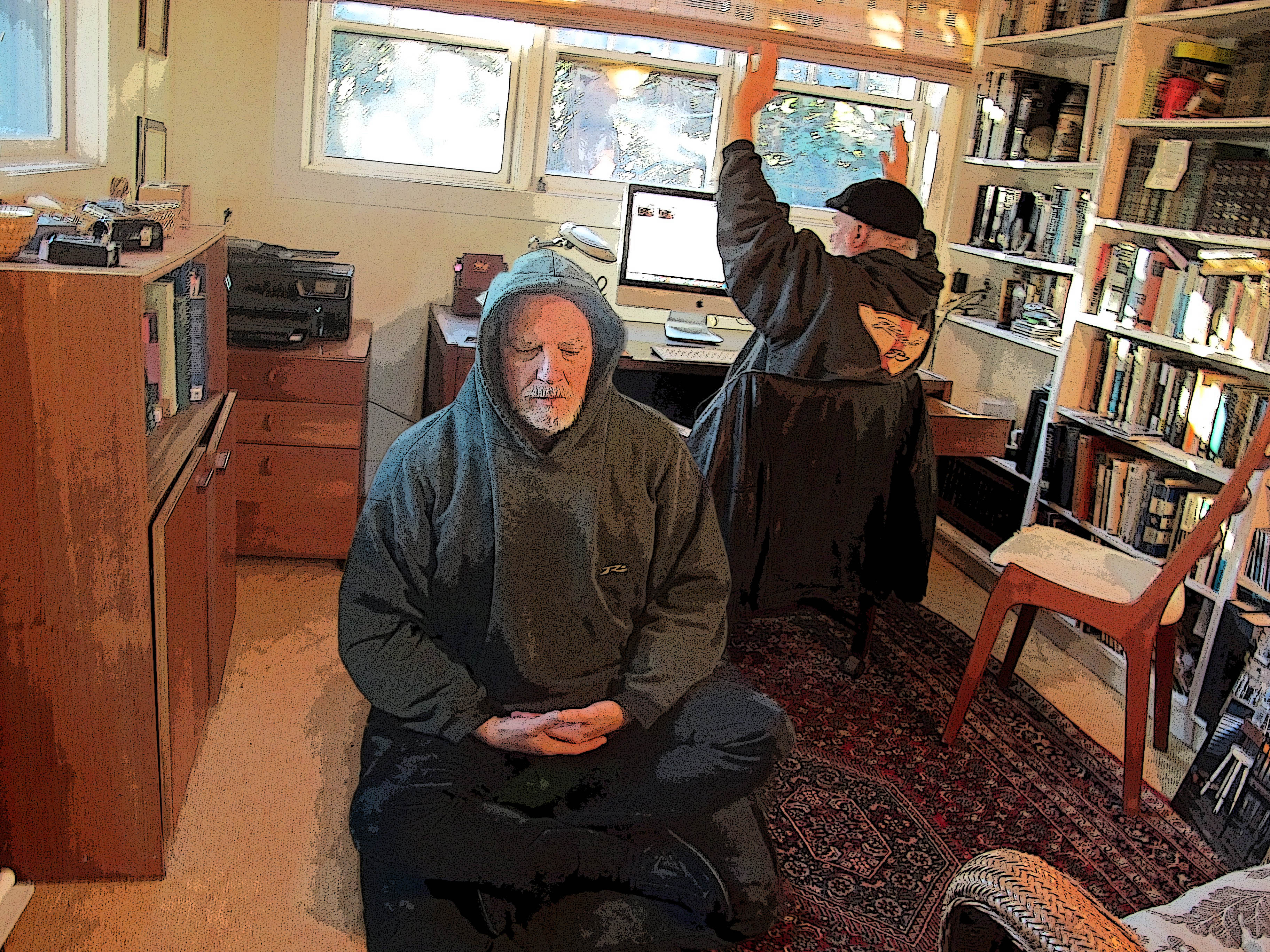
Tenzin and Woody

Tenzin and Woody


Let’s face it, in this artificially flavored, dioxin-laden world of ours, either you or someone you dearly love is going to get cancer, especially if you manage to dodge the jihadists’ and nativists’ bullets to live long enough.

Obviously, people deal with cancer in different ways. Everyone from scientists to your Aunt Tessie will tell you to be positive, which, of course, is good advice, if not all that easy to take, especially if you’re facing chemotherapy.

For the last 17 months, my wife and I have shared our lives with a particularly rare and more-often-than-not fatal form of lymphoma known as Peripheral T-Cell Lymphoma, Not Other Specified, or for shortness sake, PTCL-NOS.

Essentially, you can deal with cancer in two ways, the Dalai Lama way or the Woody Allen way, so I thought I’d recap my wife’s journey of the last year and a half focusing on her husband’s behavior, imagining him as either the Dalai Lama or Woody Allen so you can decide for yourself which role you might play if you ever face similar challenges.

9 July 2014

Woody Allen, husband of Judy Birdsong, spends the morning cleaning the house preparing for guests, an artist friend and former colleague who’s bringing an Italian mother and her two teenaged sons to go kayaking.

Judy has gone out “to run some errands,” and Woody is getting somewhat peeved because she’s been gone so long and has left so much of the housework to him.

Finally Judy calls.

“Where have you been?’ Woody asks.

“Getting a chest x-ray.”

“A chest x-ray? What for?”

“I have this lump near my breast bone. The doctor thinks it’s probably just some bone outgrowth. No big deal.”

“Oh, my God,” Woody thinks, “she’s got lung cancer!”

* * *

Tenzin Gyatso, husband of Judy Birdsong, enjoys picking up each individual knick-knack from the shelf and gently rubbing the dust cloth over its surface. Although he knows Judy’s getting a chest x-ray, he concentrates on the task at hand, gently returning the clay statuette of the Indian mother to her place on the shelf next to the hand-painted Mexican fish.

* * *

That evening around six, the phone rings. Woody, upstairs in his study, sees on the phone’s screen that it’s the doctor’s office. He picks up the receiver just as Judy does but doesn’t hang up.

He hears: “The x-ray is inconclusive. It’s cloudy. Have you had any fever? Coughing? We don’t see a mass, but you have something called a pleural effusion, that is, fluid in your lungs, so you’ll need to come in tomorrow for a C-scan.”

Woody hangs up the phone and immediately googles “plural effusion.”

Numerous medical conditions can cause pleural effusions. Some of the more common causes are:

  • Congestive heart failure

  • Pneumonia

  • Liver disease (cirrhosis)

  • End-stage renal disease

  • Nephrotic syndrome

  • Cancer

  • Pulmonary embolism

Lupus and other autoimmune conditions

Woody spends a very miserable night, the worst one since his last night in jail (c. 1978), tossing and turning and speculating just what horrible type of cancer Judy has. Finally, because she’s had no symptoms, Woody becomes convinced that it’s metastatic ovarian cancer.

* * *

That evening around six, the phone rings. Tenzin, upstairs in his study, sees on the phone’s screen that it’s the doctor’s office. He waits to see if Judy picks up, and she does.

After the conversation, she comes up and tells him the x-rays weren’t clear, that she needs a C-scan.

He takes a deep cleansing breath, then exhales slowly.

11 July

The C-scan did detect a mass, “a primary cancer probably a lymphoma,” according to the radiologist. Woody and Judy arrive at Roper Hospital for Judy’s initial visit with her oncologist. When they arrive, they discover the appointment is at a different facility across town, so they rush to their car and take off. Even though the receptionist has assured them they have enough time, this soundtrack plays in Woody’s mind.


They do arrive on time, and the oncologist, an acquaintance, the husband of a colleague of Woody’s, is a calming presence. He shows them the tumor on a screen and agrees that it looks like lymphoma, and says that’s what he hopes it is because lymphomas are curable. He introduces them to the paradox that the faster a cancer grows, the easier it is to kill.

Woody goes home and googles lymphomas, which indeed are very treatable if it’s the B-cell variety. T-cell lymphomas are a different story.

15 July

While Judy’s out kayaking with Tenzin, the oncologist calls and tells Woody they need to run about a thousand new tests on Judy to find out “what type of t-cell lymphoma we’re talking about.”

“Oh no,” Woody says. “T-cells are harder to cure, aren’t they?”

“They can be,” he says tersely.

When Judy returns, she can see it on Woody’s face.

“What’s the matter?”

He tells her. For the first time they weep together.

20 July

Tenzin has put Woody in a strait jacket, jammed a sock in his mouth, and locked him in a closet so he can call his sons and tell them the bad news. He also calls his siblings and closest friends.

Judy is stoic as well, suffering through a barrage of tests without a complaint.

They nervously wait to see how far it’s spread.

22 July

Good News! It’s Stage 1, confined to that one tumor. No bone marrow involvement. The treatment will be aggressive. 96-hour continuous hospital infusion, two weeks off, then another blast. There will be 6 to 8 cycles, then perhaps a stem cell transplant and even after that radiation.

28 July – Early December
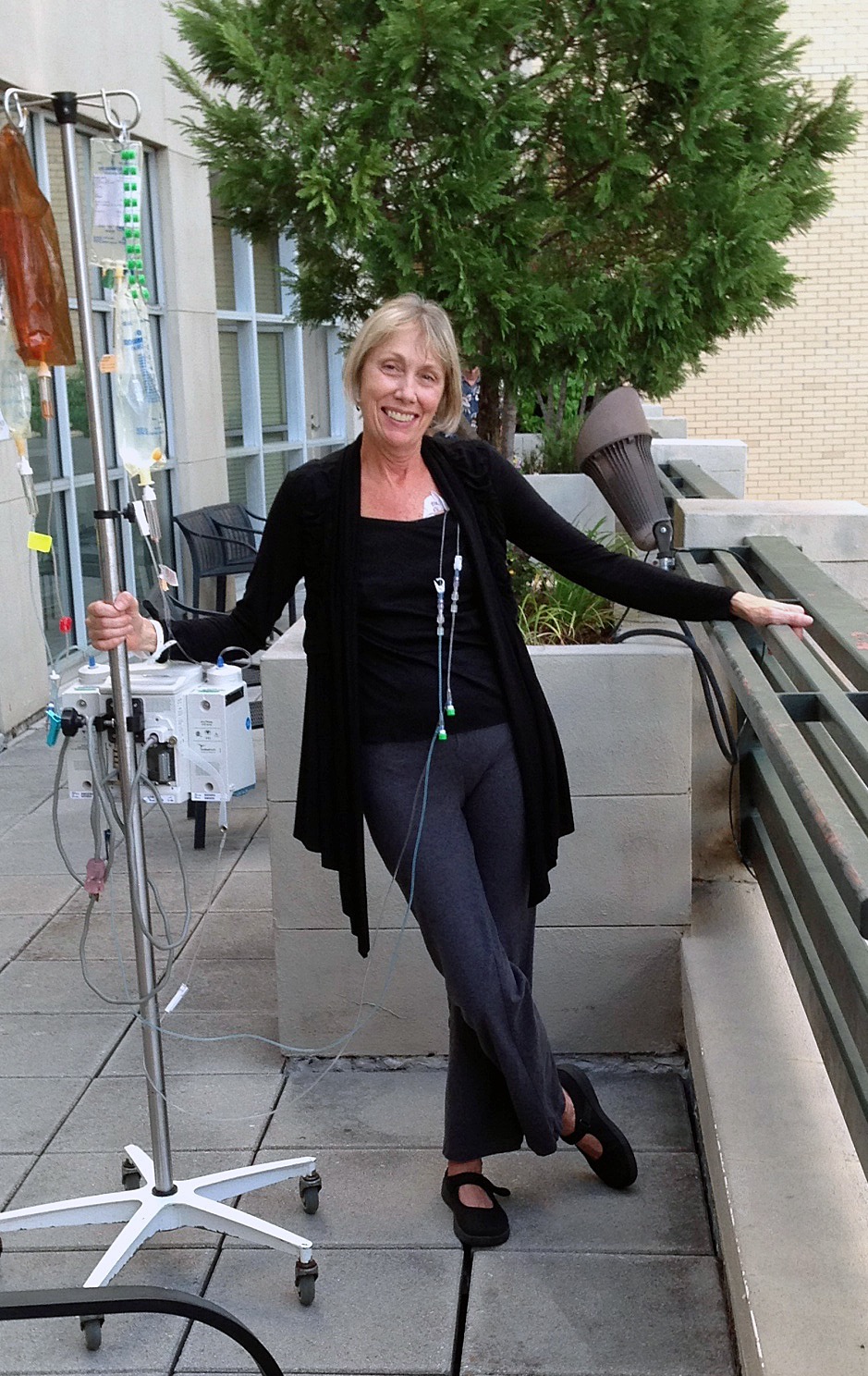
Judy on the 5th Floor Balcony of Roper

Judy on the 5th Floor Balcony of Roper

Although Tenzin can sometimes hear muffled sounds from Woody’s closet, he – Tenzin – is very much in control. During hospital weeks, he wakes up at 5, walks their doomed dog Saisy, showers, etc., and delivers the paper to Judy on the 5th floor of Roper and sits down to enjoy a cup of coffee. Then he shuffles off in his blue footies, down the hall to the elevator, hitting the first floor, greeting the staff coming on as he heads to the parking garage and to work.

After only four days of chemo, the tumor has shrunk so much that the oncologist says he wouldn’t know it were there by external inspection.

Of course, everyone loves Judy because of her courage and exquisite manners. The nurses try to see to it that she gets the rooms that look out over Charleston Harbor. She walks a lot, dragging the chemo-shit along with her. She continues her work as a school psychologist from her hospital bed, and in the third week goes to work in Berkeley County wearing a wig. In the afternoons when she’s in the hospital, Judy and Tenzin sit on the balcony and note the beauty of the light as it falls upon the steeples of the city.

In October on a Friday, Tenzin returns from work to find a voice message from the oncologist. He’s delighted to inform them that Judy’s scan has come back all clear; there’s not a trace of cancer.

Nevertheless, they’re going to continue for two more cycles of chemo, culminating in a grand total of 6.

Late December 2014 – January 2015

Tenzin’s mother has had a stroke as Judy’s preparing for a stem cell transplant. Tenzin allows Woody to come out of the closet to google stem cell transplants, but marches him right back in there afterwards.

One morning they come downstairs to find that Saisy has died during the night. Tenzin and his neighbor Jim load Saisy’s carcass in the back of Judy’s SUV (Tenzin’s Mini isn’t an option), and she drops Saisy off at the Vet’s to be cremated. She then drives on to work as Tenzin does the same.

Over the next week, Tenzin tries to make it to his hometown to see his fading mother while meanwhile Judy suffers the worst part of her treatment, bone-marrow killing doses of a different type of chemo that incapacitates her.

When Tenzin’s mother dies, Judy’s very ill; she can’t attend the funeral because she’s been hospitalized.   The good news is that Judy’s sister and sister-in-law have come to help. Despite all the negativity, spirits are somewhat high.

February – March 2015

Scans again clear. Time for radiation, which is no fun, but it’s much better than chemo.

June 2015

Judy’s and Tenzin’s son is getting married in June, right after another scan. Woody, who has been released from the closet but remains under house arrest, thinks the scan should be put off until after the wedding, but Tenzin and Judy disagree. How great to hear the news beforehand they say.

But they don’t hear the news. Woody is not allowed to come up to DC for the festivities (though he does text twice). The wedding week is wonderful as Judy and Tenzin reunite with loved ones and enjoy interacting with their new in-laws. All agree the ceremony and reception are a blast.

When Judy and Tenzin return to Charleston, they learn the scan was “all clear.”

17 December 2015

Judy goes in for her six-month scan. Woody has been sneaking around googling, looking for PTCL-NOS success stories, and under that heading what’s below is all he can find:

07/08 DX Peripheral T-Cell Lymphoma-Not Otherwise Specified. 50+ tumors with BMI

08/08-12/08 Four cycles CHOEP14 + four cycles GND (Cyclofosfamide, Doxorubicin, Vincristine, Etoposide, Prednisone & Gemcitabine, Navelbine, Doxil)

02/09 Relapse.

03/09-06/13 Clinical trial of Romidepsin > long-term study. NED for 64 twenty-eight day cycles

07/13 Relapse/Suspected Mutation.

08/13-02/14 Romidepsin increased, but stopped due to ineffectiveness. Watch & Wait.

09/14 Relapse/Progression. Visible cervical nodes appear within 4 days of being checked clear.

10/06/14 One cycle Belinostat. Discontinued to enter second clinical trial.

10/25/14 Clinical trial of Alisertib/Failed.

01/12/15 Belinostat resumed/Failed 02/23/15

02/24/15 Pralatrexate/Failed 04/17/15

04/15 Genomic profiling reveals mutation into PTCL-NOS + AngioImmunoblastic T-Cell Lymphoma. Two dozen tumors + small intestine involvement.

04/22/15 TREC (Bendamustine, Etoposide, Carboplatin). Full response in two cycles. PET/CT both clear. Third cycle followed.

06/15-07/15 Transplant preparation (X-rays, spinal taps, BMB, blood test, MUGA scan, lung function, CMV screening, C-Diff testing etc. etc. etc.) Intrathecal Methotrexate during spinal tap.

BMB reveals Myelodysplastic Syndrome (MDS), technically a third cancer.

07/11-12/15 Cyclofosfamide + Fludarabine conditioning regimen.

07/16/15 Total Body Irradiation.

07/17/15 Haploidentical Allogeneic Transplant receiving my son’s peripheral blood stem cells.

07/21-22/15 Triple dose Cytoxan + Mesna, followed by immunosuppressants Tacrolimus and Mycophenolate Mofetil.

07/23-08/03/15 Blood nose dive. Fever. Hospitalized two weeks.

08/04/15 Engraftment official – released from hospital.

08/13/15 Marrow is 100% donor cells. Platelets climbing steadily, red cells follow.

09/21/15 Acute skin GvHD arrives. DEXA scan reveals osteoporosis.

09/26/-11/03/15 Prednisone to control GvHD.

To date: 17 chemotherapeutic drugs in 8 regimens. 4 of those drugs at least twice.

Knowing the redemptive value of suffering makes all the difference.

Woody also discovers that the median time for relapse is 6.7 months after primary treatment, and it’s been seven months since Judy’s ended. Plus her SED rate is way high at 38 (20’s normal). Woody googles for possible reasons for high SED rate. “Cancers: lymphoma, leukemia.”

18 December 2015

Judy tells Woody (who’s wearing a Tenzin mask) he doesn’t need to accompany her to her 3 o’clock appointment.

As soon as she leaves for work, Woody clobbers Tenzin over the head with a walking cane and shoves him in the closet.

Woody goes to work and grades one set of exams, attends a brunch, then goes home at one-thirty and tries to take a nap.

He falls into a fitful sleep but awakens.

The clock crawls. Three finally arrives. Why didn’t meet her there? Imagine a text message. Or if it’s bad, wouldn’t she call? Imagine her driving back by herself knowing. Poor thing. 3:05. Friday’s NY Times crossword puzzle. It’s impossible. 3:15. He imagines Judy being weighed, getting her blood pressure taken. 3:30, no word. 3:35 goes down to play solitaire. 3:50. Knows Judy might get irritated but calls.

She hasn’t been seen yet!

4:05; Billie Holiday’s text ring tone “Comes Love” sounds. He sees ”scan’s all clear” on the screen. Screams Yes!! Literally dances a jig. Judy calls. “Yes!” He texts his sons “Yes!” He texts friends. “Yes!”

He rides his bike down to the Jack of Cups where he finds the owner Nick sitting at the bar with Tyler, a Chico Feo bartender, sitting next to him, and Samantha, a lovely tattoo-covered “girl next door” stationed behind the bar. He shares the good news. Larry comes in. Lesley, Nick’s wife comes in. They all high five. Nick disappears and returns with six shots.

They raise their glasses and chug.

Meanwhile, Tenzin is just coming to back home. He walks slowly up the stairs to his study and takes from the shelf The Selected Poems of WH Auden. He looks at the index of first lines, flips to the sought after page, and reads:


That night when joy began

Our narrowest veins to flush,

We waited for the flash

Of morning’s levelled gun.


But morning let us pass,

And day by day relief

Outgrows his nervous laugh,

Grown credulous of peace,


As mile by mile is seen

No trespasser’s reproach,

And love’s best glasses reach

No fields but are his own.



Not So Fabulous Pick-Up Lines from Master English Poets

coy

Is poetry really the way into a lover’s heart? Here’s the Swan of Avon, Mr. William Shakespeare himself, having a go at it:

But no roses see I in her cheeks,

And in some perfumes there is more delight,

Than in the breath that from my mistress reeks.

Here, Master Will is attempting to flatter his dark-skinned mistress by underscoring how she doesn’t conform to pale-faced Elizabethan standards of beauty while mocking poets who overstate their lovers’ charms. However, judging by the limited number of women I have courted, I don’t see this strategy working well at all.

For example, I would not have attempted to flatter my late beloved wife with these lines:

My mistress’s breasts are fairly flat

And her hair a sort of mousey brown,

Yet she makes my heart go rat-a-tat-tat

Whenever I take her out on the town.

Nor do I think John Donne’s “The Flea” would work with most women. Sure, his comparing flea bites to sexual intercourse is “imaginative” and his “a-ha” comeback at the end of the poem clever, but, really, do you think this argument has even a Casper-the-Friendly-Ghost of a chance:

It sucked me first, and now sucks thee,

And in this flea our two bloods mingled be.

Thou knowst this cannot be said

A sin, nor shame, nor loss of maidenhead.

Then there’s Andrew Marvell’s “To His Coy Mistress,” which at least starts off on the right foot with some extravagant praise.

An hundred years should go to praise

Thine eyes and on thine forehead gaze;

Two hundred to adore each breast,

But thirty thousand to the rest;

An age at least to every part,

And the last age should show your heart.

For, lady, you deserve this state,

Nor would I love at lower rate.

But then gets all morbid on us:

Thy beauty shall no more be found;

Nor, in thy marble vault, shall sound

My echoing song; then worms shall try

That long preserved virginity . . .

As one of my students once said when I told her that faculty members often lie around unclothed in the faculty lounge:

BAD MENTAL PICTURE!

Sir John Suckling, he of the unfortunate name, creates this sure-not-to-please image:

Her feet beneath her petticoat

Like little mice stole in and out,

As if they feared the light;

But oh, she dances such a way!

No sun upon an Easter-day

Is half so fine a sight.

Maybe chicks back then thought vermin cute, foot-fetishes adorable?

Here’s another from Sir John:

Her lips were red, and one was thin;

Compared with that was next her chin,—

Some bee had stung it newly.

Jacobean Botox!

No, boys and girls, I doubt seriously that poetry is capable of melting hearts. After all, the greatest of poets, William Butler Yeats, devoted god knows how many iambs in his lifelong but vain attempt to win the love of Maud Gonne.

He leaves us with this good advice:

Never give all the heart, for love
Will hardly seem worth thinking of
To passionate women if it seem
Certain, and they never dream
That it fades out from kiss to kiss;
For everything that’s lovely is
But a brief, dreamy, kind delight.
O never give the heart outright,
For they, for all smooth lips can say,
Have given their hearts up to the play.
And who could play it well enough
If deaf and dumb and blind with love?
He that made this knows all the cost,
For he gave all his heart and lost.

WB Yeats

Santa Agonistes

Sound is essential here; please click on the arrow as you read along.


Here we go again —

the twilight of the equinox

has darkened into winter’s perpetual night.


I’ve grown a-weary of the midnight sun

here at the polar prison house.


No youthful, immortal Jove am I

but find myself frozen forever

at a corpulent seventy-five,


my neuropathy

perpetually

pin-pricking my feet

as I limp along

hauling bag after bag

from roof to roof.


(FYI, Mrs. Claus and I haven’t done it

since Nietzsche was alive,

and, no, Cialis doesn’t work:

our twin bathtubs have frozen over with ice).


The toyshop has morphed into a factory

running 3 shifts 24/7.


The elves stand dead-eyed

on stepstools along the assembly lines

cranking out what will break or soon be cast aside.


Restive, the reindeer wait back in the barn,

eager to do something besides sleep and feed,

their breaths streaming into the thin frigid Arctic air.


Come Comet, come Blitzen, ah, come, et al.

It’s time to defy Sir Isaac and take our yearly ride.

Down below stretch endless rows of tract housing,

each like the other, each with its requisite cookies and cocoa . . .


Here I go again, the Sisyphean elf, ho-ho-hoing.


samson agonistes

Blood-Dimmed Tides

William Cullen Bryant

William Cullen Bryant

In the misty pre-Darwinian year of 1818, William Cullen Bryant published his oft-anthologized poem “To a Waterfowl.” In the poem he apostrophizes a somewhat generic migratory bird. His vagueness in pinpointing species is probably a good idea here, because the titles “To a Duck” or “To an Egret” or “To a Wood Stork,” not only sound a bit cacophonous, but they also create concrete images that might distract from the poem’s high-minded contemplations. The image of an egret awkwardly lumbering into the air might call into question Bryant’s central message: Don’t worry; God’s in charge.

“[W]ither [. . .] dost though pursue thy solitary way?” the poet asks, addressing the waterfowl.  “Seekest thou [. . .] weedy lake [. . .] or marge of river wide” or “chafed ocean side?”

Dangers abound – “Vainly the fowler’s eye/Might mark [the waterfowl’s] distant flight to do [it] wrong.”

However, not to worry, “There is a Power/Whose care/Teaches [the waterfowl’s] way along [the] pathless coast” towards “a summer home” where it can “rest/And scream among [its] fellows.”

Bryant concludes the poem with this stanza:

He, who, from zone to zone,

Guides through the boundless sky thy certain flight,

In the long way that I must trace alone

Will lead my steps aright.”

Flash forward 101 years:

Turning and turning in the widening gyre,

The falcon cannot hear the falconer.

Things fall apart; the centre cannot hold;

Mere anarchy is loosed upon the world,

The blood-dimmed tide is loosed, and everywhere

The ceremony of innocence is drowned;

The best lack all conviction, while the worst

Are full of passionate intensity.

Charles Darwin

Charles Darwin

Forty-one years after the publication of Bryant’s “To a Waterfowl” and sixty years before Yeats’ composition of “The Second Coming,” Darwin published the Origin of the Species. Now, very few would buy into the concept that a micromanaging deity orchestrates the flight of migratory birds.[1]

What Darwin did was to thrust randomness and happenstance into the forefront of the scientific version of how human beings came to be human beings, which, of course, suggests that randomness and happenstance play roles in our petty lives from day to day for better or for worse.

No wonder, then, that Yeats’s poem resonates more with modern readers than does Bryant’s.

This, via, The Paris Review:

“The Second Coming” may well be the most thoroughly pillaged piece of literature in English. (Perhaps Macbeth’s famous “sound and fury” monologue is a distant second.) Since Chinua Achebe cribbed Yeats’s lines for Things Fall Apart in 1958 and Joan Didion for Slouching Towards Bethlehem a decade later, dozens if not hundreds of others have followed suit, in mediums ranging from CD-ROM games to heavy-metal albums to pornography.

[. . .]

In the wake of Didion’s success, publishers have come to realize they can apply Yeats’s lines to pretty much any book that documents confusion and disarray. Thus Elyn Saks’s 2008 memoir, The Center Cannot Hold: My Journey Through Madness, concerning her bout with schizophrenia. Though these four words from Yeats surely resonate with Saks’s feelings, the “center” in question here isn’t the moral authority of the Western world, it’s one person’s sense of stability. The trend has held for art books (David Gulden’s photography collection The Centre Cannot Hold), politics (The Center Holds: Obama and His Enemies), alternate history (American Empire: The Center Cannot Hold), popular history (A Blood-Dimmed Tide: The Battle of the Bulge by the Men Who Fought It), reportage (A Blood-Dimmed Tide: Dispatches from the Middle East), religion (The Second Coming: A Pre-Mortem on Western Civilization), international affairs (Slouching Towards Sirte: NATO’s War on Libya and Africa), right-wing moral hectoring (Slouching Toward Gomorrah), memoir (Slouching Toward Adulthood), and even humor (Slouching Towards Kalamazoo; Woody Allen’s Mere Anarchy). It seems that for every cogent allusion (Northrop Frye’s Spiritus Mundi, anyone?) there are a dozen falcons that truly can’t hear the falconer.

William Butler Yeats

William Butler Yeats

Well, as matter of fact, the polarization of our own politics in addition to the utter disregard for human life of those who strap on suicide vests do suggest that “the centre cannot hold’ and “the worst are full of passionate intensity.” Virtually, every day we’re confronted with slaughter, whether it be at a bistro in Paris, a luxury hotel in Mali, or a African American church in Charleston, South Carolina.

The blood-dimmed tide has been loosed. No wonder incorporating a quote from “The Second Coming” into a title has become cliché.


[1] Of course, many still reckon that God micromanages our human existences, His making sure, for example, that Judy Birdsong’s application to her first choice graduate school was rejected so that she could meet up and marry me at USC, her second choice. (Not to mention how He later saw to it that teachers misbehaved at my present place of employment so that they would be fired to make room for me). Cf., Dabo Swinney’s “Game Plan for Life.”

After All


What has Ursula Hazelwood Hunt Blanton

been up to in Heaven all this time?


Shelling beans, watching soaps,

cackling among gossiping seraphs and cherubim?


I’d like to think so, along with her

sisters, Ruby and Pearl, up there

over yonder in Heaven’s Baptist wing

doing what they loved most doing

but without life’s worries

gnawing away at the back of their heads.


And what about their husbands,

where are they? Certainly, not with them,

but outside behind some cloudy bank

sneaking a drink, enjoying the fiddle music

of some winged, yodeling hillbilly gone to his reward.


Mama’s up there now as well,

maybe with daddy, his restlessness abated.

Curled up on a sofa, they smoke cigarettes

that can’t kill them, chuckling

about how, after all, it all turned out all right.

Hillbilly Heaven

Harsh Discords and Unpleasing Sharps

a rather unflattering depiction of Pope

a rather unflattering depiction of Alexander Pope

Nowadays, Alexander Pope is so unpopular that the Robin Williams character in Dead Poets Society demanded his students rip Pope’s poems from their texts.   Certainly, the polished closed heroic couplets that flowed from Pope’s quill would make an incongruous soundtrack for what Eliot called “the immense panorama of futility and anarchy that is contemporary history.” Yep, the minuet has given way to slam dancing; fixed poetic forms have followed their cousin the typewriter into obsolescence.

Adieu. Toot-a-loo. Later.

Nevertheless, when it comes to the poetic confluence of sound and sense, very few poets can equal that four-foot six-inch Colossus, Alexander Pope, that satiric terror who immortalized his enemies in his verse.

Here he is on synthesizing sound with image and movement:

Tis not enough no Harshness gives Offence,

The Sound must seem an Echo to the Sense.

Soft is the Strain when Zephyr gently blows,

And the smooth Stream in smoother Numbers flows;

But when loud Surges lash the sounding Shore,

The hoarse, rough Verse shou’d like the Torrent roar.

When Ajax strives, some Rocks’ vast Weight to throw,

The Line too labours, and the Words move slow;

Note how via spondees he slows down the first half of line six, a lesson learned by Frost in his short poem “The Span of Life”:

The old dog barks backwards without getting up.

I can remember when he was a pup.

Not only do the four consecutive stressed beats of old dog barks back echo what a bark sounds like, but their slowness also reinforces the dog’s old age, his sluggishness. On the other hand, the opening anapests of line two suggest the bounding energy of a puppy. Here the sound does indeed “seem an echo to the sense.”

Ultimately, Pope’s dictum demands that when describing ugliness, poets need to make their poems sound ugly, so I thought it might be interesting to check out a few great poets depicting unpleasant images and to see how successful they are in creating dissonance.

Let’s start with Chaucer’s description of the Summoner from “The Prologue to the Canterbury Tales.”

Click the arrow for sound:

A SOMONOUR was ther with us in that place,
That hadde a fyr-reed cherubynnes face,
For saucefleem he was, with eyen narwe.
As hoot he was and lecherous as a sparwe,
With scalled browes blake, and piled berd,
Of his visage children were aferd.
Ther nas quyk-silver, lytarge, ne brymstoon,
Boras, ceruce, ne oille of tartre noon,
Ne oynement, that wolde clense and byte,
That hym myghte helpen of his whelkes white,
Nor of the knobbes sittynge on his chekes.
Wel loved he garleek, oynons, and eek lekes,
And for to drynken strong wyn, reed as blood;
Thanne wolde he speke and crie as he were wood.

Fast-forwarding 200 years, here’s Edmund Spenser’s personification of Gluttony from Canto 3 of Book 1 of The Faerie Queene (I’ve modernized the spelling):

And by his side rode loathsome Gluttony,

Deformed creature, on a filthy swine,

His belly up-blown with luxury

And also with fatness swollen were his eyes

And like a Crane his neck was long and fine

With which he swallowed up excessive feast,

For want whereof poor people did pine;

And all the way, most like a brutish beast,

He spewed up his gorge, that all did him detest.

Although Spenser succeeds in creating disgusting visual images, I’m not so sure he’s completely successful in creating sonic dissonance.  On the other hand, note the dissonance of these lines from Gerard Manley Hopkins describing Industrial England.

And all is seared with trade; bleared, smeared with toil;
And wears man’s smudge and shares man’s smell: the soil
Is bare now, nor can foot feel, being shod.

Now that’s brilliantly untuneful. Read it out loud. The rhyme toil/soil is deliciously dissonant, and seared/bleared/smeared ranks up there in rankness as well.

I’ll leave you with Master Will piping some appropriately sour notes:

It is the lark that sings so out of tune

Straining harsh discords and unpleasing sharps.

That’s Juliet talking, lying in her bridal bed with Romeo, realizing that the bird singing outside her window is not, as she hoped, the nightingale.

Time to get up, star-crossed lovers, and march off to your doom.

No, that’s too dark of a way to end this post.

A Meditation on the Sound of Indecorous Words

Fellatio is a lovely word,

Operatic, in a way:

“The role of Fellatio will be sung

By Mr. Richard Cabot-Clay.”

*

Sodomy, on the other hand,

Lacks that light Italian ring:

Biblical, confessional,

A cry of pain! a serpent’s sting!

*

Cunnilingus could be a caliph,

Thundering across Arabian sands

Seeking long lost treasure troves

Guarded by Jinn in distant lands.

*

Fuck, of course, isn’t exotic.

Its harsh cough can cause vexation.

But when a car door smashes your fingers,

It sure beats fornication.

~Wesley Moore

During the Deluge Blues

During the Deluge Blues

Got the stranded, sodden, ennui blues, baby.

Sick and tired of this here deluge, baby.

Rains day and night, no end in sight.

We talking federal emergency blight.

*

Done run out of booze, way low on beer,

Water in the road up over my ear,

Sharks feasting on feral cats —

even I-and-I ain’t going out in that.

*

So come here, mama, let’s hunker on down.

It ain’t like we gonna literally drown.

We can play us some Fats Domino

On that thousand dollar stereo

And get our thrill on Blueberry Hill.

*

Got the stranded, sodden, ennui blues, baby.

Sick and tired of this here deluge, baby.

Rains all day and night, no end in sight.

But Fats gots us feeling all right, baby.

Poets on Pain

Expressing physical pain in words is next to impossible.

Here’s a short poem by Trumbull Stickney (1874-1904), who died of a brain tumor:

Sir, say no more.

Within me ’tis as if

The green and climbing eyesight of a cat

Crawled near my mind’s poor birds.

Certainly, if any one would know about pain, the Empress of Calvary would.

Pain has an element of blank;

It cannot recollect

When it began, or if there were

A day when it was not.

It has no future but itself,

Its infinite realms contain

Its past, enlightened to perceive

New periods of pain.

But no one, I mean no one, can top poor John Keats when it comes to embodying illness in words :

Ode to a Nightingale

MY heart aches, and a drowsy numbness pains

My sense, as though of hemlock I had drunk,

Or emptied some dull opiate to the drains

One minute past, and Lethe-wards had sunk:

‘Tis not through envy of thy happy lot,

But being too happy in thine happiness,

That thou, light-wingèd Dryad of the trees,

In some melodious plot

Of beechen green, and shadows numberless,

Singest of summer in full-throated ease.

O for a draught of vintage! that hath been

Cool’d a long age in the deep-delvèd earth,

Tasting of Flora and the country-green,

Dance, and Provençal song, and sunburnt mirth!

O for a beaker full of the warm South!

Full of the true, the blushful Hippocrene,

With beaded bubbles winking at the brim,

And purple-stainèd mouth;

That I might drink, and leave the world unseen,

And with thee fade away into the forest dim:

Fade far away, dissolve, and quite forget

What thou among the leaves hast never known,

The weariness, the fever, and the fret

Here, where men sit and hear each other groan;

Where palsy shakes a few, sad, last grey hairs,

Where youth grows pale, and spectre-thin, and dies;

Where but to think is to be full of sorrow

And leaden-eyed despairs;

Where beauty cannot keep her lustrous eyes,

Or new Love pine at them beyond to-morrow.

Away! away! for I will fly to thee,

Not charioted by Bacchus and his pards,

But on the viewless wings of Poesy,

Though the dull brain perplexes and retards:

Already with thee! tender is the night,

And haply the Queen-Moon is on her throne,

Cluster’d around by all her starry Fays

But here there is no light,

Save what from heaven is with the breezes blown

Through verdurous glooms and winding mossy ways.

I cannot see what flowers are at my feet,

Nor what soft incense hangs upon the boughs,

But, in embalmèd darkness, guess each sweet

Wherewith the seasonable month endows

The grass, the thicket, and the fruit-tree wild;

White hawthorn, and the pastoral eglantine;

Fast-fading violets cover’d up in leaves;

And mid-May’s eldest child,

The coming musk-rose, full of dewy wine,

The murmurous haunt of flies on summer eves.

Darkling I listen; and, for many a time

I have been half in love with easeful Death,

Call’d him soft names in many a musèd rhyme,

To take into the air my quiet breath;

Now more than ever seems it rich to die,

To cease upon the midnight with no pain,

While thou art pouring forth thy soul abroad

In such an ecstasy!

Still wouldst thou sing, and I have ears in vain—

To thy high requiem become a sod.

Thou wast not born for death, immortal Bird!

No hungry generations tread thee down;

The voice I hear this passing night was heard

In ancient days by emperor and clown:

Perhaps the self-same song that found a path

Through the sad heart of Ruth, when, sick for home,

She stood in tears amid the alien corn;

The same that ofttimes hath

Charm’d magic casements, opening on the foam

Of perilous seas, in faery lands forlorn.

Forlorn! the very word is like a bell

To toll me back from thee to my sole self!

Adieu! the fancy cannot cheat so well

As she is famed to do, deceiving elf.

Adieu! adieu! thy plaintive anthem fades

Past the near meadows, over the still stream,

Up the hill-side; and now ’tis buried deep

In the next valley-glades:

Was it a vision, or a waking dream?

Fled is that music:—do I wake or sleep?

After reading that, my scratchy throat and lethargy seem almost heavenly. O for a draught of John Jameson!

0af2ebb0a36738aeb8bcbb526d1d25fa

Folly Beach Life, Ain’t the Good Life, But It’s My Life

Eddie Cabbage

Eddie Cabbage

Okay, I’m on the upstairs porch of Chico Feo the afternoon after a Screamin’ J’s Friday night gig listening to some jamming when Eddie Cabbage asks me if I would like a poem on demand.

I demur, but he insists.

Hank Weed suggests something that incorporates cancer and poison ivy, because Hank claims that last year he asked me how it was going, and I said, “I have a bad case of poison ivy, and, oh yeah, Judy has cancer.”

[cue the Coasters]: Going to need an ocean of calamine lotion (and fifty bags of chemo).

Before I share the poem, here’s Eddie at work yesterday.

And here’s the poem with the warning that the squeamish might find its imagery unpalatable.

zoom ivy

And here be the Screamin’ J’s