Relatively early in his career, Yeats would come up with long, unwieldy titles for some of his poems.
Here’s one:
To a Poet, who would have me Praise certain Bad Poets, Imitators of His and Mine
You say as I have often given tongue
In praise of what another’s said or sung.
‘There politic to do the like by these;
But have you known a dog to praise his fleas?
So in this vein, I humbly present:
A Subliterate Buddhist with Work Issues Writes to His Love Seeking Seventeen Syllables That Will Deliver Him from the Eternal Cycle of Birth, Suffering, and Death
I guess from now on, I’ll always associate spring with death, Mother’s Day especially, the day my sons’ mother passed, a word I don’t use in this context. It’s probably such a popular euphemism because it suggests travelling, passing through death’s dark door into another realm, the undiscovered country, Hamlet calls it.
Although I don’t believe in an afterlife, I’m not arrogant enough to think I could not be wrong about my disbelief. Once again, Hamlet, to his pal Horatio, after having conversed with the spirit of his father:
There are more things in heaven and earth, Horatio,
As it turns out, my younger son Ned has recently conversed with his mother Judy, though in a dream. Aglow, Ned said, with golden light, she told him she was fine, and that things were more important where she was now, that she was busy.
At any rate, any rational person perceives the ubiquity of death — the fallen leaf, roadkill in the medium, swatted mosquito, ill-tended orchid — with a measure of dispassion. The not-so-sad fact is the last thing that dying or grieving makes you is special.
Of course, we’re all destined to die – the blight that man was born for, Hopkins calls it in “Spring and Fall.”
Márgarét, áre you gríeving
Over Goldengrove unleaving?
Leáves like the things of man, you
With your fresh thoughts care for, can you?
Ah! ás the heart grows older
It will come to such sights colder
By and by, nor spare a sigh
Though worlds of wanwood leafmeal lie;
And yet you wíll weep and know why.
Now no matter, child, the name:
Sórrow’s spríngs áre the same.
Nor mouth had, no nor mind, expressed
What heart heard of, ghost guessed:
It ís the blight man was born for,
It is Margaret you mourn for.
On the other hand, more importantly, we’re born to live, and spring, of course, is all about resurrection. Look at Good Friday’s full moon at the top of this page, perched in a tree above the Pour House porch. How beautiful!
Now it’s waning, melting away, obliterating fewer stars as it progressively disappears, and, of course, our favorite star continues to do its thing.
And for all this, nature is never spent;
There lives the dearest freshness deep down things;
And though the last lights off the black West went
Oh, morning, at the brown brink eastward, springs —
Gerard Manley Hopkins, “God’s Grandeur”
Yesterday, Caroline and I picked up two six-day-old peeps as an Easter present for her daughter. Downstairs in Ned’s vacated room, growing seemingly in time-lapse fashion before our very eyes, downy little dinosaurs pecking away, stretching their tiny embryonic-looking wings, lucky to be alive.
To me, this seems enough: to be able to breathe, to taste, to fall in love again, to read Hopkins out loud backed by wind chimes as the melting moon makes her way towards the horizon to be reborn.
View from A Rented Cottage in County Clare, photograph by Wesley Moore III
Although I’m certain I have a drop or two of Irish blood, I’m not of the Catholic immigrant variety with distant cousins in Kerry or Donegal. Nevertheless, ever since I saw at the age of seven Darby O’Gill and the Little People, I have loved that “little green place” and its soulful inhabitants, its poetry, music, fairies and leprechauns, its abundance of foxgloves, and those mountains in the distance so vaporous it looks as if you could puncture them with your forefinger.
And, oh my god, that rainbow I encountered in 1978 outside of Limerick!
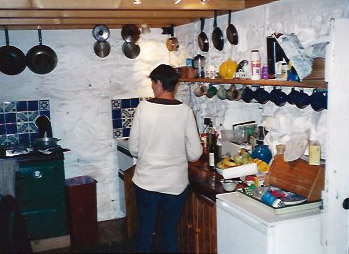
Judy Birdsong Preparing Supper in County Cork, photograph by Wesley Moore
Ireland was the first place I went abroad at twenty-five, and I have been twice again since. In the previous century, Judy, our boys, and I rented cottages, burned peat, shopped at the butchers, drank and listened to music in the pubs, climbed Ben Bulben’s back, and crawled our way up Croagh Patrick.
Ned Moore descending Croagh Patrick, photograph by Judy Birdsong
We got to know our neighbors, so hospitable. Here below are the boys helping John Joe O’Shea shear a sheep near Bantry Bay on the Berea Peninsula in County Cork.
Ned and Harrison Moore and John Joe O’Shea shearing sheep
What truly astounds me about Ireland, though, is how an island the size of South Carolina could produce so many literary masters– Swift, Goldsmith, Yeats, Shaw, Wilde, Joyce, Beckett, and Heaney, to name the ones who come immediately to mind.
Despite his kooky mysticism and rightist politics, Yeats is my hero, and despite his arrogance and sometime meanness, Joyce is my hero.
Joyce, of course, had his issues with his native land. For example, Dubliners isn’t exactly what you would call a flattering portrait of that city. I’m currently on Disc 30 of the Donal Donnnelly/Miriam Healy-Louie recording of Ulysses, “Episode 16,” the so-called Eumaeus episode when Bloom and Stephen seek refuge in a cabman’s shelter after Stephen has been punched out by an English soldier.
An old tar, DB Murphy comes into the shelter and asks Stephen if he knows Simon Dedalus, Stephen’s father, and Stephen says, “I’ve heard of him.” The seaman answers, “He’s Irish [. . .] All Irish.” Stephen “rejoins” (to use Joyce’s dialogue prompt) “All too Irish.” As a Southerner, I can certainly identify with Stephen’s love/hate relationship with his native land.
Anyway, listening to Donnelly read Joyce’s rich broth of Anglo-Saxon and French-derived words, I have gotten the cadences stuck in my head, and to purge them, I’ve composed this negative ditty, trying to stick with only Anglo-Saxon, through which I mean not to stereotype my Irish brethren but merely to make music out of misery.
Manic Irish Reeling
Slop flung from a window above
Splatters on stone in globby plops.
Curses, fists, flung and shook,
Shuffling brogans, baleful looks.
“With a high ro and a randy ro and my galloping tearing tandy O!”
After toil a stop at the pub,
Reeking redbearded guzzling swabs
Fritter away their coppery coins
Picking scabs by swapping tales.
“With a high ro and a randy ro and my galloping tearing tandy O!”
Baggy-eyed mothers fret
Greedy sucklings at their breasts,
Keening toddlers at their feet,
Their stillborns gone, but not forgotten,
Their overripe love on the road to rotten.
“With a high ro and a randy ro and my galloping tearing tandy O!”
Out in the street across the way
Waifs and strays banding about.
Rail thin curs and scrawny cats.
Yelping and mewling till the sun comes up.
“With a high ro and a randy ro –
Hit it!
“With a high ro and a randy ro and my galloping tearing tandy O!”
On the train you get smaller, as you get farther away.
The roar covers everything you wanted to say.
Was that a raindrop or a tear in the corner of your eye?
Were you drying your nails or waving goodbye?
Tom Waits, “2:19”
In “Madame George,” the second song of Side Two of Van Morrison’s Astral Weeks, I love it when Madame George says to the narrator, “Hey love, you forgot your gloves.”
And then the narrator, (rather than Madame George, I think) says
The gloves to love, to love the gloves
The gloves to love, to love the gloves
The gloves to love, to love the gloves
The gloves to love, to love the gloves
To say goodbye to Madame George
Dry your eye for Madame George
Wonder why for Madame George.”
Wonder why about what?
In the last stanza, it’s as if the narrator has to self-hypnotize himself leave, as if he has to verbally will his very locomotion:
Get on the train
Get on the train, the train, the train
This is the train, this is the train
Whoa, say goodbye, goodbye, goodbye, goodbye
Get on the train, get on the train.
Glove equals love, liltingly. Gloves sometimes wave goodbye.
Goodbye for good?
I don’t pretend to know what’s happening here, but it’s something very, very sad; we’re in a world of woe, outré, impressionistic, hypnotic.
You can feel the inarticulate hurt, and it’s bad to feel so good to know you’re not the only one hurting.
We’ve all felt this. This is the train. Get on the train. Dry your eyes. This is the bed. Get out of the bed. Put Visine in your eyes.








 You Do Hoodoo