Smack Dab in the Middle of the Summer

Smack Dab in the Middle of the Summer

I try not to take things for granted. For example, yesterday Caroline and I sludged on foot through heavy humidity to Planet Follywood for breakfast, and as my sunglasses fogged up like a time-lapsed cataract, I thought to myself how nice it is not to have to assess essays. 

Of course, we’re smack dab in the middle of the summer, so I wouldn’t have any essays to grade anyway, but still, if I weren’t retired, I’d be lamenting that it’s really not the middle of the summer, given contemporary school schedules. The post Labor Day onset of school has gone the way of the hand-cranked eggbeater, a relic of the predigital era. I recently overheard someone say that school this year starts on August 7th, which is way too early — way, way too early.

Of course, the very beginning of school does have its charms, like meeting new colleagues and students, and the welcome-back faculty and staff cocktail party is fun, but the next thing you know, you’re slogging through over-annotated summer reading books and their accompanying journals. More than any other project, including research papers, I hated assessing those annotated novels and journals, fussing over inelegant quotation integration, encouraging students to break quotes into small units and imbed them into analytical prose.

For example, 

Not: “Moore juxtapositions descriptions of impoverished Camilla Creel and Jill Birdsong during Activity Period. Camilla has no friends. ‘As usual Camilla Creel doesn’t move from her seat when the bell rings for Activity Period. The rest of the girls in her home economics class can’t wait to put away the dress patterns they’re cutting out and stow those scissors so they can rush out into the teeming halls where boys cut fool and girls gossip.’ Compare this with ‘Jill Birdsong has made her way to the Junior Civitan meeting in Miss McGee’s room.'”

[vigorous yawn]

But Instead: Moore adds another set of foils to underscore differences among the characters, in this case Camilla Creel and Jill Birdsong. At Activity Period, friendless Camilla ‘doesn’t move from seat when the bell rings,’ unlike Jill Birdsong, who is making ‘her way to the Junior Civitan meeting in Miss McGee’s room’ to interact with her peers in choosing a charitable project for an African American nursing home. Ironically, Camilla is so impoverished that her family lives in an abandoned school bus, but to the rest of the school, she’s essentially invisible.”[1]  

[lesser yawn]

So, my mid-summer Island life isn’t darkened by dreading upcoming responsibilities. Now I can complain about the heat and tourists walking five abreast on Hudson Street instead of interminable faculty meetings and the annual blood borne pathogen tutorial and accompanying test.

[cue Alice Cooper]: “School’s out forever.” The back-to-school sales no longer produce sighs.


[1] from Today, Oh Boy, (121-3).  BTW, I realize it’s obnoxious to market my novel like this. But buy it, dammit. Here’s a LINK.

I Do Miss It Afterall

For whatever reason, this summer I’ve started missing teaching. I have an acquaintance, a very intelligent and accomplished young woman who is trilingual, spent a couple of years in Africa with the Peace Corps but who now suffers from what I’ll call low-grade ennui, her post jungle job not as satisfying as it seemed on paper. I see her occasionally at Chico Feo, and I ask her how her ennui is going, I’ve also been reciting snippets of poems dealing with profound boredom, riffing on Baudelaire, Yeats, Eliot, Roethke, Berryman, and Bukowski. 

For example, J. Alfred Prufrock is no stranger to tedium.

For I have known them all already, known them all:

Have known the evenings, mornings, afternoons,

I have measured out my life with coffee spoons.

She enjoys these snippets, leans in so she can hear Prufrock above piped-in music. 

Contemporary culture is so impoverished. TikTok, Insta, Facebook, et. al offer quick fixes to sate the need for constant stimulation, but they’re about as nourishing as cardboard. It’s not only fun but also life enhancing turning young people on to what Matthew Arnold called “the best that has been thought and said.” As a teacher, I especially enjoyed explaining how the elements of cultures reinforce each other and how the best art incorporates contemporary science and history into its mix: Planck and Einstein + WW1 + Freud = Modernism. 

   And no rock

   If there were rock

   And also water

   And water

   A spring

   A pool among the rock

   If there were the sound of water only

   Not the cicada

   And dry grass singing

   But sound of water over a rock

   Where the hermit-thrush sings in the pine trees

   Drip drop drip drop drop drop drop

   But there is no water

So yeah, I miss that (but not meetings, emails, EpiPens, essay grading, overwrought parents, dress code violations, and all that life-negating rigmarole. 

***

What brought this nostalgia to mind was watching last night a video of Elvis Costello in 1978 performing “Watching the Detectives” in Kohn, Germany. We had a tradition that if every student in my class scored a 100 on a reading or vocabulary quiz, we’d have what I called a “Festival” and turn them on to some really wonderful music videos like Etta James and Dr. John performing “”I’d Rather Be a Blind Girl” or the Pogues doing “Dirty Old Town.” I considered it not a waste of time but an enrichment of their lives.[1]

“Watching the Detectives” is an homage to film noir, and the lyrics mimic a screenplay: 


Long shot at that jumping sign
Invisible shivers running down my spine
Cut to baby taking off her clothes
Close-up of the sign that says, ‘We never close’
He snatched at you and you match his cigarette
She pulls the eyes out with a face like a magnet
I don’t know how much more of this I can take
She’s filing her nails while they’re dragging the lake.

And the music that supports these lyrics percolates ska-like. It’s such a good song, and I wish I could share it with someone and explain it to them[2] why it’s relevant. 


[1] Also, it was a huge incentive to read the assignments. 

[2] Yeah, I know, I know, “them” should be a singular pronoun. 

The Hawkes and Flannery O’Connor

Thursday night, our friend David Boatwright met Caroline and me at the Terrace Theater to check out the Ethan Hawke Flannery O’Connor biopic Wildcat.[1]  It’s gotten mixed reviews—hovers around 5 on the Rotten Tomato ten point scale— but I wonder if to fully appreciate the film you need to be familiar with O’Connor’s work. Throughout the action, Hawke and fellow screenwriter Shelby Gaines intersperse fiction from O’Connor’s canon into the story of her adulthood, but if you’re unfamiliar with her stories — e.g., “Parker’s Back” or “Revelation”— you very well may find the film quilt-like, a series of narratives stitched together that don’t create a comprehensive or unified overview. Brandon Yu, who reviewed the movie for New York Times, complains, “Half-sketched and sometimes hard to follow, the stories glimpsed here ultimately fail to produce a fully legible or consistently engaging arc of what must be a roiling inner world.” However, if you’ve read the stories, this is not the case. You see how they came to be via her daily interactions with others and understand how the stories embody her Catholic vision.

I don’t think the Hawkes (Ethan’s daughter Maya plays O’Connor and his wife Rachel is credited as a producer) necessarily set out to produce a fully integrated masterpiece like Citizen Kane but rather made the movie as an homage to Flannery, an artist of the highest caliber who simultaneously can make you laugh out loud and feel pathos. Maya Hawke discovered O’Connor in high school, used O’Connor’s Prayer Journal for her audition monologue at Julliard, and essentially became obsessed with the writer. 

I can empathize. I’ve learned a lot from Flannery O’Connor about writing fiction. Not only that, but her stories are so fun to teach, are so well crafted with each element of the plot — name selection, physical description, characterization, symbolism, and tone—linked to a common central theme: in a Catholic universe underserving people can be granted grace, even in the seemingly godforsaken Southern Gothic world of rural Georgia. 

Take the story “A Good Man Is Hard to Find,” for example, which dramatizes a family vacation where a mother, father, two bratty children, an infant, and a grandmother are murdered by an escaped convict called the Misfit. Yet I’d classify the story as a comedy, both in the literary sense and also in the Medieval sense of “The Divine Comedy” where a soul moves from darkness to light. The grandmother in the story is a self-centered pain-in-the-ass who essentially causes the wreck that allows the Misfit to murder the family and steal their car. However, at the very end of the story, grace descends upon the old woman when she sees how miserable the Misfit is and tries to comfort him:

[The Misfit’s] voice seemed about to crack and the grandmother’s head cleared for an instant. She saw the man’s face twisted close to her own as if he were going to cry and she murmured, “Why you’re one of my babies. You’re one of my own children!” She reached out and touched him on the shoulder. The Misfit sprang back as if a snake had bitten him and shot her three times through the chest. Then he put his gun down on the ground and took off his glasses and began to clean them. 

Hiram and Bobby Lee returned from the woods and stood over the ditch, looking down at the grandmother who half sat and half lay in a puddle of blood with her legs crossed under her like a child’s and her face smiling up at the cloudless sky. 

illustration by Jeffrey Smith

Note that her “legs are crossed,” an obvious Christian symbol, “under her like a child,” which suggests innocence regained, and that she is “smiling up at a cloudless sky.” In O’Connor’s Catholic universe, this amounts to a happy ending for the Grandmother’s death comes at a moment of redemption. This message is no doubt alien to most contemporary US citizens; however, as the movie makes abundantly clear, she wasn’t writing for the materialistic middle class. 

“Either one is serious about salvation or one is not,” O’Connor writes in Mystery and Manners. “And it is well to realize that the maximum amount of seriousness admits the maximum amount of comedy. Only if we are secure in our beliefs can we see the comical side of the universe.”

For me a movie is a successful if I think about it a lot after seeing it. In the wee hours this morning, as I wandered the barren moors of my insomnia, I thought about how the subdued colors of the film in general and threadbare genteel shabbiness of her home in specific underscore the profound melancholy of Flannery O’Connor’s life. She had studied at the famed Iowa Writer’s Workshop, hung out with Robert Lowell and Katherine Anne Porter, but after developing lupus was exiled from a literacy life in the North to a suffocatingly provincial existence on a farm in Milledgeville, Georgia, There she worked in pain and physical decline until her death at 39, all the while being totally unappreciated by her homefolk who found her fiction to be inaccessible and life-negating.

My only gripe is that the Hawkes’ depiction of O’Connor lacks the dry humor that she demonstrated in her letters. Maya Hawkes’ acting is superb, but she portrays O’Connor as sort of a rigid, humorless young woman on the spectrum whereas in reality O’Connor was fun to be with. I once had dinner with the late Ashley Brown, a professor at the University of South Carolina, who was close friends with Flannery and who appears often in her collected letters. I asked him if she were as severe a Catholic as the stories suggested, and he said, “Oh, no, not at all. She was delightful, very witty, fun to be with.” Then he whipped out photo albums featuring pictures he had taken of her with her peacocks. She was often beaming in those photos.

Nevertheless, by external standards, her life was bleak, and the film’s underscoring of that fact has made me appreciate her achievement even more. To see her alchemizing on screen the characters from her daily life into the immortals of her stories is very satisfying indeed. I also appreciate the way she didn’t outline her stories but had them unspool spontaneously from her subconscious, which is the way I also write fiction.

I’ll leave you with this delightful seduction scene from “Good Country People” where in a hayloft Manly Pointer, a door-to-door Bible salesman, demands that one-legged hot-to-trot nihilist Hulga Joy Hopewell say the words “I love you” to satisfy a mechanical formula he insists must be followed as a prerequisite for sex:

The boy’s look was irritated but dogged. “I don’t care,” he said. “I don’t care a thing about what all you done. I just want to know if you love me or don’tcher?” and he caught her to him and wildly planted her face with kisses until she said, “Yes, yes.”

“Okay then,” he said, letting her go. “Prove it.”

She smiled, looking dreamily out on the shifty landscape. She had seduced him without even making up her mind to try. “How?” she asked, feeling that he should be delayed a little.

He leaned over and put his lips to her ear. “Show me where your wooden leg joins on,” he whispered.

I often say that my novel Today, Oh Boy has the most unerotic sex scene in all of American literature, but now, rereading the above, I take it back.


[1] Although better known in Charleston a muralist and a painter, David is also a filmmaker, and sitting next to a filmmaker made me pay closer attention to technique, which is a good thing. 

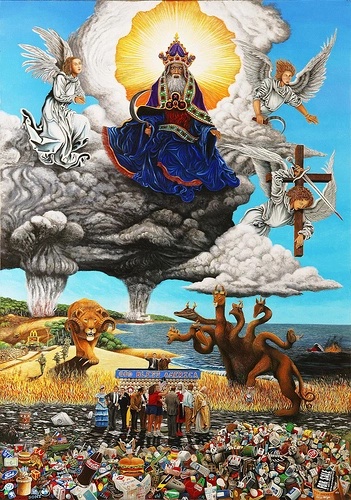
America, Good Luck by David Boatwright

Recitation of “Adam’s Fall” on Yeats’ 159th Birthday

A year or so ago, Buxton Books invited me to recite a favorite poem for their on-line series, “The Power of Poetry” as part of the promotion for my novel Today, Oh Boy. However, I don’t think the clip was ever posted, so in honor of Yeats’ 159th birthday, I’m posting it here. The text of poem itself is below the video.

We sat together at one summer’s end,
That beautiful mild woman, your close friend,
And you and I, and talked of poetry.
I said, ‘A line will take us hours maybe;
Yet if it does not seem a moment’s thought,
Our stitching and unstitching has been naught.
Better go down upon your marrow-bones
And scrub a kitchen pavement, or break stones
Like an old pauper, in all kinds of weather;
For to articulate sweet sounds together
Is to work harder than all these, and yet
Be thought an idler by the noisy set
Of bankers, schoolmasters, and clergymen
The martyrs call the world.’
And thereupon
That beautiful mild woman for whose sake
There’s many a one shall find out all heartache
On finding that her voice is sweet and low
Replied, ‘To be born woman is to know—
Although they do not talk of it at school—
That we must labour to be beautiful.’
I said, ‘It’s certain there is no fine thing
Since Adam’s fall but needs much labouring.
There have been lovers who thought love should be
So much compounded of high courtesy
That they would sigh and quote with learned looks
Precedents out of beautiful old books;
Yet now it seems an idle trade enough.’

We sat grown quiet at the name of love;
We saw the last embers of daylight die,
And in the trembling blue-green of the sky
A moon, worn as if it had been a shell
Washed by time’s waters as they rose and fell
About the stars and broke in days and years.

I had a thought for no one’s but your ears:
That you were beautiful, and that I strove
To love you in the old high way of love;
That it had all seemed happy, and yet we’d grown
As weary-hearted as that hollow moon.

The Candy House: Meta Fiction in the Digital Age

Like its older sibling A Visit from the Goon Squad, Jennifer Egan’s 2022 novel The Candy House consists of a series of interlinked short stories written in various voices featuring a host of characters we meet and reencounter at various unchronological stages of their lives. Its narrative structure is in a sense digitalized, modeled on various Internet modes such as Facebook, email, texting, and constructs a sort of narrative labyrinth of mirrors where the virtual is privileged over the corporeal. 

Or to paraphrase the abstract of my son’s PhD dissertation[1]The Candy House (and other contemporary novels of its ilk) explore how new media technologies affect psychological and sociological structures and blur the boundaries “between history and fiction, physical and virtual spaces, as well as public and private notions of the self.” 

The novel demonstrates that not only has the richness of raw “undigitalized” reality been diminished by our habit of staring into screens, but also that “authenticity” becomes incredibly problematic as we scroll through the filtered sunsets captured by our Facebook friends whose profile pictures have also been filtered. 

A plot summary is virtually (pun intended) impossible. But here’s a stick figure drawing. 

Miranda Kline, an anthropologist and the ex-wife of a famous record producer Lou Kline, writes a book called Patterns of Affinity that creates an algorithm that explains what makes people like and trust one another. Based on Kline’s theory, Bix Bouton creates a technology that allows humans to upload their consciousnesses to a cloud and starts a company called Mandala where you can pay to have your consciousness uploaded and then tap into it to relive your past. Also, you can pay to have access to anyone else’s consciousness who has agreed to buy a subscription to Collective Consciousness.[2]

As far as point-of-view is concerned, now even first person narrators can be omniscient. For instance, Lou Kline’s eldest daughter Charlene, after accessing Collective Consciousness, relates her father’s introduction to cannabis during an expedition into a forest, which took place when she was only six.

Other characters, often interrelated by kinship or friendship, find themselves attempting to experience authenticity.  One character works at a startup where his job is to reduce possible events in fiction to algebraic equations, e.g. “(a (+ drink) x (action of throwing drink) = a (- drink) + i/2.”

Another chapter is narrated in the second person by a chip implanted in a spy’s brain to provide instructions during a dangerous mission:

Spread apart your toes and

gently reinsert the plug, now

magnetically fused to 

your subject’s phone, into your

Universal Port.

Yet another chapter consists of texts featuring a medley of characters attempting to set up an interview with a famous fading movie star.

The Candy House is quite a tour de force.

I wonder, though – despite its brilliant polyphonic orchestration of narrators’ voices, its imaginative story telling techniques, and its construction of an all too real Brave New World – if the novel itself abstracts itself from the corporeal richness of the very best of literary fiction. 

It’s a bit of a paradox: the fragmentation of its narrative mode, which reflects the shattered lives of its characters, makes reading the novel a mental exercise of sorts, something akin to solving a puzzle, which abstracts the reader from the characters. But then again, this may be Egan’s point: people have become, to riff on my main man Will Shakespeare, walking shadows, or better yet, walking holograms. 

Here’s a character cloud created by someone who goes by u/astroloveuz on Reddit.


[1] Wesley Edward Moore

[2] Bix owns a copy of Joyce’s Ulysses that he treats as a sort of talisman.

What’s in a Name, Um, Could You Spell That?

In the last twenty or so years, parents have been opting for phonetic spellings for their children’s names, which often increases the number of letters needed to convey the sound of the name. The other day in the obituaries I ran across a survivor, a grandchild, whose first name was Kennidee. (I’m not sure of the pronunciation: Is it Kennedy or Ken-a-DEE?). I’m assuming Kennidee’s a girl because these cutesy spellings almost invariably are assigned to female names – Ashlee, Emmalee, Brandee, etc.  Also, sometimes parents invert the vowels E and A to create a sort of Celtic look, rendering Haley as Haeley, for example.

Obviously, it’s none of my business what parents name their progeny, and I’m not claiming that my family’s names are particularly stellar. My maternal great grandparents, David and Minnie Fairey Hunt, named their daughters Ruby and Pearl, and Aunt Ruby named her daughter Zilla. Sister Pearl christened one of her sons Fairey, so his name ended up being Fairey Goodman, which sounds like a character in a nursery rhyme fantasy.[1] My own grandmother, the younger sister of Ruby and Pearl, was named Hazelwood Ursula Hunt, a mouthful, if you ask me, which became even more of a mouthful after she wed Jerome Kistler Blanton and became Hazelwood Ursula Hunt Blanton.[2]

Lewis David Hunt, born 1863; Minnie Anna Fairey Hunt, born 1873

Given that I’m a fiction writer, I’m in the business of naming characters, and for me it’s a lot of fun because I try to imbue my characters’ names with symbolic meaning. For example, I tagged the protagonists of a break-up story Abby Huffington and Ashton Gray, she quick to take offense, he as drab as sackcloth. In Today, Oh Boy, the main character’s Rusty Boykin’s name weds incompetence and immaturity, and conveniently Boykin is a traditional South Carolina surname. 

His foil and eventual friend’s name is Ollie Wyborn, a transplant from Minnesota with Nordic roots. Ollie is an intellectual, a questioner, so I chose Wyborn to suggest that Ollie possessed a philosophical bent. 

Anyway, it must be nice to have a distinctive name. For example, if you google Wesley Moore you get hundreds of thousands of hits, from the current governor of Maryland to Wesley Charles Moore serving 30 years in Michigan for child molestation. Wes Moore is about as distinctive a name as John Smith when you get down to it. 

But I’m not complaining. I grew up around the corner from a girl named April Lynn Paris.


[1] I have a copy of the Fairey family tree. The first American Fairey’s name was John, born in Ireland in 1720 and killed at the Battle of Hanging Rock in 1780 during the American Revolution. When I first visited Ireland, I told the proprietor of the B&B where we were staying that some of my ancestors came from Ireland, the Faireys, and he looked at me as if I were daft and said, “Now, there’s a name I’ve not heard of.”

[2] Grandmama Hazel wanted to name my mother Barbara Ursula, but the doctor talked her into shortening it to Bobbi Sue, a name my mother detested because she considered it way too country cute.

Random Thoughts: Late Empire/Peggy Lee/ Bette Midler/ Tom Waits Edition

Today in Manhattan in a dingy 14th floor courthouse with inadequate heating, lawyers will present their opening arguments in Donald Trump’s first trial of 2024. He’s accused, of course, of falsifying business records to hide $130,000 paid to a porn actress so that the American people would not find out that he and she had engaged in adulterous sex during his first run for the presidency. 

Pundits speculate that the prosecution’s first witness will be David Pecker.

David Pecker was then the publisher of the National Enquirer. When I was a child, I used to peek at the Enquirer at the magazine rack at Kramer’s Pharmacy in segregated Summerville, South Carolina. Back then, it published photographs of splattered suicides who had leapt from high rise windows and other violent images. I confess I’ve always had a morbid imagination.

This dark memory has engaged in the jukebox of my subconscious Peggy Lee’s rendition of “Is That All There Is,” a sad, decadent tune that sounds as if originated in a cabaret in Berlin during the Weimer Republic. I suspect that Tom Waits loves this song. 

To exorcise the tune, I’ve gone to YouTube and discovered this wonderful video of Bette Midler covering the song.  Here it is.

And also dig this: Tom and Bette doing a duet in which virtually every line of the song is a cliche.

I’d call this a successful exorcism.