I’m not going to lie. I’ve been angry at Judge Kavanaugh’s nomination. Sexual accusations notwithstanding, there’s enough evidence to show that he’s generally been, objectively, an asshole his whole life. But I’ve noticed that assholes often get what they deserve. For example, OJ Simpson, who got away with double murder, eventually got arrested for armed robbery. It’s not karma, rather it’s not-karma, where, in general, the continuing actions of an asshole will eventually bite them in the ass in the end. While I could give on-the-point personal examples, they could get good people in trouble, so I’ll refer you to The Sound And The Fury instead. Spoiler alert: Jason Compson doesn’t live happily ever after.
As I’ve grown older and been through serious shit—friends dying, acquaintances dying, Mom dying—I truly believe strength comes from a human being being dealt a bad hand and being able to handle it nobly. “My…
Although Brett Kavanaugh slung a slew of lies under oath Thursday[1], he did get one thing right. His reputation has been forever ruined, and by my reckoning, his sniveling lachrymose barking performance Thursday played a significant role in furthering tainting what he likes to call his “good name.” Now we know that, not only was he a sloppy drunk who may have sexually abused more than one woman, but also that even as an adult, he’s a spoiled brat who thinks he’s better those below him (ie., everyone).
Ultimately, without corroboration, the allegation in question at the hearing amounts to a he said/she said stalemate. On the other hand, his performance during that hearing makes it perfectly, unequivocally clear that he is an asshole in the league of Pride and Prejudice’s Lady Catherine de Bourgh. We’re talking pantheon dwelling assholedom. Zeus, Ted Cruz, Trump.
Yet, I read on Twitter that the White House was thrilled with his guns-blazing impertinence, saw it as “masculine.”
What? Masculine? If whining and anger denoted masculinity, Lindsey Graham = the Marlborough Man.
I’m gonna bite you, I’m gonna bite you
No doubt you’ve already seen this, but just in case:
Since when has pouting insouciance become to denote masculinity?
Kavanaugh seems to think that because he got into Yale, was a popular jock at a prestigious prep school, attended church, etc. that he is somehow above being questioned about a serious allegation. When one senator asked him had he ever blacked out from over-drinking, he barked back, “Have you?”
I mean, his sense of entitlement out-neros Nero, which, according to philosopher Aaron James’ Assholes, a Theory is the defining trait of assholedom:
Our [i.e. James’s] theory has three main parts. In interpersonal or cooperative relations, the asshole:
allows himself to enjoy special advantages and does so systematically;
does this out of an entrenched sense of entitlement; and
is immunized by his sense of entitlement against the complaints of other people.
If little Brett had any sense, he’d withdraw his name, resign his judgeship, and sign on with Fox News. That would take care of his serious cash flow problems. His financial disclosure statements clearly demonstrate a lack of restraint, that the judge lacks good judgment. He buys houses he can’t afford, joins country clubs he can’t afford, etc.
Anyway, if his story teaches us anything, it’s that in the Republican Party, power trumps decency, that sexual assault isn’t taken all that seriously by lots of men, and that males and females are held to much different standards when it comes to their deportment in hearings.
Oh, yeah, and being an asshole in high school can come back to haunt your ass.
[1]Eg, in his yearbook, he referred to “the devil’s triangle” as a drinking game. Here are two definitions from the Urban Dictionary:
1 A threesome with 1 woman and 2 men. It is important to remember that straight men do not make eye contact while in the act. Doing so will question their sexuality.
Larry: Did you hear that Eric and Brian were in a Devils Triangle with Sarah last night?
Brad: Yeah man, I did, what homo’s.
Larry: No man, its cool, they didn’t make eye contact.
2 A made up game of quarters with three cups arranged in a triangle. The rules are unknown because the inventor of the game, Brett Kavanaugh, could not explain them under oath.
“Hey Renate? Want to play devils triangle with Mark and I (sic)?” Brett asked.
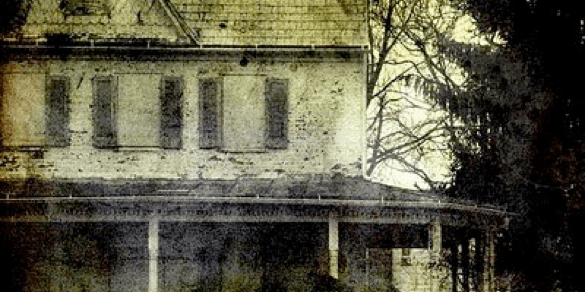
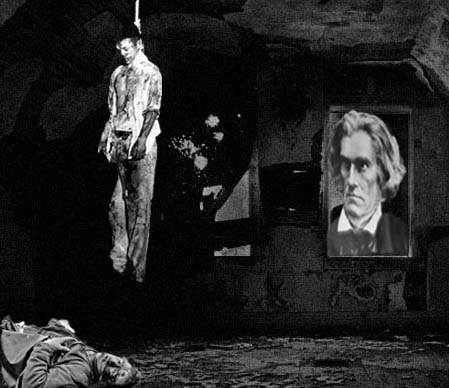
How about with invasion, muskets versus bows and arrows. Wind borne lamentations. Later, clinking chains, songs of woeful repetition. The worst kind of karma, evil spreading out in concentric circles, spreading like an oil spill, sullying every man, woman, and child.
This degradation is Faulkner’s great theme: the darkness of terrible wrongs blighting the landscape, passing from generation to generation, destroying both the rich and the poor, Joe Christmas and Quentin Compson.
These shadows – genocide, slavery, the War – incubate the genre’s monsters: incestuous aristocrats, necrophilic halfwits, sadistic Alabama sheriffs – not to mention the supernatural, hoodoo and haunts. No wonder Southern Gothic has become a genre unto itself.
WB Yeats is purported to have said, “All of the leprechauns are dying out because no one believes in them anymore.”[1]
You need people who believe in the supernatural for Gothicism to thrive.
When I was little, I remember asking our maid Alice who was part Cherokee and part African if she believed in ghosts, and she told me that she had seen her father standing in her backyard the night after his death. Sitting in a Ford Fairlane 500 in the parking lot of the Summerville Piggly Wiggly, I could see wonder and dread in her face when she told me about that visitation. I heartily believe if you had pumped Alice with sodium pentothal, she would have sworn she had seen her father’s ghost in that backyard. The dog was howling she said; a howling dog is a sign of a death.
Lots of white folks believe in ghosts as well. Even some of my students believe.
So, down here, or at least in the Lowcountry of South Carolina, I suspect that ghosts aren’t in any imminent danger of dying out.
* * *
Then, there’s that other non-supernatural strain of Southern Gothicism, the suicide hanging in the attic, the alcoholic great aunt who gave birth to the idiot child.
A few years ago at one of Shirley Gibson’s killer dinner parties, I got a heavy dose of that more mundane variety of Southern Gothic when I sat next to [potentially off-putting name-dropping warning] Walker Percy’s niece (Melissa). She told me the story of her grandmother’s death, her plunging her car into a creek with Melissa’s father in the car. Her father, only nine years at the time (six years younger than his brother Walker), somehow managed to extricate himself from the automobile, but his mother would or could not escape. Uncle Walker, she told me, regarded the death as a suicide. Suicide runs in the family. Walker Percy’s grandfather, the son of a Civil War hero, had killed himself with a shotgun; his son, Melissa’s grandfather (Walker’s daddy), also committed suicide.
After crawling his way up the creekside, Melissa’s father waited on the side of a desolate Mississippi road in the middle of nowhere, his mother a corpse in the car. He sat there alone for twenty minutes. Melissa said that the next car that came by was Uncle Walker’s. They, along with another brother, were now the orphans of suicides, fortunate to find a good home with their uncle but forever darkened by the ever-spreading shadow. At the time, her father was still alive – though not alive – in a nursing home, one of the living dead.
The Attic by Wesley Moore III
Of course, as they widen, concentric waves eventually dissipate, and it seems logical that with the passing of years and with the homogenization of the South, Southern Gothicism might well be on the wane as a literary genre. I do know that the Charleston brogue has about had it. A few of my students’ parents still motor aboot in boo-oats casting for shramp, but none of their sons and daughters do. They clept their mamas and daddies moms and dads. I’m a dad myself.[2]
Nevertheless, Southern Gothic seems more durable than our regional accents, at least as long as Cormac McCarthy, Donna Tartt, and Ron Cooper dream into being their dark worlds where the ghosts of the past still rattle their chains, where bigotry, fanaticism, and incest still breed monsters. People seem to enjoy the macabre, get a rush from skulls and insanity. It makes them feel alive I suppose.
Some types of creepiness do possess a certain amount of charm:
Southern Gothic by Maggie Taylor
Others not so much.
Or so it is writ/tattooed . . .
[1]I can’t remember where I read this quote, and I so want it to be true that I dare not attempt to verify it.
[2] In fact, I’m starting to feel like a ghost myself sometimes.
I had this post all mapped out in my head as I drove to Folly Beach from West Ashley this morning. Since public safety is allowing only residents on the island, I have the beach to myself, more or less. I drove to the Washout, Folly Beach’s premiere surf break, ready to write about the awesome swell and how twenty years ago I would have been right there with those well-warned surfers, struggling to paddle outside of the break, and once I’d made it, how I’d be eager to catch one of those monsters, hoping to make the drop and achieve stokification or, perhaps more likely, to suffer a crushing avalanche-like wipe out.
I was going to complain that now I was too old to even try, reduced to getting my thrills vicariously, like the old man in The Big Sleep. (I suspect that William Faulkner, who received partial credit for the screenplay, wrote this part).
The problem is here is the Washout on Day 4 of Governor Henry McMaster’s mandatory evacuation. It’s as flat as a John Brown’s EKG.*
On Monday afternoon, declaring that even one life was too precious to lose, Governor McMaster, who refuses federal Medicaid money, ordered a mandatory evacuation of the South Carolina coast.* Drop everything, close your businesses, find refuge with loved ones or at Motel 6 inland (which doesn’t sound all that safe to me).
And for the third year in a row the mandatory evacuation was completely unnecessary for Folly Beach. Four school days down the drain. Millions of dollars squandered.
A legitimate fear is that when a real storm comes a-callin’ some of the population might be too jaded to take warnings seriously. I’m all for evacuating for deadly storms but not when they’re a week away and their paths uncertain.
*”John Brown’s body”, of course, “lies a-mouldering in the grave.”
As my dedicated blog and Facebook followers may know (we’re talking of literally tens-of-people), I got married last Saturday to Caroline Brooks Tigner Traugott, a woman known for her beauty, intelligence, learning, and Hellen-Keller-grade blindness (hence the possibility of our union).
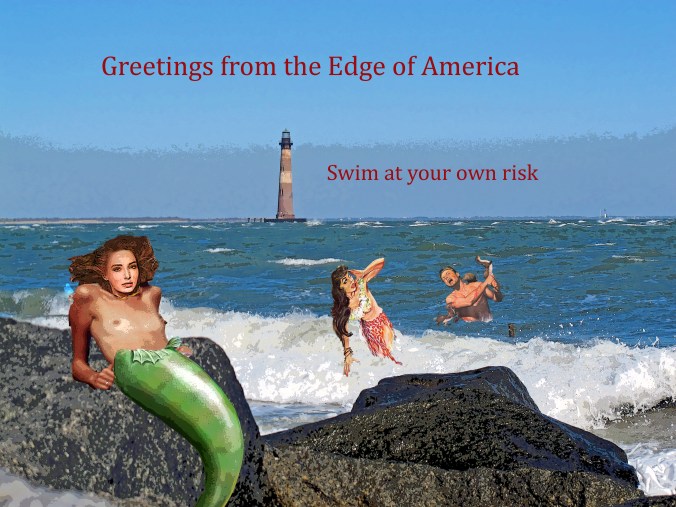
Anyway, Caroline booked a couple of days at the Grove Park Inn Monday and Tuesday for our honeymoon.[1] Sunday night, thanks to the generosity of Hank Weed, the owner of Chico Feo, Caroline and I stayed in the upstairs apartment, which boasts perhaps the best porch on Folly Beach, especially if, as former resident Charlie Neeley has noted, you’re into 4 am people watching. A couple of weeks earlier, I had traded Ashville musician Luke-Dogg a copy of one of my masterpieces, “Greetings from the Edge of America, Swim at Your Own Risk” for tickets to his show in Ashville.
View from the porch at Chico Feo
So after a lovely Sunday evening of porch sitting and chatting with younger son Ned, we awakened to sunny skies and took off in Caroline’s Prius for the Grove Park Inn.
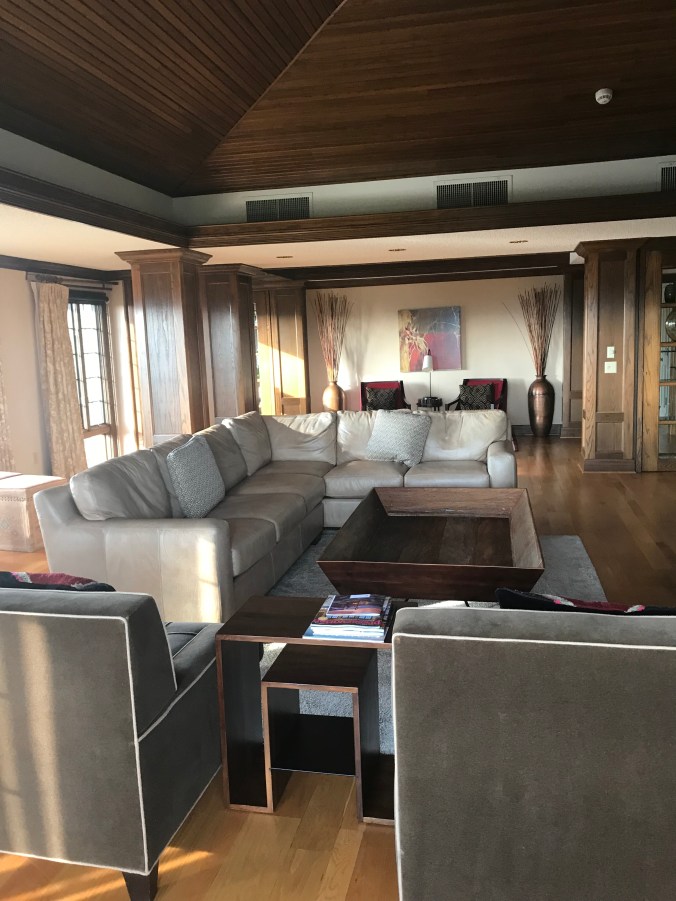
Caroline had booked rooms on the club level, and upon our arrival, the desk clerk congratulated us for being upgraded to the Penthouse Suite, where Mrs. Grove herself used to spend her summers. Not surprisingly it’s a huge corner suite of beautifully furnished rooms that feature panoramic views of mountains, sunsets, and Ashville’s skyline.
Soon after we unpacked, a lovely young woman brought in chocolate strawberries, a bottle of champagne, and a celebratory note addressed to “Mr. and Mrs. Traugott.”
So here’s what you get on the club level: breakfast, drinks, and dinner on the hall, access to the spa, and in-room performances by none other than the retro 70s Chippendales revue.
Frankly, I wasn’t too keen on going to the spa. When I think of spas, I think ancient Rome, frighteningly obese and hirsute Chris Christie types wrapped in towels and sweating like professional wrestlers. So I quickly wove my way through the men’s section to join Caroline in the co-ed pool area, which featured hot tubs with waterfalls and a cooling pool, and most importantly, a bar.
Ta da! I thoroughly enjoyed it![2]
The views from the suite were so spectacular we hesitated to leave, but we had friends to see. First, on Tuesday night, Anna Williams, daughter of best friend Jake, and on Wednesday after checkout the mighty Cat Forester who gifted us two of her beautiful prints. We met her at Nine Mile, a killer Jamaican restaurant I highly recommend.
Anna, I-and-I, and Caroline
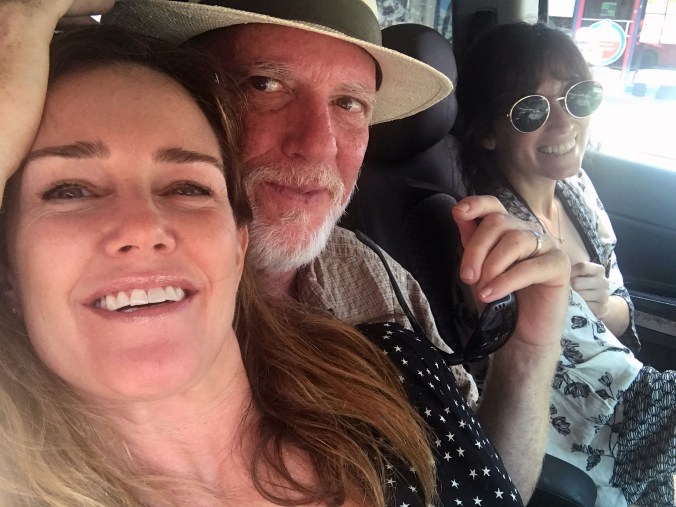
Crammed into the front seat of Cat’s car
We killed time in an underground Brewery before meeting Luke-Dogg at 4 at the farmhouse, and as we sat there sipping on craft beers, the lights went out thanks to a lightning strike on a power station that wiped out all the traffic lights in Ashville. Once it was time to go, Caroline, undaunted, hopped behind the wheel of the Prius and negotiated the traffic-clogged thoroughfares and got us to the farmhouse in time.
Luke-Dogg met us there, introduced us to his housemate Leslie, and later transported us to the gig in his VW bus. He’s associated with at least two bands, “What It Is” and “Pleasure Chest,” who play at Chico Feo now and then. Interestingly, for “What It Is” he plays guitar but the drums for “Pleasure Chest.”
Move over, Stevie Wonder.
The venue, whose name I forgot was killer, and so was the music.
Here’s a snippet from Pleasure Chest from last night at Chico Feo. The cat on trumpet, Justin Stanton, also plays for the three-time Grammy winner instrumental jam fusion band Snarky Puppy.
And here’s a clip of Snarky Puppy:
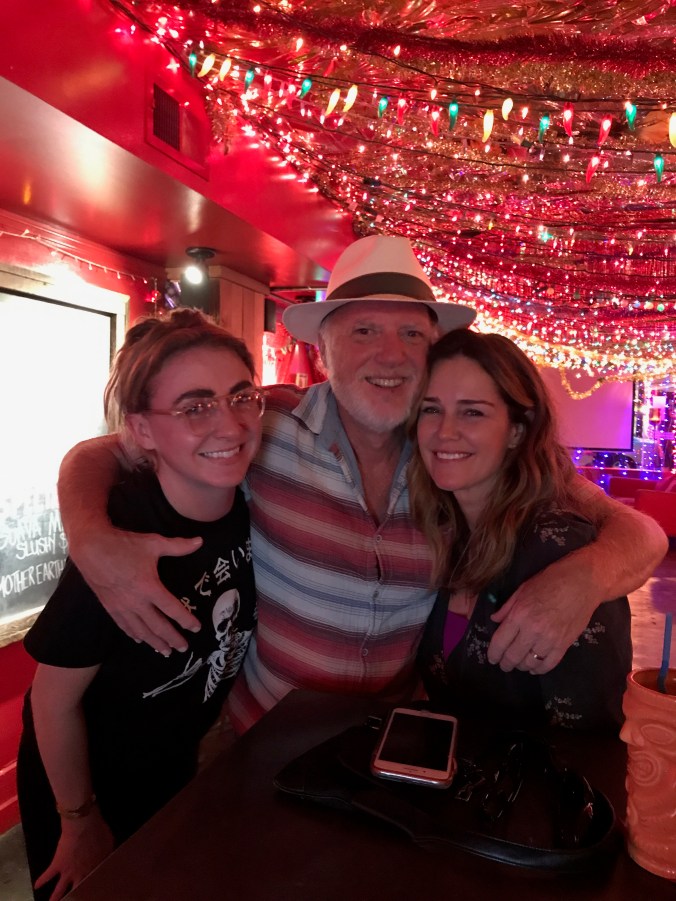
From left to right, Luke-Dogg, Wesley, Caroline, Leslie, and Justin
Alas, like all good things, our honeymoon came to an end, which means, not alas, the beginning of a new life of love.
[1]Because we had more overnight guests than bedrooms, I spent Saturday night on the sofa while Caroline slept with her daughter Brooks.
And long since ready forth his maske to move . . .
Edmund Spenser, “Epithalamion”
It was Federico Fellini who first turned me on to Petronius the Arbiter, the Oscar Wilde of Nero’s reign, a witty hedonist famed for his exquisite taste. In fact, Petronius’s official function in Nero’s court was to determine what was tasteful (or not), hence his title arbiter elegantiarum, judge of elegance.
Scholars don’t know much about him. Here’s a snippet from Tacitus’s Annals copped from Wikipedia:
He spent his days in sleep, his nights in attending to his official duties or in amusement, that by his dissolute life he had become as famous as other men by a life of energy, and that he was regarded as no ordinary profligate, but as an accomplished voluptuary. His reckless freedom of speech, being regarded as frankness, procured him popularity. Yet during his provincial government, and later when he held the office of consul, he had shown vigor and capacity for affairs. Afterwards returning to his life of vicious indulgence, he became one of the chosen circle of Nero’s intimates, and was looked upon as an absolute authority on questions of taste in connection with the science of luxurious living.
Unfortunately, however, like so many in Nero’s circle, Petronius was tried and convicted of treason. Rather than waiting for the inevitable sentence, the Arbiter took matters into his own hands.
Again, Tacitus:
Yet he did not fling away life with precipitate haste, but having made an incision in his veins and then, according to his humour, bound them up, he again opened them, while he conversed with his friends, not in a serious strain or on topics that might win for him the glory of courage. And he listened to them as they repeated, not thoughts on the immortality of the soul or on the theories of philosophers, but light poetry and playful verses. To some of his slaves he gave liberal presents, a flogging to others. He dined, indulged himself in sleep, that death, though forced on him, might have a natural appearance. Even in his will he did not, as did many in their last moments, flatter Nero or Tigellinus or any other of the men in power. On the contrary, he described fully the prince’s shameful excesses, with the names of his male and female companions and their novelties in debauchery, and sent the account under seal to Nero. Then he broke his signet-ring, that it might not be subsequently available for imperiling others.
At any rate, none of this would be of any interest if Petronius had not written the Satyricon, a fragmentary mishmash of verse and prose that satirizes Roman life in the first century BC. I actually wrote a paper on this picaresque “novel” in the spring semester of my senior year, but alas, like many sections of the Satyricon itself, that work of genius has been lost to the ages [cue sarcastic cough].
Click below, if you dare, to watch the trailer of Fellini’s Satyricon.
Although “Trimalchio’s Dinner” is the most famous section of the Satyricon (Fitzgerald at one point thought about entitling The Great Gatsby as Trimalchio in West Egg), my favorite section is the vignette “The Widow of Ephesus,” an oft-repeated tale that traditionally has been interpreted as an invective against the fickleness of women; however, in Petronius’s version, sophisticated readers might see it, to quote Douglas Galbi, as showing “the imperatives of the living trumping respect for the dead.”
In other words, reading it as “pro life” in the best sense of that phrase,
Amphetaminic Synopsis of Petronius’s “The Widow of Ephesus”[1]
A widow renowned for her chastity goes apeshit after her husband dies, and with over-the-top historonics (exposing her breast and beating it, e.g), she follows his corpse’s funeral parade into an underground crypt.
There, attended by a “most loyal slave-woman,” the widow keens, gouges her face, and yanks out her tresses with the intention to starve herself so she can join her husband in Oblivionville.
Impervious to the pleadings of her parents and her loyal slave, for five days, without food or drink, the widow continues her frenzied mourning, out-Niobe-ing Niobe, “tearing her hair, plac[ing] the tresses on the corpse of her dead husband.”
Meanwhile, a soldier stationed to guard two crucified robbers hears the widow and abandons his post to see what’s going on.[2] Once he’s hip to the scoop, he returns with food, which she refuses, but the slave woman “seduced by the odor of wine,” indulges, and once renourished, starts in on her mistress.
”What good will this do you, if you will have been undone by starvation? — if you will have buried yourself alive? — if you will have poured forth your life’s breath when you have not yet been condemned to die, before the fates demand it?”
As Margaret Atwood once noted, “Hunger is a powerful reorganizer of the conscience,” and the widow gives in. Once she’s sated, the soldier starts cajoling her to ditch her chastity. Though we don’t get to hear his love talk, it must have been Barry-White-like and coming from the mouth of one sexy [insert noun from two-word Prince title that begins with “Sexy.”]
Click arrow below for an example of what I mean by “Barry-White-like”:
She submits.
So they as my mother would put it, “shack up” in the sepulcher, he sneaking out now and then to procure food and presents.
During his frequent absences from his station, a relative snatches one of the crucified men and buries him. When the soldier notices the missing body, he knows he’s a goner, so he decides to dispatch himself before the judge’s sentence comes crashing down.[3]
He informs the widow and asks “her only allot him a place, since he was doomed to die, and make the fatal tomb common to both her friend and her husband. “
Here’s the key passage:
The woman, who was no less merciful than chaste, [my italics] said, ”May the gods not allow that — that I should at the same time look upon the deaths of the two men most dear to me. I prefer to sacrifice the dead man rather than to kill the one who is alive.” In accordance with this pronouncement, she orders the corpse of her husband to be lifted out of its coffin and affixed to that cross which was empty. The soldier made use of the ingenious scheme of that most judicious woman, and the next day all the townspeople marveled at how the dead man had gone onto the cross.”
Oil paining of crucified slaves in ancient Rome
As Horace Walpole famously said, “Life is a tragedy for those who feel, but a comedy for those who think.” One equipped with a tragic vision might turn this story into a heartbreaker, the widow refusing to the very end, her gaunt body wild-eyed as she hallucinates tender scenes from her married life. However, there’s something deep down in every living thing that prompts it to live. Even if buried beneath the cement of a sidewalk, a weed will attempt to push its way through the cracks towards the sun.
There lives the dearest freshness deep down things;
And though the last lights off the black West went
Oh, morning, at the brown brink eastward, springs —
Gerard Manly Hopkins, excerpt from “God’s Grandeur”
[1]Quotes are from John R. Porter’s translation.
[2]He’s guarding them so their relatives won’t remove the bodies to give them proper burial. Some scholars claim this alludes to Jesus’s crucifixion story, but if it does, then it doesn’t jive with Petronius’s dates.
[3]Note how eerily similar this is to Petronius’s eventual fate.
Reading the late James Hillman’s Selected Writings (edited by Thomas Moore) frustrates me because Hillman deals with terms — soul, archetype, spirit – that by his own definition defy definition. He creates metaphors, uses Greek gods and goddesses as examples. The gist is that like Steppenwolf’s Harry Haller, we have an infinite number of selves that slosh around the in a murky swamp of soul, a sort of neuronbuzz that connects mind to body. What frustrates me is his lack of empiricism – where does he get his ideas? from an oracle? Nor does he provide case histories to help embody these archetypal inner beings.
Nevertheless, I agree with much of what says about our contemporary world, and he offers some wonderful turns of phrase.
illustration of James Hillman by Jason Stout
For example:
Dumb sex is cultural. Our white American speech doesn’t provide good words for genitals and intercourse – and hardly any phrases about places, rhythms, touches, and tastes. Listen to the marvelous language of foreign erotica; jade stalk, palace gates, ambrosia! Compare these with cock, prick, dick, nuts, balls, with suck, jerk blow, yank, and with gash, bush, frog, slit, clit, hole. A Chinese plum is to be deliciously enjoyed; our cherries are to be taken, popped, or broken [. . .] Our Puritan prose cannot encompass the sexual imagination to which great temples are built in India.
The human person as a data bank does not need to read more than functionally. A data bank deciding yes or no on the basis of feedback (i.e. reinforcement) need not imagine beyond getting, storing, and spending. Just get the instructions right; never mind the content. Learn the how rather than the what with its qualities, values, and subtleties. The human agent becomes an incarnated credit card performing the religious rituals of consumerism.
[. . .] places tend to remind us of history, of ethic and earthly differences that cannot be homogenized into the universal sameness of our contemporary utopias, the nowhere everywhere of our shopping centers and roads to and from them.
West Ashley (Charleston, SC at rush hour
So, according to Hillman, materialism has triumphed over spirituality.
Although perhaps generally true, it certainly isn’t universally true. I cannot think of one close friend who prefers things to experiences, who would drive a Range Rover at the expense of not being able to travel. The few very wealthy acquaintances I know are interested in both mind and spirit and never flaunt their fortunes. And my Chico Feo bar buddies, many who live from paycheck to paycheck, seem well satisfied with their lives. Before work each morning (and perhaps, even more impressively, on weekends), my friend Jason watches the sun rise above the Stono River and then posts a photograph with an accompanying prose passage, poem or song.
Today’s (11 July 2018) sunrise captured by Jason Chambers
Nevertheless, fighting traffic at rush hour through a wasteland of billboards and cell phone towers on the thoroughfares Hillman describes does indeed suck/blow/yank — especially if you’re in a hurry. But if you’re riding in an air-conditioned vehicle with a system that plays music or words you select, you shouldn’t complain too loudly.
Summon your inner Apollo or Athena, or, in my case, given that I’m likely to be listening to James Brown or the Rolling Stones, inner Dionysius.
And remember (see the story of Lazarus for an example) Jesus was never in a hurry.
Jason and Me at Chico Feo (photo credit Caroline Traugott)
If I were to gather containers of sand from Charleston’s various beaches – the Isle of Palms, Sullivans, Kiawah, Seabrook, and Folly – I doubt anyone could identify where each container came from. The sands of our barrier islands are pretty much indistinguishable. This, however, isn’t the case with the three beaches we’ve visited in Andalucía – Zehora, Caleta, and Tarifa.
Caleta Beach, Cadiz
Zahora’s sand reminds me a bit of slushy snow – it’s wet and sticky and orange-ish in hue (think Trump’s spray-on tan), and its blanket holds smooth rocks, ocean glass, and some cool shells. The sands of Caleta, on the other hand, are drier, but also orange-colored. Alas, Caleta’s beach is strewn with seaweed and litter. By far the nicest sand is found in Tarifa, a funky mecca for surfers and kite boarders. There the sand is white, dry, and fine. Unlike the sands of Zahora, you can brush it off with a flick of your wrist. One of my traveling companions, Brooks, age nine, was so taken with it, she gathered some and took it home to the apartment.
Perhaps of more interest to the general reader is the topic of naked female breasts, which, of course, are on display at most European beaches. Like Mr. Palomar, the protagonist of Italo Calvino’s novel of the same name, I feel awkward when I get the opportunity to gaze at a total stranger’s mammary glands, and like Mr. Palomar, I do end up sneaking a peek, which I hope won’t be taken the wrong way by the flaunter of aureoles, which unfortunately isn’t the case when Mr. Palomar encounters a topless beachgoer in the novel.
In college, I remember being peer-pressured into going to a bar that featured a topless waitress. When I entered, immediately, my inner-Victorian[1] took over as I stared intently into her sardonic eyes while she cracked jokes about the awkwardness of the situation. I was way uncomfortable in the head-hanging area of what might be called un-fun, but, of course, I couldn’t help indulging in a surreptitious glance or two (or maybe eight or seventy-eight).
Well, at the three beaches mentioned above, you occasionally encounter bare-breasted women but not to the extent I did in Cannes and Mykonos in the early ‘80s.[2] Here in Spain, all but two of the topless I’ve encountered were closer to menopause than puberty. But, hey, I admire their lack of inhibition. Bikini tops (and bras) look uncomfortable. Why not give the voyeur a thrill and Mr. Palomar the heebie-jeebies?
I don’t mind, however, staring at whatever in museums, and Caroline, Brooks, and I have taken in quite a few. My favorites on the Vejer leg of our holiday are located in Gibraltar and Cadiz. Both display a rich trove of ancient artifacts dating back to Paleolithic times. The one in Gibraltar has a couple of Neanderthal replications, “Nana” and “Flint,” constructed according to skeletons found in caves in the rocks. Caroline questions the unkemptness of these two. Wouldn’t they groom one another she wonders.
The museum in Cadiz has an impressive cache of Phoenician, Greek, and Roman artifacts. Photography wasn’t allowed there, so you’ll have to take my word for it.
So here’s a naked breast for you voyeurs out there
All in all, we’ve had such a good time, especially hanging with Charlie and Concha. We even got to go to a pool party at the home of one of Charlie’s acquaintances, allowing us a more intimate peek at the Spanish having fun. Everyone was so nice and welcoming.
In general, I have found the Andalusians to be incredibly helpful and patient, whether it’s demonstrating how to operate a parking meter or preparing a special dish for Brooks. And, by the way, the food here in Vejer is wonderful. The town has justly earned a reputation for fine dining. You won’t find sand in your food or topless waitresses but some absolutely delicious Moroccan cuisine to go along with traditional Spanish dishes.
Buenos noches from Vejer.
View of Vejer from our apartment’s terrace
[1]Hat tip to Charlie Geer for this useful coinage.
[2]Those beaches don’t have sand at all, but what the English call shingles, pebbles that are uncomfortable to lie on without a blanket.
I read the other day that almost all of Trump’s supporters – 90% of Republicans according to a recent poll – admire him because he tells it as [he perceives] it is. For example, Maxine Waters is “low IQ,” Senator Mark Warner “a drunk,” and “whimpering” Jimmie Fallon less than “a man.”[1]
In other words, they admire him because he is a vulgarian. But he’s not a clever vulgarian – his insults lack wit. I never found Don Rickles funny, but compared to Trump, Rickles seems like Churchill vis a vis Lady Astor.
For example, Trump could utilize someone on his staff to crib insults from the Internet, since plagiarism didn’t seem to hurt the campaign one iota.
“Hey, Fallon,” he might tweet, “you’ll never be the man your mother was” or he could bitchslap Maxine Waters with, “If I ever wanted to kill myself, I’d climb up the top of your ego and jump down to the level of your IQ.”
“You know Senator Warner has a bad drinking problem: one mouth and two hands.”
Har har har.
And Republicans are whining that civility is at an all time low.
[1]That the leader of the so-called Free World” might be investing his time in more important ways than stooping to celebrity bashing doesn’t seem to occur to them.
In Ronda, we made the rounds of museums, first Museo Lara, owned by a collector of oddities who lives in an apartment above those cultural artifacts on display, obsolete and obsolescent gadgets like telegraph apparatus, gramophones, and typewriters and other interesting collectables like pipes and musical instruments.
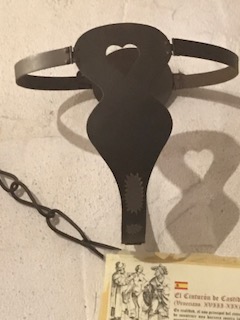
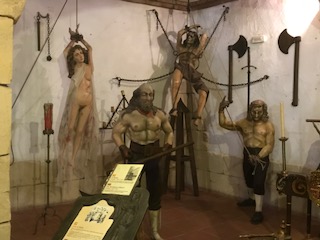
More interesting — at least for me — are the rooms dedicated to the Inquisition where you can actually run your hands across the spikes of an iron maiden or check out the crudity of a head crusher or a chastity belt and marvel at other ingenious instruments of torture.
Then there’s a room devoted to the so-called black arts. Here you can see such wonderful specimens like this:
Bat-headed crab?
The dioramas are also worth a peek.
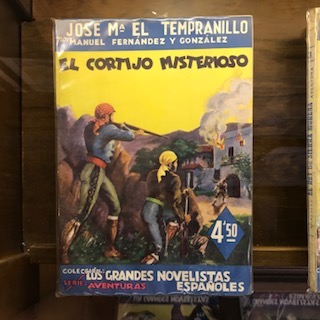
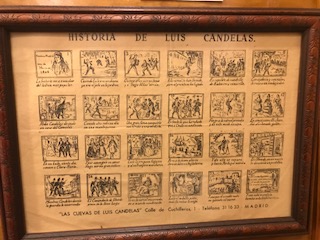
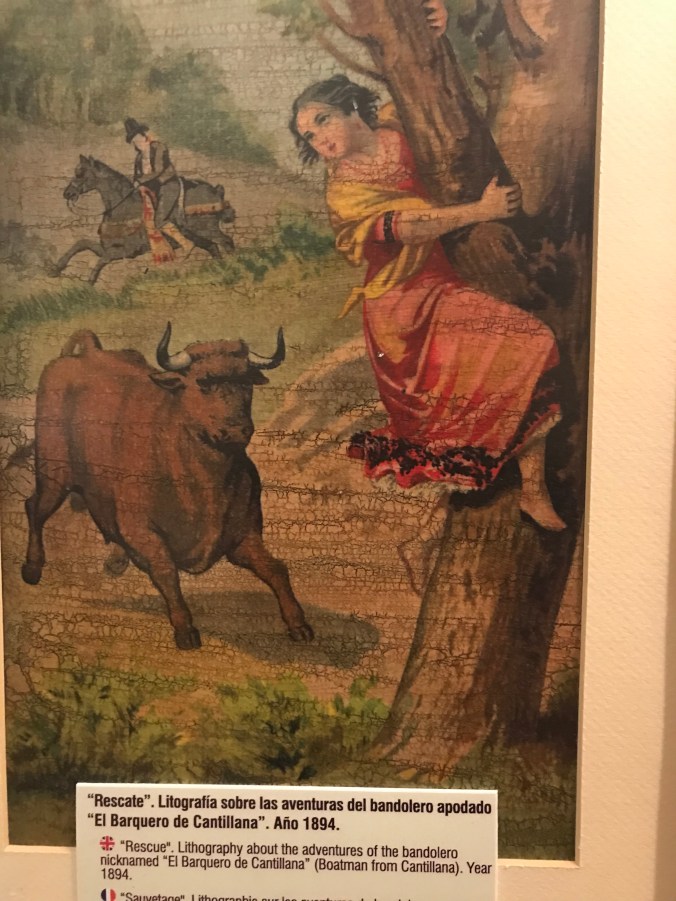
Next we visited the Museo del Bandoleros, a unique collection dedicated to those highwaymen who have become the stuff of legend in Andalusia. Some of the more famous ones actually have comic books dedicated to them and comic-book like poetry, some in couplets, others in terza rima.
Our favorite is Juan Jose Mongolla, aka Pasos Largos, who favors the Moore family.
Anyway, these marauders lived in caves along the highway and would swoop down on horsemen and stage coaches divesting their victims of cumbersome gold and jewelry. They also appear to have been popular with the ladies, if several paintings and woodcuts can be trusted that show the bandoleros on horseback serenading women troubadour-style.
They also were on hand to rescue damsels in distress.
These cats aren’t as lucky.
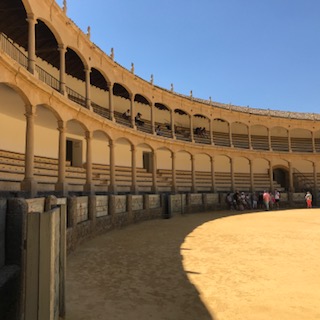
We also visited the Plaza del Toros, the bullring, one of the most revered in Spain, according to our travel guide. Although it only seats 5,000, it’s circumference makes it one of the largest in Spain. Hemingway, of course, was a paying customer here. You can read about his association with the town here.
Still, one of the town’s coolest attractions is the Hotel Enfrente Arte, Spain’s answer to New York’s famous Chelsea Hotel. I failed to mention in my previous post the wonderful breakfast they serve, which like beer and wine, is included in the daily rate. A vast array of culinary delights are available. My favorite was quail eggs and bacon with tomato on toast, brought to your table with a loud ta-da by the gregarious chef.
Our last night in Ronda, we hit another Flamenco show. Although inferior to the performance we caught in Jerez, this one did feature a female dressed to the nines who was very impressive. As she stomped her feat and contorted her body, an occasional bangle would disengage from her costume and fly across the stage.
Here she is the afternoon before the performance with one of her fans.
Like all good things — long-running sitcoms, bottles of Jamesons, happy marriages — our stay in Ronda had to come to its end. On Thursday, we retrieved our rental car and made our way down to Vejer, which I have dubbed the Beirut of Southern Spain. Here, we’re going to visit our first beach, so stay tuned.



























 You Do Hoodoo