Encyclopedias

I actually still own a set of encyclopedias, Collier’s, which takes up more than a yard of my precious bookshelf space in my drafty garret/book depository. Judy Birdsong and I bought the set in 1983 from a traveling salesman in Rantowles when Judy was pregnant with Harrison.

I had grown up with the Encyclopedia Americana and its companion set for children, the Book of Knowledge, which I loved, not only for the magic tricks and entertaining scientific articles, but also for the images of naked female breasts sported by the likes of Aphrodite and La maja desnuda. The Book of Knowledge had abridged novels like Treasure Island and A Christmas Carol, plus children’s verse galore.  I see this evening it’s possible to purchase a complete 1952 [1] set for $250 from Amazon, which seems like a bargain.

I’m tempted, but no, there’s no room at the inn, as it were.

For the hell of it, from my Collier’s set, I’ve randomly pulled out “Volume 19, Phyfe to Reni.”

As it turns out, the first entry, “Duncan Phyfe“ [faif], was an 18th and 19th century American cabinetmaker.  Born in Scotland, Phyfe moved to New York City about 1783.

Not surprisingly, a hick from the Lowcountry of South Carolina, I  hadn’t heard of him.

In approximately, 350 words, the author of the entry, Donald D. Milliken, offers this rather faint praise of the cabinetmaker:

Phyfe was an adapter rather than an originator of furniture designs, but he did create a style.

Wikipedia’s entry, on the other hand, runs to almost a thousand words and provides a more glowing assessment:

Although he did not create any new furniture style, he interpreted fashionable European trends in a manner so distinguished and particular that he became a major spokesman for Neoclassicism in the United States, influencing a whole generation of American cabinetmakers.

Collier’s doesn’t mention the 1922 Metropolitan Museum’s exhibition of his work, the first ever for a cabinetmaker.

In addition, Wikipedia provides some fun facts to know and share.  For example, did you know Karl Shapiro in his poem “The Fly” refers to Phyfe? I remember this poem from my “Contemporary Poetry” course from 1973, but, of course, I didn’t bother looking up “Duncan-Phyfe.”

O hideous little bat, the size of snot,

With polyhedral eye and shabby clothes,

To populate the stinking cat you walk

The promontory of the dead man’s nose,

Climb with the fine leg of a Duncan-Phyfe

The smoking mountains of my food

And in a comic mood

In mid-air take to bed a wife.

F. Scott also drops Phyfe’s name in this passage from Tender is the Night:

She wept all over a set that cost a fortune, in a Duncan Phyfe dining-room […]

Homophonic Phyfe even shows up in a season one episode of Andy of Mayberry “A Plaque for Mayberry,” when Barney Fife claims Duncan as an ancestor.

A sofa of his can be found in the Green Room of the White House, and a replication of one of his chairs is “one of the world’s largest roadside attractions” in the furniture-making city of Thomasville, NC.

I admit, Collier’s possesses a bit of musty charm;  no doubt it is probably much more accurate than Wikipedia, but you can’t cut and paste from Collier’s. You got to type out the stilted prose yourself.

Very few are going to bother to do that nowadays, so maybe it makes sense to ditch the staid black and red bound beauties for a set of something else, like, say, the 1952 set of the Book of Knowledge. I can relearn some of those magic tricks and entertain my bar mates today and future neighbors at the assisted living home tomorrow.

the man himself


[1]Coincidentally, the year of my birth, way back in the Truman Administration.
Here They Come – and I Ain’t Talking About Immigrants

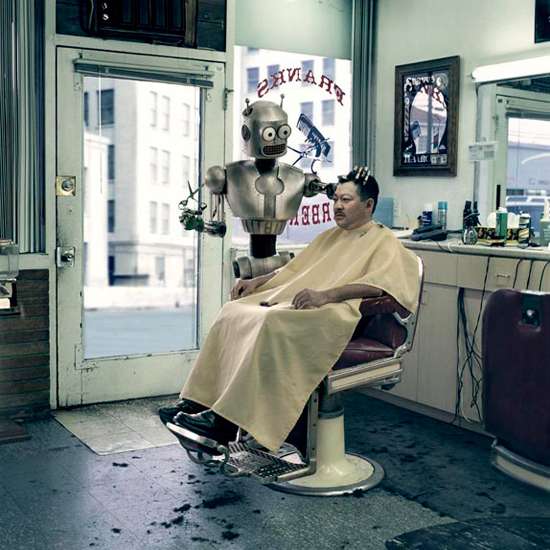
markku-lahdesmaki-robots

image credit: Markku Lahdesmaki’

If y’all think these immigrants are nefarious, stealing our lawn-mowing and curing-cancer jobs, you’re really going to resent the robots.

Of course, they’ve been displacing factory workers for decades, but they’re getting ready to start driving our taxis, buses, and semis. If you don’t think that’s a big deal, on your commute tomorrow, count delivery trucks parked outside convenience stores, supermarkets, and liquor stores; check out the garbage trucks rumbling off to the landfill; take note of those cement trucks on the way to the soulless and practically treeless developments where the houses look like inbred siblings.

Where are these drivers, mostly males, going to find gainful employment?  How are they going to earn a living?

Not at Uber or Lyft.

Use your imaginations, dental hygienists.  I suspect you’re not long for this world of employment if you’re counting in decades.

Surgeons?

Maybe barbers will survive —  or maybe not. Rather than boring you with chitchat about professional sports, your robotic barber could be programmed to sing arias or replicate Lenny Bruce’s stand-up routines, depending upon your predilections.

Of course, they’ll have personalities, like Siri does, sort of.  I find myself asking “please” and calling her by name. “Siri, would you please call Loquacia Muldoon?”

She sometimes direct-addresses me using my childhood moniker Rusty.   We’re one little happy master/slave duo. “No, sorry, Rusty, I can’t chant the Odyssey in Linear B Greek.”

Our mechanic servants will be charming, whether urbane, or folksy; you’ll get to choose, to designate their personalities, i.e., if you’re one of the lucky ones, i.e., employed, i.e., not scrounging around the Blade Runner hellscape picking through garbage.

I have to admit, though, the only robots I’ve ever encountered that I like are the ones on Mystery Science Fiction 3000.

The rest of them — the Jetsons‘ robot maid, for example, the Class M-3 Model B-9 General Utility Non-Theorizing Environmental Control Robo from Lost in Space, and even Hal from 2001, a Space Odyssey– bore me.

Working folks and professionals should find robots much more frightening than Guatemalan refugees. Automatons don’t need Social Security or Medicare or Xmas bonuses.   They don’t get black lung or pregnant or ask for raises.

Or pop bennies on cross-country trips in their sixteen-wheelers.

F142558306 copy

A Dwarfish Thief vs. a Man of Integrity

like a giant’s robes upon a dwarfish thief

I suspect that you would be hard pressed to find two individuals as diametrically antithetical as Donald Trump and Robert Mueller.

Granted, they’re both New Yorkers of German descent, prep schools alums, and Ivy leaguers.

Also, Republicans.

On the other hand:

Mueller

A family man, married (and is still married) to his high school sweetheart

Trump

Multi-married, adulterous, a pussy-grabber and porn-star aficionado

Mueller

Marine Corps, Vietnam, Purple Heart, Bronze Star

Trump

Bone Spurs, Studio 54, tangerine tan, gold-plated foyer

Oh, yes, and there’s this: Mueller is learned, patriotic, and meticulous. Trump, on the other hand, embraces ignorance, has attempted to sell out his country for personal profit, and impulsively spews from his mouth whatever his gut secretes.

The distinctions that define these men will ultimately lead Mueller to triumph and Trump to disgrace. While Mueller has been assembling a staff of formidable prosecutors, amassing a mountain of documentary evidence, and demonstrating laser like focus, Trump has been appointing hacks to positions for which they’re not qualified, playing golf and multitasking, (i.e., watching Fox News while tweeting).

29 November 2018, was the beginning of the end for Donald Trump. Cohen’s guilty plea makes it clear that Trump and son lied about his negotiations with the Russian government in the prospective building of a Trump Tower in Moscow, which goes a long way in explaining Trump’s embrace of Putin, despite the annexing of Crimea, and why the Republican Party deleted anti-Russian planks from its platform right before the convention.  Trump even considered offering Putin a $50 million penthouse in that tower to sweeten the deal.  Oh yeah, also today, Deutsche bank, Trump’s biggest lender, was raided. Besides himself, it’s Mammon that Trump worships, money before country.

Foolish man, house of cards on sand, ka-bam.

So, I suspect, in a matter of months, we’ll be able to exclaim, like Angus in Macbeth, “Now does he feel his title/ Hang loose about him, like a giant’s robe/ Upon a dwarfish thief.”

Despite the weaklings in an enabling Republican Congress, it appears that thanks to one patriotic Republican, Robert Mueller, the rule of law will triumph.

Peek-a-Boo

During a scavenger hunt to cop some eye-arresting images for a commentary on our Orwellian world, I ran across this rather disquieting tidbit.

For the past few years, federal agencies have defended body scanning by insisting all images will be discarded as soon as they’re viewed.  The Transportation Security Administration claimed last summer, for instance, that “scanned images cannot be stored or recorded.”

Now it turns out some police agencies are storing controversial images after all.  The U.S. Marshal’s Service admitted last week that it had surreptitiously saved tens of thousands of images recorded with a millimeter wave system at the security checkpoint of a single Florida courthouse.

Way to go fundamentalist Islamic terrorists! Thanks to your penchant for slaughtering innocents,  your females’ burka-shrouded mysteries (including ankles, knee caps, and eye-brows) are now on display for gawking infidels stationed at TSA monitors. Worse, downloaded images of your wives, daughters, sisters, and mothers are being passed along to police agencies where they’re no doubt swapped like baseball cards, ending up on the hard drives of buzzed-cut, steely-eyed cretins who joined the force hoping that working in law enforcement would stem the perverted sexual fantasies that have haunted them ever since that fifth-grade Boy Scout campout.

Obviously, most reasonable people value their lives over their modesty as evidenced by our trips to proctologists and gynecologists; however, I wonder if these scanners might be a bit of  (if you’ll forgive the expression) overkill.  After all, we have metal detectors, pat downs, etc, and it’s not as if planes are dropping from the sky like confetti.

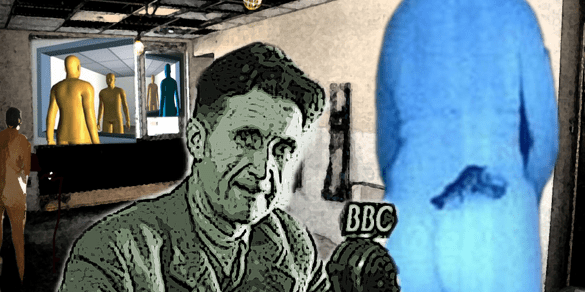
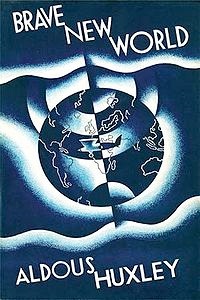
Of course, whenever we discover that we’re being spied on, whether it’s by the government or the cookie-dispensing porn site we you visit, George Orwell comes to mind. Most would agree, I think, that when it comes to winning the dystopian prophecy contest, we have to award the laurel to Eric Blair (Orwell) over the estimable Aldous Huxley. All in all, Late Empire America c. 2018 resembles Orwell’s Oceania of 1984 much more than it does Huxley’s London in the Year of Ford 632.

Not that Huxley’s novel isn’t impressively prophetic.  Brave New World certainly foretells the cult of consumerism, the proliferation of recreational sex, the consumption of hallucinogens; however, we don’t live in a peaceful World State where citizens consciously eschew individuality and discount death, and although genetic engineering does exist, our legions of pizza delivery drivers and cosmetologists haven’t been pre-programmed into those occupations by soulless biologists in state-run human hatcheries.

Orwell, on the other hand, gave us newspeak (Reagan officially dubbed the MX Missile with its 300-kiloton W87 nuclear warhead as The Peace Keeper); perpetual war against inscrutable, unconquerable, and sometimes interchangeable enemies (e..g., terrorism /our sometime friend Saddam); and a society in which its citizens are monitored (see above).

Donald Rumsfeld and Saddam Yukking it up antebellum

But what Blair/Orwell failed to foresee is that Big Brother would have a fraternal twin, Big Business,  who seems the more dominant of the two and who also is gathering information about you and me with more zest and much more efficiently.

Lots of entities keep track of our seemingly insignificant gestures.  E.g., our monetary gift to John Spratt’s reelection campaign of 2006 has been dully noted, digitalized, and appears on the Web.  No telling who’s monitoring your Facebook shenanigans, scrutinizing those photographs of you posted by your ex-girlfriend’s husband documenting that unfortunate evening at your recent high school reunion.

And, who really minds a security camera recording a thug snatching your purse at the Kwik Shop?  Like virtually everything nowadays, surveillance poses complicated questions.  Whatever the case,  whether you’re picking your nose as you hurry across the parking lot of your campus or purchasing online an audio recording of De Sade’s Justine, your action has been recorded and duly noted.

Privacy is impossible is the wired world.

Weekends

In contemporary American society, many citizens endure a dualistic existence in which the work week stretches forth like some dreary dust bowl landscape.  Punctuating these dismal five-day journeys is the weekend, that carnival luridly lit on the horizon, its distant Ferris wheel and roller coaster barely in view.

You trudge through the sands of the days, Monday, Tuesday – Humpday –  Thursday, the carnival getting closer, the music audible, Pink singing over a calliope:

Just when it can’t get worse, I’ve had a shit day (NO!)
Have you had a shit day? (NO!), we’ve had a shit day (NO!)
I think that life’s too short for this, I want back my ignorance and bliss

David Levine: The Thunderbolt

Like the work week itself, the weekend possesses its own life cycle, beginning with the boundless hope of Friday afternoon, the happy hour gathering, dinner and a movie, snuggling with your baby sipping something intoxicating on the sofa as Lester Young blows his tenor Saxophone through those Bose speakers you shouldn’t have indulged in but did.

Saturday is just slightly less hopeful – unless, of course, if you’ve slept deep into the afternoon and awaken to the desolation of strewn clothes, unbrushed teeth, and a WC Fields-grade hangover. In that scenario the weakening October afternoon sunlight is as tragic as Van Gogh reaching for the razor.

On the other hand, if you’re older, chances are you wake up feeling fairly upbeat, peruse the paper (digital or otherwise) leisurely on the porch, deck, or patio. Yard work, a fishing excursion, a novel, quilting, football, cooking, model airplanes – it’s up to you because you live in the land of the free and don’t need to set that alarm tonight.

And, as the pop songs say, Saturday nights are made for dancing or getting behind the wheel of your Oldsmobile as you barrel down the Boulevard with Tom Waits cranking on the stereo:

Then you comb your hair
Shave your face
Tryin’ to wipe out ev’ry trace
All the other days
In the week you know that this’ll be the Saturday
You’re reachin’ your peak

Oh, but the night is going, going, after midnight – that means Sunday, Sunday with its tolling church bells and lengthening shadows. The weekend balloon is leaking helium, wrinkling around the edges. [cue Nato King Cole]: The party’s over . . .

nat-king-cole-anthology-3cd

The philosopher, Robert Grudin, has thought long and hard about our perception of time. He offers this bit of wisdom:

The years forget our errors and forgive our sins, but they punish our inaction with living death.

Here’s that self-righteous celibate Thoreau:

Little is to be expected of that day, if it can be called a day, to which we are not awakened by our Genius, but by the mechanical nudgings of some servitor, are not awakened by our own newly acquired force and aspirations from within, accompanied by the undulations of celestial music, instead of factory bells, and a fragrance filling the air–to a higher life than we fell asleep from; and thus the darkness bear its fruit, and prove itself to be good, no less than the light. That man who does not believe that each day contains an earlier, more sacred, and auroral hour than he has yet profaned, has despaired of life, and is pursuing a descending and darkening way.

An Embarrassment of Riches: Pat Conroy, Log-Heaving Lowcountry Highlanders, and/or James T Crow?

If I were a decent human being, someone who cared about his unborn grandchildren, I would be out canvassing, ringing doorbells door-to-door and begging voters to cast their ballots because, if Republicans control Congress and the Presidency, we’re up the River Styx for sure.

But, the thing is, I sort of look like a homeless person.  My hair, though scant, is unruly, like my beard, and my clothes, no matter how hard I try, always look like I’ve slept in them.

I’d be afraid that when I rang a doorbell and the working mom checked me out through the peephole, she’d call the cops.[1]  I’m a suspicious looking person.  Salespeople stalk me at department stores.

And anyway, hey! [Cue the Beach Boys] I wanna have fun fun fun, /Till my sons take the car keys away!

Too much with too little time.

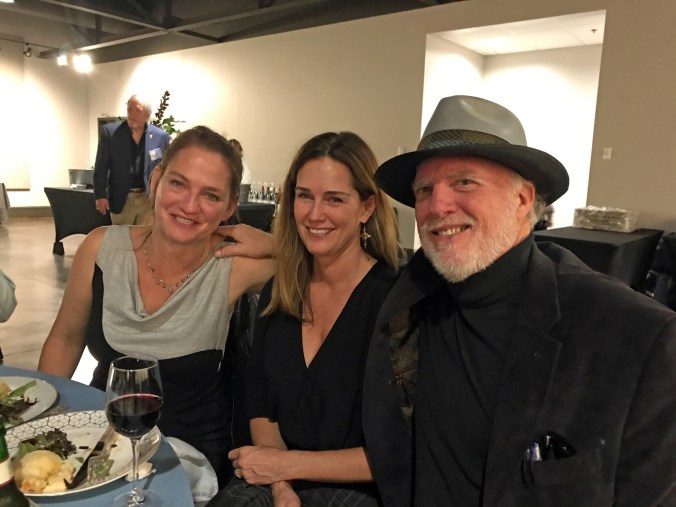
Caroline and I drove down to Beaufort Friday afternoon for the Pat Conroy Literary Festival. There, we got to see Megan and sit at the same table with her and her Uncle Tim and meet her mother Barbara for the first time.  I absolutely adore Megan, whom I consider the funniest woman I know outside of showbiz. There were speeches I couldn’t hear, but it’s not the PA’s fault.  The folks at my table laughed at words that to me were less than whispers.  Maybe I need to go do something about my hearing?  Afterwards, you could buy books and get them signed.  A tribute volume for Pat has just come out, Our Prince of Scribes.

Megan Conroy, Caroline, and I-and-I

The B and B where we stayed was .6 of a mile from the dinner at Tabby Place, so we walked Saturday morning to retrieve Caroline’s car. We had expectantly bumped into a couple of former students at a bar and took an Uber “home” to the B and B.  The inn itself I’d call Southern-Gothic Lite, with the proprietor a California transplant taking over dead mama’s mansion. He blinked very slowly a good bit, but he didn’t resemble Anthony Perkins, and the bath wasn’t equipped with a stand-alone shower.

Oh yeah, the walk.  What a beautiful day.  What a beautiful city.

IMG_3039.jpg

So we left Beaufort without breakfast or coffee to pick up Brooks and meet Caroline’s dad at the Scottish Games on the grounds of Drayton Hall.  Unfortunately, we couldn’t stay long enough to enjoy the complete array of contests and parades. We had to catch some of Porch Fest, Jim Crow’s set at three followed by Brother Fleming’s at four.

Too much with too little time.

For me, Porch Fest ranks right up there with the X-mas parade as Folly’s premiere parties  This year marks its 5th anniversary. It’s a community-enhancing exercise; musicians are booked to perform at various houses on Folly Beach simultaneously.  Luckily, Jim and Fleming were playing at different times and only a couple of blocks apart. Unfortunately, I didn’t get to catch Danielle Howle because she was playing at the same time as Fleming.

You just wander into the someone’s yard, meet some new neighbors maybe, open a beer, and listen.

Here’s a peek.  First Jim, accompanied by Timmy Morris, and then Fleming.

Like I said, Too much with too little time.


[1]Of course, my Joe Cunningham for Congress sweat shirt might have made me look more legit.

Shuffling Off to Brownsville

Shuffling Off to Brownsville

1 November 2018: Soldiers Deployed to Border to Confront the Saddest Caravan This Side of the Bataan Death March


You may know the mid-century cliché,

the crazed artist

spazzily slinging

paint on canvas,

an object of derision.

That’s the Trump Presidency,

sort of,  kind of.

Clown hair instead of beret,

and it’s shit being slung not paint.

Splat!

distracting you

from yesterday’s

splat!!

the story about

Splat!!!

Splats of yore — outrages

from. like two weeks ago,

have already disappeared,

hardened, crumbled into desert dirt.

Splat!!!!

Fast Track Cultural Revolutions

Each April, as lilacs push their way out of the dead land, I provide my Brit Lit students an overview of the early 20th Century, showing them how art reflects a culture’s history, science, psychology, philosophy and how the alchemy of art can alter the way in which we see the world.

I show them these three photographs, taken a mere decade or so apart:

circa 1910

circa 1917

circa 1921

See what you get when Picasso and Planck start to play ping pong:

Picasso: The Guitar Player 1910

Obviously, between the years of 1905 and 1920, Europe underwent a radical change in perception, a cultural revolution, and you don’t have to don a deerstalker hat nor peer through a magnifying glass to identify the motive in this case.  I offer the analogy of European culture as a gorgeous stained-glass window – a millennium in the making – that has been shattered by “the Death of God,” the de-objectification of science, and WWI. Modernists like Eliot and Joyce and Picasso pick up the pieces, arrange them in different patterns, trying to make sense of chaos.

Poi s’ascose nel foco che gli affina

Quando fiam ceu chelidon—O swallow swallow

Le Prince d’Aquitaine à la tour abolie

These fragments I have shored against my ruins

Why then Ile fit you. Hieronymo’s mad againe.

DattaDayadhvamDamyata.

Shantih    shantih    shantih


TS Eliot, The Waste Land


To my mind, the enormous sea change in the public’s perception of homosexuality in the last ten years rivals that of the rapid cultural transformation embodied in that shift in fashion from the corsets and bustles of the Edwardians to the short flimsy dresses of the flappers.

However, in the case of homosexuality, the reasons for the shift in the public’s attitude are not that obvious.  I’ve been soliciting opinions from my colleagues and friends, and they not only disagree, but occasionally offer opposing suppositions.  Like virtually everything else, the phenomenon is probably much more complicated than it might seem.

Obviously, one possibility for the shift in the public’s perception of same sex marriage lies in an erosion of traditional Christianity, which you could certainly argue is the case in post-Christian Europe.  However, with 77% of Americans identifying themselves Christians in 2009, and given that the movement within Christianity has been a shift from mainline to evangelical churches, it seems dubious to suggest a “falling away from God” is the reason for the increasing tolerance of “the love that dare not speak its name.”

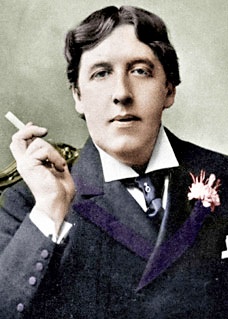
Oscar Wilde: Who would ever have guessed?

In fact, presupposing that the temple/church has possessed a monolithic view of marriage through the ages doesn’t stand scrutiny – as the shift from the polygamy of the OT to the monogamy of Salt Lake City s attests.  Actually, traditional European marriages were established on the bedrock of property rather than on misty marshes of eros[1].  In fact, from what I understand, this loving-your-spouse innovation arose from of all places, English Puritanism.  John Milton himself wrote tracts espousing[2]incompatibility as grounds for divorce.  Here’s a layperson-friendly summary from Stephanie Coontz[3]

Parents arranged their children’s unions to expand the family labor force, gain well-connected in-laws and seal business deals. Sometimes, to consolidate inheritances, parents prevented their younger children from marrying at all. For many people, marriage was an unavoidable duty. For others, it was a privilege, not a right. Often, servants, slaves and paupers were forbidden to wed.

But a little more than two centuries ago, people began to believe that they had a right to choose their partners on the basis of love rather than having their marriages arranged to suit the interests of parents or the state. Love, not money, became the main reason for getting married, and more liberal divorce laws logically followed. After all, people reasoned, if love is gone, why persist in the marriage? Divorce rates rose steadily from the 1850s through the 1950s, long before the surge that initially accompanied the broad entry of women into the workforce.

A slippery slope indeed: John Milton enabling George Jones

In keeping with history, friend/colleague posits that the AIDS epidemic is responsible for the sea change.  The epidemic underscored that homosexuality was more widespread than heterosexuals imagined and acquiring the disease (unless you were a hemophiliac or a junkie) became a sort of outage in itself.

As more and more exited the closet, this theory suggests, the more we discovered that this once-called abomination was prevalent among kind, gentle souls, the saintly professor, your first cousin, your brother, your son or daughter (cf Dick Cheney).

This theory seems reasonable to me, but I would also add that, at least among the educated, it has become abundantly clear that sexual orientation is essentially innate.  I certainly didn’t make the post-pubescent decision to become hethero/(morose?), so it doesn’t seem likely that others would decide they would choose to be gay.  Why would someone, especially in the ‘50s and ‘60s when “rolling queers” ranked just behind quail hunting as a redneck pastime? And, if indeed, you’re born gay, shouldn’t you be allowed to fall in love and to marry?

Whatever the reasons for this rapid transformation of attitude – imagine Gore coming out for gay marriage in 2000 and Dubya merely demurring that although against it himself, he thought it was a matter for individual states to decide – I can’t imagine the tide ever reversing on this issue, despite the Trump Administration’s dreams about turning back the clock.  He would be better off, I think, concentrating on keeping his hands to himself.


[1]The Misty Marshes of Eros, soon to be out in paperback.

[2]Pun intended

[3]I swear that’s her name.

It’s All about Me, Me, Me!

Vain the ambition of kings
Who seek by trophies and dead things
To leave a living name behind,
And weave but nets to catch the wind.

John Webster

“Vanitas Vanitatum”

School’s been cancelled. After all, a hurricane has made landfall half-a-continent away in the Central Time Zone and tomorrow may pass a hundred miles north of us.

Picture an angry old man cycling his fists like John L Sullivan itching for a fight.  [Not me, cycling my fists, the personified hurricane].

So here I am literally the only customer at Chico Feo, sitting on a rain-soaked stool distraught as I contemplate what TS Eliot called “the immense panorama of futility and anarchy that is contemporary history.”[1]

IMG_2933

Note the handy Founders All Day IPA and legal pad and pen

It’s little recompense that on Chico’s sound system the so-limited but oh-so-cool baritone of Lou Reed is celebrating “a magic moment as sweet as wine.”  And now it is — was —  David Byrne with sugar right there on his tongue –  and now Donovan’s “Sunshine Superman.”

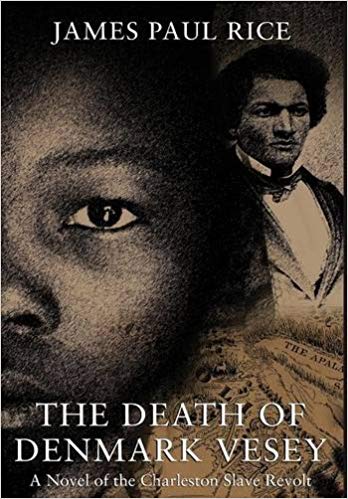
My one-time housemate James Paul (aka Mike) Rice used to listen to Donovan back in ’74.  Mike was a romantic (still is, I suspect, if he’s alive).  Donovan’s Greatest Hits is a treasure trove of hyper-romanticism.  For example, indulge me and check this out:

I hadn’t heard from Mike until about four years ago. In fact, it was the day Judy and I first met with her oncologist to confirm that indeed she had cancer, probably a lymphoma; he hoped it was a lymphoma.  Awkwardly, I cut Mike off and said we had a doctor’s appointment.

Anyway, Mike had called to tell me that the University of South Carolina Press was considering publishing the manuscript that he had mailed me months ago, the one, he said, “that I was probably too busy to read.”

Oops. I still had the manuscript so starting ripping through its lush prose.  It was about the antebellum world of Denmark Vesey and a made-up slave woman named Lucinda.

The plot propelled me right along, but occasionally a technical problem would intrude, a slight violation of point-of-view or the omniscient narrator’s voice lapsing too poetic, reminding the reader that this was historical fiction, not real life.

USC rejected the novel, so he revised it, and the very next publisher he sent it to, Knox Robinson, accepted it.

Mike Rice novel


He ended up dedicating the novel to I-and-I:

“To Wesley Lee Edward Moore III, a real Charlestonian.”

The only problem is I’m not from Charleston.  It should have read to WLEM3, a real Summervillian.

Unfortunately, I’m no longer the “onliest” (as we sometimes say in Summerville) customer at Chico’s. An old genial man named Alex and some know it all 30-something are droning on about biking on James Island, swapping various adventures.

Swat!  A mosquito. Bartender Jen has fronted me some repellent, which I slapstickishly spray onto my sunglasses.  This, the same day that I ‘ve ruined a relatively new shirt by placing an uncapped blue pen in its breast pocket . . .

[Cut to footage of Category 4 Hurricane Michael ripping apart people’s houses . . .]

Anyway, poor Mike has serious kidney issues and spends an inordinate amount of his time on dialysis and will no doubt end his life in the dark shadows of the First or Second Trump Administration.

Talking about “futility” and “anarchy.” Somehow the warranty has run out on the Founding Father’s clever contraption, and a narcissistic[2]wanna-be mobster who looks like a clown and runs the country like a second rate criminal enterprise is in some stadium inciting furious white people to chant “lock her up” while he blusters about how unfair it was that Brett Kavanaugh didn’t receive proper due process.

Here’s Kavanaugh, who prides himself on hiring females, pushing his wife out of the way at his signing ceremony.

Whoa, Donovan has reappeared.  “Hurdy Gurdy Man.”

A couple of weeks ago Mike left a whispering message on my landline.  I’ve called him back a dozen times but no answer,

And so it goes.

Nevertheless, thanks, maybe, to the panhandling flattening fury of Michael, a pleasant breeze has kicked up at Chico, which should blow away the mosquitos.  The thirty-something has moved away from me to sit next to Alex, so I can barely hear him.

“As a small boy, he told me, Dylan . . .”

Hey, Mike, Do not go gently into that good night.


[1]Un-fun facts to know and share: 4 of the last 5 Supreme Court justices have been appointed by presidents who lost the popular vote.

[2]Who’s calling whom a narcissist?