My brother, Fleming Moore, aka Shady, candidate for mayor of the Flowertown on the Pines, opened for Americana all star Danielle Howle last night at Chico Feo on the Edge of America. Here’s some video from the show. Cheers.
My brother, Fleming Moore, aka Shady, candidate for mayor of the Flowertown on the Pines, opened for Americana all star Danielle Howle last night at Chico Feo on the Edge of America. Here’s some video from the show. Cheers.

A few years ago when I chaired an English Department at an independent school, it occurred to me that I could save my employer literally thousands of dollars by replacing the ridiculously expensive textbooks of our survey courses with compilations we put together ourselves. After all, 90% of our texts fall in the realm of public domain. Rather than forking out $145 a pop for an anthology, we could download the material, format it, print and bind it for $20 each. Although the volumes would lack background on historic periods and authorial biographies, we could provide the cultural underpinnings of the Augustan Age or Ernest Hemingway’s gallivanting via lecture. Even better, the kids could keep the books and therefore annotate the texts. Since it was my big idea, I volunteered to do the amassing, formatting, and editing myself.
O, dear readers, that was a promise I wish I could have undone. Formatting was nightmarish. Any slight correction would send the text gaping open, sliding along the screen, the blocks of prose or poetry gaping open here and there, like this:
[. . .] afraid of Jim; he was a drunkard, but he could twist the law to suit his client’s needs as no other man in all western Kansas could do; and there were many who tried. The lawyer closed the door gently behind him, leaned back against it and folded his arms, cocking his head a little to one side. When he assumed this attitude in the courtroom, ears were always pricked up, as it usually foretold a flood of withering sarcasm.
Plus I needed to number lines or paragraphs, which further disjointed the format. We’re talking hours, days, weeks, a summer of uncompensated labor.
One aspect I came to enjoy, however, was providing footnotes. Ever since I was a child, I’ve dug footnotes (endnotes not so much). Anyway, I started traditionally enough:
Passage: A wise man will only be useful as a man, and will not submit to be “clay,” and “stop a hole to keep the wind away,”
Footnote: From Act 5.1 of Hamlet, the graveyard scene, when Hamlet contemplates Alexander the Great’s corpse decomposing into clay and Alexander’s clay ultimately being used to plug up beer barrels.
However, as time passed, I started relating the material to works they had read the previous year.
Passage: “The false society of men —
— for earthly greatness
All heavenly comforts rarefies to air.”
Footnote: From George Chapman’s (c. 1559 – 1634) The Tragedy of Caesar and Pompey. Chapman, by the way, is the translator Keats lauds in “On First looking into Chapman’s Homer.”
As even more time passed, I became self-indulgent and egocentric.
Passage: By the rivers of Babylon, there we sat down. Yea! we wept when we remembered Zion. We hanged (sic) our harps upon the willows in the midst thereof. For there, they that carried us away captive, required of us a song; and they who wasted us required of us mirth, saying, Sing us one of the songs of Zion. How can we sing the Lord’s song in a strange land? If I forget thee, O Jerusalem, let my right hand forget her cunning. If I do not remember thee, let my tongue cleave to the roof of my mouth.”
Footnote: Psalm 137. Also, the first two lines are the beginning of the Reggae great Jimmy Cliff’s “By the Rivers of Babylon,” a lament about Jamaicans’ colonial enslavement. Slaves of the Americas identified with the Israelites of the Old Testament.
And then even more egocentric.
Passage: Porphyrogene!
Footnote: Literally “born to be purple,” as in of royal blood. Cf. the composer of “Purple Rain” and ”Little Red Corvette.”
Then downright sardonic:
Passage: “The evil that men do lives after them.”
Footnote: This famous line you should know, damn it! (BTW, you don’t get footnotes like this at the Magnet).
Passage: It is the excess of the suggested meaning — it is the rendering this, the upper instead of the undercurrent of the theme — which turns into prose (and that of the very flattest kind) the so called poetry of the so called transcendentalists.
Footnote: Not exactly a ringing endorsement of ol’ Ralph Waldo and his gang.
Passage: The next desideratum was a pretext for the continuous use of the one word “nevermore.”
Footnote: Why spend all those days and nights studying Latin unless you get to flaunt your learning with an unnecessary, showoffish phrase or two?
At any rate, I managed to complete the project in time, and now, even in my retirement, I continue to edit the Readers as my former colleagues add and subtract entries. It’s not nearly as burdensome now that I don’t have classes to prepare for or summer reading to complete.

Ah, get born, keep warm
Short pants, romance, learn to dance
Get dressed, get blessed
Try to be a success
Please her, please him, buy gifts
Don’t steal, don’t lift
Twenty years of schoolin’
And they put you on the day shift.Bob Dylan, “Subterranean Homesick Blues”
Vladimir Nabokov begins his memoir Speak Memory with an arresting sentence: “The cradle rocks above the abyss, and common sense tells us that our existence is but a brief crack of light between two eternities of darkness.” He adds, “Although the two are identical twins, man, as a rule, views the prenatal abyss with more calm than the one he is heading for (at some forty-five hundred heartbeats an hour).
To me, it’s not surprising that we don’t fret over our pre-natal non-sentience, and it certainly makes sense that relatively happy people typically dread their post-mortem non-existence. The problem lies in that we perceive life as linear, a journey — tick tock, tick tock — a pilgrimage — tick tock, tick tock. But there’s a real problem in perceiving our existence in this manner, because the payoff of a journey or pilgrimage is reaching the final destination – Emerald City or Canterbury Cathedral – and, of course, when we reach the end of our life’s journey/pilgrimage, we’re no longer we but something to be disposed of, to be burned or buried.

detail from All Our Yesterdays by Michael Bilotta
Alan Watts:
And then you wake up one day, about 40 years old and you say “My God! I’ve arrived.” ”I’m there.” And you don’t feel very different from what you always felt. And there is a slight letdown because you feel is a hoax And there was a hoax. A dreadful hoax They made you miss everything. We thought of life by analogy with a journey, with a pilgrimage, which had a serious purpose at the end and the thing was to get to that end. Success or whatever it is, maybe heaven, after you’re dead. But we missed the point the whole way along. It was a musical thing and you were supposed to sing, or to dance, while the music was being played.
Ulysses to Achilles in Shakespeare’s Troilus and Cressida:
Time hath, my lord, a wallet at his back,
Wherein he puts alms for oblivion.
Yet, we keep wishing away the present, for the workday to end, for the workweek to end, for football season to begin or the holidays to arrive or for retirement.

Cindy Streit Mazzaferro: Sometimes Broadway, Sometimes the Catskills
But who are they – the they Watts accuses of making us “miss everything?”
Well, as Porfiry Petrovich said famously to Rodion Romanovich Raskolnikov in Crime and Punishment when the latter asked him who had killed the old pawnbroker and her sister:
“What do you mean, who killed?” [Porfiry Petrovivh] asked as if he couldn’t believe his own ears. “Why, Rodion Romanovich, you killed! You committed the murders, yes.”
The they are we. We possess free will, BF Skinner be damned. How many sages have walked upon the earth extolling us to consider the lilies of the fields or that it is better to travel well than arrive?
Those sages say we must murder that conception-of-self psychologists call the ego, abandon the self-delusion that a homunculus somewhere inside our brain is the sum total of who we are, to realize that we and the lilies of the fields and the clouds in the sky and the birdcall are one.
Easier said than done. Droughts can decimate fields, and although form is emptiness, the swirling subatomic particles of an axe can do real damage. Food and shelter demand, unless you’re a Trump or Kennedy, labor, and most of us labor under the supervision of someone more powerful, whether it be a foreman or the always-right customer. And, in truth, a very few people own and control almost everything, but we do ostensibly have autonomy over our thinking, how we behave.
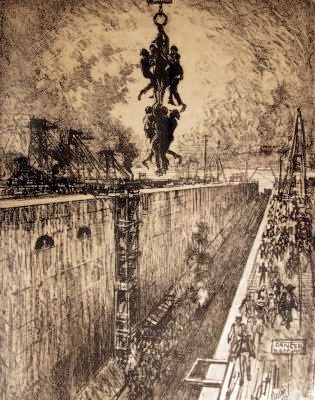
Joseph Pennel: End of Work Day, Gatun Lock
Last night my wife Caroline said she thought that happiness ultimately lies in work, and I agree. It’s crucial to find employment that we love and to train our minds to concentrate on the bits and pieces of that employment, whether it be whisking an egg, laying a brick, or constructing a math test, in other words, to enjoy the music of the moment rather than racing forward in our minds to the final cymbal crash of the coda.
It’s hard to do, especially with all of the distractions, the mechanical slicing of time into periods, shifts, breaks, etc. – but we certainly don’t want to end up like John Marcher in Henry James’s “The Beast in the Jungle”:
He had justified his fear and achieved his fate; he had failed, with the last exactitude, of all he was to fail of; and a moan now rose to his lips as he remembered she had prayed he mightn’t know. This horror of waking–THIS was knowledge, knowledge under the breath of which the very tears in his eyes seemed to freeze. Through them, none the less, he tried to fix it and hold it; he kept it there before him so that he might feel the pain. That at least, belated and bitter, had something of the taste of life. But the bitterness suddenly sickened him, and it was as if, horribly, he saw, in the truth, in the cruelty of his image, what had been appointed and done. He saw the Jungle of his life and saw the lurking Beast; then, while he looked, perceived it, as by a stir of the air, rise, huge and hideous, for the leap that was to settle him. His eyes darkened–it was close; and, instinctively turning, in his hallucination, to avoid it, he flung himself, face down, on the tomb.
So, ladies and gents, let’s don our dancing shoes before it’s too late.

Ernie Barnes, The Sugar Shack, 1976

That Was Then
I had always liked the Stones, but it in 1969, I fell head-over-heals when I heard “Honky Tonk Women” for the first time, that opening clang-clang of a cow bell followed by those guitar riffs rattling the tiny speakers of my tenth-grade transistor radio. The Stones’ previous LP, The Satanic Majesties Request, had abandoned the R&B bass and rhythmic guitar play that provided the propulsion for such classics as “Get Off My Cloud” and “Under My Thumb.”[1] Not surprisingly, the Stones weren’t very good at psychedelic music. It didn’t suit them. Imagine Keith Richards sitting in a half lotus next to the Maharishi. Un-uh.

However, the next LP after Satanic Majesties, Let It Bleed, is my favorite album all time, and the opening song of Side 2, “Midnight Rambler,” my favorite song.[2] Its violent lyrics leavened by a John-Lee-Hooker-like boogie produce sonic cognitive dissonance as Jagger threatens to stick his “knife right down your throat” while the rest of the band lays down the jauntiest of grooves. I remember sitting in the Summerville High School library fantasizing about taking over the campus and blasting “Midnight Rambler” over the intercom after we had secured the office area.
Did I mention that I was an angry young mannish-boy?
Anyway, my newly acquired infatuation with the Stones led me to explore in depth their earlier albums and to check out some the original artists the Stones had covered – Howlin’ Wolf, Slim Harpo, and Robert Johnson, to name only three. Of course, I was ravenous to see the Stones, but ’69 was the year of Altamont, that disaster of a festival that some claim sounded the death knell of the Sixties. No way the Stones ever would come down South, or so I thought. However, in ’72, they did do Charlotte, and the late David Williams and I drove up there in his notorious blue VW Bug and copped a couple of scalped tickets for $25 each. I remember someone chiding me for paying that much to see a concert (a beer cost 25 cents back then). By the way, Stevie Wonder was the opening act.
I saw them again in ’75 in Greensboro and again in ’94 in Columbia, but my interest in the Stones had waned by the 90s. Except for their recent blues cover album Blue and Lonesome released in 2016, Tattoo You of 1981 is the last original Stones’ record I’ve purchased.
This Is Now
My wife Caroline and I love New Orleans, and when I saw the Stones were playing at Jazz Fest, I foolishly bought tickets from a third-party vendor for a lot more than $25 a pop. Of course, the tour was delayed because of Mick Jagger’s heart valve replacement operation, but we did manage to get our money back. In the rescheduled dates, I saw that they were playing in Jacksonville just south of where my Dionysian advisor Furman lives, Fernandina Beach. (You can read about our anthological adventures here).

Furman and I-and-I
To break up the trip, Caroline and I spent Wednesday night on St. Simon’s Island with my late wife Judy Birdsong’s brother Mike and his lovely wife Patti and Mike’s son Matt. We dined at the Crab Trap where Mike’s older son Michael works as manager. Talking about delicious fried flounder. Oh my God, as the kids say. It was a good wholesome warm-up for the festivities to follow – that is, if you consider drinking high end Irish whisky and more beers than AMA recommends wholesome.
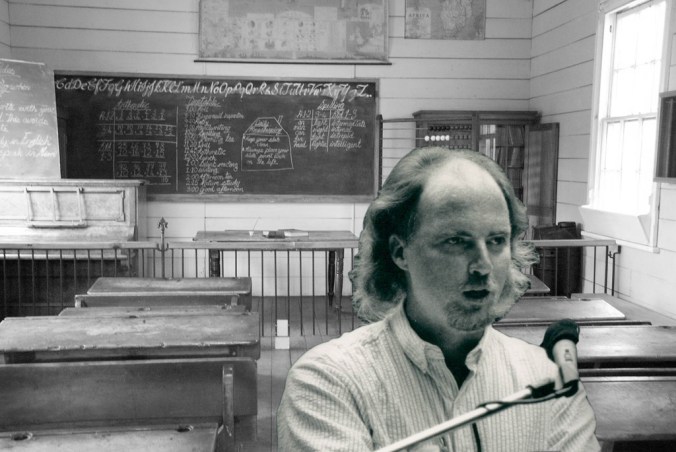
Caroline had booked a room at The Schoolhouse Inn on Amelia Island about two miles from Furman’s beach compound. A converted schoolhouse, the Inn features spacious rooms with old-fashioned educational touches, like vintage photographs of principals ass-thrashing young miscreants with sticks. I meant to take a picture but didn’t.
The Sweltering Chill
In a way, we were doing a college reunion. In addition to Furman and his wife Jeanie, our entourage included old party mates Joe and Kathy, Steve and his wife Christi, Cheryl and Chris, Bill and Dana, Furman’s brother Bill and his wife Veronica (who had already seen four previous shows on this tour), plus various offspring and friends of Furman and Jeanie. We spent Thursday night on Amelia Island drinking at the Green Turtle Tavern, where Jagger supposedly ended up later that night, though I’m always skeptical of rumors like that. The next day at lunch, we met Amelia’s legendary harmonica-blowing street musician Felix from whom I bought a tee shirt/sartorial business card.

Felix
So we turned in rather early, awoke the day of the concert, lounged around the pool, did lunch at an old-fashioned seafood restaurant, and headed over to Furman’s. He had hired three vans to deposit us at TIAA field in time to catch the opening act, The Revivalists.

From left to right, Caroline, I-and-I, Cheryl, Chris, Kathy (photo credit Joe Brown)
The Concert
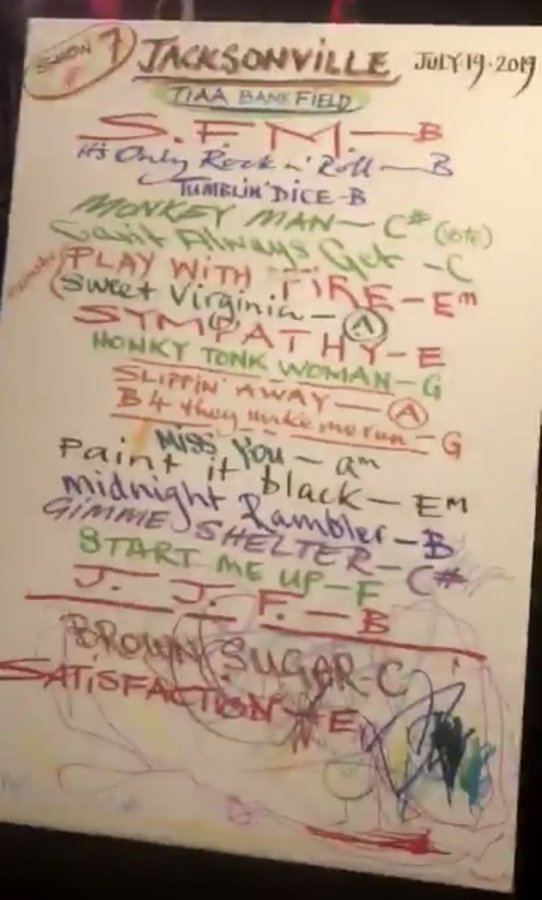
Here’s the set list, provided by Ronnie Wood himself.
Here they are doing “Street Fighting Man,” courtesy of First Coast News:
First and most importantly, the sound was fantastic, unreal, more like music you would hear in a studio than in a football stadium.
Highlights – and there were many – included Darryl Jones’ bass solo on “Miss You”; a killer rendition of “Midnight Rambler”; one of my favorites, “Monkey Man”; and the last song played, the second song of the encore, “Satisfaction.”
Here’s a rendition of Darryl’s solo from Rio in 2016 via João Paulo Moreira Lima.
Aftermath
O my brothers and sisters, I have had in the course of my 66 years many a day of mighty fun, and let me tell you, Saturday, the day after the concert, ranks right up there at the apex. We all gathered at Furman’s and reviewed the show, shared memories from bygone days, and after the “raising of the flag” ceremony, we went swimming in the ocean on a perfect sunny day that featured some of the coolest clouds ever.

From left to right, Furman, Bill (and behind him Dana) Steve, Christi, Kathy, Cheryl, and Lauren (photo credit Caroline Moore)
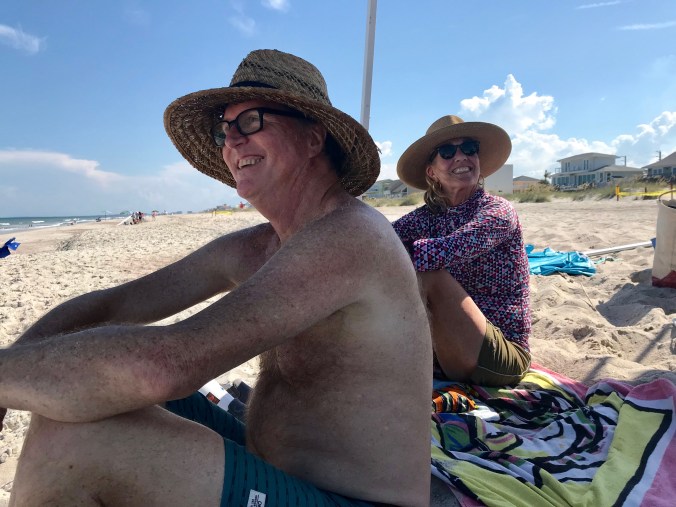
Bill and Dana
All Good Things Must Come to an End
Caroline and I left Furman’s and Jeanie’s around ten-thirty and made our way back to the Inn for a final nightcap of Jameson’s before we hit the way.
The next morning, we bid good-bye to the excellent staff at the Schoolhouse and took the back roads back to our own little barrier island on the Edge of America.
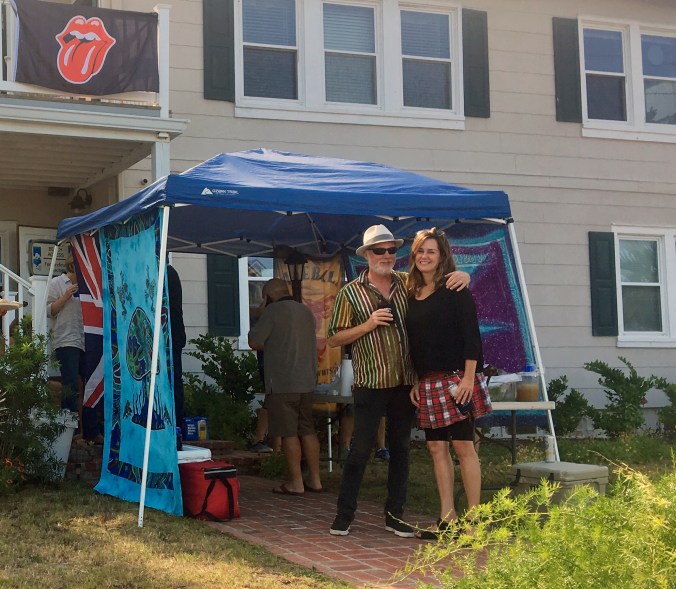
Thursday afternoon
[1]“Honky Tonk Women” and “Jumpin’ Jack Flash” were released as 45s and didn’t appear on an album until the greatest hits compilation Through the Past Darkly.
[2]Rolling Stonemagazine ranks it 32 on its 500 greatest list, one below Dylan’s Bringing It All Back Home.Exile on Main Streetis the 7thgreatest, according to the list.
Time to Pop the No-Doz
Let’s face it; you enjoy taking grammar tests because they make you feel socially superior to Deplorables who say, “Between you and I, I think Melania Trump’s nude photo shoots were choreographed by the Deep State.”
So here’s a chance to fill five minutes of your otherwise angst-fraught day in a beleaguered Late Empire democracy located on a dying planet having fun with rhetoric.
Uh-oh. That sentence has a misplaced modifier. Can you find it?
Damn right, the dying planet is incapable of having fun, even with something as absolutely entertaining as parsing sentences.
To begin the frivolity, let’s stick with misplaced modifiers. Here’s an easy question: which of the following sentences doesn’t contain a dangling modifier?
While reading a book, Reginald’s dog chewed the Chippendale.
While repairing the chipped Chippendale, Reginald’s dog urinated on the Persian rug.
While steam-cleaning the Persian rug, Reginald’s dog clawed a hole in the screen door.
While Zika-virus-bearing mosquitos flew through the hole in the screen, Reginald adjusted his dog’s flea collar.
Wow, that was fun, wasn’t it? Let’s try something a little different. Read carefully each group printed below, and decide which one of the four choices expresses the idea most correctly and efficiently.
Having picked up a meth addict via Tinder at the rave, Edith invited the meth head up to her attic.
When Edith picked up a meth addict she met via Tinder at the rave, she invited him up to her attic.
Edith’s meth addict Tinder pick-up at the rave was invited up to Edith’s attic.
Edith invited her meth-addict Tinder pick-up from the rave up to her attic.
The section below contains a series of short choppy sentences, resulting in a monotonous style. Using appropriate connectives and proper subordination, combine the sentences to show the relationship of the ideas that apparently belong together. You should be able to combine all the statements into a single sentence.
Extra Credit: Who is the author of the above speech?
Okay, let’s close out by increasing our word power by doing some synonyms.
Okay, boys and girls, the fun is kaput, time for a libation, followed by soporific reclining, if you catch my drift.

Probably no creative artist in history can match the universal adoration that Master Will Shakespeare enjoys (well, would enjoy if not dead for 403 years). However, a recent biography claims that when his theatre company, the King’s Men, travelled to Whitehall to entertain James I, the actors actually served their royal patrons meals between performances.
Imagine the author of King Lear approaching some drooling Hapsburg-lipped hemophiliac with the greeting, “Hark, I’m William Shakespeare, and I shalt be thy server this evening.”
His much scrutinized signature? An autograph unsought.

The fact is that Elizabethans and Jacobeans looked upon actors and playwrights the way we old folks do fire eaters and tattooed bearded ladies. Amusing, perhaps, but not the sort we want visiting our homes. Of course, nowadays, entertainers are the royalty: Sir Mick Jagger. Sir Nick Faldo. Sir Johnny Rotten (just wait).

Johnny Rotton sporting slimming vertical stripes
On the other hand, poets remain as impoverished as ever. For example, when appointed, Poet Laureate Billy Collins taught at two different universities to make his mortgage. As my man, Willie B, whined so exquisitely in “Adam’s Curse”:
[. . . ] A line will take us hours maybe;
Yet if it does not seem a moment’s thought,
Our stitching and unstitching has been naught.
Better go down upon your marrow-bones
And scrub a kitchen pavement, or break stones
Like an old pauper, in all kinds of weather;
For to articulate sweet sounds together
Is to work harder than all these, and yet
Be thought an idler by the noisy set
Of bankers, schoolmasters, and clergymen
The martyrs call the world.
[muffled sob]
Well, if you happen to be reading this post on lifted wifi in a drafty garret as you warm your hands over a burning pile of rejection slips, here’s a suggestion in how to augment your income. Start touting yourself as a body language expert.
It’s as easy as lying.
Just apply the analytical process you use in interpreting poems to the dress, postures, and mannerisms of celebrities. For example, courtesy of Us magazine, here’s body language expert Patti Wood on winsome Academy Award winner Sandra Bullock.

She is gripping the coffee cup very high up [. . .] That’s what you do when you really want to grab a hold of something and show your power. She’s really making it obvious and playing toward the camera to show that empty [i.e., ringless] finger.
[snip]
Bullock also is wearing a black North Face jacket, black ball cap and scarf around her neck.
She’s chosen a heavily padded jacket and has it zipped up very high,” observes Wood. “The choice of her scarf, which is tied over heart, means that she is hiding her heart window and throat window, which is the communication window.”
As you might know (and congratulations if you don’t), Sandra Bullock’s story book marriage (as in Creepy Comics story book) to dashing motorcycle mechanic/television personality/daredevil Jesse James ended when she discovered hubby James had been trysting with “tattoo model and stripper Michelle ‘Bombshell’ McGee” [Wikipedia]. James’ previous, not-so-winsome wife, adult film star/producer Janine Lindemulder, had battled James the year before for custody of their daughter Sunny. James, whose cocky sneer might outnumber Shakespeare’s pate in a Google image search face-off, has conceded having “made bad decisions” (i.e., committing adultery over an 11-month period with someone who goes by “Bombshell”) but blamed his transgressions on his abusive father, who once when 7-year-old Jesse tripped over a wire, “laughed at [him] and called [him] a dummy” New York Daily News.
No wonder Sandra has shrouded her heart window, opened the trench coat of her naked ring finger, and covered her communication window in tinfoil.
* * *
Poets, I guarantee you that Body Language Guru Patti got paid more for her analysis of Sandra’s ensemble than you did the last time you got published. What was it? Two complimentary copies of the flimsy issue that featured your open wound of a love poem?
I bet we can do just as well as Patti Wood. All we need is a degree from an on-line university, and we’re in business. Let’s give it a shot. Here’s a photo of disgraced Ponzi Master Al Parish in his glory days before the hook of law-and-order yanked him off the stage of the Charleston Chamber of Commerce production of No New Taxes. He’s in his eleventh years of a twenty-four year sentence at Butner Federal Correctional Complex in Raleigh. Bernie Madoff is also an inmate there.

Al Parish, aka Economan
Piece of (purchased cheese) cake:
Falstaffian in appetite, Professor/Post Courier columnist/ official Chamber of Commerce economist Parish wraps himself in regal purple to accentuate his ties to the powers-that-be. Even though his 300-plus pounds of sidewalk dominating heft might catch the eye of the blind man selling pencils on the corner, grey and black swirling patterns on purple demand even more attention, screaming I’m comfortable in my 24-square yards of skin, parachute-sized fabrics, jumbo-sized Cadillac. Note how jauntily he cocks the angle of his right jowl across the 12-lane highway of his lapel – lapels that steeply climb his belly, that Great Divide of his torso and legs. He’s at once a king and sycophant, a mogul and court jester
And yet – and yet – the ensemble displays Rorschach-like signals of chaos ahead, his left shoulder bearing a hurricane-like swirl, his tie twisted like a cyclone, both boldly streaked in ominous black . . .
Like, I said, it’s as easy as lying.
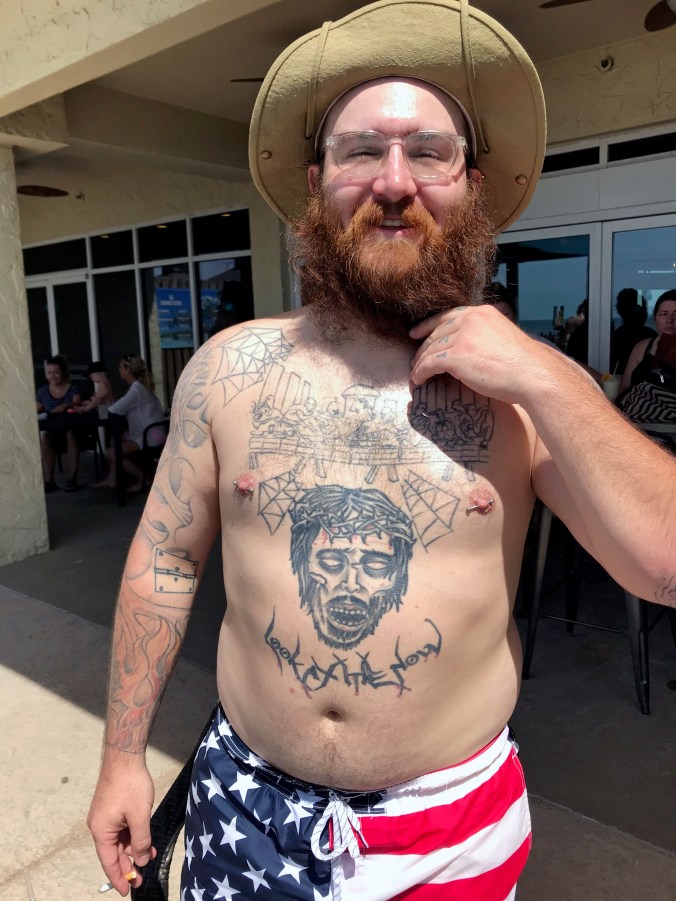
Last Sunday, after returning a rented golf cart, Caroline and I walked over to Planet Follywood for breakfast and then over to the Tides for a rum-infused tropical treat (her) and a hoppy yeast-born malt-based brew (I-and-I). As we sat in a slice of shade in the corner of the plaza of the outdoor bar, a shirtless, bearded fellow walked past. He had a picture of a spine tattooed over his own spine, flanked by a pair of wings tattooed on his shoulder blades. “Wow, dig that,” I whispered.
We continued our conversation as the man and two of his companions – also shirtless and heavily tattooed – took a seat at a table about ten meters away, the wings-spined fellow facing us.
“What’s that tattooed on his chest?” Caroline asked. “Jesus?”
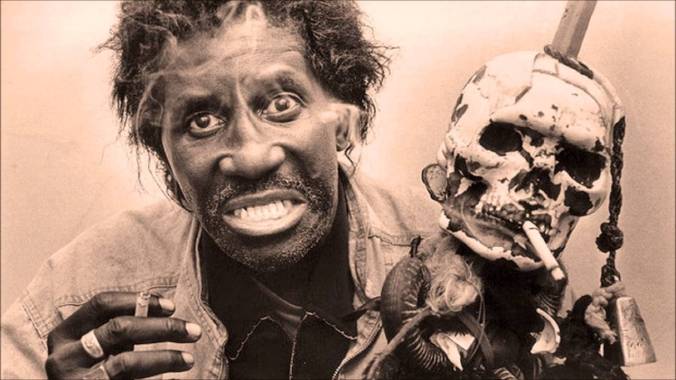
“Looks more like Screamin’ Jay Hawkins,” I said.
We talked about trying to take a surreptitious snapshot but decided against it. It was then that the title came to me: “Ode on a Tattooed Torso.”
When we passed them in leaving, Caroline asked him whose face was tattooed on his stomach.
As we entered the cool of the bar proper, Caroline asked me if I had heard what he had said.
“Yeah, Jesus.”
“No, he said ‘Zombie Jesus’.”
That stopped me in my tracks. “I got to get a picture.”
“Do you think he’ll be annoyed?”
“I’ll ask politely. If he says no, he says no.”
“Okay, I’ll wait here. It will be less awkward without me there.”
So I retraced my steps and introduced myself, handed him my Hoodoo website card, explained that I wrote a blog and would love to take a picture and write about his tattoos. “Of course,” he said, standing up beaming. “That’s not the response I was expecting to get,” he said. “I was afraid you might be offended.”
I wished I had asked him if many people were offended, but I didn’t, nor how he came to acquire such an animus for Jesus. Fanatical parents? Anger at the horrors of the world? He seemed the opposite of angry, just another hedonist spending the Sabbath in self-indulgence.
So we went home and studied the photograph, which prompted several ideas. First, this tattoo was testament to our First Amendment rights, which allow us to say or display ideas that are anathema to the majority. As George Orwell put it in “Freedom of the Press,” [a]t any given moment there is an orthodoxy, a body of ideas which it is assumed that all right-thinking people will accept without question. It is not exactly forbidden to say this, that or the other, but it is ‘not done’ to say it, just as in mid-Victorian times it was ‘not done’ to mention trousers in the presence of a lady. Anyone who challenges the prevailing orthodoxy finds himself silenced with surprising effectiveness. A genuinely unfashionable opinion is almost never given a fair hearing.”
Second, it occurred to me how tolerant we US citizens are for the most part. If our tattooed man lived in Saudi Arabia and went out in the public square sporting a tattoo of Zombie Muhammad, he’d be a corpse faster than you could say, “All praise be unto him.”
I decided to write the poem “Ode on a Tattooed Torso” modeled on Keats’s “Ode on a Grecian Urn,” employing the so-called ten-line Keatsian Ode Stanza. Although I intended the poem to be comic, a sort of parody, it became something a bit different: praise for a brave lost soul who uses his body as a canvas to display his obviously heartfelt but unpopular beliefs.
If you decide to read it, I highly recommend hitting the audio and to read it along with my voice.
Ode on a Tattooed Torso
With apologies to John Keats
In the juvescence of the year
Came Christ the tiger [. . .]
The tiger springs in the new year. Us he devours . . .
TS Eliot, “Gerontion”
Thou rotund torso beneath that russet beard,
Thou iconoclastic mockery,
Sacrilege silently, rudely, crudely shared
Like profane Pompey crockery
Uncovered from a brothel. Zombie Jesus
Thorn-Crowned, blood dripping from brow
Come not to save but to devour us,
The antithesis of the sacred cow.
Its human canvas confronting us
With an objective correlative. Wow!
Shouted obscenities spit gall,
But those unheard are often ignored.
Though Bosch-like, the tattooed Last Supper doesn’t call
Attention to itself above the Zombie Lord.
Faintly rendered, half-hidden, a thatch of chest hair
Obscuring bird-beaked apostles,
Like Leonardo’s originals leaning here and there.
We barely notice them, if at all.
And who would have the courage to stare,
To lean in, to take it all in, though enthralled?
O badass iconoclast! Fearless commentator!
I wonder what images adorn your balls.
Onan perhaps spilling his seed? The traitor
Judas hanging from a tree? The walls
Of Jericho richly graffitied?
Thou russet-bearded wonder, profane wretch,
You walking act of art, when old age bleeds
Away that ink, may this verse your protest protect,
Your icon-injected flesh preserve, your rude screed
Freeze in time, though an inchoate protest.
Screaming’ Jay Hawkins
Let me also wear
Such deliberate disguises
Rat’s coat, crowskin, crossed staves
In a field
Behaving as the wind behaves . . .
TS Eliot, “The Hollow Men”
It’s been my fate for the last twenty years or so to explore Heart of Darkness each spring with sixteen-year-olds. The novella provides a rich cache – not of ivory – but of literary artistry, historical relevance, and profound prophecy. I also find Marlow’s rebellious disdain for the soullessness of the people he encounters during his journey good role-modeling. By the end of his odyssey, Marlow has, as he puts it, “some difficulty in restraining [himself] from laughing in their faces so full of stupid importance.” He resents the sight of his fellow citizens “hurrying through the streets to filch a little money from each other, to devour their infamous cookery, to gulp their unwholesome beer, to dream their insignificant and silly dreams.” Marlow’s experience in the jungle has shredded the veil of illusion, or to move a bit westwardly metaphorically, he has stumbled out of Plato’s cave and can now see beyond the flickering shadows projected on the walls of his former existence.
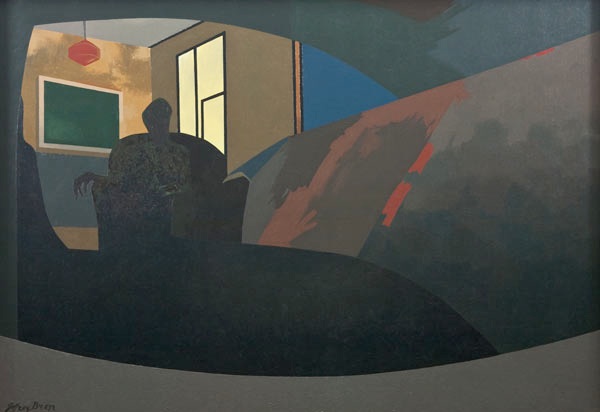
Jeffrey Bren
Self-portrait watching television
The pressure of conformity weighs down adolescents like sodden woolen coats, whether it be the pressure to join a gang, the Fellowship of Christian athletes, or the circle around the bong. Our narrator Marlow is a loner, the father of Nick Adams and Sam Spade (not to mention Philip Marlowe), an individual who remains true to his non-conformist core convictions. As Marlow is telling his story to his colleagues on the deck of the Nellie, he’s also speaking directly to those adolescents – mocking hollowness and extolling independence and courage. Given the barrage of images that assault young people each day through their various media – images of air-brushed celebrities as insubstantial as Plato’s shadows, images of smiling actors succeeding at DeVry University, images of Vaseline-enhanced Big Macs beaming down from billboards – Marlow’s example of delving beneath the surface is more relevant than ever.
***
(To leaven the proceedings for a moment. What do you think Marlow would think of this cover?)
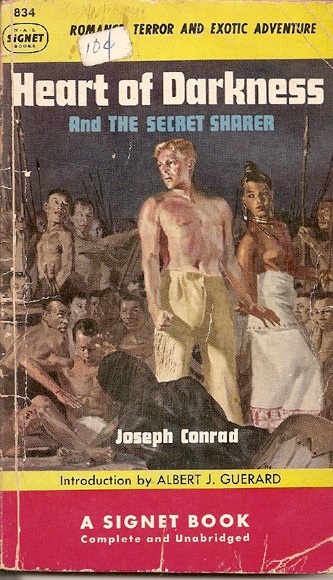
Romance, Terror, and Exotic Adventure (rendered in 3.5-page sentences!)
***
TS Eliot in “The Hollow Men” quotes Heart of Darkness in the epigraph and employs Conrad’s symbol of the scarecrow to embody people without true convictions, people who go with the flow, behaving as the wind behaves, people who will say whatever it takes to get what they want – and then again, unsay it, with a mere shake of the Etch-a-Sketch. The hollow men, the stuffed men.
Shape without form, shade without colour,
Paralysed force, gesture without motion . . .
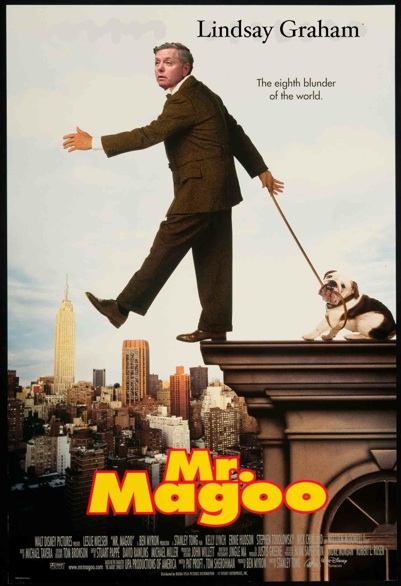
In contemporary American politics, I can’t think of a better embodiment of those hollow men Marlow describes than Lindsay Graham. If we’re going to draw analogies from “real life'” to Conrad’s novel, Trump comes off like Kurtz (albeit without his learning, Kurtz’s appreciation of and facility in creating art). Kurtz sees himself as the center of the universe, as a god, a god worshipped by the natives as Trump is by his ardent xenophobic MAGAs.
Graham, on the other hand, obviously “behaves as the wind behaves.”
That was then, this is now.
“I am like the happiest dude in America right now,” a beaming Graham said on “Fox & Friends.” “We have got a president and a national security team that I’ve been dreaming of for eight years.” (19 April 2019).
Here’s Marlow on lying:
You know I hate, detest, and can’t bear a lie, not because I am straighter than the rest of us, but simply because it appalls me. There is a taint of death, a flavour of mortality in lies–which is exactly what I hate and detest in the world–what I want to forget. It makes me miserable and sick, like biting something rotten would do. Temperament, I suppose.
But, like I said, Trump is more like Kurtz or Guy Fawkes from Eliot’s epigraph, “lost/ Violent souls.” Graham lies for the sake of power; I doubt if megalomaniacal Trump even realizes he’s lying.
I guess it’s possible that Trump will be caught one of these days doing something that upsets the populace and that Graham will do some reverse flip flops, but I wouldn’t bet on it.
I guess it makes more sense to take Yeats’ advice:
Now all the truth is out,
Be secret and take defeat
From any brazen throat,
For how can you compete,
Being honor bred, with one
Who were it proved he lies
Were neither shamed in his own
Nor in his neighbors’ eyes;
Bred to a harder thing
Than Triumph, turn away
And like a laughing string
Whereon mad fingers play
Amid a place of stone,
Be secret and exult,
Because of all things known
That is most difficult.

Holy fools subvert prevailing orthodoxy and orthopraxis in order to point to the truth which (sic) lies beyond immediate conformity. The Concise Oxford Dictionary of World Religions
“Our nation demands the scrutiny of a completely disengaged observer like your Working Boy, and I already have in my files a rather formidable collection of notes and jottings that evaluate and lend a perspective to the contemporary scene.” Ignatius P Reilly, A Confederacy of Dunces, John Kennedy O’Toole
In the literary landscape of the West, from the plains of ancient Troy to the streets of contemporary New Orleans, Wise Fools have thumbed their bulbous noses at decorum and provided contrarian views against the cultural status quo of their respective milieus. Armed with wit, not weapons, these outsiders can see beyond entrenched hierarchies and customs, and historically, in the employ of a king or queen, court jesters (or licensed fools as they were sometimes called) could in frankness utter truths that a higher individual dared not.
On the literary side of the ledger, let’s look at Thersites from The Iliad, that bandy-legged malcontent, “a menial, a nonentity among dynastic aristocrats,” according to C.R. Beye.
But wait. What are these “dynastic aristocrats” up to? Waging a ten-year war to avenge someone’s wife running off with someone else’s husband. And ultimately, it’s the gods’ fault anyway, the Judgment of Paris and all that jazz. With the hindsight of a couple of millennia, waging a decade-long war because of elitist adultery seems even more foolish than the post 9/11 invasion of Iraq.
When the Iliad begins, the siege is at a stalemate because King Agamemnon, the alpha male of the Achaeans, has usurped Achilles’ war spoil Briseis. Even though Achilles is his best warrior, his LeBron James, Agamemnon gets dibs on (forgive me) Achilles’ booty because he’s higher on the totem pole. Achilles retreats to this tent to pout (the equivalent of LeBron benching himself) while swords clash and “night descends upon the eyes” of warrior after warrior slain in the service of trying to retrieve runaway Helen, whose face (aided and abetted by other body parts) “launched a thousand ships /And burnt the topless towers of Ilium.”
Thersites recognizes the absurdity of the war and the unfairness of Agamemnon’s receiving “the lion’s share of the spoil” while “Achilleus (sic) does the lion’s share of the fighting.” [1]
Although despised by the soldiers, Thersites wisely advises them to abandon the war, to return to their homelands, to their own wives and children, so they can teach Agamemnon a lesson.
He confronts Agamemnon directly:
Your shelters are bulging
With bronze, and whenever we sack a city you always
Get the choicest booty, including whole bevies
Of beautiful women. Can it be you still want gold,
The ransom some horse-trading Trojan brings out of Troy
To pay for his captured son whom I or some other
Achaean bound and led away? Or would you
Prefer a ripe young lady to sleep with and keep
Shut up somewhere for yourself? Truly, it hardly
Becomes their commander to burden with so many troubles
The sons of Achaeans.
Translated by Ennis Reese[2]
Perhaps because his physical hideousness has alienated him from the heroic slaughterers who surround him, Thersites recognizes the absurdity and unfairness of the heroic ideal.
***
Thersites also appears in Shakespeare’s Troilus and Cressida, one of the so-called problem plays. Like his ancestor in Homer, the 17th Century Thersites is hideously ugly but much wittier than his counterpart in The Iliad. He’s a king of vituperation who out-Don-Rickles Don Rickles. Here he is suggesting that old, supposedly wise, Nestor’s mind has seen better days:
There’s Ulysses and old Nestor, whose wit was mouldy
ere your grandsires had nails on their toes.
When Ajax threatens to cut his tongue out, Thersites replies, “’Tis no matter! I shall speak as much as thou afterwards.”
And what a rich source of insults: loathsome scab, sodden-witted, scurvy-ass, idol of idiot worshippers, full dish of fool, idle immaterial skein of sleave milk, green sarcenet
flap for a sore eye, tassel of a prodigal’s purse, waterfly.
Agamemnon, he says, has “not as much brains as earwax.”
Of course, the wisest of all of Shakespeare’s wise fools is employed by Lear. Unlike the two Thersites, Lear’s Fool’s wit, though sharp and biting, is noble-minded. He loves the king and speaks frankly to him, trying to point out to Lear his own foolishness.
Fool: That lord that counsell’d thee
To give away thy land,
Come place him here by me-
Do thou for him stand.
The sweet and bitter fool
Will presently appear;
The one in motley here,
The other found out there.Lear: Dost thou call me fool, boy?
Fool: All thy other titles thou hast given away; that thou wast
born with.
Shakespeare, of course, did not invent the court jester, or licensed fool, as they were sometimes called.
Here’s a brief history from the blog Under the Tudor Rose:
In ancient times, courts employed fools and by the Middle Ages the jester was a familiar figure. In Renaissance times, aristocratic households in Britain employed licensed fools or jesters, who sometimes dressed as other servants were dressed, but generally wore a motley (of mixed colours or materials) coat, hood with ass’s ears or a red-flannel coxcomb and bells. Regarded as pets or mascots, they served not simply to amuse but to criticize their master or mistress and their guests. Queen Elizabeth is said to have rebuked one of her fools for being insufficiently severe with her. Excessive behaviour, however, could lead to a fool being whipped, as Lear threatens to whip his fool.
His is not an enviable position in that most dysfunctional of households.
Fool: FooI [i.e. Lear] marvel what kin thou and thy daughters are. They’ll have me 705
whipp’d for speaking true; thou’lt have me whipp’d for lying;
and sometimes I am whipp’d for holding my peace. I had rather be
any kind o’ thing than a fool! And yet I would not be thee,
nuncle. Thou hast pared thy wit o’ both sides and left nothing
i’ th’ middle. Here comes one o’ the parings.710
The most famous of these fools was Will Somers, Henry VIII’s court jester. Perhaps because of their unequal social status or that fact that Somers didn’t try to capitalize on his relationship with the king, Somers and Henry developed a genuinely deep friendship, though the most often quoted anecdote is that Henry threatened to kill Somers with his bare hands after Somers called Anne Boleyn a “ribald” and princess Elizabeth “a bastard.”

Family of Henry VIII, c. 1545. Will Somer is depicted in the right doorway, and Anne Parr’s fool, Jane Foole, appears in the left doorway.
After Henry’s death, Somers was reduced as a sort of a comical sidekick to Queen Mary. His last public performance was at Elizabeth’s coronation.
The idea of a ruler employing a wise fool to leaven the ruler’s ego seems like a good idea to me. Obama and Chris Rock would have made a dynamic duo, and how wonderful would it be to have Louie CK try to deflate his fellow vulgarian Donald J Trump’s gaseous ego.
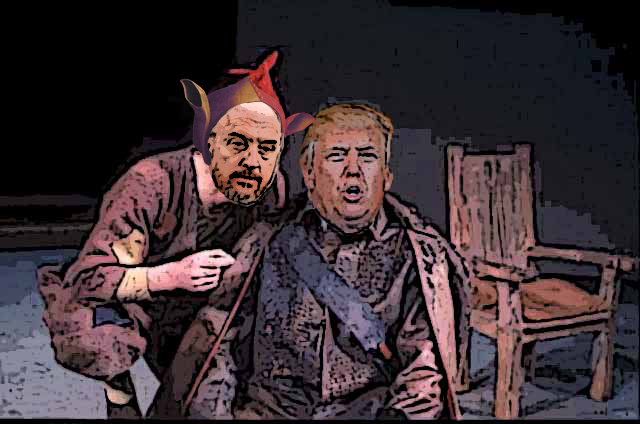
Louis CK as the Fool and Trump as the King in the Hoodoo Productions dream staging of The Tragedy of King Lear
***
Although by far not the grandest, my favorite wise fool is Yeats’ Crazy Jane. Yeats based her on a local character called Cracked Jane who wandered around County Galway when he lived in his tower, Thoor Ballylee, near Gort. The great great great granddaughter of the Wife of Bath, Crazy Jane has nothing to fear from middle class censure so when a bishop chides her for her licentiousness, she provides him a little lesson on bodily matters:
I met the Bishop on the road
And much said he and I.
`Those breasts are flat and fallen now
Those veins must soon be dry;
Live in a heavenly mansion,
Not in some foul sty.’
`Fair and foul are near of kin,
And fair needs foul,’ I cried.
‘My friends are gone, but that’s a truth
Nor grave nor bed denied,
Learned in bodily lowliness
And in the heart’s pride.
`A woman can be proud and stiff
When on love intent;
But Love has pitched his mansion in
The place of excrement;
For nothing can be sole or whole
That has not been rent.’
So let’s raise a glass to the dispossessed, those unworthies who wear white after Labor Day, who don polka-dotted blouses with plaid skirts, who, to paraphrase my favorite line from Apocalypse Now, are beyond our lying, timid moralities, who are willing to call a king or bishop or president a jackass to his face.
[1]From “Thersites in then ‘Iliad’” by N Postlewhaite published in Greece and Rome, 35.2, October 1988.
[2]The best poetry teacher I ever had.

When I was five or so, we lived across the street from a playground and tennis courts on Laurel Street in Summerville. When no one was playing tennis, we would ride our bikes on the court and hear, quite clearly, a television blaring from across the street. The first time I noticed it, I asked my Aunt Virginia, only six years older, what was causing all that racket.[1] She informed me that Mr. Whatshisname was watching The Edge of Night.
“Why does he have his tv on so loud?” I asked.
“Because he’s deaf, you nitwit.”
“Wow. He must be really deaf.”
“No shit, Sherlock.”[2]
Flash forward sixty years.
Me (passing a student on a school stairway): How’s it going Lucas?
Lucas: Terrible!
Me: Great.
Or worse.
Me: sitting across from someone in a bar leaning across the table, trying to hear.
My companion: We just found out last week that Mom has inoperable brain cancer.
Me: smiling, nodding, saying nothing.
Of course, given my, as Dr. John might say, my lassitudinoushood, until today I had not done anything about my condition.[3] Although I sensed others’ irritation with my saying sorry and leaning over with a cupped ear, it was tolerable to me to spend the rest of my life following in the footsteps of the old drinker in Hemingway’s “A Clean, Well-Lighted Place.”
“You should have killed yourself last week,” [the Young Waiter] said to the deaf man. The old man motioned with his finger. “A little more,” he said. The waiter poured on into the glass so that the brandy slopped over and ran down the stem into the top saucer of the pile.”Thank you,” the old man said. The waiter took the bottle back inside the cafe. He sat down at the table with his colleague again.
[snip]
“Another brandy,” he said, pointing to his glass. The waiter who was in a hurry came over.
“Finished,” he said, speaking with that omission of syntax stupid people employ when talking to drunken people or foreigners. “No more tonight. Close now.”
“Another,” said the old man.
“No. Finished.” The waiter wiped the edge of the table with a towel and shook his head.
The old man stood up, slowly counted the saucers, took a leather coin purse from his pocket and paid for the drinks, leaving half a peseta tip. The waiter watched him go down the street, a very old man walking unsteadily but with dignity.
So anyway, I drove to North Charleston where I had my ears examined, and a goodly quantity of wax vacuumed from my right ear, which Caroline had correctly identified as my worse ear. I then took a hearing test in which I scored a 100% on spoken words but not so hot on frequencies, especially upper level frequencies. The physician concluded that “I had a fair amount of hearing loss” and “would probably benefit from hearing aids” but seemed sort of “meh” about it.
So, I’m going to – forgive me – play it by ear. If I can hear the cat loudly mewing outside my bedroom door while I nap, I’ll know I’m good. If I hear her just audibly whispering a mew, I’ll go ahead and get hearing aids – but not until by Medicare B kicks in.
Why do today what you can put off till September?
[1]Even in those days, your beloved blogger had a way with words, despite having a speech impediment that prevented him from pronouncing the letters S and L. According to my mother, on Sunday evenings when our television beamed Timmy calling his beloved collie to come, I would scream along with him. “ASSIE! ASSIE!”
[2]Virginia was quite a character. For example, click here.
[3]My wife Caroline took the bull by the horns Quasimodo by the ear and made an appointment.