Easter Weekend 2021: Matt Gaetz and Barroom Brawls

I wonder what Matt Gaetz is up to this weekend. Shopping for lawyers? Taking one last peek at nude pix of his sexual conquests before erasing them on his iPhone 12?[1] Checking out rehab facilities?

I suspect right about now Matt probably agrees with TS Eliot’s assessment that April is the cruelest month, breeding investigations out of his sordid past, mixing memory with desire, etc. 

You’ve probably heard the Hemingway definition of beauty: grace under pressure. Well, Matt’s initial response to the revelation that he may have been involved with sex trafficking with minors wasn’t exactly pretty. He allowed himself to be interviewed by Tucker Carlson and spewed a bucketful of ill-considered information, for example, that his father wore a wire in an FBI investigation. And although Gaetz has categorically denied the various lurid allegations, the long list of colleagues and acquaintances who can’t stand him are sharing raunchy stories of deviant behavior stretching back to his days in the state legislature where he represented Florida’s Panhandle, the setting of the murder in Easy Rider, i.e., a rustic-ridden south-of-Alabama rightwing hellhole.

Well, all I can say to Representative Gaetz are the very words I said to a drunk who got punched out by a woman last night at the Surf Bar, “There’s some danger in being an asshole.”

This incident is the second instance in which I’ve been interviewed by the Folly Police in the last year. The first dealt with a couple behaving Gaetz-like on the screened porch of a neighbor who had moved. He had asked me to keep an eye on the house, and when I saw a strange car in the driveway and the workshop door open, I donned my Philip Marlowe persona and investigated.[2]  Despite my deafness, I heard some clamor on the screen porch and caught a heterosexual couple in flagrante delicto.[3] I suggested they leave, and they apologetically obliged, but the police caught wind, so I had to be interviewed. The owner was benevolent, didn’t press charges, but wanted the lustbirds to suffer some slight discomfort for their misdeeds. 

The fellow last night at the Surf Bar suffered more than a little discomfort: he got punched twice in the face by a young woman who could have been Laila Ali’s sparring partner. 

Caroline, our friend Whitney, and I were braving the cold on the porch of the Surf Bar enjoying their excellent Philly cheesesteak. This short White fellow in his twenties, dressed like an Eminem wannabe, approached our table and asked for a light, which we couldn’t provide.[4] There’s a fireplace on the porch, and five young women were sitting in a semicircle in front of it, enjoying the flames. After a while, I noticed that the young lighter-seeking man had joined them on the far end of the semicircle. I also noticed that the man and a couple of the women were engaged in a heated conversation. I asked one of the women who had returned from the restroom if the fellow was bothering them, and if so, I’d be happy to intervene. She smiled and said, “No thanks.” She then circled around the back of the dude and yanked the leg of his chair, sending him sprawling backward. As he attempted get up, she smacked him in the face twice with two well-delivered rights. Before she could cause more carnage, I leapt up and pulled them apart. He, of course, had been harassing them, had called one next to him the c-word, told her she was too ugly to sit next to, and continued to harass them until our heroine had had enough. 

the fireplace at the Surf Bar

I suggested to the fellow that he mosey along because he wouldn’t want the police involved, but he adamantly refused and sat back down in the now upright chair, whining about how he had been hit. Some muscle from inside the bar emerged and escorted him out, trying, as I had, to reason with him. 

It was sort of exciting in an adrenaline pumping way, and our meals were comped, but then who returns with policemen in tow. The twerp. He actually summoned the police because “a girl” had punched him. After interviewing the provocateur, the officer asked for my version, and I gave him a non-judgmental cinematic retelling of what had transpired, including the toppling and punching. The officer said this fellow had already been banned from several Folly bars and that he was from Philly on the lam from a petty larceny charge that was too smalltime to warrant extradition. 

So that was that, but I couldn’t help but feel in light of how horribly Gaetz treats women, how horribly many men treat women, a certain warm glow of satisfaction to see the sawed-off Kid Rock get coldcocked by a pissed-off damsel.

Yes, there is some danger in being an asshole.


[1] I understand that nude photography is now commonplace among romantic partners and that sending explicit photos of oneself can be part of the early stages of wooing, and although I have no personal experience in the phenomenon, I do have some advice for Representative Gaetz: hire an airplane, fly down to Costa Rica, and drop the phone into the volcanic vent of Arenal. 

[2] Not surprisingly, I was sporting a fedora. 

[3] Literally, “in flaming offense.”

[4] A less delicate sensibility than mine might tag him as a w-word, you know, that designation for funky clad White hip-hop aficionados that rhymes with the name of Roy Rogers’s horse. 

The Not-So-Good-Humor Man

illustration by Emily Wood

When I was a child, I grew up across the street from Mr. Fagylalt, a Central European immigrant who owned and operated an ice cream truck.[1]  In the summers, he circumnavigated our neighborhood, his truck tinkling repetitive music that lured nickel-and-dime-toting children to the edges of their yards. Back then, even in the heavy humidity of a South Carolina August, we mostly played outside.

I doubt that Mr. Fagylalt could make it today with children ensconced in their rooms engaged in Mortal Kombat or OD-ing on TikTok videos. I know I would have stayed inside if I had owned Madden NFL 2020 instead of the electric football game we owned. Most of the vibrating plastic players merely rambled around and around in circles. With an open field in front of him, a running back would suddenly hang a hard right and run out of bounds. You passed the ball by putting a felt oval in the quarterback’s hand, pulling his arm back, and catapulting the felt in hopes of hitting the receiver. It was so boring I rarely found anyone willing to play it with me.

Anyway, in those days, people called mobile ice cream vendors “good humor men, ” and, sure enough, Mr. Fagylalt was always in a good mood when I talked to him, or rather, when he talked to me. However, now when I think of Mr. Fagylalt, the adjectives “dirty” and “old” have supplanted  “good” and “humor” as modifiers. Let’s put it this way: although Mr. Fagylalt never attempted to molest me in any physical way, he did infuse my vocabulary with a host of Anglo-Saxon vulgarities, words that no one used (at least in front of us) in our house. He didn’t define the words; I picked up their meanings in context from the same old stories he told over and over.[2]

Stories delivered in an accent as thick as Porkolt.[3] One of his favorites featured a mutt named Champ and our neighbors the Foxes, who lived on the corner of Lenwood and Dogwood. The Foxes kept a meticulous yard with neatly trimmed shrubbery and manicured grass. They took great pride in their yard’s appearance, seemingly removing fallen pine needles on a daily basis. One day Champ got into some ice cream chemicals stored in the Fagylalt carport. He ended up slurping down the found treasure and urinating on the Foxes’ chain link fence. “Oh, zat, dog,” Mr. Fagylalt would say in an aside and launch into a side story about the time he saw Champ mount such-and-such a bitch vividly describing the apparatus involved in the procreative act. Eventually, he’d return to the main plot, to wit: Mr. Fox mistook the brownish urine staining his fence for rust until a rainstorm washed it away. At the end of these too-oft-told tales, Mr. Fagylalt laughed and laughed. I hated every minute but was too timidly polite not to stand there for at least one retelling. I don’t remember if I faked-laughed myself, but I doubt it.

Luckily, Mr. Fagylalt and I had a falling out. One summer, when the Fagylalts vacated their house for several weeks, some friends and I entered his ice cream truck, which was unlocked. When inside, we merely looked around to see what it was like in there, and I discovered to my delight that the truck’s music was produced just the way a jack-in-the-box makes music –  with a crank that propels a rubber mechanism that goes around and around plucking out notes. 

Unfortunately, others at various times also got inside the truck and engaged in a bit of vandalism. When the Fagylalts returned and made inquiries, someone noted that he or she had seen a red-headed boy over there, so Mrs. Fagylalt told my mother, who ended up taking my word that I had not vandalized the ice cream truck. I also think my parents (and others in the neighborhood) were hip to Mr. Fagylalt’s off-color ramblings.

When I left for college at eighteen, the Fagylalts still lived across the street. I remember bumming a ride home one Friday for a weekend in Summerville.  Upon arrival, as I walked across our lawn with a sack of dirty clothes slung over my back, a swarm of kids on banana bikes were popping wheelies in our yard. As I shouted “hey” to my nine-year-old brother Fleming, he yanked back on the handlebars too hard and landed on the ground on his rear end.

“If you keep that up, you gonna break your coccyx,” I warned.

He looked up at me with a puzzled expression. 

“Sounds like you’ve been talking to Mr. Fagylalt.”


[1] Even though this man and his wife must be long dead by now – they were older than my parents – I’m going to obscure his identity in the very unlikely event that one of his offspring were to happen upon this post.  Just for fun, though, see if you can guess his country of origin, as I sprinkle hints throughout the post. Hint #1: his native language is not Indo-European in origin.

[2] In James Joyce’s short story “An Encounter,” the young narrator runs across a Mr. Fagylalt-like man whose stories also orbit in circles: “He began to speak on the subject of chastising boys. His mind, as if magnetized again by his speech, seemed to circle slowly round and round its new centre. He said that when boys were that kind they ought to be whipped and well whipped. When a boy was rough and unruly there was nothing would do him any good but a good sound whipping.”

[3] A meat and vegetable stew popular in Székesfehérvár.

With Her Myriad and Sunken Face Lifted to the Weather

Here’s Faulkner’s physical description of Dilsey Gibson from The Sound and the Fury, Dilsey, the Black caretaker of the fucked-up[1] Compson clan, as dysfunctional a collection of kin you’ll find this side of the House of Cadmus. 

She had been a big woman once but now her skeleton rose, draped loosely in unpadded skin that tightened again upon a paunch almost dropsical, as though muscle and tissue had been courage or fortitude which the days or the years had consumed until only the indomitable skeleton was left rising like a ruin or a landmark above the somnolent and impervious guts, and above that the collapsed face that gave the impression of the bones themselves being outside the flesh, lifted into the driving day with an expression at once fatalistic and of a child’s astonished disappointment, until she turned and entered the house again and closed the door.

A remarkable human being, Dilsey, transcendent in her morality. She stoically endures subjugation, poverty, and the day-to-day depredation of having to tend to the Compsons[2], all the while doing her best to raise her own grandchildren and by proxy provide damaged teen Quentin Compson some desperately needed love. Dilsey’s just passing through this vale of tears, her degradation a temporary burden before the everlasting glory commences. She’s seen the first and the last, she says.

Like the woman in Douglas Balentine’s painting Cargo II.

Cargo II

When I saw the painting for the “first time in the flesh” at Douglas’s home last Saturday night, I thought immediately of Dilsey. There she is in the center of the canvas, transplanted from Yoknapatawpha, Mississippi, to Sullivan’s Island, South Carolina. She’s traded her Mississippi ratty Easter Sunday purple for something more African, but the expression is hers, Dilsey’s, “with her myriad and sunken face lifted to the weather.”  She, too, has seen the first and the last.

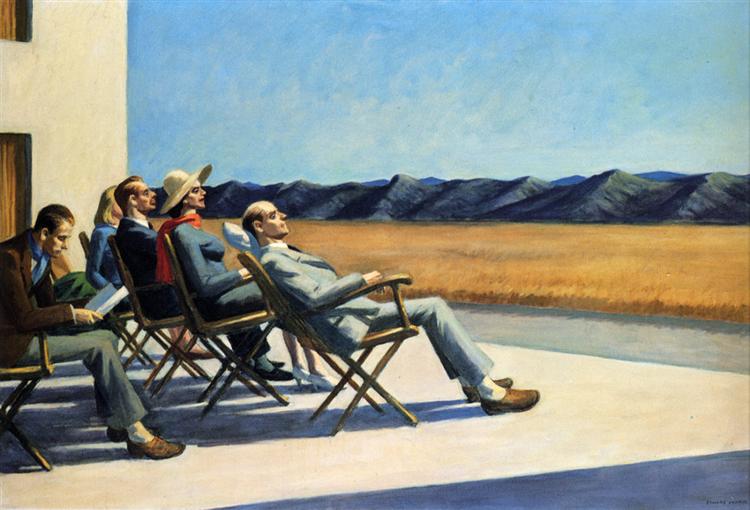
The freighters on the right side of the canvas heading to the harbor follow the path that brought Dilsey’s ancestors to Charleston as beachcombers loll about, attempting to darken their skin. The woman lying on her stomach between the two freighters seems to be developing a sunburn. These folks remind me somewhat of Edward Hopper’s People in the Sun, though they’re much more rigid than Balentine’s more relaxed and fleshy beachgoers. 

Cargo II is truly a beautiful, thought-provoking painting. I absolutely love it.


[1] Generally I’m not one to lob f-bombs, but the phrase “the fucked up Compson clan” sounds so right you can almost dance to it, and I can’t think of a more apt word to describe their situation. . 

[2] Okay, let’s start with Benjy, the thirty-three-year-old castrato with an IQ in the teens; then there’s his banished sister Caddie and her neglected way-damaged teenaged daughter Quentin, named for the Compson son who drowned himself at Harvard. The youngest brother Jason makes Bull Connor look broadminded. And, lastly, maybe the worst mother in American literature, the matriarch Caroline Compson, lying in dark rooms huffing on camphor day and night in a wallow of self-pity.

Sunny Kafka

Look, I’m proud to claim the name Kafka and to share with Franz a common ancestor. I blame my mother, not him, for the absurd pairing of my names. Sure, it’ his fault that my last name is synonymous with dark unfunny gummed-up absurdity, with torture machines, with crushing heartless totalitarian bureaucracy. You hear Franz Kafka and you think hellscape, but it’s not like Cousin Franz consciously set out to make that his legacy. I doubt he’d be happy to know that thanks to him our family name has mutated into a negative adjective, the suffix esque attaching itself like a cancer to the Czech-German word Kavka, which means “jackdaw.”[1] It’s my mother’s fault; she should have known better to turn my names into an oxymoron.

To me, Jackdaw sounds sort of cool, like a bird baked in a pie fit for the king. And as it turns out, jackdaws are avian, crow kin found in Africa and Eurasia.  They’re famous for nesting in towers and ruins and also for taking bright objects back to their nests.[2]  Although not as black or glossy, they look a lot like carrion crows. Hey, it could be worse. My mother could have named me Carrie Crowe, Carrie short for Carrion.

Could have named me that because, weirdly enough, my father’s name was (or is) Crow but without an “e.” So I come from crows on both sides – ha ha! He was an Indian of the reservation variety and split forever before I was born, so my retro hippie mother laid her last name on me and slapped the adjective “sunny” in front of it. That’s exactly what it reads verbatim on the birth certificate, Sunny Kafka, just those two names, not even a middle initial.

She says she named me after the girl in the song “Sunny.” If you haven’t heard it, you can listen to it in the YouTube below.  Sounds like parakeets and canaries. Chirpy. I’m more of a jackdaw caw-caw Tom Waits, Velvet Underground kind of gal. She should have named me Cloudy Kafka.

I hope I don’t sound too whiny. To tell you the truth, my name’s rarely an issue. After all, I’m a bartender on Folly Beach.[3] Only a skinny fraction of my customers have heard of Franz Kafka, much less read him, and I suspect not a single one has “Kafkaesque” in their speaking vocabulary, though a few might know what an oxymoron is.

Which reminds me.  I met a guy at Snapper Jacks who taught English at Trident Tech. When he asked me what my last name was, I told him, and he smiled but didn’t say anything after that, so I broke the awkward silence by squawking, “So I’m a walking oxymoron – Sunny Kafka!”

He chuckled and said, “Pleased to meet you, Sunny Kafka,” then launched into a tedious mini-lecture on Kafka’s being the great great grandaddy of Groucho Marx, Woody Allen, Larry David, and especially Richard Lewis. I guess I had a sour look on my face because he interrupted himself and asked if I was Jewish.

“Do I look Jewish?” I asked in my trademark snarky tone.

“How should I know? I’m blind as a bat.” 

He took off his sunglasses. 

He looked like a white Willie McTell or a thirty year old Doc Watson, squinty-eyed. By the way, did you know that Roy Orbison wasn’t really blind?


[1] And if you, listen, they do sound somewhat alike, both two syllables, accents on the first, the vowels rhyming sort of.

[2] I’m picturing a sepia-tinged abandoned Albanian factory, krow-like kafkas (sic) flitting out of its windows like black tears but coming back with Rubrik cubes in their beaks.

[3] I’m not making any of this up. Charlie Marlow’s my man. I wouldn’t lie to you.  

The Moore Brothers, Ridiculous and Sublime Edition

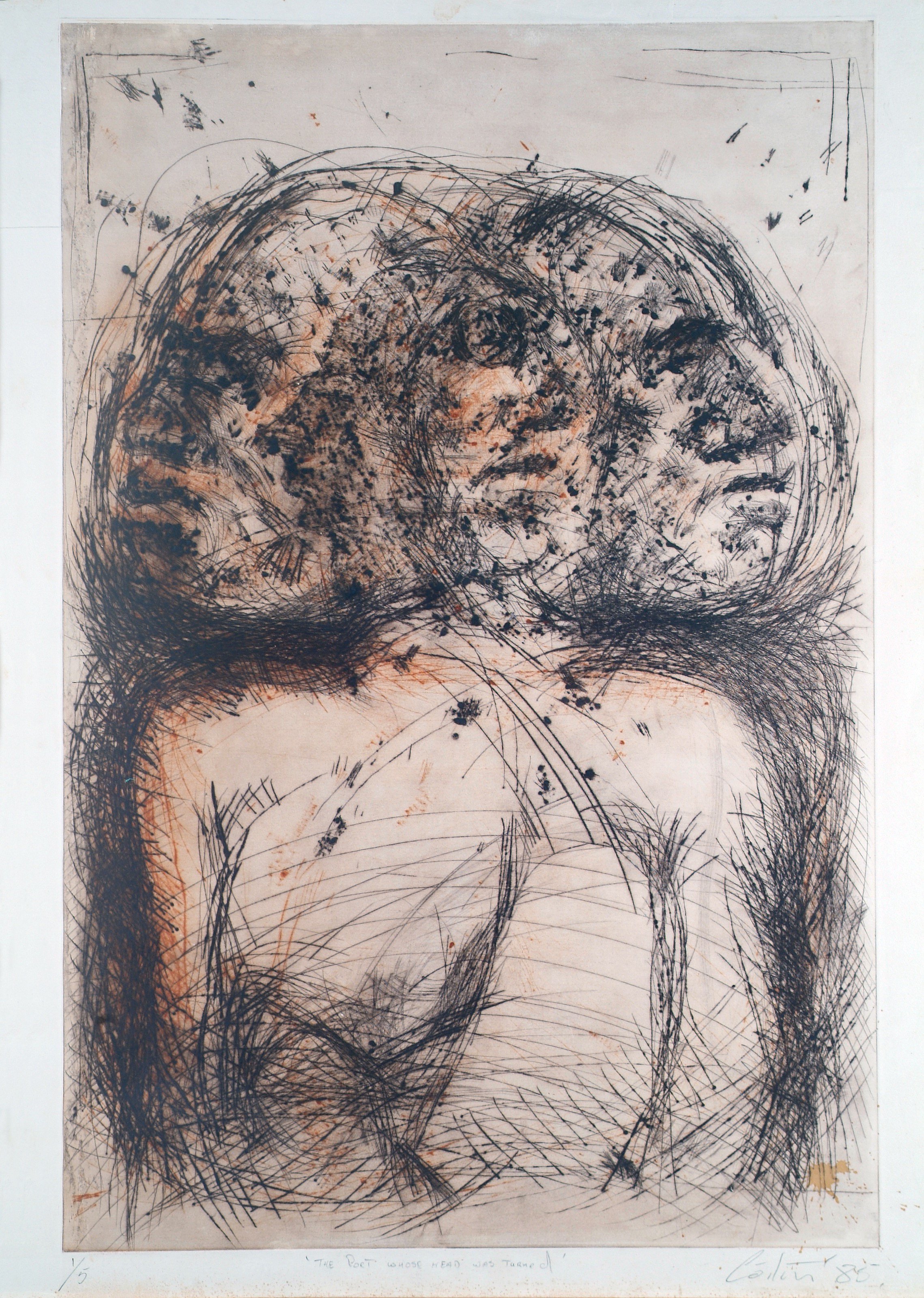
Self-portrait as a Bobble Head

Last night, the Moore Brothers, Fleming and Wesley, performed at George Fox’s Chico Feo Music Extravaganza. The elder Moore, Wesley, his head bobbing like, well, like a Bobble Head, recited his poem “Roaring Twenties Redux.”

Wowee, pretty silly.

Roaring Twenties Redux

O O O O that Shakespeherian Rag—
It’s so elegant
So intelligent

TS Eliot, “The Waste Land”

One-two-three, one-two-three, ow, uh, alright, uh!

Wilson Pickett, “Land of a Thousand Dances”

Once this pandemic is done, y’all, people gonna be hollering siss-boom-bah, packing the tattoo parlors, barbershops and bars, macro-dosing, doing the Hedonism like it’s wa-wa-tusi, dancing on tables, dancing in the streets, there’ll be swingin’ and swayin’ and records playin’, live bands blasting covers past curfew, PO-lice sirens wailing and blue lights swirling, sweatpants discarded, shimmering gowns flowin’, flasks flashin’ in the comet light of the apocalyptic party, alack and alas and all that jazz!


Brother Fleming, on the other hand, teamed up with Robert Lighthouse and David George Sink for a moving tribute to the Charleston Nine.

Here’s an excerpt:

As our late mother was won’t to say “There’s no accounting for taste.”

Roaring Twenties Redux

Photoshopped by I-and-I

Roaring Twenties Redux

O O O O that Shakespeherian Rag—

It’s so elegant

So intelligent

TS Eliot, “The Waste Land”

One-two-three, one-two-three, ow, uh, alright, uh!

Wilson Pickett, “Land of a Thousand Dances”

Once this pandemic is done, y’all, people gonna be hollering siss-boom-bah, packing the tattoo parlors, barbershops and bars, macro-dosing, doing the Hedonism like it’s wa-wa-tusi, dancing on tables, dancing in the streets, there’ll be swingin’ and swayin’ and records playin’, live bands blasting covers past curfew, PO-lice sirens wailing and blue lights swirling, sweatpants discarded, shimmering gowns flowin’, flasks flashin’ in the comet light of the apocalyptic party, alack and alas and all that jazz!

Robert Lighthouse, Swedish Bluesman Extraordinaire

What do you think of when you think of Sweden? Viking ships? Ingmar Bergman? The Girl with the Dragon Tattoo? The blues?

The blues? What in the hell am I talking about?

I’m talking about Robert Lighthouse – nee Ivan R. Palinic[1], the Swedish blues guitarist who at the tender age of fourteen heard an Alan Lomax field recording of Muddy Waters – boom – Road to Damascus. Farewell, Nazareth, hail, Dr. Ross, John Lee Hooker, and Jimi Hendrix.

“Muddy ’67” photograph by David Gahr

I chatted with Robert in bright sunshine on our dock yesterday before his gig at the Singer/Songwriter’s Soapbox at Chico Feo, the best free music you’ll find in anywhere in what once was called Tri-County Area.[1]

Prompted by my questions, Robert related a CliffNote summary his life: moving to the States at eighteen, playing for tips on DC street corners, getting discovered by Charlie Sayles, the one-eyed harp master (who also got his start in music playing for tips on street corners).

Charlie Sayles

Robert toured Belgium and Holland with Charlie’s band and ended up landing a record deal of his own. His critically acclaimed first album, Drive-Thru Love, available on Smithsonian Folk Ways Recordings[2], includes both covers and originals. In addition to his second record, Deep Down in the Mud, Robert also appears on the Folkways compilation 1996 album, The Blues You Would Just Hate to Lose, Vol. II.  He has shared a stage with Dr. John and opened for Taj Mahal and Johnny Winter, whom Robert describes as a man of few words but many bong hits.

The pianist/blues impresario Gary Erwin (aka Shrimp City Slim) recruited Robert to appear at blues festivals in Camden, Greenwood, and Charleston, and somehow, Robert and my brother Fleming met, and, the rest, as they say, is history.

If you ever get the chance, check him out.

Here’s a clip of his version of the Charlie Patton tune “Rattlesnake Blues.”

And him warming up at Chico Feo last night (8 March 2021)

photo credit I-and-I


[1] That be Charleston, Dorchester, and Berkeley Counties. The Soapbox runs on Mondays from 6 to 10. Be there are be square.

[2] How cool to share a label with Woody Guthrie, Pete Seeger Leadbelly, and Dave Van Ronk. I made the mistake of clicking on their website and see a Lord Lavender calypso record I can’t live without.


[1] Robert tells me that his surname, which is Croatian, means fire-starter, as in arsonist, so he anglicized it to “Lighthouse” in the sense of setting a house on fire, not in the sense of guiding sailors safely to shore. 

Sure, I’m a Marxist

During the 50s and 60s, my grandmother’s television, a small black-and-white model perched on a metal stand, played constantly, both day and night, commencing with Dave Garraway’s Today Show and ending with Jack Paar’s Tonight Show[1]

When I spent the night with Mama Blanton, she allowed me stay up as long as I could keep my stinging eyes open. As a young child, I fought sleep as if it were an enemy, as if it were death itself. At home, I had to be in bed by 7:30 on weekdays and nine on weekends, so I always looked forward to staying over at Mama Blanton’s on Saturday nights and watching those old black-and-white movies, which seemed in my naivety ancient artifacts from a more glorious age.[2]

When I was five or six, I recall watching a Marx Brothers movie – probably Duck Soup – and making it past midnight. The Brothers’ antics enthralled me, especially horn-honking Harpo. I struggled mightily that night to stay awake but eventually succumbed to the Sandman’s strangle hold. Mama Blanton let me sleep on the couch until the movie ended, then led me, shuffling like a blind boy, to bed. I can’t recall if I realized then that the Groucho in the movie was the same Groucho (now twenty years older) who hosted the gameshow You Bet Your Life. However, I do I remember some time after the movie purchasing one of those Groucho masks featuring glasses, nose, eyebrows, and mustache.

I didn’t see another Marx Brothers’ film until college when my high school friend and Citadel cadet Gene Limehouse visited USC for a weekend.  High on whatever, we decided to catch a matinee screening of A Night at the Opera at the Russell House theater in the student union building. Fifteen or so years had passed since that first taste of manic Marx Brothers madness at Mama Blanton’s, but once again, I was laughing out loud, though now appreciating more than the slapstick, taking note of the verbal cleverness and also the mockery of the upper classes, most deliciously, Groucho’s offering a tuxedoed opera attendee a tip for retrieving his top hat that had fallen from the balcony. “Go buy yourself a stogie,” Groucho says, leaning over the railing and offering the fuddy-duddy a coin, which he refuses in a huff.

Yet another fifteen years later when I taught AP English and we studied Marxian criticism, I’d show A Night at the Opera on the week of Porter-Gaud’s musical, offering exhausted students a reprieve of sorts. I’d explain how the promotion of the impoverished tenor, the rollicking fun the peasant passengers below deck enjoy on the trans-Atlantic voyage (as opposed to the stiff stiltedness of the first-class passengers), and the Marx Brothers’ revolutionary takeover of the performance of La Traviata conform to Karl Marx’s theories.

Although students back then – perhaps still do – balked at anything in black-and-white, the classes eventually got into it, sometimes applauding at the film’s conclusion.

A Night at the Opera, Marx Brothers’ movie with a Marxian message.

At any rate, I appreciate my grandmother’s liberality in allowing me to wander into her late-night adult world and watch movies not not necessarily suited for children, a benefit I passed along to my boys when they were growing up. 

Despite the clucking of a few disapproving tongues at the time, I’d say we turned out okay.


[1] I remember the local NBC station’s signing off with the National Anthem, followed by a short film featuring the poem “High Flight,” and then an announcer’s canned spiel about kilowatts and licensing. That done, the Indian head test pattern appeared with its accompanying high-pitched whine. Finally, exactly at one a.m., a blizzard of static would obliterate the test patten. Time to go nighty-night.

[2] Ironically, many had been filmed during the Depression.

Open Mike Community Spotlight

Captain Phil (You Can’t Keep a Maimed Man Down) Frandino

If you live within thirty miles of the Edge of America and can afford to party on Monday nights, you owe it to yourself to take in the Singer/Songwriter Soapbox held at Chico Feo from six to ten.

This event, hosted by the killer musician and songwriter George Alan Fox, showcases an eclectic array of music makers and poets, not only rockstar wannabes, but established entertainers like Danielle Howle and Robert Lighthouse.

The sessions have led to community building on Folly the likes I’ve never seen. Caroline and I I have met so many talented musicians –  Pernell McDaniel, Jeff Lowry, and Captain Phil Frandino, for example. Plus, I’ve developed a greater appreciation for talents of people I already knew, like Charlie Stonecypher and his funky ukulele (complete with wha-wha pedal), and now I’ve developed an even greater appreciation of the deep and soulful poetry of my pal Jason Chambers. Not only have the performers grown closer with each other, but they have also formed friendships with the audience as well. The word family is overused, but it is sort of like that, like distant cousins at a family reunion.

Last night the guitarist David Sink sat in with the acts, and man, oh, man. 

The first clip features George Fox performing a lovely original song “Books, Seeds, and Bullets” inspired by the Singer/Songwriter Soapbox.[1]


[1] And what an honor have my name mentioned in the lyrics.

video shot by Fleming Moore

Next some solo guitar work by David Sink at the end of Brother Fleming Moore’s paean to marital discord, “Busted Husband.”

Oh yeah, and Pernell McDaniel was in the house selling copies of his new CD. More about that later!

Excerpt from Today, Oh Boy – in the Principal’s Office

photograph by Joseph Szabo

A loud electronic crackling.  The red light of the intercom has flashed on. Never a good sign.  Every class has one, a rectangular speaker box mounted somewhere on the wall.  Another crackle. 

Speakerbox: (crackle) Miss Turlock, Principal Pushcart. Is Alex Jensen in your class?

Miss Turlock: (looking up at the intercom, addressing it as if a person) No sir. It was my understanding that he was there with you.

Speakerbox: Who told you that?

Miss Turlock: Althea Anderson.

Speakerbox: By any chance is Rusty Boykin in your class?

Miss Turlock (still looking up, still addressing the intercom): Yes sir. He’s sitting right here working on a drawing.

Speakerbox: Send him to me. Stat!

Miss Turlock: Yes sir.

Speakerbox: (crackle)

All pencils, brushes, kneading hands have halted. Rusty’s on his feet, a look of panic stamped on his freckled face. James Hopper glances at Althea, who is frowning. Rusty casts a rueful glance at his crude rendering of the digestive tract lying next to his open Biology II notebook with its hurried, smudged, barely decipherable and misspelled anatomical terms. Then he looks up and encounters Miss Turlock’s sympathetic, blunt, open features. 

“Run along, Rusty. You can leave your things here for now. “

“Okay,” he says, oblivious to the students’ staring faces, oblivious to the clay torsos, oblivious to the smell of paint, oblivious to the splattered tile, oblivious to the silence.  He’s pushing open the door and stepping into the cool autumn air, oblivious to the yellow disc of morning sun suspended above distant loblolly pines. He’s deep, deep, deep inside the auditory darkness of a cave of dread where an echoing voice catalogs his various crimes and misdemeanors: smoking marijuana; drinking beer; mocking (though behind their backs) administrators, teachers, students, the Mighty Green Wave, Congressmen, Senators, Vice Presidents, Presidents, television shows, movies, Judeo-Christian Deities; purchasing and hiding Playboy magazines as visual aids in acts of self-pollution; masterminding a high stakes scheme to run away from home; receiving stolen goods in accordance with the above-mentioned scheme; not living up to his potential . . .

As an elementary student, if he had been called to the office, Rusty might have feared that someone in his family had died or that he was being summoned to receive an award, but his name in conjunction with the initials AJ can only mean trouble. He’s forgotten his signature walk, the freak flag flop, and leans forward, head down, oblivious to the pebbly paving beneath his high-top Converse All-Stars.  In the thin cavity of his chest, his heart pounds like timpani as he reaches for the cold handle of the main building’s outer double doors. The hall is virtually void, the only sound clacking heels, out of sight, dopplering into the distance.  His hand shaking, he grips the handle of the glass doors of the administrative offices, pulling outward. 

In the bright florescent light of the outer administrative office, he recognizes immediately that the employees are in an everyday mode. No one has died. No uniformed policeman with badge, billyclub, and handcuffs glowers in a corner waiting for him. Rusty clears his dry throat and approaches Miss Cartwright sitting at a desk next to Principal Pushcart’s door. As he nears her desk, a tiny pink bubble puffs out from her lips, then pops.

 “Mizz Cartwright,” he says, his voice unsteady, “I think Principal Pushcart wants to see me.”

“Now that’s an interesting shirt,” she says coyly, snapping the gum. “Where’d you get that?”  She’s dressed in a yellow alpaca V-neck sweater and a kelly green skirt, the official school colors.                 

Rusty had forgotten all about his shirt, a new acquisition, part of a service station uniform with the name “Buddy” stitched in an oval on its breast. It’s sure to exacerbate whatever vitriol’s brewing in Pushcart. Rusty realizes he’s left his Mr. Zig Zag denim jacket back in the art room, which is probably a good thing.

 “Uh, I got it from Buddy.”

  “Good ol’ Buddy,” she says smiling. “Mr. Pushcart and Mrs. Laban are expecting you.”

  She gets up and cracks open the door. “Mr. Boykin is here,” she says into the crack.

  The muffled bark of a drill sergeant.

  “Go on in,” she says.

The door creaks open squeakily like a coffin lid in a Christopher Lee movie. Sitting, leaning forward with his palms down on the surface of his desk, Principal Pushcart looks as if he might be on the verge of doing a hundred or so push-ups. Sitting across from him, looking over her shoulder, a frowning Mrs. Laban pumps her crossed leg like crazy.

“Yes, sir?”  

“Have a seat, son.”

There is an empty chair next to Mrs. Laban, a wooden chair, upholstered in some sort of dark green leather-like synthetic something-or-other, the kind of fabric (maybe fabric) that sticks to the back of your thighs when you’re wearing shorts in the summer. Principal Pushcart removes his right palm from the desk like some gangster in an old movie and positions it palm-up, sweeping it in a downward motion towards the chair as he nods his head in mock gentility. Across his pink scalp strands of brownish gray flimsily stretch to feebly hide his encroaching baldness. Rusty, dropping into the chair, sighs audibly in tune with the upholstery, which also sighs.

 “Now, Blanton,” he says, using Rusty’s baptismal nomenclature. “I want you to promise to tell me the truth.” The intonation isn’t all that unfriendly.

 “Yes sir,” Rusty says automatically. He’s a terribly inept liar anyway. 

 “You know,” Pushcart says, “that AJ was dismissed from homeroom to come to my office.”

 This is an easy one. “Yes sir, I was in homeroom this morning.”

 “Tell me. What did you think of the events of this morning?”

 “Think, sir? I’m not sure I thought anything.”

 “You didn’t think it was funny?”

 “I wasn’t paying all that much attention. I was sort of preoccupied. I have this really big Anatomy test today.” He looks over at Mrs. Laban for encouragement, but her features have hardened into a Madame Tussaud’s mask of unalterable unhappiness: Lucretia Borgia displeased with the consistency of her soft-boiled egg.

“Did you know that AJ hadn’t come to the office?”

 “No, sir.  Not till the announcement over the intercom.”

  “Any idea where he’s at?”

Rusty successfully stifles the impulse to say, “Behind the preposition.”

  “I dunno,” he says instead.  “Home, I’d guess. His daddy’s office maybe. I dunno.”

  Pushcart can see the little son-of-a-bitch is telling the truth. “Son,” he says, “are you aware that you’re out of dress code?”

  “It wouldn’t surprise me. I guess my hair might be.”

  “Where’s your pride, son?”

Rusty doesn’t begin to know how to answer this.  A trick question?  Of course, he possesses pride, that doom-laden quality that they talk about in English class every year, the moral failing that forces Antigone to break the burial edict, Ahab to pursue the great white whale, Macbeth to go all Charlie Manson on his kinsman Duncan.  

“I dunno, sir,” he says. “Yes and no. You know Alexander Pope called pride ‘the never-failing vice of fools.”’

As soon as the words are out of his mouth, he wants them back.  

“What!?”

“Nothing.”

“What did you say?”

“I meant sometimes pride can be a bad thing, so I was hesitant to admit I had some.”

“Well, Mr. Philosopher, I’m sending you home to get a haircut and to change that shirt. The dress code is rules, son. Not suggestions. Rules. When you look presentable, you come back here to report to me before you resume your education here at Summerville High. Consider it a suspension. Zeroes on all work missed.”  

“Yes, sir,” Rusty says. 

“I suggest you hurry.”

“Yes sir.”

 When he’s out the door, Paul looks over at Eula Lynne and asks, “What period is his anatomy test?”

 “Fourth.”

 “Well, then,” he chuckles. “I wish him God’s speed.”

“That secretary of yours is almost as bad as the kids. Out there chewing gum.  I don’t know about that, Paul.  It sets a bad example. . . ”