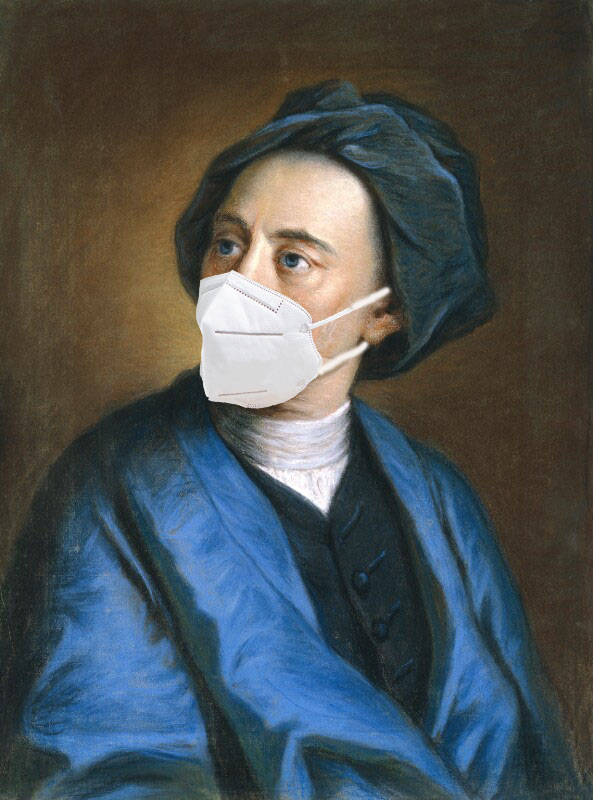
Of all the causes which conspire to blind. Man’s erring judgement, and misguide the mind, What the weak head with strongest bias rules, Is PRIDE, the never-failing vice of fools.”
Alexander Pope, “An Essay on Criticism”
Is it really, really such an odious task during a pandemic to put on a mask?
In the Trump White House, no mask is the rule, Targeting the base, those Kool-Aid mainlining fools.
Masks remind voters of the invisible dread That’s left more than 200,000 Americans dead.
What dat? Sistah Karma done come a-calling unexpected? Kayleigh and Kellyanne done been infected?
Along with Thom Tillis, Hope Hicks, Mike Lee, not to mention Donald J Trump and the First Lady?
Do Lawd! White House itself got more cases than New Zealand, a country of just under five million people?
So is it really, really too much to ask in a goddamn pandemic to put on a goddamn mask?
Okay, as I write this, President Trump languishes at Walter Reed Hospital battling a virus he claims was a “hoax” and would “magically disappear.” Four years ago, he mocked Hillary Clinton’s locomotion and coughing as she suffered from a short-lived bout of pneumonia.
Ironic? Karmic? Or both?
I like to think of karma and irony as a sort of comedy duo, a married couple, Karma, the female more powerful and profound, and Irony as male, wisecracking, cynical. They travel hand-in-hand around and around the crumbling empire of post-Modernism, she acting, he reacting, she detached, he involved. It’s a symbiotic relationship that can help educate us about the benefits and perils of good and bad behavior, so it’s helpful to be able to distinguish one from the other, to discern their similarities and differences.
Trump Mocking Hillary’s Pneumonia
Irony, of course, is often misunderstood, mistaken for coincidence, as it is throughout the Alanis Morrisette song “Ironic.”
[Irony’s] like rain on your wedding day It’s a free ride when you’ve already paid . . .
Of course, precipitation on your wedding day isn’t ironic, that is, unless it’s a destination wedding in the McMurdo Dry Valleys of Antarctica.[1] A free ride when you’ve already paid isn’t a free ride. The song “Ironic” isn’t ironic, which stupidly makes it sort of ironic.
Bone fide irony is all about incongruence, the discrepancy between expectation and reality.
I sometimes run across the phrase “irony is dead” when a commentator is highlighting some blatant act of ignored hypocrisy. However, the failure of people to perceive the incongruences that create irony doesn’t mean that irony is dead; it merely demonstrates that irony is dead to them.[2]
Yes, Trump’s calling a disease that smites him a hoax is somewhat ironic, only somewhat because you might not be surprised that a foolish man who flips off science ends up regretting it. However, it is ultimately ironic because, unlike rain on a wedding day, getting ill from a virus you claim is a hoax is incongruent.
What’s not ironic is that Trump’s flaunting of safety protocols, like not wearing masks and eschewing social distancing, has resulted in his infection. That’s karmic.
Karma, कर्म in Sanskrit, means action; karma’s all about cause and effect, as in the cliche “what goes around comes around.” Is mocking Hillary’s illness the reason Trump’s now fallen ill? Is it karmic? Only in the sense that it’s indicative of his modus operandi of defying human norms of decent behavior, of embracing a hubris that distorts his perceptions of reality, of cultivating a false sense of invulnerability. Actions such as these will eventually, as the vulgar say, “come and bite you in the ass.”
[2] I remember fondly Misahn Bootay’s response Donald Trump’s tweet proclaiming “The Democrat [health] plan would obliterate Obamacare” during the 2016 midterm elections:
“Not only is irony dead,” he tweeted, “but it’s grave has been dug up and it’s been dressed in gaudy finery and paraded through the streets like the decaying corpse of a medieval pope.”
I wondered the other day is there’s even such a thing as “conservative poets” anymore.[1]
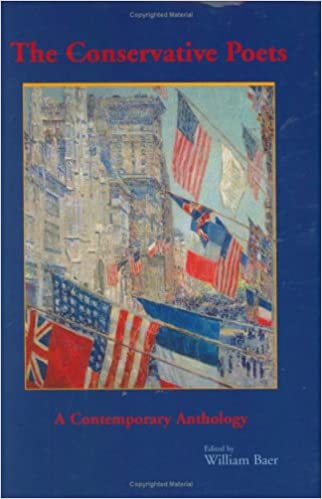
Well, it didn’t take me long to discover an anthology entitled The Conservative Poets: A Contemporary Anthology, edited by William Baer, who offers this estimation of the contemporary literary landscape:
Although it often seems that liberals and the radical Left have assumed complete hegemony over the arts, especially the literary arts, there exists a remnant of very talented American poets who create beautiful, serious, witty, moving, and diverse poetry from a conservative point of view. This unique anthology illustrates the wide range of these determined and sometimes defiant artists, who hope that their work will encourage more like-minded Americans to learn the poetic craft and pursue the literary endeavor.
By the way, Baer is a genuine scholar. Here’s his bio from Amazon:
WILLIAM BAER is the author of ten books, including ” ‘Borges’ and Other Sonnets”; “Fourteen on Form: Conversations with Poets”; “Luis de Camoes: Selected Sonnets”; and “Writing Metrical Poetry”. The Founding editor of “The Formalist: A Journal of Metrical Poetry” (1990-2004), he is currently the director of the Richard Wilbur Poetry Series, the poetry editor and film critic for “Crisis,” and a contributing editor to “Measure.”
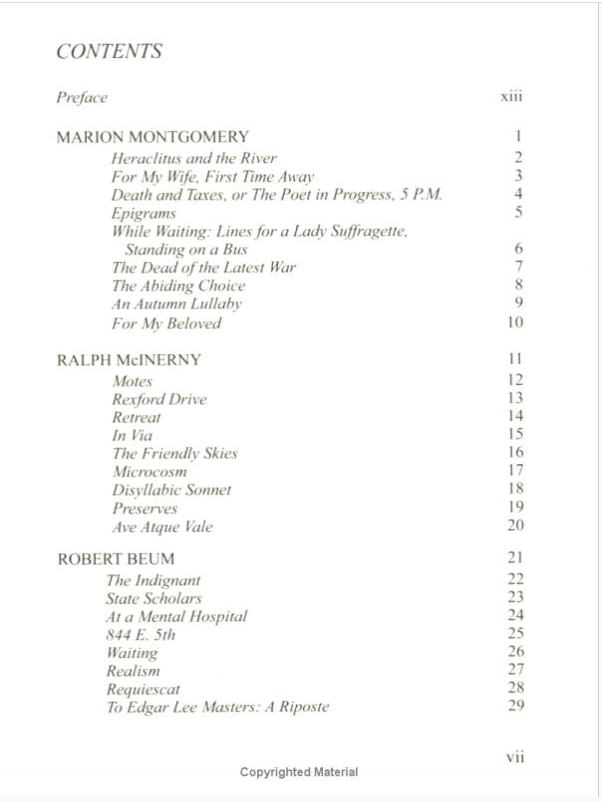
Here’s a screenshot of the table of contents.
I tried to track down some of these poets, only to discover most had, to quote Richard Wilbur himself, “gone from this rotten/Taxable world to a standard of higher living.” The late Marion Montgomery’s “While Waiting: Lines for a Lady Suffragette, Standing on a Bus” certainly seems to adhere in some ways to an antifeminist’s view of what Montgomery might call the “fair sex.”
Ah, Lady. Ah. It is a stirring sight.
Franchisement by the gods is now complete.
You now have won the inalienable right
Of standing on your own two feet.
Alas, Montgomery checked out of this Motel 6 of Sorrow in the penultimate year of W’s second term, so it would not be accurate to name him as a conservative poet writing today.
Editor Baer in his preface admits that most of the anthologized poems’ conservatism lies in their traditional forms rather than politics, but adds, “Some, myself included, would even tend to see meter as a poetic representation of the provident order of God’s universe.”[2]
So I continued my search and found a website from 2016 called Scholars & Writers for America. Beneath its banner this: “Given our choices in the presidential election, we believe that Donald J. Trump is the candidate most likely to restore the promise of America, and we urge you to support him as we do.”
Scrolling down my screen past names like Burton W Folsom, Jr., author of The Myth of the Robber Barons and Steve Mosher of the Population Research Institute looking for a poets or novelists, I discovered, to my delight, at the bottom of the screen, Thomas C McCollum, novelist.
Here’s the second paragraph of text from McCollum’s website, from an article by Louise Cook, the editor of Absolute Marbella Magazine:
If one were to view all aspects of Thomas McCollum’s professional and avocational life, one might be very tempted to call him a Renaissance man–albeit with a strong entrepreneurial bent. Wisely McCollum leaves all such pretentions to others, preferring the doing rather than the talking about.
What follows is a most-interesting-man-in-the-world litany: Can-Am racing, bull running in Pamplona [Spain she helpfully adds], man-eating crocodile hunting, a golf-addiction, insurance sales, original pen and ink drawings street-corner sales, med-school matriculation, med-school abandonment, medical laboratory founding, medical laboratory selling, retirement to Marbella, Spain, “to live out all the fantasies of his youth. He has camped, safaried, and traveled to every continent on earth.”[3]
McCollum has published four novels: Whipsocket, Tainted Blood, Palmer Lake, and Uncle Norm.
Here are the first and last sentences from Publisher Weekly’s review of Tainted Blood.
Readers willing to suspend disbelief beyond belief may find McCollum’s first novel an interesting medical thriller; others will be dismayed by characters manipulated by incredible plot contrivances.
McCollum makes the medical details microscopically authentic, but too many standard diatribes against government agencies, characters who speak polemic as often as they do dialogue and a conclusion that’s painfully anticlimactic render a hot topic tepid. (my italics)
Now compare that MSM review to this one for Uncle Norm from Christopher Feigum, Grammy Award winner and Metropolitan Opera Singer:
“Thomas McCollum has delivered a book of operatic proportions…a tale full of intrigue that tempts us to explore the what ifs of life and the possibility of encountering one profound love. Whether he is delighting pygmies with donuts or sharing his smuggled discoveries along the way, Uncle Norm is a warm, comical hero deeply connected to his fellow lost soul in the Congo, Ottobah Cuguano, and their shared faith in everlasting friendship. As they strive to break down racial barriers and transform the world, their adventures amaze the restless traveler in all of us. This timely piece is a declaration that we each have the choice to leave behind a better place than we found.”
Oh, yeah. There is also this snippet from of all places, Publisher’s Weekly describing Tainted Blood: “an interesting thriller…McCollum makes the adventure microscopically authentic.” Hmmm. “an interesting thriller . . . microscopically authentic.” Where have I seen that before?
So anyway, if you happen to be a Trump supporter who feels somewhat culturally isolated, there are indeed “conservative” literary artists out there working today, maybe not on the analogous level of Jon Voight and Bruce Willis, but they are out there.
[1] I don’t mean conservative in the old-fashioned sense of embracing traditional values and being skeptical of innovation, like Alexander Pope, but in its contemporary sense of someone rejects the Enlightenment and institutions of liberal democracy.