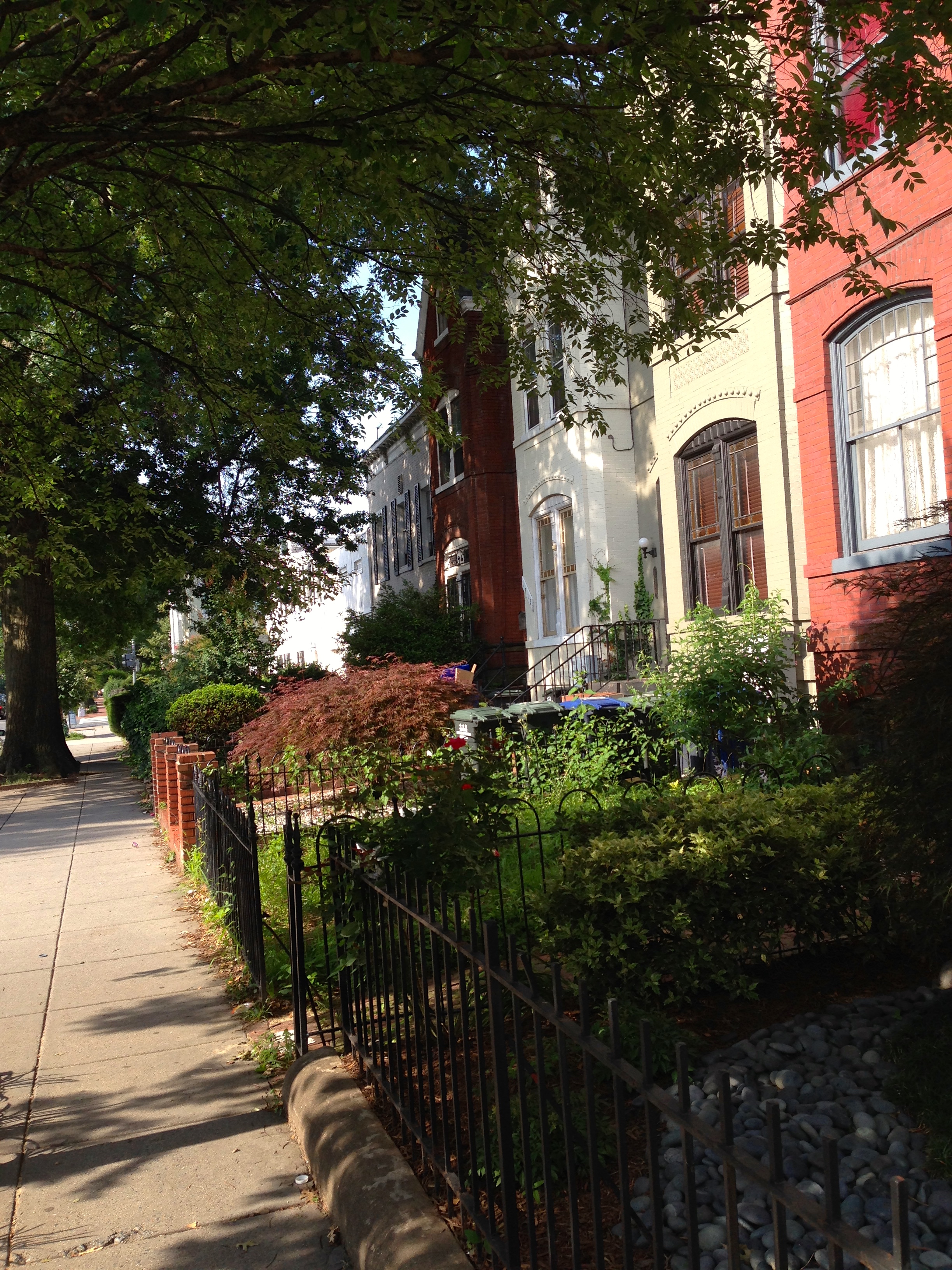
What a Dump!


kitchen-design-altrinchamaltrincham-road-wilmslow-northern-design-awards---friday-22nd-m4pgid2jI’ve lived in some spectacular dumps in my life, especially during my days as an undergraduate and graduate student.

For example, my bedroom in my first off-campus apartment was more or less the kitchen, the bed separated from WW2 vintage appliances by a breakfast bar. My housemate Stan had found the two-room apartment in late August in a subdivided two-story house on Henderson Street just up the hill from the Nursing Building that was under construction.

Actually, I had the premier sleeping spot because Stan’s bedroom was also the “living room,” the room you stepped into when you entered the apartment. Stan was the bassist in a band called Buddy Roe, and his post gig “friendships” offered me many opportunities to catch him and a companion in flagrante delicto as I returned from classes at the unholy hour of nine, ten, or eleven a.m., not to mention noon, or one, two, or three p.m.

I don’t know why we never figured out a sign on the door might have prevented my intrusions. Then again, a sign that read “Do Not Disturb” would more or less proclaim to the other occupants what was going on, but that still seems preferable to having your coitus interrupted.

Gas stoves, one in each room, provided the heat, and lighting those suckers for the first time proved a real adventure. One night I inadvertently destroyed Stan’s 300-plus LP collection. Need I mention that there were no sprinklers or fire escapes, that the wood was rotting, that the entire mold-ridden structure smelled like a cross between the River Styx and a long-enclosed attic?

where the Henderson Street house once stood

where the Henderson Street house once stood

Two years later, bulldozers would raze our Henderson Street house for a new university parking lot.

That year in my Milton class I met my next-to-be housemate, who enjoyed much nicer digs on Confederate Avenue. Mike not only was an excellent scholar, but he also owned furniture that looked downright bourgeois, so at the end of the spring semester, I returned to Summerville and put him in charge of finding us a place, which he did, seven miles from campus in a sturdy two-bedroom cottage nestled squeezed between two convenience stores on Fairfield Road, a four-lane highway.

Although the “space” was nice, as they say, getting to and from school meant riding city buses, and when the buses quit running at eleven, that meant hitchhiking or stumbling seven miles on foot through one sketchy urban area after another.

Praise Darwin, I survived.

Warren back in the day

Warren back in the day

That December, Mike left school suddenly after the first semester, so I teamed up with former sophomore roommate Warren Moise, and we moved into a miniscule mill house up North Main, even further away from school than Fairfield Road. The bad news was that the neighbors hated our long-haired asses. Once, in the wee hours when I was alone, someone banged meancingly on a side door of my bedroom that led outside.  I went out to investigate and heard someone whistling a tune. The Night of the Hunter meets Animal House. A couple of weeks later, a crew burglarized us, poured our food out onto the kitchen floor, and as a final, sociopathic touch, shat thereupon.*

We got the message.

Coincidentally, my former next-door neighbor from Henderson Street, Jim, was recruiting people for a great house he had found just off campus, so Warren and I went in with six others and rented 1879 Green Street, a veritable mansion compared to my previous domiciles. (It was a good bit seedier than it appears in the photo below courtesy of Google maps). Of course, only three were supposed to live there, but we never got caught. The house did get busted in a citywide drug sweep our second night there, but I wasn’t at home so could save my pre-trial intervention card for a later date. I will say, however, the officers from SLED left the joint looking a lot like the burglars had the mill house.

The very best news was that in my third year on Greene Street, I met Judy Birdsong, who, of course, lived in a nice apartment on Deerwood Drive, so my days of dire poverty were coming to a fruitful end.

The good news is that living in dumps is sort of romantic when you’re young and don’t know any better — and as long as you’re the only vermin living there.

*Forgive me; I’ve been abridging and editing Chaucer
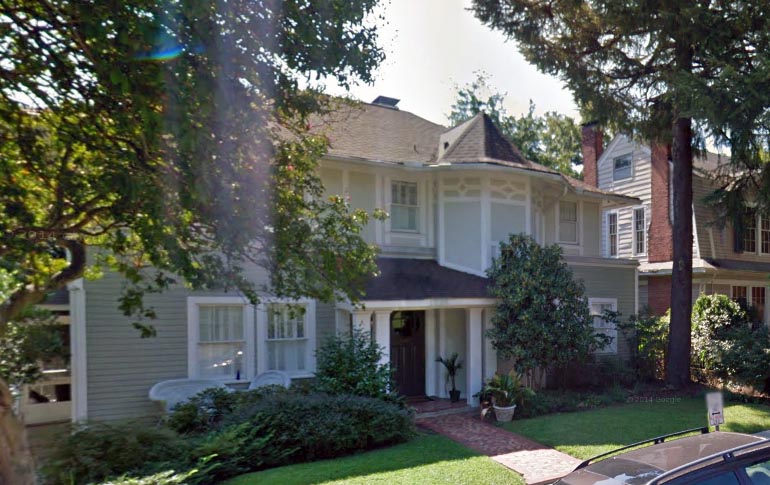
 

1867 Greene Street
1867 Greene Street

Coprophilia

04ae716c6996c460216f5229c0061626Coprophilia is a lovely sounding word, like mortician, cuspidor, fellatio, but, alas, denotes what most finger-wagging moralists would denounce as deviation, pathology, perversion.

Merriam-Webster, on the other hand, defines coprophilia matter-of-factly as “marked interest in excrement.” “Wolfman” Mozart and Jonathan Swift are two notables with whom we associate the word. If you’ve never read Swift’s “The Lady’s Dressing Room,” by all means do so. Click here.

I bring up this seldom used word because this afternoon as I was relaxing at Folly Beach’s most interesting outdoor square footage, Chico Feo, a lithe, attractive witty woman in her twenties upon exiting what Chaucer called a “privy” announced, “I like to describe my poop with movie titles.”

“Poop” was the word she used.

“For example,” she continued, “that was Children of Corn.”

I’m not making this up.

Tyler, the bartender said, “A River Runs through It.”

A bearded cat with a handlebar mustache: “Splash.”

The original woman: “The Nutty Professor.”

I would be proud for her to be the mother of my grandchildren.

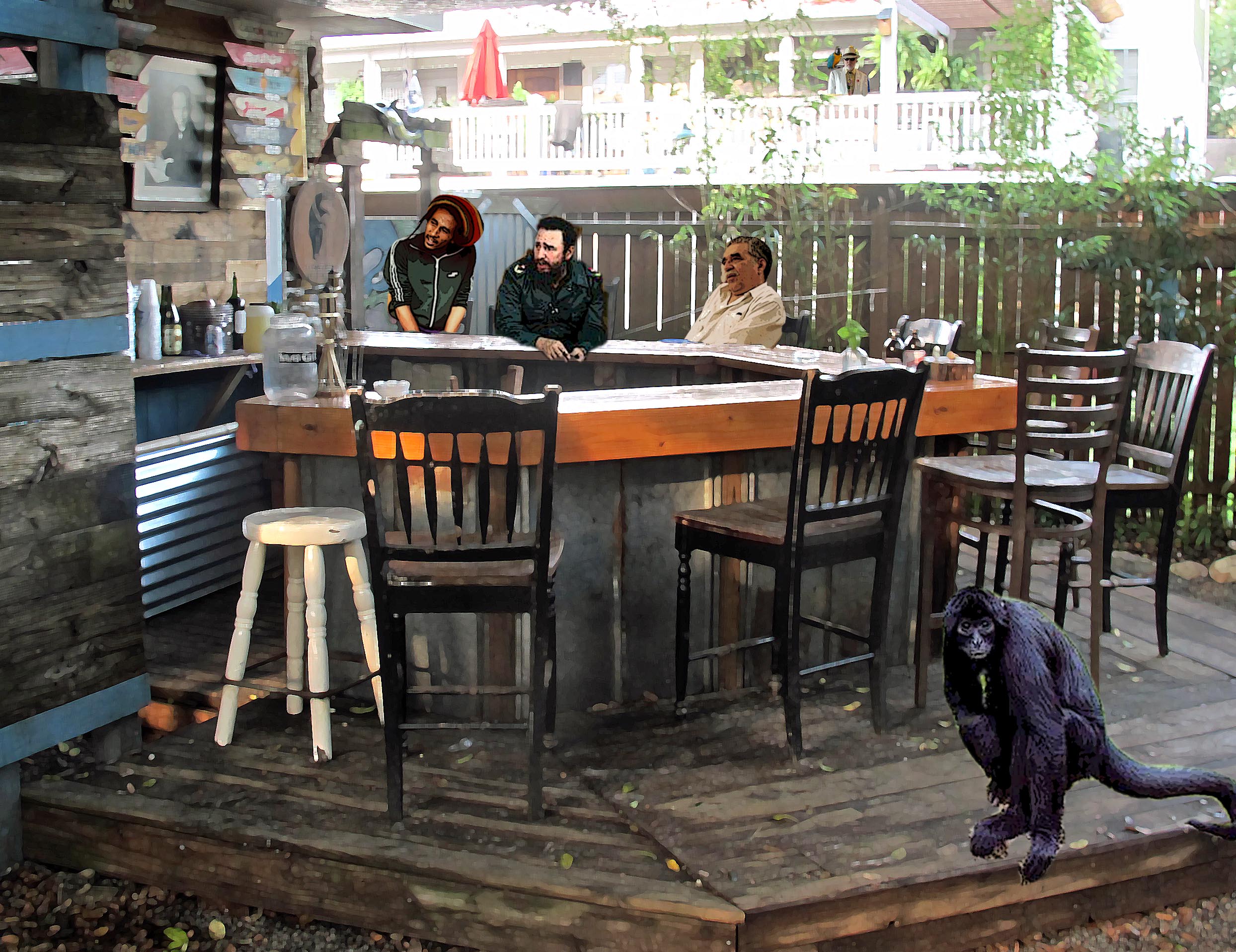
"Chico Feo in the Morning" a collage by Wesley Moore

“Chico Feo in the Morning” a collage by Wesley Moore

Atticus Finch versus Atticus Finch

BOOKLEE1-master180I’m not at all shocked that Atticus Finch, the “saintly” father of the narrator of To Kill a Mockingbird, ends up a racist in its just published sequel Go Set a Watchman.

As a matter of fact, Atticus is a racist in Mockingbird as well, albeit a benign racist who won’t allow his children to use the n-word but who does nothing to change the status quo of segregation in the tiny Alabama town where the novel is set.

In fact, I dare say that it would be very difficult to find a native Southerner born around 1900 who was not in some degree a racist.*  Although I was born half-a-century later, the doctor offices of my hometown had both “white” and “colored” waiting rooms. I never heard a soul complain, yet our townspeople weren’t monsters, merely benighted.

Being a racist didn’t necessarily mean you were overtly cruel or weren’t compassionate but that you held blacks to be inherently inferior and believed that the races should be segregated.

No one better exemplified the paradox of compassionate racism than my father.


*Perhaps we could make this charge to the nation in general.  Though no Southerner, Ernest Hemingway was certainly a racist, as his letters make abundantly clear.


image_07_01_040_coloredwaiting

* * *

One Easter Sunday as we pulled up to my grandmother’s house after church, a ten-year-old black boy approached our car and asked for some money to buy a pair of shoes because he had none to wear to his brother’s funeral. My father not only gave the boy, whose name was John-L, the money but also a ride home, and when Daddy discovered the utter squalor John-L lived in and that both his mother and her lover were “drunk as skunks,” he took John-L home with us where he lived for the next two weeks. However, despite this act of compassion, which made us very unpopular with our neighbors and me the target of racial taunts, my parents didn’t allow John-L to bathe in our tub.

It’s mind-boggling but true.

* * *

An admission: I’ve never been a fan of To Kill a Mockingbird, probably because I didn’t first read it as child but as a 32-year-old preparing to teach it to Reagan Era 9th graders.

It’s interesting that all the folks that are buying [To Kill a Mockingbird] don’t know they are buying a children’s book.

Flannery O’Connor

Although the novel effectively portrays the day-to-day lives of Depression-era smalltown Alabamans, the plot is episodic and the characters one-dimensional. For example, Mockingbird’s antagonist Robert E Lee “Bob” Ewell makes Simon Legree of Uncle Tom’s Cabin look like a saint in comparison. On the plus side, as Michiko Kakutani points out in her front page New York Times review of the new novel, in Mockingbird Lee masterfully manipulates Scout’s point-of-view, “managing the stereoscopic feat of capturing both the point of view of a forthright, wicked-smart girl (who is almost 6 when “Mockingbird” begins) and the retrospective wisdom of an adult.” This rendering of life through the eyes of a six-year-old no doubt influences the reader’s assessment of Atticus and somewhat masks his racism (and also explains why no one in the entire town seems to engage in sexual intercourse).

Coincidentally, yesterday Kakutani’s review shared space with a story about the removal of the Confederate battle flag from the South Carolina’s State House grounds. Perhaps Shakespeare’s Marc Anthony’s observation that “The evil that men do lives after them;/The good is often interred with their bones” holds true. At least Atticus got to enjoy 55 years of being considered “wise, honorable, an avatar of integrity,” words that very well might in some ways describe Bob Ewell’s namesake, the slave owner Robert E Lee.

The situation in the South was and is more complicated than the unsubtle strokes of black and white that Lee depicted in Mockingbird; it sounds as if her “new” novel reflects a more complex world, but then again, maybe not. Perhaps in Watchman Atticus is all-ogre all the time.

I guess I’ll have to read the book to find out.


Enjoying Genocide at the Drive-in

Apr_SheWoreAYellowRibbonLast night TMC broadcast the John Ford classic She Wore a Yellow Ribbon. This early Technicolor production relies heavily on the majestic vistas of Monument Valley located on the Arizona-Utah border. You might even go so far as to say the setting steals the show, more like the scenery chewing up the actors instead of vice versa.

The film came out in 1949, right about the time television started to invade postwar households. Ford and his cinematographer Winton Hoch, who won an Academy Award for the picture, make heavy use of long shots that exploit the incredible russet beauty of the landscape but also render the characters antlike in the grand scheme of it all. Seeing it on TV barely hacks it, even now with our current technology. Imagine what would be lost watching it back in the day on a black-and-white 16-inch screen Zenith.

1959-Zenith-16C20-17in

I remember first seeing the movie in the late 50’s with my parents, either at the North 52 or Flamingo Drive-in Theater. Until last night, all I recalled of the film was its invasive theme song and John Wayne’s character having conversations with his deceased wife at her graveside.

Those were the halcyon days before education when you could blithely curse the Arapaho, Cheyenne, and Kiawah for having the temerity to wander off their reservations. You could innocently celebrate the replication of their genocide as arrows whizzed, rifles thundered, and stuntmen tumbled from galloping horses.

large-3Going to Drive-ins offered working class families like mine a cheap night’s worth of entertainment. Kids under 12 got in free. My brother David and I would dress in our pajamas, Mama would pop popcorn at home, and we’d bring along our own Coca-Colas. Not only did we save money, but also my parents could chain smoke, which, along with the burning mosquito repellent, helped to diminish the chances of our contracting Malaria. Usually, David and I would conk out, so Mama and Daddy could engage in adult conversations without forking out money to a babysitter.

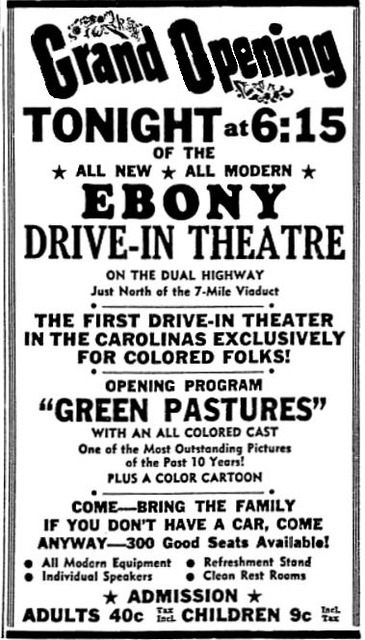
large-4The Flamingo had been originally called The Ebony and catered to, as the ad says, “Colored Folks,” but it only lasted less than a year. Its next incarnation was as the Bonny Drive-In, which was actually integrated, but this social experiment ended in less than a month. It reopened finally as the Flamingo and had by far the coolest sign, a neon-tubed flamingo that lit up in progressive sections over and over again on the back of the screen facing the highway.

West Ashley also had its drive-ins, the Magnolia, located at 1500 Savannah Highway, the present location of Rick Hendricks Chevrolet. There were others as well, the St Andrews Drive-In, also on Savannah Highway, the 4-Mile Drive-In on North Meeting Street Road, but I don’t remember them, nor do I recall the Sea-Breeze Drive-In on Coleman Boulevard in Mt. Pleasant. (You can read all about those lost treasures at this site, Special Feature: Charleston Area Drive-Ins).

I do, however, remember the Gateway, where we went as teenagers, not so much to watch movies but to risk our lives making out in back seats, because as anyone knows who has ever seen a B-horror flick at a Drive-in movie, teenagers necking in cars are the number one target of monsters, whether they be zombies, werewolves, or radioactive mutated reptiles.

Later the Gateway specialized in porn films, which no doubt led to more than one auto crash as drivers tooling across overpasses caught glimpses of the screen as they exited onto 52, which in those days was called “the Dual-Lane.”

Rumor has it that some of my high school acquaintances sneaked into area drive-ins by getting into surf bags and strapping themselves on surf racks on the top of VW buses. Of course, it wasn’t Coca-Colas they were smuggling inside.

I can’t say I pine for those long gone days  — in many ways they sucked . However,  I wouldn’t mind catching another John Ford film at a drive-in, though like last night, I’d be pulling for the Indians.

700px-Monumentvalley

Geoffrey Chaucer and Lee Bright Make Strange Bedfellows

This summer I’m compiling a “Reader” for the British Literature survey I teach. We figure since we have a millennium-and-a-half of material in the public domain, why not compile our own texts and give them to students “for keeps” so they can annotate passages and eventually carry the books with them to college (if any be so foolish as to major in English).

My man G. Chaucer by far is the most time-consuming to download and format because of footnotes and marginal glosses, but I’ve had fun adding archaic words to my vocabulary, and I’ve started including some Chaucerian locutions in casual conversations.

For example, “How was Chico Feo, Ned?”

“Great. Greg was there, but he was really drunk.”

“Fordrunken, was he?”

Here’s another: Shamefastness. Any idea of what that might mean?[1]

Lee Bright as Bottom

Lee Bright as Bottom

Anyway, I took a break yesterday to take in a bit of the televised flag debate, and, of course, the stealer of the show — the thef of the feste – was Lee Bright, whose surname strikes me as inapt, given as a thinker he seems so [forgive me] inept.  I suspect poor Lee is all too familiar with sardonic puns on his name, and only a churl like I-and-I would stoop to such.

Chaucer might say of Senator Bright, “He [knows] not Cato, for his wit [is] rude,” or to put it much more crudely, we might borrow Thersistes’s description of Agamemnon from Shakespeare’s Troilus and Cressida: Bright “has not so much brain as ear-wax.”

It appears that Bright’s education is limited to Dorman High School, from which he received a diploma in 1988, but this lack of learning didn’t disqualify him from serving on the school board or being on the Board of Visitors at the Southeastern Baptist Theological Seminary or from thinking he knows what a high school biology curriculum ought to look like. Not that a college degree insures success or demonstrates intellectual curiosity.  Yeats and Faulkner lacked one, and George W Bush sported two, one from Yale, the other from Harvard.  Nantheless, as Chaucer might say, based on yesterday’s speech, Bright makes W look like Cicero.

Although the speech was supposed to address whether the Confederate flag should continue to fly on the State House grounds, it ended up an inchoate rant, a poisonous, disjointed catalogue of disparate issues expressed in hopelessly entangled syntax.   He began by saying he heard President Obama singing “a religious hymn” then bemoaned in an emotion-choked voice that he had seen the White House “lit in the abomination colors.”  He urged the “Church to rise up.”  Claimed that our nation was founded on “Judeo-Christian principles” and “was under assault by men in black robes who were not elected by you.” He then sputtered that he “would like to see the folks working as, in the positions of dealing with, the marriage certificates not to have to betray their faith or compromise their faith in order to subject themselves to the tyranny of five judges.” He admitted that the Governor had called the special session to deal with “the flag that sits out front” but urged the body instead “to deal with the national sin that we face today.”

“And to sanctify deviant behavior from five judges,” he continued, but left the phrases airborne (and me wondering just what deviant behavior the judges had been engaging in) to shift to the exhortation that “it’s time we made our stand in church.”  Then in a voice choked with emotion, in a sort of half sob he said, “We can rally together and talk about a flag all we want, but the Devil is taking over this land, and we’re not stopping him.”  Then he warned, “If the state’s got to get out of the business of marriage, then let’s get out of the business of marriage because we cannot succumb to what’s being done to the future of this nation.” He offered a concession by admitting that Christ has taught us to “love the homosexual” but that he also “teaches us to stand in the gap against sin” and that “we cannot respect this sin in South Carolina.” He ended the oration by describing the government of the United States of America “a tyrannical government.”

Perhaps some might agree with John, the cuckolded carpenter and champion of anti-intellectualism in the “Miller’s Tale”:

Yea, blessèd be always a lewèd man

That nought but only his beliefè can.[2]

But do we really want him representing us?

[1] Shyness.

[2] ”Blessed is the illiterate man who knows (can) nothing but his belief [in God].”

Celebrating the 4th on Folly after the Alcohol Ban

10th Street Easy 4 July 2012

10th Street East 4 July 2012

Has it already been three years since Folly Beach’s infamous 4th of July fiasco?  You know, when busloads of “patriotic” vulgarians descended Attila-the-Hun-like on 10th Street East to stage a Jersey-shore-like shitshow, trashing the strand, tussling with police, resisting arrest, chanting USA! USA! USA!

Fortunately, I was up in Baltimore sampling Natty-Bos at the One-Eyed Cat and missed the carnage, but as all Lowcountry residents know, after the 10th Street Conflagration of 2012, Folly Beach City Council outlawed alcohol on the beach, which sent shivers of dread up and down the curved spines of dedicated hedonists from Awendaw to Edisto, from South Battery to Pimlico.

OMG, what’s next? No smoking on the beach, “a no shirt, no service” sign at Bert’s, the renaming of Arctic Avenue to Ronald Reagan Boulevard?

onlooker with dog 1.0Well, I’m happy to report that despite the alcohol ban Folly remains Folly, a safe haven for sybarites of all stripes, for grannies with tattooed palm trees rising in wrinkles from their bikini bottoms, for aspiring white hip hop stars weighing in at 204 kb[1], or for those methadone clinic alums taking it one day at a time. In other words, for my fellow misfits, my out-of-step brothers and sisters.

Yesterday, for example, Judy Birdsong and I rode bikes down to Chico Feo to check out their annual 4th of July hotdog eating contest. As a matter of fact, yesterday was a historic day in the annals of hotdog eating contests. Legendary frankfurter swallower Joey Chestnut, the King of the Hotdog Inhalers, was upset up at Coney Island by Matt “the Megatoad” Stonie to end 8 straight years of triumph.


They sure do things in a hurry up North.  Here’s a hotdog eating contest on Folly Time:


Now that’s what a call gentility and an affirmation of the wisdom of ragwatercat’s brilliant socio-cultural study Dealing with Yankees for Dummies.

Actually, I don’t find hotdog eating contests all that captivating, especially the Folly variety, which has all of the excitement of televised fishing.  No, I’d rather stake that corner of the bar where the breezes always blow and watch a true master at work, Charlie, the best bartender in the Charleston area now that Steve Smoak has hung up his bar rag.

Groove on, Master, groove on to the dulcet tones of the Screaming J’s.

.[1] Damn right, I’ve gone metric; that’s 450 lbs. for you Medieval measurers

Those Were the Days


for Jack Miles

In the beginning, God talked to himself.

“Let there be light,” he said.


His words were simple, his

sentences declarative.


Let there be this and that,

and it was so.


Finally, he made “mankind,” a pair,

in his own image, male and female.


In those first days, he walked

in the garden in the cool of the day.


Barefooted, in the garden,

on breezy afternoons talking to Eve and Adam.


Those were the days before farming,

before thistles and thorns.


Those were the days before poetry,

and poetry, alas, begins with a curse:


And dust shalt thou eat

all the days of thy life.


And the beat goes on . . .

The grass divides as with a comb.

d2030191r-2

More Dorothy Day, Less Franklin Graham

Brooks quixote_04David Brooks, whom I like personally from his television and radio appearances, but with whom I rarely agree, has a thought-provoking but quixotic op-ed piece in yesterday’s Times.

Brooks begins with a blunt statement of fact: “Christianity is in decline in the United States.” He goes on to point out that its “gravest setbacks are in the realm of values,” particularly in the realm of sexual permissiveness. Premarital sex is virtually universal, out-of-wedlock pregnancy no longer a cause for shame, adultery considered a trivial misstep, etc.

On the homosexual side, not only does gay love dare speak its name, but it shouts it out, Martha-Reeves-and-the-Vandellas style. Gay lovers have stepped from the shadows of alleyways and stroll openly holding hands on the sunny side of our streets, their streets, and to that, most of us — and least the people I hang with — shout Hallelujah!

Of course, others disagree. Brooks quotes Rod Dreher, author of How Dante Can Save Your Life, who suggests that it is “time for Christians to strategically retreat into their own communities, where they [can] keep ‘the light of faith burning through the surrounding cultural darkness.’” Dreher adds, “We have to accept that we really are living in a culturally post-Christian nation. The fundamental norms Christians have long been able to depend on no longer exist.”

Of course, Christianity is complicated. Jesus himself never considered himself a Christian. After all, on the night before his execution, he was celebrating Passover.

Although Christianity and Islam have incorporated elements of Judaism, they aren’t syncretic in the sense that they don’t see Yahweh, Jesus, or Allah as cultural masks for a universal deity that transcends tribal affiliations. In other words, fundamentalists in these religions mistake their myths for history, and this literalism has been [gross understatement alert] problematic (cf. the Inquisition).

Science is the enemy of literalism. Obviously, Noah would have a hard time rounding up penguins in Mesopotamia. Less obviously, scholars agree that Judaism was originally a polytheistic religion and that there is virtually no archeological evidence of an Egyptian captivity. On the Christian side, N.F. Gier writes in God, Reason, and the Evangelicals:

There is no record of Caesar Augustus’ decree that “all the world should be enrolled” (Lk. 2:1).  The Romans kept extremely detailed records of such events.  Not only is Luke’s census not in these records, it goes against all that we know of Roman economic history.  Roman documents show that taxation was done by the various governors at the provincial level.[1]

So some people, naively in my view, tend reject the mythic truth of Judaism and Christianity when they dogmatically argue that the bible is literally true. Millennials especially have little patience with ancient edicts that restrict their behavior. They dismiss it all as “a big bunch of bullshit.”

Enter genetics. I believe that the great shift in US citizens’ acceptance of homosexuality lies in its not being a choice but a biological imperative. Commonsense tells us that we don’t choose our sexual orientations. No one remembers that special day during puberty when she decided to opt for boys instead of girls. So it follows that if people are hard-wired to love certain sexes, why not allow people of both sexual persuasions to make lifelong commitments? Doing less seems uncharitable, and in one sense, un-Christian.

Brooks urges Christians to abandon their “decades-long culture war that has been fought over issues arising from the sexual revolution” and to “consider a different culture war, one just as central to [their] faith and far more powerful in its persuasive witness.”

Here’s his alternative:

The defining face of social conservatism could be this: Those are the people who go into underprivileged areas and form organizations to help nurture stable families. Those are the people who build community institutions in places where they are sparse. Those are the people who can help us think about how economic joblessness and spiritual poverty reinforce each other. Those are the people who converse with us about the transcendent in everyday life.

In other words, he urges the religious right to become missionaries in their own culture. I love the idea, but alas, as many of the commentators on the piece point out, this solution ain’t going to happen.

After all, Nikki Haley, Bobby Jindal, and Rick Perry attend Christian-themed prayer rallies but in the name of ideology refuse to expand Medicaid in their states, essentially preventing their indigent populations from receiving healthcare.

But, yes, Mr. Brooks, I agree. A cultural war that “is s more Albert Schweitzer and Dorothy Day than Jerry Falwell and Franklin Graham, more Salvation Army than Moral Majority” is a concept devoutly to be wished.

[1] I fault the copy editor for that inelegant sentence, which could have been cast: “Roman documents show that various governors at the provincial level levied taxes.”

My First Jewish Wedding

For whatever reason, I’ve attended very few weddings in the course of my lifetime. As a child, I only remember one, and hick that I am, the very first rehearsal dinner I attended was my own. It may indeed have been the first time I ever sat down at a table with place cards, and I was totally ignorant of rituals involved – toasting, for example – which seemed to go on as long as the Pleistocene Age. In his toast, my father quoted Nipsey Russell’s criteria for the perfect woman: “deaf, dumb, over-sexed, and owning a liquor store.”

It was a long night.

Of course, I have gone to several weddings since and served as a groomsman in one, but until yesterday, I had never attended a Jewish wedding, and this one happened to be the wedding of my older son.

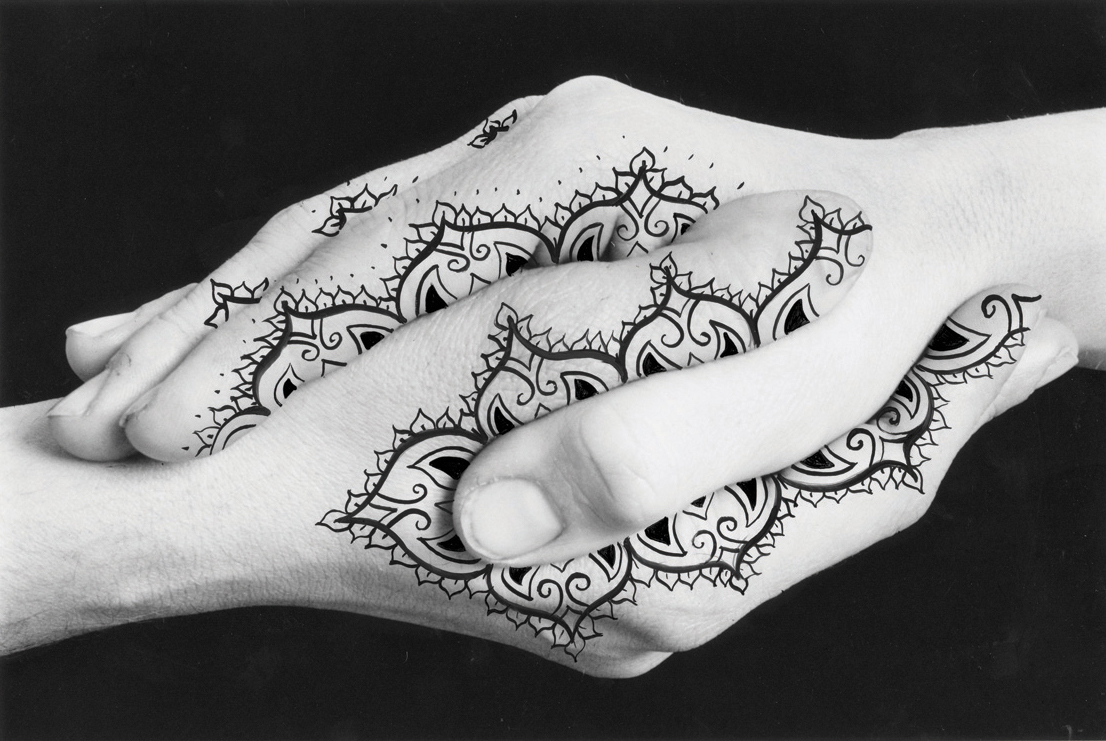
The ceremony took place at the Monaco Hotel, in Washington, DC, that city of “northern charm and southern efficacy,” to quote President Kennedy.[1] However, in this case, the setting was perfect. The hotel is right across the street from the Chinatown Metro exit. (DC’s Chinatown, by the way, boasts the highest density of Mexican restaurants this side of San Antonio). Anyway, you could hop on a train and hit the museums, which younger, single, available son Ned and I did to catch the Iranian artist Shirin Neshat‘s exhibit at the Hirshhorn. Her photographs and films create an aura of beautiful strangeness and remind you just how different and alike human beings can be, and, of course, there is nothing more universal than marriage ceremonies.

photograph by Shirin Neshat

photograph by Shirin Neshat

More, importantly, you could walk from the hotel to the rehearsal dinner at 600 F Street and avoid cab/Uber fares, not to mention vehicular manslaughter. It amazes me that in 2015 that the bride’s parents still pay for the wedding and the groom’s parents pay for the rehearsal dinner, but in this case, doing so saved the Birdsong-Moores from putting a second mortgage on their house or my having to sell my prized collection of very well-used — snap, crackle, pop — LPs dating back to the early ‘60’s .

If I do say so myself, the dinner went off well, the Lebanese food was excellent, and we ran out of alcohol just about when we were supposed to be out of there.

Like I said, I’ve only been to two rehearsals before, my own and one of a friend. Judy Birdsong and I had a no-frills, bagpipe-less ceremony that my father-in-law clocked at 23 minutes. My friend’s rehearsal was much longer, but I think that was attributable to the bedroom-slipper sporting wedding director’s being in the first stages of Alzheimer’s.

A Jewish wedding is more complicated, though. At the rehearsal, Taryn and Harrison pantomimed circling around each other, first Taryn circling Harrison, then Harrison circling Taryn — sort of like a cross between flamenco dancers and prizefighters — and then they interlocked arms and circled as a pair. It was very beautiful. Then her brother Logan went over and pantomimed picking something up and reading from it, and we practiced processing and recessing a couple of times, and that was it.

Rabbis seem much more involved in weddings than Protestant ministers, or this one, the excellent Arnold Saltzman, was.  Short, slightly stooped, smiling that comfortable smile that those who have made peace with metaphysics do, he looked as if he had stepped out of central casting. As it turns out, he is a big deal, has composed four symphonies and an opera and was an internationally sought-after cantor until a virus did in his vocal chords. Relaxed, he made slight jokes, even during the ceremony. When I thanked him at the rehearsal for performing the service on his Sabbath, he waved his hand dismissively and said, “This is about love.”

wedding day

wedding day

The day of the wedding dawned with drizzle, which eventually turned into a downpour, but for me, who had nothing much to do except practice reading a poem and memorizing my toast, it was a non-issue. The bridesmaids and groomsmen weren’t so lucky. At noon, they were off on a five-hour photo shoot in various locations around the capital.

Judy had an appointment with a make-up person at eleven-thirty and came back to the room with fake eyelashes and a Buster-Keaton-thick coat of pancake make-up. She went back to lighten it a bit, but the woman knew what she was doing because over the course of the day it faded, and by the time of the ceremony, she looked less like Joan Rivers and more like herself. Here’s a picture of her ordering at a Mexican Restaurant in Chinatown a couple of hours later.

IMG_2050

The family pictures were taken in the lobby at 4:45, and then we went to a room for the “signage.”   Rabbi Saltzman produced a certificate of marriage and had witnesses read prayers and sign documents. Judy and Taryn’s mother, Susan, also read a prayer. There’s a board, suitable for framing, written in Hebrew and English on the left-hand side and with art the bride and groom choose on the right-hand side. This board is what brother Logan had been holding in pantomime during the rehearsal.

* * *

Finally, it was time.

We walked down the hall and waited just outside the Paris Ballroom. Inside, a stringed quartet had been playing Jewish folk music. The wedding director opened the double doors, the quartet started playing again, and the groomsmen processed followed by Judy, Harrison, and me locked arm in arm, followed by the bridesmaids, and then by Taryn and her parents, Chris and Susan, locked arm-in-arm. I prefer this ritual to the Christian procedure where the groom appears from seemingly nowhere at the altar and the bride comes in escorted by only her father.

Of course, a room full of loved ones made the proceedings more emotional than the rehearsal. Parents sit in a row that would be behind the altar in a Christian ceremony, so we had a really intimate view of the proceedings. The bride and groom did their circling, the Rabbi prayed, talked, chanted; then father Chris and I were summoned to read, he a passage from the “Song of Songs” and I from the ee cummins poem “I Carry Your Heart”:

here is the deepest secret nobody knows

(here is the root of the root and the bud of the bud

and the sky of the sky of a tree called life; which grows

higher than soul can hope or mind can hide)

and this is the wonder that’s keeping the stars apart

Like the poem, the service was beautiful. The board came out, brother Logan and mother Susan read from it.  The Rabbi spoke and sang, rings were produced.  First Taryn, then Harrison, read letters to each other explaining why each had fallen in love.  Vows were exchanged, Harrison smashed a glass with his foot — Mazel Tov! — and they were married, man and wife without kissing.  Then before recessing, they turned beaming and faced each side of the audience who flanked them rather than being arranged in rows behind.

Another nice touch is that when we the parents processed, we did so so abreast, arm-in-arm, a now joined family ourselves, the Birdsong-Moore-Antigones or the Antigone-Birdsong-Moores.

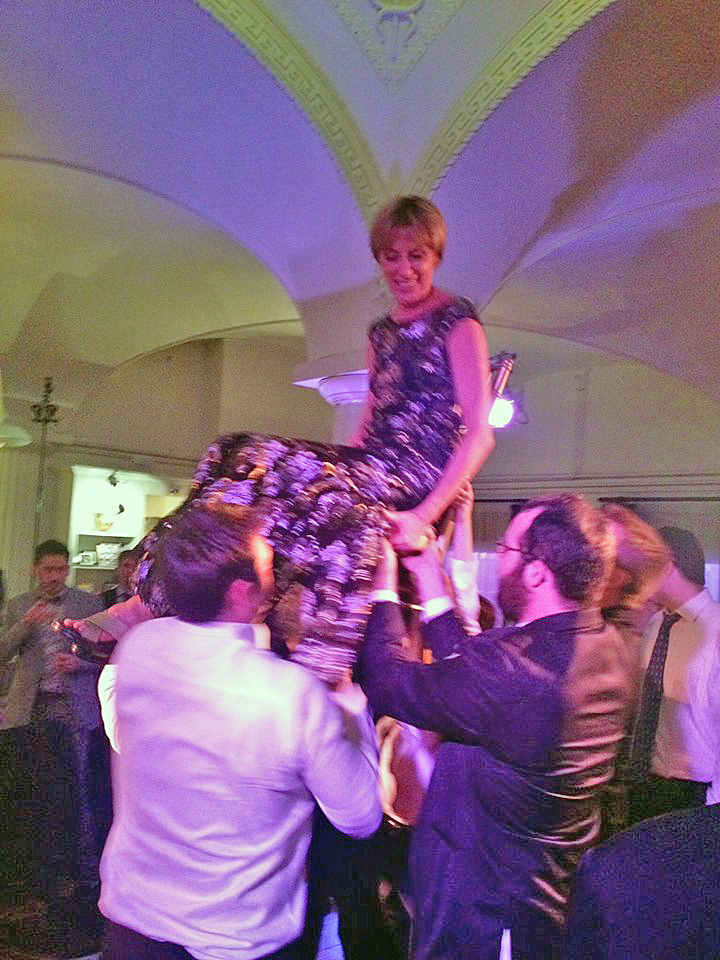
11692700_10205384243299647_870698187978786767_nThis post has gone on long enough, so I’ll skip the delightful reception, the delicious dinner, the toasts – though I have to mention the hoisting in chairs, which, is actually a lot of fun in a carnival ride type of way.

Being surrounded by people I love was so wonderful, my brothers and sister and nephews and nieces and their spouses, my in-laws, old friends I’ve known longer than Judy, the friends I’ve met since our marriage or during my career, new friends I met at the ceremony. How nice every single one of Taryn’s friends were with their warm smiles, handshakes, and hugs.

We danced the rest of the night away doing the Wa-Wa-tusi like Bela Lugosi.

I’ll leave you with the final line of my toast:

“I look forward to the birth of our first granddaughter, Wesleyanna Susan Christine Birdsong Antigone Moore – be fruitful and multiply!”

[1] Hat tip to Richard O’Prey for turning me on the phrase.

Wedding Traditions, U-Street, and Boiled Peanuts

13th Street in the U-Street Corridor

13th Street in the U-Street Corridor

We’ve fled the heat, humidity, and high drama of Charleston to celebrate the marriage of our elder son, Harrison, in DC. In fact, I’ve just put the finishing touches on a couple of toasts I’ll be delivering, one at the rehearsal party and one at the reception dinner.

Not surprisingly, wedding traditions vary north and south of the Mason-Dixon line. Traditionally, wedding receptions down south didn’t include a sit-down dinner. Mine certainly didn’t. It was held at a swanky club atop a high rise in Decatur, Georgia, but the guests stood as they munched on heavy hors d’oeuvres and sipped champagne. No one raised a glass in a communal toast. That had been done the night before at the rehearsal dinner.

My first sit-down postnuptial dinner caught me by surprise. A transplant from Chicago’s sister had married, and when Judy Birdsong and I sauntered into the reception at the Country Club of Charleston, we figured the festivities would last forty-five minutes or so, and this was back in the day of baby-sitters. Nevertheless, it was lovely and lavish and no doubt very expensive. Perhaps that’s why Southerners didn’t throw big sit-down shindigs after weddings – we were too poor.

At any rate, my first toast will be of the welcoming variety, and I’ll save the heavy Faulknerian bombast for the wedding reception. In the meantime, I’ve been gadding about the District checking out the U Street Corridor where we’ve rented an apartment (tomorrow we transfer lodgings to the Monaco Hotel where the ceremony will take place).

Scrub It Off!

Scrub It Off!

The U-Street Corridor is DC’s version of Harlem, dubbed as the “Black Broadway” by Pearl Bailey back in the day, and our apartment is located on the same block as Duke Ellington’s boyhood home. Of course, there are no Confederate flags flying here, but I did notice this perhaps problematic display on the façade of the famous eatery Ben’s Chili Bowl.

Of course, in keeping with the tradition of Birdsong frugality, we’ve been riding the Metro instead of taking cabs, and what has struck me about that experience is the incredible interiority of the commuters as they stare into their cell phones or into space as they listen to music through their ear buds. It’s as if they’ve pulled the blinds on the outside world. Need I mention that in general people are not as friendly up here?

Obviously, it’s been a horrible week in Charleston, and the Confederate flag is an embarrassment, but one thing I’m not embarrassed about is hailing from the South. We’re an odd bunch for sure, but we know how to tell a story, draw out a vowel, and boil us up some peanuts. Imagine American music without the South – imagine American culture without the South.

All I can say is praise be for blacks and crackers, hillbillies and debutantes.