What If Mrs Malaprop and W Had a Baby?

Kitty Balay as Mrs. Malaprop

Kitty Balay as Mrs. Malaprop

Somehow I copped an undergraduate degree in English and earned 24 graduate hours without ever running across Mrs. Malaprop, one of the great comic characters of the English stage. Nope, I didn’t make her acquaintance until I started teaching high school, specifically Richard Sheridan’s The Rivals, a 1775 play.

It is from Mrs. Malaprop, a pompous fuddy-duddy moralistic widow, that we get the word malapropism, that delightful linguistic confusion that arises when someone stretches her vocabulary just a bit too far, confuses polysyllabic words, and makes a colossal ass out of herself.

Here is Mrs. M chastising her niece Lydia:

You thought, miss! I don’t know any business you have to think at all — thought does not become a young woman. But the point we would request is, that you will promise to forget this fellow — to illiterate him, I say, quite from your memory.

Through the course of the play, she reprehends true meaning, bemoans the slight affluence she has over her niece, can’t provide the perpendiculars of a murder.

Certainly, Archie Bunker can trace his line of descent through her:

“I ain’t a man of carnival instinctuals like you.”

“The hookeries and massageries…the whole world is turning into a regular Sodom and Glocca Morra.”

Off-the-boat Jews” (i.e., Orthodox).

Tim Moore portraying Kingfish Stevens

Tim Moore portraying Kingfish Stevens

Then there’s that earlier African American sitcom character, Mr. George “Kingfish” Stevens of The Amos ’n’ Andy show from the ’50’s who not only “resents the allegation’ but also “resents the alligator.”

Of course, malapropisms aren’t only the domain of fictional characters. Can you name the following real life malapropisms with their linguistically challenged flesh-and-blood originators, three of whom are politicians and two baseball hall-of-famers?

1. Republicans understand the bondage between a mother and a child.

2. Oftentimes we live in a processed world; you know, people focus on the process and not the results.

3. Alcoholics Unanimous

4. “The players returned to their respectable bases.

5. “Texas has a lot of electrical votes.”

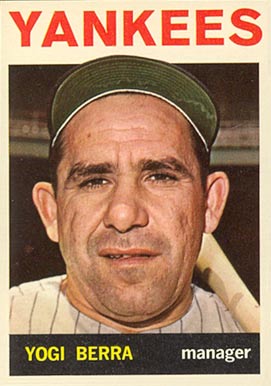
Oh, yeah, the answer to the question — what would you get if you crossed Mrs. Malaprop  with George W Bush — is the great and beloved Yogi Berra.

Now, thet answer to that question is what Yogi once called a very close game, i.e.,  “a cliff-dweller.

169688

It’s Story Time – Measure for Measure Edition

In 1951 in a letter to Harold Adam Innis, Marshall McLuhan claimed that “[t]he young today cannot follow narrative, but they are alert to drama. They cannot bear description, but they love landscape and action.“ It is perhaps foolish for a pedestrian blogger to dare to contradict such a colossus as McLuhan, but I beg to differ. High school students still love to hear a story told out loud, or at least my students do.

I don’t know whether their delight in hearing oral narratives stems from nostalgia for those less complicated days of kindergarten when they sat in circles on carpeted floors, or if it stems from even more profound depths, from some deep-rooted inclination that made keen listeners around ancestral fires more likely to pick up on life-enhancing lore. Whatever the case, whenever I announce to one of my classes, “It’s story time,” they slap shut their laptops and lean towards me in eager anticipation. Of course, I don a mask, assume a postmodern irony-laden patronizing narrative voice, supply dialogue in various tonalities, and gesticulate when appropriate.

For example, last Thursday, I announced it was story time, and told them a tale which I informed them is called “Measure for Measure.”

* * *

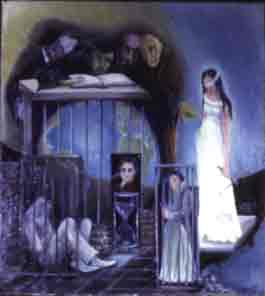
Measure for measure by by Hannah Tompkins

Measure for measure by by Hannah Tompkins

Boys and girls, once upon a time in the city of Vienna, there was a Duke named Vincentio who was sort of like a Dean of Students and Principal wrapped up in one, and because Vincentio was a kindly man, he sometimes didn’t enforce the letter of the law, or even some of the laws themselves. Human nature being what it is, the citizens of Vienna started taking advantage of this laxity, the way you do by violating the dress code with your short skirts and contraband hoodies, you know, because we teachers are too lazy or pusillanimous to enforce the dress code.

Plus, some of the Vienna’s laws were ridiculously old-fashioned and inhumanely severe. For example, boys and girls, [cue Pentecostal preacher’s voice] forn-i-CA-tion was a capital crime. If an unmarried man and an unmarried woman engaged in [cue effete professorial voice] coitus and were caught, the state beheaded the man (but let the woman live much to the chagrin of some feminist critics).

But the thing is. because laws against sex were being ignored, Vienna had become – pardon the pun – a hotbed of lechery and had been overrun by strumpets (what your hiphop heroes call hos), bawds (what your hiphop heroes call pimps), and pox (what your heath teacher calls STDs).

Well, Duke Vincentio decides enough is enough, but he doesn’t want to seem like the bad guy, so he claims to be running off to Hungary and puts his Deputy Angelo in charge to do the dirty work of cleansing Vienna of riffraff and sexual escapades. Only the Duke doesn’t really leave Vienna but disguises himself as a friar so he can keep tabs on how Angelo handles things.

The Duke chose Angelo because like his name implies, he seems to be without sin. You see, this Angelo is a rule-follower extraordinaire. He would never like you, Ashley, wear a baseball cap indoors, or you, Mason, jaywalk on King Street. And not only that, not only has he never engaged in any kind of sexual activity, he has never even had the desire to. His blood, as one of the minor characters puts it, is “like snow broth.”

So Angelo gets to work pulling down bordellos (i.e. whorehouses) in the suburbs and enforcing all of the other laws pertaining to sexual misconduct.

As it turns out, the first person to get busted for intercourse is a twenty-year-old named Claudio who impregnated his finance Juliet. Even though it has been years since anyone has been arrested, much less beheaded for this crime, Angelo not only has Claudio shackled but insists he be perp-walked through the streets to advertise that the times they are a-changing.

Claudio and Juliet are a nice couple from nice familes and were engaged at the time when weak-willed they made what our guidance counsellors call “a bad decision.”
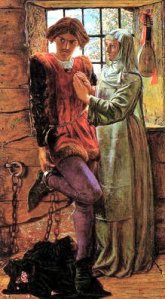
“Claudio and Isabella” by William Holman Hunt:

Everyone else in the government is sympathetic to their plight, and luckily, for Claudio, he has a beautiful and eloquent sister named Isabella who is in the process of jumping through the hoops young women jumped through in those days to become nuns. After she visits Claudio in prison,  one of Claudio’s pals Luciano accompanies Isabella to Angelo’s house to have her plead for mercy. If anyone has the power to change anyone’s mind, it’s Isabella, who like I said, is not only beautiful but is so articulate that she makes your own modest storyteller sound by comparison like Lenny in Of Mice and Men.

And Isabella succeeds, all too well. Yes, she melts that snow broth of Angelo’s blood, all right, but raises its temperature so high it turns into a hot volcanic eruption of lust. That’s right, for the first time in his entire life, Angelo suffers what Patti Smith calls “the arrows of desire,” and even though Angelo knows it’s wrong, even though he fully understands the base hypocrisy of what he proposes, he tells Isabella that he will let her brother go if she will sleep with him, i.e., Angelo.

Isabella storms out in rage confident that her brother Claudio would prefer to die a thousand deaths rather than have her commit such an act of ignominy.

When she arrives at the prison to give Claudio the bad news, the Duke is there disguised as a friar trying to console Claudio with this killer contemptus mundi speech, cataloging all the slings and arrows that flesh is heir to, like growing old and ugly while your children “do curse the gout serpigo, and the rheum,/For ending thee no sooner.”

The Duke retreats and eavesdrops on Claudio and Isabella’s conversation, which goes like this.

“What’s the scoop, Isabella?”

“Good news. Lord Angelo has some business in heaven. He’s sending you there as his ambassador. You’ll be shipping off tomorrow.”

“You call that good news! That’s not good news!”

“Claudio, I hesitate to tell you this because it’s really going to infuriate you, but Angelo actually did say he’d let you go if I did something for him.”

Really! What is it? Tell me!”

“It will make you furious.”

“Why? C’mon tell me. What is it he wants you to do for him!”

“He said he’d let you go if I slept with him.”

“Really!?!?! What did you say?”

“Of course, I said what you would want me to say, of course not!”

“Wait, Isabella, you said no? Oh, sister, come on! If by committing such a sin you save a life, that sin becomes a virtue. You gotta do this for me. Dying sucks, it’s scary, please-please-please!”

Isabella’s not having any of it. She storms out furious but is approached by the Duke-in-Friar’s-Clothing who shares with her a plan.

“Marianna” by Małgorzata Maj

The Friar tells Isabella that Angelo has a fiancée of his own, a woebegone woman named Mariana who pines away in a “moated grange”; that’s a “farm with a ditch around it” for you lazy students who haven’t found time yet to memorize the Oxford English Dictionary. Anyway, Angelo has refused to marry Mariana because the ship carrying her brother who was transporting riches for her dowry sank drowning her brother and losing the riches.

“No way, Jose” (or the Italian equivalent) Angelo says, “I’m not marrying you because you’re no longer rich.”

This Angelo is a piece of work, don’t you think? He makes pre-conversion Ebenezer Scrooge look charitable.

Anyway, the Duke shares the plan: “Go back and tell Angelo, yes, you’ll sleep with him, but only at this certain moated grange, and in complete silence and darkness.”

So she does so, and Angelo arrives at the moated grange, enters the bedroom, and in utter darkness does the deed with – can you guess who – that’s right, Mariana!

So Angelo returns to Vienna and demands that Claudio be put death anyway because he’s afraid Claudio will find out he’s had sex with his sister and seek revenge. He demands that Claudio’s head be brought to him for proof. What a, as Sugar-Boy says in All the King’s Men, b-b-b-b-astard!

Well, there’s another prisoner to be beheaded named Bernardine, so the Duke says behead him and bring Angelo that head, but Bernardine refuses to be put to death because he’s too hungover and is so persistent that they give up. Anyway, as luck would have it, a pirate who looks more like Claudio anyway died in prison that night, so they cut off his head and take it to Angelo.

The Friar lets Isabella think, though, that her brother is dead. It seems that friars back in those days —- remember Friar Laurence from Romeo and Juliet — had no qualms having loved ones think their kinfolk were dead.

Anyway, news arrives that the Duke is returning to Vienna. He sheds his disguise and arrives at the gates where he’s met by virtually everyone in the story who’s not in jail. Isabella tells the Duke her story, and Angelo denies it, relying on the universal common knowledge that he’s never broken a rule, much less a [no, I didn’t go there].

The Duke pretends to think that Isabella is mad because what she claims is so wildly out of whack with Angelo’s reputation. How could Angelo be, as she claims, a “virgin-violater?” But again, her speech is so articulate it seems to defy the charge of insanity.

Isabella then tells what some might call a lie, others a fib. She claims she’s slept with Angelo.

No, way, Jose (or it’s Italian equivalent) the Duke says. There’s no way Angelo would put to death a man for something he himself has done unlawfully. No one could possibly be such a vile hypocrite, much less such a noble outstanding non-jaywalking citizen like Angelo!

The Duke demands his underlings to cart Isabella to jail for lying, and she moans, “Only if the Friar were here.”

The Duke calls for the Friar, but is told by another priest that he’s sick and cannot come.

They haul Isabella off, and Marianna enters hidden by a black veil. She says Isabella was lying, that it was she — Mariana — who had slept with Angelo. She takes off her veil.

Angelo admits he used to be engaged to but has never slept with Mariana. The Duke pretends to lose patience and tells the Provost to settle matters.

The Duke splits but then reenters wearing his Friar disguise.

All the while this man named Lucio has been lying to the Duke-as-Duke telling him that the Friar had been speaking out against the Duke, calling the Duke a fishmonger [what your hiphop heroes call a pimp], etc., which of course is ironic given the Duke and Friar are one in the same. He claims the Friar has put up Mariana and Isabella to slander Angelo. A Provost tells the guards to go fetch, Isabella, which they do.

Abusing the friar, Lucio yanks off his hood to discover to his horror that – uh-oh!
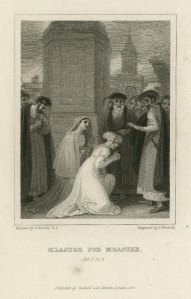
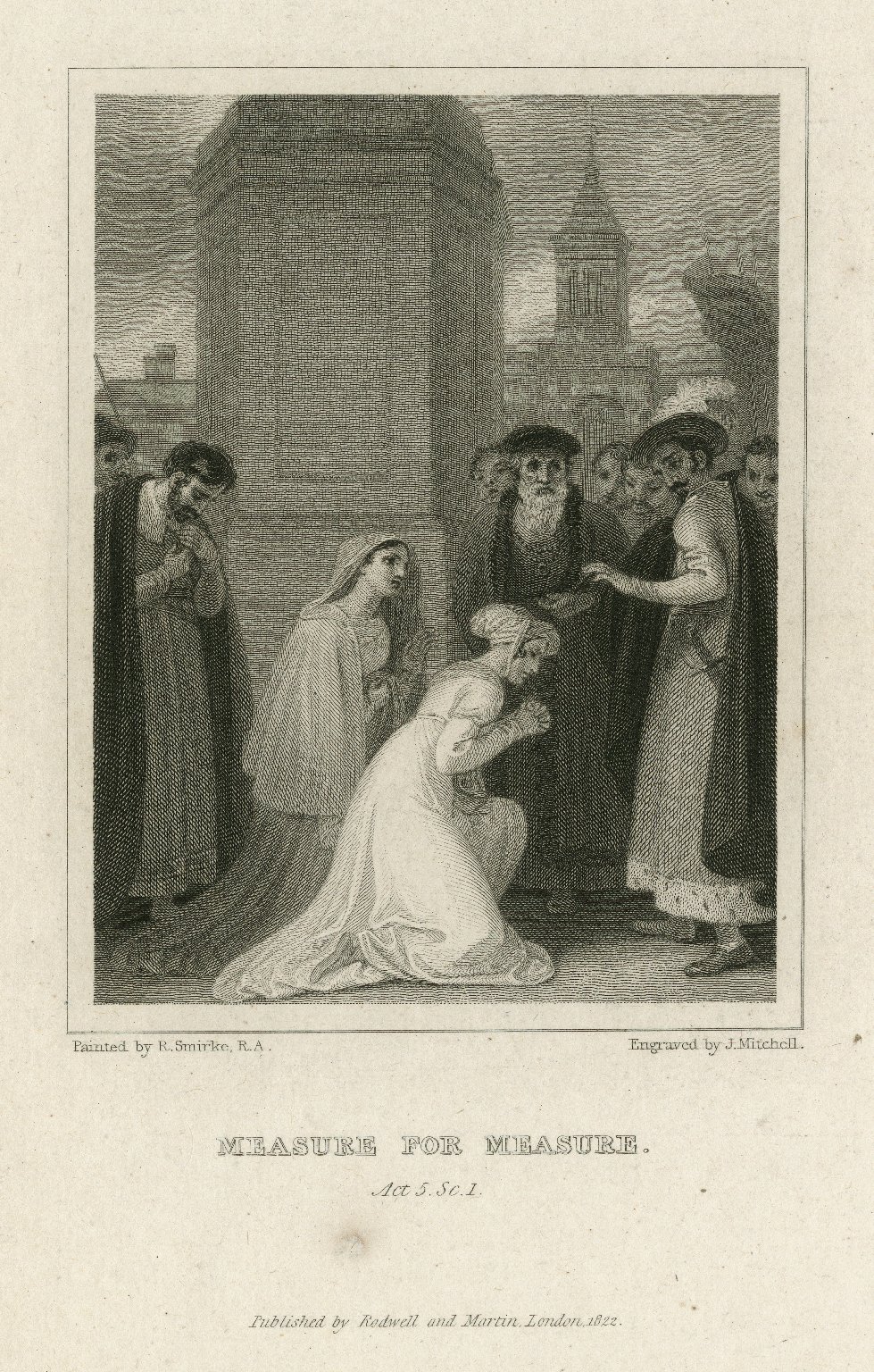
026635Time to wrap things up? Angelo confesses, begs to be executed, but the Duke makes him marry Mariana. Then he says the must execute Angelo because Claudio has been executed. Mariana pleads with Isabella to help save Angelo’s life, which she does on her knees in a reprise of her original pleading for Claudio’s life.

The Duke ain’t no Angelo; he pardons him, then pretends to fire the Provost who returns with — drumroll — symbol clash !!! – Claudio!!!. TA DA!

The Duke asks Isabella to marry him, but she doesn’t answer. The Duke says he’s gonna have Lucio beaten and then hanged but instead makes him marry a prostitute he had “known in the biblical sense. “ Ha Ha! Even though Lucio would rather be beaten and hanged, the Duke makes him marry anyway.

Just for a little icing, the Duke pardons Bernadine, who may be the original model for Otis Campbell in Andy of Mayberry.

So the story ends with four marriages  and a pardon — though happily ever after isn’t exactly the vibe we get when the story concludes.

And that’s, boys and girls, story time for today!

* * *

Of course, this written rendition lacks the dynamics of listening to oral stories – voices, gestures, eye-contact, the dynamic energy between audience and tale-teller, questions that the students ask, etc.

I promise, though, they virtually all pay attention and often ask when are we going to have another story time.

My reason for providing them Measure for Measure’s plot is this: we’re studying that saddest of sad sacks, Alfred, Lord Tennyson, whose poem “Marianna” the students had read for homework the night before.

The epigraph of the poem, as you can see below, is “Marianna of the moated grange.” Of course, epigraphs are supposed to provide readers with a cross-reference, some insight into the meaning of the poem. After “hearing” the story of Measure for Measure what might you think the poem might be about? Justice? Hypocrisy? What Alex calls in A Clockwork Orange the “ol’ in-and-out.”

We’ll see for yourself, and if you’re not the poetry-reading type, at least check out the first and last stanzas:

Mariana

“Mariana in the Moated Grange” 
(Shakespeare, Measure for Measure)

With blackest moss the flower-plots
Were thickly crusted, one and all:
The rusted nails fell from the knots
That held the pear to the gable-wall.
The broken sheds look’d sad and strange:
Unlifted was the clinking latch;
Weeded and worn the ancient thatch
Upon the lonely moated grange.
She only said, “My life is dreary,
He cometh not,” she said;
She said, “I am aweary, aweary,
I would that I were dead!”

Her tears fell with the dews at even;
Her tears fell ere the dews were dried;
She could not look on the sweet heaven,
Either at morn or eventide.
After the flitting of the bats,
When thickest dark did trance the sky,
She drew her casement-curtain by,
And glanced athwart the glooming flats.
She only said, “The night is dreary,
He cometh not,” she said;
She said, “I am aweary, aweary,
I would that I were dead!”

Upon the middle of the night,
Waking she heard the night-fowl crow:
The cock sung out an hour ere light:
From the dark fen the oxen’s low
Came to her: without hope of change,
In sleep she seem’d to walk forlorn,
Till cold winds woke the gray-eyed morn
About the lonely moated grange.
She only said, “The day is dreary,
He cometh not,” she said;
She said, “I am aweary, aweary,
I would that I were dead!”

About a stone-cast from the wall
A sluice with blacken’d waters slept,
And o’er it many, round and small,
The cluster’d marish-mosses crept.
Hard by a poplar shook alway,
All silver-green with gnarled bark:
For leagues no other tree did mark
The level waste, the rounding gray.
She only said, “My life is dreary,
He cometh not,” she said;
She said “I am aweary, aweary
I would that I were dead!”

And ever when the moon was low,
And the shrill winds were up and away,
In the white curtain, to and fro,
She saw the gusty shadow sway.
But when the moon was very low
And wild winds bound within their cell,
The shadow of the poplar fell
Upon her bed, across her brow.
She only said, “The night is dreary,
He cometh not,” she said;
She said “I am aweary, aweary,
I would that I were dead!”

All day within the dreamy house,
The doors upon their hinges creak’d;
The blue fly sung in the pane; the mouse
Behind the mouldering wainscot shriek’d,
Or from the crevice peer’d about.
Old faces glimmer’d thro’ the doors
Old footsteps trod the upper floors,
Old voices called her from without.
She only said, “My life is dreary,
He cometh not,” she said;
She said, “I am aweary, aweary,
I would that I were dead!”

The sparrow’s chirrup on the roof,
The slow clock ticking, and the sound
Which to the wooing wind aloof
The poplar made, did all confound
Her sense; but most she loathed the hour
When the thick-moted sunbeam lay
Athwart the chambers, and the day
Was sloping toward his western bower.
Then said she, “I am very dreary,
He will not come,” she said;
She wept, “I am aweary, aweary,
Oh God, that I were dead!”

I declare this poem to be musically brilliant – a slow, dirge-like symphony of monotony – of fined-tuned repetitions. Of course, the danger lies in that this poem about monotony can itself become monotonous, but my students, who for the most part are conscientious, do read it, and through Socratic questioning, they ferret out imagistic patterns of dilapidation and stagnation, sonic patterns, repetitious sentence structure, etc.

But the exercise also provides another example of existentialism for them to ponder, how each individual can see the world differently. Tennyson’s melancholy cast of mind focused on the sadness of a character who engages in a bed-trick to entrap her fiancé. You have to wonder if Tennyson ever even smiled while reading the play.

In other words, for Tennyson Measure for Measure is not a comedy but a tragedy, which it very well could be if not for the contrived ending. Let’s face it, the first four acts of Romeo and Juliet with its rhyming and comical Nurse seems less like a tragedy than a comedy.

Anyway, like Hamlet says, “Nothing is neither good nor bad but thinking makes it so. Or funny or not. Or as Robert Walpole said, “Life is a comedy for those who think, a tragedy for those who feel.”

Adieu.

Five Quick Tips That Will Immediately Make You a Better Writer

wesely tech guru1. Avoid the overly long parenthetical side note.

For example, the sentence:

Our book club (think alpha male with brilliant and beautiful and ridiculously well-read women dropping in from time to time to remind us that males and females often perceive the world differently) last night discussed Julian Barnes’s A Sense of an End, a novel that explores the misconceptions of an insecure man exploring his past and discovering that memory can be selective and unreliable — think Brian Williams meets J Alfred Prufrock

sucks.

Bet you forgot the subject is sentence.

2. Avoid the stilted, pretentious, anally-retentive compulsion to use the third person pronoun one when you want to provide a general example.

NOT: When one shops for crack cocaine, one should try to purchase the product through third party acquaintances who retrieve the crack and deliver it to one, which makes it less likely that one finds himself bleeding to death on a street in an unfriendly neighborhood of track houses.

BUT: Cop your crack from a buddy, not a dealer, or you might find yourself bleeding to death in some godforsaken lower lower middle class cul-de-sac located in Phosphate Acres.

If you find yourself incapable of committing to such shocking familiarity, you can eliminate both one and you:

Cop crack from an acquaintance, not a dealer, and avoid bleeding to death in some godforsaken lower middle class cul-de-sac located in Phosphate Acres.

Zangaki._0263._Chech_arab-23. Every time you proofread, look for nouns that could be more definitive.

For example, our English Department uses a vocabulary series called Wordly Wise. I still use my original 1985 copy for nostalgia’s sake, and believe or not, the publishers have seen fit to make various changes over the years, like dropping the word “buxom” (defined as “plump”) from its word lists.

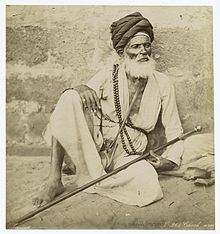
Here’s an original sentence from my 1985 edition : “The answer to the conundrum ‘Why did the Arab starve in the desert’ is ‘because he couldn’t use the sand which was there.’”

Here’s the edited 2015 version: “The answer to the conundrum ‘Why did the man starve in the desert’ is ‘because he couldn’t use the sand which was there.’”

The first one is much superior because you get a visual clue as to what the man looks like, his native costume, etc.

Plus, when did the word “Arab” become pejorative in and of itself?

4. Be precise using the relative pronouns “who,” which,” and “that.” For example, the sentences above use the pronoun “which” imprecisely. Both sentences regarding the conundrum should read “the sand that was there,” even though it fucks up the joke, a groaner anyway.

Here are the rules.

Use “who” instead of “that” for people.

NOT: He’s one of those Rolex-wearing Saudis that only flies first class.

But: He’s one of those Rolex-wearing Saudis who only flies first class.

Most people won’t notice, but the ones who do, do.

The choice between “that” and “which” is more subtle. Use “which” only when you’re adding superfluous info to the sentence, in other words, parenthetical, i.e., non crucial, information.

For example, I totaled a car Lamborghini that I had stolen from Prince Alwaleed Bin Talal Alsaud.

I totaled a Lamborghini this morning, which obviously got my day off to a less than stellar start.

5. Don’t write when you’re drunk or high on judiciously purchased crack, or if you do, proofread when sober.

Well, ladies and gentlemen, bulldogs and babies, there you have them: five quick tips that that will make you a better writer.

Let’s Get Real

A few years back, I contemplated moving to western or southern Ireland for retirement, maybe to the Beara Peninsula down in County Cork or up to County Mayo on the coast, perhaps purchasing a rustic cottage with a glimpse of distant mountains or of the sea.

3229244181_a516f6ab0d_zHave you ever witnessed a rainbow in Ireland? I don’t know if it’s the air up there or the angle of the sun, but the rainbow Judy Birdsong and I saw in ’79 mesmerized us. It was so misty-shimmering wonderful that it could almost make you believe in leprechauns, in magic, in Lir.

Beara’s and Mayo’s landscape is gorgeous, their people gregarious. The Irish and my kinsmen, folk from the South Carolina Lowcountry, share a love for the oral tradition of story-telling. We’d get along fine I think. The Irish love music and poetry and literature. For example, before the Euro, James Joyce himself appeared on Ireland’s ten-pound note, which would be like having Walt Whitman on a US fifty. We Americans might put our beloved authors on stamps, but they don’t rank high enough in our estimation to appear on legal tender. Of course, Irish currency doesn’t have “In God We Trust” printed on it, which would not go all that well thematically with Mr. Joyce’s bespectacled mug nor with Herman Melville’s otherwise presidential countenance.

IEP-banknote-10-irish-pounds-james-joyce

melville fifty


But I digress. When I mentioned this silly romantic notion to Judy, she reminded me that my three trips to the Emerald Isle occurred in May or June, not December or February, and she reckoned that in those dark and dreary months the odor of burning peat might very well lose its allure as building a fire transitioned from exoticism to drudgery.

Miss Birdsong knows all too well that dreary weather and Wesley don’t get along. In fact, a shrink back in the day suggested that I could very well suffer from Seasonal Affective Disorder (which I have immortalized in a poem you can listen to me read in my golden Lowcountry baritone HERE). No, day after day of leaden skies, the sun setting by three or four, would be bad for my state of mind.

Take this winter, for example. We might as well be in Ireland — or Ingmar Bergman’s Sweden. A glance at the five-day forecast, more often than not, has yielded a succession of cartoon clouds, dark, with resiquite raindrops slanting down.

Max Von Sydow

Max Von Sydow

My neighborhood “pub,” Chico Feo, roofless as it is, has been closed for days at a time, often for rain, less often for cold, but closed nonetheless. As I have driven to work morning after morning through fog, I have half expected to see Max Von Sydow and/or Liv Ullman trudging along the side of Folly Road.

But as PB Shelley famously put it, “If winter comes, can spring be far behind?” Sure enough, the sun peeped out on consecutive days this week, so I popped in at Chico Feo. On the first day, I got to witness a book burning and on the second some low wattage police brutality.

Perhaps I underestimate Folly as a retirement locale.

bookiburning 2But, before I go, let me assure you that the book burning wasn’t Fahrenheit 451.1.0 but part of a very indie film noir murder mystery starring the Chico crew, my hobo hero Greg, and prolific Chris, a graphic artist and novelist who works at Bert’s.

And the “police brutality” merely consisted of a very, very, very drunk man having his arms twisted behind his back and then being slammed rather roughly to the pavement of Second Street. Alas, I had absentmindedly left my phone at work, so I didn’t get to capture the disturbance, which was quite a spectacle taking place as it did in front of the mural of Bert done up like a smiling, squinting, dismembered pirate.

IMG_0004


Ten Literary Riddles

Hoodoo Headquarters

Hoodoo Headquarters

Back in the late 80’s, when academics were more demanding where I teach, I included a section on my exam called “Association.” Students had to match a character or work they had read that semester with an enigmatic phrase I provided — only there was nothing to match the phrase to, no list of possible choices. When they complained, I told them all they needed to do was to read my mind.

Of course, no way I get away with something like that nowadays. Parent-piloted Blackhawks would be raining rockets on my drafty garret, Hoodoo Headquarters.

Just for fun, though, I thought I’d recreate “Association” for this post. See if you can identify these novels, plays, or long poems.  Of course, it’s going to be harder for you since your choices aren’t confined to a limited number of works you’ve read in the last five months.

1. Libidinous Lydia’s Lucky Elopement

2. Doing Dublin in a Day from St Stephen’s to the Quay

3. Idiot Tale, Tick-Tock-Not, Red Neck Rambles, House in Shambles

4.  Loon River, Longer Than a Mile, Portal Through Time, Jungle Fever

5.  Un-Moored, Senator’s Daughter Couldn’t Be Any Poorer, According to O’Connor

6.  Mama’s Boy Outwits Catty Riddler, Wins Crown, Then Goes Down, Down, Down

7.  Echo Chamber: April showers, Tarot readings, Demobbed Husbands, and Neurotic Pleadings.

8.  Jake Lost His Snake in a Trench So He Drinks.

9.  The Black Cat in This Story Is, like, a HG Wells No Show.

10.  Ch-Ch-Changes: Model Son Turns Out to Be a Pest.

Hints: Two plays, five novels, two novellas, one poem. Authors’ home turfs:

Ireland, Germany, USA, Greece, England.

Answers

1.  Pride and Prejudice:  15-year-old Lydia’s elopement with Wickham provides Darcy the opportunity to save the Bennet family from ignominy and bring about the twin marriages that bow ties the novel with the very happiest of endings.

2.  Ulysses: On 16 June 1904 Joyce covers all of Dublin, from St. Stephen’s Green to the quays.

3.  The Sound and the Fury:  Part One is literally narrated by an the idiot, Maury/Benjy; Part Two features Quentin’s yanking the hands off of his great-grandfather’s pocket watch; Part 3 is a tale told by a Southern bigot; Part Four completes the Fall of the House of Compson.

4.  Heart of Darkness.

5.  Othello:  Note Moor is capitalized. Othello’s wife Desdemona is the daughter of a Senator, and Flannery O’Connor perhaps not-so-famiously said, “You can’t be any poorer than dead,”  which Othello and Desdemona are at the end of the play.

6.  Oedipus Rex:  After killing  the king his daddy in a fit of road rage, Poor Eddie answers the Sphinx’s riddle, becomes the king of Thebes, marries his mama, and goes down, down, down.

7.  The Waste Land:  It’s an echo chamber of allusions. Here are specific references in the riddle: The first line of TWL is “April is the cruelest month.”  There’s a Tarot reading in “The Burial of the Dead” section.  From “The Game of Chess:” we get “When Lil’s husband got demobbed, I said.”  Also, finally there are several  lines spoken by a hysterical woman.  E.g.,   “What are you thinking,  What thinking?  Think.”.

8.  The Sun Also Rises.  Jake Barnes loses unspecified parts of his reproductive system during WWI and spends the course of the novel easing his pain via alcohol.

9.  Ralph Ellison’s The Invisible Man shares the same title of HG Well’s novel, only the protagonist of Ellison’s novel is black and not literally invisible.

10.  The Metamorphosis:  Gregor Samsa, a dutiful son, metamorphoses into an noxious insect (and not because he had received vaccinations),


Six Most Exquisite Literary Suicides

One concept I attempt to convey to students when I teach tragedy is that when tragedy works, it exhilarates rather than depresses the audience. Much depends on the protagonist; he or she must outstrip us in stature, or as my translation of Aristotle puts it, be “better” than we are, i.e., more profoundly human, capable of greater deeds (and greater misdeeds).

However, Aristotle is not my man when it comes to tragedy. My man is Richard Sewell whose The Tragic Vision offers a brilliant description and analysis of the tragic landscape, that bleak Darwinian plain of pre-Christian darkness, an elemental shriek-filled darkness that hearkens to that time in human history before we had mastered fire.

Or, as Yeats puts it, when

The night can sweat with terror as before
We pieced our thoughts into philosophy.

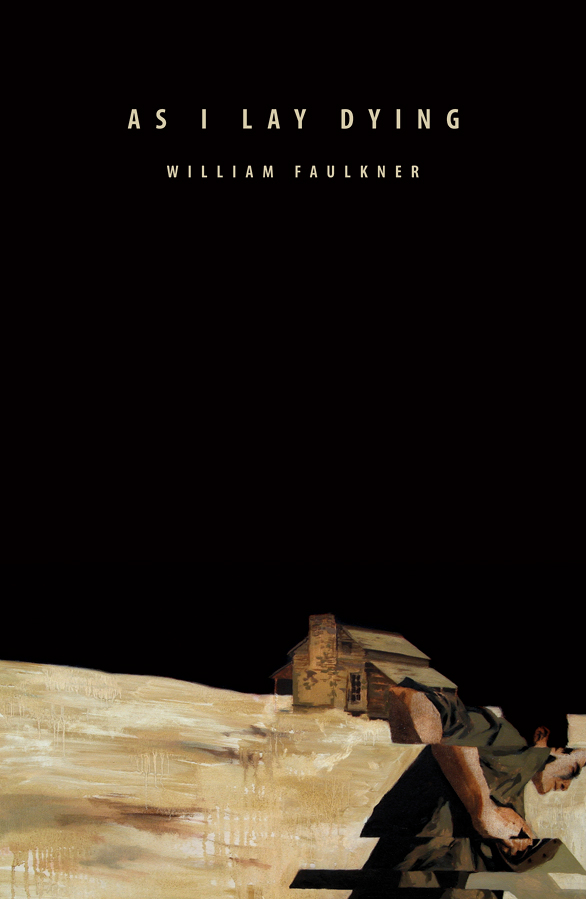
Faulkner possessed this tragic vision, and Addie Bundren in As I Lay Dying beautifully articulates it:

And then [husband Anse] died. He did not know that he was dead. I would lie by him in the dark, hearing the dark land talking of God’s love and His beauty and His sin: hearing the dark voicelessness in which the words are the deeds, and the other words that are not the deeds, that are just the gaps in people’s lacks, coming down like the cries of the geese out of the wild darkness in the old terrible nights.

asilay_0What has set my mind to such dark contemplations is the penultimate episode of Season 1 of the HBO series Treme, and in the unlikely event if, like me, you’re four years behind and still on Season 1, you might not want to read any further, but then again, a careful viewer would already have noted the not-very-subtle foreshadowings of the character Creighton Bernette’s impending suicide.

Bernette, played by John Goodman, is an English professor at Tulane struggling with his beloved New Orlean’s destruction after Katrina and with the paralysis of writer’s block. Even though he has a loving wife, an early teen-aged daughter, and an intact, lovely house in the city, he pulls a Harte Crane and jumps off a ferry into the Mississippi River and drowns himself. Notably, he had just finished teaching Kate Chopin’s The Awakening, whose protagonist Edna Pontellier, also a New Orleans citizen, drowns herself over a failed extra-marital affair and in essence because marriage and motherhood don’t offer her enough satisfaction — despite the fact she has servants to do housework for her.

These two, Creighton and Edna, fail the tragedy test — they’re merely pathetic, i.e., worthy of pity — but there’s nothing exhilarating about their copping out over problems that pale compared to those of the wretches who follow below — my top six literary suicides, which I catalog in chronological order.

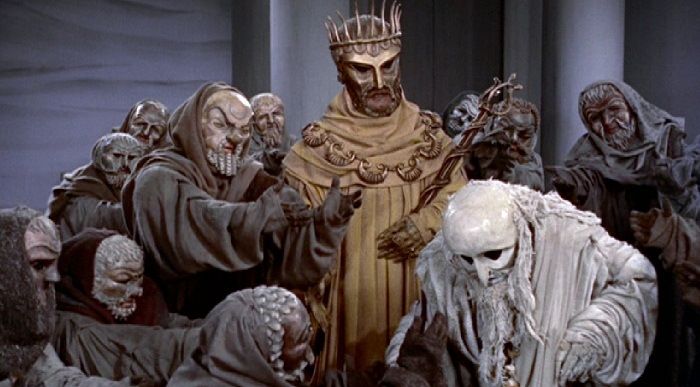
Jocasta

Sophocles oedipus_photopresents us with a perverse and terrible vision of life. The drama takes place in a universe governed by malevolent deities who rain horror upon the otherwise innocent offspring of evil doers (Yes, Oedipus suffers from hubris but is the epitome of integrity and about as well-meaning as any tragic hero out there. He, his wife/mother, half-sisters/daughters and half-brother/sons don’t deserve their fates).

Near the close of the play, his wife and mother Jocasta stands on the stage mutely listening as Oedipus bullies an old shepherd in telling him the truth of Oedipus’s origins.

As he undergoes his anagnorisis, the agonizing recognition of his horrible situation, Jocasta runs off stage to hang herself.

Someone called “Second Messenger” fills us in in Dudley Fitts’ and Robert Fitzgerald’s translation:

When she had left us,
In passionate silence, passing through the court,
She ran to her apartment in the house,
Her hair clutched by the fingers of both hands.
She closed the doors behind her; then, by that bed
Where long ago the fatal son was conceived—
That son who should bring about his father’s death–
We heard her call upon [Oedipus’s father]Laius, dead so many years,
And heard her wail for the double fruit of her marriage,
A husband by her husband, children by her child [. . .]

[. . .] For with a dreadful cry
[Oedipus] hurled his weight, as though wrenched out of himself,
At the twin doors: the bolts gave, and he rushed in.
And there we saw her hanging, her body swaying
From the cruel cord she had noosed about her neck.
A great sob broke from him, heartbreaking to hear,
As he loosed the rope and lowered her to the ground.

I would blot out from my mind what happened next!
For the King ripped from her gown the golden brooches
That were her ornament, and raised them, and
plunged them down
Straight into his own eyeballs, crying, “No more.
No more shall you look on the misery about me,
The horrors of my own doing! Too long you have known
The faces of those whom I should never have seen,
Too long been blind to those whom I was searching!
From this hour, go in darkness!” And as he spoke.
He struck at his eyes—not once, but many times;
And the blood spattered his beard.
Bursting from his ruined sockets like red hail.

Othello

Of course, in Shakespeare we have several suicides from which to choose — Romeo and Juliet, Ophelia, Cleopatra — but I opt for Othello, who has just strangled to death his innocent bride Desdemona after having been cruelly convinced by the sociopath Iago that Desdemona had been unfaithful with Othello’s friend and confidant Cassio.

Here’s Othello’s great suicide speech.

Soft you; a word or two before you go.
I have done the state some service, and they know’t.
No more of that. I pray you, in your letters,
When you shall these unlucky deeds relate,
Speak of me as I am; nothing extenuate,
Nor set down aught in malice: then must you speak
Of one that loved not wisely but too well;
Of one not easily jealous, but being wrought
Perplex’d in the extreme; of one whose hand,
Like the base Indian, threw a pearl away
Richer than all his tribe; of one whose subdued eyes,
Albeit unused to the melting mood,
Drop tears as fast as the Arabian trees
Their medicinal gum. Set you down this;
And say besides, that in Aleppo once,
Where a malignant and a turban’d Turk
Beat a Venetian and traduced the state,
I took by the throat the circumcised dog,
And smote him, thus.
[Stabs himself].

Madame Bovary and Anna Karenina

mqdefaultEmma Bovary and Anna Karenina might be considered the great-great grandmothers of Edna Pontellier, but they’re so much more alive, so much richer creations that their suicides, the first by poisoning herself, the second by throwing herself in front of a train, move us more — and they are certainly more terrible.

Here’s Emma’s in Paul De Man’s translation:

Suddenly from the pavement outside came the loud noise of wooden shoes and the clattering of a stick; and a voice rose — a raucous voice — that sang

Often the heat of a summer’s day
Makes a young girl dream her heart away.

Emma raised herself like a galvanized corpse, her hair streaming, her eyes fixed staring.

To gather up all the new-cut stalks
Of wheat left by the scythe’s cold swing.
Nanette bends over as she walks
Toward the furrows from whence they spring.

“The blind man!” she cried.

And Emma began to laugh, an atrocious, frantic, desperate laugh, thinking she saw the hideous face of the poor wretch loom out of the eternal darkness like a menace.

The wind blew very hard that day
It blew her petticoat away.

A final spasm threw her back on the mattress. They all drew near. She had ceased to exist.

Arkady Ivanovich Svidrigailov

drawing by Yakov Petrovich Golyadkin

drawing by Yakov Petrovich Golyadkin

Of course, with its happy ending, Fyodor Dostoyevsky’s Crime and Punishment is not a tragedy. However, its supposed villain Svidrigailov’s suicide near the end of the narrative is so incredibly cool it makes my top six.

Svidrigailov has reached hedonism’s dead end, has been rejected by Dounia, the protagonist’s sister, and finds himself in a mouse-infested flop house suffering through one of the greatest nightmares ever conceived and rendered.(Here, Henry James’s admonition, “Tell a dream, lose a reader,” is proven false).

A description of Svidrigailov’s last few minutes from Constance Garnet’s translation:

“I’ve had nightmare all night!” He got up angrily, feeling utterly shattered; his bones ached. There was a thick mist outside and he could see nothing. It was nearly five. He had overslept himself! He got up, put on his still damp jacket and overcoat. Feeling the revolver in his pocket, he took it out and then he sat down, took a notebook out of his pocket and in the most conspicuous place on the title page wrote a few lines in large letters. Reading them over, he sank into thought with his elbows on the table. The revolver and the notebook lay beside him. Some flies woke up and settled on the untouched veal, which was still on the table. He stared at them and at last with his free right hand began trying to catch one. He tried till he was tired, but could not catch it. At last, realising that he was engaged in this interesting pursuit, he started, got up and walked resolutely out of the room. A minute later he was in the street.

“What do you want here?” [a soldier] said, without moving or changing his position.
“Nothing, brother, good morning,” answered Svidrigailov.
“This isn’t the place.”
“I am going to foreign parts, brother.”
“To foreign parts?”
“To America.”
“America.”
Svidrigailov took out the revolver and cocked it. Achilles raised his eyebrows.
“I say, this is not the place for such jokes!”
“Why shouldn’t it be the place?”
“Because it isn’t.”
“Well, brother, I don’t mind that. It’s a good place. When you are asked, you just say he was going, he said, to America.”
He put the revolver to his right temple.
“You can’t do it here, it’s not the place,” cried Achilles, rousing himself, his eyes growing bigger and bigger.
Svidrigailov pulled the trigger.

Quentin Compson

Too bad Treme’s Creighton Bernette wasn’t teaching The Sound and the Fury instead of The Awakening because pathetic, doomed Quentin Compson’s self-drowning would add some literary heft to Bernette’s own pathetic situation. Interestingly enough, although fictional, Quentin has a commemorative plaque on the Anderson Bridge over the Charles River that reads

186868_m“QUENTIN COMPSON
Drowned in the odour of honeysuckle.
1891-1910”

Here’s the first paragraph of the Quentin Section:

When the shadow of the sash appeared on the curtains it was between seven and eight oclock and then I was in time again, hearing the watch. It was Grandfather’s and when Father gave it to me he said I give you the mausoleum of all hope and desire; it’s rather excruciatingly apt that you will use it to gain the reducto absurdum of all human experience which can fit your individual needs no better than it fitted his or his father’s. I give it to you not that you may remember time, but that you might forget it now and then for a moment and not spend all your breath trying to conquer it. Because no battle is ever won he said. They are not even fought. The field only reveals to man his own folly and despair, and victory is an illusion of philosophers and fools.

This is Quentin’s last day. He wrenches the hands from this watch that once belonged to General Compson, CSA, but the watch keeps ticking.

Here is the last paragraph:

The last note sounded. At last it stopped vibrating and the darkness was still again. I entered the sitting room and turned on the light. I put my vest on. The gasoline was faint now, barely noticeable, and in the mirror the stain didn’t show. Not like my eye did, anyway. I put on my coat. Shreve’s letter crackled through the cloth and I took it out and examined the address, and put it in my side pocket. Then I carried the watch into Shreve’s room and put it in his drawer and went to my room and got a fresh handkerchief and went to the door and put my hand on the light switch. Then I remembered I hadn’t brushed my teeth, so I had to open the bag again. I found my toothbrush and got some of Shreve’s paste and went out and brushed my teeth. I squeezed the brush as dry as I could and put it back in the bag and shut it, and went to the door again. Before I snapped the light out I looked around to see if there was anything else, then I saw that I had forgotten my hat. I’d have to go by the postoffice and I’d be sure to meet some of them, and they’d think I was a Harvard Square student making like he was a senior. I had forgotten to brush it too, but Shreve had a brush, so I didn’t have to open the bag any more.

Lots of, if not most, people try to avoid tragic works because of the reasonable idea that the world is so full of woe — ISIS, Ebola, tornadoes, head-on collisions, etc. However, in great tragedies like Oedipus and Lear we can take solace in our shared humanity with these great figures, our shared woe. Antigone is my sister and Hamlet my brother. After hanging out with them, I can agree with Hamlet:

What a piece of work is a man, how noble in reason, how
infinite in faculties, in form and moving how express and
admirable, in action how like an angel, in apprehension how like
a god!


Flat Footed journalists

Scott Walker

Scott Walker

Please, please, please, can we find one journalist out there who can think on her feet and come up with an impossible-to-dodge follow-up question?

For example, someone recently asked presidential candidate Scott Walker if he considered Obama a Christian, and Walker essentially said he had no idea.

No, Walker has not spent the last decade in a Iron Lung battling polio.

Suggested follow up question: “Governor Walker, have you ever heard of Jeremiah Wright?”

This is a yes or no question. Walker would be forced to answer. If he hemmed and hawed, my theoretical journalist could prompt, “You know, Jeremiah Wright, the radical preacher of Trinity United Church of Christ in Chicago, the church Obama attended in his senatorial days?

Walker could say, “I’ll have my people follow up on that,” or, “Oh yeah, now I remember!” or “No, never heard of him.”

(BTW, in one sermon, Wright famously thundered, “God damn America for treating our citizens as less than human. God damn America for as long as she acts like she is God and she is supreme.”)

Obviously, if Scott claimed he’s not heard of Wright, there’d be negative consequences: Walker’s unfamiliarity with Wright would suggest that Walker, a college dropout, was too intellectually lazy to have followed the first 2004 campaign, an odd incuriosity for someone aspiring for the highest office in the land.

Jeremiah Wright

Jeremiah Wright

(Of course, not picking up on Wright’s name could merely mean that Scott doesn’t think very well on his feet — Wilbur, Orville, Jeremiah? — but we could perhaps see confusion on his face and learn at least something).

Or Scott could have answered, “Yes,” I know Wright and Obama’s association with him. Scott could then explain why he thought Obama’s regular church attendance didn’t necessarily make him a true Christian, which, though impolitic, if not politically suicidal, seems more honest than his pretending not to know. He could also use Wright to support the question Scott had been asked before the Christian one — if he thought Obama loved his country.

Or, Scott could have simply avoided the never-asked follow-up question, “Yes, I think Obama is a Christian,” which strikes me as the most charitable (i.e., Christian) answer he could make, but because we never get penetrating follow-up questions, all we get it is scripted bullshit.

What this country desperately needs are journalists willing to risk non-access by asking meaningful questions.

What good is access if you’re only parroting the candidate’s messages?

Journalists, it ain’t your job to smooze or to fellate but to poke.

Those Rainy Days of Yore

No way I'm descending these treacherous stairs leading from my house when the temperature is hovering a mere 5 degrees above freezing!

No way I’m descending these treacherous stairs leading from my house when the temperature is hovering a mere 5 degrees above freezing!

One of the peculiar aspects of living in the South that Northern transplants have to acclimate themselves to is our inability to cope with the slightest manifestation of winter precipitation — including rain. Here, in Charleston County, the schools are closed today, even though my outdoor thermometer reads 3 degrees (38F). True, it is raining, the highways are slick, but folks in Boston might just perceive the driving conditions as optimal.

Don’t get me wrong.  I’m okay hanging out at home. I can sit with a steaming cup of Jameson-laced coffee hot cocoa and grade my essays without interruption, or better yet, I can waste time by recalling the not-so-halcyon days of my youth and how we entertained ourselves on miserable rainy days like today.

Although I liked to read as a pre-and-early teen, I spent most days outside playing unsupervised with the neighborhood kids. We built forts or played whatever sport was in season — football in the fall, basketball or field hockey in the winter, and softball on summer evenings when the temperatures became bearable.

If the weather precluded playing sports outside, I often sought out an indoor sport substitute.

For example, on a rainy February day like today, I might break out my electric football game. For the uninitiated, these games consisted of a metal gridiron that vibrated and tiny plastic men – linemen, wide receivers, and quarterbacks with arms cocked – whose plastic foot flanges responded to the vibrations by putting the men in motion. Unfortunately, more often than not, the men moved in circular paths, making the spectacle seem less like a football game but more like a Greek tragedy where the plague-smitten citizens of Thebes nonsensically stumble blindly, bumping into one another, wheeling in senseless circles of crazed despair.

The football itself was a molded-spongy manmade cotton-like oval. You’d line the men up, your opponent would line his up, and then you’d hit the switch and set the Thebans to their inchoate ramblings. Not surprisingly, I could rarely find anyone willing to play with me, so I played myself, having one team be Clemson and the other be Michigan State or some other detested Northern powerhouse.

Oedipus as Electric Football Halfback

Oedipus as Electric Football Halfback

That electric football set ended up being destroyed by a brother in a well-deserved act of revenge I’d just as well forget about.

But then there was always auto racing.

One Christmas, seduced by commercials, I asked for a slot car set, which I received, and it would have been the ideal toy for a miserable rainy day; however, for whatever reason, we could never get the goddamn thing to work properly. The metal brushes beneath the cars never made contact, and if they did, one car was so much faster than the other, it was sort of like Usian Bolt racing Orson Wells. The attached video shows two cars actually flying through the air and landing successfully on the track, a feat I suspect took thousands of takes.

By far, my favorite rainy day sports substitute was a hockey game that required no electricity. You and your opponent operated sliding men with rods you pulled out and twirled to manipulate a puck. It was fun, if not very much like hockey.

All in all, I’m not sorry in retrospect these toys were mostly lousy, nor do I lament not having the realistic games like John Madden Football or Forza Motorsport 3 because that’s all I would have done for hours. No doubt my vocabulary and imagination would have suffered.

No, back then I had to turn to books to occupy my time indoors, and the Hardy Boys certainly allowed me the vicarious thrills of road racing:

Frank and Joe Hardy clutched the grips of their motorcycles and stared in horror at the oncoming car. It was careening from side to side on the narrow road . . .

[. . .]To their amazement, the reckless driver suddenly pulled his car hard to the right and turned into a side road on two wheels[. . . ]

[. . . ]The boys scrambled back onto their motorcycles and gunned them a bit to get past the intersecting road in a hurry [. . .]

On their right an embankment of tumbled rocks and boulders sloped steeply to the water below. From the opposite of the road rose a jagged cliff. The little traveled road was winding and just wide enough to pass.

“Boy, I ‘d hate to fall off the edge of this road,” Frank remarked. “It’s hundred-foot drop.”

“No shit, Sherlock,” Joe said smiling. “We’d sure be smashed to bits before we ever got to the bottom.”

Who needs kinesthetic stimulation when you’re hanging with Frank and Joe.

Hbtt1rev

A Lenten Folly Gras

Despite USA Today’s designating Folly’s celebration of Mardi Gras as one of the top ten in the USA, New Orleans and Mobile have nothing to fear from us. Folly Gras still has a way to go, and by a way to go, I mean a long way, like a couple of light years.

One particularly glaring deficiency of our local version of Fat Tuesday* is a paucity of people of color. Call me racist, but when I think of Mardi Gras, I think of ragtime, Dixieland jazz, plain ol’ kickass jazz, and funk, and when I think of those genres, I think of Jelly Roll Morton, Louis Armstrong, Cab Calloway, Coleman Hawkins, Vic Dickenson, Lester Young, Roy Eldridge, Billie Holliday, Ella Fitzgerald, the Meters — you know, black people.

Calling out around the world, we'll go shagging in the streets

Calling out around the world, we’ll go shagging in the streets

And even though yesterday’s 4th Day of Lent/Folly Gras boasted the biggest crowds I’ve seen in the 8 years it’s been around, I could count the number of African Americans I saw on one hand. Though Charleston did have a history of jazz back in the day, that tradition has gone the way of the trolley car. Ain’t no second line funeral celebrations round here. And even though the Godfather himself was born just a couple of hours northwest of the Edge of America, funk’s not a Lowcountry staple either.

bead fling 2Not that yesterday’s street party wasn’t fun. You could stand on the sidewalk and listen to decent rock-n-roll. You could watch folks throw beads from balconies and pretend that the ladies below were exposing their breasts. You could sip hurricanes from elongated glasses and jostle among the crowd . You could shag and sport funky clothes.

Or you pedal your bicycle home and take a two-hour-and-forty minute nap and awaken to the sun setting on another Lenten Saturday.

*That fact that it occurs during Lent screams inauthenticity.


Reading Fiction as a Utilitarian Exercise in Self-Improvement

I’ve always been contemptuous of commercial self-improvement because it so smacks of the time clock — protestant fear of predestined damnation meets hedonism lite.

On the one hand, who but a churl would be against sharing good advice?

On the other hand, who but a charlatan — a snake oil salesman — would seek pecuniary profit from enlightening the masses?

buddhaAndJesusAnswer to above question (in chronological order): not Siddhartha, not Jesus.

After all, in the age of the Internet, good advice can be disseminated at no cost. No longer is it necessary to decimate acres of loblollies to inform the huddling masses of the magic steps/habits/protocols that successful/happy/thoughtful people take/inculcate/follow to achieve a less fucked-up state that they have been muddling through.

So in the spirit of altruism, here’s the title of my unwritten masterpiece in the genre:

7 Steps That Sentiment Beings Sick with Desire and Fastened to Dying Animals Take to Get the Most out of the Ever-Foreshortening Days Left to Them.

Climb aboard!

Here are the 7 Steps in chapters:

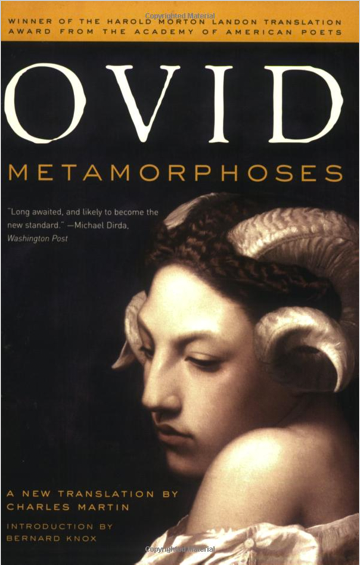
MetamorphosesOvidChapter 1: Step 1: Sunday

Sequester yourself for an hour — especially you non-church/temple types — and read from various myths — good translations of Ovid’s Metamorphosis, Native American trickster tales, Irish folklore, e.g. — and think about how what you’re reading relates to the universal human condition.

Chapter 2: Step 2: Monday

Take a half-hour off after having done something you have dreaded but have completed –e.g. gone to work, to court, to hell in a hand basket — and then listen to thirty minutes of the Blues, and by listen, I mean not only to the instruments, but also to the lyrics.

 Delia, Delia.

Poor girl, she’s gone.

With all I hate, she done left me all alone.

She’s all I got; it’s gone.

Blind Willie McTell by R Crumb.

Blind Willie McTell by R Crumb.

Chapter 3: Step 3: Tuesday

Put down for at least an hour your cell phone, joystick, remote control, and unhand that mouse.

Get into a non-escapist novel. When’s the last time you’ve read Huck Finn? If you’re reading this blog, I goddamn guarantee you’ll enjoy Huck (not to mention it’s time better spent than reading any blog).

Chapter 3: Step 3: Wednesday

Read slowly, carefully and out loud a ballad, which shouldn’t take up any more than 15 minutes.

I’d start early with folk ballads like “Lord Randall” and steadily work my way up chronologically to literary ballads like XJ Kennedy’s “Down in Dallas.”

Down in Dallas, down in Dallas,

where the wind has to cringe tonight,

Lee Oswald nailed Jack Kennedy up

on the cross of a rifle sight.

Chapter 4: Step 4: Thursday

Spend 45-minutes to following up on something you’ve discovered so far in your reading.

Chapter 5: Step 5: Friday/Saturday

Watch a universally acclaimed motion picture or attend local theater (and by that I mean see a play).

* * *

If you were to so regulate your animal spirits, it would cost you ~6 hours of time you otherwise squander lost in social media, trapped in the repetitive sturm und drang of video games, or seated in front of the flat screen.

Of course, I’m being facetious by suggesting this regimen. This regulation of dabbling in the arts would be destined to fail for the same reason diets fail. After a while, the spirit rebels against the assembly line sameness of eating healthy vegetables or reading outloud every Wednesday quatrains of tetrameter.

However, I can tell you this, reading good fiction can provide invaluable vicarious experience because it creates characters true to life. Cynical Mr. Bennett in Pride and Prejudice, despite his delightful wit and clever putdowns, suffers mightily for his detached parenting and refusal to listen to good advice, and his suffering certainly could have been catastrophic if not for Mr. Darcy.

This ARTICLE my friend Ed Burrows sent me scientifically supports the idea that good fiction can also increase your “moral intelligence.”

Dig this:

A 2013 study by the psychologists David Comer Kidd and Emanuele Castano explored the causal relationship between reading high-quality literary fiction and the ability to take the perspective of others, as measured by one of several well-tested tools, such as judging others’ emotions and eye-gaze directionality for interpreting what someone is thinking. The researchers found that participants who were assigned to read literary fiction performed significantly better on these “mind reading” tests that measured where subjects were looking and how they judged the emotions of others than did participants assigned to the other experimental groups, which did not differ from one another.

Think of reading good fiction and poetry as discovery, not escape.