In the Year 2025

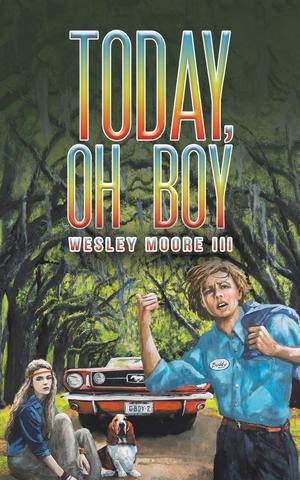
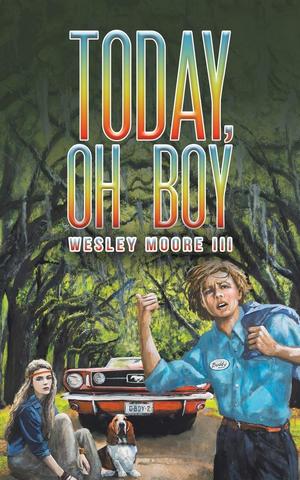
Each December, I assemble a month-by-month retrospective with links to what I consider that year’s greatest hits. Alas, in 2025, we have what my curmudgeonly grandfather Kiki would call “slim pickings.” Most years, I crank out 60 or so posts; however, this year I only produced 40 (and not a one in November). The good news is that the paucity of publishing is a by-product of greater productivity elsewhere. I’ve just finished Too Much Trouble, a sequel to Today, Oh Boy. The new book is essentially “a Southern Gothic romantic Comedy,” and who doesn’t love a “meet cute” during a serial killer’s murderous spree?

Now I’m attempting to land an agent so I can upgrade publishers, a tedious exercise in filling out forms on on-line platforms. Here’s a common request: In one sentence, pitch your novel.

“Oh, y’all, it’s so good, set in 1972, a page turner, literary, with characters you care about, a weird ass combination of pathos and fun, Harry Met Sally meets Night of the Hunter.

Already, even before official publication, David Boatwright is working on a screenplay, and his short film Summerville 1970, inspired by Today, Oh Boy, has recently won a handful of awards on the festival circuit.

So, anyway, grab a beverage, kick back, and gaze into the rearview mirror of 2025 as Jalopy USA races towards the edge of a cliff.

NOTE: WORDS IN BOLD ARE LINKS TO THE POSTS.

January

One of my favorite filmmakers David Lynch died in January, which prompted Caroline and me to take in several of his works, including Blue Velvet, Twin Peaks, and, of course, Eraserhead.

February

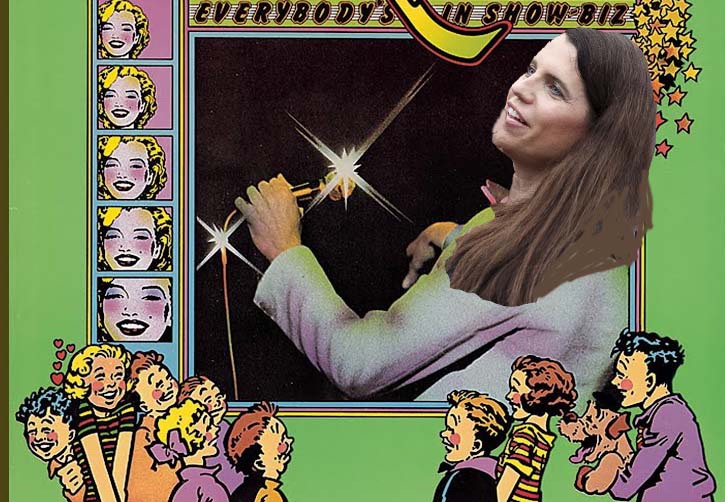
I’m what our narcoleptic president would consider “a lunatic leftwing communistic fascist low IQ individual,” so I revel in doing political hatchet Howitzer jobs on Donny; however, for the sake of my sanity, I’m only including two in this retrospective, and this one is more of a hit job on Nancy Mace than it is an excoriation of 45/7.

Take it away, Nancy!

Governing as a Performative Art.

March

As an astute reader might infer from the above, I’m also not a fan of Lindsey Graham.

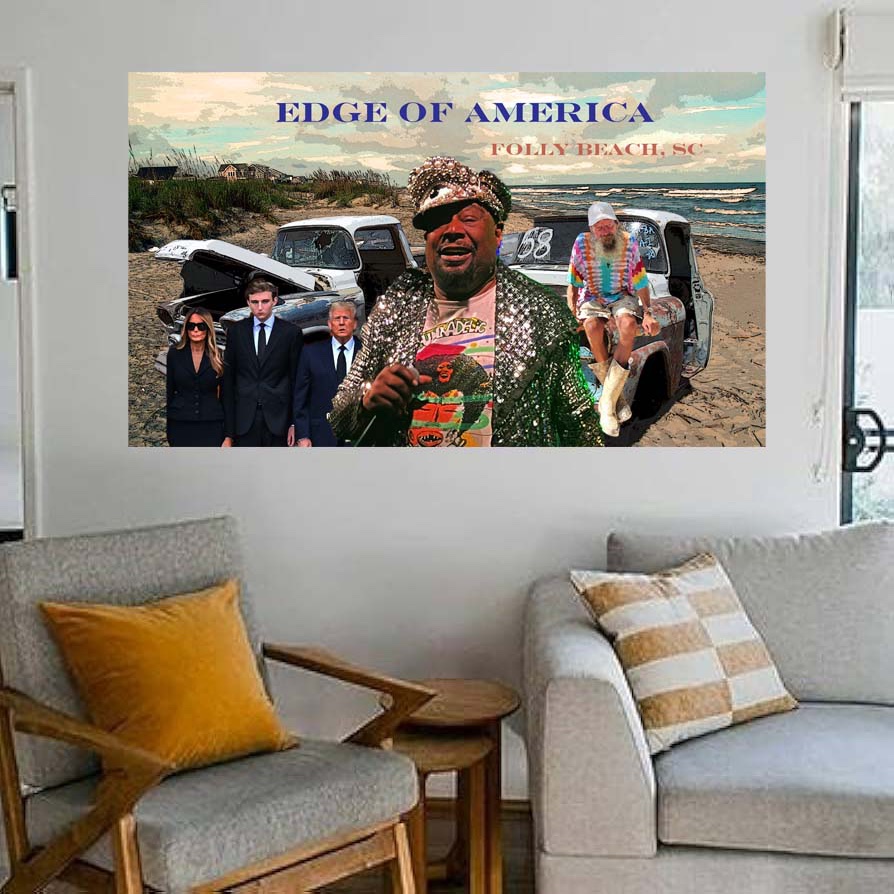
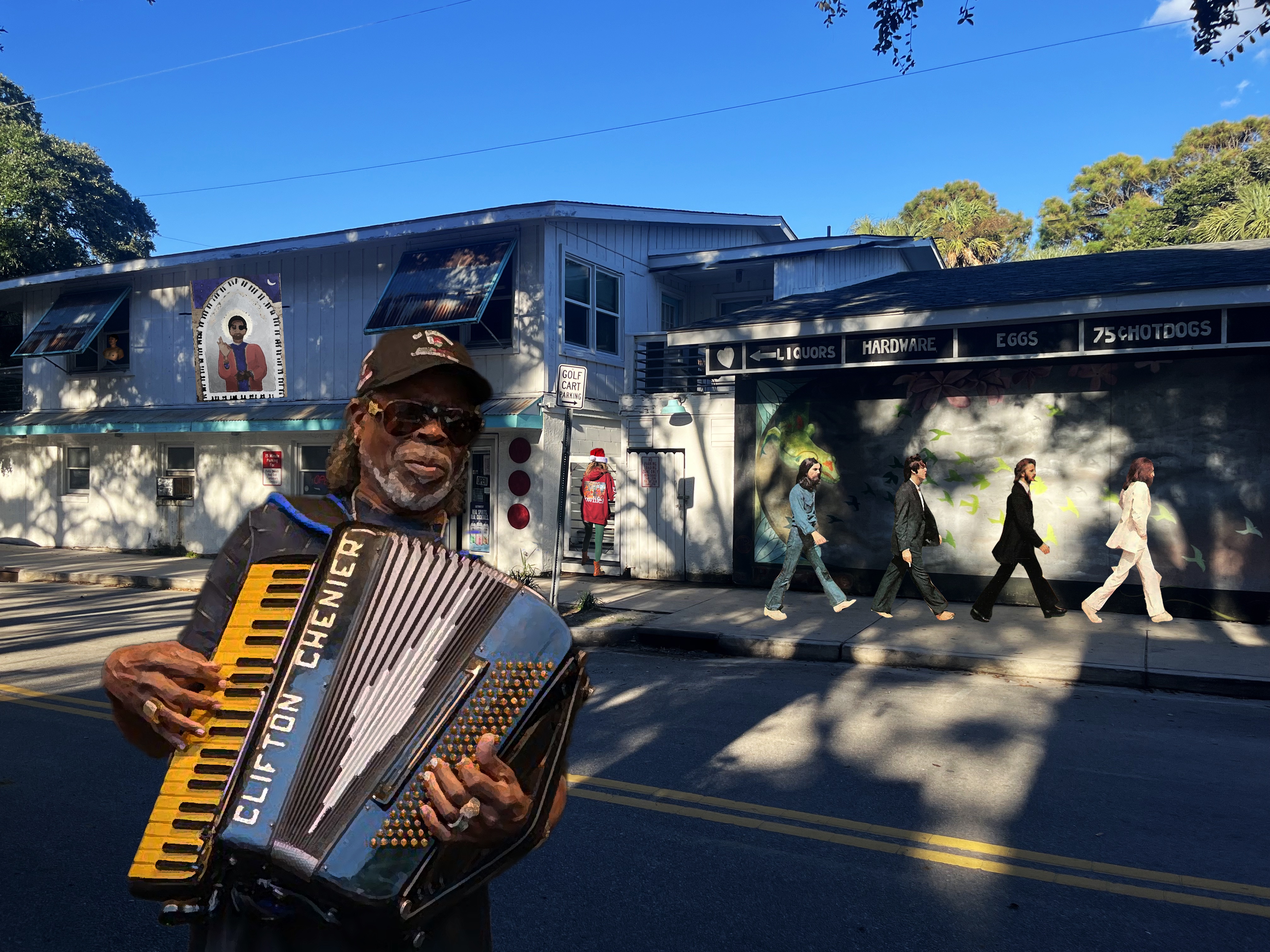
After reading the next one, entitled “Failed Poems, Fake Art, and Commerce,” you’ll definitely gonna wanna DM me so you can buy one of these fake paintings before they become unaffordable. By the way, Lowlife Bar now features the very first image in the post on the back of their hoodies. Lowlife’s located on the first block of East Hudson. Go grab you a hoodie before they sell out.

April

I attempted, unsuccessfully it would seem, to transform Today, Oh Boy into a screenplay, and this post explores the differences in the genres from a narrator/filmmaker’s perspective. Click: Novels Vis-a-Vis Screenplays.

May

Here’s what you get when you ask AI about Summerville 70.

“Summerville 70” refers to a recent 15-minute short film, an adaptation of a chapter from Summerville native Wesley Moore III’s novel Today, Oh Boy, depicting life and coming-of-age lessons in Summerville, SC, during the summer of 1970, directed by David Boatwright and produced by Paul Brown, which premiered in late 2025 and has been winning film festival awards.

(AI needs to work on its syntax. You could practically hang yourself with those dangling modifiers.

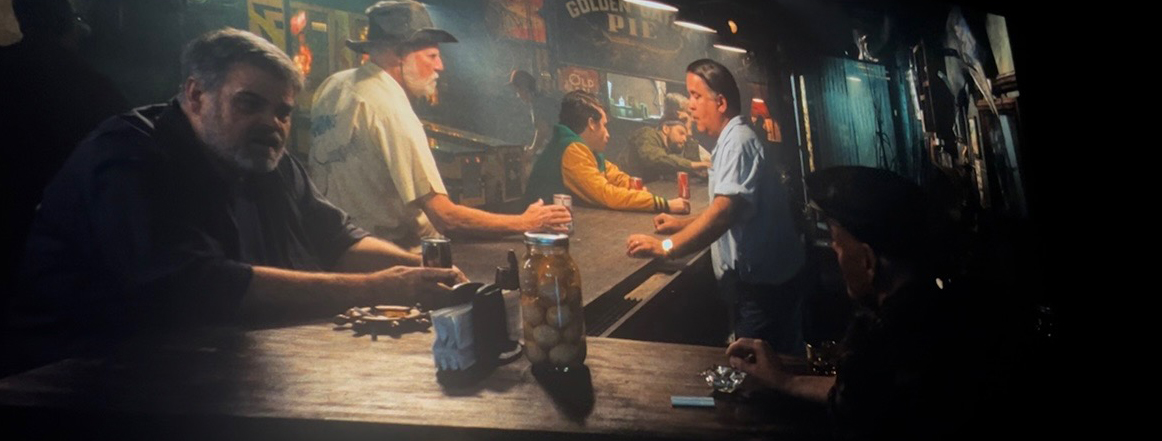
Anyway, I visited the set and gave Hitchcock a run for his money in fat boy cameo appearances.

June

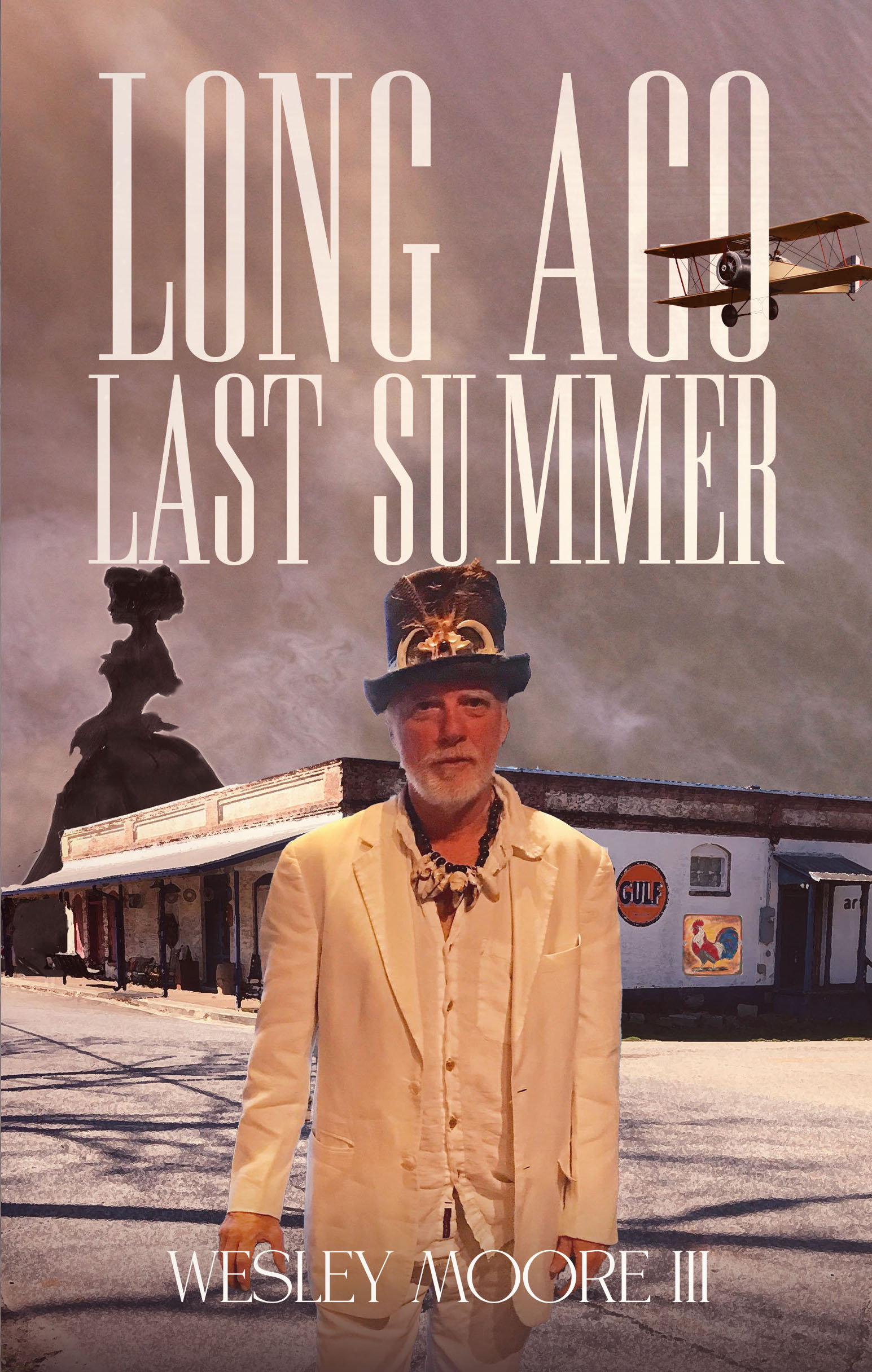
Oh, yeah, I had a book come out in June. Here’s eloquent Alex Werrell’s introduction of Long Ago Last Summer at its launch at Buxton’s Books, which was, to quote my friend Lee Robinson quoting Alan Shapiro, “the storm before the calm.”

July

What’s real? What’s not? I can’t hardly tell (sic) cause Everything’s Ersatz.

August

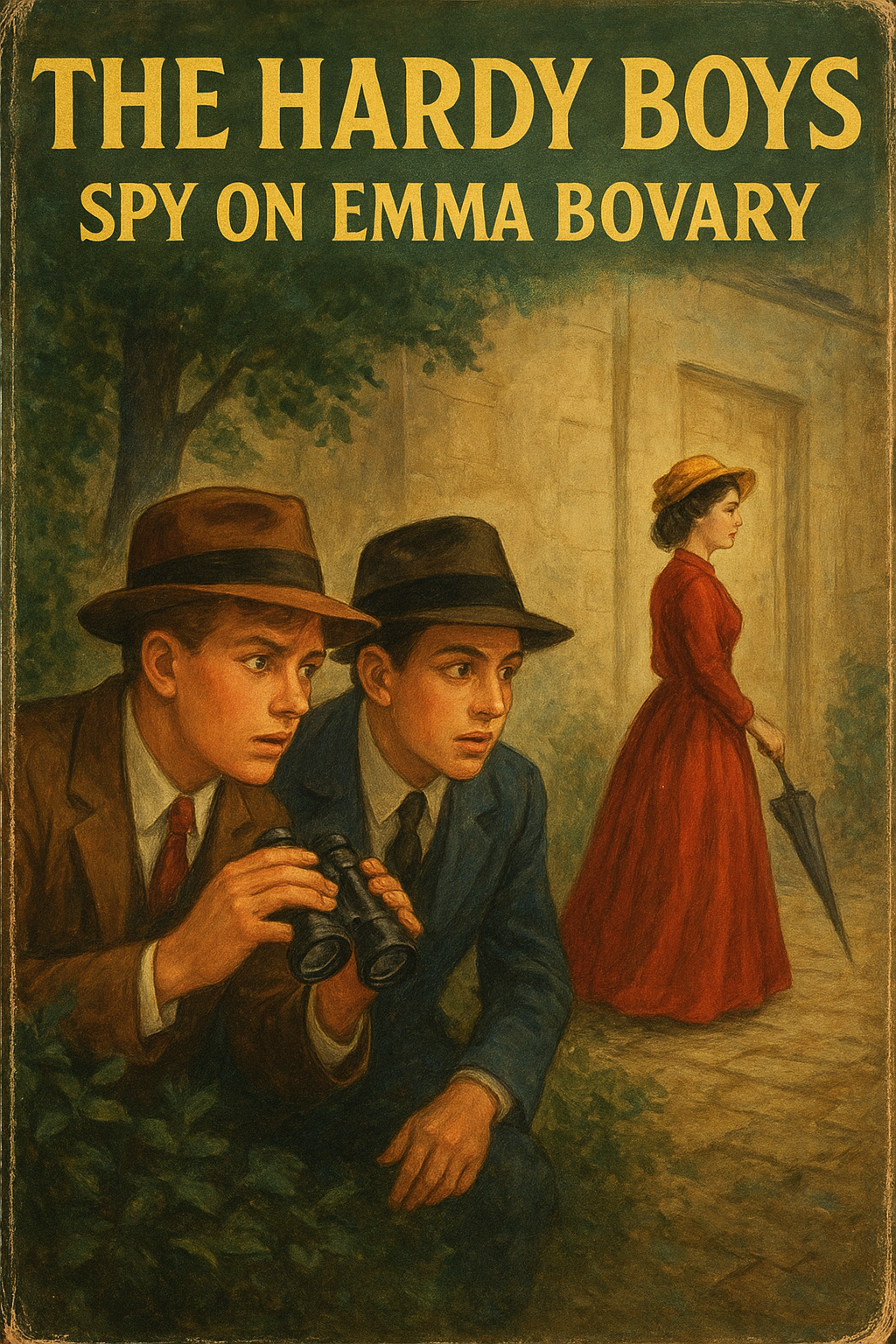
Imagine if Flaubert had written the Hardy Boys series.

September

After the premiere of Summerville 70, I wrote this review in which I claim that David Boatwright, like David Lynch, creates “moving paintings.”

October

Caroline and I went to see Elvis Costello and Charlie Sexton.

November

the sound of one and clapping

December

Here’s the first chapter of Too Much Trouble, read in my gorgeous Lowcountry baritone.

Happy Holidays, Happy Solecist, Happy New Year and thanks for reading!

Pee Wee’s Here, Pee Wee’s There, Pee Wee’s Everywhere, Pee Wee’s Dead, But Be Aware

Probably my favorite and most oft-repeated personal anecdote is my half-hour ride to Folly Beach chauffeured by none other than that legendary folk hero and serial killing cut-up Donald “Pee Wee Gaskins,” nee Donald Parrot, AKA Junior Parrot.[1]

In fact, the Kirkus review of my memoir Long Ago Last Summer highlights the Pee Wee incident:

One of the standout pieces involves the author hitchhiking to Folly Beach as a teenager—he and his brother survived an encounter with someone who was likely the serial killer Donald “Pee Wee” Gaskins. Even though the hitchhiking story is only four pages long, it fits a lot of frightening intrigue into a short space; the reader not only learns who Gaskins was, but gets to see the monster in action, doing things like casually burning a boy with a cigarette. [2]

Of course, during that harrowing hitch-hiking experience, Pee Wee didn’t formally introduce himself or the beer-swilling, cigarette smoking ten-year-olds accompanying him, but twenty years later when I read his autobiography Final Truth, I put two-and-two together when he mentioned that he’d take nephews on beach excursions to Folly.

By the way, the memoir also boasts an original poem entitled “Pee Wee Gaskins Stopping at a Lake House on a Summer Evening.”  Because of its macabre content and abject vulgarity, I dare not post it here in its entirety, but I will share its first stanza:

Whose corpse this is I ought to know

Cause I’m the one what killed it so.

I hope no one comes by here

To watch me in the lake it throw.

So you can imagine how delighted I was last week to receive unsolicited through the mail a pre-publication copy of Dick Harpootlian’s upcoming book Dig Me a Grave: The Inside Story of the Serial Killer Who Seduced the South.

I’ve not quite finished it, but when I do, I’ll post a review here. For now, I’ll just say it’s a real page turner written in noirish prose as Harpootlian, who prosecuted Pee Wee, weaves the narrative of Pee Wee’s life with his own.  Exposure to cold blooded killers transforms Harpootlian from an underground newspaper publisher[3] into a prosecutor of murderers and from an anti-capital punishment advocate into a diehard (forgive the pun) proponent.

And as luck would have it, just last night I was privileged to hear my pal David Boatwright and his band Minimum Wage perform David’s song “Pee Wee Gaskins” at art reception at Redux Contemporary Art Center where Buff Ross is showing some of David’s murals that have lost their original homes in Charleston’s real estate shuffles.

The murals are so great.  My favorite is a street scene in which Fredick Douglas is operating a Trolly Car that runs from White Point to the Neck.

Cool ass art is displayed throughout the building, which is located at 1054 King Street.

It’s not every day you see an ad for a James Brown inflatable sex machine sex toy.

Anyway, here’s a snippet of Minimum Wage performing “Pee Wee”Gaskins.”  The iPhone video doesn’t do it justice.


[1] He’s also the namesake of an Indonesian punk rock band. 

[2] It’s floundering at number 1,125,593 on the Amazon Best Sellers list, so why don’t you do a senior citizen on a fixed income a favor and order yourself one.

[3] The Osceola, which I read as an undergrad at USC

I Read the Obituaries Today, Oh Boy

At my age, with 2.7 billion heartbeats (and counting) above my belt and 26,598 days (and counting) marked off my calendar, I’m not surprised when I learn that one of my highschool classmates has departed for “that undiscovered country from whose bourne no traveler returns.”[1]

A couple of weeks ago, for example, news that my junior-and-high school acquaintance Roanld Pinkney had died appeared on Facebook.  Ronald was one of the pioneering Blacks who integrated Summerville schools years before wholesale integration. No telling what indignities he suffered in silence. I’ve likened these pioneering Blacks to Jackie Robinson, intelligent, thick skinned stoics courageous enough to subject themselves to abuse for progress’s sake. Ronald was a genuinely good guy, and I toyed with the idea of attending his funeral, but didn’t, of course, because I’m selfish.

However, this Wednesday when I turned to the obituary pages of the Post and Courier and saw the name Adam Martin Reiley Jacobs VII, I was taken aback. Although Adam and I lost touch after he was drafted and I left for college, he was one of my best friends in my last two years of high school. I often stayed at Adam’s house, or we’d hang for days at Jerry Locklair’s beach house across from the Washout. 

The thing is, even though I hadn’t seen Adam since his Uncle Sammy’s funeral a quarter century ago, I’ve been hanging out with him over the past few years because he’s the inspiration for the character Will Waring in my novel Today, Oh Boy. Perhaps that’s why I’m taking his death so hard.

Right now I’m in the process of writing a sequel to the novel set in 1972 when characters from Today, Oh Boy return to Summerville for Christmas after their first semester of college.[2] Will has just been drafted, has received orders to report to Fort Jackson in early January.  

Last Wednesday, the morning I learned of Adam’s death, I had just finished writing a scene where Rusty’s visits Will at his place. For Christmas, Rusty gifts Will his beloved blue jean jacket with the rolling paper icon Mr. Zig Zag silkscreened on the back. [3]  Will had openly coveted the jacket.

“Damn, Rusty, you scared me!”

“Sorry, man. I knocked, but those headphones make you as deaf as Helen Keller.”

Will stiffly rises from the sofa, and they shake hands.

“I guess you’ve heard the news,” he says.

“God, yes. I’m so sorry, man.  Whatcha gonna to do?”

“Bite the bullet.  I thought for a second about going to Canada, but I’m just gonna bite the bullet and hope like hell I don’t end up in Nam.”

Will looks – what’s the word? – haggard – though 20-year-olds aren’t supposed to look haggard.  In their friendship triad, it was always Will who preached chill to AJ and Rusty, chastising them for what he dubbed their “reel-to-reel anxiety.”

Rusty extends his arm that holds the present. “Merry Christmas!”

“Man, looks like whoever wrapped this was on smack.”

“Guilty but not guilty,” Rusty says.

Will removes the paper and sees that it’s the Zig Zag jacket. He pauses, holds it out at arm’s length to admire the silk-screening.

“Wow, man, thanks, but I can’t accept this. Though really appreciate the gesture.”

“But I want you to have it.”

“When I wear it, people behind me will mistake me for you.”

“So you’re planning on dying your hair red?”

“You mean like a dick on a dog?”

They both laugh.  

After Today, Oh Boy was accepted for publication, I worried that Adam might read it and get pissed off I had partially based Will’s character on him.  I worried that Adam might not appreciate the scene where he and AJ share a joint or how I portrayed his mother, a source of comic relief, though she’s really not his mother (and I find her sympathetic). 

There’s a bit of solace in that no one in the novel comes off worse than Rusty, the character based loosely on me. Wesley Moore III probably has the strongest case for a lawsuit. But the thing is, even though Rusty and I had red hair and both our parents smoked like fiends, he’s not really me. He’s much stupider than I was, but also much nicer.  When an interviewer once asked my pal Josephine Humphreys if any of the characters in her novels were based on her, she said, “No, but I sometimes let them wear my sweaters.”  I can relate.

When I posted news of Adam’s passing on Facebook, I was surprised by how people seemed to be moved by his death even though their constant refrain was “I haven’t seen him in 50 years.”

Here’s my brother David’s response, “This has affected me more than I would have thought.” Mutual friend Susan Wallace Hoppe, though she hadn’t seen Adam since the 1970s, wrote, “This death has really hit hard.”

Why? Why are we so moved by his death when he’s been absent from our lives for a half century? 

I believe it’s because Young Adam was handsome, charismatic, kind, modest and came to be a sort of icon in the early days of Summerville’s rather tepid counterculture.  He was an artist, a drummer, a rebel, a sympathetic friend.  In our minds, he’s the avatar of our youth, so to speak, a sort of immortal. But, of course, he wasn’t immortal. If dashing Adam is dead, we can’t be far behind. 

I was expressing all of these sentiments to my wife Caroline, and she said she thought that Adam would be grateful to be in the novel because he’ll come to life whenever someone reads the book.  

I don’t know if Adam would have liked Will, but I’d like to think so. I created him to be likable like Will. He’s, in a way, the most humane character in Today, Oh Boy. 

In fact, at least in the novel, I’d rather be Will than Rusty.

Anyway, goodnight, sweet prince.


[1] From Hamlet’s 3d soliloquy.

[2] Those of you who have read the novel will be happy to learn that Ollie Wyborn’s dream of attending the Air Force Academy has come to pass. 

[3] The jacket actually belonged to Tim Miskell, and Adam, who was an artist, had done the silkscreen.

The Unlikely Story of How I Became an English Teacher

Sleep Walking on High by Pauline Lim

I left for college as a journalism major, but I quit before ever taking even one introductory journalism class.  All of the journalism professors I met at the freshman orientation were chain-smokers who seemed to have a mild case of the heebie-jeebies.  Also, you had to pass a typing test, and not only didn’t I know how to type, but I also possessed –– and still do –– the fine motor skills of a platypus.[1]

So I gave up on being a newspaper scribe, and without declaring a major, took whatever classes seemed interesting ––  German Expressionism in the Weimar Republic, Film Studies, Shakespeare’s comedies, etc.

Because I was dream-ridden, impractical and enjoyed reading, when forced in my junior year to choose a major, I opted for English without giving future employment a nanosecond’s consideration. No way did I ever envision myself as a future high or middle school teacher. I recalled my highschool days, not with nostalgia, but with a feeling of good riddance, like Japanese Californians might look back on their internment during WW2.

Yet somehow I ended up teaching highschool for 34 years, and how I got that job is not unlike that Popeye cartoon where Olive Oyl sleepwalks her way across crane-hoisted girders swaying several stories above sidewalks far below during the construction of a skyscraper. 

She’s unconscious but amazingly lucky as she blindly makes her way


[1] In fact, believe it or not, I’m still a hunter and pecker.

In 1977, I was engaged to be married but unemployed.  I had only taken one education course as an undergraduate, so teaching high or middle school was out of the question.  Not only that, but I had dropped out of graduate school after earning the requisite 30 hours.  

In late August or early September of that year, I ran across an ad in the Post and Courier seeking an adjunct instructor at Trident Technical College.  The ad directed the applicant contact the Dean of English, Ed Bush.

So the next day, I drove to the North Charleston campus seeking Dr. Bush, although I was supposed to apply at the central office, a detail that I had somehow overlooked.  After asking around, someone directed me to Dr. Bush’s office.  Obviously, I didn’t have an appointment, but there was a line outside his office, so I got in the queue and awaited my turn.  When I approached his desk, he asked what class I wanted to drop or add.  I informed him I was there to apply for the job advertised in the paper.  After asking a few questions –– did I have a Master’s –– “no but I have the hours.”

“But you do have experience teaching, right? 

 “Um, yes” (after all, I had occasionally presented papers to fellow grad students in classes). 

So he hired me on the spot without checking any of my credentials. After all, classes were about to begin, and they needed someone to teach English 102, Technical Report Writing, and Business Communications.

So at 24, I became a podunk adjunct professor who grew to really enjoy teaching, even continuing to teach at night when I had a full time job keeping books and training for management of a company that sold safety equipment. 

Professor Rusty

My wife Judy ended up also teaching at Trident as well, but full time, and she eventually became the head of the psychology department.  After being one of 12 writers selected to study under Blanche McCrary Boyd in a SC Arts Commission workshop, I quit my daytime job, wrote short fiction by day, and taught by night.[2]  

However, once we had our first child, Harrison Moore, Ruler of the Third Planet, Judy wanted to be a stay-at-home mom.  I took care of Harrison in the day, then drove him and handed him off to Judy before teaching my night classes.  It was the worst of both worlds, sort of like being two single parents living under the same roof.

In that first autumn of being a father, I received a call from the chair of Porter-Gaud’s English Department, George Whitaker.  Ed Bush, my former boss at Trident, had given George my name.  Some teacher had been fired mid-year, and Porter-Gaud needed someone ASAP.  I told him I couldn’t, given my child-rearing responsibilities, but that I would love to teach at Porter in the following year.

As it turned out, the fellow they hired midyear also had to be fired that spring.  In addition, an older teacher, Mr. Hubbard, was retiring, and George himself was leaving to pursue writing.

So I interviewed for the job, and despite my not stellar credentials, the new chair, Sue Chanson, the greatest high school English teacher I’ve ever known, hired me, because she later told me, Ed Bush had given me such a stellar recommendation.

So perhaps there is some truth in the old adage “It’s better to be lucky than good.”

Right Olive?


[2] Other writers selected included Josephine Humphreys, Billy Baldwin, Lee Robinson, Harland Greene, Steve Hoffius, Rebecca Parke, and Greg Williams, to name a few.

Deaf Heaven, Bootless Cries, Sha La La La La Live for Today

Like the recurring characters in Cheers, I show up most afternoons at what the quaint call “a local watering hole.”  Chico Feo, my bar of choice, is one part Cannery Row, one part Key West tourist mecca, one part – as far as the cooks and bartenders go – extended family.  

I enjoy watching people interact, hearing the latest gossip, and, if the opportunity arises, engaging tourists with meaningful conversations. After all, I suspect my obituary will mention that among other things I was a fiction writer, and as I often inform total strangers, I’m constantly gathering “data” about this and that, which I might use in creating a character. It’s a way to justify my personal questions about their lives.  To me, constructing characters that readers care about is the most gratifying aspect of fiction-writing.

Unfortunately, today I happened to sit next to a borderline asshole. He was in his late 20s sporting muscles, tattoos, and the ubiquitous baseball cap worn backyards.  On the plus side, he might end up in one of my stories and receive the karmic comeuppance he deserves. 

Solle, perhaps the most effective bartender I’ve encountered in a drinking career that spans over a half a century, asked me how my book promo TV interview went, and the aforementioned borderline asshole said, “I saw it!”

I informed the borderline asshole that his having seen it was impossible in the current space/time continuum because the interview hadn’t aired yet.  Then he said, “I saw you at the studio.”  It occurred to me that he might be a camera person, so I asked him if he worked for FOX 24, and he said, laughing, “No, I’m just fucking with you.”

I was not amused.

He and his friend started talking about how great it must be to live on Folly, and I agreed it was, that I was very fortunate.  They live in West Ashley, and I said that was a convenient place to live because it’s near everything – the airport, downtown Charleston, Folly itself.

A few minutes later, the borderline asshole asked me what the book was about, so I clicked off some sound bites from the interview.  “It’s a memoir,” I said, “but it’s as much about the South as it is about me – antebellum plantations, shotgun shacks, Pentecostal churches, juke joints.  It’s a collection of short stories, essays, and poems, each of which can stand alone and be enjoyed separately, but if you read it cover to cover you get a history of the South from segregation through the civil rights movement and the cultural revolution of the 60s.”

“Wow, you must be a racist,” he said.

“What!!!??? Why do you say that?”

“If you’re not a racist, then why aren’t you?”

“Why not, because I grew up with Black people. I like most of them I’ve met.”

“I’m a racist,” he said.

No doubt I was scowling, because he immediately said, “Ha, ha, I’m not really a racist. I’m just fucking with you.”

Dark clouds were scudding overhead, so I decided it was time to walk home, which takes me past a melancholy memorial marking the spot where someone named Phillip died in a traffic accident.  For some reason – maybe because before I left the bartender Katarina clasped her hands in mock prayer asking the skies not to rain – my inner poetic jukebox cued a line from one of Shakespeare’s sonnets: “And trouble deaf heaven with my bootless cries” and then a line from A Midsummer’s Night’s Dream followed: “Chanting faint hymns to a cold fruitless moon.” And finally, a line from a Grass Roots song that I don’t even like: “Sha la la la la la live for today.”

I took a right on Erie, and as coincidence would have it, I encountered an interracial couple pushing a baby stroller. They were taking up the entire right hand lane, so I suggested they walk on the left so they could see the traffic coming.  The red-haired woman and her husband smiled. She said, “Thanks, but we’re staying right here” and disappeared into the yard of a rental.

So much for my mansplaining.

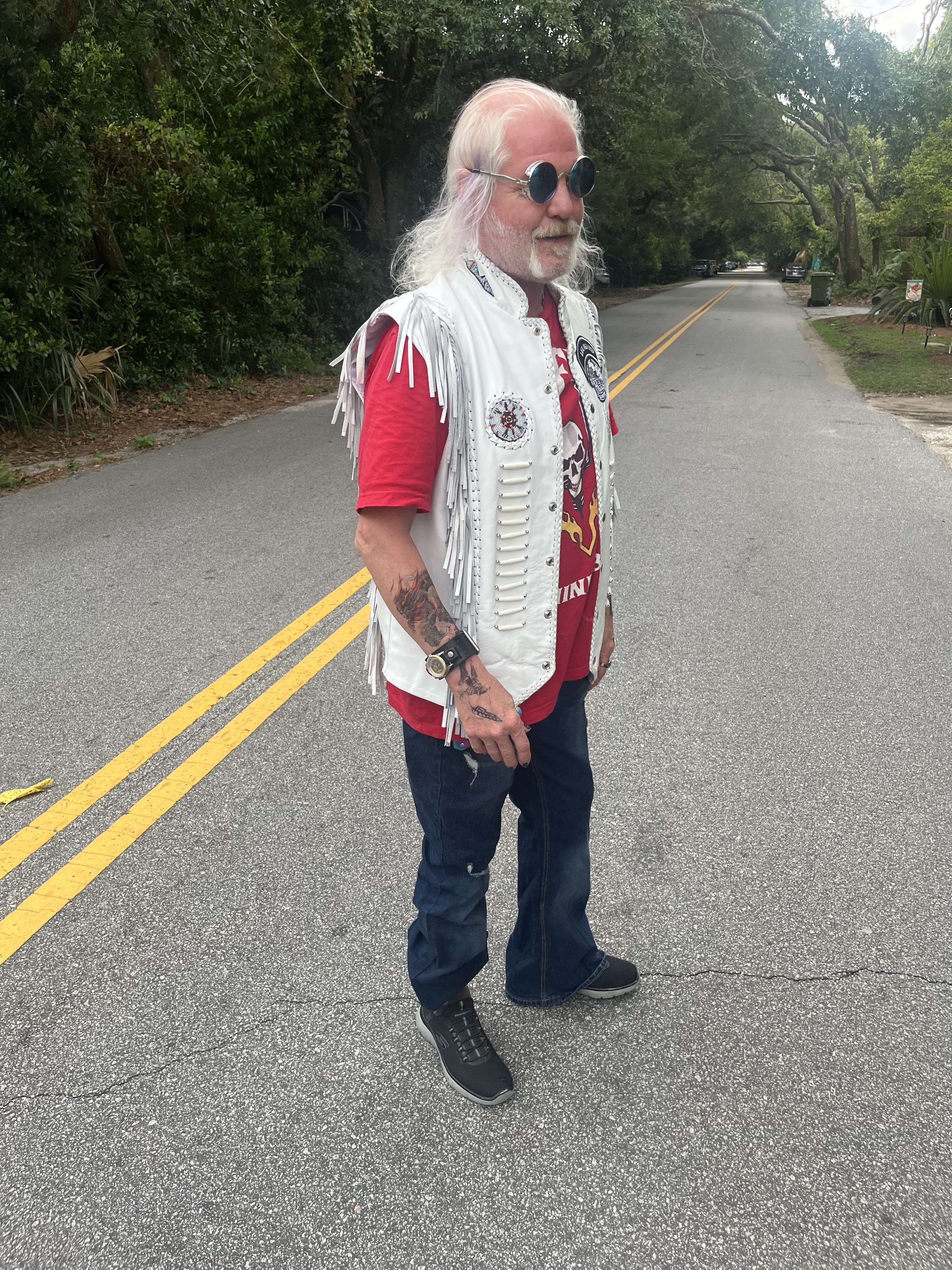
I decided to cross over to Hudson using a tree embowered beach access path and spotted through the tree tunnel a couple weaving past on skateboards.  Once I hit 5th Street, I bumped into my neighbor Lance.  I asked him about his outfit, a white fringed patch-bedecked vest over a red tee shirt emblazoned with a skull, and he explained the various patches and emblems.

As I said good-bye, he said, “I love you, man,” which was a nice way to end my excursion.  

Fa la la la la, live for today.

Vaudeville Meets William Faulkner Meets The Hallmark Channel

Vaudeville Meets William Faulkner Meets The Hallmark Channel

On Friday, I had my first interview involving my new book Long Ago Last Summer.  Lorne Chambers, who owns the Folly Current and has an MFA in writing from the College of Charleston, met me at Chico Feo where we chatted about creative writing in general and Long Ago in particular over a couple of beers. 

Occasionally, I didn’t know how to respond to Lorne’s excellent questions because Long Ago is such a strange book that it can’t be easily categorized.  When you’re trying to sell something, it’s helpful to have a clear, simple message like it’s “a coming-of-age novel” or a “dystopian sci-fi epic” or “a romantic comedy.”  With Long Ago Last Summer it’s more like Vaudeville meets William Faulkner meets The Hallmark Channel.

In essence, it’s a memoir, which is embarrassing enough because of the egocentricity inherent in thinking my life is so noteworthy that it warrants being shared with others.  And in many ways, my life has been unadventurous. I enjoyed a long lasting, loving marriage for 38 years, a stable teaching career for 34 years, reared two successful sons, owned a succession of dogs, remarried as a widower and gained a remarkable stepdaughter. I’m well-travelled, I guess, but that’s not unusual in this day and age.  To adapt a cliche: my adulthood has not been much to write home about as far as excitement goes.

On the other hand, I grew up in the segregated South, a very dark, fascinating place, a fallen civilization forever picking its scabs but then licking those newly opened wounds.  The little Lowcountry town of Summerville where I grew up had two (what I’m going to uncharitably call) village idiots, among other eccentrics, like the old crone Miss Capers, religious fanatics galore, creepy good humor men, and more alcoholics per capita than most places this side of the Betty Ford Center.

Much of the book deals with an awakening consciousness that develops in a Southern Gothic setting, or, as the back cover puts it, Long Ago Last Summer “embodies the profound paradoxes of Southern culture against a landscape dotted with antebellum plantations, shotgun shacks, suburban subdivisions, Pentecostal churches, and juke joints.” 

However, Long Ago is not a typical memoir in that it’s fragmentary, a collage of sorts, a mosaic, a smorgasbord or gumbo that runs the gamut from lighthearted vignettes to bleak accounts of terrible wrongdoing.  If I were going to wax hyper-pretentious, I’d call it neo-Modernistic because like Eliot’s “The Waste Land,” it pieces together fragments to create a narrative held together by recurring themes.  In this case, Sothern Gothicism, alienation, insomnia, and the vagaries of memory and reality. 

Short fiction, verse, essays, and parodies that can stand alone out of their context occur chronologically to trace my life from its beginnings in 1952 to the present. Long Ago is, as stated in the preface, “a guided tour of the haunted houses and cobwebbed attics of my youth” followed by my college experience, my meeting and falling in love with Judy Birdsong, her illness and death, and my finding new love after her departure.  In fact, included in the collection is a villanelle written by my wife Caroline that deals with Judy’s lingering presence in our marriage.  In some cases, fiction is juxtaposed with non-fiction so that it’s not necessarily clear which is which. 

In other words, Long Ago Last Summer is really weird, like its subject matter. 

I’m appearing next week on Fox News 24’s midday show to attempt to explain all of this to viewers who may or may not have heard of TS Eliot and/or Modernism or vaudeville for that matter.

Also, weather permitting, I’m reading brief samples Monday, May 26 around 7:20 at George Fox’s open mic Soap Box at Chico Feo. 

So, thoughts and prayers, y’all. I need them.

Little Baby Blues: 1953 Edition

Little Baby Blues: 1953 Edition

On 14 December 1952, a rare snowy day in Summerville, South Carolina, Dr. Howard Snyder, aided and abbeted by forceps, yanked me from my mother’s womb into a world of relative woe.  The procedure flattened my head, which resulted in cephalohematoma, a condition in which blood pools under a newborn’s scalp. My father had to leave that afternoon to return to Clemson via a Greyhound bus.  When the lady sitting next to him asked why he looked so sad, he replied, “My wife just gave birth to a seven pound, eight ounce monkey.”  

As a child and teenager, I heard this anecdote on more than one occasion, which would elicit a cackle from my mother, who in so many words agreed that indeed I was a hideous newborn. However, she was quick to assure me that in a couple of weeks I was so beautiful that when she pushed my stroller around Colonial Lake, strangers stopped her to admire my beauty. 

I took solace in my mom’s stroller story as a child, not realizing that praising a baby’s looks is a common practice of adults when they run across almost any infant. On Facebook, I often encounter the red puffy yet wrinkled faces of newborns who are deemed “beautiful” or “adorable” by scores of friends of the parents. 

Meanwhile, elsewhere, Ethel and Julius Rosenberg sat in a courtroom being grilled by Roy Cohn, Donald Trump’s mentor.  My first full year, 1953, marked the feverous height of the Red Scare, back when the Russians were our enemies rather than our friends (or at least our President’s friend).[1] This collective commiephobia spread, appropriately enough, during an epidemic of polio. 

Trump and Cohn

In 1953, R&B had not made it to the mainstream, and rock-n-roll was in utero.  Every artist but one in Billboard’s top 30 singles of 1953 is white, mostly male crooners and female sopranos. Overly orchestrated instrumentals were also popular. The number one hit that year is “The Song from the Moulin Rouge” by Percy Faith and His Orchestra, a song so saccharine sounding that your ears might develop diabetes if you listen to more than twice. 

I’ve never heard of loads of these hitmakers like Pee Wee Hunt, Frank Chacksfield, Richard Hayman, Joni James. By far, the coolest song in that top 30 is from the one Black performer, South Carolina’s own Eartha Kitt, singing and purring “C’est si Bon” en francais.  She later was cast as Cat Woman in the Batman TV series. 

On the other hand, I have not only heard of but seen all of the top movies of ‘53, except for The Naked Spur. I’ve seen From Here to Eternity and Gentlemen Prefer Blondes at least twice, I’ve also watched Roman Holiday and Stalag 17.  Disney’s Peter Pan was one of my favorite movies in childhood, especially because the leader of the Lost Boys was, like me, a red head.

Nevertheless, despite the general awfulness of 1953, being born around then ended up being a propitious time to begin life’s journey. My parents, who had grown up during the Great Depression, wanted my siblings and me to have a better life than they suffered yet didn’t monitor our every move, allowing us to roam freely, unencumbered with water bottles or walkie talkies, the ’60’s equivalent cell phones. 

And by our adolescence in the mid ’60s, the music got ridiculously good, though we feared getting drafted and going to Nam, but by then the war was winding down and a draft lottery was in force. Compared today, college tuitions were dirt cheap. I could earn enough money in the summers to cover tuition.

However, I must say, for me at least, it’s a melancholy situation in my twilight years to witness the spectacle of lawlessness and corruption foisted on the Republic by Roy Cohn’s mentee, who obviously, as far as Machiavellianism is concerned, was an A+ student. 

C’est la vie, as Eartha might sing.

I’ll leave you with the number 1 hit of 1953.


[1] Fun facts to know as share: Roy Cohn, who in addition to being one of the prosecutors at the Rosenberg trial, also served as chief counsel for Joseph McCarthy’s witch hunts, a term Donald Trump appropriated during his first term to describe investigations targeting him for such acts of malfeasance like storing stolen classified documents in bathrooms and paying hush money to porn stars. 

Novels Vis-a-Vis Screenplays

Novels Vis-a-Vis Screenplays

At the request of an actor who’s interested in pitching my novel Today, Oh Boy to producers he’s worked with, I’ve written an adaptation of the novel for the screen.[1] It’s not an official screenplay per se, but a roadmap for the actor to determine what scenes he will use to produce a short “teaser” reel consisting of would-be shots from the would-be movie. I have no idea how this is done. Via AI I suspect.  Anyway, with the final proofs from the novel to the right of my iMac’s screen and a blank Word document on the left, I began writing and cutting and pasting.

The good news is that originally, using present tense and employing crisp visual imagery, I consciously composed Today, Oh Boy to read like a movie progressing. For example, here’s the opening of the novel.

A mango-hued, pockmarked bulletin board hangs on a classroom wall of pale lime green concrete blocks, the bulletin board pencil-stabbed and compass point-gouged. Among the graffiti are the names of the star-crossed lovers: Sandy + Tripp. Tragic Tripp, whose body was found last week tangled in blackberry bushes along the banks of the Ashley River, his skull smashed after falling off Bacons Bridge.

S-A-N-D-Y + T-R-I-P-P.

Rusty Boykin, a skinny, freckled redhead sitting on the bulletin board row in Mrs. Laban’s homeroom, traces his index finger in the depression of Sandy’s name. He supposes it’s Tripp’s work – the letters inartistic, juvenile. Sandy hasn’t been to school since Tripp’s death, four class days ago, and now it’s Monday, and she’s still not here. She should be sitting right in front of Rusty, her honey-colored hair hanging like a curtain to her waist. 

How to adapt this for the screen?  One way, you could have Rusty tracing his finger in Sandy’s name and then suddenly cut to Tripp falling off the bridge, or you could begin with Tripp’s accident. What I did was to begin with Tripp’s last meeting with Sandy, a conversation through her open bedroom window, his leaving in a rage, jumping into his GTO, pealing off, and ultimately driving his car off the road at Bacons Bridge into the Ashley River.

Actually, Tripp’s death is what Hitchcock called a McGuffin, a misleading device that’s irrelevant to the overall narrative.  After all, Today, Oh Boy is a comedy. Its title comes from the Beatles’ song “A Day in the Life.”

I read the news today oh boy

About a lucky man who made the grade

And though the news was rather sad

Well I just had to laugh 

So, by having Tripp drive off the bridge rather than falling off the bridge, what I gain in cinematic excitement, I lose in the comic pairing of his first and last names. As it turns out, Tripp was a bully, a high school version of Trump.  At one point in the book, Alex Jensen, a junior at Summerville high, says to a friend Will, “Your last name is Trotter, you name your son Tripp, and he falls off a bridge to his death. What a surprise.”

In addition, the novel employs a great deal of what critics call “indirect discourse,” a device that allows a narrator to report what someone is thinking without using his exact words. For example, in the above excerpt, the sentence, “She should be sitting right in front of Rusty, her honey-colored hair hanging like a curtain to her waist” is rendered second-hand through Rusty’s consciousness. In a screenplay, you have to “show” rather than tell “tell,” which can lead to really awkward exposition, like you find in bad fiction like “The Most Dangerous Game”:

You’ve good eyes,” said Whitney, with a laugh,” and I’ve seen you pick off a moose moving in the brown fall bush at four hundred yards, but even you can’t see four miles or so through a moonless Caribbean night.”

That I couldn’t use direct narration or indirect discourse meant I had to omit some characters, like Camilla Creel, the impoverished girl who lives in an abandoned school bus with her mother and sister, and Weeza Waring, Will’s mother, who added several comic touches throughout the narrative.

So, overall, the script is much tidier than the novel, much more streamlined, yet not as rich in my attempt to capture the zeitgeist of Summerville, South Carolina in 1970, during integration, the beginning of the counterculture, and during an influx of Northerners moving to what at the time was a staid, conservative community.

Then again, I’m sure a professional screenwriter could do a much better job.


[1] By the way, it’s on sale at Amazon for a mere $10. 

“Go Away, Lindsey; You Bother Me.”

Let me say right off that I’m an avid admirer of WC Fields, who, in fact, is the inspiration for Colonel Duckenfield, the amiable but drunken calculus teacher in my novel Today, Oh Boy.[1]

Here he is in action:

Colonel Dukenfield has charged his minions with two in-class problems using the squeeze principle, so he has excused himself, ostensibly to use the restroom. A huge veined bulbous nose dominates his round, puffy, flushed face, though there’s still a gleam in his squinty blue eyes, especially when he’s talking to a pretty lady. His knees, though, are killing him, along with his corn-riddled toes stuffed into a pair of scuffed wingtips, the only dress shoes he owns. Once he reaches the faculty men’s room, he closes the door and takes out the pewter flask that bears his name and the name of his plane, the Flying Fortress, etched handsomely in ornate, old-fashioned cursive. He sloshes the Jameson’s whiskey around before taking a long, hard draw. Carefully, he screws the cap back on and places the flask in the right pocket of his blazer.

I mean, what’s not to love?

So I don’t intend any disrespect to Field’s surviving progeny (his great granddaughter’s wedding picture appeared in the Santa Cruz Sentinel in 2018) when I suggest that Lindsey Graham could be plausibly cast as an older Fields in a biopic once his political career is over, which may be sooner rather than later, given that he could get primaried on the one hand, and the country is on the road to economic and geopolitical ruin under our unhinged Dear Leader on the other.

What a great pairing of buffoons, Fields’ cinematic persona with Graham’s real life personality!

I know you might be thinking that Graham’s a little long in the tooth at 69 to embark on a new career; however, look at me at 72, getting ready to make a cameo in an upcoming short feature based on a chapter from Today, Oh Boy.[2]

So, Lindsey, see, it’s never too late to segue into something new. Look, man, you’re addicted to the limelight, and look, even if there’s not a Fields biopic on the horizon, maybe some enterprising filmmaker will buy the rights to Today, Oh Boy, and you can end up playing the Colonel himself.

As my wife Caroline says, “We can hope. We can dream.”


[1] You can read a review and purchase it here.

[2] I’ll be sitting at a bar, sipping a PBR, a role that I was born to play.

Failed Poems, Fake Art, and Commerce 

I subscribe to an internet entity called “Poem of the Day,” which provides me each a.m. with a dollop of verse to go along with a cup of whatever ground coffee is on sale at Harris Teeter on the previous Senior Citizen Discount Thursday.

This morning’s poem, Copyright © 2025 by Jessica Abughattas, has a title guaranteed to perk the interest of anyone interested in verse. It’s called “Failed Poems.” It’s one of those works where the title serves as the subject of the first sentence. To wit:

            Failed Poems

            will crawl out of the drain and try to kill you
            like some 80s horror flick.[1]

I like the poem, its witty catalogue of unpleasant analogies. Bad poems are like “a black widow creeping/from the mound of linens still warm from our bodies.”  They “steal your breath/ when you wake parched, hungover, emptied,” etc.

What really caught my attention, being a fake artist and all, were these lines describing another, much more successful fake artist:

Once, in Zurich, we were served rabbit paella at a party 
celebrating an exhibition of an artist from Venice Beach 
who used to be homeless but drinks $25 Erewhon smoothies and paints 
hundreds maybe thousands of happy faces with his feet. His canvasses 
go for $25,000. Toe paintings are better or at least significantly 
more profitable than failed poems.

This really hit home because the day before yesterday I got a text from a number I didn’t recognize with this message:

“Found some ‘fake’ art at goodwill today. I’m going to buy it as an investment.”

I responded, “Who in his right mind would give a masterpiece like that away?”

But to be honest, I did know. It was the fellow who won it at Chico Feo’s annual Canine Halloween Costume Contest. Harlan, the organizer, asked if I would donate a print, and I thought it was one of the better prizes, but as luck would have it, the winner is an actual artist who upon receiving it asked me if I’d seen any of his works.  

I hadn’t.

But I’ll also admit it would take a certain, rare art lover with a funkadelic sensibility maximus to want to hang the print above the mantle.

Anyway, the poet nails it when she whines about the unprofitability of writing poems vis-à-vis creating pictural art. In fact, believe it or not, despite receiving a rave review from Kirkus Reviews and having appeared on a local television show and several national podcasts, my novel Today, Oh Boy has provided me with less income than my fake paintings.[2]

Already this month, I’ve received two commissions and sold another print, not including the secondhand Good Will purchase. 

Anyway, I’d say that creating these canvases is more fun that writing fiction and certainly more fun that going over the “corrected proofs” of a manuscript that soon will be bound and sold in bookstores and online, which I have been doing of late.

I don’t  have a pub date yet for Long Ago Last Summer, but I’m guessing late spring or early summer.

PS. Speaking of commissions, Caroline and I have commissioned the unfake funkadelic artist Thom Piragnoli to create a sign for our driveway to alert visitors where our hidden house hides. 

You can check out Thom’s art at Chico Feo. The one above is called Galaxy Gals. Check out this LINK for more on Thom. 


[1] Rather than cutting and pasting the entire poem, I’ll provide a link because non-poetry lovers, i.e., 99.97% of people, would abandon this post for the greener pastures of a TikTok video. Here’s the LINK. You can read along while Jessica Abughattas reads it in a rather pleasant regionless accent.

[2] To be honest, this was not the case in 2023, the year Today, Oh Boy was published.