My Take on Summerville 1970, an Adaptation of My Novel Today, Oh Boy

poster designed by Gil Shuler

Given that my novel Today, Oh Boy inspired David Boatwright’s and Paul Brown’s short film Summerville 1970, I won’t pretend that my critical assessment of their movie possesses the clear-eyed detachment that disinterest fosters.  

On the other hand, the number of authors who hated film adaptations of their work is legion.  For example, Gore Vidal considered the adaptation of his novel Myra Breckenridge “not just a bad movie [but also] an awful joke” and Donn Pearce, the author of the novel Cool Hand Luke, hated its screen adaptation. “They did a lousy job,” he said, “and I disliked it intensely.”  Other unhappy authors include Ken Kesey, Stephen King, and PL Travers.  Like I say, a lot of authors have hated films based on their works. 

Therefore, my admiration of the project was by no means guaranteed.

That said, I loved Summerville 1970.  

photo credit Joan Perry

Shortly after David Lynch’s death, Caroline and I watched a documentary about Lynch’s transition from painting to movie making.  In the documentary, he described a revelation he experienced at film school: it suddenly occurred to him that he could make “moving paintings” rather than merely “moving pictures.”  

In other words, Lynch attempted to render each scene of his movies so visually interesting that each still could be frozen and stand alone as a painting.  

Like Lynch, Boatwright is also a painter, and like Lynch, studied at the American Film Institute in LA. Summerville 1970 is a “painterly film,” rich in color and artistic in layout.

For example, check out this photograph Caroline took of my cameo appearance during the premiere Friday night.

When Caroline showed the shot to me, she said, “It looks like a painting.”  

“Wow, yeah, that looks like it could have been painted by Hopper,” I said.

 “Or [Thomas Hart] Benton,” she replied, which indeed is more accurate.

One of the most vexing problems a short story writer and short film creator faces is having to constrict action within a confined space and time. David does a terrific job of compressing the events of poolroom chapter of the novel into a fluid narrative that doesn’t have one second of down time.  The movie has, as all good stories must, a beginning, a middle, and end. Crisply edited, the plot unfolds efficiently with a disquieting subtle sense of foreboding.  Of course, any work of fiction requires conflict, and in addition to the central physical conflict of rednecks attacking a hippie, we have other conflicts as well: a developing high school crush, the vet’s anguish, and the lost basset hounds’ wandering.[1]

To simplify matters, David took four of my characters – Rusty Boykin and Ollie Wyborn, the co-protagonists, and Jill Birdsong and Sandy Welch, the female leads – and fused them into two characters, i.e., into a single male and a single female.   In the film, the character Rusty is actually more Ollie than Rusty. For example, in Summerville 1970, Rusty, like Ollie, hails from Minnesota and knows karate.  On the other hand, like the Rusty of the novel, cinematic Rusty has embraced the counterculture of the late ’60s and early ’70s.  In the novel, Ollie is a conformist who wants to attend the Air Force Academy. Because the film is limited to fifteen minutes, these changes make a lot of sense. 

The Jill Birdsong character of the movie closely resembles Jill of the novel, only she’s less straightlaced and less shy, though the character does maintain a quiet shyness, nevertheless.

Olivia Brooks, the actress who portrays her, is superb, as is Thomas Williams, who plays Rusty.

Not only do the main characters shine, but the minor characters do as well. Patrick Basquill’s Bobby Ray Bossheen exudes mindless menace, and his two redneck cohorts, the twin brothers Andre and Remy Levesque, come off as authentically belligerent, not-too-bright country boys. In addition, David Mandell is a stabilizing force as the compassionate bartender who attempts to maintain peace. Jill’s wisecracking friend Nanci played by Sara Rudeseal is spot-on as well. 

My favorite character of all is David Boatwright’s invention, a Viet Nam vet who tells a horrific war story to the bartender and later breaks up the fight outside the tackle shop. The actor, Logan Marshall Green, makes the vet’s PTSD seem all too real as he draws heavily on his cigarette with shaking hands, knocking back whiskey after whiskey as he shares his horrible memory of a situation that brings to mind My Lai.

In addition, the costumes, sound, and editing are all superb.  It’s truly a pleasure to watch, and I hope you get a chance to see it.

BTW, here’s a LINK to a review of Today, Oh Boy that provides a link to its Amazon and Barnes and Noble pages. .  Rumor has it that it might be screened again at the Terrace for the general public.  Fingers crossed. 

[1] I got the idea of writing Today, Oh Boy after listening an audio book of Joyce’s Ulysses.  The basset’s actual name is Hambone Odysseus Macy, but the kids who find him on the side of the road dub him Mr. Peabody.  He is the Ulysses character in the novel who wanders all over Summerville to finally making his way home safely to his family.

The Hawkes and Flannery O’Connor

Thursday night, our friend David Boatwright met Caroline and me at the Terrace Theater to check out the Ethan Hawke Flannery O’Connor biopic Wildcat.[1]  It’s gotten mixed reviews—hovers around 5 on the Rotten Tomato ten point scale— but I wonder if to fully appreciate the film you need to be familiar with O’Connor’s work. Throughout the action, Hawke and fellow screenwriter Shelby Gaines intersperse fiction from O’Connor’s canon into the story of her adulthood, but if you’re unfamiliar with her stories — e.g., “Parker’s Back” or “Revelation”— you very well may find the film quilt-like, a series of narratives stitched together that don’t create a comprehensive or unified overview. Brandon Yu, who reviewed the movie for New York Times, complains, “Half-sketched and sometimes hard to follow, the stories glimpsed here ultimately fail to produce a fully legible or consistently engaging arc of what must be a roiling inner world.” However, if you’ve read the stories, this is not the case. You see how they came to be via her daily interactions with others and understand how the stories embody her Catholic vision.

I don’t think the Hawkes (Ethan’s daughter Maya plays O’Connor and his wife Rachel is credited as a producer) necessarily set out to produce a fully integrated masterpiece like Citizen Kane but rather made the movie as an homage to Flannery, an artist of the highest caliber who simultaneously can make you laugh out loud and feel pathos. Maya Hawke discovered O’Connor in high school, used O’Connor’s Prayer Journal for her audition monologue at Julliard, and essentially became obsessed with the writer. 

I can empathize. I’ve learned a lot from Flannery O’Connor about writing fiction. Not only that, but her stories are so fun to teach, are so well crafted with each element of the plot — name selection, physical description, characterization, symbolism, and tone—linked to a common central theme: in a Catholic universe underserving people can be granted grace, even in the seemingly godforsaken Southern Gothic world of rural Georgia. 

Take the story “A Good Man Is Hard to Find,” for example, which dramatizes a family vacation where a mother, father, two bratty children, an infant, and a grandmother are murdered by an escaped convict called the Misfit. Yet I’d classify the story as a comedy, both in the literary sense and also in the Medieval sense of “The Divine Comedy” where a soul moves from darkness to light. The grandmother in the story is a self-centered pain-in-the-ass who essentially causes the wreck that allows the Misfit to murder the family and steal their car. However, at the very end of the story, grace descends upon the old woman when she sees how miserable the Misfit is and tries to comfort him:

[The Misfit’s] voice seemed about to crack and the grandmother’s head cleared for an instant. She saw the man’s face twisted close to her own as if he were going to cry and she murmured, “Why you’re one of my babies. You’re one of my own children!” She reached out and touched him on the shoulder. The Misfit sprang back as if a snake had bitten him and shot her three times through the chest. Then he put his gun down on the ground and took off his glasses and began to clean them. 

Hiram and Bobby Lee returned from the woods and stood over the ditch, looking down at the grandmother who half sat and half lay in a puddle of blood with her legs crossed under her like a child’s and her face smiling up at the cloudless sky. 

illustration by Jeffrey Smith

Note that her “legs are crossed,” an obvious Christian symbol, “under her like a child,” which suggests innocence regained, and that she is “smiling up at a cloudless sky.” In O’Connor’s Catholic universe, this amounts to a happy ending for the Grandmother’s death comes at a moment of redemption. This message is no doubt alien to most contemporary US citizens; however, as the movie makes abundantly clear, she wasn’t writing for the materialistic middle class. 

“Either one is serious about salvation or one is not,” O’Connor writes in Mystery and Manners. “And it is well to realize that the maximum amount of seriousness admits the maximum amount of comedy. Only if we are secure in our beliefs can we see the comical side of the universe.”

For me a movie is a successful if I think about it a lot after seeing it. In the wee hours this morning, as I wandered the barren moors of my insomnia, I thought about how the subdued colors of the film in general and threadbare genteel shabbiness of her home in specific underscore the profound melancholy of Flannery O’Connor’s life. She had studied at the famed Iowa Writer’s Workshop, hung out with Robert Lowell and Katherine Anne Porter, but after developing lupus was exiled from a literacy life in the North to a suffocatingly provincial existence on a farm in Milledgeville, Georgia, There she worked in pain and physical decline until her death at 39, all the while being totally unappreciated by her homefolk who found her fiction to be inaccessible and life-negating.

My only gripe is that the Hawkes’ depiction of O’Connor lacks the dry humor that she demonstrated in her letters. Maya Hawkes’ acting is superb, but she portrays O’Connor as sort of a rigid, humorless young woman on the spectrum whereas in reality O’Connor was fun to be with. I once had dinner with the late Ashley Brown, a professor at the University of South Carolina, who was close friends with Flannery and who appears often in her collected letters. I asked him if she were as severe a Catholic as the stories suggested, and he said, “Oh, no, not at all. She was delightful, very witty, fun to be with.” Then he whipped out photo albums featuring pictures he had taken of her with her peacocks. She was often beaming in those photos.

Nevertheless, by external standards, her life was bleak, and the film’s underscoring of that fact has made me appreciate her achievement even more. To see her alchemizing on screen the characters from her daily life into the immortals of her stories is very satisfying indeed. I also appreciate the way she didn’t outline her stories but had them unspool spontaneously from her subconscious, which is the way I also write fiction.

I’ll leave you with this delightful seduction scene from “Good Country People” where in a hayloft Manly Pointer, a door-to-door Bible salesman, demands that one-legged hot-to-trot nihilist Hulga Joy Hopewell say the words “I love you” to satisfy a mechanical formula he insists must be followed as a prerequisite for sex:

The boy’s look was irritated but dogged. “I don’t care,” he said. “I don’t care a thing about what all you done. I just want to know if you love me or don’tcher?” and he caught her to him and wildly planted her face with kisses until she said, “Yes, yes.”

“Okay then,” he said, letting her go. “Prove it.”

She smiled, looking dreamily out on the shifty landscape. She had seduced him without even making up her mind to try. “How?” she asked, feeling that he should be delayed a little.

He leaned over and put his lips to her ear. “Show me where your wooden leg joins on,” he whispered.

I often say that my novel Today, Oh Boy has the most unerotic sex scene in all of American literature, but now, rereading the above, I take it back.


[1] Although better known in Charleston a muralist and a painter, David is also a filmmaker, and sitting next to a filmmaker made me pay closer attention to technique, which is a good thing. 

America, Good Luck by David Boatwright

Recitation of “Adam’s Fall” on Yeats’ 159th Birthday

A year or so ago, Buxton Books invited me to recite a favorite poem for their on-line series, “The Power of Poetry” as part of the promotion for my novel Today, Oh Boy. However, I don’t think the clip was ever posted, so in honor of Yeats’ 159th birthday, I’m posting it here. The text of poem itself is below the video.

We sat together at one summer’s end,
That beautiful mild woman, your close friend,
And you and I, and talked of poetry.
I said, ‘A line will take us hours maybe;
Yet if it does not seem a moment’s thought,
Our stitching and unstitching has been naught.
Better go down upon your marrow-bones
And scrub a kitchen pavement, or break stones
Like an old pauper, in all kinds of weather;
For to articulate sweet sounds together
Is to work harder than all these, and yet
Be thought an idler by the noisy set
Of bankers, schoolmasters, and clergymen
The martyrs call the world.’
And thereupon
That beautiful mild woman for whose sake
There’s many a one shall find out all heartache
On finding that her voice is sweet and low
Replied, ‘To be born woman is to know—
Although they do not talk of it at school—
That we must labour to be beautiful.’
I said, ‘It’s certain there is no fine thing
Since Adam’s fall but needs much labouring.
There have been lovers who thought love should be
So much compounded of high courtesy
That they would sigh and quote with learned looks
Precedents out of beautiful old books;
Yet now it seems an idle trade enough.’

We sat grown quiet at the name of love;
We saw the last embers of daylight die,
And in the trembling blue-green of the sky
A moon, worn as if it had been a shell
Washed by time’s waters as they rose and fell
About the stars and broke in days and years.

I had a thought for no one’s but your ears:
That you were beautiful, and that I strove
To love you in the old high way of love;
That it had all seemed happy, and yet we’d grown
As weary-hearted as that hollow moon.

What’s in a Name, Um, Could You Spell That?

In the last twenty or so years, parents have been opting for phonetic spellings for their children’s names, which often increases the number of letters needed to convey the sound of the name. The other day in the obituaries I ran across a survivor, a grandchild, whose first name was Kennidee. (I’m not sure of the pronunciation: Is it Kennedy or Ken-a-DEE?). I’m assuming Kennidee’s a girl because these cutesy spellings almost invariably are assigned to female names – Ashlee, Emmalee, Brandee, etc.  Also, sometimes parents invert the vowels E and A to create a sort of Celtic look, rendering Haley as Haeley, for example.

Obviously, it’s none of my business what parents name their progeny, and I’m not claiming that my family’s names are particularly stellar. My maternal great grandparents, David and Minnie Fairey Hunt, named their daughters Ruby and Pearl, and Aunt Ruby named her daughter Zilla. Sister Pearl christened one of her sons Fairey, so his name ended up being Fairey Goodman, which sounds like a character in a nursery rhyme fantasy.[1] My own grandmother, the younger sister of Ruby and Pearl, was named Hazelwood Ursula Hunt, a mouthful, if you ask me, which became even more of a mouthful after she wed Jerome Kistler Blanton and became Hazelwood Ursula Hunt Blanton.[2]

Lewis David Hunt, born 1863; Minnie Anna Fairey Hunt, born 1873

Given that I’m a fiction writer, I’m in the business of naming characters, and for me it’s a lot of fun because I try to imbue my characters’ names with symbolic meaning. For example, I tagged the protagonists of a break-up story Abby Huffington and Ashton Gray, she quick to take offense, he as drab as sackcloth. In Today, Oh Boy, the main character’s Rusty Boykin’s name weds incompetence and immaturity, and conveniently Boykin is a traditional South Carolina surname. 

His foil and eventual friend’s name is Ollie Wyborn, a transplant from Minnesota with Nordic roots. Ollie is an intellectual, a questioner, so I chose Wyborn to suggest that Ollie possessed a philosophical bent. 

Anyway, it must be nice to have a distinctive name. For example, if you google Wesley Moore you get hundreds of thousands of hits, from the current governor of Maryland to Wesley Charles Moore serving 30 years in Michigan for child molestation. Wes Moore is about as distinctive a name as John Smith when you get down to it. 

But I’m not complaining. I grew up around the corner from a girl named April Lynn Paris.


[1] I have a copy of the Fairey family tree. The first American Fairey’s name was John, born in Ireland in 1720 and killed at the Battle of Hanging Rock in 1780 during the American Revolution. When I first visited Ireland, I told the proprietor of the B&B where we were staying that some of my ancestors came from Ireland, the Faireys, and he looked at me as if I were daft and said, “Now, there’s a name I’ve not heard of.”

[2] Grandmama Hazel wanted to name my mother Barbara Ursula, but the doctor talked her into shortening it to Bobbi Sue, a name my mother detested because she considered it way too country cute.

Lurking in Some Obscure Corner

Like a shortwave radio attempting to tune into a remote overseas station, my threadbare synapses sometimes spit out static as I try to remember the point of story I’m trying to tell. 

Maybe it’s the cannabis, maybe the onset of dementia, or to harken back to Big Brother and the Holding Company, “a combination of the two.”

For the uninitiated, “A Combination of the Two” is the opening track of Big Brother’s album Cheap Thrills featuring the incomparable Janis Joplin. I had always assumed that the song was a live recording, but as it turns out, the audience noise and Sam Andrew’s introduction of the band, “Four gentlemen and one great, great broad,” have been dubbed in to create the illusion of a live recording. Well, it certainly had me fooled for over a half century.

BTW, the great Robert Crumb did the cover art.

In my novel Today, Oh Boy, as Will Waring is popping Cheap Thrills into his van’s 8-track tape player, he says out loud to himself, “Four gentleman and one great, great broad.”  Recently, when Rodgers Nichols interviewed me on his podcast Cover to Cover, he mentioned the allusion, said as a former radio DJ he really appreciated it.[1]

Anyway, what was my point?

Oh, yeah, forgetfulness.

The name of the author is the first to go
followed obediently by the title, the plot,
the heartbreaking conclusion, the entire novel
which suddenly becomes one you have never read,
never even heard of,

as if, one by one, the memories you used to harbor
decided to retire to the southern hemisphere of the brain,
to a little fishing village where there are no phones.

Long ago you kissed the names of the nine Muses goodbye
and watched the quadratic equation pack its bag,
and even now as you memorize the order of the planets,

something else is slipping away, a state flower perhaps,
the address of an uncle, the capital of Paraguay.

Whatever it is you are struggling to remember,
it is not poised on the tip of your tongue,
not even lurking in some obscure corner of your spleen.

It has floated away down a dark mythological river
whose name begins with an L as far as you can recall,
well on your own way to oblivion where you will join those
who have even forgotten how to swim and how to ride a bicycle.

No wonder you rise in the middle of the night
to look up the date of a famous battle in a book on war.
No wonder the moon in the window seems to have drifted
out of a love poem that you used to know by heart.

“Forgetfulness” by Billy Collins


[1] You can catch the interview HERE.

Different Sides of the Same Coin

Warren Moise and I experienced similar childhoods in that we grew up as White males in relatively small South Carolina towns in the Fifties and Sixties, both graduating from high schools that were integrated in the 1970-1971 school year.

Here’s a quote from the back cover of Warren’s excellent historical memoir The Class of ’71.[1]

When the Class of ’71 began first grade as young children in 1959, they lived in a totally segregated society. Except for some few prior student transfers and with limited other exceptions, the Black and White members of the Class of ’71 had never met, played music together, gone to church with one another, eaten food at the same lunch counters, or swum together in the same pools. All of that would change on the first day of their senior year. 

In Summerville, South Carolina, where I lived, even physicians’ waiting rooms were segregated into White and Black sections. In fact, Bryan’s, the Black owned barbershop that I patronized, only cut White people’s hair.  John F. Kennedy, Malcom X, Martin Luther King, and Robert Kennedy were assassinated within five years of one another when we were students. A cultural revolution was underway. 

Again, to quote Warren:

Soul music, oxford shirts, and oxblood Wejuns penny loafers were disappearing from the streets of Gamecock City[2]every day, It was as if the 1960s were burning rubber in a Chevelle V-8 Super Sport on Highway 15 South leaving town toward Paxville. At the same moment, the 1970s were rollin’ into town on Highway 15 North inside a Volkswagen van painted with slogans of peace, love, and daisies.

Warren and I met our freshman year in Thornwell dorm the fall of 1971 at the University of South Carolina and became fast friends, deciding to room together in Tenement Nine on the Horseshoe the next year, which we did until Warren left college to pursue a musical career.[3]

Warren and I circa 1972

We also shared houses when Warren returned to USC to earn his undergraduate degree in history in 1974 -1976. Unfortunately, we more or less lost contact after school. Oddly enough, fortyish years later we both ended up writing books about being in high school the same year. My novel Today, Oh Boy takes place during the course of one day, October 12, 1970, a month or two after Warren began his senior year at Edmunds high school.[4]

So, The Class of ’71 and Today, Oh Boy cover some of the same terrain, small towns transitioning from the Old to New South, the tumultuous raging of hormones, adolescent crushes, physical violence engendered by culture clashes. 

In my not-all-that-humble opinion, they offer interesting perspectives from non-fictive and fictive landscapes in that pivotal school year that ended the Sixties and ushered in the Seventies.

We better stop
Hey, what’s that sound?
Everybody look, what’s going down?

from “For What It’s Worth,” lyrics by Stephen Stills


[1] I don’t know if there’s such a thing as a historical memoir. The Class of ’71 contains multitudes – it’s a history of Sumter County, a coming-of-age story, a judicial and political chronicle of desegregation, a sociological review of the cultural changes of the late Sixties, a profile of serial killer Pee Wee Gaskins. In short, it’s difficult to succinctly classify. Here’s some more expansive. You can purchase the book HERE.  It’s a great read propelled by well-crafted prose. 

[2] I.e., Sumter, South Carolina.

[3] You can read the horror story of the roommate who replaced him HERE BTW, Warren’s musical career was successful. He’s a member of the Beach Music Hall of Fame, though he abandoned life on the road for a career in law.

[4] Actually, I decided to delay Summerville’s integration until the next year, which we novelists have the freedom to do. You can purchase Today, Oh Boy HERE.

Heeding Andrew Marvell

Heeding Andrew Marvell

Thus, though we cannot make our sun 

Stand still, yet we will make him run.

                                    Andrew Marvell – from “To His Coy Mistress”

One of the entries in the epic catalog of my character flaws is a lotus-eater-grade tendency towards lassitude, which I’ve written about HERE.

However, in the last two weeks I’ve been on the go-go-go, on a tear – touring Mexico City, hosting family and friends, signing books, reading from Today, Oh Boy at its book launch, attending the reading of an original play in a private home, and dancing to the music of the Krushtones.[1]

Mexico City

Caroline had booked the trip before we discovered that T,OB‘s publication date was to be 31 March, the day before our departure. Buxton Books scheduled the launch for 11 April, so the trip didn’t interfere with promotion.[2] On the other hand, ex-pat son Ned booked a flight to Charleston that arrived on 4 April, three days before my scheduled return, so I came back a day early while Caroline and Brooks stayed on in Mexico City, which is 2000 miles higher than Denver, the Mile High City. Hey, but none of us suffered any altitude sickness, so praise Huitzilopochtli!

We traveled with Celeste Joye and her husband Tom Foster and their daughter Juliette. The short-term rental they had booked was a falsely promoted malodorous, sofa-stained apartment without hot water. The rental is located the floor below at kick-boxing studio where a cousin of Cujo barked ferociously.  

Not succumbing to the languor that would have me holding my nose (literally) and staying there all week, Celeste and Caroline scouted out new digs, called and cancelled, and we ended up staying at the swank Camino Real, which boasts a 007 early-60s vibe.

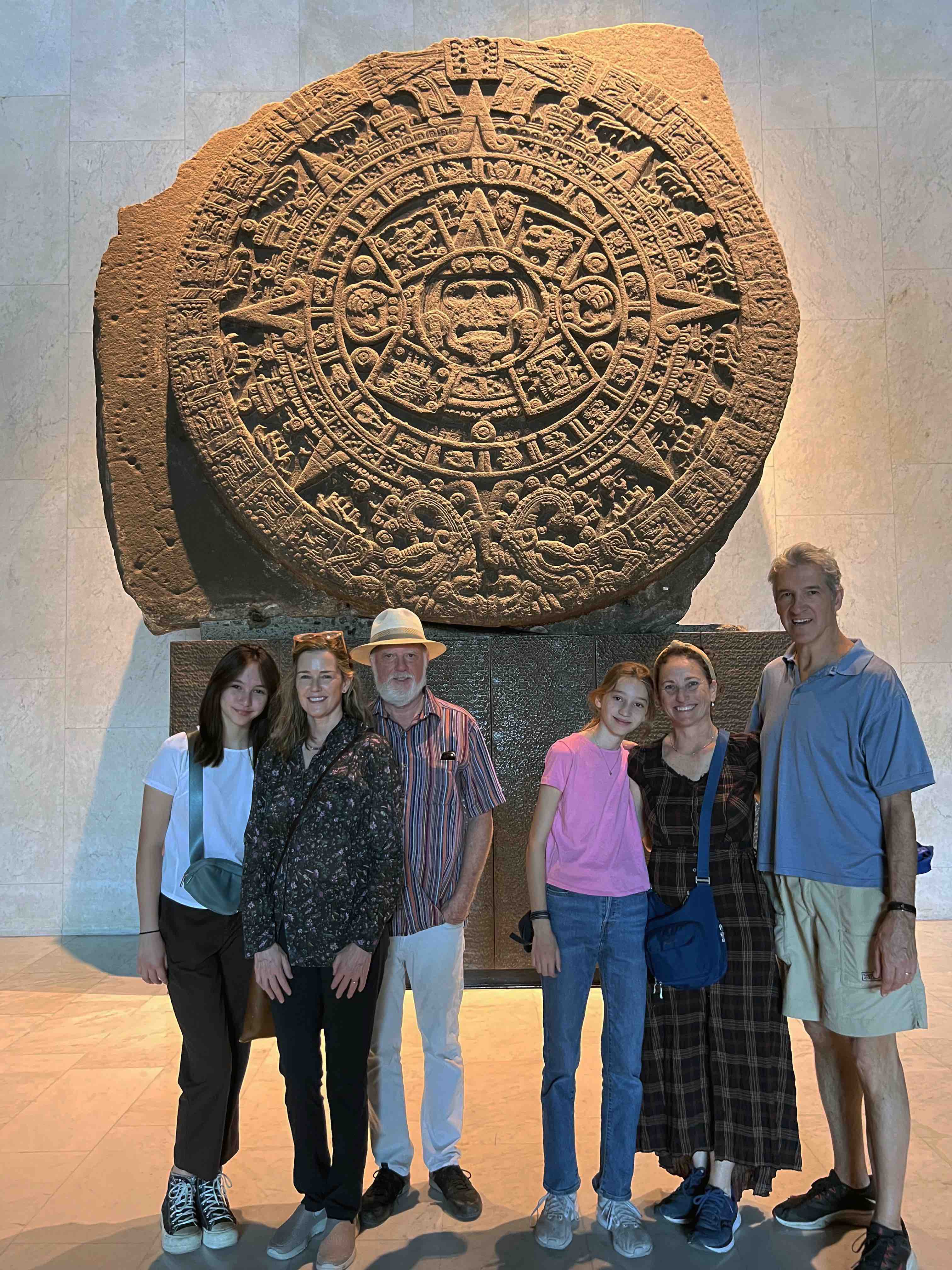
When I travel, my above-mentioned lassitude demands that I engage in only two tourist activities a day, one mid-morning and one after lunch; however, Celeste, Tom, and Caroline were go-getters, and the days and nights were filled with sight-seeing which featured a guided tour of Aztec ruins and a guided tour of Museo Nacional Antropologia.[3]

We also ate a various top tier restaurants, had drinks at Tenampa, a mariachi bar, and saw the Ballet Folklórico perform in a beautiful performing arts center.

But, as Andrew Marvell was wont to point out, all good things must end.[4]

Hosting my Family

Last week was the first time that my two sons had been home at the same time since 2018 – Harrison, his wife Taryn, her mother Susan, and grand-toddler Julian rented a house on Folly, and Ned and his love Ina came all the way from Nuremberg and stayed with his at 516 East Huron.

Also, I had the pleasure of having lunch with a childhood friend John Walton whose mother and my mother were best friends growing up and always.

But dammit, but that too had to end with Harrison and crew flying out Wednesday and Ned and Ina Friday.

The Book Launch[5]

I’ve already gone on enough about the launch. The curious can access the reading HERE if they have “world enough and time.”

Seeing Is Believing 

The indefatigable Eugene Platt and his wife Judith hosted a soiree of sorts in which a cast of seven or so readers performed his play-in-progress Seeing Is Believing. Based on the account in the Gospel of John, the play is set post-resurrection and consists largely of Andrew and Thomas walking to a “safe house’ where Jesus appears and puts a screeching halt to Thomas’s skepticism. 

If I were Eugene, I’d produce it as a film instead of trying to get it produced as a play. Staging a fifteen-minute walk would be challenging, but you could really do some interesting things on film.

I bet some religious-minded film student at SCAD would find it interesting.

The Krushtones

What can I but enumerate old themes? I love me some Krushtones, who play at the Sand Dollar around 15 April every year. I couldn’t believe how fresh and practiced they sounded.

If you’re interested in learning more about this killer cover band and the Sand Dollar Social Club, click HERE.

THE END

Sometimes, Mr. Marvell, endings aren’t all bad. For example, I’ve finished writing the first draft of this blog post, and my dear readers have finished reading it and can get going on something more productive, because, as you have pointed out so eloquently: 

 [. . .] all before us lie/ Deserts of vast eternity.

So, carpe diem, y’all. Hubba-hubba-hubba, swish-boom-ba-ba-ba-ba-Barbara Ann.


[1] Not to mention doing our taxes.

[2] After zooming to number 570 on Amazon’s Young Adult and Teen Historical Fiction category, it’s now dropped into the 900s. C’mon people. I’m a senior citizen on a fixed income!

[3] I’ve been told my Spanish accent isn’t terrific. BTW, I’ve never been much for guided tours, but I must admit you learn a helluva lot more.

[4] E.g., “The grave’s a fine and private place/ But none, I think, do there embrace.”

[5] Thank you, Polly and Julian Buxton!

My Novel “Today, Oh Boy” IS Out Today, Oh Boy!

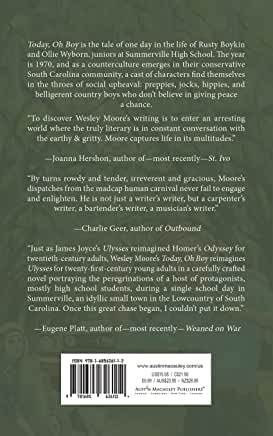
Fourteen months after its acceptance, my novel Today, Oh Boy is out and available at

Buxton Books

Barnes and Noble: LINK

Amazon paperback: LINK*

Amazon ebook: LINK

Coming soon to Guerin’s Pharmacy in Summerville and Bert’s Market on Folly Beach


Upcoming Events:

Book Launch at Buxton Books


Reading and signing from 6:30-7:30 p.m. near Hutchinson Square during Third Thursday on Apr. 20 (featuring music by Fleming Moore).

Reading and signing at Porter-Gaud School April 29th from 5:00 – 6:00 PM


Media

Story in the Charleston City Paper by Bill Thompson LINK

Interview with Eugene Platt in The Post and Courier LINK

Interview with Mary Reagan in the Summerville Journal Scene LINK

Television interview with Leyla Gulen. Click Below

Get ’em while they’re hot!


*Note, the back cover is displayed on Amazon’s paperback link:

Late Life Hullabaloo

I’ve written on Hoodoo previously that I don’t blame young people for holding golden-agers, i.e., senior-citizens, i.e., their elders, i.e., old farts in contempt as we shuffle along taking tiny steps, fumbling for our checkbooks while striking up conversations with grocery store clerks, or poke along doing 45 in passing lanes, oblivious to the hustle and bustle of Late Empire capitalism.

Even I-and-I, a forgetful 70-year-old, have been known to disparage my fellow geriatrics when their egocentricity (or declining faculties) don’t take in account the needs of others. No doubt I get on young people’s nerves myself, an overly dressed gadfly Oscar Wilde wannabe nodding my head and droning on about myself on barstools and in dentist offices.

Yet here I am in my twilight the author of a little ol’ bagatelle of a YA novel written on a 12th-grade-plus reading level, and I’m shamelessly promoting it as if it’s the great American novel.  Three newspaper articles have appeared that focus on my late life productivity[1], and I’ve also appeared on midday local television program talking about me, me, me, not exactly a fascinating subject.

Ultimately, it’s much ado about not much.

Yet it does give me something to do and to dread.

My sons and their significant others are coming to the book launch[2] (Harrison and Taryn from Chevy Chase, Ned and Ina from Nuremburg), Old and new friends will be there. Eugene Platt, who has recently published his collected poems Weaned on War will introduce me, an honor for sure. I see the launch as a sort of funeral I get to enjoy before I die.

However, I do want to set it down here that I’m a little ashamed of myself for all this hullabaloo. There’s something a little tawdry about it, a little needy. 

Rather, I should 

like a laughing string

Whereon mad fingers play

Amid a place of stone,

Be secret and exult

or better yet, as the young people say STFU.

Cheers!


[1] I’m also, to use a polite term, a digital collagist.

[2]Buxton Books, 120 King Street, 11 April 2023 6 PM rsvp@buxtonbooks.com