Although spring offers rebirth, for example, dollar weeds resurrecting, azaleas ablaze, etc., it also has its downsides.
Nature’s first green is gold,
Her hardest hue to hold.
Her early leaf’s a flower;
But only so an hour.
Then leaf subsides to leaf.
So Eden sank to grief,
So dawn goes down to day.
Nothing gold can stay.
Robert Frost “Nothing Gold Can Stay”
OMG! My life is slipping through my fingers! Nothing good ever lasts for long!
April is the cruelest month, breeding
Lilacs out of the dead land, mixing
Memory and desire, stirring
Dull roots with spring rain.
Thomas Sterns Eliot “The Waste Land”
Same ol’ same ol’, death and resurrection, death and resurrection, death and resurrection . . .
Here on Folly Beach, springtime attracts sybarites of all stripes, like those 25 cent beer nights in the 1900s, those days of yore.
Today at Lowlife, on my side of the bar, a crew of northern males in their early sixties sported expensive haircuts, retro bowling-like shirts, and satiric lanyards celebrating impending inebriation. Maybe it was a college alum get-together. Who knows? I asked one of them what was up, but he was not forthcoming.
Meanwhile, inside the restaurant, across the bar from where I sat, a bushel of bachelorettes were doing something similar in the team party department, dressing alike, engaging in one last bacchanalia before the sacred vows.
Elsewhere (all over the world, in fact) more serious folks were amassing to protest the hare-brained economic and geopolitical executive orders of a leader who always wins golf tournaments held on courses he owns.
Here’s the White House’s official announcement: “The President won his second round matchup of the Senior Club Championship today in Jupiter, FL, and advances to the Championship Round tomorrow,”
To quote Bob Dylan,
I couldn’t help but feel ashamed
to live in a land
where justice is just a game.
But here’s the good news (and the bad news). Trump and his cabinet are too slapdash careless to topple our democracy. Their idiotic unprovoked trade war is sure to produce a blue tsunami in the midterms next year.
Pity the poor Nancy Maces who’ll have to choose between getting primaried a year from now or continuing to vote for destruction.
Trump’s insanity will lead to failure. People will pretend they didn’t vote for him.
So don’t despair. Nothing orange can stay. Spring leads to summer, summer autumn, fall winter.
Around and around we go, and where we end up is in the rat’s alley where the dead men lost their bones. so I say, to quote the late great Warren Zevon, “Enjoy every sandwich.”
Lines Stolen on a Gloomy Sabbath after Being Led Astray
Do you know the New York Times game Connections?
If not, in the game, you’re presented each morning with a square consisting of sixteen boxes, four up and four down. The object is to discover an affinity of four of the words/terms that appear in the boxes, in other words., to find a common thread. Essentially, if you correctly identify three groups, you win because the final four you didn’t choose, will form the last group.
Here’s today’s puzzle:
Frost Beach Pump Pope
Race Bishop Pet Shop Pound
Hardy Beat Prior Bake
Throb Bad Preheat Pastor
The first category that came to my mind was poets’ surnames.
(Robert) Frost
(Alexander) Pope
(Elizabeth) Bishop
(Ezra) Pound
(Thomas) Hardy
This seemed unfair because there are five obvious choices, but not to worry, poets weren’t a category, and I almost botched my 48-day streak, missing my first three guesses but somehow managed to get the blue category (the second to the hardest), then the green (the second easiest), and finally, the yellow, the easiest, third, which left the purples, the hardest, now a gimme.
So I decided in protest to construct a poem by lifting lines from the poets that appeared in the puzzle. Here it is:
Lines Stolen on a Gloomy Sabbath
Back out of all this now too much for us,
Down their carved names the rain drop ploughs.
One tear, like the bee’s sting, slips.
The paired butterflies are already yellow with August
And sport and flutter in the fields of air.
Sources:
Robert Frost, “Directive”
Thomas Hardy, “During Wind and Rain”
Elizabeth Bishop, “The Man Moth”
Ezra Pound, “The River Merchant’s Wife: A Letter”
Alexander Pope, “The Rape of the Lock, Canto 1”
So thank you, whoever, constructs Connections, for leading me astray.
Hey, I got a beef with whoever writes the narratives of the PBS series Nature. It really bugs me when the narrator – and it happens all the time – says stuff like the panther chameleon’s eyes have been engineered by nature to rotate independently as they stalk their prey.
Note to the science writers at Nature: check out Charles Darwin’s The Origin of the Species. Natural Selection ≠ Engineering. Natural Selection is a horrifically random process that includes genetic mutations, asteroids colliding with the Earth, etc. Your use of the word engineering suggests the decrepit teleological intelligent-design argument (as if having an asteroid smack into the planet is an efficient way for an engineer to facilitate the rise of mammals).
I’ll give Robert Frost the last word on this topic:
Design
I found a dimpled spider, fat and white, On a white heal-all, holding up a moth Like a white piece of rigid satin cloth — Assorted characters of death and blight Mixed ready to begin the morning right, Like the ingredients of a witches’ broth — A snow-drop spider, a flower like a froth, And dead wings carried like a paper kite.
What had that flower to do with being white, The wayside blue and innocent heal-all? What brought the kindred spider to that height, Then steered the white moth thither in the night? What but design of darkness to appall?– If design govern in a thing so small.
Now, that’s what I call engineering: a Petrarchan sonnet that through pattern debunks the argument from design!
Hey, what’s all this negativity, mon? It’s Bloomsday, for Joyce’s sake and Father’s Day to boot, not to mention Sherry Browne’s birthday.
Let’s not squander this day bellyaching. Why not in honor of the Master spend your day wandering the streets of Folly, breakfasting on Guinness and kidney, writing love letters using a nom de plume, hitting a funeral, lunching in a pub on cucumber sandwiches, visiting a library and then another pub, releasing some tensions at the beach, getting into an altercation with a one-eyed anti-semite, dropping in on a maternity ward and then a brothel, bringing home a troubled young man, peeing together in your garden as you bid him adieu, then crawling into bed with your wife who has fond memories of you in your youth.
O and the sea the sea crimson sometimes like fire and the glorious sunsets and the figtrees in the Alameda gardens yes and all the queer little streets and pink and blue and yellow houses and the rosegardens and the jessamine and geraniums and cactuses and Gibraltar as a girl where I was a Flower of the mountain yes when I put the rose in my hair like the Andalusian girls used or shall I wear a red yes and how he kissed me under the Moorish wall and I thought well as well him as another and then I asked him with my eyes to ask again yes and then he asked me would I yes to say yes my mountain flower and first I put my arms around him yes and drew him down to me so he could feel my breasts all perfume yes and his heart was going like mad and yes I said yes I will Yes.
Getting and spending, we lay waste our powers . . .
Wm. Wordsworth
In his long life, Richard Wilbur has never lost his Wordsworthian sense of childlike wonder. Wilbur’s heart leaps up, not only when he behold[s] a rainbow in the sky, but also at such overlooked mundane wonders like the turbine-vent [that] natural law/ Spins on the grill-end of the diner’s roof.
Many of his poems grapple with the relationship between metaphor and perception, suggesting that poetry works its magic in casting the commonplace (by the way, that diner is located on a planet swirling around a star hurtling in concert within a galaxy spinning into the vast abyss of space/time) – [ahem] casting the commonplace in strange ways that paradoxically help us to shake off the staleness of familiarity so that we suddenly can perceive the spectacular it-ness of the whatever.
Here Wilbur in an English sonnet called “In Praise of Summer” wonders why we need the distortions of jazzy description to jar into seeing:
Obscurely yet most surely called to praise,
As sometimes summer calls us all, I said
The hills are heavens full of branching ways
Where star-nosed moles fly overhead the dead;
I said the trees are mines in air, I said
See how the sparrow burrows in the sky!
And then I wondered why this mad instead
Perverts our praise to uncreation, why
Such savour’s in this wrenching things awry.
Does sense so stale that it must needs derange
The world to know it? To a praiseful eye
Should it not be enough of fresh and strange
That trees grow green, and moles can course in clay,
And sparrows sweep the ceiling of our day?
Wilbur, as it were, offers poetic language as a sort of perceptual slap in the face, awakening us to the unseen wonder right there before us while at the same time lamenting our inability to see freshly in the first place..
Seeing is half-creating, as Wordsworth himself puts it in “Tintern Abbey.”
Nevertheless, in Wilbur, our consciousness is both a wonder and a curse – sometimes in the same poem. For example, in “A Question from Milton,” the poetic speaker dismisses prelapsarian consciousness as boringly 2-D:
In Eden palm and open-handed pine
Displayed to God and man their flat perfection.
Carefully coiled, the regulation vine
Submitted to our general sire’s inspection.
Yet in the very last stanza of the same poem he suggests that Adam should
Envy the gorgeous gallops of the sea,
Whose horses never know their lunar reins.
Wilbur as a young man studied under the mighty Robert Frost, who echoes this post’s epigraph in the first line of his poem “Directive:”
Back out of all this now too much for us,
Back in a time made simple by the loss
Of detail, burned, dissolved, and broken off
Like graveyard marble sculpture in the weather . . .
The past, a simpler time, childhood.
All three poets – Wordsworth, Frost, and Wilbur wish we could chill, notice the glint of sunlight on that discarded aluminum soda can up ahead (rather than focusing our life force somewhere deep down in the mine shaft of self-absorbed work-based anxiety), that is, to have our childlike vision and sense of wonder restored.
However, if the office below is your workspace, good luck with those mind-forged manacles.
Chances are after 40-hour week cooped in your cubicle, you’re probably looking for something a little stronger than a shot of chiasmus and splash of synecdoche to get away from it all. It’s going to take something stronger than Wilbur or Wordsworth to appreciate the it-ness of the StickyNote slapped on the particle board next to your computer. But you gotta eat, right; the kids need braces; it’s the price we pay.
As one highly successful minstrel put it: They dope you with religion and sex and TV. To evoke a cliche that the cubicles pictured in the above office suggest, contemporary corporate life is a competitive and repetitive rat maze where functionaries (what Marx called workers) glance repeatedly at digital clocks’ counting down the hours and minutes until 5 o-clock liberation and the slow creep of gridlock home.
Day after day, each missed sunset and rising moon are subtracted from the finite number of future possibilities.
I have measured out my life with coffee spoons.
And, of course, the soulless dissatisfaction with getting and spending isn’t limited to the corporate world. Stroll down the halls of any Monday-thru-Friday workplace on the fifth day PM, and you’ll hear folks murmuring psalms of praise, not to Jesus, Yahweh, or Allah, but to Odin’s wife Freya/Frigg.
Day by day our world becomes more complex, and it sometimes seems that somehow there must be some diabolical conspiracy among the top 1% – the they in Lennon’s song – who have hypnotized us and led us onto this dizzying not-so-merry-go-round of consumption. Even in rather seemingly slow paced professions like teaching, the proliferation of voicemails, emails, committee meetings, etc. means longer school days and school years.
Yet, truth be told. We have only ourselves to blame for falling lockstep into the ranks of the conventional, sighing TGIF zombie corps. A brave few souls, sons and daughters of Blake, refuse to conform.
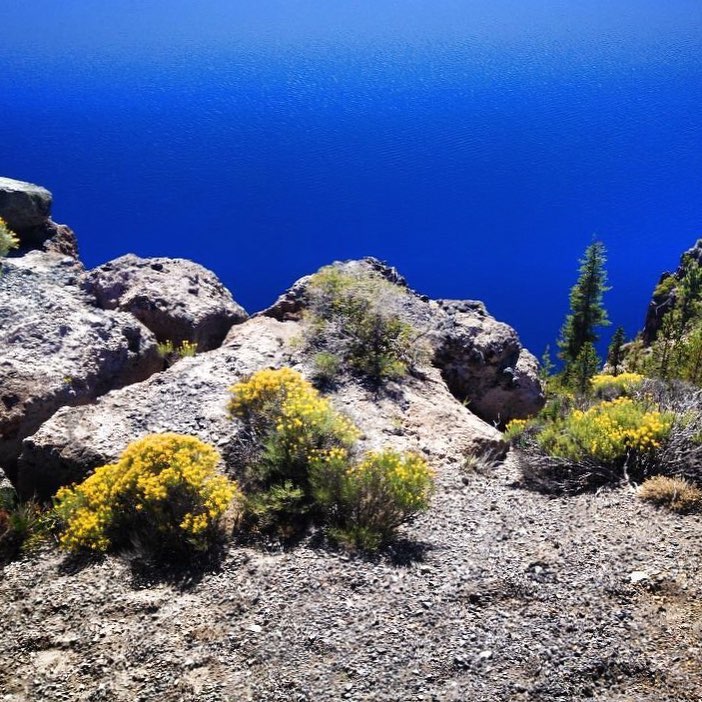
Take my former student and now friend, David Connor Jones, who for the last few years has been living out of his car roaming the North American west “like Caine in Kung Fu. meet[ing] people, get[ting] in adventures” and encountering gorgeous vistas that would raise the hair of Richard Wilbur “[l]ike quills upon the fretful porcupine.”
photo by David Connor Jones
It, of course, takes great courage to be free. When I was in the USSR in ’89, the citizenry wasn’t digging perestroika, preferring the safe status quo.
At any rate, we should at least try to take Wilbur’s advice, to remember always the miracle of our being, to savor this very second, no matter in a cubicle, a jail cell, or worse. We should strive to attain Buddha-consciousness in this here very life now, so as Wilbur puts it a bit more eloquently, we can find ourselves






 You Do Hoodoo