The ABZs of Auto-Obituary Writing

Look, I’m vain, love attention.[1] Therefore, there’s no way I’m going to let anyone get in the last word after I have checked out of this Motel 6 of Life. 

No, I’m writing my own obituary before I expire, and you should as well. After I succumb, I certainly don’t want my cousin Zilla to compose my obituary. Rather than merely “dying” or “passing away” or “entering eternal rest,” I might have “left the world to be with the Lord,” or worse, “entered the loving embrace of [my] Lord and Savior Jesus Christ.”  Though I wouldn’t mind getting a hug from Jesus, I’m agnostic, so I want my obituary to be an accurate reflection of my life. 

Don’t trust others to do right by you. Do it yourself!

So, what follows is an easy guide for composing your very own obituary.[2]

Okay, let’s get started.

Rule #1. Know your audience. Chances are the readers of the obit are friends, family, or acquaintances. Most people don’t read strangers’ obits (yours truly being a notable exception), and if they do, you can bet they’re retired, likely former English teachers, and/or grammar Nazis. Therefore, make sure to proofread carefully but address the audience in a familiar fashion.

Rule #2. Sentence one should state the sad fact that Wesley is dead and when and where that regrettable transition took place. Although it’s not necessary to state the cause of death, inquiring minds want to know. In the following I have bracketed words that can be omitted according to your own predilections. 

Wesley “Rusty” Moore died Monday [at his home/at a sterile assisted living facility/on the side of the road] [after a short/long illness[3]//months of neglect// stumbling in front of a car outside of Chico Feo].

Rule #3. It’s best to get the bio out of the way first. Make sure to include the occasional introductory subordinate clause; otherwise, these lists of facts are deadly tiresome enough without your bludgeoning the reader with an unrelenting barrage of declarative sentences.

Wesley, the first son of Wesley E Moore, Jr and Sue Blanton Moore, began life on 14 December 1952 in Summerville, South Carolina. After graduating from Summerville High, Wesley attended the University of South Carolina and received a BA in English in 1975.[4] [Because of the post-OPEC oil embargo recession of 1975 and the fact that he didn’t own a car and couldn’t score a job], Wesley immediately entered the English graduate program the fall after his graduation.

Tending bar as a graduate student, Wesley met his first wife, fellow bartender Judy Birdsong. After they decided to marry, Wesley [weary of scaling the mountainous molehills that characterize literary criticism] left the university without a Master’s. After [somehow] getting an adjunct gig at Trident Technical College, Wesley and Judy wed on 4 February 1978 [in Decatur, Georgia.]

[After a short stint of collecting rejection slips,] in 1985, Wesley started teaching at Porter-Gaud. By then, Wesley and Judy had two sons, Harrison and Ned, [who eventually attended Porter-Gaud and rode to school with their father, providing the boys the opportunity to amass quite a quantity of profane and vulgar words as their father battled traffic from the Isle of Palms and later Folly Beach on their way to West Ashley.]

After Judy’s death from lymphoma [on Mother’s Day] in 2017, Wesley fell in love and married Caroline Tigner.  Caroline, her daughter Brooks, and Wesley made their home in Folly Beach, a community they treasured [until it was overrun by Airbnb short term rentals that transformed the once funky residential island into a virtual Sodom and Gomorrah/ Myrtle Beach].

Bored yet? 

Rule #4. You should follow the bio with a paragraph that humanizes the deceased. I don’t know how many obits I’ve read that have short-changed the not-seemingly-so-dearly departed by expending a scant sentence or two. 

For example, Harold enjoyed fishing. That’s it; that’s all it says. Or Mabel enjoying playing with her grandsons.

In mine, I would mention my writing, particularly the novel Today, Oh Boy! and the handful of writing awards I’ve received. I would also mention my collage-making and blog and perhaps my four decades of surfing.
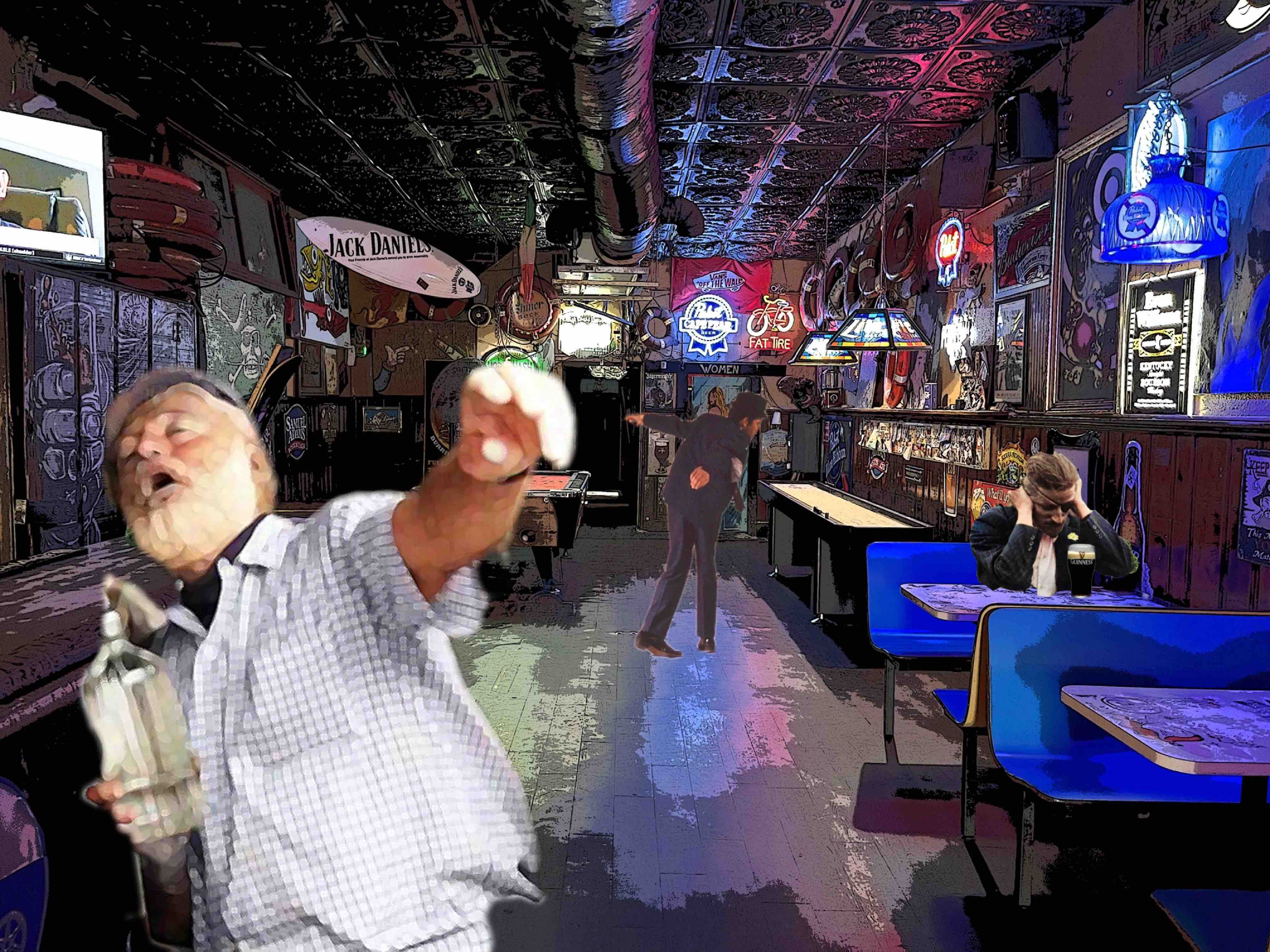
Papa Hemingway, Joyce, and Tom Waits in Wilmington, a collage by Wesley Moore

Rule #5. You should then list survivors and pre-decedents. By the way, if you’re old like me, there’s no need to specify that your parents preceded you in death.

NOT: The great-great-great-great-great grandson of Adam and Eve, Methuselah was predeceased by his parents . . . 

Rule #5. Although the time and place of the memorial service/funeral/burial at sea, can be stated at the beginning of the obituary, I prefer it at the end, though it’s completely up to you.

Now, all you have left is to designate where memorial donations should go and perhaps to thank anyone who was especially helpful in the dying process.

So that’s it, have at it, don’t put off until tomorrow because, well, you know why.

Fin.


[1] Hence this blog.

[2] I realize that most people (Prince Hamlet being a notable exception), don’t cotton to contemplating their own demise. However, look upon the exercise of auto obituary composition as a fond look back on a life well lived. On the other hand, if you consider your life a tale told by an idiot, full of sound and fury, signifying nothing, you can lash out at your enemies in your obit. It’s up to you! [insert smiley emoji].

[3] For me, the more specific the better. If possible, I’d like to precisely name the illness, for example, “after an acute case of cirrhosis of the liver.” BTW, I hate the trite trope of illness as a martial encounter. Waging heroic battles with Goliath-like adversaries such as inoperable brain cancer is yawn-producing. Certainly, there must be people out there who whined their way to the grave.

[4] Why are red-blooded Americans omitting the “from” in sentences pertaining to graduation, as in “graduated high school or graduated university?”  

Farewell, Porter-Gaud Class of 2020

DJI_0125-L

photo of Class of 2020’s Day of Caring lifted fro Porter-Gaud’s website

I’m distressed that Porter-Gaud’s sterling class of 2020 cannot celebrate publicly the important rite of high school graduation. Last night, they should have donned their flowered dresses and seersucker suits to celebrate baccalaureate at the Church of the Holy Communion on Ashley Avenue. Beforehand, I would have ducked into a nearby bar, Fuel, and consumed two IPAs, then jauntily rounded the corner on foot to greet the progression of faculty members and seniors waiting in front of the church. Everyone would be smiling, the parents proud, the siblings impatient, looking forward to it being over.

Once inside, I would gaze up at the Jesus-of-Color who looks over the congregation from the stained glass behind the altar, listen to the lovely choral music, watch the senior choir members leave the altar and disappear backstage[1] to shed their robes. Then they would reemerge and take their seats with the rest of the graduating class, a transition fraught with emotion. Finally, I would strain my ears to try to catch the homily but undoubtedly fail, my hearing having been destroyed by the Rolling Stones, Bruce Springsteen, and heredity. The final “amen” would be intoned, the seniors would march out nodding and smiling to the congregation as they headed for the freedom of the late afternoon sunlight, fading, the last few hours of their childhoods fading.

church

Church of the Holy Communion

I feel a special connection to this class. They were with me during my late wife’s illness and death. I especially remember teaching a short story to two sections of them as 9th graders on Skype from Houston where Judy was getting consultations, a melancholy prelude to the last weeks of their education.  I also taught three sections of them as sophomores the next year when Judy died.

Porter-Gaud undeservedly has the reputation with some in the community of being  a haven for “a bunch of spoiled rich kids,” but it’s a terrible misrepresentation. Just ask the leaders of Charleston’s charitable organizations. They’ll set you straight. When I returned to school the Wednesday after Judy’s death, all three of the whiteboards in my classroom had been covered with their hand-written condolences and sweetly drawn hearts and musical notes.

board

Love manifest.

What a remarkable group of young people, talented in so many different ways. I would love to hear the graduation speeches, discover who has won the academic awards, and watch each receive that hard-earned diploma, but, of course, it’s impossible. Pandemics are indifferent to sentimentality.

A few years ago, our Head of School asked me if I knew of a suitable poem that he might read at graduation, and I suggested this one:

To a Daughter Leaving Home

When I taught you

at eight to ride

a bicycle, loping along

beside you

as you wobbled away

on two round wheels,

my own mouth rounding

in surprise when you pulled

ahead down the curved

path of the park,

I kept waiting

for the thud

of your crash as I

sprinted to catch up,

while you grew

smaller, more breakable

with distance,

pumping, pumping

for your life, screaming

with laughter,

the hair flapping

behind you like a

handkerchief waving

goodbye.

—Linda Pastan


I know they’ll be fine. They’ll certainly get over this disappointment – even make wry jokes about it  – but I did want to honor them in some small way and to let them know that I wish I could say goodbye in person and that they will not be forgotten.


[1] Bad role model that I am, I’m too lazy to look up the correct ecclesiastical term. PS. Update, a friend of mine who is a priest has enlightened me: “In ecclesiastical terms, they left the sanctuary via the sacristy and chapel and re-entered the nave to be seated with their classmates. ” Hat tip to Brian McGreevy.

Wild Kingdom 2020, Folly Beach Backyard Edition

bunting uncnscious

To tell the truth, I’m not a fan of nature documentaries. For one thing, I don’t need to be constantly reminded that exotic habitats are rapidly disappearing from our poisoned planet, nor do I enjoy the spectacle of claws, talons, and incisors ripping the flesh from scampering rodents, warthogs, zebras, giraffes, antelopes, or baby elephants. The whole Darwinian horror show of survival shivers me timbers, sends rushes of disgust up my spinal cord.

And who in the hell are you supposed to pull for?  The pride of lions with their adorable cubs and dead-beat dads need to eat, but the elands about to be preyed upon seem somehow more sympathetic. Inevitably, after the kill come packs of scurvy hyenas (who also need to eat) who chase off the lions and take over the flesh-ripping and ravenous swallowing. Yuck.

Not surprisingly, given my delicate sensibility, in my youth I became an avid indoorsman, an inept male incapable of stringing a rod and reel (or baiting a hook for that matter) but one who could distinguish Jimmy Cagney from George Raft, Buster Keaton from Harold Lloyd. Why go traipsing through insect infested swamps when you can read “The Big Two-Hearted River” while sipping on a peaty single-malted Scotch?

That said, I happen to live in a spot that provides wide open views of the Folly River, which boasts an abundance of wildlife. Out back I’ve seen dolphins, otters, a mink, herons, egrets, ospreys, bald eagles, wood storks, bats, racoons, and rats. About twenty years ago, my late wife Judy Birdsong cajoled me into building a bird feeder, which consisted of a sheet of plywood positioned on a metal pole in the backyard. Judy would scatter seeds there, and birds would visit, chasing each other off until that fateful day when a red-tailed hawk swooped down and snatched one of the birds while the rest frantically peppered the plate glass windows that provide us our views. Afterwards, Judy insisted I disassemble the feeder, which suited me fine.

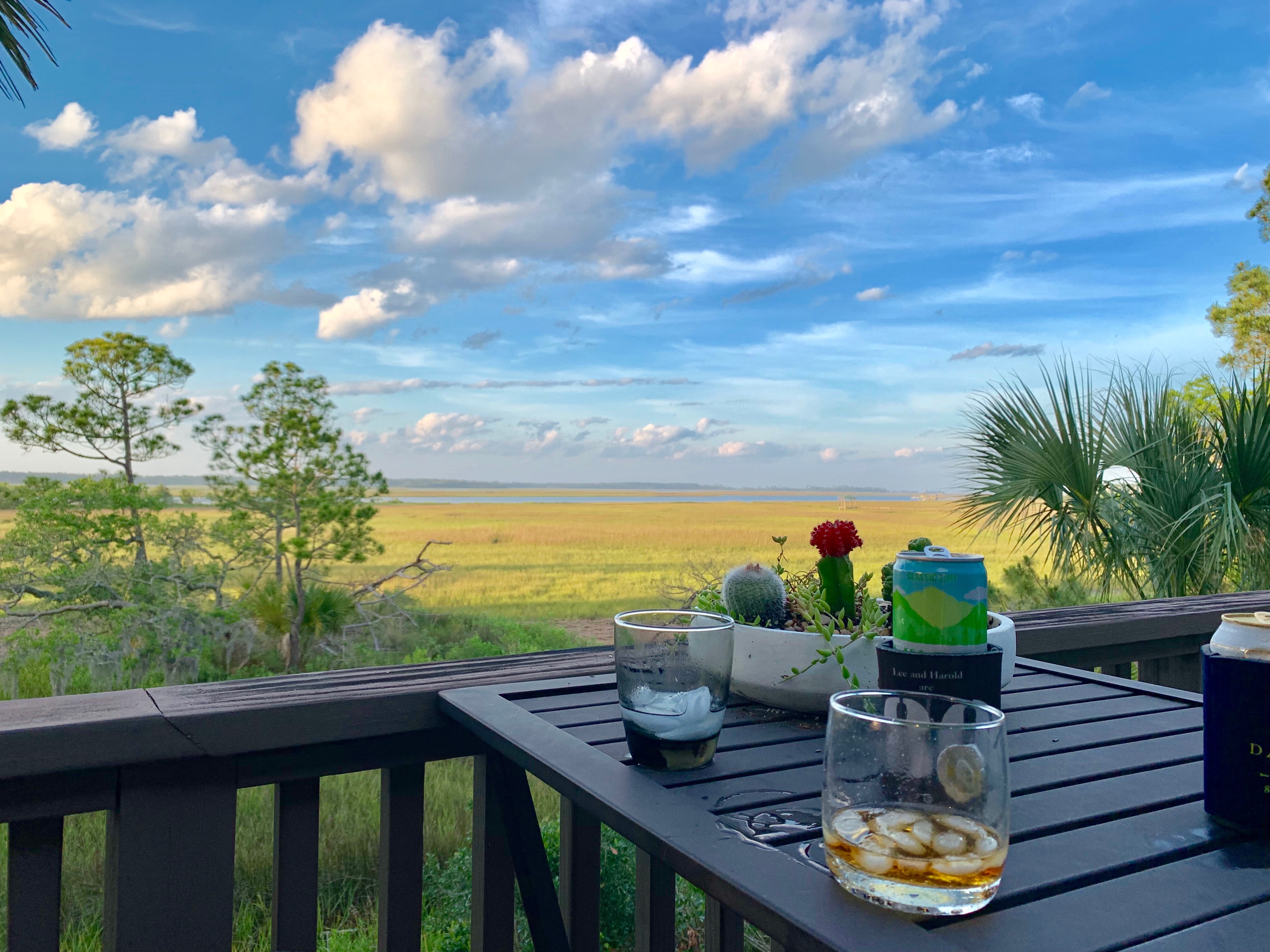
Don’t get me wrong. I have nothing against sunlight, consider vitamin D an asset. In fact, my favorite watering hole Chico Feo is an al fresco bar that closes when it rains or gets too cold. So now with Chico Feo shut down during the quarantine[1], my wife Caroline and I spend our happy hours on our back deck enjoying a couple of pre-dinner libations. This April has featured unusually low humidity, and it’s enjoyable looking out over golden sunlight dappling the greening marsh and watching merchant ships in the distance sliding past the Morris Island Lighthouse in and out of Charleston Harbor.

IMG_4125


IMG_3083

So there we were yesterday sitting on our deck enjoying our ridiculously highbrow conversation (was Wallace Stegner’s Lyman Ward a more sympathetic amputee than Hemingway’s Harry Morgan) when Caroline suddenly stood up cried, “Oh, no!”

“What’s the matter?”

A bird just slammed into the window and dropped to the ground!”

“What kind of bird?”

“I think it was a cardinal,” she said.

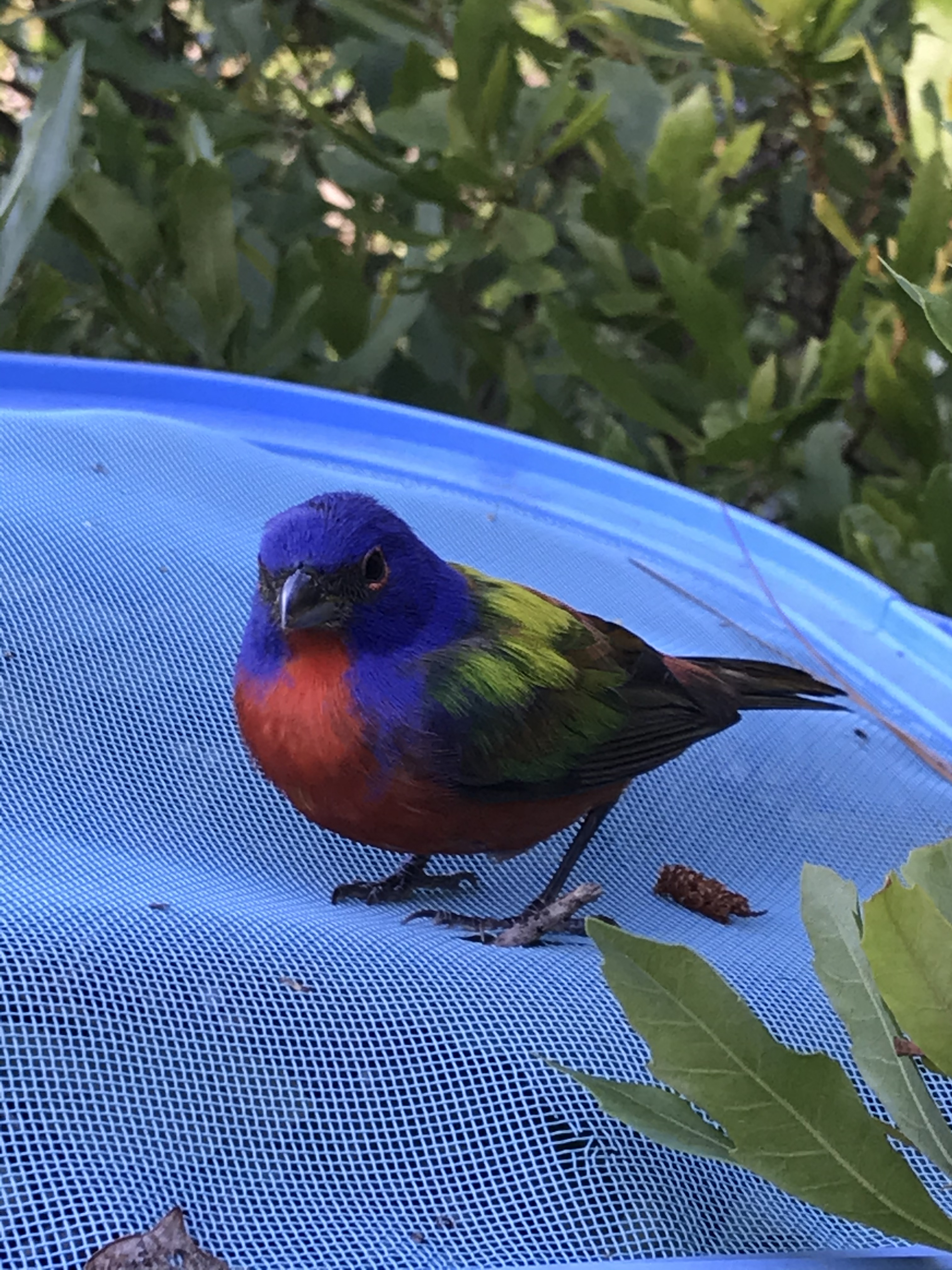
“Oh, it’ll probably come to,” I said, unmoved (and unmoving), but Caroline was already scampering down the steps to comb through the Asiatic jasmine for fallen bird, which, amazingly she found in a couple of minutes, a male painted bunting, not a cardinal, inert but not dead.

IMG_3117

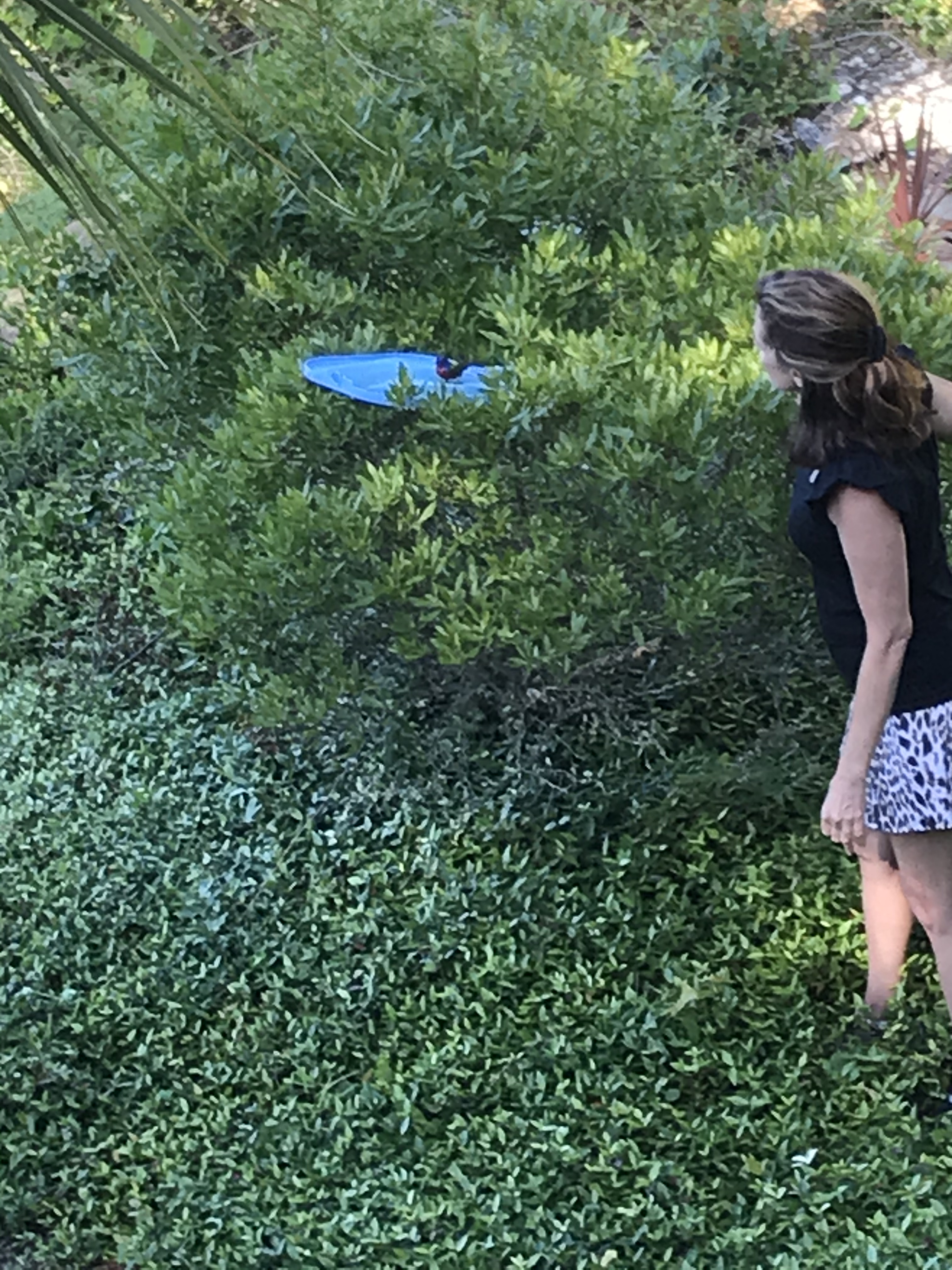
Caroline picked him up and placed him in a net we use for scooping out our water garden and placed the net in the middle of the yard. We watched intensely, hoping for some movement, but there was none. Then the shadow of a large bird darkened the deck, and sure enough, we looked up to see a red-tailed hawk cruising.

So both of us went down and placed the net in a wax myrtle for greater camouflage. The bunting was now standing, but otherwise not moving, looking like the taxidermized Carolina Parakeet (long extinct) that was displayed in the Old Charleston Museum off of Calhoun Street.

Caroline noticed that maybe his claw was entangled in the mesh of the net, and as she reached down, the bunting flew off into a thicket of Elaeagnus, where I think he and his mate nest.

We cheered!

The gorgeous fellow will live to see another day –– maybe.

IMG_3123

And as far as the red-tailed hawk is concerned, let him eat rats.

hawk 3 (original)


[1] You can on some days still get takeout.