Folly Beach’s Cat Lady, Potential Serial Killer?

Greetings From Folly Beach, SC

Greetings From Folly Beach, SC

There’s a high profile, eccentric old lady on Folly Beach whom I encounter practically every day feeding feral cats. I’d say she’s in her mid-to-late 80s, and even if you were to straighten out her stoop, she wouldn’t hit 4’10.” Not surprisingly, people who don’t know her name – and I don’t – call her the Cat Lady.

Every block or so she has placed plastic containers, and every afternoon feral cats gather in anticipation of her arrival. Sometimes, she has a helper, but on most days when I see her, she is alone, wearing an expression of great seriousness as she leans over dumping dry cat food into the bowls. In fact, I saw her this afternoon when I was headed to Chico Feo for a pre-supper malted aperitif. Staring off into space, she had her hands on her hips, like a diminutive, determined, female edition of General Patton. Obviously, this diurnal “mission trip” is her raison d’etre.

Of course, feeding feral cats is an environmental no-no. According to FETA (not exactly an anti-animal organization):

Many people who encounter feral cats start feeding them, but feeding alone can actually make the situation worse. Feeding ferals increases their ability to give birth to even more kittens who are destined to suffer and die premature deaths. It is essential to get these cats off the streets in order to prevent not only their own suffering, but that of their offspring. Feeding should only be done as a prelude to trapping, to get cats accustomed to eating in a certain place at a certain time.

The article goes on to state that feral cats have abbreviated life spans, suffer from a multitude of maladies thanks to non-vaccination, and even if their autism rates are super low (I just made that up), the food can also attract non-feline varmints. The Cat Lady learned this the hard way last year when a rabid raccoon took a chunk out of her, an event so newsworthy it made the Charleston papers.

Folly Beach is certainly no “Mayberry by the Sea” – its official civic moniker is the Edge of America – but even after the coon attack, the authorities, Sheriff-Taylor-like, look the other way as she putts along in her cart circumnavigating the island. Maybe they figure what the hell, stopping her would kill her, so what if scores of cats suffer or some surfer comes down with a case of rabies? Sometimes targeted human compassion trumps common sense, and going by Haruki Murakami’s brilliant novel Kafka on the Shore, feral cats dig the freedom of homelessness.
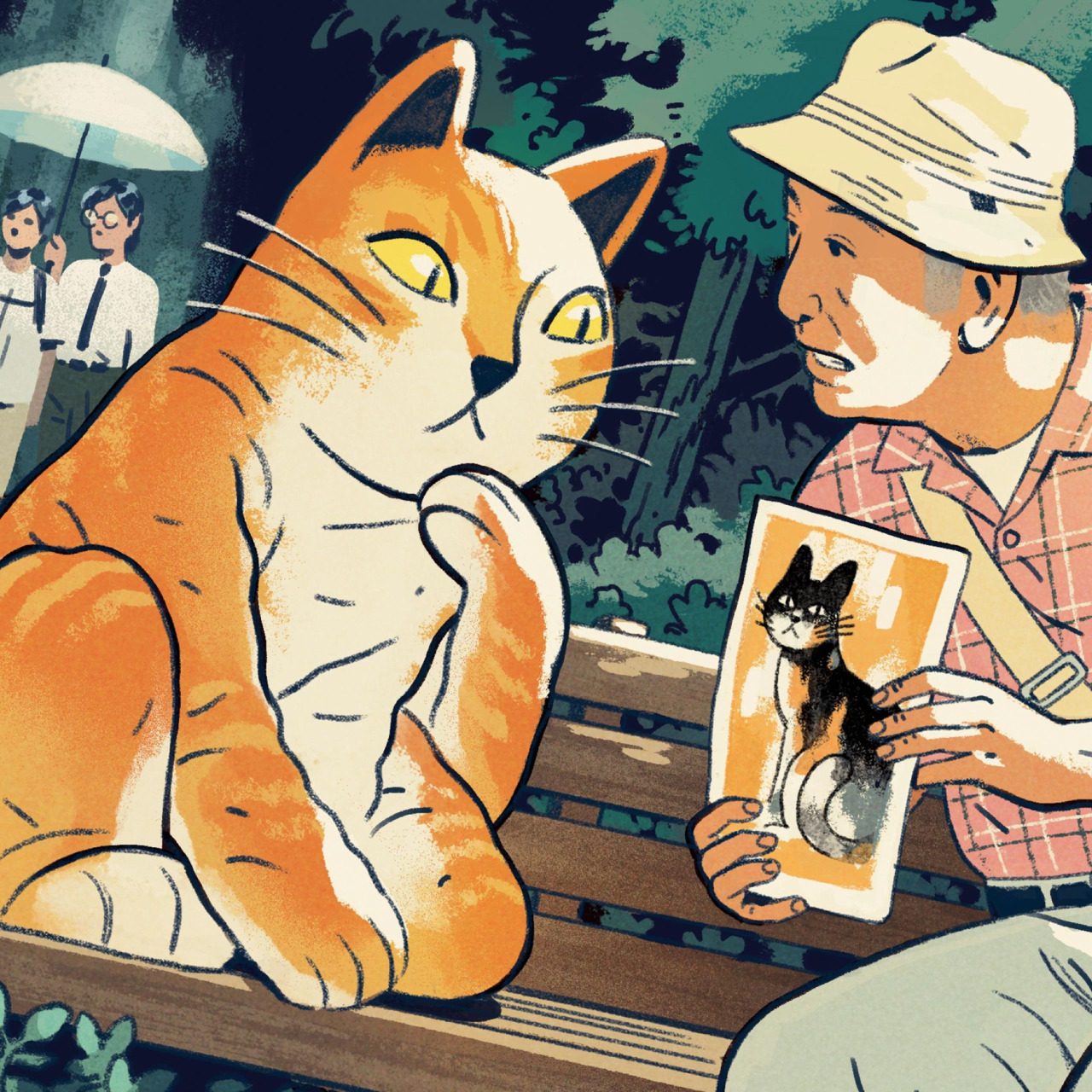
ILLUSTRATION BY SAM BOSMA

ILLUSTRATION BY SAM BOSMA from The New Yorker

One of the characters in the novel, Satoru Nakata, through circumstances too complex to relate here, has obtained the ability to converse with cats. People hire him to find their lost pets. Nakata usually begins his investigations in city parks where the ferals hang. In one incident, he strikes up a conversation with a stray and asks the cat his name. “I used to have one when I lived with people,” the cat says, “but I’ve forgotten what it was.” You get the idea [absurd mixed-animal-metaphor-cliché alert] that wild horses couldn’t drag him back to domestication.


I’ll admit that the Cat Lady has irritated me on occasion, blocking my path when I’m running late, but even if her head isn’t in the right place, her heart certainly is. Nevertheless, I sense something sinister about her, so for fun, I’m outlining a murder mystery set on Folly in which she’s a serial killer. What’s really enjoyable is deciding whom among the people on Folly I don’t like she murders, in what order, and how. Hey, it’s summer time. It keeps me off the streets, safe from a potential attack by a mad, foaming calico.
Random Thoughts

This week, during our summer break, the members of the mighty English Department where I teach have met voluntarily to fine tune our program.

Despite my having to abandon the funky barrier island where I reside and drive twenty minutes to the mainland, it’s really enjoyable to banter and swap stories with friends and colleagues who can pick up on obscure literary allusions.

Part of the fun is that we establish motifs, repeat at apt times absurdities that have come up, and one of the major motifs this week has been an anonymous student’s declaration after reading Walden that he or she “hates nature.” (By the way, we don’t name names – I only know whoever made this absurd statement as “a student”).

Of course, hating nature is hating the complex interconnectedness of atmosphere, water, vegetation, geology, animal life, etc. that has given rise to the consciousness of the nature-hater. It’s sort of like saying I hate ingestion or respiratory systems.

Nevertheless, we know what the student means. She/he doesn’t dig Thoreau, the great outdoors, would rather be inside in an air-conditioned space staring into some sort of screen.

And maybe, this American Lit student learned when reading Stephen Crane and Jack London that nature is absolutely indifferent to him or her.

So, there!

Anyway, yesterday, when riding my bike along Atlantic Avenue, I caught a whiff of a rotting carcass hidden from my view, and a nature-hating muse descended.


Random Thoughts

I detect death’s sour stench,

some small decomposing carcass,

oleander hidden, as I pedal past

into a stiff salty headwind.


Overhead in the same direction,

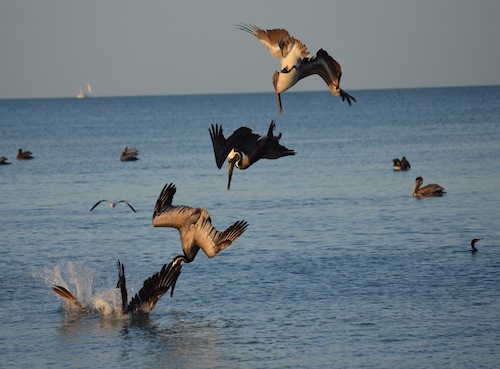
the broken V of five pelicans

flap – flap – flap – glide – flap,

and the stench is now behind me.


How sweet it would all seem

If Charlie Darwin hadn’t thrown

his monkey wrench into the works.

The pelicans splash like kamikazes.

diving-pelicans


Bravo, Ted!

U.S. Vice President Joe Biden, right, rests his head in his hand during a viewing for his son, former Delaware Attorney General Beau Biden, Thursday, June 4, 2015, at Legislative Hall in Dover, Del. Standing with Vice President Biden are Beau Biden's widow, Hallie, from left, and daughter Natalie, and the the vice president's wife Jill. Beau Biden died of brain cancer Saturday at age 46. (AP Photo/Patrick Semansky, Pool)

Stunted is a harsh word, but I think it does justice to Ted Cruz.

Oh, I’ve read about how brilliant he is, how he blazed his way through Princeton, won the Speaker Award at the 1992 North American Debating Championship, edited the Harvard Law Review, etc., but, as the saints, say, “What profit a man if he garner academic accolades but has a social IQ that falls far below Quasimodo’s?”

It’s as if Cruz has never ventured outside the grandiosity of his egomania to even bother having imagined being anyone but himself.

I’ll offer two quick examples. Last Monday, with a microphone in his hand, he mocked Joe Biden as Biden’s eldest son’s coffined body lay in a funeral home in Delaware. Certainly, Cruz follows the news, certainly he had read of Beau Biden’s death, certainly he could wait a couple of weeks before publicly mocking the Vice President.

Earlier, in April, showing his softer side at a fundraiser at the penthouse of gay businessmen Ian Reisner and Mati Weiderpass, Cruz declared, “If one of my daughters was (sic) gay, I would love them (sic) just as much.”

How noble! After witnessing her birth, giving her bottles, changing her diapers, guiding little spoons into her little open mouth, watching her take those first awkward steps, listening to her delighted pre-verbal laughter, trying to make out those first hard-to-decipher sentences, running beside her as she learned to ride a bike, witnessing her transformation from a girl to a young lady, he would still love his daughter if she were gay!

Bravo, Ted!

Packing for Mars

mars


You may have been asked what one book you would want to have with you if you were stranded on that proverbial desert island, you know, the one with ever ripening fruit falling from the trees and bacteria-less fresh water bubbling from springs and handy flint lying around for sparking palm frond fires, an island where you could kick back and be sedentary rather than spending all day searching for edible grub worms.

desert island

My suspension of disbelief won’t allow it. I’ve found a better hypothetical opportunity for selecting a limited library, a trip to Mars. According to Tom Kizzia of the New Yorker, NASA is prepping astronauts for a Martian mission, a voyage that would take them “a hundred million miles from home, no longer in close contact with mission control.”

“Staring into the night for eight monotonous months,” Kizzia asks, “how would they keep their focus? How would they avoid rancor or debilitating melancholy?”

Lauren Leveton heads NASA’s Behavioral Health and Performance program, and if I were to be chosen for the 3-year round trip to Mars (because of planetary motion, you’d be stuck on the surface for months), I’d love for her to allow me to bring three hardback bound books, ancient non-electronic artifacts with paper pages that turn and can be annotated with a sturdy #2 pencil. She might begin by telling me to choose one poem, one novel, and one play. As much as I love non-fiction, I would want works that recreate the Earth and its denizens as vividly as possible, which means dramatization.

The Poem

Of course, you’d want an epic, something worthy of your own journey, and the obvious candidates the Iliad, Odyssey, and Aeneid leap to mind; however, I don’t read Linear B Greek or Latin, so I have to rule those three out. My poem must be in English, so nothing’s lost in translation, and the obvious choice seems to be Paradise Lost, which contains all time and space, justifies the ways of God to men, describes not only Eden’s earthly paradise but also many an exotic non-mythical locale in ravishingly beautiful baroque language. Also, he’s managed to embed much of the Bible and Greek mythology into the mix. You get as much of pre-18th century human history as possible in a mere 10,000 lines.

Dig this epic simile that vivifies the number of fallen angels rolling on the fiery seas of Milton’s hell:

[Satan] stood and call’d

His Legions, Angel Forms, who lay intrans’t

Thick as Autumnal Leaves that strow the Brooks

In Vallombrosa, where th’ Etrurian shades

High overarch’t imbowr; or scatterd sedge

Afloat, when with fierce Winds Orion arm’d

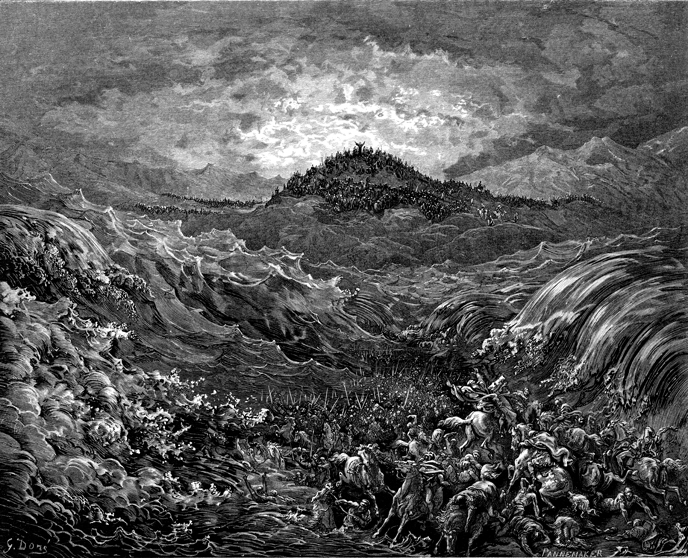
Hath vext the Red-Sea Coast, whose waves overthrew

Busiris and his Memphian Chivalry,

While with perfidious hatred they pursu’d

The Sojourners of Goshen, who beheld

From the safe shore their floating Carkases

And broken Chariot Wheels, so thick bestrown

Abject and lost lay these, covering the Flood,

Under amazement of their hideous change.

dore # 2

The brilliance and beauty of these lines amaze, the fallen angels compared to fallen leaves, then floating sedge on the Red Sea, the setting where Moses escaped the Pharaoh’s army, who like the Fallen Angels dared defied Yahweh.

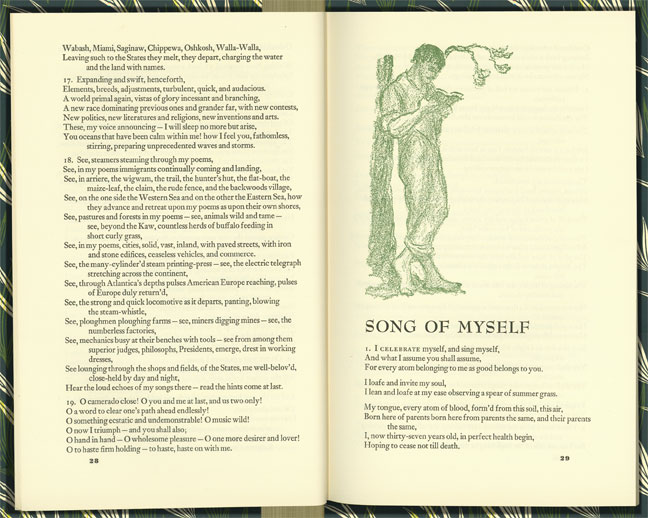
But no, it’s not Paradise Lost I’m packing but Walt Whitman’s “Song of Myself :

The smoke of my own breath,

Echoes, ripples, buzz’d whispers, love-root, silk-thread,

crotch and vine,

My respiration and inspiration, the beating of my heart, the

passing of blood and air through my lungs,

The sniff of green leaves and dry leaves, and of the shore and

dark-color’d sea-rocks, and of hay in the barn,

The sound of the belch’d words of my voice loos’d to the

eddies of the wind,

A few light kisses, a few embraces, a reaching around of arms,

The play of shine and shade on the trees as the supple boughs

wag,

The delight alone or in the rush of the streets, or along the

fields and hill-sides,

The feeling of health, the full-noon trill, the song of me rising

from bed and meeting the sun.

Every time I read it, it makes me come more alive, and I absolutely love its catalogues. Walt would remind me of the cities farther and farther away on the out, closer and closer on the way back:

The blab of the pave, tires of carts, sluff of boot-soles, talk of

the promenaders,

The heavy omnibus, the driver with his interrogating thumb,

the clank of the shod horses on the granite floor,

The snow-sleighs, clinking, shouted jokes, pelts of snow-balls,

The hurrahs for popular favorites, the fury of rous’d mobs,

The flap of the curtain’d litter, a sick man inside borne to the

hospital,

The meeting of enemies, the sudden oath, the blows and fall,

The excited crowd, the policeman with his star quickly

working his passage to the centre of the crowd,

The impassive stones that receive and return so many echoes,

What groans of over-fed or half-starv’d who fall sunstruck or

in fits,

What exclamations of women taken suddenly who hurry

home and give birth to babes,

What living and buried speech is always vibrating here, what

howls restrain’d by decorum,

Arrests of criminals, slights, adulterous offers made,

acceptances, rejections with convex lips,

I mind them or the show or resonance of them — I come and I

depart.

And also he’d be right there in the capsule with me:

Speeding through space, speeding through heaven and the

stars,

Speeding amid the seven satellites and the broad ring, and

the diameter of eighty thousand miles,

Speeding with tail’d meteors, throwing fire-balls like the rest,

Carrying the crescent child that carries its own full mother in

its belly,

Storming, enjoying, planning, loving, cautioning,

Backing and filling, appearing and disappearing,

I tread day and night such roads.

song of myself

The Novel

No time wasted here. Despite Faulkner’s great achievement, it’s Joyce’s Ulysses, which brings to life the human condition like no other work I know. I can shoot the rapids of Stephen Dedalus’ consciousness, or Leopold Bloom’s, or his wife Molly’s. I can walk the vivid streets of Dublin, day and night. I can adjust to and savor each new style as Joyce shifts from one episode of the Odyssey.

 Yes!

The Play

Although I virtually have it memorized already, I’d bring along my old pal, the Danish Prince. He’s a lonely sort, and as Harold Bloom says, the most intelligent human ever. I suspect I’d prefer his company to my fellow astronauts, technical folk who remind me of camp counselors, and Hamlet is a worthy companion for Walt and Leopold and plays no small role in Ulysses. And, yes, the poetry!

Uh-oh, Dr. Leveton has informed me I can take only one!

Given the above, which one would you choose?

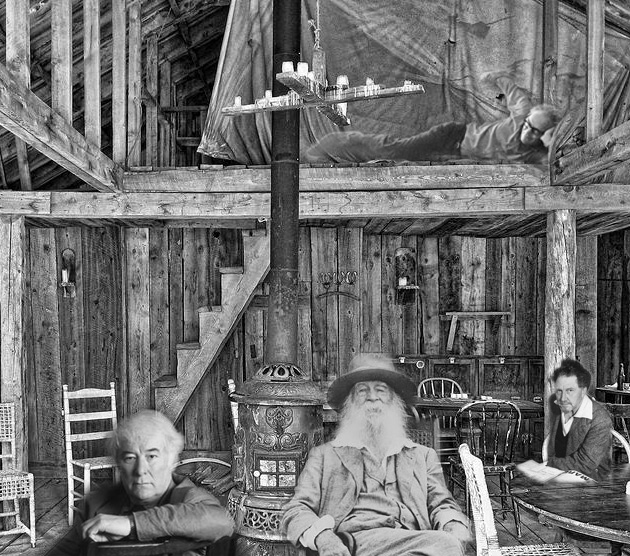
Walt Whitman’s Boys

daddywalt


It was you that broke the new wood.

Ezra Pound, “A Pact”

Old Ezra said to ditch the metronome
and use the musical phrase instead,
locked doors, keyholes, camisoles, not ideas.

Robert Lowell made it personal.
Mental illness was his muse,
his fingers trembling as the typewriter clacked.

Seamus Heaney brought us down to earth,
his pen scratching old words across the page,
bogs, tors, spades, blackberries, frogs.

But Old Walt Whitman was the daddy of them all,
whirling his words like a hurricane,
snapping trees, flooding streets, derailing trains.

A Week of Caitlyns

Sampan massacre scene from Apocalypse Now

Sampan massacre scene from Apocalypse Now

I don’t remember ever seeing the name Caitlyn spelled with a “y” before this week, but now, this morning it appears in two incarnations on the front page of my local paper, Charleston, SC’s Post and Courier. One “Caitlyn” belongs to the decathlon 1976 Olympic gold medal winner formerly known as Bruce, the other to a 15-month-old Chocolate Staffie mix whose muzzle had been wrapped shut with electric tape right here in Charleston.

Caitlyn, sometimes spelled as Caitlin, is an Irish female given name. It’s a lovely trochee with its long A and liquid L, and I suspect you’d lose a bit of its lilting cadence if you were to Anglicize it to Katelynn, though that would be a killer name for an Americana singer from Natchez.

Caitlyn the dog has become an international phenomenon, and for sure, it ‘s heartbreaking to think of the suffering she must have endured (I can’t bring myself to post a picture of her), and it’s encouraging that the sadist who tortured her has been arrested. I’m reminded of my own recently deceased German longhaired pointer/ border collie/ Cerberus mix, Saisy, who had been starved and tied to a post with a two-foot rope before noble souls rescued her. She ended up fairly okay, though, except for food issues, which never really went away, but over the years, she quit flinching when you leaned over to pet her head or rub her muzzle and quit snapping at you if you petted her for too long.

I miss her every day.

The late, great Saisy

The late, great Saisy

For some reason, many of us tend to care more about pets, especially dogs, than other people. I noted this evolutionary oddity over the years through showing the film Apocalypse Now to high school students as a follow up to their reading Heart of Darkness, the novella the film is loosely based on.

Set in Viet Nam, the film earns its R-rating via violence. In one particularly harrowing scene, known as the Sampan massacre, American soldiers machine gun to death an entire family of Vietnamese transporting produce on a boat – men, women, and children – when the soldiers panic after a Vietnamese girl runs to protect a puppy.  As the family is ripped apart by bullets, my students sit there silently; however, when one of the soldiers – Chef – finds the surviving puppy and picks it up roughly by its scruff, the room fills with highly audible disapproving oooohs.

Meanwhile, stories like the one below we hardly hear about, and most of us don’t care about:

[Kansas Governor] Brownback has often characterized his opposition to expanding Medicaid and other poverty programs, in Wright’s words, as a “moral rejection of dependency.” Last June, for example, Brownback told the Heritage Foundation’s Daily Signal Web site that Kansas had not expanded Medicaid because “We’re trying to push people that are able-bodied right now to get a job.” Similarly, Brownback pledged in his State of the State address this year to continue “helping people move from dependence on the government to independence.”

But, in practice, Brownback’s resistance to Medicaid expansion is causing some people to move from independence to desperation. [Nation editor Kai] Wright spoke with several Kansans who are suffering because of Kansas’s severe eligibility requirements. Far from the right-wing caricature of lazy moochers, they are hard workers who aren’t looking for a handout. One woman, RaDonna, is too sick to hold down food, let alone a full-time job. Yet, as a childless adult, she doesn’t qualify for Medicaid — and the state rejected her application for disability benefits. While RaDonna now lives with her sister, Cathy, she insists on helping with the laundry and dishes to earn her keep. “She can’t do the whole sink full of dishes without stopping and sitting down for a while,” Cathy says.

No, we’re more interested in Bruce Jenner’s transformation into Caitlyn and argue about whether he’s courageous or merely an attention-starved ex-Kardashian in-law.  After all, the poor will always be with us.

In the courage department, though, I give the nod to RaDonna.

Adventures in the USSR (featuring Dizzy Gillespie in a cameo appearance)

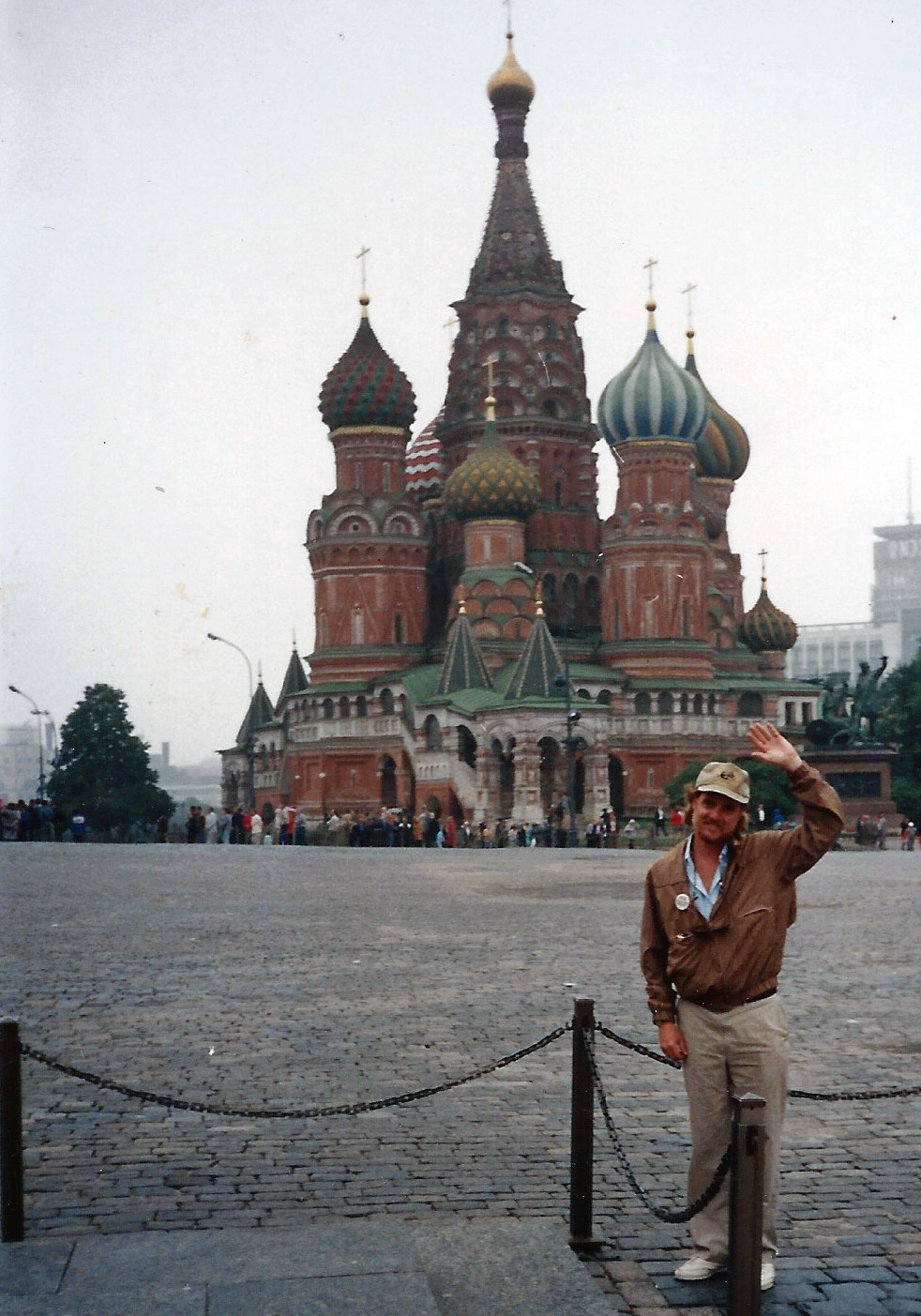
the author back in the day

the author back in the day

Chances are I’ll never return to Russia, the country formerly known as the Soviet Union, where I spent twenty-eight days in June of 1989, a quarter of a century ago and counting. I didn’t realize it at the time, but I was taking a last peek at an empire on the brink of collapse, and indeed I didn’t experience the police state I thought I’d encounter. My naive expectation was that the KGB would sweep down on jaywalkers and haul them off to some gulag in Irkutsk, but what I found instead were swarms of black-marketers openly operating everywhere I wandered, exchanging money or swapping a Soviet flag for a pair of blue jeans or sunglasses.

During a long sunshiny night on the Gulf of Finland, just west of Leningrad, an East German tourist pulled a knife on me.  I had knocked on the door of his room where five men were bellowing patriotic songs at 3 AM. At first, the knife-wielder and his non-English speaking compatriots invited me in to share beer and sausage, but after I communicated that I was from the US, one pulled out a knife. The others quickly quieted him and produced snapshots of their children to establish our brotherhood. I didn’t carry photos of my own boys who were five and four at the time and would have appreciably “aged” when I would see them next.

I was one of four chaperones in charge of twenty high school students and two college freshmen. It was a frenetic trip that took us from Leningrad to Moscow to Siberia, then westward down through Uzbekistan, Kazakhstan, Soviet Georgia, then finally back to Moscow. However, it was Leningrad — now St. Petersburg — the setting of Crime and Punishment — that was the most surreal.

The ornate subways of St. Petersburg/Leningrad

The ornate subways of St. Petersburg/Leningrad

Criss-crossed with canals, Leningrad was a beautiful city of 18th century pastel-colored buildings (and, of course, so is St. Petersburg today). However, back then, its citizens were the most morose human beings I’ve ever encountered. To a man and woman (I don’t remember seeing any children), they shuffled along wearing expressions of total, abject despair. Even on the two-story escalators leading to and from the gorgeous subway stations, lovers who faced each other holding both hands wore the expressions of people about to be taken away to be shot.

In fact, the only time I saw anyone smile was on a city bus. I was by myself and had mastered the arcane procedures of dealing with city transportation. You bought a ticket, an unofficial looking thin sheet of paper, from a machine at the station and then punched it yourself on the bus.  However, you didn’t give it to the driver; you just held onto it in perpetuity. In other words, the buses operated on the honor system.

Anyway, I was seated next to a woman whose mien made images of Mary at Golgotha look upbeat in comparison. As we sat there in stony silence — no one conversed with each other — a thin East German tourist, a David Byrne lookalike in a dark suit and skinny tie, boarded with a ticket in his hand. He was as jittery, as nervous as I’ve ever seen anyone in my life. He stood there trembling, turning this way and that, holding the ticket up beseechingly, so I got up and showed him what to do. He punched the ticket, and as I turned around, every single person on the bus hit one sarcastic clap in unison, and on their collective faces a pained smile broke through the ice of their glacial unhappiness.  It was as if they had forgotten how to smile, as if they were using muscles unaccustomed to exercise.  

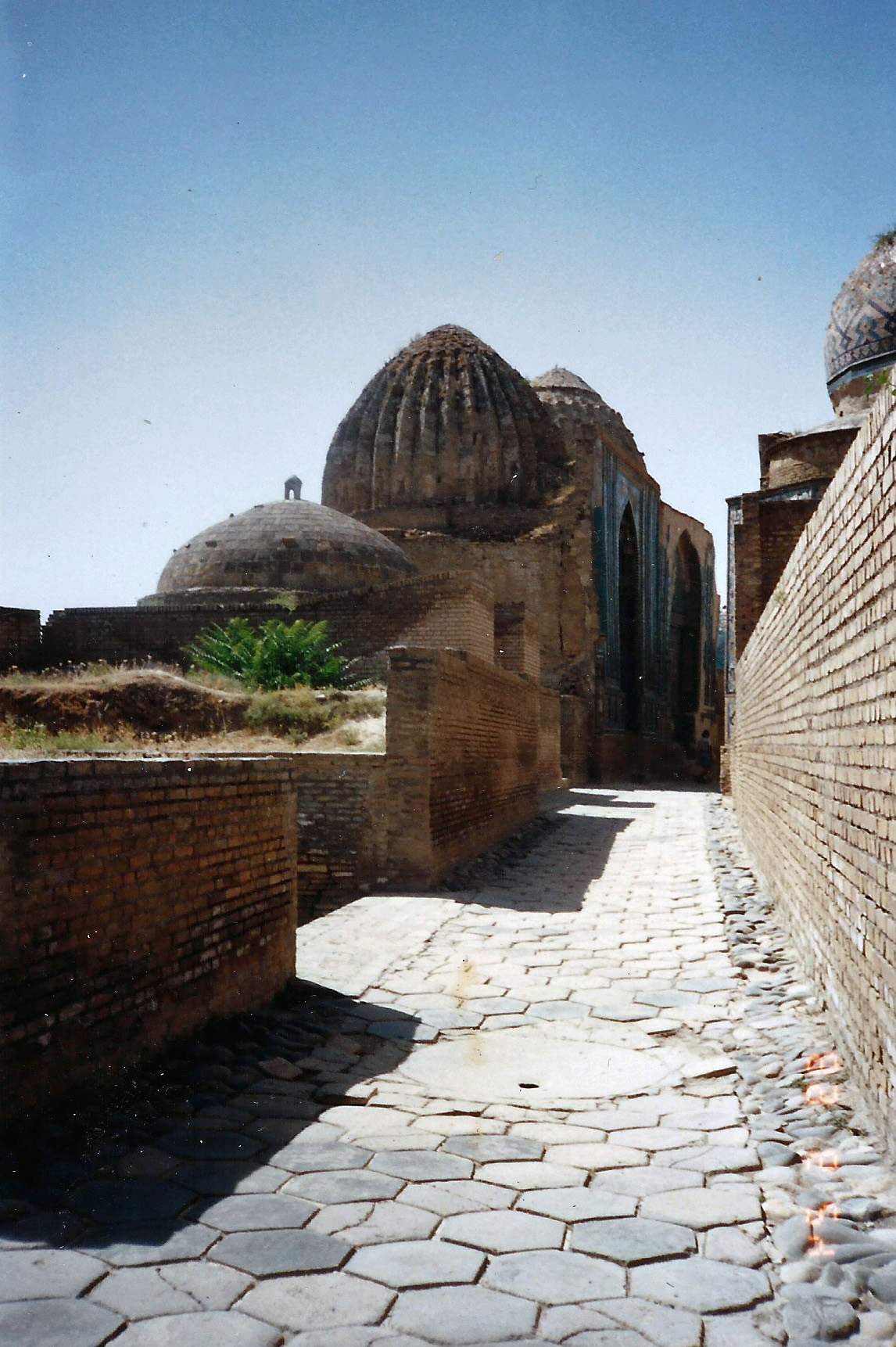
Moscow was slightly less Kafkaesque, and the further east you travelled, the happier the citizenry and the better the food. I would never have guessed that Siberia would be more upbeat than Leningrad. The Islamic Republics were interesting (and deafeningly quiet). In a hotel in Samarkand one afternoon, I purchased a two-dollar Heineken and handed the bartender a five in US currency. He handed me a twenty pound British note and some kopecks for change. I tried to explain that it was too much, but he misunderstood and thought I was complaining. I explained the situation to Sasha, our Intourist guide, and he said, “Keep it. These people are pigs.”

So we left Samarkand the next day for Bukkara. At dinner that night, Sasha summoned me and explained that he had just talked on the phone with the bartender from Samarkand who “had tears in his voice, tears in his voice.” Unless I reimbursed the £20, the bartender, a father of five, would lose his job. So, of course, I forked it over, not at all sure Sasha was on the up-and-up. 

an alleyway in Bukkara 1989

an alleyway in Bukkara 1989

Our final destination was the Republic of Georgia. Two months before, an anti-Soviet demonstration had been brutally crushed by the Soviet Army in what is now known as the Tbilisi Massacre. Soviet troops were still heavily present. Nevertheless, Georgia was the most pleasant place we encountered. People wore colorful clothes and seemed much more prosperous. 

Not surprisingly, I was ever so eager to return home to my family, to sidewalks that didn’t need mowing, to signs sporting the Roman alphabet, to well-stocked grocery stores where you didn’t receive your change in mixed combinations of foreign currencies.

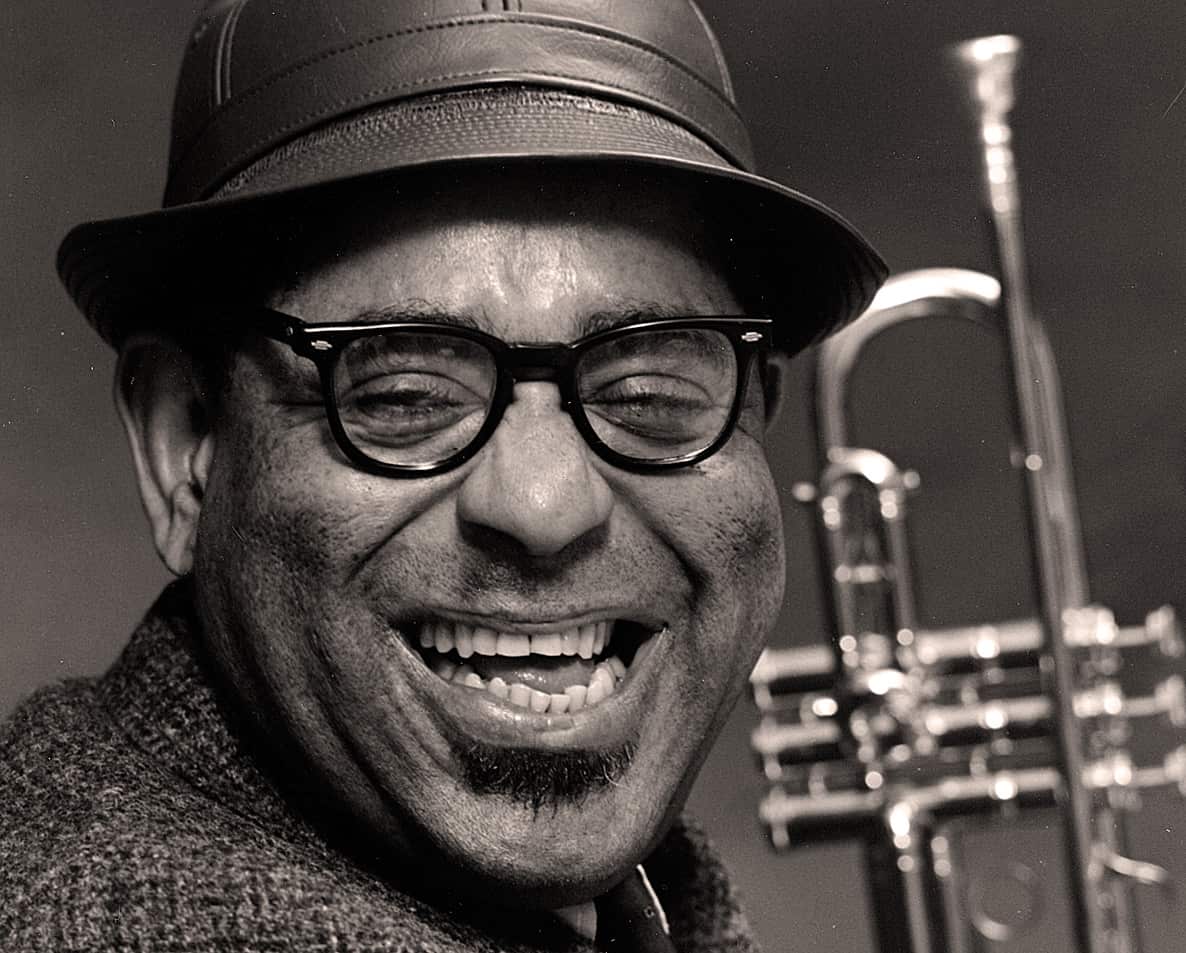
Standing waiting in Heathrow for our London to Washington flight, a student asked me if I’d ever heard of Dizzy Gillespie.

“Of course,” I said.

“Well, he’s standing right over there. He just finished an interview.”

And, sure enough, there he was, a tall black man with glasses sporting a jazz dot.

I approached him and said, “Mr. Gillespie. I hate to bother you, but it would be a great honor to shake your hand.”

Ne parle pas Anglais, he replied.

“Ah, come on, Dizzy,” I said. “I’m from South Carolina.”

He smiled broadly, and in a thick Southern African American accent asked, “Where? Myrtle Beach?”

It was music to my ears.

Dizzy Gillespie, a native of Cheraw, South Carolina

The Not So Advanced Training Institute

The Destruction of Sodom and Gomorrah The Golden Haggadah, c. 1320

The Destruction of Sodom and Gomorrah
The Golden Haggadah, c. 1320

Well, when it comes to stanching libidinal urges, in the case of Josh Duggar, the un-spared rod, limited access to secular entertainment, daily devotionals, and home-schooling were to no avail. Despite his family’s full literal embrace of five-thousand-year-old cultural dictates of nomadic sheepherders (no seed-spilling, frontal hugging, uppity females, e.g.), Josh succumbed to, depending on your point of view, Satan’s solicitations and/or the human hard-wired propensity to seek sexual contact.

As Dana Milbank[1] writes in this morning’s Washington Post, it’s somewhat troubling that such a weird ass family (all of the 19 children’s first names begin with J) would receive boot licks from virtually every Republican seeking their party’s nomination for the presidency. As Milbank points out,

A quarter of Americans are evangelical Christians, but only a small fraction of them are like the Duggars. Only 3 percent of American kids are home-schooled, as the Duggars are. Only 7 percent of Americans think using birth control is morally objectionable, as the Duggars do. As for the percentage of Americans who favor arranged-in-all-but-name marriages? The answer is so obvious there’s no need to ask the question.

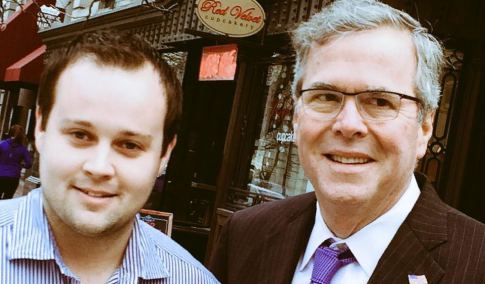
Josh Duggar and Jeb Bush

Josh Duggar and Jeb Bush

So why the kowtowing?

Republican primary voters tend to be really conservative radical.

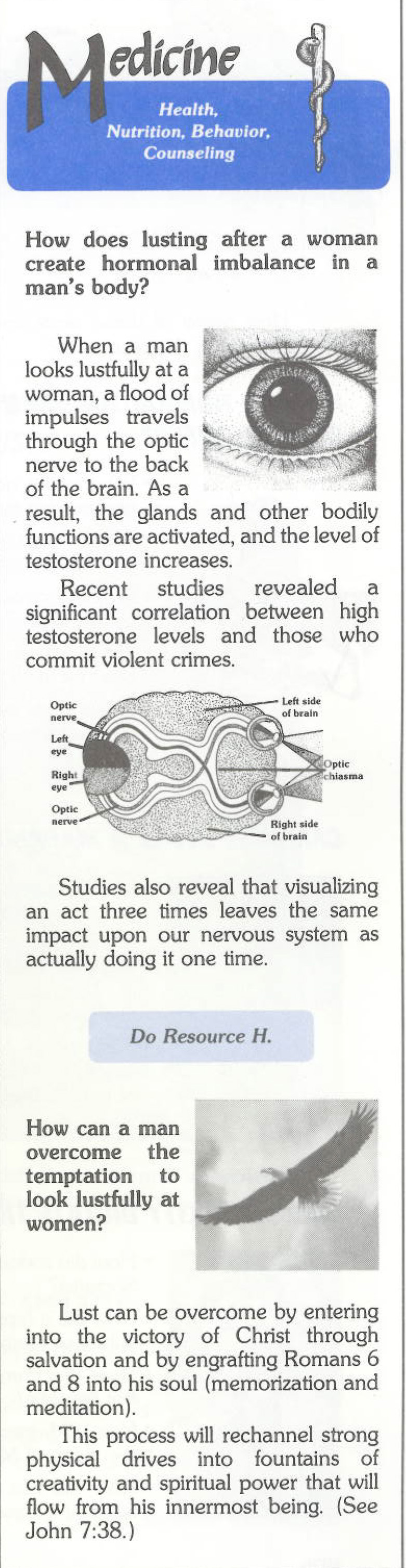
Now that I’ve answered Dana’s question, I thought I’d shift to what I find more interesting, the Duggar family’s homeschool curriculum, the Advanced Training Institute, founded by someone called Bill Gothard (not making up the name) who himself is currently on “indefinite administrative leave” because 34 women have accused him of sexual harassment. Be that as it may, thanks to the website Gawker, I have obtained a work sheet from the ATI, which I would like to share for your entertainment.

According to Gawker,

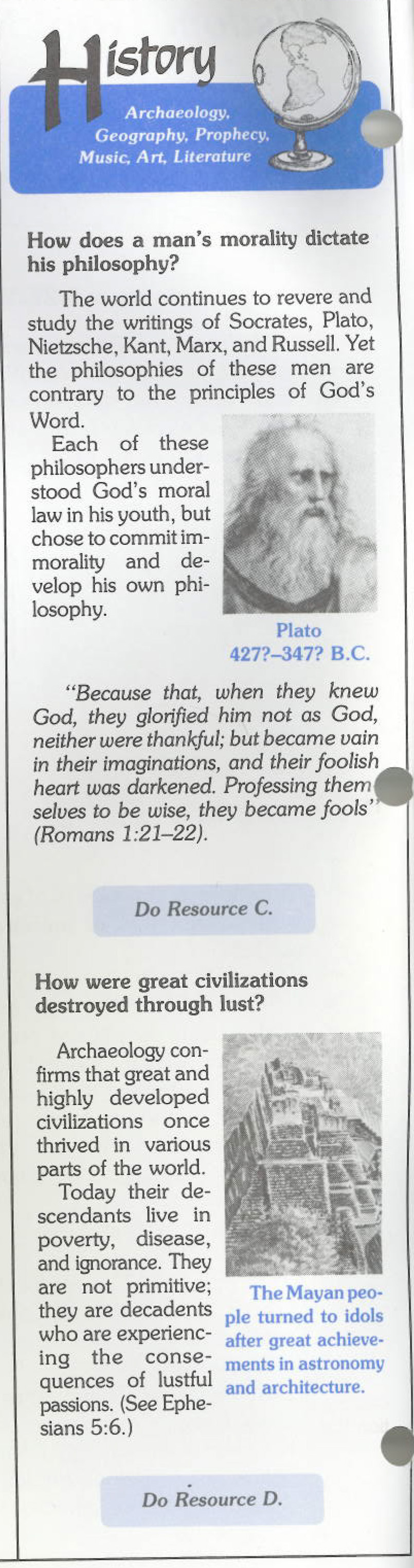
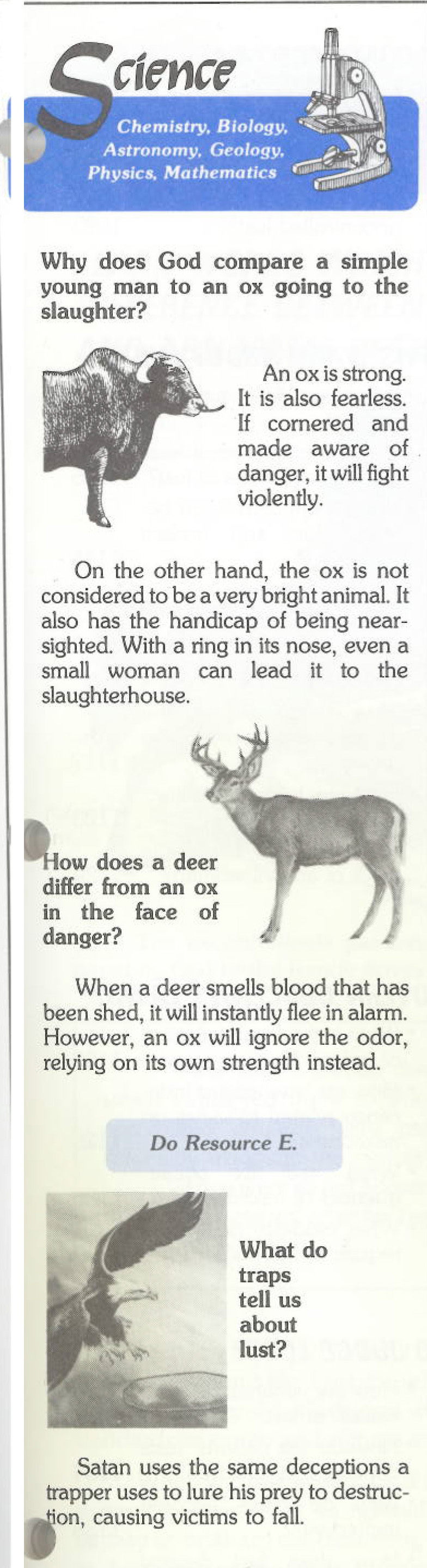
The lessons themselves consist of bizarre, forced attempts at inserting some type of traditional education into biblical passages. Which is where you get questions such as: “How did the ‘Socratic method’ of reasoning come from a sodomite manner of living?” “How can graphs help to visualize the consequences of lust?” And “How do prime numbers illustrate the principle of ‘one flesh’ in marriage?

For example, here are three examples from “Wisdom Worksheet” On Matthew 5:27-28. (Click on Images for larger viewing)

medicine history science

Obviously, photography is also a manifestation of modernism that the institute finds dangerous.

[1] Milbank claims not to “join in the schadenfreude on the left over the latest case of hypocrisy among family-value conservatives,” but I’d love to see the results of a polygraph strapped to him as he was typing that statement. But come to think of it, Denny Hastert has bumped the Duggars from “the latest case of hypocrisy among family-value conservatives.” Remember during Clinton’s impeachment when Hastert was railing against him?

School’s Out for the Summer

helicopter helicopter

Cue Alice Cooper’s “School’s Out for the Summer,” or, if you prefer, that older ditty, “No more pencils, no more books, no more teacher’s nasty looks,“ which might be updated from my perspective to “no more laptops, no more iPads, no more helicopter moms and dads.”

In case you older readers don’t know, parents can now go on line to keep track of their darlings’ academic progress via an app called “net classroom.” We teachers must post grades from pop quizzes, written homework assignments, vocabulary quizzes, essays, and oral presentations to a site that parents can log onto to mark the progress (or lack there of) of their progeny.

In my 30 years teaching at a prestigious Independent School, I’ve noticed a significant change in parental ambitions for their sons and daughters, which may reflect a national shift from legacy to meritocracy. Back in ’85, before the curse of instantaneous messaging, back when we wrote progress reports by hand, bearing Bic ballpoints down to insure our “good jobs” made it through the carbons onto the yellow and pink sub-copies, parents, many of them laidback lifelong Charlestonians, took more or less a hands-off approach to their children’s education. They seemed to trust that we knew what we were doing. A “C-” here or a “C+” there wasn’t going to keep Drayton Rhett Ball Rutledge Manigault out of Sewanee.

In fact, in the ‘80s, I can only remember one unpleasant encounter with a parent, and I didn’t even teach her son. She was angry because they had missed a deadline for a trip we were taking to the Soviet Union, an unrectifiable problem given deadlines for procuring visas. The conversation seemed to go on for hours.   It was like breaking up with a lover. We kept saying the same things over and over. My wife kept looking over and giving me the index-finger-across- the-neck slice, the universal sign of cut her off now.

The other parental interaction I remember was much more positive. A father, in fact a board member, came up to me and said, “I saw where you failed the boy on that Moby Dick test. Thank you! I caught him with those goddamned CliffNotes. Good job!”

(By the way, that rapscallion student, despite failing a major test that term, did manage to get accepted to Harvard, go to Northwestern for Medical School, and complete a post-doc at Yale).

Over the years, some parents have lost perspective on the weighting of grades. They seem to think that the tiniest assessment might make the difference between their replicated DNA’s attending Stanford or having to slum it at some state university. They seem to have forgotten that we can learn a great deal from our failures. (For example, you’ll never catch me again climbing an extension ladder with a couple of high-gravity IPAs sloshing around in my bloodstream). Anyway, these overweening parents squander their peace of mind by checking grades every hour (I’m not exaggerating) and probably blanch all of the joy of learning from their children who refuse to take intellectual risks because missing one question might make the difference between a distinguished medical career versus 60-hour shifts as an assistant manager at a suburban Sam’s Club.

When a student complains to me about such a parent, I suggest that she demand to see her parent’s high school report cards, which must be preserved given they had studded with A-pluses. Obviously, this suggestion doesn’t endear me to those parents.

But, hey, like I say, school’s out for the summer, so what the hell? Think I’ll put the top down, lay some rubber as I’m leaving the parking lot, crank up Alice Cooper’s anthem and gun it down Folly Road on my way home to the Edge of America.

tumblr_nbwd89geEb1rluzljo1_500

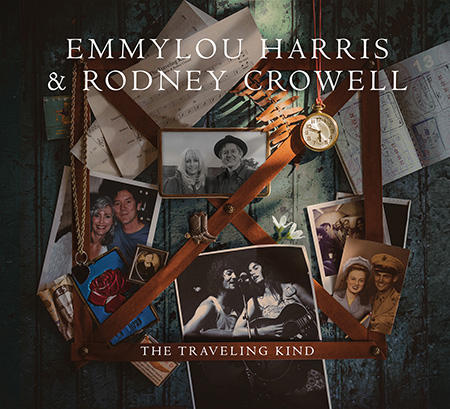
A Very Brief Peek at What to Expect in the 2015 Emmylou Harris and Rodney Crowell Tour

emmylou-harris-rodney-crowell-the-traveling-kind-450x409n

Expect a fairly prompt start. Slated for a 7:30 beginning, the lights went down at 7:41 with Emmylou, Rodney, and the band unceremoniously taking the stage clad in what could be street clothes. For really big shots in the music industry, these two are as unpretentious as you get.

The songs – 20 of them – came in quick succession punctuated occasionally with pleasant banter directed at the audience, comprised of mostly old folks. Last night’s show was part of Charleston’s Spoleto Arts Festival, which may have had something to do with the audience’s advanced age. Several of them stiffly fled as the band took their bows as if they didn’t realize that encores were sure to follow.

The set list sandwiches cuts from their new album of duets — The Traveling Kind – between covers and selections from their previous work. They kicked off with a cover of Lucinda Williams’ “I Just Wanted See You So Bad,” (which actually appears on the new album), then went right into “Grievous Angel.” Highlights from the pre-album phase included “Poncho and Lefty,” “Red Dirt Girl,” and “Love Hurts.”

Before they launched into the new songs, Emmylou remarked that she and Rodney had somehow managed to achieve longevity without getting much radio play. Then she said that she’d rather be on a jukebox than a radio to cheers from the audience.

I may have enjoyed the new stuff even more than lead-in tunes. The band — some of whom are not the musicians performing on the record – consisted of Steuart Smith on pedal steel, John somebody on drums, Michael somebody alternating between stand-up and electric bass, a killer keyboardist who also played accordion on the delightful “La Danse de la Joie,” and impressive Australian lead guitarist Jed Hughes who thrilled the crowd with searing solos.

Emmylou announced that we’d just heard most of the new album and then treated us to five more songs.

The lights came up, some septuagenarians headed for the exits, and then Emmylou came back on the stage alone and said that she only played this song – “Hickory Winds” — in South Carolina, and Rodney and the rest of the band ambled out one by one to join in.

So ultimately, what you can expect is 100 plus minutes of Americana music performed by a couple of national treasures.