With all of my students gone on field trips, I sat around today deleting antiquated files and ran across this blast from the past, our annual “corporate” “Holiday letter” from 2002:
Oh my, how the years do fly. It seems just yesterday that our boys were in the Lower School waiting patiently in line at their prestigious prep school to have their hair checked for head lice, and suddenly, in a blink of an eye, here they are each old enough to have wrecked one of our late model Volvos. And, yes, we realize it’s been five years since we’ve shared our great good fortune with you, but building a beautiful new riverfront house, searching for a college prestigious enough for our first born, and traveling back and forth to Ireland have been time consuming endeavors. Nevertheless, we can no longer ignore the clamorous heartfelt supplications to allow you to at least peek into our rich, meaningful lives. So back, by popular demand, here is the Moore Family Christmas Letter, v. 2002.
Ned is a junior at Porter-Gaud School (founded 1867, tuition $11,432 per annum) and has been active in several extracurricular activities such as the Friday Detention Club and the Salvation Army Shopping Society. There is, of course, a lot of peer pressure at Porter-Gaud, especially to make high grades. So many students there spend an inordinate amount of time paying attention in class and studying for tests. Ned, blessed with artistic genius, refuses to run with the herd. You won’t find Van Gogh, Einstein, or Faulkner’s names on any faculty lists or honor rolls either. We expect great things from Ned, and we’ll keep you posted of any future awards he garners.
According to both emails we’ve gotten from Harrison, he’s flourishing at Georgetown University (founded 1789, tuition $39,500 per annum). Given Harrison’s lifelong dream of working for the South Carolina Democratic Party, Georgetown seems an apt choice given its impressive Center for Cervantes Studies. Plus, Harrison will be right there in Washington learning the ropes from master politicians such as Trent Lott and Walter Mondale. We couldn’t be prouder of him. Walter Mondale, that is.
Judy’s broken a personal record for consecutive years at the same school: 2. Admittedly, she sometimes gets frustrated with the Napoleonic administrators and Kafkaesque bureaucracy she deals with unrelentingly on a daily basis, but just last night she told me that working for Charleston County Schools was like being a character in a Beckett play that just won’t end. In other words, she’s leading an award-winning dramatic working life. You go, girl!
Unfortunately, Wesley is having trouble finding a publisher for his latest manuscript, The Lighter Side of 9/11; nevertheless, he’s already at work on a new project, a coffee table book he plans to self-publish entitled The Picturesque Bars of Folly Beach, South Carolina. Of course, researching the project takes him away from home and into the field nightly, but Ned and Judy seem to be weathering his absences remarkably well. In fact, they encourage him to be as gone as long as needed. Sometimes, it’s almost as if they’ve forgotten that he’s not there, because it’s not unusual for them absentmindedly to lock him out of the house.
We’d like to close by assuring the petit bourgeois who apologize for cataloging their mundane triumphs in impersonal solstice letters such as this one that it’s okay. Hey, it’s not your fault that you have a somewhat of a life and can’t find the time to “hand craft” messages to personal friends. We understand.
All that we ask is that you never drop in without calling first.
Is it just I-and-I, or does it seem as if the first Republican Debate took place months ago?
You may remember that spectacle, the game show set, Meghan Kelly grilling the Donald, who hammed his way through the night’s entertainment like Don Rickles at a celebrity roast.
Horse-race-wise, much has happened since early August with Jeb Bush and Scott Walker falling back and Carly Florina and Ben Carson advancing in pursuit of a frontrunner who has put some distance between himself and the rest of the pack.
In fact, three-term Texas governor Rick Perry has pulled up lame, and to put a merciful end to this old nag of a metaphor, it’s hard to imagine donors ponying up much more money for the likes of Graham, Pataki, and Santorum.
If I were a Republican – and praise Darwin I’m not — I’d be hoping to shed a few more of the side show performers because, as we saw last night, eleven is about six or seven too many.
Last Night’s Debate
The good news: the set seemed less like Family Feud; the bad news: even though Ronald Reagan’s Air Force One provided an appropriately phallic backdrop for a debate featuring foreign policy, it was not the Gipper but Richard Nixon who came to mind as sweat beaded on the debaters’ upper lips and brows.
It reminded me of those old movies when cops/bad guys shove a detainee “on the hot seat.” Sweating makes people look uncomfortable, as if they’re lying.
Kudos, though, to whoever runs maintenance at the Reagan Library for saving energy in beleaguered California by keeping the thermostat at a planet-saving 78 F.
Jerry Brown, no doubt, approved.
Did Debate 2 Derail the Donald?
This race has befuddled the pundits, made them gun shy. Conventional wisdom says Trump should have faded by now a la Michelle Bachman or Herman Cain last time around. However, because Trump has thrived after tarring POW war hero senator John McCain, smearing Megan Kelly, etc., pundits are equivocating when gauging Trump’s performance last night, speculating that “maybe the air’s coming out of Trump’s balloon” but then quickly adding “you never know.”
One thing’s for certain, however. The candidates have embraced the Trump meme that America is in decline and that each of them is the man or woman who can restore us to greatness.
Oh, for the halcyon days of the second Bush Administration when the economy was in free-fall, financial institutions failing, and ISIS was in utero!
Okay, I’m on the upstairs porch of Chico Feo the afternoon after a Screamin’ J’s Friday night gig listening to some jamming when Eddie Cabbage asks me if I would like a poem on demand.
I demur, but he insists.
Hank Weed suggests something that incorporates cancer and poison ivy, because Hank claims that last year he asked me how it was going, and I said, “I have a bad case of poison ivy, and, oh yeah, Judy has cancer.”
[cue the Coasters]: Going to need an ocean of calamine lotion (and fifty bags of chemo).
Before I share the poem, here’s Eddie at work yesterday.
And here’s the poem with the warning that the squeamish might find its imagery unpalatable.
So far, I’ve seen two episodes of the Late Show with Stephen Colbert, Thursday’s and Friday’s broadcasts, and I thought that the Thursday interview with Joe Biden was captivating television. From the time Biden walked out, despite the mega-wattage of his smile, you could see in his eyes he was grieving, and Colbert dove right into the subject of Biden’s son Beau’s recent death, segued to Biden’s losing his first wife and his eighteen-month-old daughter in an automobile accident in 1972.
It was as if Colbert, a devout Catholic, who lost his father and two brothers in a plane crash in 1974, were holding a mirror up to himself when he asked Biden, a devout Catholic, about the role his faith had played throughout his travails. Furthermore, Colbert scored an enormous scoop by coaxing from Biden that he was not emotionally strong enough to run for president. It was uncomfortable to watch Biden in pain, but also life-affirming to witness his courage, and it was authentic, Colbert and Biden both speaking sincerely. I can’t imagine either of the Jimmys pulling off the Biden interview (Kimmell maybe, Fallon no way, and certainly Colbert’s alter ego from the Report would have had a hard time as well). Authenticity in late night television is as rare as a pro golfer without logos.
Lennon and Snyder
That interview reminded me of poor old long forgotten Tom Snyder and his Tomorrow Show where you could witness Snyder interviewing, sometimes grilling, the likes of John Lennon or Ayn Rand.
Dick Cavett also comes to mind. Cavett’s reruns are still entertaining today (unlike, say, old Carson interviews or watching 30 years from now Colbert’s Friday night interview with Amy Schumer). Although I’m fairly certain 62-year-old snobbish males who eschew Hollywood’s focus-group-tested movies isn’t the demographic CBS is dying to win over, I wish that Colbert would shoot for something more substantial than that Schumer interview.
It was even more boring than the Stephen King interview that followed. In fact, the Schumer conversation reeked of narcissism as she and Colbert gushed about hanging together at so-and-sos not all that long ago and then gushed about other celebrities they hang with, and then we got to see Amy drunk eating a cake in a home video and to hear both of them boast about being slackers in high school and then apologizing on air to two of their former teachers.[1] The self-congratulation meter was registering way up there at the danger level, like Dr. No’s underwater compound about to blow.
Of course, it might take some time for Colbert to shed his former persona and don a new one, and the show hasn’t had time to iron out its kinks, but Stephen’s entrance where he party dances with his bandleader Jon Batiste needs to be dialed down, and the audience itself comes off like a bunch of trained seals who have been injected with ALKS 5461. Also, I wish they’d hire someone to do the voiceovers announcing the line-up instead of Colbert’s doing it.
Enough carping. Not only is Stephen Colbert brilliant (his fast-draw witticisms during interviews rank right up there with Groucho’s) and charming, but he’s probably the only late night host working who has read Kierkegaard. I wish him the very best in a medium whose repetitious format gets really old really fast. As brilliant as the John Stewart’s Daily Show was, I eventually quit watching it because of the same ‘ol, same ‘ol.
Still, if Colbert can pull in interesting people (Phillip Roth instead of King, say, Björk instead of Schumer), then who knows?
[1] I actually teach at Colbert’s high school alma mater, and the teachers who taught him didn’t consider him a slacker but a quiet, polite kid who had been through hell, starred in the musical, and was into Dungeons and Dragons.
Tomorrow night I’ll participate in my 30th Parents Night at the independent school where I teach English. I remember my first fairly well, being really nervous addressing these older people putting down some serious jack to have me, an imposter — someone who had never taught high school — in charge of teaching their precious replicated DNA. In the two weeks I’d been teaching them, I had learned that many of my students — as far as well-wired cerebral cortexes go — were more intelligent than I, so I assumed their parents would be the same.
Like I said, I was nervous. I remember sweating profusely and my hand shaking in my pocket as I improvised my way through an overview of the course, fielded a couple of questions, and bid them a fond farewell. Several wanted to shake my hand as they left and told me how much Leland or Penelope enjoyed my class. Generally speaking, if your students like you, their parents like you.
Of course, much has changed since then, back then when Ronald Reagan was president and it was morning in America. For one thing, the mothers of my students have gone from seeming matronly to looking like jailbait. I myself have gone from svelte redheaded virility to portly bald-headed senescence.
There is recompense, however. In the classroom, I now know what I’m doing. On Parents Night, with my professorial persona in place, I no longer sweat, and my hands are out of my pockets sawing the air for emphasis. Essentially, I attempt to convince parents to take the long view, to look at that not-so-great essay grade as a snapshot in time, not as a colossal failure that kills Mason’s chances of ever getting into Harvard. I try to convince them to see that less-than-stellar essay as an opportunity to show Mason[1] that proofreading is important (i.e., unless you publish a blog).
The last thing you want to do is make learning an exercise in anxiousness.
Sometimes parents show up drunk, especially in Charleston. I guarantee you no new teacher tomorrow night will face a question as awkward as this one I faced about a dozen years ago.
“Mr. Moore, is it true that you’re a lesbian trapped in a man’s body?”
She was an acquaintance. Maybe my first word of advice is don’t get too chummy with your students’ parents.
I don’t remember what I said, but if someone were to ask me that tomorrow night, I’d say, “a black lesbian trapped in a white man’s body.”
Okay, the promised advice.
First, these people are bored stiff. Sitting in high school desks rekindles their high school insecurities. Entertain them rather than trying to inform them, though avoid icebreakers featuring a rabbi, a priest, and an imam.
Second, I suggest two weakish bloody marys a half hour before the festivities. This WC Fields-approved strategy will take the edge off without impairing your speech; in fact, it might even facilitate better communication. Note, I said weak bloody marys, which are odorless. You definitely don’t want to do two high gravity craft beers, not to mention two lines of coke or even one tab of LSD. I mean, c’mon, duh.
Otherwise, just be you. Obviously, you must interview well, or you wouldn’t have gotten the job in the first place. Try to have fun. Time flies. The next thing you know you’ll be on the cusp of retirement, your pretty plumage molted, your first parents night a distant memory.
[1] Mason’s a great gender-neutral name that allows you to avoid gender pronouns.
Kim, Davis, the Rowan County Kentucky functionary who refuses to issue marriage licenses to homosexuals because doing so violates her Christian values, has been married four times.
Jesus on homosexuality:
Jesus on divorce: “I tell you that anyone who divorces his wife, except for sexual immorality, and marries another woman commits adultery.” Matthew 19:9.
I’m assuming the reverse must be true, that anyone who divorces her husband . . .
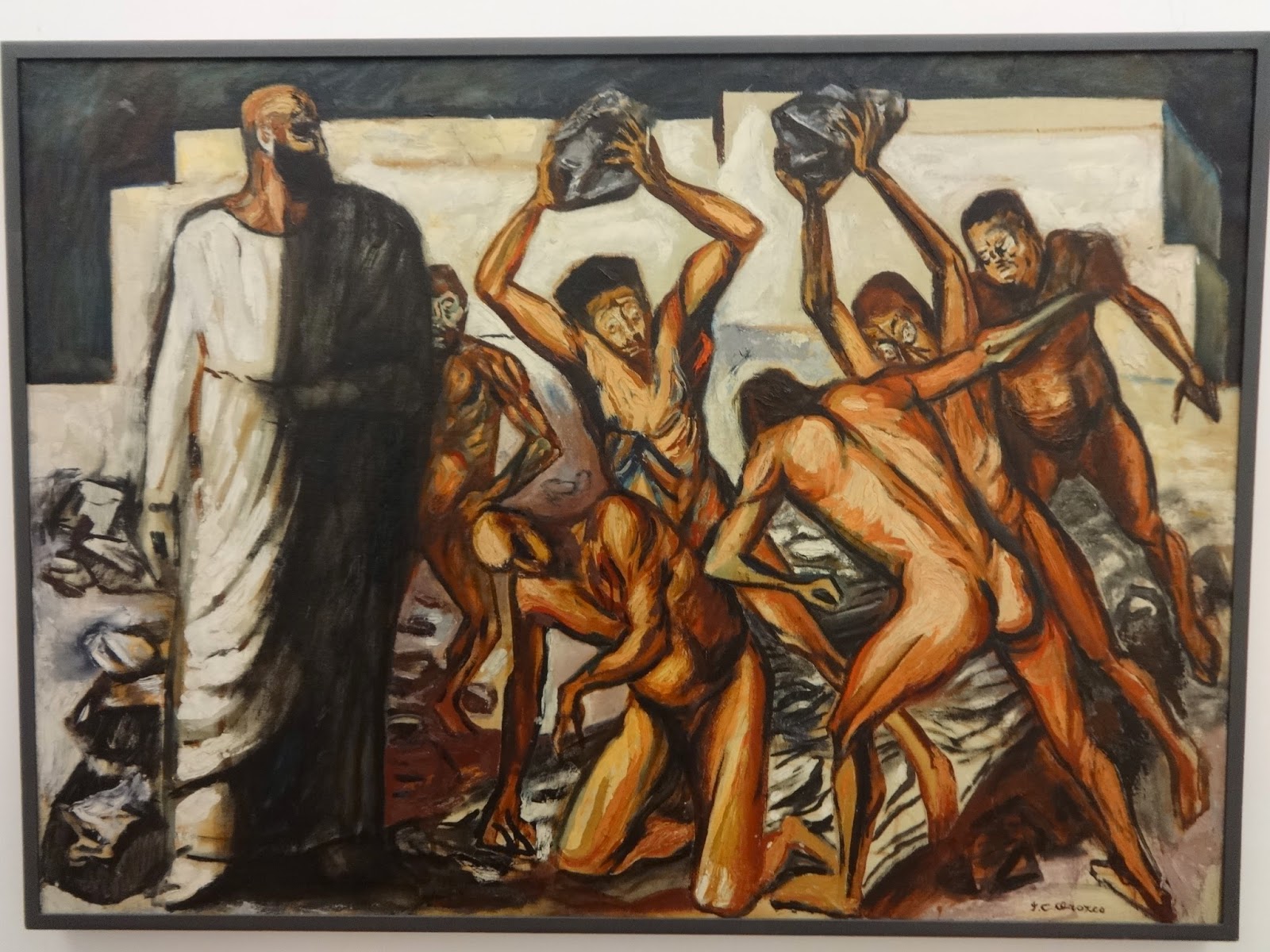
True, St. Paul was not a fan of “the love that dare not speak its name,” and his garden variety homophobic First Century proclamations against what we now know is hardwired genetics made it into the Canon, but then again, as St. Stephen might have said to pre-conversion Paul, he who is without sin . . .
The Martyrdom of Saint Stephen, by José Clemente Orozco
But I’m not here to cast stones (despite the above pebble flinging) but to offer common sensical solutions to the problem.
I think the worst possible scenario (not involving AK-15s) is Mrs. Davis’s getting fined and relenting and then issuing licenses to “sodomites” and therefore demonstrating to the wired world that her religious convictions have a price, never mind that she gets to cherry pick her religious convictions as far as the New Testament and homosexuality and divorce are concerned.
If I were believer, I’d take Jesus’s proclamations more seriously than Paul’s, but obviously Mrs. Davis doesn’t.
She could become a 21st Century martyr in the Age of Hyperbole by resigning or getting fired but would be immediately forgotten and jobless in a state that brings to mind coal mines rather than lilies, fields.
I have a better idea. How about transferring Mrs. Davis to another department in the county? Firing even po-dunk governmental lowlings is tedious and, like almost everything else in government, non-expeditious. We are, fortunately, a nation of laws, and drawing out this lawlessness for the entire world to see is counterproductive (not to mention embarrassing).
Transferring her to a clerical position not involving issuing marriage licenses might facilitate “a happy issue out of all our afflictions.”
At one point in The End of the Tour, the David Foster Wallace character (Jason Segal) introduces the David Lipsky character (Jessie Eisenberg) as “Mr. Boswell.”
It’s what we used to call a “cut” when I was a kid, a playful little knife nick to the ego’s epidermis. As future biographer Thomas Boswell followed the Great Samuel Johnson around the salons of 18th Century London scribbling down his every word so Rolling Stone reporter David Lipsky follows the Great David Foster Wallace around the fast food joints of Bloomington and Minneapolis scribbling down (and recording) his every word.
A major difference, though, is that Boswell worshipped Johnson, and being 30 years younger, looked up to him as you might an adored father. True, Lipsky recognizes that Wallace is a genius (and he was) and that he Lipsky is not (and he’s not); unfortunately, though, Lipsky suffers from that common young male testosteronic compulsion to see any contemporary as a rival. In his head he knows when it comes to Foster and him, it’s the literary equivalent of Bogey versus Barney Fife, but in his heart – or at least in his testes – he wants to be considered Wallace’s equal.
So the Lipsky character is both an ardent admirer and a resentful rival, and this tension provides the slight dramatic arc of the movie. Frankly, if I were you, I’d wait until the film comes out on Netflix.
Not that the film’s not well crafted and superbly acted (Segal might deserve an Oscar). However, this little movie with its appropriately washed out colors straining in winter light to render those undistinguishable commercial corridors that lead to every city in the US as soulless as possible ain’t exactly crying out to be seen on “the big screen.” The movie’s sort of claustrophobic. Our characters don’t talk about fiction, much less Infinite Jest, which could be a multi-generational novel set in Alaska for all we know. They migrate from emblematic soulless room to emblematic soulless room talking mostly about themselves, and the Wallace character’s social awkwardness doesn’t make you wish you could trade places with Lipsky.
What would have made the movie more interesting (and let me assure any Hollywood moguls out there reading this that I am available) is if we could have peeked inside of Wallace’s head on occasion. For example, when Lipsky asks Wallace why Wallace wears a head bandanna, we could have been treated to a montage from Wallace works – surreal scenes – for example, rapidly edited shots of wheelchair bound terrorists . . . a father strapping a Raquel Welch mask to his daughter before abusing her . . . a rollercoaster ride at the Indianapolis State Fair . . . dinner on a cruise ship with its Felliniesque diners, etc. etc. – all of these quick cut images gaining momentum until DFW’s head literally explodes.
The good and bad news is that this movie is very stage adaptable.
But here’s why I’m glad I went. A cartoon light bulb went off over my head as I was watching. The DFW character as Segal plays him is a lot like the Great Samuel Johnson. He’s straggly-haired, overweight, disheveled, stooped, ursine, shambling, prone to a soul’s darkest nights, pitifully self-absorbed, and, despite his genius, someone who strives as hard as he can to be a good man.
I love Boswell’s Johnson, and in my way, I love David Foster Wallace, but not Lipsky’s Wallace. In fact, in this movie, he’s not as clever or fun or witty as at least three friends I can think of – Furman Langley, Jake Williams, and Melissa DeMayo Reiss.
I’d much rather spend a couple of hours with them on a rainy Sunday.
I guess I was one of the last English majors to be trained to look at literature through the supposedly un-tinted lens of what used to be called New Criticism.
New Criticism demanded we look at and judge a poem, play, story, or novel according to its architectonics and organic synthesis. In other words, it was the imposition of the scientific method upon the creative product, a detached analysis of how parts fit into a whole to highlight some sort of significant statement about what it means to be human. Call me hidebound, but I prefer New Criticism, which now goes by the moniker of “formalism,” to reader-response criticism, semiotics, new historicism, etc.
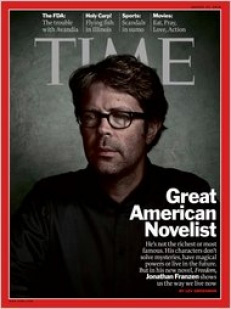
So I’m not much interested in Jonathan Franzen’s biography, his Midwestern roots, his literary heroes, his divorce, his love of birds and disdain for predatory house cats. I’m not interested in judging him as a human being; I am, though, interested in his art, his novels’ architectonics, character development, and entertainment value – not necessarily in that order. Even if Franzen himself in an essay on Edith Wharton claims that “a fiction writer’s oeuvre is a mirror of the writer’s character,” I’m not interested in writers’ characters or personalities; I’m interested in their books.
Why Creative Artists Frequently Hold Critics in Disdain
I’ve started to write I don’t know how many novels but only finished two, both of which were comic and featured adolescent protagonists, so I didn’t have to wrestle with the complexities of adulthood nor fear the consequences of failing at trying to create a serious work of art. Nevertheless, even in the construction of those piddly narratives, I suffered a bit in that I ended up spending hour after hour locked in the sordid little garret of my own unconscious, not a very pleasant or healthy place.
Writing a novel is hard. Faulkner, who cranked out As I Lay Dying in 6 weeks, said writing a novel is like “trying to nail together a henhouse in a hurricane.” Of course, the English form has its roots in the 18th Century and especially flourished in the 19th when middle class people needed something to do during those long, gaslit but wirelesses nights. Back then, many considered novels unhealthy, the way my father thought my reading comic books was unhealthy, the way some parents think playing video games is unhealthy. Another oft-employed metaphor in this context is junk food. Think of Paradise Lost as a banquet and Monk Lewis’s The Monk as a big bag of licorice jellybeans.
According to Marc McGurl’s The Novel Art: Elevations of American Fiction after Henry James, before James no one thought of a novel as a work of art, and, of course, James Joyce’s Ulysses demonstrated not only that a novel could be a work of art, but it could also be high art. So I say J. Joyce and H. James have made the serious novelist’s work more difficult because now this genre that has its origins in entertainment and costs a lot to produce and market needs to be ideally both high art and entertaining, and when’s the last time you’ve seen someone on the subway reading a paperback edition of Absalom, Absalom?
When critics do their jobs and judge books and find them lacking, so-called creative writers sometimes mock the critics as functionaries (muse-less hacks), or worse, vampires (parasites living off of someone else’s creativity).
Not surprisingly, Yeats has expressed these sentiments as well as anybody:
Don’t get me wrong. Lorentzen’s review is in many ways brilliant and unequivocally very entertaining. The cat is a superb stylist and, as we say on Folly Beach, knows his shit. In fact, I laughed out loud in the bar where I was reading the review when I read this sentence:
Franzen proves adept at telling an old-fashioned murder story, even if he pounds the notes of guilt and shame a little too hard with his Victorian hammer.
However, despite his protests otherwise, you can’t help get the impression that Lorentzen really dislikes Franzen the man. I’ve added the italics:
Prisoner of a too-early, too-idealistic marriage premised on mutual artistic success, a taste of which he got and she didn’t. En route to a divorce colored by his wife’s failure to sell a book, confusing the end of love with rage against environmental devastation, trying in vain to sell out with a dud of a screenplay that sublimated his marital crack-up. Depressed and penniless divorcé, coping with writer’s block and his own competitive instincts in the face of his friend’s magnum opus, Infinite Jest, by trying to figure out what it means to be a reader. Resurgent literary champion, reaping the rewards of a decade’s struggle but always prone to media gaffes. Advocate and lover of birds, even if it sometimes seemed the ornithologist-novelist was copping a move from the lepidopterist Nabokov. Time cover boy with a net worth reported to be in the eight figures, but always generous to younger writers as well as select literary forebears. Failed television writer (when HBO preemptively canceled a series adapted from The Corrections) and pained bystander to his brilliant friend’s suicide, an awful thing to endure, however muddled Franzen’s public response (“suicide as career move”?) has sounded. Scourge of online culture, an endearingly Sisyphean self-appointment. I confess I find Franzen the man sympathetic at every turn. I only wish that next time he returns with a novel that isn’t a bad date.
Only 6 of the 21 paragraphs of the review deal with Purity, and given the above, it’s not surprising that Lorentzen finds the novel lacking. Its “execution is shoddier” than that of TheCorrections and Freedom, its “[b]its of sociology break the spell of a convincing present.”
Franzen in 1977
For whatever reason, lots of people seem to have it out for Franzen, people like Matt Yglesias, whose writing I dig. They tend to develop a real animus for Franzen. Do they find him smug, too contemporary, too ambitious? Was Franzen that kid in school whom everyone picked on?
All I know is that I find his novels entertaining, and I care about his characters. From The Corrections I know what having Alzheimer’s feels like, and I also know that creating realistic characters and placing them in three-dimensional spaces is really, really difficult, like, um, “nailing up a henhouse in a hurricane,” so I’m inclined to give novelists more slack.
I know, I know, creative and analytical intelligences are very different (I suspect that Mrs. Harold Bloom isn’t packing heat, even in her purse), and critics must do their jobs, but every once in a while, before they start gathering their stones, they ought to at least sit down and try to write a sonnet.
A rara avis incarcerated in a penal colony of digits is more valuable than twice that in the lantana.
A factotum of all vocational occupations is conqueror of nil.
An observed container of H(OH) heated at 1000 never reaches effervescence.
Transferring pedagogical innovative stratagems to geriatric canines is not practicable.
Prematurely supine in soporific recumbence and prematurely engaged in diurnal responsibility facilitates prophylaxis, pecuniary abundance, and pansophism.
![Xmas 2002 - seems like yesterday [sob]](https://wlm3.com/wp-content/uploads/2015/09/xmas-2002.jpg)













 You Do Hoodoo