Closet Drama/Musical: Let’s Not Turn the Weekend into a Beckett Play

Translated from the French by Kingbeat Fuller Foster.

A couple in their twenties lounge in a not-all-that cramped studio apartment.  She sits on a ratty couch staring into her device, earbud wires dangling from her ears.  Reclining in a decrepit recliner, he reads the print edition of the New York Times.  A coffee table still life installation: skull, vaping device, utility bills, vintage post cards (Bertolt Brecht, Buster Keaton), an incense burner sprouting three sticks burning simultaneously.

Behind, a Batik hanging, concrete block bookshelves.

She [staring down at her device, then removing the earbuds]: Hey, Sam [we can’t see him because he holds the paper open with two hands thrust wide, the paper shielding.  The headline is in Pearl Harbor font:  TRUMP AND MELANIA  DEAD; MURDER/SUICIDE]Hey, Sam.  Do you still love me?

Sam: No.

She: But I love you.

Sam:  So you say.

She:  We’re five lines into the play,  and the so-called playwright hasn’t even bothered to give me a name yet.  Have you picked up on that?  Of course not.

Sam:  It’s because I haven’t said your name yet.

She:  Bullshit.  All he had to do is write in the directions above, a couple in their twenties, Sam and Sam, lounge in a not-all-that cramped studio apartment.  Plus, it seems like he got the title wrong.  Ionesco, not Beckett.

Male Sam lowers the newspaper and smiles enigmatically.

Female Sam: I used to think it was so cool we had the same name.  “Sam-plus-Sam= love” I wrote once on a dusty windshield instead of “wash me.”

Male Sam: [almost inaudibly]: Did this happen in the 1950s?  Nobody talks like that. “I wrote once on a dusty windshield.” No one ever talked liked that.  Except in plays.  [He yawns, turns the page, re-hides his person behind the paper.] Now the headline reads: Melania and Trump Dead, Suicide/Murder.

Female Sam:  I want you to move out.

Male Sam: [snatching newspaper down, ramming his legs to make the recliner un-recline, his feet slapping on the floor]: What???  Why????

Female Sam: Because you don’t love me anymore.

Male Sam: But I don’t love anyone.  Not MeMaw, not PaPa, not Mom, not Dad, not my shitass siblings, not Brooklyn, my job, not me.  You know what they say.  If you’re incapable of loving yourself, you’re incapable of loving in general. I’m the living proof.  Cmon, don’t kick me out, Sam.

He gets up, heads to the kitchen area, methodically concocts a bloody mary. She has the buds back in, her eyes closed, sways to unheard melodies.

He returns, drink in hand.  She doesn’t realize he’s there.  He touches her arm.  She opens her eyes, smiles.  Takes the drink.

Female Sam [Her smile has turned into a sardonic sitcom smile]:  I want you to move out.  In four weeks.

Male Sam [singing to the tune of “Goodnight Irene”]:  My mother wished that I might be/A man of some renown/But I am just as refugee/As I go rambling round boys/As I go rambling round.

Female Sam:  If we had a tv, we could watch the suicide/assassination extravaganza.

Male Sam:  I got an idea.  Let’s listen to the same song at the same time.  We never listen to the same song at the same time.

Female Sam:  Like what? What song?

Male Sam:  “Nobody But Me.” The Human Beinz.

Female Sam: The Human Beings?

Male Sam:  Yes.

From his device the song is bluetoothed to a red cylindrical speaker.

No-no, no, no, no-no-no, no, no-no, no, no-no
Na-no, no, na-no, no-no, na-no, no-no, no, no-no, no
Nobody can do the (Shing-a-ling) like I do
Nobody can do the (Skate) like I do
Nobody can do (Boogaloo) like I do
Nobody can do (Philly) like I do
Well, don’t you know
I’m gonna skate right through
Ain’t nobody do it but me
Nobody but me (nobody but me)
Yeah, I’m gonna spin, I do
Ain’t nobody do it but me, babe
(Nobody but me)
Well, let me tell you nobody
Nobody but me
Let me tell you, nobody
(Nobody) nobody
(Nobody) nobody
(Nobody) nobody
(Nobody) nobody
(Nobody) nobody
(Nobody) nobody
(Nobody)
—Instrumental Interlude—
No-no, no, no, no, no-no-no, no, no-no, no, no-no
Na-no, no, na-no, no-no, na-no, no-no, no, no-no, no
Nobody can do the (Shing-a-ling) like I do
Nobody can do the (Skate) like I do
Nobody can do (Boogaloo) like I do
Nobody can do (Philly) like I do
Ooooooh, yeah
Nobody, nobody
Nobody, nobody

Female Sam: I’d never heard that before. It’s kinda catchy.

Male Sam: Aint nobody do it but me, babe.

Female Sam: It’s very danceable.

Male Sam: Wanna dance?

Female Sam: Do you still love me?

Male Sam: If I say ‘yes’ can I stay?

Female Sam: Maybe.

Male Sam: Let’s not turn this weekend into a Beckett play. Let’s go for romcom, okay?

Female Sam: Okay, I’ll give you six weeks. Then I want you to move out.

Male Sam: Fine!

Fin.

Testy Delirium, Featuring Robert Penn Warren and Great Granddaddy Moore

Robert Penn Warren

I’ve just finished Wallace Stegner’s The Spectator Bird, the National Book Award recipient for fiction in 1977. Its narrator, the sixty-nine year old Joe Allston, is so curmudgeony that he makes Ebenezer Scrooge and Miss Havisham seem like Fred Astaire and Ginger Rodgers. Allston, whose one attribute is his penchant for erudite allusions, has taken Dylan Thomas’s advice about raging, raging, against the dying of the light. Obsessed with his arthritis and a deteriorating dental situation, he has become an insufferably angry old man.

Petty occurrences like newscasters’ eliding syllables bring his “blood pressure up to about 250/200,” and when he discovers that “the mailbox [is] empty, that the postman [is] late again,” he “announces a loud God damn.” His “internal grumblings [go] on, the way a high-compression engine running on low-octane gas will go on galloping and coughing and smoking after the ignition is shut off.”

Lacking both the supernatural solace of religion and the philosophical consolation of stoicism, he focuses only on himself, which makes him miserable. His long suffering wife Ruth tries to push him in a more positive direction but to no avail.

***

Years ago, I attempted to be a Buddhist because I realized that I squander most of my time among cluttered bric-a-brac in the attic of my mind, blind to the wonders of nature that Wordsworth extolls in his poetry, glories like “the sportive wood run wild,” or less majestic miracles, like the sway of sunlight and shadow on the bookcase to my right, what my friend Leopold Bloom of Ulysses would call “a phenomena.”

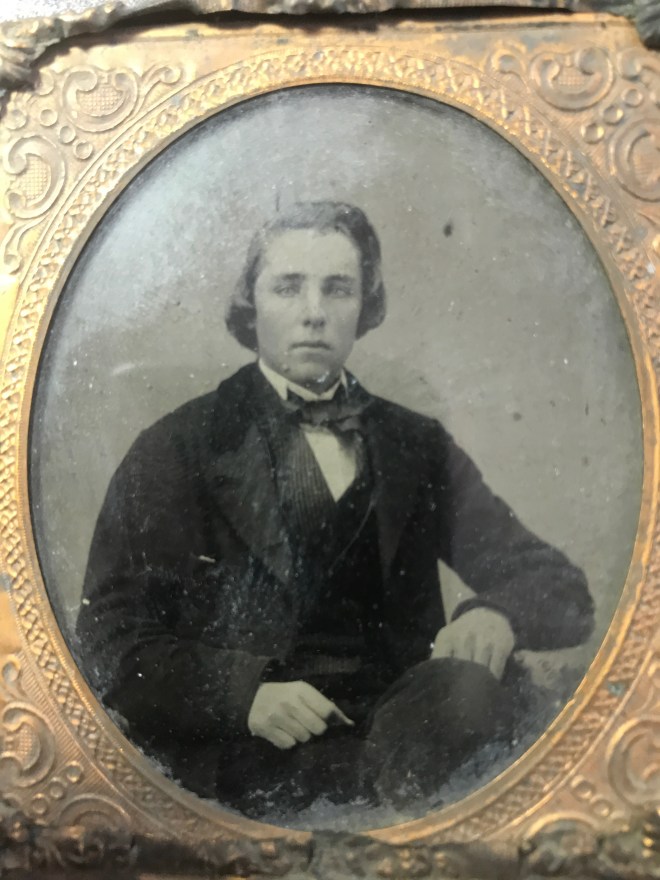
The fellow in the daguerreotype is one of my late wife Judy’s ancestors. In those days, posing for a photo was serious business. You had to be very still. Very few people sit still nowadays. I don’t know his name, but I can see a resemblance between him and Judy’s sister Becky around their eyes. Judy knew who he was, I think.

No one thinks about this man anymore, except for me, and now, for a second, you.

* * *

Close to forty years ago, a newlywed living in Rantowles, I ran across a poem by Robert Penn Warren, still alive at the time, a poem about old age in which he mused that when he would die so would all living memory of his grandfather.

I sat in the same room with Robert Penn Warren once in the early ‘70s when he met with about 20 or so students to answer our questions. David Tillinghast, the TA who taught me fiction writing, asked Mr. Warren the first question, if he thought a formal education would have “ruined” Ernest Hemingway.

“How in the hell should I know,” was Warren’s rude answer, barked loudly, in a tone bordering on exasperation.

* * *

Although I was only five or so, I remember when my great grandfather Luther Moore died. There was an article about him in an upstate paper because he had been some minor elected official and ridden a bicycle all over Bishopville in his 90s. I met him once at my other great grandfather’s house in North Charleston.

When he arrived, Grandfather Luther, croaked, “I’m blind and deaf so there’s no need for any of you to come and try to talk to me.”

After their opening salvos, I didn’t engage with either Robert Penn Warren, a fellow redhead, or Grandfather Luther, who may have had a thick head of white hair or been as bald as an emu egg – I don’t remember, and there’s no one alive to ask. Both old men were scary, angry about something, probably, like Joe Allston, about being old.

* * *

What shall I do with this absurdity—

O heart, O troubled heart—this caricature,

Decrepit age that has been tied to me

As to a dog’s tail?

If Yeats had been a Buddhist, he wouldn’t have written these lines. Sure, he would have been happier, but his poetry less profound.  I’ll take The Scarlet Letter or Moby Dick over Walden Pond any day.

Which is ultimately more important? Happiness or poetic profundity? Does it even matter?

Here’s how Yeats’s poem ends:

Now shall I make my soul,

Compelling it to study

In a learned school

Till the wreck of body,

Slow decay of blood,

Testy delirium

Or dull decrepitude,

Or what worse evil come—

The death of friends, or death

Of every brilliant eye

That made a catch in the breath—

Seem but the clouds of the sky

When the horizon fades,

Or a bird’s sleepy cry

Among the deepening shades.

Oh. Yes. Om. Amen.


Lethargy

Marle, Edward; Lotus Eaters


Surely, surely, slumber is more sweet than toil, the shore 

Than labour in the deep mid-ocean, wind and wave and oar; 

O, rest ye, brother mariners, we will not wander more. 

Tennyson “The Lotus Eaters”


In 1957, when I was five, I came down with rheumatic fever and was bed bound for two months or maybe even longer. (I can’t remember, and there’s no one left living to ask). I do know it was long enough for me to have forgotten how to ride a bike.

During the period of my incapacity, my mother borrowed a piece of furniture designed especially for the bedridden called a secretary. With me propped up on pillows, my legs stretched out underneath, the secretary provided a platform for coloring, putting together puzzles, and playing board games (which adults allowed me to win out-of-pity). It also provided me a stage to perform plays with my Zorro hand puppet (complete with mask and cape). I can’t remember if there was another puppet or not. It seems as if Zorro monologues delivered by a lisping five-year-old affecting a Mexican accent might get pretty boring.

On the non-Humanities side, my uncle Jerry bought me an erector set, which was about as appropriate a gift as presenting Donald Trump with a copy of Proust’s À la recherche du temps perdu. I recall lots of screws dropped, uncomfortably discovered when I rolled over, but I don’t remember a project ever being completed, which brings to mind graduate school and that phantom thesis on Auden’s poetry in relation to painting.

no fun ahoy


Anyway, I wonder if spending such a long period in bed with only 60 months-of -being to my name negatively affected my personality or character, if I can point a finger at my fifth year and blame rheumatic fever for my sloth.

This Sunday, for example, I felt like not getting out of bed (as opposed to not feeling like getting out of bed), like lying there the entire day, like maybe calling Bert’s Market to deliver some camphor-soaked handkerchiefs. I had essays galore to grade, sheets to wash, groceries to buy, a garage in desperate need of sweeping . . .

Got the lotus-eater’s blues,

Too lazy to put on my shoes . . .

[Not to be continued].

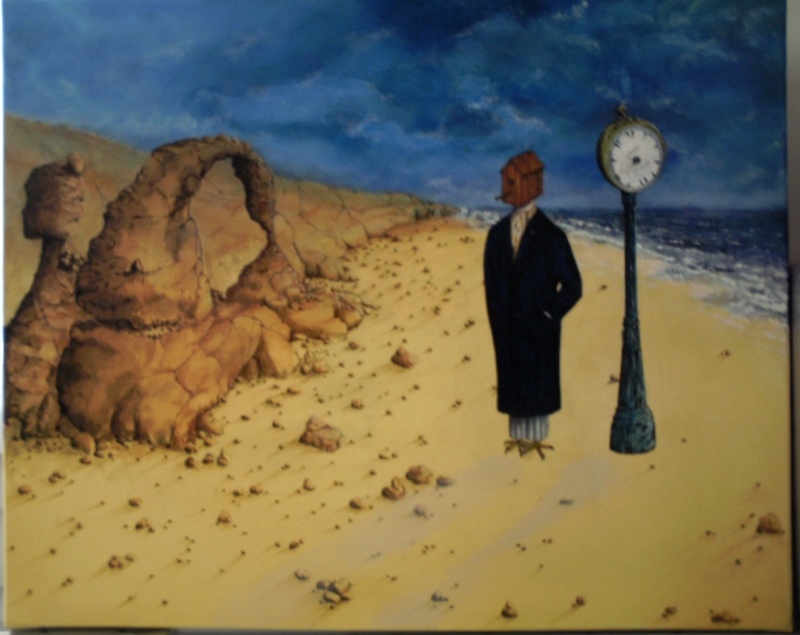
le temps perdu dans le temps 1 (acrylique)
artist: Paul Vigne Pavi


A Paean To Ireland, Sort Of

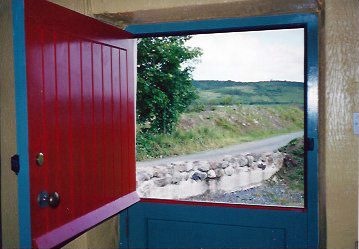
View from A Rented Cottage in County Clare, photograph by Wesley Moore III

Although I’m certain I have a drop or two of Irish blood, I’m not of the Catholic immigrant variety with distant cousins in Kerry or Donegal. Nevertheless, ever since I saw at the age of seven Darby O’Gill and the Little People, I have loved that “little green place” and its soulful inhabitants, its poetry, music, fairies and leprechauns, its abundance of foxgloves, and those mountains in the distance so vaporous it looks as if you could puncture them with your forefinger.

And, oh my god, that rainbow I encountered in 1978 outside of Limerick!

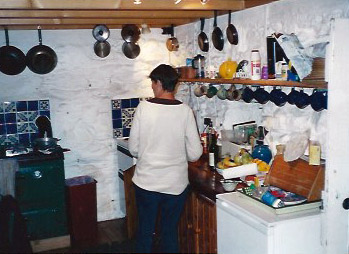
Judy Birdsong Preparing Supper in County Cork, photograph by Wesley Moore

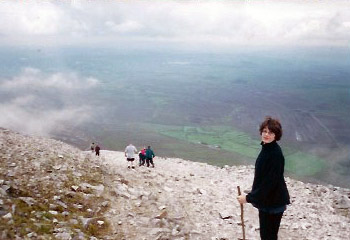
Ireland was the first place I went abroad at twenty-five, and I have been twice again since. In the previous century, Judy, our boys, and I rented cottages, burned peat, shopped at the butchers, drank and listened to music in the pubs, climbed Ben Bulben’s back, and crawled our way up Croagh Patrick.

Ned Moore descending Croagh Patrick, photograph by Judy Birdsong

We got to know our neighbors, so hospitable. Here below are the boys helping John Joe O’Shea shear a sheep near Bantry Bay on the Berea Peninsula in County Cork.

Ned and Harrison Moore and John Joe O’Shea shearing sheep

What truly astounds me about Ireland, though, is how an island the size of South Carolina could produce so many literary masters– Swift, Goldsmith, Yeats, Shaw, Wilde, Joyce, Beckett, and Heaney, to name the ones who come immediately to mind.

Despite his kooky mysticism and rightist politics, Yeats is my hero, and despite his arrogance and sometime meanness, Joyce is my hero.

Joyce, of course, had his issues with his native land. For example, Dubliners isn’t exactly what you would call a flattering portrait of that city. I’m currently on Disc 30 of the Donal Donnnelly/Miriam Healy-Louie recording of Ulysses, “Episode 16,” the so-called Eumaeus episode when Bloom and Stephen seek refuge in a cabman’s shelter after Stephen has been punched out by an English soldier.

An old tar, DB Murphy comes into the shelter and asks Stephen if he knows Simon Dedalus, Stephen’s father, and Stephen says, “I’ve heard of him.” The seaman answers, “He’s Irish [. . .] All Irish.” Stephen “rejoins” (to use Joyce’s dialogue prompt) “All too Irish.” As a Southerner, I can certainly identify with Stephen’s love/hate relationship with his native land.

Anyway, listening to Donnelly read Joyce’s rich broth of Anglo-Saxon and French-derived words, I have gotten the cadences stuck in my head, and to purge them, I’ve composed this negative ditty, trying to stick with only Anglo-Saxon, through which I mean not to stereotype my Irish brethren but merely to make music out of misery.


Manic Irish Reeling

Slop flung from a window above

Splatters on stone in globby plops.


Curses, fists, flung and shook,

Shuffling brogans, baleful looks.


“With a high ro and a randy ro and my galloping tearing tandy O!”


After toil a stop at the pub,

Reeking redbearded guzzling swabs

Fritter away their coppery coins

Picking scabs by swapping tales.


“With a high ro and a randy ro and my galloping tearing tandy O!”


Baggy-eyed mothers fret

Greedy sucklings at their breasts,

Keening toddlers at their feet,

Their stillborns gone, but not forgotten,

Their overripe love on the road to rotten.


With a high ro and a randy ro and my galloping tearing tandy O!”


Out in the street across the way

Waifs and strays banding about.

Rail thin curs and scrawny cats.

Yelping and mewling till the sun comes up.


“With a high ro and a randy ro –


Hit it!


“With a high ro and a randy ro and my galloping tearing tandy O!”


Thomas Hardy on Zoloft


The smile on your mouth was the deadest thing

Alive enough to have the strength to die.


Windows, willows, gray clouds, a lake,

A landscape sketched by Thomas Hardy,

Heartache’s bald-headed ambassador,

Who wondered what life’s fuss was for.


Yet why so glum? The willows wave,

As if to welcome the scudding clouds.

This vacay cottage sports a tin roof.

Pounding percussion is in store.


Pull down the shades, shut down Pandora.

Listen to the rhythm of the falling rain,

Telling you just what a fool you’ve been

Groaning and bemoaning tick tocks away . . .

Poetry Versus Verse

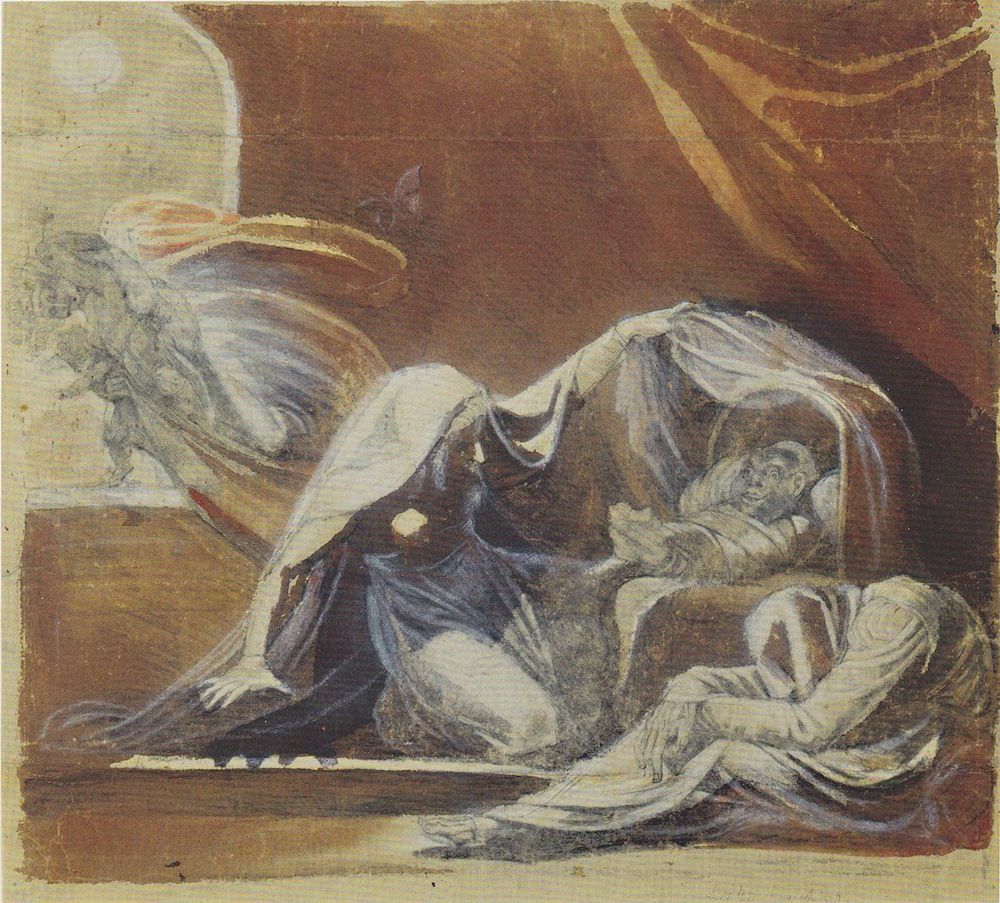
thechangeling

Whenever I begin a unit on poetry, I remark on the virtual impossibility of defining it.  For example, compare this sentence:

Just be tender, just be true,

Just be glad the whole day through,

Just be merciful, just be mild,

Just to be trustful as a child,

Just to be gentle and kind and sweet,

Just to be helpful with willing feet,

Just to be cheery when things go wrong,

Just to drive sadness away with a song,

Whether the hour is dark or bright,

Just to be loyal to God and right,

Just to believe that God knows best,

Just in his promises ever to rest –

Just to let love be our daily key,

That is God’s will for you and me.

With this sentence:

The aged sisters draw us into life: we wail, batten, sport, clip, clasp, sunder, dwindle, die; over us dead they bend.

Even though the first sentence is written in rhymed couplets that fall into repetitive metrical patterns, it should not be mistaken for poetry.

After all,

A poem should be palpable and mute

As a globed fruit,


Dumb

As old medallions to the thumb,

Silent as the sleeve-worn stone

Of casement ledges where the moss has grown—


A poem should be wordless

As the flight of birds.

In other words, a poem shouldn’t be a series of non-compressed sing-songy platitudes, nor, I would argue, can it be.  Imagine, answering that Nigerian email’s promise of riches “trustful as a child” or approaching a bereaved spouse after a funeral with the advice “just be cheery when things go wrong.”  Although jauntily rendered and upbeat in message, the first sentence is life-cheapening because it is false and hollow. What we have is verse, not poetry.

The second example is, literally speaking, prose, a sentence from Joyce’s novel Ulysses when Stephen Dedalus and Leopold Bloom visit a maternity ward where Mina Purefoy has been in labor for three days struggling to give birth to her son. The “aged sisters” are midwives, sisters of mercy, ushering us onto the stage for our hour of joy and sorrow.

Joyce reduces Shakespeare’s “seven ages of man” to eight verbs: wail, batten, sport, clip, cleave, sunder, dwindle, die.  And there they are again, a different set of aged sisters, nurses, ushering us out.[1]

Pure poetry, truth compressed, ringing like a bell.

I quoted Joyce’s sentence to two of my colleagues sitting next to each other this morning, one who had lost her aunt last weekend and the other who is about to give birth in a month or so.

“Sorry about your loss,” I said to Megan. “Happy about your gain” I said to Jen.  Then I quoted Joyce’s sentence.  They both smiled.

I didn’t add, “Just be tender, just be true,/ Just be happy the whole day through.”


[1] In Ireland, perhaps nuns.

OxenOfTheSun

Goodbye for Good

On the train you get smaller, as you get farther away.
The roar covers everything you wanted to say.
Was that a raindrop or a tear in the corner of your eye?
Were you drying your nails or waving goodbye?

 Tom Waits, “2:19”


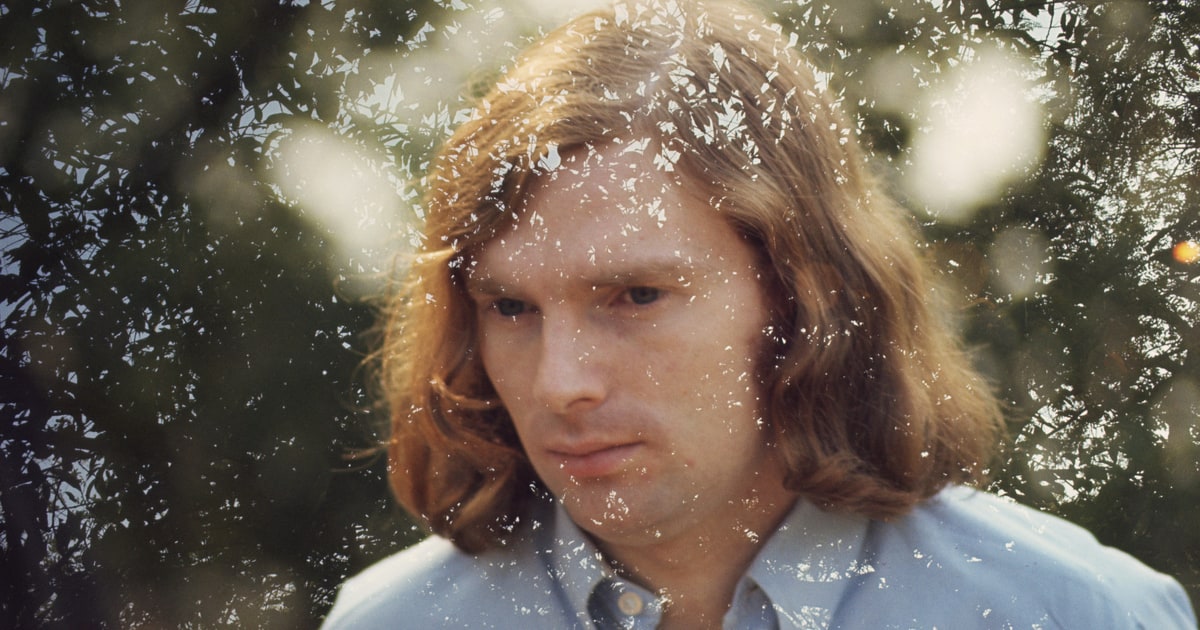
In “Madame George,” the second song of Side Two of Van Morrison’s Astral Weeks, I love it when Madame George says to the narrator, “Hey love, you forgot your gloves.”

And then the narrator, (rather than Madame George, I think) says

The gloves to love, to love the gloves

The gloves to love, to love the gloves

The gloves to love, to love the gloves

The gloves to love, to love the gloves

To say goodbye to Madame George

Dry your eye for Madame George

Wonder why for Madame George.”


Wonder why about what?

In the last stanza, it’s as if the narrator has to self-hypnotize himself leave, as if he has to verbally will his very locomotion:

Get on the train
Get on the train, the train, the train
This is the train, this is the train
Whoa, say goodbye, goodbye, goodbye, goodbye
Get on the train, get on the train.


Glove equals love, liltingly. Gloves sometimes wave goodbye.

Goodbye for good?

I don’t pretend to know what’s happening here, but it’s something very, very sad; we’re in a world of woe, outré, impressionistic, hypnotic.

You can feel the inarticulate hurt, and it’s bad to feel so good to know you’re not the only one hurting.

We’ve all felt this. This is the train. Get on the train. Dry your eyes. This is the bed. Get out of the bed. Put Visine in your eyes.

Your eyes, your eyes, your eyes.

Miles Davis, John Coltrane, So What?

Miles Davis at the Vancouver International Jazz Festival, 1986

Miles Davis at the Vancouver International Jazz Festival, 1986

If it weren’t for his furtive, occasionally darting eyes, Mile’s Davis’s 1959 performance of “So What?” (see below) might serve as an ideal video embodiment of the word nonchalance.[1]

I.e., the projecting an aura of a relaxed, confident detachment.[2]

It seems as if no one’s all that into it, maybe not all that interested.

For example, at 2:41, notice Coltrane looking impassive in the background during Miles’s solo, eventually, however, nodding his head in half-assed admiration.

When Coltrane begins his solo, Miles splits for backstage. At 4:28, check out the two white fellows behind Coltrane actually conversing, seemingly deaf to gorgeous notes streaming from the tenor saxophone five feet in front of them.

At 4:40-ish there’s Miles himself in the background smoking a cigarette, detached.

At 5:03, though still offstage, he’s back into the flow of the music, swaying.

Throughout the entire performance, you see people who should be behind the scenes casually milling around, talking.

The obliviousness to momentousness of the music reminds me of that Auden poem describing an “untidy spot” on the canvas of an Old Master’s painting depicting an unnamed martyrdom where “dogs go on with their doggy life and the torturer’s horse scratches its innocent behind on a tree.”

Anyway, when the camera’s on Miles in profile, his body appropriately takes the shape of a question mark.

It’s like Miles is cool cubed, which being too too too cool, threatens to heat up into violence.

There’s tension, calculation in those eyes looking backwards into their skull. They’re not looking at what’s ever opposite of them in that studio.

But it’s the music that really matters. Check it out for yourself. The trumpet saying so what, so what, so what.

Do it, Miles.


[1] I’m imagining an on-line dictionary that provides multiple multimedia examples so that you really get a feel for the word

[2] My definition.


The Briefest of Tributes to John Hiatt

I just read Wikipedia’s account of John Hiatt’s career, a disjointed narrative that comes off more like a collection of bullet points than it does an essay. However, I did learn something that surprised me. Because my first Hiatt record was Slug Line, I always assumed that he started as a new wave musician, but as it turns out, Hiatt moved from the rock/country rock of his first two albums, Hangin’ Around the Observatory and Overcoats (1974), to the punkish, ska-ish Slug Line (1979) and, finally, then back to rock/country rock. When he ran away to Nashville after dropping out of school, Hiatt worked for Tree Publishing earning $25 a week as a songwriter. Although Hangin’ Round the Observatory wasn’t a commercial success, a Three Dog Night cover of “Sure As I’m Sitting Here” hit #16 on Billboard.

In fact, it’s hard to find someone who hasn’t covered a Hiatt song. Dylan has, the Neville Brothers have, Springsteen has, even one of his boyhood heroes, Mitch Ryder has. Of course, Bonnie Raitt scored a big hit with “A Thing Called Love.”

Whatever the genre, Hiatt delivers solid melodies and clever lyrics, often in the form of narratives. Here’s a snippet from Slug Line’s “The Night That Kenny Died,” a tale of teen hypocrisy as high schoolers go all hooey when a classmate they disliked dies suddenly.


It was so touching all the girls that would not touch him
He drew their pictures in his books I used to watch him
And then he’d pick his nose
And wipe it on his clothes
But everybody cried
The night that Kenny died
Everybody cried
The night that Kenny died
Died on a motorcycle
We never understood
That he was holdin’ on tight
Through the middle of the night
Starin’ at a [?] one Mercury hood
It seemed so spooky that the nerd we all detested
Would die so gloriously and so unexpected
A wonderful guy God knows
They kept the casket closed
And everybody cried
The night that Kenny died
Everybody cried
The night that Kenny died
And everybody cried
The night that Kenny died
Everybody cried
The night that Kenny died

Perhaps his two best records are Bring the Family (1987) and Slow Turning (1988), recorded with Ry Cooder, Nick Lowe, and Jim Keltner.

Hiatt’s wit, I think, rivals Warren Zevon’s. In “Your Dad Did,” Note the sitar during the daughter’s prayer,  which she immediately undercuts with her coda.


Well, the day was long now, supper’s on
The thrill is gone
But something’s taking place
Yeah, the food is cold and your wife feels old
But all hands fold
As the two year old says grace
She says, “Help the starving children to get well
But let my brother’s hamster burn in hell.”
You love your wife and kids
Just like your dad did.

Check out this from “Perfectly Good Guitar.”

:

Well he threw one down form the top of the stairs
Beautiful women were standing everywhere
They all got wet when he smashed that thing
But off in the dark you could hear somebody sing
Oh it breaks my heart to see those stars
Smashing a perfectly good guitar
I don’t know who they think they are
Smashing a perfectly good guitar
It started back in 1963
His momma wouldn’t buy him
That new red harmony
He settled for a sunburt with a crack
But he’s still trying to break his momma’s back.


I finally got to see Mr. Hiatt live on his 2014 Terms of My Surrender Tour,[1] a great show but a melancholy one for me personally. My wife Judy had just been diagnosed with lymphoma, and it would be her last concert.

Although he didn’t play it at the show, this was Judy’s favorite (and you ought to check out the Johnny Adams cover).  Dig the lyrics.


[1] I had seen him with Lyle Lovett, Joe Ely, and the late Guy Clark but not by himself.