I went home with a waitress the way I always do How was I to know she was with the Russians, too?
I was gambling in Havana, I took a little risk Send lawyers, guns, and money Dad, get me out of this, hiyah!
An innocent bystander, Somehow I got stuck between a rock and a hard place, And I’m down on my luck. Yes, I’m down on my luck. Well, I’m down on my luck.
I’m hiding in Honduras, I’m a desperate man Send lawyers, guns, and money The shit has hit the fan.
“Lawyers, Guns, and Money”
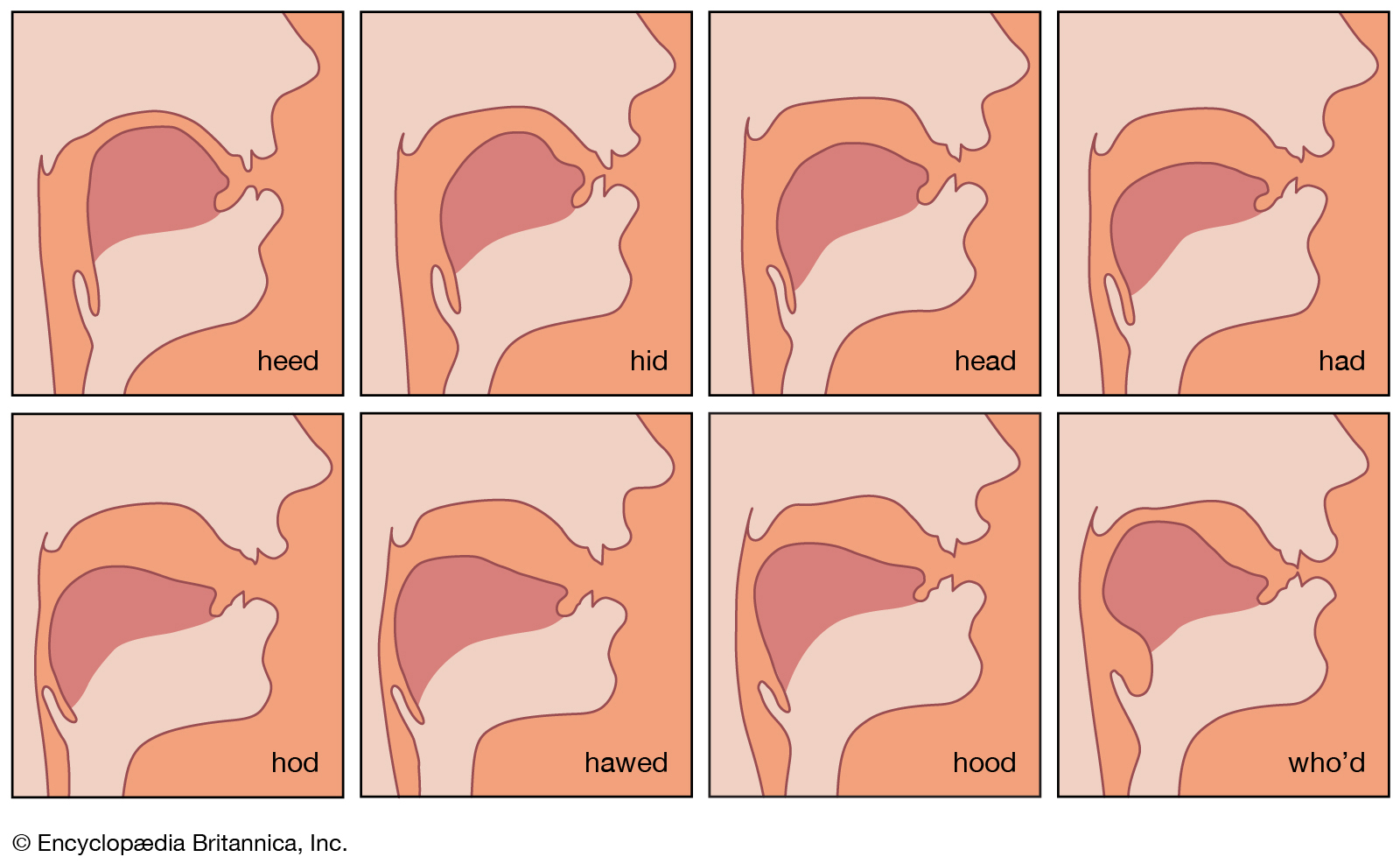
image from Britannica
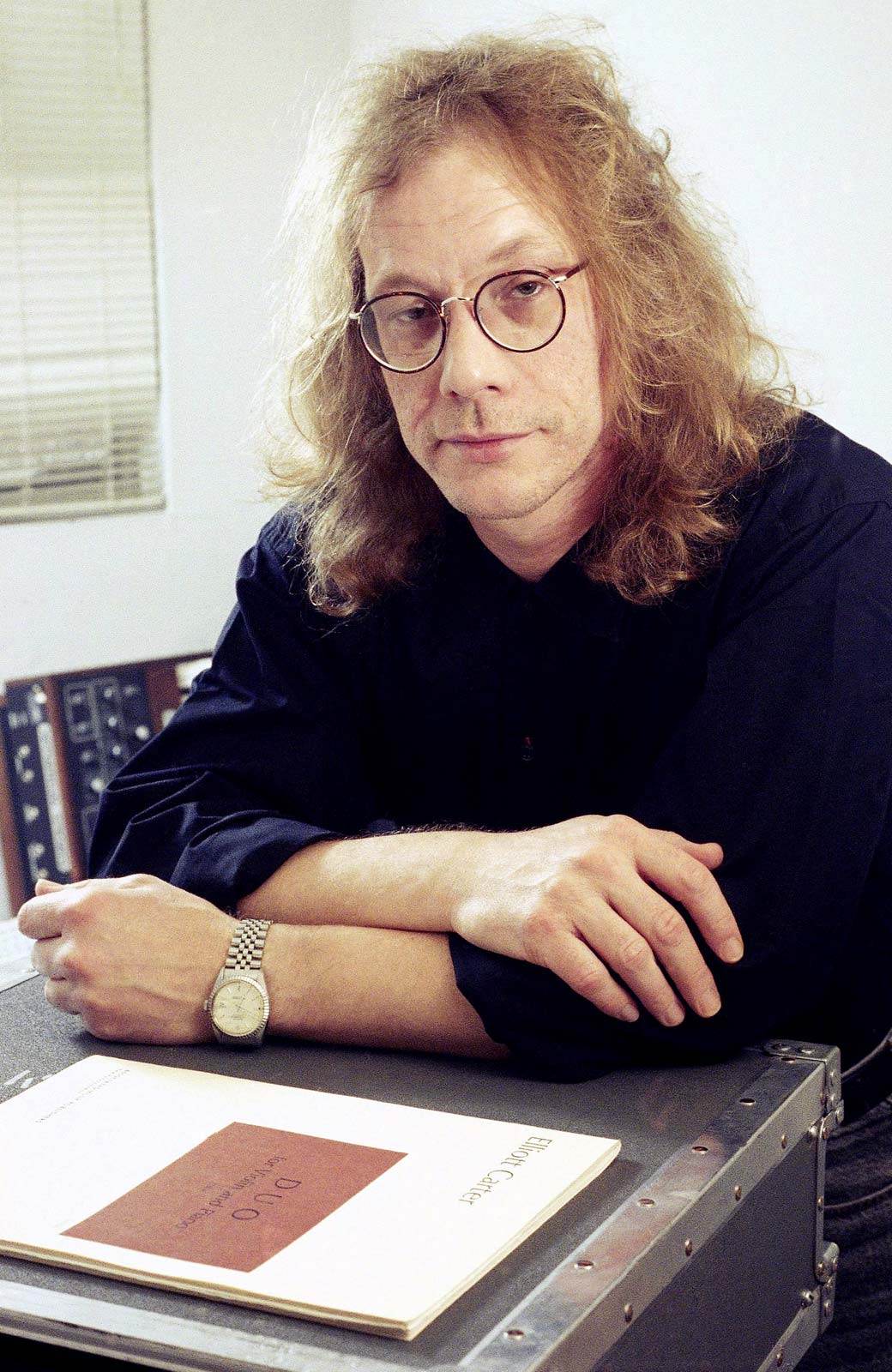
I miss Warren Zevon, his catchy tunes, his erudite cynicism, his geo-political obsessions. The first Zevon song I heard came blasting from an AM/FM radio in my cramped three-brother bedroom in 1977 when I had moved back home as a place to crash before getting married. I had just dropped out of grad school, didn’t have a job, and even though my wife-to-be was relatively wealthy, my mother insisted that every day I drive fifteen miles to the Temp Agency on Rivers Avenue to see if I could cop some sort of stopgap gig in construction, a trade I had never plied. It was, in a word, depressing.
And, of course, no one ever chose me, lacking both construction boots and biceps.[1]
The song blasting from that radio on that autumn evening was “Werewolves of London,” a joyous, literate, tongue-in-cheek send-up celebrity society.
Well, I saw Lon Chaney walking with the Queen Doing the Werewolves of London I saw Lon Chaney, Jr. walking with the Queen Doing the Werewolves of London I saw a werewolf drinking a piña colada at Trader Vic’s And his hair was perfect.
Those lyrics are perfect – slyly allusive, absurd, funny, like the howling ah-hoos of the chorus. With Warren I had a pal, someone I could relate to, a hip, literate compadre who employed humor to keep chase away the darkness that stalked him like an obsessive spurned lover.[2]
The majority of my hometown Summerville pals had moved on, and most of the ones who had stayed fell into the demographic of “white males without a college degree,” hard drinkers and pot smokers who wouldn’t know Lon Chaney, Jr. from Zeno of Elea.[3]
And as the years passed, I continued to follow Warren’s career and was lucky enough to see him twice, once in a bar called the Music Farm with a Canadian backup band in 1992 and a couple of years later in a solo acoustic show at Mynskens on Market Street.
Although we would never have a conversation, he would continue to be my pal up to the very end when he accepted his death sentence of Mesothelioma with characteristic good humor.
Warren Zevon is sitting at a table in a Hollywood hotel cafe, patiently waiting for someone to bring him a menu. Ten, fifteen, twenty minutes seep by. “At a time like this,” he says with an arched eyebrow and a low, rumbling laugh, “you really get the feeling of time marching on.”
David Fricke, “Warren Zevon and the Art of Dying”
I’m writing this on 15 November 2020 in the interregnum between Trump’s concession and Biden’s inauguration and could use a new Zevon name-dropping record to drop, something rhyming “Kayleigh” and “Tiffany,” “Giuliani” and “Proud Boy Army,” something with a resonant bass line, emphatic drumming, and lively guitar licks that would provide me the opportunity to show off my gold-capped molars in a wide ass sardonic grin.
Guess I’ll just have to settle for “Boom Boom Mancini,” “Desperado’s Under the Eaves,” and “Roland the Headless Thompson Gunner.”
[1] I did do some substitute teaching, though it was more like babysitting than pedagogy, and eventually through a set of divine missteps seemingly ordained by Tyche herself, landed a job at a community college teaching in one semester English 101, Technical Report Writing, and Business English. Obviously, they were as desperate as I was.
[2] In fact, a hade-sporting skull bogarting a cigarette became Zevon’s trademark.
[3] Yes, I am a card-carrying elitist. Check this out:
I’m really not a fan of slam poetry, but I thought I’d give it a try anyway, something to do to while away the interregnum.
Look up at your TV screens, it’s a turd, it’s a pain, it’s Donald Trump, reality TV star President who has lowered the bar on truth, justice, the American way, a fat-ass Superman wannabe, who can’t stand up straight, much less fly, doesn’t care if we live or die, calls the pandemic a gimmick, has updated the leech with bleach, this snake oil salesman extraordinaire (who claims to be a billionaire, but is drowning in debt way over his head while flooding the nation in blood red ink). Think, he can’t even drink a glass of water with one hand, shuffles down that ramp like a senile Diogenes without a lamp, spreading the seeds of dishonesty, a living embodiment of depravity, in a gaslit nation in need of a vacation. His. It’s way past time to concede.
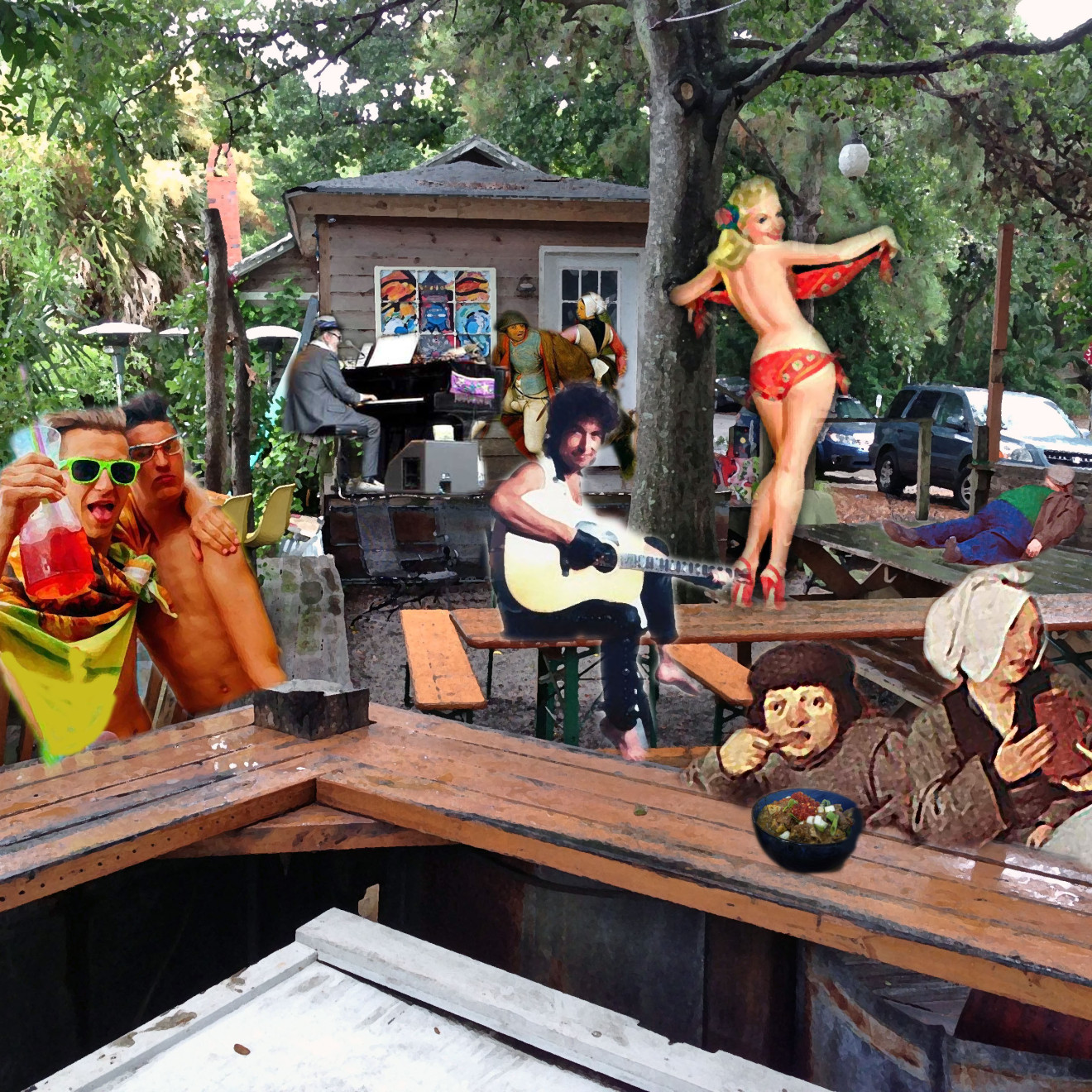
After a week off, Chico Feo’s Songwriter’s Soapbox returned in fine fashion. George Alan Fox, our inimitable host, bookended the extravaganza with a sampling of original tunes. This one’s my favorite, the brilliant “Figurin’ It Out,” performed at the end of the evening.
Pernell McDaniel laid down some country tunes he had recently written:
Alas, I didn’t get to record an outstanding set by Captain Philip Frandino, whose song “Compromise” speaks to our times. I promise to get him next time he performs.
Here’s a second or to of my occasional poem on Georgia flipping Democratic:
What an easy act to follow, especially for a talented songwriter like Gracie Trice, who, believe it or not, just started writing songs last month.
OMG, as the young people say, get a load of these spoken words by Brianna Stello:
Brother Fleming Moore did a set ending with a gospel tune.
Alas, I also failed to record Jeff Lowry, whom I also promise to video next time he performs, and, even though I did video Jason Chambers, I did so on his phone and don’t have access. It’s a big ass file, and I’ll add it if he can transport it. Lastly, several other performers were outstanding, but I didn’t catch some of their names.
What fun, y’all. Whitney Wienmann was there, celebrating her birthday, along with Caroline Tigner Moore. In addition, a Who’s Who of Folly illuminati made the scene: Surfer Phil, Tyler, Greg, Jesse, Matthew, Dan and Becca (who did a duet early in the evening with Becca on banjo) – the list goes on and on.
A shoutout to bartenders Rachelle, Katie, and Gavin. I also believe I saw a hatless Solly lurking on the periphery.
So if you’re in town, next Monday, head out to Chico Feo. Open Mike starts at 6PM.
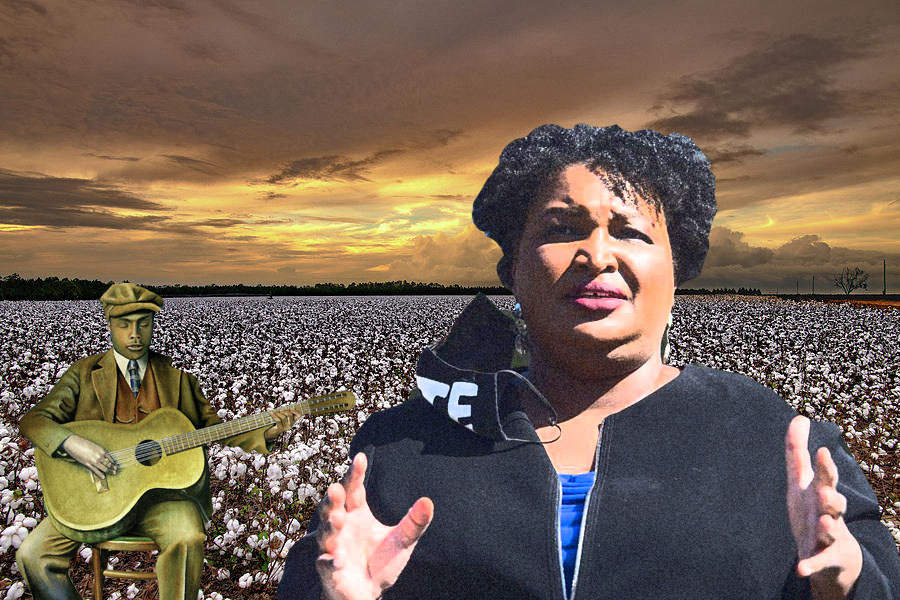
There’s a chain gang on the highway I can hear them rebels yell And I know no one can sing the blues Like Blind Willie McTell
Bob Dylan, “Blind Willie McTell”
Back in my wilder days of manic Boppa-bop-a-bebop – PAR-DEE, I’ll admit I got arrested a couple of times,
blinded by them PO-lice lights swirling and stuttering blue in the nightscape like a UFO landing.
I’ve survived slope driving in suburban Atlanta, not looking both ways before crossing streets, trafficking in whatever to make ends meet,
have tossed and turned a couple of nights in jail, which amounted ultimately to next to nothing, except for experience to cross reference and relate.
I once told my late wife’s oncologist, “Doc, I guess you’ve never spent a night in the clink.”
His blank stare a tacit no-he-hadn’t.
“But that’s what it’s like in the middle of the night, when you’re waiting for the biopsy to drop the next day.”
Experience to cross reference and relate.
Nowadays the Boppa-bop-a-Bebop – PAR-DEE, rarely sparks in my nervous system circuitry – except it actually did yesterday – when James Brown’s Georgia, when Otis’s Redding’s Georgia, when Little Richard’s Georgia, when Ray Charles’s Georgia, when Ma Rainey’s Georgia turned a very light shade of blue.
Blind Willie McTell himself Had limped past the President.
So I stepped outside on the deck, took in a deep breath, opened my mouth, and scat-bellowed at the top of my lungs into the wild blue yonder:
And nothing now remained to do But begin the game anew.
AE Houseman “Terence, This Is Stupid Stuff”
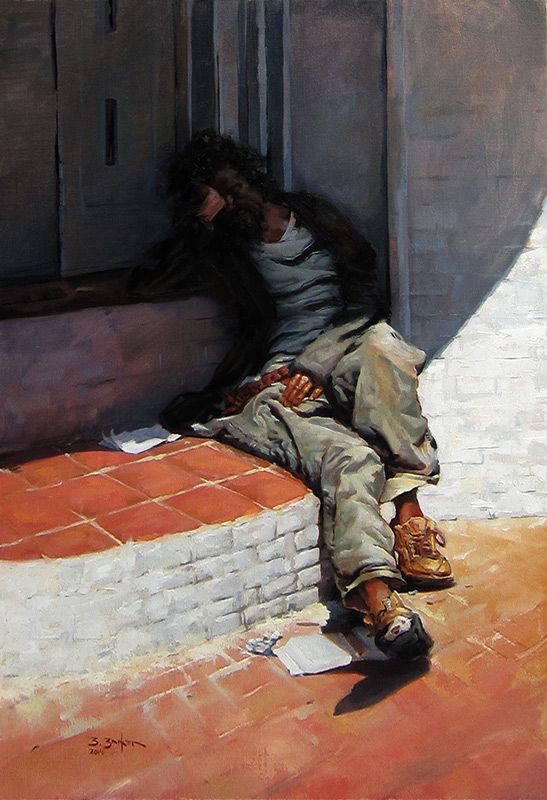
The cost of trying to make it go away Is the post beer binge sour bloated belly. Pushing my cart along Savannah Highway, It feels as if my heart is pumping jelly,
Not blood, thick sludge. Dehydrated, ever thirsty, Broke and broken, palsied, badly in need of a drink, I have my cardboard sign at the ready, “HOMELESS VETEREN BEYOND THE BRINK.”
Acid reflux, crackers for lunch. How about a handout? Unfriendly faces roll on by. If stopped by a light, Most avoid eye contact, though occasionally they shout Obscenities at me, cursing the depressing shambling sorry sight.
Here are some brief videos chronicling a bit of what went down at the Songwriter Soap Box last night on the Edge of America.
The first clip features singer/songwriter Fleming Moore accompanied by bluesman Robert Lighthouse on guitar and an unnamed percussionist.
Next, Robert Lighthouse solo, laying down some blues.
Here’s an excerpt of Jason Chambers reading one of his poems.
Too, too short of a clip of the incomparable Danielle Howle.
Sorry, I couldn’t provide videos for all of the performers who included George Alan Fox, Pernell McDaniel, Toomey Tucker, Charlie Stonecypher, Pete Burbage, Eric Barnett, Jeff Lowry, Jamime Crisp, George Honeycutt and Bobby Sutton, Eliza Novella, and Leon David.
Note: Despite the academic-sounding title, I’m no historian, so the following is merely a personal remembrance of events that happened a half-century ago. Here’s alinkto more legitimate article on Black history in Summerville.
Like virtually every community in the South in the ‘50s and ‘60s, my hometown Summerville, South Carolina, was segregated. Black people could not patronize the town’s movie theater (when it was intermittently open), the bowling alley, restaurants, or laundromats. Even doctors’ waiting rooms were divided into “white” and “colored” sections, the way vets separate cats and dogs.
Because the schools were “separate but equal,”[1] the only Black children I ever encountered socially were the children of domestics my mother and grandmother occasionally employed.[2] Racism was deeply embedded in my upbringing. Although my parents were kind to Black people – we actually once sheltered a Black boy in our house to protect him from abuse – my parents considered the African American race inferior.[3]
I remember one Saturday when our maid[4] Alice worked, she brought along her daughter Sallie who asked if she could watch Jump Time, a locally produced African American dance show modeled on American Bandstand. Jump Time wasn’t something we would have tuned into ourselves, but my brother David and I acquiesced, foregoing whatever Saturday TV fare we were accustomed to viewing at 1pm. After that visit, I made a point of watching Jump Time when I happened to be home watching TV at that hour. We’re talking the golden age of R&B, James Brown, Wilson Pickett, Aretha Franklin. And the dancers! They allowed the beat to lead the way, gracefully swaying and juking, turning what to me was a staid social convention into something primal and thrilling.
One small step.
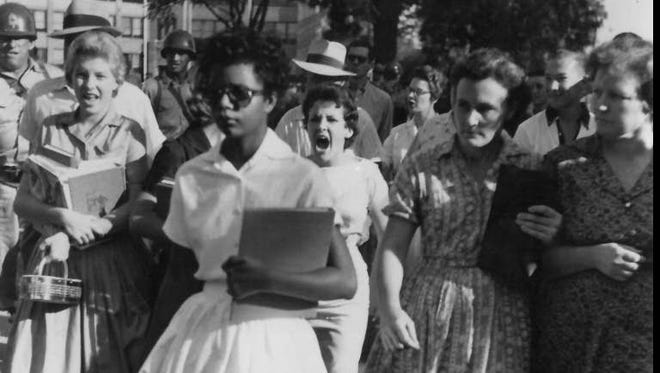
Of course, Brown versus Board of Education had come down years before in 1954, so Summerville Schools were not in compliance with the laws of the land in 1957 when I first placed my hand over my heart and recited the Pledge of Allegiance in Mrs. Wiggins’s first grade class. At some point – I can’t remember the year – as a sort of compromise, the powers-that-were selected a few African Americans to integrate Summerville Elementary School. I suspect these students were chosen not only for their academic talent, but also for their Jackie-Robinson-like ability to withstand a certain amount of bigoted abuse. From my immature perspective, the transition seemed to go smoothly, or at least there was not that public spectacle of abuse that had occurred in Little Rock where Whites stalked Black children, screaming at them as they were escorted to school on the first day of integration.
Little Rock Seven
After passage of the Civil Rights Act in 1965, our public parks became integrated, and my first co-equal social interactions with students from the Black high school, Alston High, began at the Laurel Street basketball courts. In the late ‘60s, a few of my friends and I joined the Blacks there playing on Saturdays and Sundays and sometimes after school. These Summerville High kids included Gordon Wilson, Tim Miskel, and a few transplants from the North whose names have faded from the fraying annals of my memory.
Players would choose a three-man team to challenge whoever had won the last game, and we played by African American rules. In my subdivision, Twin Oaks, you maneuvered the ball to back court after a defensive rebound, but here you could tip in an opponent’s missed basket and receive a point. We counted by ones, and eleven was the winning score, though you had to win by two. I don’t recall even an iota of racial tension.
One glorious sunny afternoon Richard Blalock, Gordon Wilson, and I won three straight games.
Unfortunately, after our third triumph, Carl Whetsell, a Black Summerville High student in my English class, asked me if I knew that two players on the other teams were starters for the Alston Tigers. I passed the info along to Richard and Gordon. The next time we faced them, we immediately choked, never to beat them again, which suggests, to flip the cliché, that what you do know can hurt you. Anyway, we became friendly with some of our Black competitors, especially with a couple of kids known as Mookie and Tubby.
Once the high school was fully integrated in the academic year 1969-1970, knowing the Laurel Street Alston crew made the transition meaningful for me, and Tubby and Mookie joined us once at a party at Adam Jacobs’s apartment Boone’s Farm from person to person. Our parents would not have been pleased.
A much bigger step.
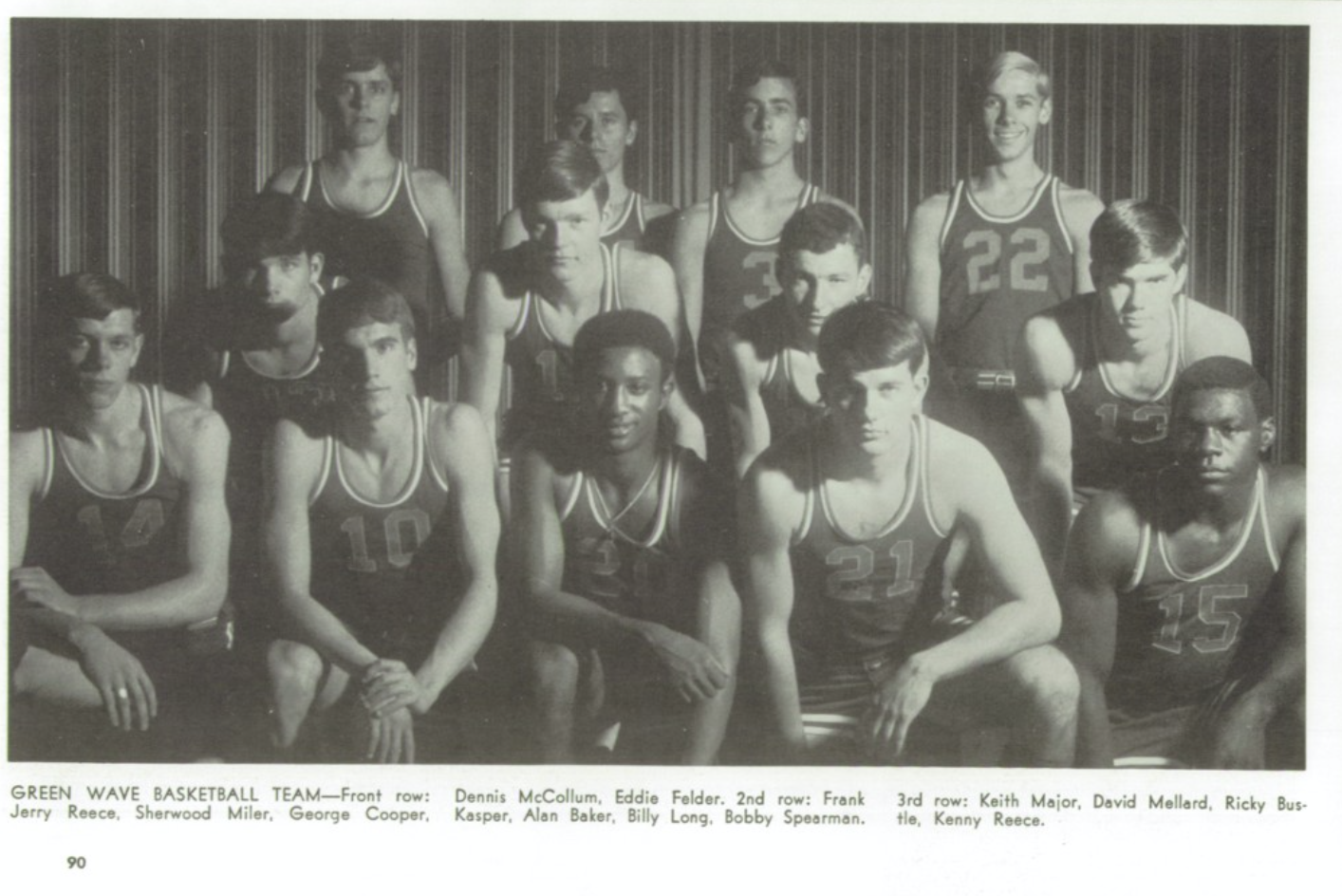
That year, the integrated basketball team, led by Summerville High’s Sherwood Miler and former Alston High’s George Cooper, made it to the State Finals. Although we lost that game, the very worst of the bad ol’ days of segregation were behind us. Athletics helped enormously in bringing the two races together in our sports-crazed town. People like to win, and when it comes to football, basketball, baseball, volleyball, and track, fielding an all-white team is a disadvantage.
Black athletes like Harry Blake and Eddie Felder became local heroes in those days, though that is not to say that even they escaped the racial bigotry so entrenched in society, in both the North and the South. Most people weren’t then – and aren’t now – colorblind. The original sin of slavery continues to darken our days as the events of the year 2020 have demonstrated. Nevertheless, compared to many other communities in across the country, Summerville’s integration was, thank goodness, relatively peaceful.
[1] As I typed that phrase, my tongue was lodged firmly in my cheek.
[2] The fact that we were lower middle class suggests how low wages must have been. Of course, no social security taxes were involved.
[3] This act of mercy was not popular with our neighbors. I was mocked at the bus stop for having a [racial expletive] as a brother.
[4] I realize the word “maid” has fallen into disfavor, but it doesn’t designate a race and actually sounds better to me than “female domestic servant” or the euphemistic “helper.” Imagine if Molly Maids changed its name to Dolly Domestic Servants or Molly Domestic Helpers.
What shall I do with this absurdity — O heart, O troubled heart — this caricature, Decrepit age that has been tied to me As to a dog’s tail? WB Yeats, “The Tower”
While Webster was much obsessed with death And saw the skull beneath the skin, Yeats was obsessed with the aging process, The hollow cheek that drank the wind.
Fastened to a dying animal, his soul Sought solace in a Martello tower Where he climbed its winding stair To compose swan songs in his waning hours.
Retrospective poems, autobiographical, That rehashed old loves and battles fought. Attempting to come to terms at last With the ravages that time had wrought.





 You Do Hoodoo