As a Jesus-revering lapsed Buddhist, I know I should detach myself from desire and step beyond the swirl of samsara.
I know, I know.
But, goddamn it, sometimes my ego’s tempted to unzip its amiable persona so Mr. Hyde/Incredible Hulk can bust out and snatch from the cuddling arms of certain Youth Ministers their teddybearjesuses! I long to confront, to bellow like a crazed evangelist on a street corner, “Grow up, you [minced oath alert] theologically stunted pathetic puerile protoplasmic pondspawn!”
How could you not have picked up on this untidy detail: Jesus’s own father allowed him to be nailed alive to boards!
“Ye ha’ seen me heal the lame and blind, And wake the dead,” says he, “Ye shall see one thing to master all: ‘Tis how a brave man dies on the tree.”
Ezra Pound, “Ballad of the Goodly Fere”
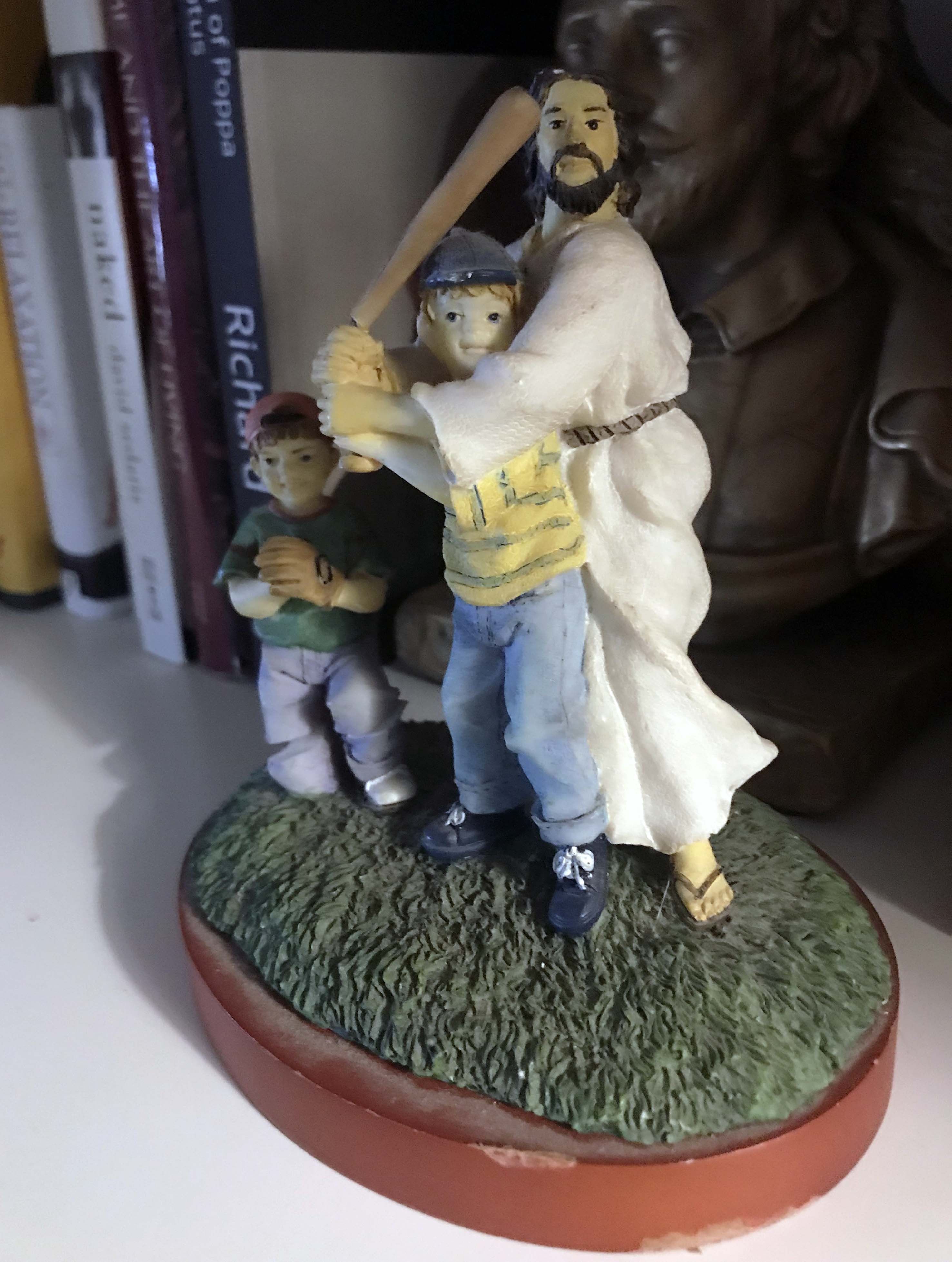
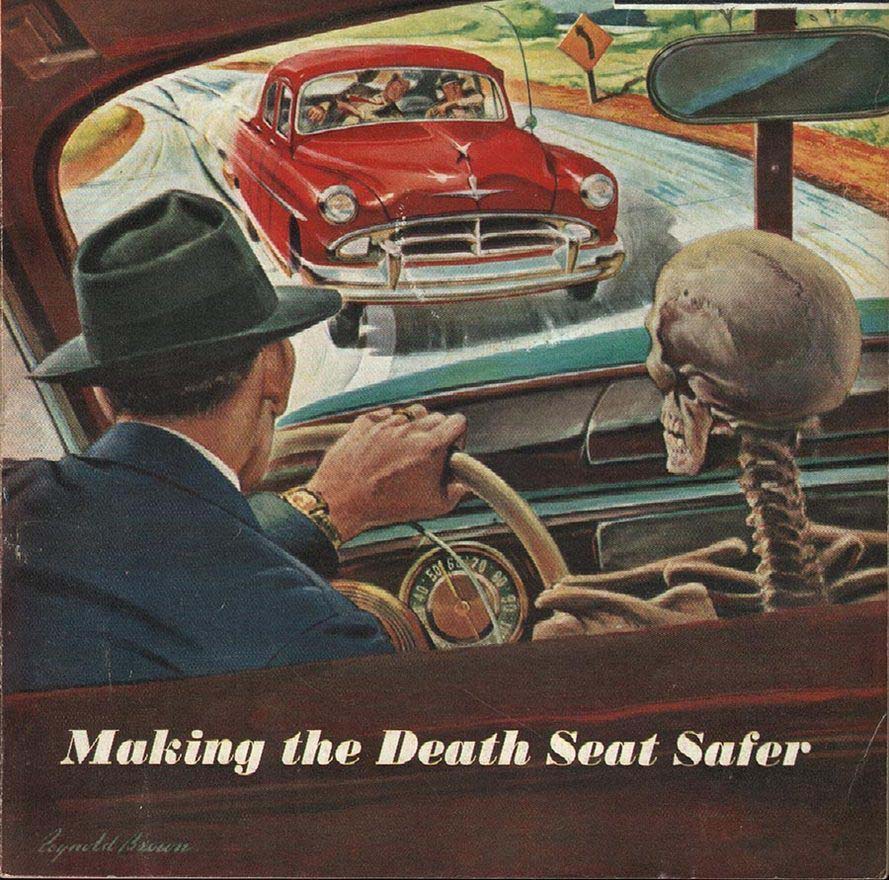
Given the illustration above [hat tip to Mel Gibson] and the never ending reaches of eternity, why would you presume that the Trinity-That-Is-One desires what is most comfortable for you in this abbreviated vale of tears? Or that the most comfortable outcome – what you desire – is best for you spiritually. We’re so blessed [I hear people say] Sally got into Swanee. We’ve been so blessed [others say] our dishwasher didn’t need replacing after all. Christianity isn’t about copping fringe benefits for the faithful but about taking an unworldly long perspective on our short stay here and sacrificing our own comfort to make others more comfortable.
It’s a hell of a lot to ask.
From what I read, blessed are the poor, not comfortable smug upper middle class lower-case christians who love Jesus but hate Biden, who write generous checks to the Good Cheer Club but who want to see unemployment benefits cease. They’re the crowd of know-nothings huddled around Job.
Blake: Job rebuked by his friends
Hey, Youth Ministers, how about offering your pledges some muscular Christian theology that doesn’t whistle past the Darwinian graveyard but confronts the ever-growing chasm between Christian dogma and science?
In other words, bring in the Jesuits.
***
If you’re extolling faith over reason, you might as well be peddling snake oil.
Q. What’s one thing that Osama Bin Laden and George W Bush had in common?
A. An unwavering, absolute and certain faith (in two very different deities).
Based on what? Mother’s milk, that’s what.
If the raw unfiltered DNA that made up Osama had somehow been born to Barbara and Poppy, would he have fervently believed that there is one god and his name is Allah?
Or switcher-roo, picture W with in long white robes and a beard hanging to his sternum. Reared in Saudi Arabia, would he know in his marrow bone that Jesus is Lord?
Let’s face it: faith is culturally conditioned and therefore unreliable as far as narrow religious affiliations go.
As my dear erstwhile friend Ed Burrows once told me, if you can’t justify your beliefs through reason, then your beliefs are worthless.
Amen, Ed. We really should go out for a drink one of these days.
Many Americans, like those who rant against Critical Race Theory, don’t have much patience with malcontents like me who catalogue the various and sundry crimes in our nation’s blood-drenched history – the initial genocide, the horrorshow of slavery, our third world murder rates. To even acknowledge these negatives is to “apologize for America” – in the words of Senator Mitt Romney – who beneath those corporate jeans and collared shirts enjoys the freedom to wear magic Mormon “temple garments,” a tribute to the wisdom of our Founding Fathers and the bravery of those heroes who made the supreme sacrifice, etc. And who can argue with the undeniable truth that a country in which a descendent of a Black African (or a bishop in a marginalized religion like Mormonism) can rise to the highest offices of the land is truly exceptional?
temple garments
Our constitution – and this is exceptional – grants us the right to pursue happiness – whether that means spending a Saturday afternoon discharging elephant guns at a shooting range, watching Sergei Eisenstein’s, Бронено́сец «Потёмкин, or cross dressing and parading down 5th Avenue in celebration of the resurrection of our Lord.
Yet, happiness can be so elusive. Great success certainly doesn’t guarantee felicity as Tiger Woods or Amy Winehouse can/could testify. There is, I think, in the USA a misconception that having a constitutional right topursue happiness means that you’re entitled to happiness, and as my childhood hero Sportin’ Life put it so eloquently in Porgy and Bess. “It ain’t necessarily so.”
However, in Late Empire America, judging by the posts of my thousand-plus Facebook friends, trumpeting one’s happiness seems to be a borderline obsession.[1] Certainly, there must be battalions of social scientists studying the ratio of positive to negative posts as they attempt to determine the happiness quotient of Facebook subscribers. Certainly, among the unscientific sampling of my friends,[2] I’d say happy dominates a thousand to one.
Of course, the tendency to post positive rather than negative feelings makes sense. When one of my barmates at Chico Feo asks how I’m doing, I virtually never put into words the existential angst that shadows every waking minute of my Beckettian existence.
“Hi, Wes. How’s it going?
“Every word is like an unnecessary stain on silence and nothingness. No, I regret nothing, all I regret is having been born, dying is such a tiring business I always found. And when I die let me go to hell, that’s all I ask, and go on cursing there, and them look down and hear me, that might take some shine off their bliss.”
“Uh, OH-Kay. Have a good one.”
Anyway, nothing much makes sense anymore. The Trump people simultaneously long for authoritarianism while decrying the tyranny of mask mandates while the far left’s free speech intolerance is so extreme that even milquetoasty comedians like Jerry Seinfeld won’t play college campuses.
Like Kris Kristofferson once put it, “Freedom is just another word for nothing left to lose.
[1] On the other hand, this isn’t the case on Twitter, which teems with death announcements and the oft repeated phrase, “I’m broken,” following. Why is Facebook so positive and Twitter so negative?
[2] I.e., “friends, acquaintances, former students, cousins, virtual strangers [including at one time Jerry Lee Lewis himself (thanks, Killer, for the Asian bikini model link)], Lucinda Williams, etc.
But weigh this song with the great and their pride;
I made it out of a mouthful of air,
Their children’s children shall say they have lied.
WB Yeats “He Thinks of Those Who Have Spoken Evil of His Beloved”
A by-product of breathing, that mouthful of air, exhalation tracking up through the trachea, plucking the vocal c[h]ords: vowels, consonants, words, words, words. Say outloud the title of this post – the sounds of words. Dissonant, sharp, as unlovely as the scraping of a rake on gravel, echoing Juliet’s lament as Romeo vacates their marriage bed:
It is the lark that sings so out of tune, Straining harsh discords and unpleasing sharps.
Romeo and Juliet by Todd Peterson
Perhaps even more discordant is Gerard Manly Hopkins postlapsarian description of industrialization:
And all is seared with trade; bleared, smeared with toil;
And wears man’s smudge and shares man’s smell: the soil
Is bare now, nor can foot feel, being shod.
Industrial wasteland matte by Ryan Morgan
Who sez that poetry’s supposed to sound pretty?
Not Alexander Pope:
But when loud surges lash the sounding shore,
The hoarse, rough verse should like the torrent roar
Nor that barbaric yawper Walt Whitman:
Nor him in the poor house tubercled by rum and the bad disorder.
Nor Ol’ Ez in St. Elizabeth’s ranting:
the drift of lice, teething,
and above it the mouthing of orators,
the arse-belching of preachers.
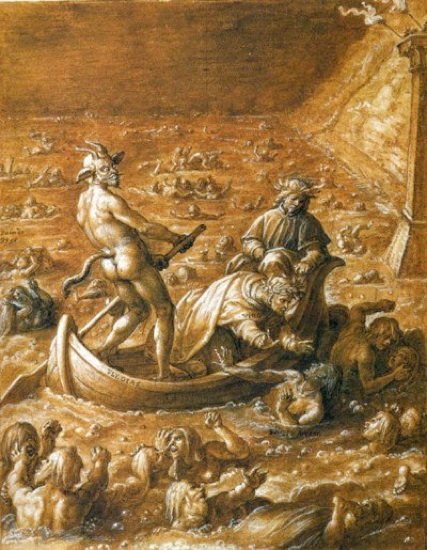
Inferno, Canto 8 by Giovanni Stradano
Thanks to its Anglo-Saxon roots, English is well-suited to screech. However, thanks to its French invaders, our language can also coo. And don’t forget the ess-cee (sc) words of the Vikings with their skalds singing of skulls and skies and scales.
English-speaking poets possess quite a synthesizer through which to sample sounds, orchestrating Anglo-Saxon, Norse, and French symphonically (Milton) or piping a simple Saxon tune in tetrameter (Anonymous).
Given global warmification/climatic alternation, the following worry may seem as trivial as the date of Alfred Tennyson’s death, but I wonder, given our beeping visual small screen secondhand exposure to actual sights and sounds, if off-the-cuff eloquence might become as rare as first edition Kafkas.
In my youth, among my compatriots, having a way with words held sway. I think of Jake the Snake Williams politely stringing together sentences to a Jehovah’s Witness in Richland Mall, and the fellow smiling, nodding his head, and saying, “Brother, you got you an excellent rap.” Or Furman Langley lamenting in a Lowcountry gumbo of gullah-echo the pain he be suffering from the “Hurry Curry Casserole Blues.”
The “like-like” syncopatations of youthful inarticulation and the ubiquitous interrogative lilt of a nation of valley girls’ declarative sentences gives me pause?
Because I suffered from rheumatic fever when I was five or so, and that malady is a nasty by-product of streptococcus, my mother overreacted whenever I had a scratchy throat. Whenever I wanted to get out of going to elementary school, all I had to do is feign a sore throat, and – presto! – there I was propped up on pillows reading The Tower Treasure or The Swiss Family Robinson. On those days I didn’t have to trudge single file to the cafeteria for a glop of canned spaghetti and mayonnaise deluged coleslaw. I’d be slurping a bowl of canned chicken noodle soup instead.
In high school whenever you missed school, the office called home to guard against truancy; however, both of my parents worked, there would be no one home to answer the phone, so I never got caught cutting school. Whenever I legitimately missed because of some ailment, my mother’s excuse always read: “Please excuse Rusty for yesterday’s absence as he was sick,” a rather awkward sentence to my ear, but a handy one, because the forged note I’d construct matched all the others, so no suspicions were raised. Anyway, I didn’t cut all that often, a couple times to go surfing at Folly and once to King Street in December with Becky Baldwin, Becky Moore, Gordon Wilson, and maybe Juli Simmons.
Not to put too fine a point on it, but I detested high school, so my ending up spending most life teaching at one is, as they say, somewhat ironic. However, as far as my teaching career goes, my attendance was stellar. I doubt if I missed more than twenty days in thirty-four years (not counting the last week of my wife Judy Birdsong’s life). Even though we got two personal days a year, I only took two in all, one to attend the third game of the 1991 World Series and another to see the Stones in 1996. The horrible truth of the matter is that missing school for a teacher isn’t worth it; it’s its own punishment.[1]
Given Porter-Gaud School’s rotating schedule, one year – it was 2010, in fact – my classes on Wednesdays ended at 10:30, but we were required to stay on campus for extra help, etc. I didn’t mind because I could get lots of grading done.
And, of course, if something came up, the administration would allow you to leave, if you informed them of your destination. That’s what happened on Wednesday 8 September 2010 when I had a flat tire. Although I usually patronized Hays Tires, I decided to go to Gerald’s Tires for the sake of frugality.
Based on their television ads, I had never liked Gerald’s. Back in the day when they went by Gerald’s Recaps, one of their ads featured an elderly black woman who said, “And they is very courtesy.” In 2010, the commercials teemed with strangely gleeful hourly employees who looked as if they might have stepped out of a Soviet propaganda film celebrating the dignity of labor. “Wheeeeee,” one says in a Mayberry drawl as he rolls a tire, “We’re having fun now.” The ads closed with a white church steeple pointing heavenward in a sky of pure blue. “It’s a great day at Gerald’s, especially on Sundays.”
With my last class over at 10:30 and nothing facing me but a department chair meeting at 3:15, I thought I’d hit Gerald’s about 1:00, grade a few journals, and return to school. When I arrived at the screeching Clemson orange of the building, there was nowhere to park. All of spaces pictured above were filled with vehicles having their tires tended to. The unshaded bench out front bore three sweating patrons. Not a good sign in that heat. On the street running perpendicular to the building, a battered line of automobiles stretched towards the horizon.
I parked illegally and entered the building. Inside, every folding chair held a patron, and a line of four patiently stood waiting their turn, an interview with the one representative who, though polite, looked as if his lean frame owed more to methamphetamines than to a rigorous workout regimen. Hoisted in the corner on a wooden platform, an early model television blared the cynical spin of a [redundancy alert] vacuous Fox newsblonde.
[sigh]
When I made it to the counter, the fellow (poorly peroxided black-rooted straw spilling from his baseball cap) informed me that it would be an hour-and-a-half. With nowhere to sit, I decided to hit the pavement. I told him I was parked illegally. “Park in the parking lot in the back,” he said. “Just ignore the Not for Gerald’s signs.” I did as I was told and brought back the key.
I decided to hoof in the heat the quarter mile to Steinmart’s to pick up a couple of dress shirts. This trek took me past a thrift shop, a bar, two consignment shops, a hair salon with a hand painted window, a couple of shuffling vagrants, a bank. Once I hit the acres of the heat-radiating parking lot, I passed a giant pet store that boasted “Unleashed Dogs Always Welcome Inside.”
I wouldn’t have been surprised to look up and see David Lynch shouting through a megaphone in one of those airborne director’s chairs.
scene from David Lynch’s Blue Velvet
Ah, Steinmart’s AC hit me like a champagne-soaked towel. The contrast between the clientele of my twin shopping experiences was akin to stepping from the boxcars of Steinbeck into the glitzy interiors of Danielle Steele. Here among the racks of brand name (albeit discounted) clothes grazed carefully coiffed matrons and Izod-sporting businessmen. Although the store wasn’t busy, I did have to stand in line, but unfortunately not long enough; only forty minutes had elapsed by the time I returned to the Bright Orange Building.
Now, I found myself in Sartre-Full-Nausea mode.[2] Should I do what I wanted to do (slide into an obscure booth in Gene’s Haufbrau and knock down a couple while I graded journals) or what society/my superego wanted me to do (sit on an uncomfortable folding chair and listen to Fox News’ distortions among the blather of ill-informed fellow citizens?) Should I suffer Nausea by exhibiting bad faith and cave to society’s petty morality or be true to myself and risk the unlikely occurrence of the Headmaster or Board member discovering me in a seedy tavern during work hours?
Bravo Id! Superego be damned! The chances of the headmaster or a board member slumming it at Gene’s Haufbrau on a Wednesday afternoon were on par with Donald Trump getting a likeness of Noam Chomsky tattooed on his chest.
When I returned to Gerald’s, things had thinned out a bit. I took a seat next to a rotund woman in her late sixties/early seventies who had poorly dyed thin red hair and clutched her bag as if it held a dozen super Powerball winning lottery tickets. Another woman, a bit younger but with age-inappropriate Bonnie Raitt locks falling in Pentecostal splendor beneath her shoulders, sat down across from us.
The Fox anchors were all a-twitter because Hillary Clinton had announced our huge deficits made us weaker, as if that were hypocritical, as if she and Obama had single-handedly produced the sea of red they had inherited, as if Fox News hadn’t been screaming for the war with Iraq and the draconian tax cuts that had created the deficit in the first place. As luck would have it, the anchors broke away to cover Obama in Ohio delivering a speech on the economy.
“I don’t see where he’s done anything but increase our debt,” the rotund redhead said to the woman across from us.
As I held my tongue, dutifully circling misplaced modifiers and ticking active verbs, the redhead suddenly said, “I lost my youngest one last week.”
“Your youngest what?” the other said.
“My youngest child. My baby.”
“Oh, I’m terribly sorry,” the other said, but looking more curious than sad. “What happened?”
“She called me up and said she had an earache, and in an hour, she was gone.”
“Oh, my goodness. I’m so sorry. How old was she?”
“Thirty-eight.”
“Do they know what it was?”
“The results from the autopsy ain’t come back yet.”
A smiling mechanic opened the door. “Mrs. So-and-So, your car’s ready.”
The woman with the long hair stood up and leaned over to the red-headed one.
“What you say your name was?”
“Ferguson.”
“I’ll say a prayer for you tonight.”
(Yep, make sure to get the name right, I thought. God’s got a lot on his plate nowadays).
I looked over my shoulder to see my car parked out front. After ten more minutes, it was still there, so I went out to discover that my tire had been repaired. Going back in, I informed the cadaverous young man behind the counter.
“I’ll go get the paperwork,” he said.
In a few minutes, another smiling mechanic came in dangling my keys. “Mr. Moore, here you go. Have a nice day.”
“But I haven’t paid,” I said.
“It’s nothing,” he said, “Only a tire repair. Have a nice day.”
So, I drove back to school, hit the Department Chair meeting and have not the slightest inkling of what transpired there, don’t recall at all.
It’s the weirdness you remember, not the mundane, the days you cut, not the days you attend.
[1] “Nausea” is what Sartre termed that way too common situation when you forego whatever you really want to do.
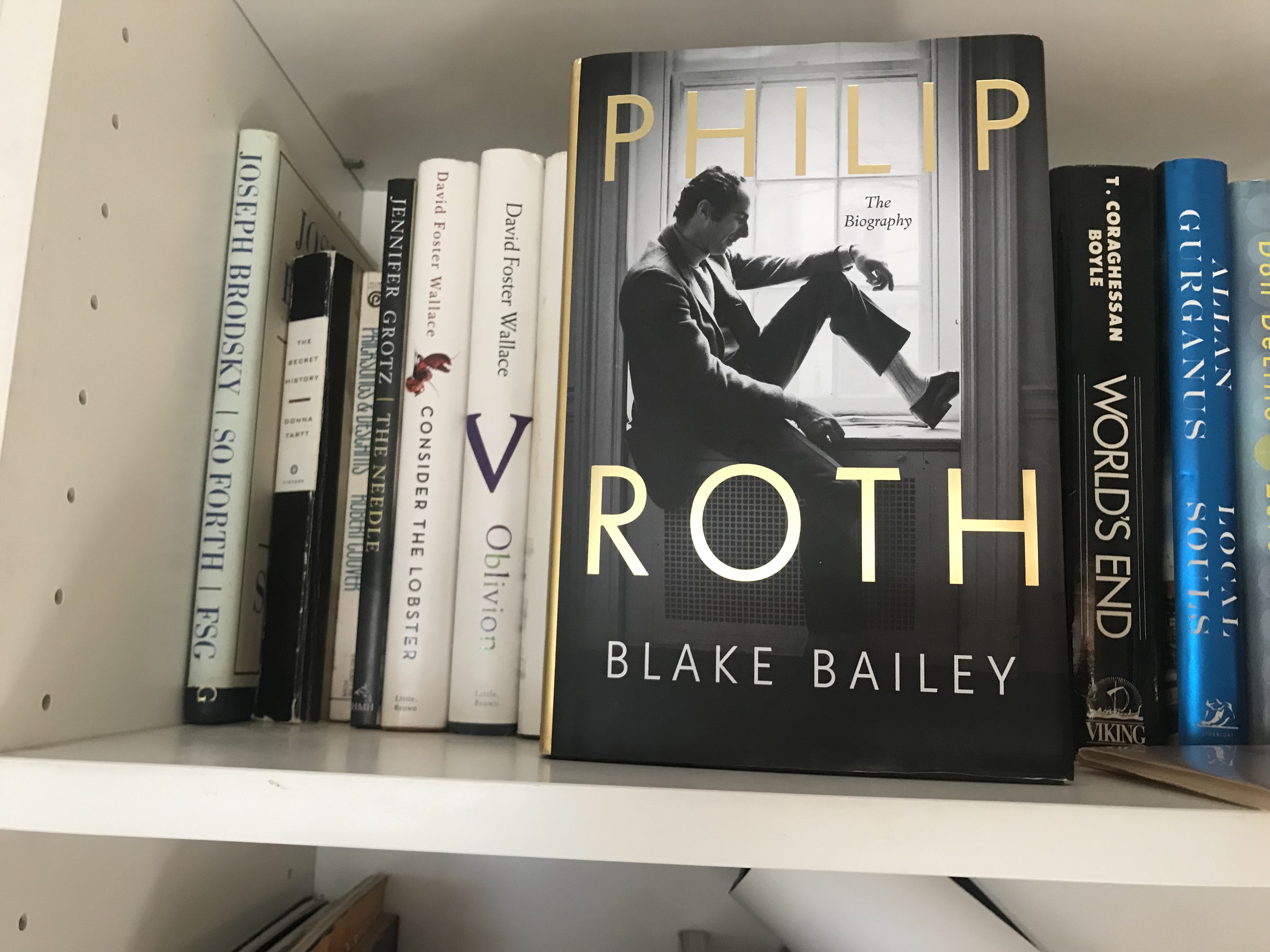
I’m currently reading Blake Bailey’s authorized biography of Philip Roth, a work removed from the shelves of America’s bookstores (not to mention from Amazon warehouses) after its publisher WW Norton suspended shipping and promotion as a consequence of several women accusing Bailey of sexual misconduct, including assault, which he adamantly denies. An independent publisher called Skyhorse has acquired the rights and issued a paperback edition, so the book is still available, though in a less glamorous format.[1]
Before tackling the biography (wrapping it in my arms and driving it to gridiron), I revisited Portnoy’s Complaint, one of the funniest books I’ve ever read, and though it came out in 1969, the prose is as fresh as this morning’s oven-extracted loaf of Jewish rye, except that Portnoy uses the c-word as both an anatomical descriptor and as a synecdoche for womankind in general.[2] Of course, Portnoy’s a madman, so we shouldn’t hold Roth personally responsible for his creation’s misogynistic language, any more than we should lambaste Nabokov for Humbert’s pederasty, except that throughout the biography, Roth himself uses the c-word in the same manner, anatomically and collectively.[3] This unfortunate habit tends to conflate the biographer with his subject.
Indeed, it seems that like Portnoy and perhaps Blake Bailey, Roth was sex obsessed. When interviewing Bailey for the job of authorized biographer, he produced a photo album devoted to his ex-girlfriends, which reminded me of the scene in Carnal Knowledge when the Jack Nicholson character projects a slideshow of photos of his sexual conquests. On the other hand, Bailey writes that the album was “an artifact attesting to the only passion that ever rivaled his writing. He doted on these women and vice versa; several of them came to his bedside while he lay dying, as did I.”
In her review of Philip Roth the Biography, entitled “In ‘Philip Roth,’ a Life of the Literary Master as Aggrieved Playboy,” Parul Sehgal writes that Bailey’s book is “a narrow portrait of a wide life. We know the ’60s have arrived because we are told that Roth is now regularly propositioning women in the elevator. When he travels to Thailand, Bailey speculates: ‘Perhaps he was most struck by the ubiquitous availability of sex.”’
Also, there is the conundrum of Roth’s relationship with Judaism. Again, Sehgal, “Whether he was pilloried as the Jewish second coming of Goebbels (‘What is being done to silence this man?’ the president of the Rabbinical Council of America wrote to the Anti-Defamation League) or a woman hater, he held to the notion of novelist as the ‘nose in the seam of the undergarment,’ the enemy of public relations. And now, he who found liberation in sex and work reported being rid of the tyranny of both.”
Ultimately, though, it’s the Roth’s literary output that I’m eager to see analyzed. I mean, his body of work inspires awe: American Pastoral, The Human Stain, The Plot Against America, The Ghost Writer, etc. To me, his not being chosen for a Noble Prize borders on criminality. So what if Roth was arrogant, self-obsessed, vengeful, it’s the work that matters. Look at Yeats, Eliot, Hemingway, Faulkner, Philip Larkin – they all possessed more than their share of human frailties. I’m only 100 pages in Bailey’s bio but haven’t seen much critical contemplation of Roth’s fiction. It reminds me of David Lipsky’s Although of Course You End Up Being Yourself, an assessment of David Foster Wallace that essentially ignores his work. What makes Roth and Wallace interesting is their art, not their foibles.
The bad news for Roth is that Blake Bailey’s own sexual misconduct may have tainted the biography, to have, in the words of Alexandra Alter and Jennifer Schuessler, “intensified a parallel conversation about Roth’s treatment of women, adding fuel to the questions of whether Bailey’s account of Roth’s sexual and romantic relationships was overly sympathetic and oversimplified” despite Roth’s attempt to, as one critic put it, through Bailey “ghost write his own biography.”
The best laid schemes of mice and men.
Roth in 2010, photo by Nancy Crampton
[1] I actually possess the hardback edition, which I copped from independent bookseller Buxton Books right after Norton yanked it out of print. I’m hoping that one day it will be considered a rare first edition and I’ll be able to swap it for a bottle of Pappy Van Winkle. (BTW, I’m weary of Microsoft Word EB-White-ing out every goddamned adverb I carefully insert in my sonorous sentences). They want me to ax “actually” which I actually don’t want to do.
[2] “Synecdoche is a literary trope in which a part stands for the whole, as in “I should have been a pair of ragged claws/Scuttling across the floors of silent seas,” or more familiarly, “Donald Trump is an asshole.”
[3] The late James Hillman made a cogent observation about the ugliness and violence of English vernacular terms dealing with sex, e.g., “nailed her,” “fucked her eyes out,” “gash,” etc. as opposed to Hindi’s “jade stalk” for penis and “pearled temple” for vagina, suggesting, of course, very different attitudes toward sex, one diseased, the other reverential.
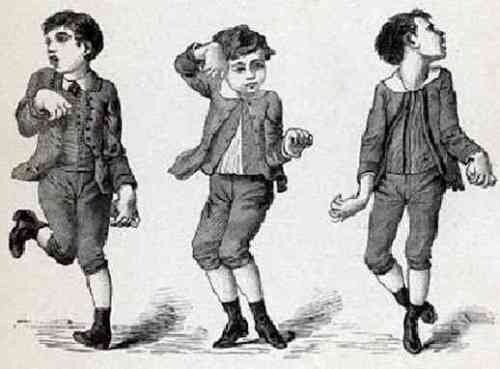
I’m squandering this glorious autumn Sabbath Sunday up in my drafty garret researching medical maladies.[1] I have discovered, to my great relief, that somehow I avoided coming down with St. Vitus Dance, also known as Sydenham’s chorea, which is a by-product of rheumatic fever, a disease that laid me up for three months when I was five. Sydenham chorea came to be known as St. Vitus Dance because its victims develop spasmodic involuntary herky-jerky movements involving arms, legs, fingers, heads, and tongues. If you want to vicariously feel what it’s like, pull out the ol’ phonograph, un-sleeve your Wilson Pickett’s Greatest Hits album, turn the speed up to 78 rpm, guide the stylus to the last song on the B-side, “Land of a Thousand Dances,” and let the music guide you.
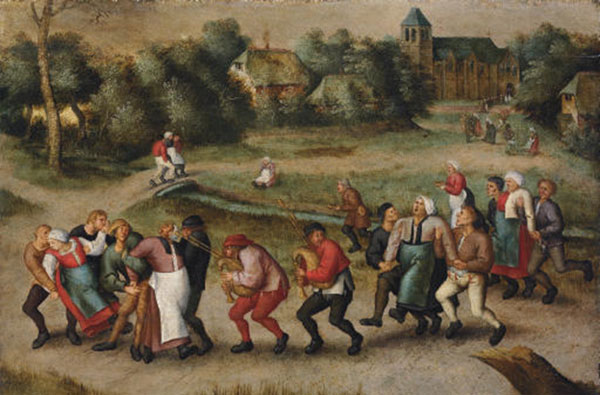
It seems, however, that during the Middle Ages, a manic compulsion, also known as St. Vitus’s Dance, swept through Europe. To quote John Waller in his A Time to Dance, a Time to Die: The Extraordinary Story of the Dancing Plague of 1518:
It started with just a few people dancing outdoors in the summer heat. Arms flailing, bodies swaying and clothes soaked with sweat, they danced through the night and into the next day. Seldom stopping to eat or drink, and seemingly oblivious to mounting fatigue and the pain of bruised feet, they were still going days later. By the time the authorities intervened, hundreds more were dancing in the same frenetic fashion.
So, this is a different type of St. Vitus dance from the post-streptococcus, post-rheumatic-fever variety. Blogger Jen Messier offers a review of theories as to whether it was “a real illness or social phenomenon,” which includes the possibility it may have been a by-product of Ergot poisoning (aka St. Anthony’s Fire), or a freaked-out response of super-stressed people facing the bubonic plague and malnutrition, or, her favorite theory, the dancers were religious cultists feigning illness so they could get around quarantine rules forbidding dancing.
Some of these enthusiasts literally danced themselves to death, especially in what has become known as “the Dancing Plague of 1518,” which took place in Strasbourg. Again, John Waller: “the dancing mania underscores the power of cultural context to shape the way in which psychological suffering is expressed.”
Mass hysteria, anti-quarantine shenanigans, cultists crashing school board meetings overcome with uncontrollable anger manifesting itself in herky-jerky movements, arms flailing, fingers jabbing, mouths –to borrow Ezra Pound’s memorable phrase – “arse belching.”
Yes, seems like old times.
[1] By the way, the windows are open, and I can see from my vantage point sun glinting on pine needles and the soft swaying of magnolia boughs just beyond the iMac screen, so I ain’t completely cut off from nature.
Bryce Hall, Tic-Tok and YouTube Super Celebrity (Gimme a D, gimme a U, gimme an H)
Last Friday, I attended homecoming at the high school where I had taught for thirty-four years. The stadium wasn’t crowded, which suited Caroline and me, given the pandemic. We stood on the perimeter of the field chatting with a couple of moms behind a fence near the goal line when a sudden din distracted us. A swarm of middle schoolers scuttled past with phones held aloft.
Some celebrity, it seemed, had entered the stadium. I figured it must be Kris Middleton, an NBA all-star alum. The squealing commotion reminded me of Beatlemania, and it surprised me that Middleton’s presence would generate so much enthusiasm. The scrum, which had swarmed past a moment ago, now stumbled en masse slowly in the opposite direction with a tall, unsmiling beefy black man in its center.
His coming [archaic usage warning] was telegraphed via Tik-Tok, his arrival announced on Tic-Tok. Eventually, the melee settled down on our end of the field, and for a half hour or so, Bryce roamed the homefield sidelines of the stadium. I think he left before halftime, prior to the coronation of the homecoming queen.[2]
As it turns out, Bryce is a Tik-Tok and YouTube celebrity with umpteen-K followers.[3] When I got home, I ascended the stairs to my drafty garret and conjured on my desktop commuter a ten-minute video of Bryce and his pals and a then subjected myself to a couple of his Tic-Toks.
Look, I have nothing against Bryce – he seems amiable enough – but over the course of that YouTube video, I decided that if I were in my early twenties, these wanna-be cats wouldn’t be hanging out in my seedy apartments. They be vacuous, mon, overly ironic in the boring contemporary unwitty way that un-spleenful cynics are ironic, as a force of habit, not conviction, trafficking in cynicism lite, if you will. In the video, they bragged about quantities of Ks and performed cannonballs in a pool overlooking a canyon. I didn’t dislike them but found them boring and wondered how such unremarkable fellows could garner so much adulation, not to mention, I’m assuming, hundreds of thousands of dollars.
***
In 1977, I read a just-released book by Christopher Lasch called Cultural Narcissism, which received megatons of media attention after President Carter read it and accused the nation of suffering from a “moral malaise.”
I have no idea what happened to my copy, so I can’t quote directly, but I clearly remember Lasch’s writing about the narcissistic individuals’ compulsion to appear on national television during football games, the desire of having CBS’s cameras focusing on them, zooming in, flashing their images around the world live (hence the attention-grabbing frat-boy war paint in Gainesville and in Green Bay middle-aged men dressed up like cheese). Lasch argued that being on live TV authenticated their being, underscored their reality.
The same thing might be said for people seeking proximity to celebrity. If you’re near a celebrity, sharing the same space, your status rises, the large number of “likes” the celebrity photo generates on your social media platforms validates your existence.
The more the merrier.
I see a similar phenomenon on Twitter, people groveling for followers, some going so far as announcing publicly mere minutes after loved ones have died how “broken they are” so they can amass “likes” and sympathetic comments.
What’s odd, though, is that one of my stepdaughter’s sleepover friends told me that “no one likes” Bryce, that, in fact, everyone hates him, though she herself admitted to being part of the mob that tried to get as close to him as possible.
It’s as if that in late capitalism that self-worth is a commodity that must be amassed, counted, verified, and broadcast.
In fact, I’m guilty of it as well.
the scowling author basking in his 15 nanoseconds of fame in Bryce’s YouTube video (hat tip Lucy Freeman)
[2] This raises the question: did the opposing team’s teens from Pinewood Prep know of Bryce’s presence? And if they, did they come over to our side to bask in his glow?
[3] Given my status as “tattered coat upon a stick,” you can bet your very last bitcoin I ain’t bothering to look it up.
Listen, when I was young, I was reckless. Just ask my dead mother who in a Biloxi, Mississippi beach cottage circa 1956 scraped me screaming off a hardwood floor after I had leapt Lone-Ranger-like from the top of my chest-of-drawers onto a rocking horse that catapulted me face first splat.
Ask Joey Brown, whose Toyota I totaled in Hilton Head on a roundabout in August of 1976.
Or ask Jacob T. Williams II who two years later rode shotgun as I drove my MG Midget down a capital city sidewalk and made an ill-fated left down steps into a parking garage whose bottom floor housed the Campus Police of the University of South Carolina.[1]
Given that regrettable history, you might think I’d grant slack to others who foolishly throw caution to the salt breeze of Folly Beach, yet, this afternoon, as I walked home from Chico Feo on East Erie, my tongue cluck-clucked as I espied[2] a family of conservative-looking folks[3] barreling past in a golf cart with a grandmother teetering on the back seat clutching a squirming child no more than six months old.
Yes, that’s foolish, I was foolish, but is it any of my business?
No, it’s not. They, though Darwinianly dense, weren’t endangering anyone but themselves (and their progeny), The odds were pretty good they’d get where they were going without a distracted texter, blind-as-a-bat octogenarian, or meth-crazed speed demon smashing into them.[4]
No, it’s none of my business.
On the other hand, reckless people who refuse to get vaccinated or wear masks indoors in close quarters are everyone’s business. Their refusal, whether prompted by political lobotomization, laziness, and/or unscientific paranoia, has allowed the virus to mutate.[5]. The needless continuance of contagion dampens sparks, snuffs out fun. Twice now, my 50th highschool reunion has been postponed – that and 1 out of 500 Americans has died of COVID according to the Washington Post.
So, c’mon people now, smile on your brother [and sister].
Everybody get together and get a vaccine right now.[6]
Right now.
Right how.
Because if you roll the dice often enough, you gonna come up snake eyes.
Here’s Rickie Lee doing “The Horses”
Rickie Lee Jones performs on Saturday Night Live in 1982, the year after she released her second album, Pirates.</e
[1] This little lark cost me a reckless driving conviction, 200 dollars, and six points off my license, not to mention a significant elevation of my insurance rates, but as Rickie Lee Jones so eloquently put it in her best song “The Horses,” “when I was young, I was a wild, wild one.”
[2] You know any writer who uses the verb “espied” has one foot in the ditch of dementia.
[3] And I don’t mean by “conservative” MAGA-hat-wearing gun-toting cretins but regular-looking Jesus-believing white Southerners.
[4] However, two blocks west of where I saw the golf cart stands a marker commemorating the spot where someone named Mark Riedel was killed by someone who ran a stop sign.
[5] The bad good news is that it seems that COVID has taken out a disproportionate number of rightwing radio personalities, which is okay with me.
[6] Of course, the odds of a vaccine holdout reading this blog are less than the University of South Carolina Gamecocks going undefeated this season.
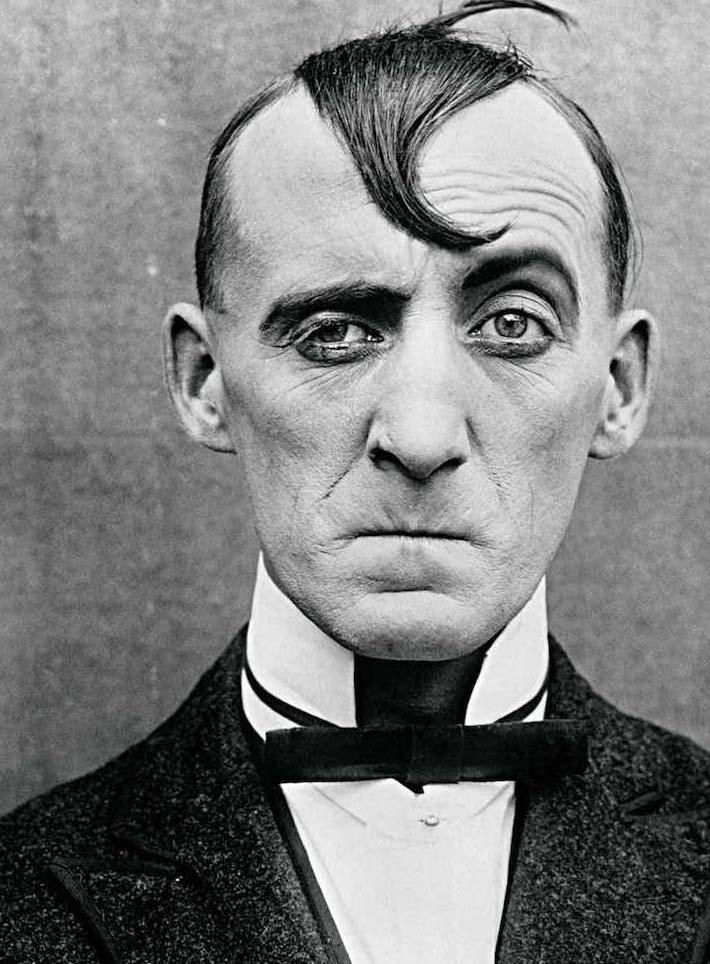
Hello, Hoodoo readers. Today I’m honored to introduce guest blogger Edward Lee-Edward Edwards IV, the distinguished Henry James Professor of Locution at Vanderbilt University. Professor Edwards holds many provocative viewpoints that no doubt would shock (and perhaps dismay you) if you could only figure out what in the hell he’s trying to get at.
So, without any further ado . . .
A Confession
I need to phrase delicately the following to soften (i.e., to obscure) with carefully selected Latinate diction and syntax rife with interruptive asides, to soften, as I say, the impact of an opinion that I hold that is anathema to Christian charity, i.e., to common human decency.
To wit: whenever I run across an account (which happens more frequently than you might imagine) of an illiberal rightwing radio personality[1] who had broadcast misinformation about the Covid-19 virus, e.g., that masks and vaccinations are ineffective, that vaccinations result in sci-fi-grade side effects such as epidermal magnification, or that other non-approved veterinary drugs such as Ivermectin can successfully treat the malady, and discover, as I read these accounts, that the said radio personality has succumbed to Covid, instead of dismay, a warm, pleasant feeling of schadenfreude washes over me until I realize that, oh no, dullards will perceive the deceased radio personality’s flaunting of COVID protocols and then dying of the disease as ironic when in fact his contracting the disease is just what one would expect, i.e., the antithesis of irony!
Edward Lee-Edward Edwards IV
Way Yonder East in the Land of Tora Bora
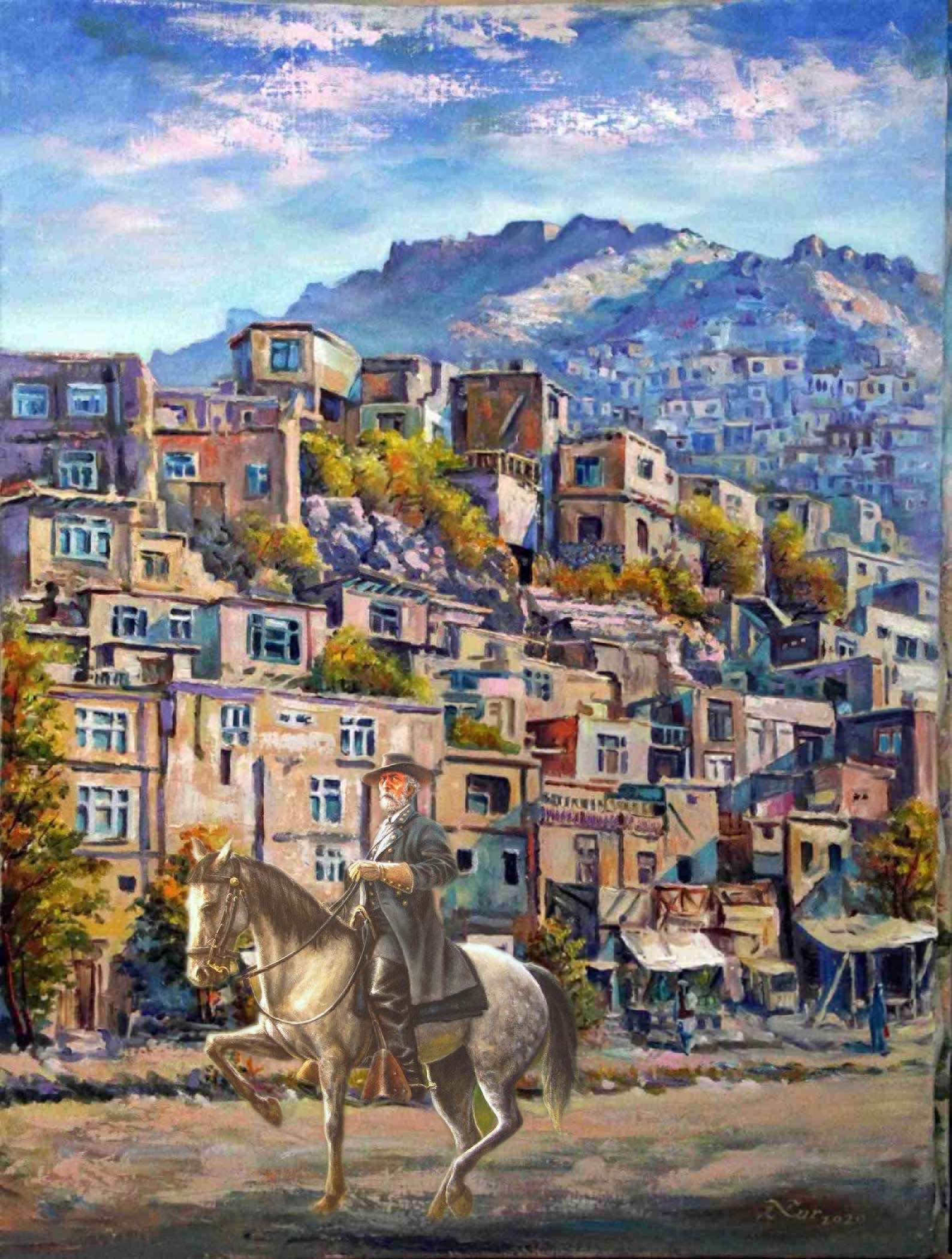
Yesterday, the former President of the United States of America, Donald J. Trump, issued a proclamation decrying the removal of a statue in Richmond, Virginia, of the famed Confederate General Robert Edward Lee.[2] After lauding the statue’s aesthetic attributes and lamenting its being “cut into three pieces […] prior to its complete desecration,” the former President muses that “[i]f only we had Robert E. Lee to command our troops in Afghanistan, that disaster would have ended in a complete and total victory many years ago. What an embarrassment we are suffering because we don’t have the genius of a Robert E. Lee!”
I won’t beleaguer my readers with an interminable recapitulation of the abject failure of Western Invaders’ attempts over the centuries (commencing with Alexander the Great) to subdue the Afghan people or to argue that perhaps the removal of the statue had more to do with Great Uncle General Lee’s status as slaveowner and insurrectionist than it did with his military genius nor point out that Trump’s claim that Lee was indeed a military genius is, in fact, not universally shared by historians[3], but rather, I’d like to acknowledge the amusement Trump’s statement provided me as I visualized the Army of Northern Virginia clashing with the Taliban in Tora Bora or in the streets of Kabul.
At any rate, few pleasures are possible for a man of my advanced age, gout-ridden, suffering from vertigo, etc., so I doff my hat to President Trump for the that wry smile that creased my age-etched visage.
ELEEIV
So that’s it for today. Kudos and thanks to Professor Edwards. We’d love to invite you back sometime. You certainly have a way with words!
WLM3
[1] I concede “illiberal rightwing radio host” may be a tautology, i.e., redundant, like the explanation in this footnote itself.
[2] For the sake of full disclosure, General Lee was a great-great-great-uncle of mine, i.e., I’m a distant relative.
[3] There is, however, a consensus among historians that Lee was the losing general in the Civil War.















 You Do Hoodoo