Seems to me that if you’ve read somewhere that a Covid vaccine reshuffles your DNA or magnetizes your epidermis or implants monitoring devices into your metabolism so that Satanic pedophiles can keep tabs on your comings and goings, that you’d want to wear a mask to avoid contracting a disease so mighty that it actually hospitalized superhuman Donald J Trump, who boasts an immune system so powerful your everyday microorganisms spontaneously combust if they dare enter the inner sanctum of his imperial badassness.
But, hell no, your garden variety anti-vaxxer is also an anti-masker. I saw a video today that captured a Tennessee school board meeting where health professionals arguing that masks help to stem infection were verbally ambushed by a pack of sign-bearing parents fearful that requiring their children to wear masks during a virulent resurgence of a pandemic would be the first step down a slippery slope of freedom-confiscation that eventually would lead to the United States becoming a country where citizens receive affordable healthcare.
“And empty words are evil,” Odysseus to Agamemnon in Hades, Book XI, The Odyssey
They say Homer didn’t write the Odyssey – The dactyls, the plot, or the sirens’ song. That idea doesn’t appeal to me. Practically everything they say is wrong.
They say you can’t teach old dogs new tricks, That years are short while days are long, They say you can’t play cricket with a sticky wicket, But practically everything they say is wrong.
They say you can trust conventional wisdom, That Leos and Geminis don’t get along. They say CEOs shun cannibalism, But practically everything they say is wrong.
With apologies to Oscar Hammerstein and Richard Rogers
Inoperable cancer and olecranon bursitis Terrorist attacks sponsored by Isis. Red painful blotches from jellyfish stings These are a few of my least favorite things
Undercooked pork that triggers trichinosis Clueless close talkers with rancid halitosis Bulls being slaughtered in Andalusian rings These are a few of my least favorite things
When the Braves win When Aretha sings When I’m feeling glad I simply remember my least favorite things And then once again I’m sad
Inoperable cancer and olecranon bursitis Terrorist attacks sponsored by Isis Red painful blotches from jellyfish stings These are a few of my least favorite things . . .
a drowsy numbness pains John Keats, “Ode to a Nightingale”
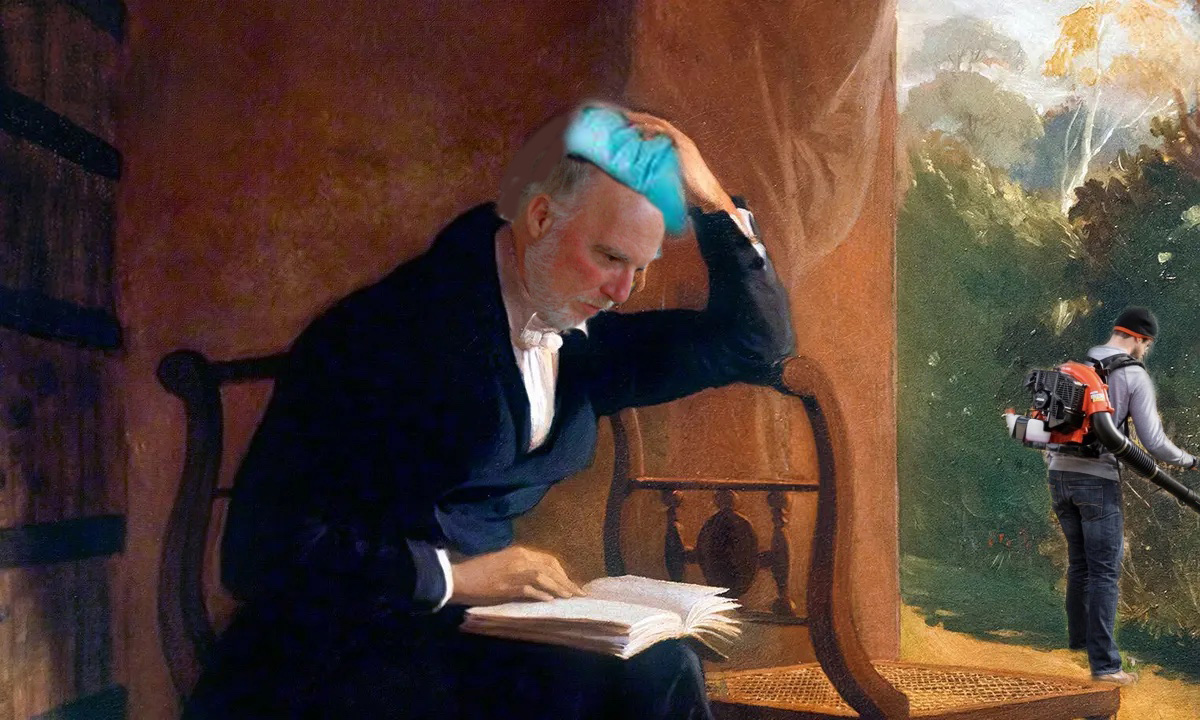
My head throbs, and dyspepsia dis-mays my corporal frame, as though I’d drunk twelve high-gravity IPAs and into a drunken snoring stupor had sunk.
O, give that leaf blower a rest, neighbor, as a favor. It’s not yet eight this balmy May morning, and over there a nest of nightingales rests. Please shut up, okay?
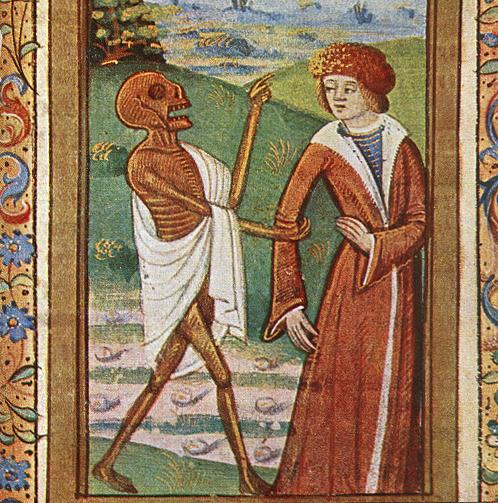
When we visited my late wife’s grandmothers in their assistant living facility, parked on the porch were ancient creatures in wheelchairs with mouths open like maws, their bodies gnarled in uncomfortable looking positions, and I hoped, like the old wanderer in the “Pardoner’s Tale,” that Death would be timely in my taking.
You, Archibald MacLeish
To feel how swift how secretly The shadow of the night comes on …
Misremembering the season, the week, the day, whatever the reason
for this purgatoric stay, the names of next of kin, gone, forgotten. How to pray,
But, for the unquiet heart and brain, A use in measured language lies; The sad mechanic exercise, Like dull narcotics, numbing pain.
Tennyson, “In Memoriam”
When it became clear that my wife Judy Birdsong would not recover from a rare form of Non Hodgkins lymphoma that had come roaring out of remission, I sought ways to numb myself, and following the example of my ol’ pal Alfred Tennyson, I began a poetic exercise in which I strung lines of unmetered terza rima together in a crude parody of Dante’s Inferno. The plan was to compose nine cantos of nine stanzas in honor of Dante’s Babylonian algebra.
When Judy died, I had completed four Cantos, but I decided to finish it anyway. Even now, though happily remarried, I’m determined to finish [nervous bad-pun cough] the goddamned thing, even though it’s silly and flawed.
No one can accuse me of not being self-indulgent.
Canto 7, The Malebolgia
No sooner than the rum had hit my belly, Catullus stopped the cab, put on the parking brake. “Get out,” he shouted, my spine turning to jelly,
My hand trembling DT-ish in the dark. “You can’t be serious,” I said, looking askance. “Listen, you pusillanimous punk,” he barked.
“Get out! Now! ASAP, STAT!” So, I sheepishly opened the door, stepped into the gloom And peered through the dark at the expanse
That lay below the rim of the cliff, an abyss of doom That Catullus called the Malebolgia, A circular series of ditches, a living tomb,
Fraught with fire and strewn with boulders, A prison for con men, hypocrites, Fake magicians, corrupt office holders,
And the like, each confined to a dire ditch Well-suited for shit-slinging shysters. “We’ll wait here,” he said, “for the witch
Hecuba to fly us down on her whirly Bird of a broom. The road ends here.” For whatever reason, Catullus had turned surly,
And began to rant and swear, Cursing God and Darwin, As we waited for Hecuba,
Who kept us waiting, waiting, waiting, My head spinning like a dervish, a dervish, a dervish – Fainting, fainting, fainting . . .
Last night I had the privilege to read a portion of my poem “Disorder Above Key West” accompanied by the immensely talented musician and painter Nathan Stephenson.
The Back Roads to Tallahassee
Took the back roads to Tallahassee to avoid the monotony of mile markers, dead armadillos, and exit signs. Took the back roads, took my time.
Didn’t make it quick enough to see him die, but my step-mama filled me in, sucking on a Marlboro like a man, “A horrible death, a horrible death,” she said,
over and over, shaking her head. I didn’t know what to say. “Too bad.” “He fought it hard,” she said, “screamed ‘Get that Gotdamn light out of my face,’
then up and passed.” She’d took a picture and showed it to me. Looked like all dead people look – his eyes froze, his mouth froze open like a fish.
No, my daddy and me didn’t get along, the house not big enough to hold the two of us. Like in that Springsteen song. We’d cuss each other
and sometimes come to blows. Of course, me, 35, half his age, been able whip him for a while. He sure whipped me back then before, cracking a buckled belt.
Can’t quite pity the poor dead bastard, laying there waxy with his hair slicked back in that Sears and Roebuck suit, striped tie, his mouth glued closed, his eyes glued shut.
His daddy beat him, and that daddy beat that daddy before that. I ain’t got no offspring, but got my own business, mind my own business,
so I have the time to take my time, to take the back roads, to avoid traffic, to miss all them 18-wheelers in a hurry to reach them warehouses they can’t abide.
I’m rereading Saul Bellow’s Humboldt’s Gift, a roman a clef fictionalizing Bellow’s relationship with bipolar poet Delmore Schwartz, pictured below, looking as if a couple of bong hits of sativa might do him some good, you know, take the edge off.
Delmore Schwartz
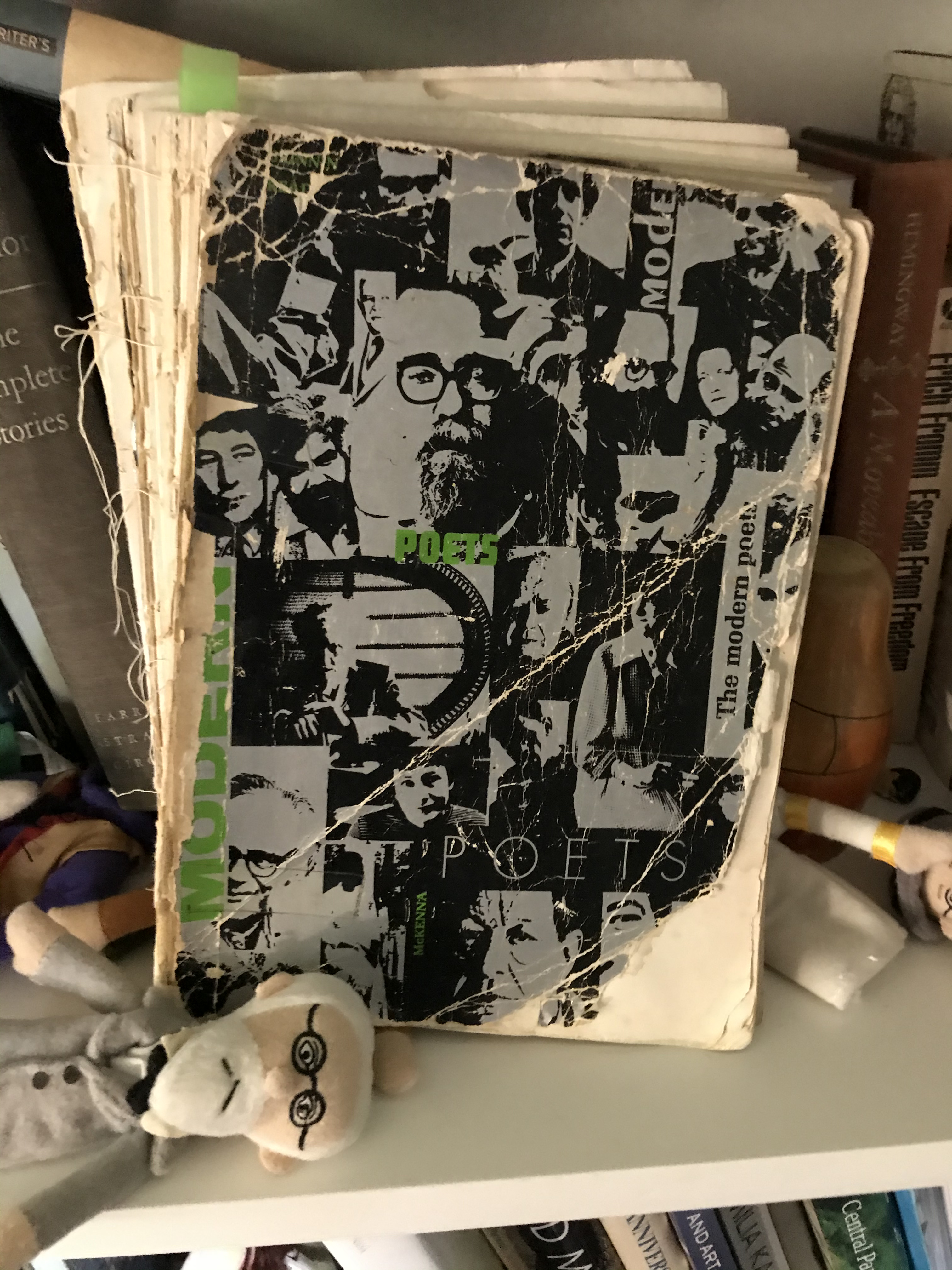
I copped the photo from the text of The Modern Poets, an undergraduate poetry anthology from my sophomore year at the University of South Carolina.[1] My professor, Thomas L. Johnson, was an excellent teacher and poet, a gentle, patient man whose love for verse was as pervasive as the cigarette smoke that wafted through college classrooms back in 1972.[2] Before then, I knew next to nothing about contemporary poetry because we didn’t cover much of it in high school. I remember reading The Spoon River Anthology (which was published in 1915), a few of the typically anthologized Frost poems, a page or two of E.E. Cummings, some Edna St. Vincent Millay, and a smattering of Yeats.
No Beats, no William Carlos Williams, no Wallace Stevens.
As the contemporary poetry course progressed, it occurred to me that mid-century to late-century poets suffered higher rates of suicide per capita than any other occupation outside of the Kamikaze corps. Every other poet we studied either drank himself to death or ended her own life. This impression, of course, might have been an aberration based on a disproportionate sampling of neurotics[3] covered in the survey. For example, if Seamus Heaney and John Ciardi had been substituted for John Berryman and Theodore Roethke, my impression might have been different.
In the table of contents, I placed a check next to the poets we covered. Here’s a partial list:
John Berryman – jumped from a bridge into the icy Mississippi River the year before I began the course.
James Dickey – drank prodigiously throughout his life, which led to erratic behavior. (Click here for an account of my semester with Dickey).
Randall Jarrell – struck by a car after being treated for mental illness after a suicide attempt.[4]
Robert Lowell – spent decades checking in and out of mental hospitals.
Sylvia Plath – committed suicide at thirty-one after a life fraught with mental breakdowns.
Theodore Roethke – victimized by two nervous breakdowns, one in the 1930s and another in 1944, “and they became increasingly more frequent in the ensuing decade; by 1958, he was attending therapy sessions six times a week.” (Poetry Foundation).
Delmore Schwartz – suffered from mental illness, alcoholism, died in a flophouse where his body wasn’t discovered for three days.
Anne Sexton – committed suicide via carbon monoxide poisoning.
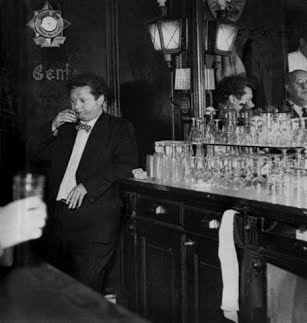
Dylan Thomas – died of alcoholic poisoning at the Chelsea Hotel in 1953.
Dylan Thomas at the White Horse Tavern in NYC
I’m sure there must be studies galore that attempt to explain this phenomenon. I’ve read a memoir by one of Berryman’s wives, Eileen Simpson, which documented Berryman’s relationships with Schwartz, Lowell, and Jarrell, so maybe there was a bit of birds-of-a-feather going on. Anyway, my first exposure to contemporary poetry convinced me that versifying was hazardous to your health.
Again, perhaps I shouldn’t generalize. Several of the poets we studied seemed mentally healthy, even happy. For example, here’s a poem by one of the sanest writers I’ve ever read, Richard Wilbur, composed shortly after he ran across Delmore Schwartz’s obituary, which Wilbur considered too cursory.
To an American Poet, Just Dead
In the Boston Sunday Herald just three lines Of no-point type for you who used to sing The praises of imaginary wines, And died, or so I’m told, of the real thing.
Also gone, but a lot less forgotten Are an eminent cut-rate druggist, a lover of Giving, A lender, and various brokers: gone from this rotten Taxable world to a higher standard of living.
It is out in the comfy suburbs I read you are dead, And the soupy summer is settling, full of the yawns Of Sunday fathers loitering late in bed, And the sshhh of sprays on all the little lawns.
Will the sprays weep wide for you their chaplet tears? For you will the deep-freeze units melt and mourn? For you will Studebakers shred their gears And sound from each garage a muted horn?
They won’t. In summer sunk and stupefied The suburbs deepen in their sleep of death. And though they sleep the sounder since you died It’s just as well that now you save your breath.
At any rate, when I taught at Porter-Gaud, through its visiting writing program, I met, dined, and drank with several highly successful poets who seemed, not only not unhappy, but also not all that eccentric – Peter Meinke, Starkey Flythe, Jr., Billy Collins, Chris Forhan, Elizabeth Spires, Cathy Smith Bowers, James Longenbach, Jennifer Grotz, and Alan Shapiro – to name nine.
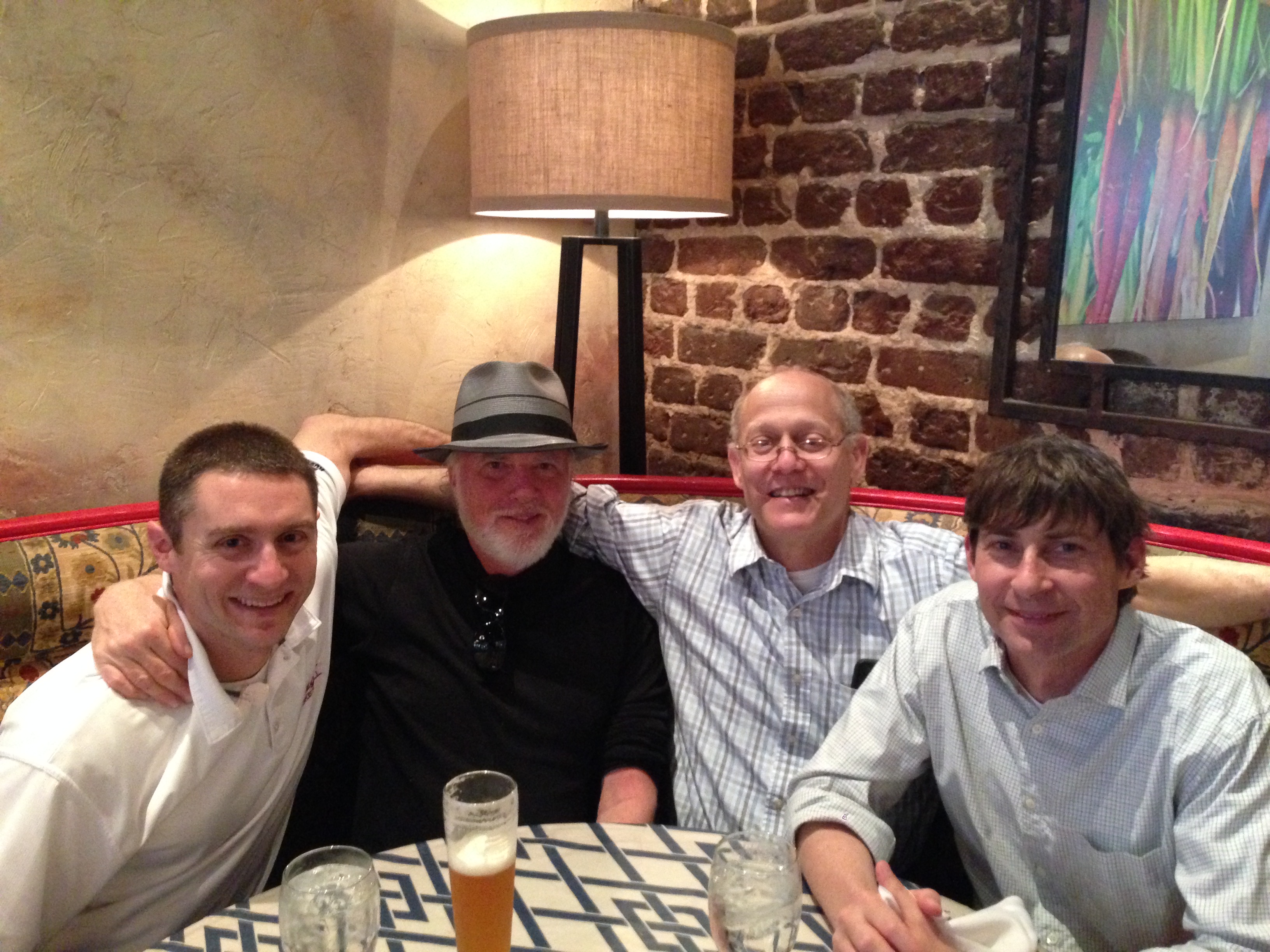
From left to right, Aaron Lehman, Wesley Moore, Pulitzer Poetry finalist Alan Shapiro, Childs Smith
Then again, I attended a Robert Lowell reading in 1974, and he seemed perfectly equanimous, though of course, we didn’t go out for drinks afterward.
At any rate, I’m enjoying hanging out with Delmore Schwartz’s fictionalized counterpart Von Humboldt Fleisher. In his case, it’s a pleasure crawling in bed with a tortured genius, especially with one so learned. If manic-depression is occurring on a page rather than in three-dimensions, it can be a gas.
[1] The course was actually called Contemporary Poetry, which would be a better title for an anthology that spans from Frost and Pound to James Tate. After all, strictly speaking, Shakespeare is a “modern” as opposed to “ancient” poet. Most of the poets in the anthology were born in the Thirties. Virtually all, if not all, are now dead.
[2] I received a generous B for my slapdash efforts and a C on the original poems I submitted in lieu of a research paper, crap I dashed off in three or four days. In 1987, Mr. Johnson and I ended up in an anthology of James Dickey’s former students’ poems, and I bumped into him at a get together celebrating the publication of the book. We both recognized each other and had an amiable chat.
[4] In a letter to Elizabeth Bishop about a week after Jarrell’s death, Robert Lowell wrote, “There’s a small chance [that Jarrell’s death] was an accident. . . [but] I think it was suicide, and so does everyone else, who knew him well.”






 You Do Hoodoo