I’ve Found the Perfect Writer to Read at Donald’s Inauguration

book-cover


Years ago, when he was visiting writer at my school, the poet Billy Collins told me that he didn’t know of one poet who would be willing to write an inaugural poem for George W Bush.[1]

After last Monday’s debate and the subsequent toxic spew of defamatory tweets, I doubt if we’ll have to consider the possibility of an American poet composing a poem to honor Donald J Trump.

Politics aside, it’s no doubt for the best: orange is probably the hardest word to rhyme in English.

I did some googling, though, and found on Amazon The Conservative Poets: A Contemporary Anthology, edited by William Baer, who offers this estimation of the contemporary literary landscape:

Although it often seems that liberals and the radical Left have assumed complete hegemony over the arts, especially the literary arts, there exists a remnant of very talented American poets who create beautiful, serious, witty, moving, and diverse poetry from a conservative point of view. This unique anthology illustrates the wide range of these determined and sometimes defiant artists, who hope that their work will encourage more like-minded Americans to learn the poetic craft and pursue the literary endeavor.

Here’s a snapshot[2] of portion of the table of contents:
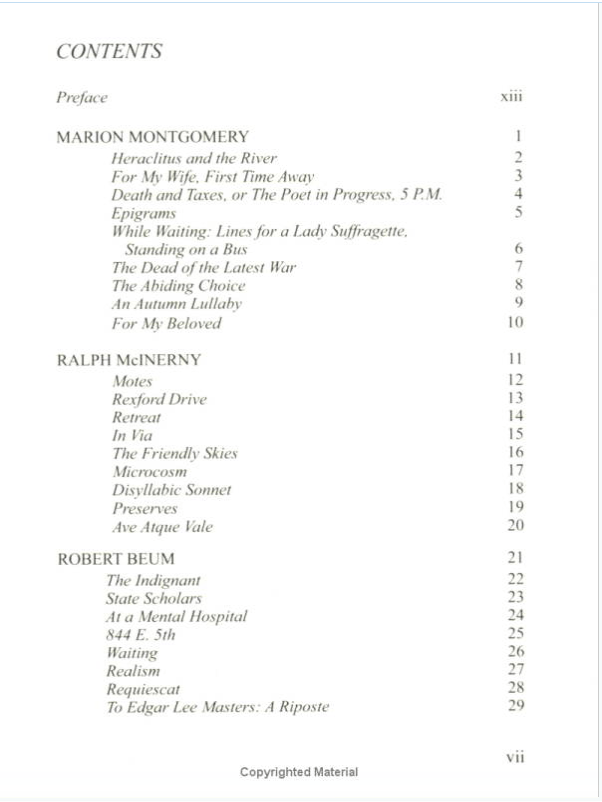
table-of-contents


I tried to track down some of these poets, only to discover the ones I deemed most suitable to be nominated as Trump’s inaugural poet had, to quote Richard Wilbur, “gone from this rotten/Taxable world to a standard of higher living.” The late Marion Montgomery’s “While Waiting: Lines for a Lady Suffragette, Standing on a Bus” certainly seems to adhere in some ways to Trump’s view of what Montgomery might call the “fair sex.”

Ah, Lady. Ah. It is a stirring sight.

Franchisement by the gods is now complete.

You now have won the inalienable right

Of standing on your own two feet.

Alas, Montgomery checked out of this Motel 6 of Sorrow in the penultimate year of W’s second term.

Editor Baer in his preface admits that most of the anthologized poems’ conservatism lie in their traditional forms rather than politics, but adds, “Some, myself included, would even tend to see meter as a poetic representation of the provident order of God’s universe.”[3]

What led me to these ruminations is the discovery of a web site entitled Scholars and Writers for America. Beneath its banner there is a statement of support: “Given our choices in the presidential election, we believe that Donald J. Trump is the candidate most likely to restore the promise of America, and we urge you to support him as we do.”

Scrolling down my screen looking for a poets or novelists, past names like Burton W Folsom, Jr., author of The Myth of the Robber Barons and Steve Mosher of the Population Research Institute, I discovered, to my delight, at the bottom of the screen, Thomas C McCollum, novelist.

Here’s the second paragraph of text from McCollum’s website, from an article by Louise Cook, the editor of Absolute Marbella Magazine:

If one were to view all aspects of Thomas McCollum’s professional and avocational life, one might be very tempted to call him a Renaissance man–albeit with a strong entrepreneurial bent. Wisely McCollum leaves all such pretentions to others, preferring the doing rather than the talking about.

What follows is a most-interesting-man-in-the-world litany: Can-am racing, bull running in Pamplona [Spain she helpfully adds], man-eating crocodile hunting, a golf-addiction, insurance sales, original pen and ink drawings street-corner sales, med-school matriculation, med-school abandonment, medical laboratory founding, medical laboratory selling, retirement to Marbella, Spain, “to live out all the fantasies of his youth. He has camped, safaried, and traveled to every continent on earth.”

McCollum has published four novels: Whipsocket, Tainted Blood, Palmer Lake, and Uncle Norm.

Here are the first and last sentences from Publisher Weekly’s review of Tainted Blood.

Readers willing to suspend disbelief beyond belief may find McCollum’s first novel an interesting medical thriller; others will be dismayed by characters manipulated by incredible plot contrivances.

McCollum makes the medical details microscopically authentic, but too many standard diatribes against government agencies, characters who speak polemic as often as they do dialogue and a conclusion that’s painfully anticlimactic render a hot topic tepid.

Now compare that MSM review to this one for Uncle Norm from Christopher Feigum, Grammy Award winner and Metropolitan Opera Singer:

“Thomas McCollum has delivered a book of operatic proportions…a tale full of intrigue that tempts us to explore the what ifs of life and the possibility of encountering one profound love. Whether he is delighting pygmies with donuts or sharing his smuggled discoveries along the way, Uncle Norm is a warm, comical hero deeply connected to his fellow lost soul in the Congo, Ottobah Cuguano, and their shared faith in everlasting friendship. As they strive to break down racial barriers and transform the world, their adventures amaze the restless traveler in all of us. This timely piece is a declaration that we each have the choice to leave behind a better place than we found.”

Oh, yeah.  There is also this snippet from of all places, Publisher’s Weekly:  “an interesting thriller…McCollum makes the adventure microscopically authentic.”   Hmmm.  “an interesting thriller . . . microscopically authentic.”  Where I have I heard that before?
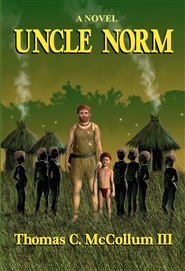
soon coming to an opera house near you

Anyway,  I have an idea for the Trump Inaugural Committee in the unlikely event that some less cationic-inducing alternative to Thorazine can be combined with some attention-disorder drug to subdue Trump’s pudgy demons and at the same time focus his attention so he can prep for the second two debates.

Here’s my idea. Instead of having an inaugural poem, have Mr. McCollum write an adventure tale with Trump as protagonist.

No one likes poetry anyway.
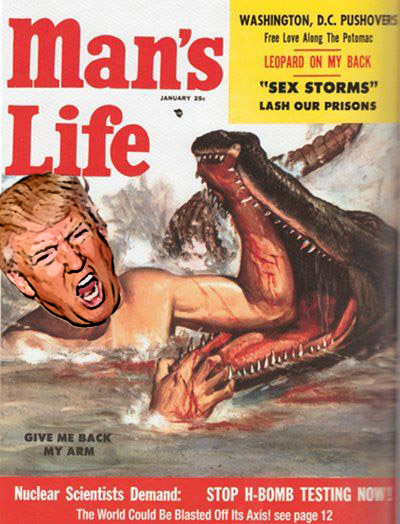
donald-solo-with-croc


[1] By the way, this conversation took place in Folly Beach, SC, at the Sand Dollar Social Club, one of the most exclusive biker bars/literary salons in the Lowcountry of South Carolina

[2] Is snapshot ever used non-metaphorically anymore? Does any one say, “Wait a sec. I have a snapshot on my phone. Actually I ended up using a screenshot to avoid the moiré-like swirls from the iPhone 7 photo.  Are you noticing the propensity of the author to name drop?

[3] For example, poetically rendering the series of explosions that occurred after that asteroid or comet or whatever slammed into the planet and did away with the dinosaurs would call for a series of spondees: Splat! Boom! Boom! Boom! Boom!

Two Stanzas of Ottava Rima Written in Earshot of a Skate Board Park

Skateboard Wipeout by Robert Mooney

Skateboard Wipeout by Robert Mooney


I said, ‘It’s certain there is no fine thing   

Since Adam’s fall but needs much labouring.

                                                                      WB Yeats


Willie B makes it seem so damned easy,

each iamb in it is appointed place,

but whenever I try it, I feel sleazy,

like a Byron wannabe pissing in the lake.

Yet even to Yeats it didn’t come easy.

A line would take him hours. Better to “break

stones,” he whined, “in all kinds of weather”

than try “to articulate sweet sounds together.”


Form versus execution. I hear the clatter

of skateboarders’ failed attempts at competence.

They flip the board, fall off, curse, batter

their knees as they try to perform the tricks

they see on TV — as if mind over matter

weren’t a myth, as if practice makes perfect,

as if talent can be willed. I say

time to shut down this computer, call it a day.


Pickpocketed Sonnets: Black Chords upon a Dulling Page

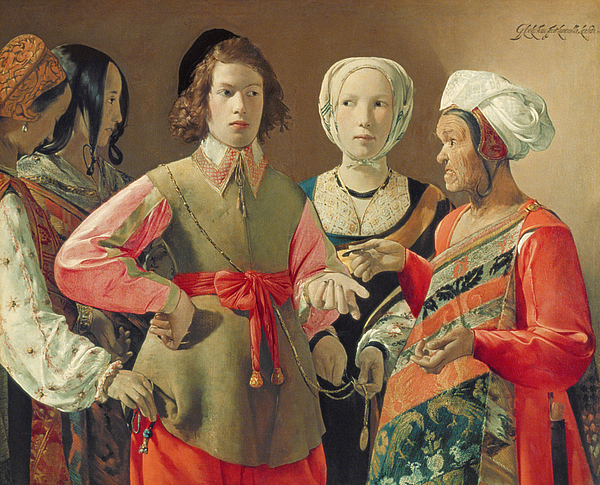
The Fortune Teller by Georges de la Tour

The Fortune Teller by Georges de la Tour


My light is spent dicing time,

shaking against the cold,

splintering, breaking

bare ruined choirs.


Pitched past pitch

of burning roof and tower,

white rush, vowels ploughed,

rebuffed, cliffs of fall frightful.


Fainting I follow;

my heart hides

the nothing that is not there

and the nothing that is.


This vain travail hath wearied me sore.

All I know into the dark is a door.


the-cabinet-of-dr-caligari-cesare-sneaking_hd-original


Sampled poets: Lou Brogan, Johnny Milton, Will Shakespeare, Bob Hayden, Gerry Hopkins, Willie B, Shay Heaney, Will Owens, Wally Stevens, Tom Wyatt


Uses and Abuses of Figurative Language, Donald Trump Edition

from left to right Chris Matthews, Hillary Clinton, Edward Snowden, Vladimir Putin, Julian Assange, Donald Trump. Anderson Cooper

from left to right Chris Matthews, Hillary Clinton, Edward Snowden, Vladimir Putin, Julian Assange, Donald Trump. Anderson Cooper


“Figures of speech are spices that add zest to language,” a tired textbook author might write.

But even though the previous sentence lazily relies on a stale metaphor, it’s still more pleasurable to read than “Figures of speech are words and phrases used in other than their literal sense, or in other than their ordinary locutions, in order to suggest a picture or image or for other special effect.’”[1]

Here’s the great American poet Richard Wilbur on the subject:


Praise in Summer

by Richard Wilbur

Obscurely yet most surely called to praise,

As summer sometimes calls us all, I said

The hills are heavens full of branching ways

Where star-nosed moles fly overhead the dead;

I said the trees are mines in air, I said

See how the sparrow burrows in the sky!

And then I wonder why this mad instead

Perverts our praise to uncreation, why

Such savor’s in this wrenching things awry.

Does sense so stale that it must needs derange

The world to know it? To a praiseful eye

Should it not be enough of fresh and strange

That trees grow green, and moles can course in clay,

And sparrows sweep the ceiling of our day?

In the octave of this sonnet, Wilbur, via metaphors, reverses the natural order, turning “hills” into “sky” and “moles” into “birds” that fly/burrow over the bones beneath them. He then reverses the mirror and transforms a “tree” into a “mine” and “sparrows” into “moles.”

In the sestet, he laments that even the most miraculous aspects of nature eventually bore us, so we end up through figurative language “perverting” what should by themselves fascinate us in their natural state — things of wonder like green trees, moles, and sparrows. Oddly enough, after questioning the need for figurative language, Wilbur paradoxically ends the poem with a metaphor as “sparrows sweep the ceiling of our day” — though at least the metaphor reflects the world in its correct orientation with the sky above and the ground below.

Because, as Wilbur notes, “figures of speech “wrench things awry,” their use can lead to misunderstanding. For example, if you don’t read much poetry, you might find “Praise for Summer” baffling, if not incomprehensible.

Problems can also arise when the less perceptive among us take figurative language literally, as Donald Trump claimed last week in his controversy du semaine.

In case you’re just emerging from solitary confinement, Trump made a literal accusation about the origins of ISIS and then tried to claim, post shitstorm, that he didn’t mean what he had said literally. He then cast the folks at CNN as dullards incapable of appreciating his use of irony.

https://twitter.com/realDonaldTrump/status/764045345332396032

Allow me to render his accusation in verse as I might if I were quizzing my high school students.

Barack and Hillary founded ISIS,

So they are to blame for our current crisis.

Identify the figure of speech found in the couplet:

A.understatement   B. verbal irony (sarcasm)   C. synecdoche   D. hyperbole

The correct answer is D. Trump wasn’t employing sarcasm; he didn’t mean to convey that Obama and Hillary didn’t create ISIS by stating the opposite. If he meant the accusation figuratively (which I doubt), he was waxing hyperbolic – exaggerating – suggesting that Obama and Clinton’s mismanagement of foreign affairs led to the rise of the so-called Islamic State, thus making them de facto founders of ISIS. That he mocks others for not getting his sarcasm when he isn’t being sarcastic is worthy of sarcasm. Like we used to say in the 7th grade, “Smooth move, X-Lax.”

[cue Alanis Morrisette’s “Ironic”]

At any rate, you Republicans out there can surely lament that Trump lacks the verbal acuity of Ronald Reagan, who as deftly as Richard Wilbur turned language topsy-turvy, calling ICBMs “peace keepers” and taxes “revenue enhancers,” but then Reagan, who hand-wrote his own letters, was a voracious reader, which Trump obviously is not.

[1] Via Dictionary.com

Reagan-5694


Overcoming Writer’s Block/ Avoiding Suicide

painting by Rigney
painting by Rigney

There’s nothing worse than writer’s block. Okay, maybe famine, genocide, or a Mensa mixer is worse.

Ever been to a Mensa mixer?

Imagine it.  The space — a Quality Inn banquet room? Something more upscale? A Hyatt?

Tables, carpet patterns, windows, drapery, caterers.

Characters? Base them on people you know. One of your old high school teachers, an aging history droner with badly dyed hair (you choose the color).

Mix and unmatch outfits.

Add a recent widow with helmet-like hair and a nasal Midwestern accent, a brayer when amused.

You, the protagonist, a lonely man or woman who has joined out of desperation. There’s someone there you sort of dig, maybe.  Make him or her up yourself. Have your would-be love interest constantly checking a Tinder feed.

Or not.

It’s all up to you because I’m not going to write that short story. Writing fiction is too damned demanding.

Crucial Tip #1: One of the most effective ways to overcome writer’s block is to give up writing.

1378995960411.cached

* * *

If you’re a poet and stuck, you can always come up with an image and start from there, whether it’s a memory from childhood, your alcoholic father snoring on a sofa at four PM on a Saturday, his hairy over-abundant stomach exposed beneath a too-small wifebeater, the stomach inflating and deflating while a college football game blares from the TV.

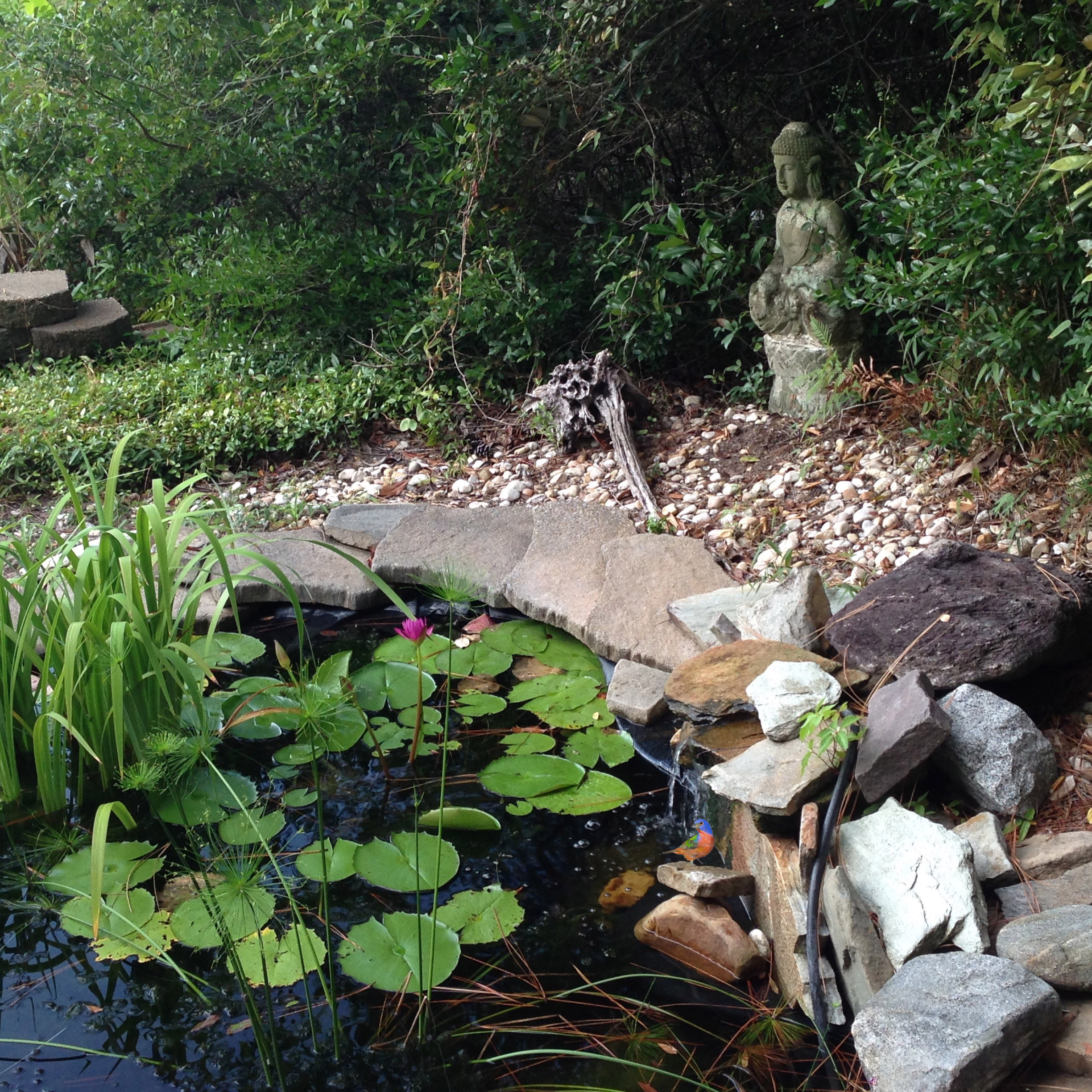
Or a tropically bright painted bunting with nervous eyes doing reconnaissance. He darts out of a thicket as he cops drops trickling from the so-called waterfall in an aquatic garden in your back yard. He flits back, disappearing into shadows.

Cf. Wordsworth and Dickinson.

water garden

Coming up with ideas for poems isn’t that taxing, but writing a good poem is almost impossible, and there’s absolutely no money in it.  Plus poets tend to commit suicide with such abnormally high rates that actuaries prefer to insure wingsuit fliers over sonneteers.

Crucial Tip # 2: One of the most effective ways to overcome writer’s block is to give up writing poetry. (It just very well could save your life).

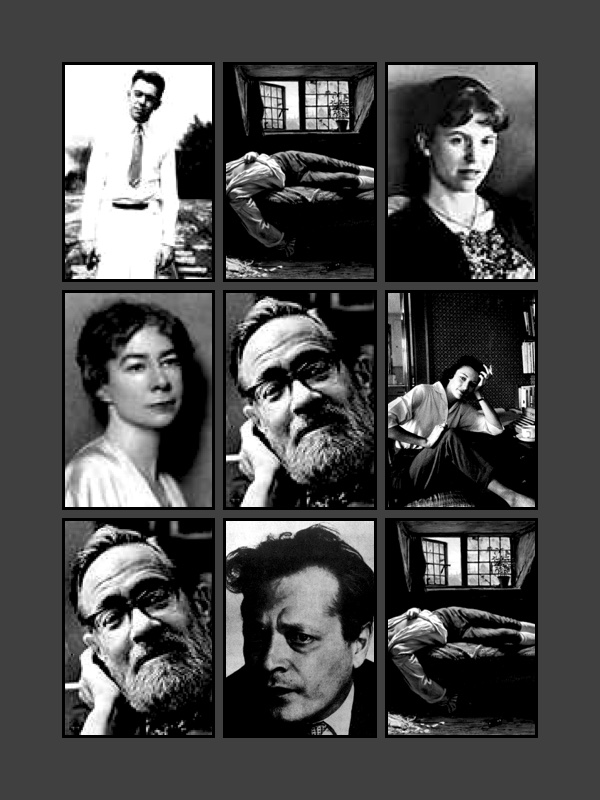
Dead Suicide Poets Society

* * *

Therefore, if you’re one of these self-indulgent people who must write, I suggest non-fiction, and it would seem there’s so much to write about – the homeless, McMansions, the state of the spray-on tan industry, the Death of God/the Republican Party, the history of Mensa/the fallibility inherent in IQ testing, sleep apnea, the Nebraska Cornhuskers, the evolution of intimate apparel, the problem of writing block and how to overcome it.

Fox News Gumbo: A Poem (with apologies to Master Will)

Fox news gumbo


Conjuration, mumbo jumbo,

Let’s make a pot of FOX News gumbo.


Wink of Palin, PAC ad break

In a black maw boil and bake;


Grumble, grumble, moil and mumble;

broadcast shit and stir up trouble.


Eye of Newt, toe of Santorum,

Copies of the Penthouse Forum.


Newscasts rife with stirred-up trouble,

Like a hell-broth boil and bubble.


Grumble, grumble, moil and mumble;

broadcast shit and stir up trouble.


Admin fuck-up – Benghazee!!!

Carnage worse than Wounded Knee!!!


Ersatz outrage, squawking heads,

looped forever in endless threads.


Rush Limbaugh: misogyny;

Xenophobic: Sean Hannity.


Israel, the Middle East?

Love the war but hate the peace.


Debunk science, evolution,

global warming, air pollution.


Grumble, grumble, moil and mumble;

Broadcast shit and stir up trouble.


Cool it with some David Frum


Presto!


Something wicked this way comes . . .

Roger Ailes as Bacchus

Roger Ailes as Bacchus

A Fractured Nursery Rhyme (or Georgie Porgie Meets Simple Simon Meets Roger Ailes)

Roger Ailes


Mrs. Mooney met a loony

standing in a puddle.


Said the loony to Mrs. Mooney,

“You think you’d like to cuddle?


With her head held high,

She walked on by,


And her wits began to gather.

“No thanks,” said she, “I reckon I’d rather not rather.”


from a Child’s Back Alley of Verses


On Bad Poetry (Which I’ve Written Lots Of)

painting by Jivan Lee

painting by Jivan Lee

Just because a poem is famous, doesn’t mean it’s any good. Take Joyce Kilmer’s ‘Trees,” which I think I was forced to memorize every consecutive year in grade school.


I think that I shall never see

A poem lovely as a tree.

A tree whose hungry mouth is prest

Against the earth’s sweet flowing breast;

A tree that looks at God all day,

And lifts her leafy arms to pray;

A tree that may in Summer wear

A nest of robins in her hair;

Upon whose bosom snow has lain;

Who intimately lives with rain[1].

Poems are made by fools like me,

But only God can make a tree.


How is this poem bad? Let me count the ways. Its meter is sing-songy, its imagery idiotic. Tree roots don’t resemble mouths, nor does the earth around them resemble a breast, so it’s hard to visualize a tree breastfeeding, nor do you want to.

Then in the penultimate couplet, the tree now has a bosom and has been “intimate” with rain. So essentially the tree is personified; it’s a suckling female child with bosoms who raises her arms to pray to God, who seems to have fashioned each tree individually with His own hands.

[Understatement alert] Here are some considerably better lines of verse concerning a tree:

Labour is blossoming or dancing where

The body is not bruised to pleasure soul,

Nor beauty born out of its own despair,

Nor blear-eyed wisdom out of midnight oil.

O chestnut tree, great rooted blossomer,

Are you the leaf, the blossom or the bole?

O body swayed to music, O brightening glance,

How can we know the dancer from the dance?

Yet, the author of this exquisite example of ottava rima, WB Yeats, also produced this poem, entitled “To a Squirrel at Kyle-Na-No”:

Come play with me;

Why should you run

Through the shaking tree

As though I’d a gun

To strike you dead?

When all I would do

Is to scratch your head

And let you go.

Squirrel to poet: You must be kidding me, man.

Dylan, whom I revere, can also come up with some clunkers.[2]   For example,

Ah, my friends from the prison, they ask unto me

“How good, how good does it feel to be free?”

And I answer them most mysteriously

“Are birds free from the chains of the skyway?”

What’s up with the Biblical diction? And the paradox of the last line doesn’t work as an image, and what does it have to do with the rest of the song, which is about breaking up with someone because her sister is an asshole?

My favorite type of bad poem was written intentionally to be bad. I have one of these, a poem I wrote after having read mass murderer Pee Wee Gaskins oral autobiography. I had to write the poem to purge myself of Pee Wee’s tortured syntax and obscene backwoods locutions.[3] I reproduce it here with the warning that it’s disgusting in about every way possible, so if you’re squeamish and find things in extraordinarily bad taste offensive, quit reading now:

Pee Wee Gaskins Stopping by a Lake on a Summer Evening


Whose corpse this is I ought to know

Cause I’m the one what kilt it so.

I hope nobody come round here

To watch it in the lake me throw.


My common law wife must think it queer

I ain’t been home in over a year.

Running up and down the coast

Slitting throats and drinking beer.


Ain’t got no ID on him, cocksucker.

Think he said his name was Drucker.

Now I got him chained up like Houdini.

Teach him call me a scrawny motherfucker.


Them chains sure makes a body sink fast

But this here good feeling don’t never last

Just like a piece of prison ass

Just like a piece of prison ass . . .


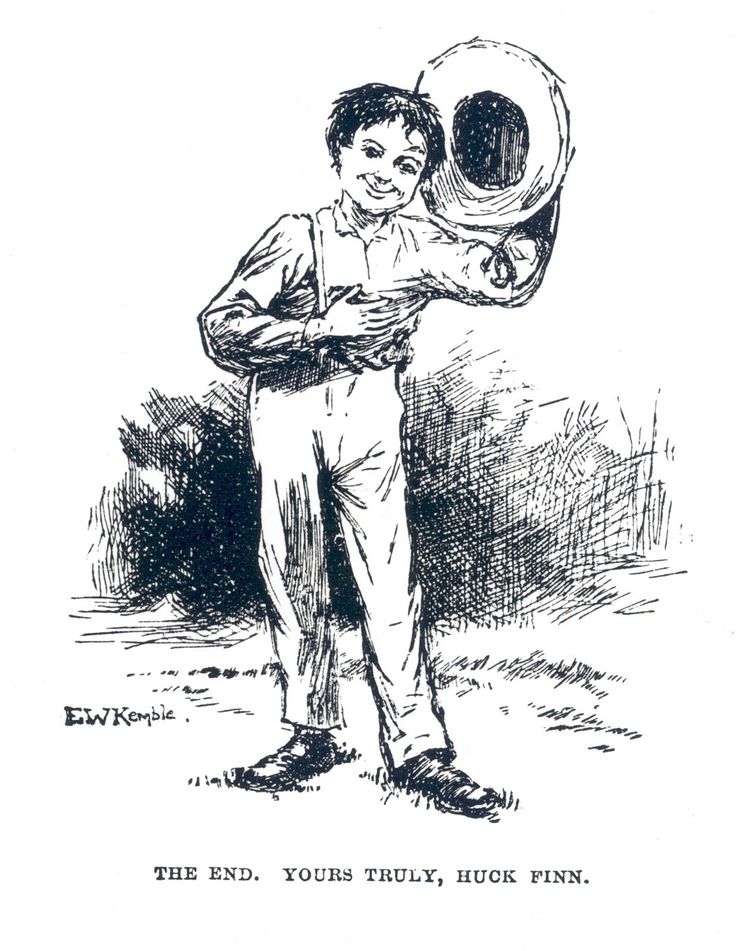
Of course, the greatest intentionally bad poem ever written is the brilliant “Ode to Stephen Dowling Bots, Dec’d” by the great Mark Twain.


Enjoy!


And did young Stephen sicken,

And did young Stephen die?

And did the sad hearts thicken,

And did the mourners cry?


No; such was not the fate of

Young Stephen Dowling Bots;

Though sad hearts round him thickened,

‘Twas not from sickness’ shots.


No whooping-cough did rack his frame,

Nor measles drear, with spots;

Not these impaired the sacred name

Of Stephen Dowling Bots.


Despised love struck not with woe

That head of curly knots,

Nor stomach troubles laid him low,

Young Stephen Dowling Bots.


O no. Then list with tearful eye,

Whilst I his fate do tell.

His soul did from this cold world fly,

By falling down a well.


They got him out and emptied him;

Alas it was too late;

His spirit was gone for to sport aloft

In the realms of the good and great.


[1] Huh?

[2] You can read my argument why he deserves a Nobel Prize here.

[3] When can read about my close encounter with Pee Wee here.

89dcb58198f5d58b8271e6dc67c03a83


Perhaps There Is Reason for Optimism

Galaxies, constellations, solar systems, stars, and planets go round and round and round in their gravitational grooves. Days are born to die, to dawn, to die, to dawn, time and time, again and again.

Yang 陽: Tribalism is brain stem stuff: Tar Heel, Blue Devil, Tyger, Tyger[1] A twig snaps; adrenalin pumps. My Territory. My Toy. My Girl.[2]   My Generation.[3] Godzilla demands that parking space. Brainstem stuff.

Life yearns to be. The lowly weed cracks through concrete in the dying strip shopping center off Folly Road. That weed feeds on the CO2 of the homeless man who instinctively dodges it with his shopping cart. Yin

Ayahuasca Shaman by Paul Heussenstamm

Ayahuasca Shaman by Paul Heussenstamm

A millennium from now, in the Amazon, ringed round a fire, Sons of the Wind tell of a time when the jungle was dying and silver birds were flying overhead buzzing with water rising and the white ghosts sighing into tiny blinking talk boxes but how Tucano chased them away with the sun itself . . .

Again and again, time and time, dawn to die, gravitational grooves, round and round, planets and stars and solar systems and galaxies.

[1] Burning bright in the darkness of the night . . .

[2] Talking ‘bout my girl, my girl.

[3] P-p-p-people try to put us down.