Unfortunately, I suffer from insomnia. Unfortunately, some nights/a.m.s I try to deflect thoughts by constructing verse. Unfortunately, some nights/a.m.s the result might be a limerick.
But weigh this song with the great and their pride;
I made it out of a mouthful of air,
Their children’s children shall say they have lied.
WB Yeats “He Thinks of Those Who Have Spoken Evil of His Beloved”
A by-product of breathing, that mouthful of air, exhalation tracking up through the trachea, plucking the vocal c[h]ords: vowels, consonants, syllables, words, words, words. Say outloud the title of this post – “screech me a poem, sugar britches.” Dissonant, sharp, as unlovely as the scraping of a rake on gravel, echoing Juliet’s lament as Romeo vacates their marriage bed:
It is the lark that sings so out of tune,
Straining harsh discords and unpleasing sharps.
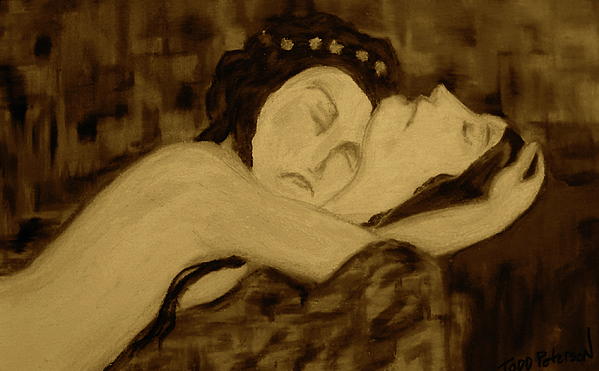
Romeo and Juliet by Todd Peterson
Perhaps even more discordant is Gerard Manly Hopkins postlapsarian description of industrialization:
And all is seared with trade; bleared, smeared with toil;
And wears man’s smudge and shares man’s smell: the soil
Is bare now, nor can foot feel, being shod.
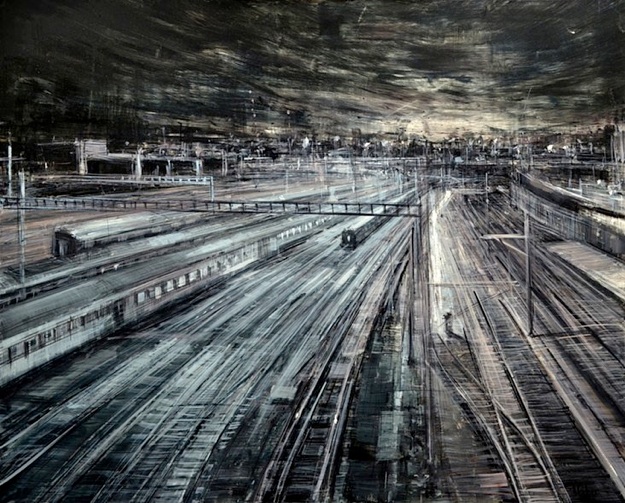
Train Tracks by Valerio D’Ospina
Who sez that poetry’s supposed to sound pretty?
Not Alexander Pope:
But when loud surges lash the sounding shore,
The hoarse, rough verse should like the torrent roar.
Nor that barbaric yawper Walt Whitman:
Nor him in the poor house tubercled by rum and the bad disorder.
Nor Ol’ Ez in St. Elizabeth’s Mental Hospital ranting his way to a Bolligen Prize:
the drift of lice, teething,
and above it the mouthing of orators,
the arse-belching of preachers.
Ezra Pound
Thanks to its Anglo-Saxon roots, English is well-suited to screech. However, thanks to its French invaders, our language can also coo. And don’t forget the ess-cee (sc) words of the Vikings with their skalds singing of skulls and skies and dragons’ scales.
English-speaking poets possess quite a synthesizer through which to sample sounds, orchestrating Anglo-Saxon, Norse, and French symphonically (Milton) or piping a simple Saxon tune in tetrameter (Anonymous).
Given global warmification/climatic alternation, the following worry may seem as trivial as the date of Alfred Tennyson’s death, but I wonder, given our beeping visual small screen secondhand exposure to actual sights and sounds, if off-the-cuff eloquence might become as rare as first edition Kafkas.
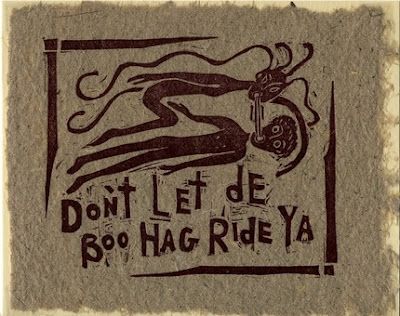
In my youth, among my compatriots, having a way with words held sway. I think of Jake the Snake Williams politely stringing together sonorous sentences to a Jehovah’s Witness in Richland Mall explaining why he wouldn’t take the tract, and the fellow smiling, nodding his head, and saying, “Brother, you got you an excellent rap.” Or Furman Langley lamenting in a Lowcountry gumbo of gullah-echo the legend of the Boo Hag.
The “like-like” syncopatations of youthful inarticulation and the ubiquitous interrogative lilt of their declarative sentences gives me pause?
Like the majority of North Americans, high school students don’t like poetry. When I teach my first lesson on poetry, I confront students with this fact, encourage them to be honest, to raise their hands if they don’t like poetry, and all but one or two hands tentatively rise.
I ask them why, and they reply “it’s hard” or “too abstract” or that “teachers read too much into it and that’s off putting.”
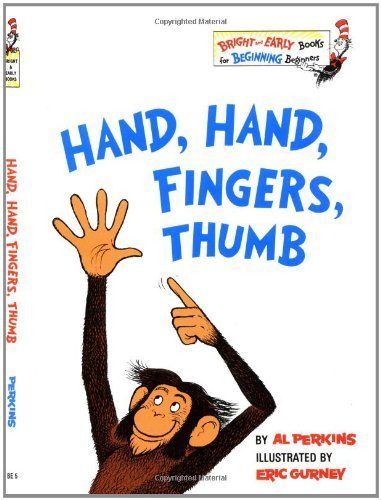
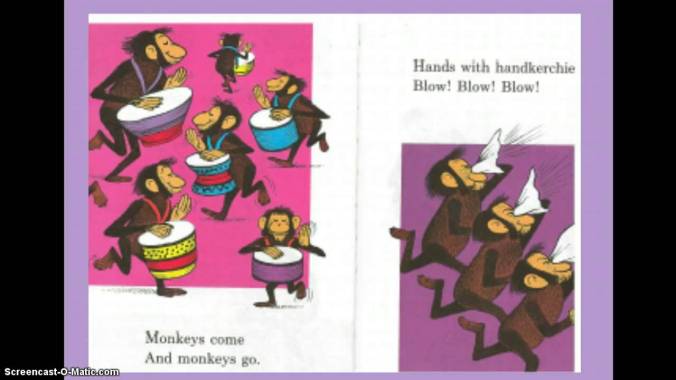
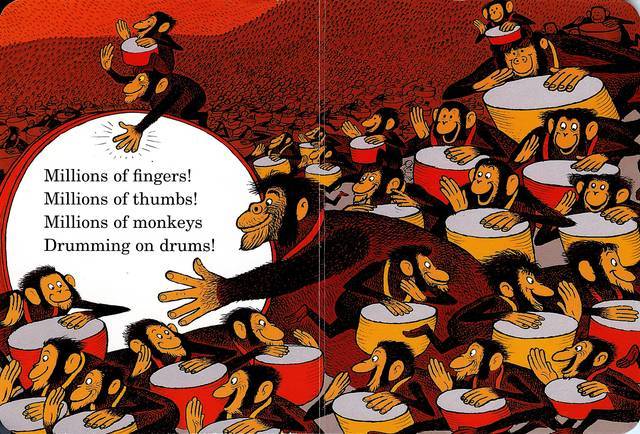
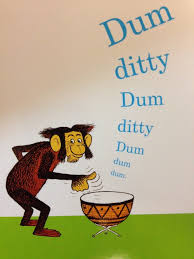
I say, “But you used to like it. You liked Dr. Seuss. See if you like this poem. Then I read them “Hand, Hand Fingers Thumb,” my older son Harrison’s favorite book when he was a preschooler.
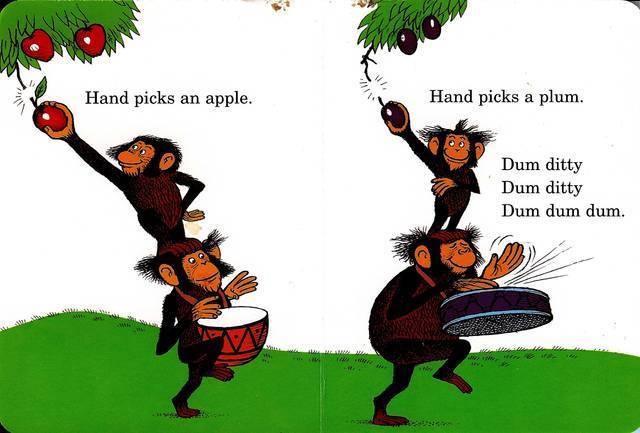
Because the illustrations constitute an important facet to the poem’s overall effect, I’m going to provide a video and then read it myself to produce a very different vibe, the one I create in the classroom.
Okay, hit the arrow to get my rendition.
Usually, I receive a rousing round of applause, but then I ruin it for them. I say, “See, you enjoyed that, but you didn’t get its deeper meaning. Let me explain.
“The poem is actually an apocalyptic history of life on the planet that incorporates both Hebraic and Hellenic myths denoting the fall of man that culminates in a population explosion that eventually kills all primates on the planet.”
“What?” they say.
“Listen. At first the monkeys are happy in their prelapsarian state, enjoying music and each other’s company until
“Here the apple represents the Eden myth’s rendition of the Fall, and the plum represents the Greek concept of the worship of Dionysius, the Greek god of wine. Perkins is using what is called poetic license, substituting one purple fruit for another for the sake of rhyme.
“It’s no accident that in the very next stanza after the chorus, disease enters the rapidly fading paradise of the monkeys’ world.
“As civilization advances, instrumentation becomes more sophisticated; banjos and fiddles augment the simple jungle drums at the beginning. An unabated and unsustainable population explosion ensues, choking the planet.
“Hence the diminuendo at the end
“This is an obvious allusion to TS Eliot’s “The Hollow Men,” its last lines stating that the world will end “not with a bang but a whimper.”
Some kids look generally puzzled, others sport wry smiles. I take my tongue out of my cheek and confess that what I just spewed was bullshit, that the poem exists to delight you with sound, rhythms and rhymes, and that a very important rule is that it’s much better to miss a symbol than to misinterpret one. That, in fact, most poems are the opposite of abstract, they’re concrete.
“The proper method of judging when or whether one should help another person is by reference to one’s own rational self-interest and one’s own hierarchy of values: the time, money or effort one gives or the risk one takes should be proportionate to the value of the person in relation to one’s own happiness.” — Ayn Rand
Good Riddance
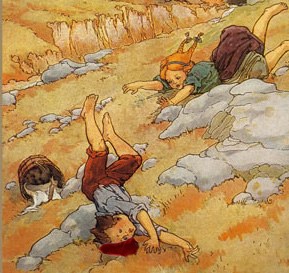
Jack and Jill went up a hill to fetch a pail of water. Jack fell down and broke his crown And Jill came tumbling after.
And none of John Galt’s women and none of John Galt’s men lifted one little finger to help either of them.
Pork
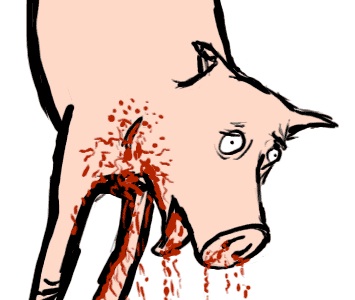
This little piggy went to market (as bacon) This little piggy as ham; This little piggy was injected with chemicals And ended up as spam, And this little piggy (see below) went wee wee on the killing floor.
Pitch Black Night
Three blind mice Three blind mice See how they stumble See how they starve.
All three were poisoned by the butcher’s wife Who didn’t get the dosage of the poison quite right, So now they spend their very last day in pitch black night, pitch black night.
Yuk
Georgie Porgy pudding and pie Hung with the girls and not the guys. Puberty’s hitting him, however, Precipitated a change in Georgie’s weather, So Georgie ditched his girly toys And hid in the closet with like-minded boys.
Mistress Ayn has this to say To all of you who might be gay. Breaking nature’s laws Denotes “psychological flaws.”
She finds you personally “disgusting” For your perverted lusting. If you want to join her nation Then you better switch your orientation.
Lullaby
Now I lay me down to sleep in a universe dark and deep. If I die before I wake, Tough shit, them’s the breaks.
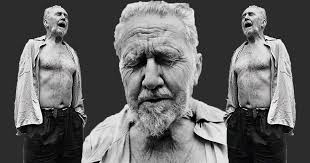
Last Sunday, after returning a rented golf cart, Caroline and I walked over to Planet Follywood for breakfast and then over to the Tides for a rum-infused tropical treat (her) and a hoppy yeast-born malt-based brew (I-and-I). As we sat in a slice of shade in the corner of the plaza of the outdoor bar, a shirtless, bearded fellow walked past. He had a picture of a spine tattooed over his own spine, flanked by a pair of wings tattooed on his shoulder blades. “Wow, dig that,” I whispered.
We continued our conversation as the man and two of his companions – also shirtless and heavily tattooed – took a seat at a table about ten meters away, the wings-spined fellow facing us.
“What’s that tattooed on his chest?” Caroline asked. “Jesus?”
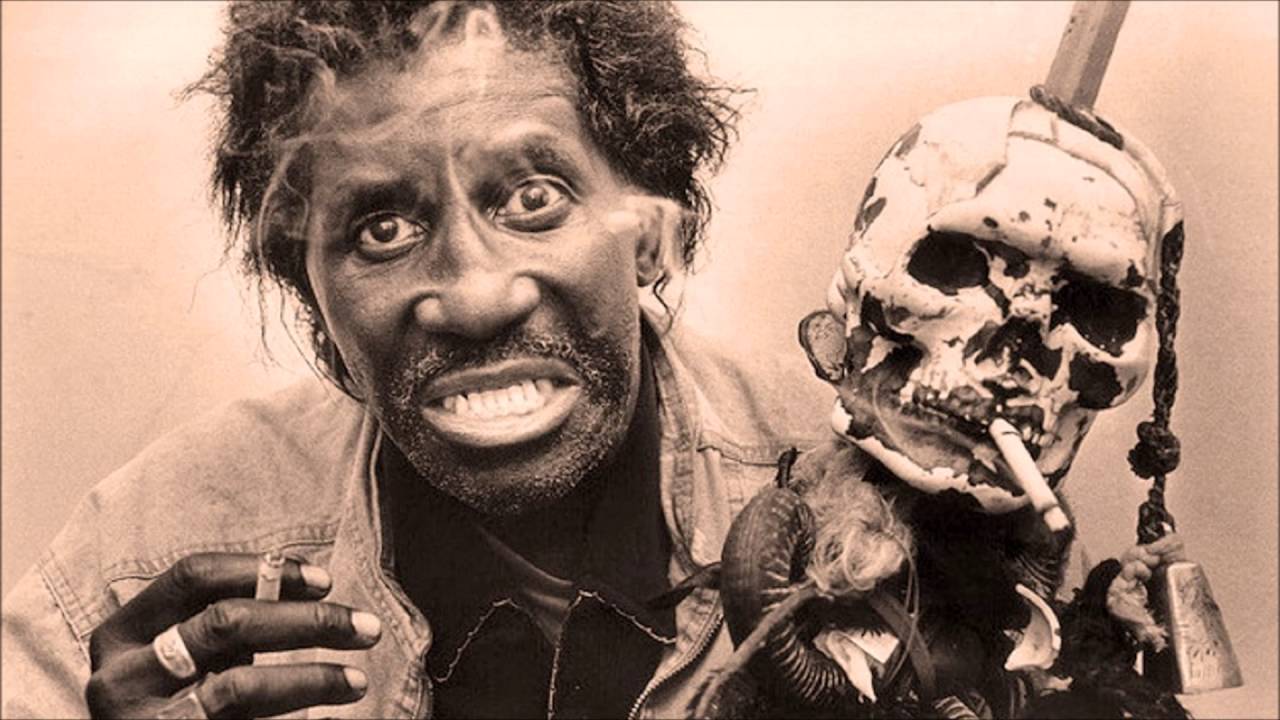
“Looks more like Screamin’ Jay Hawkins,” I said.
We talked about trying to take a surreptitious snapshot but decided against it. It was then that the title came to me: “Ode on a Tattooed Torso.”
When we passed them in leaving, Caroline asked him whose face was tattooed on his stomach.
As we entered the cool of the bar proper, Caroline asked me if I had heard what he had said.
“Yeah, Jesus.”
“No, he said ‘Zombie Jesus’.”
That stopped me in my tracks. “I got to get a picture.”
“Do you think he’ll be annoyed?”
“I’ll ask politely. If he says no, he says no.”
“Okay, I’ll wait here. It will be less awkward without me there.”
So I retraced my steps and introduced myself, handed him my Hoodoo website card, explained that I wrote a blog and would love to take a picture and write about his tattoos. “Of course,” he said, standing up beaming. “That’s not the response I was expecting to get,” he said. “I was afraid you might be offended.”
I wished I had asked him if many people were offended, but I didn’t, nor how he came to acquire such an animus for Jesus. Fanatical parents? Anger at the horrors of the world? He seemed the opposite of angry, just another hedonist spending the Sabbath in self-indulgence.
So we went home and studied the photograph, which prompted several ideas. First, this tattoo was testament to our First Amendment rights, which allow us to say or display ideas that are anathema to the majority. As George Orwell put it in “Freedom of the Press,” [a]t any given moment there is an orthodoxy, a body of ideas which it is assumed that all right-thinking people will accept without question. It is not exactly forbidden to say this, that or the other, but it is ‘not done’ to say it, just as in mid-Victorian times it was ‘not done’ to mention trousers in the presence of a lady. Anyone who challenges the prevailing orthodoxy finds himself silenced with surprising effectiveness. A genuinely unfashionable opinion is almost never given a fair hearing.”
Second, it occurred to me how tolerant we US citizens are for the most part. If our tattooed man lived in Saudi Arabia and went out in the public square sporting a tattoo of Zombie Muhammad, he’d be a corpse faster than you could say, “All praise be unto him.”
I decided to write the poem “Ode on a Tattooed Torso” modeled on Keats’s “Ode on a Grecian Urn,” employing the so-called ten-line Keatsian Ode Stanza. Although I intended the poem to be comic, a sort of parody, it became something a bit different: praise for a brave lost soul who uses his body as a canvas to display his obviously heartfelt but unpopular beliefs.
If you decide to read it, I highly recommend hitting the audio and to read it along with my voice.
Ode on a Tattooed Torso
With apologies to John Keats
In the juvescence of the year
Came Christ the tiger [. . .]
The tiger springs in the new year. Us he devours . . .
TS Eliot, “Gerontion”
Thou rotund torso beneath that russet beard,
Thou iconoclastic mockery,
Sacrilege silently, rudely, crudely shared
Like profane Pompey crockery
Uncovered from a brothel. Zombie Jesus
Thorn-Crowned, blood dripping from brow
Come not to save but to devour us,
The antithesis of the sacred cow.
Its human canvas confronting us
With an objective correlative. Wow!
Shouted obscenities spit gall,
But those unheard are often ignored.
Though Bosch-like, the tattooed Last Supper doesn’t call
Attention to itself above the Zombie Lord.
Faintly rendered, half-hidden, a thatch of chest hair
Obscuring bird-beaked apostles,
Like Leonardo’s originals leaning here and there.
We barely notice them, if at all.
And who would have the courage to stare,
To lean in, to take it all in, though enthralled?
O badass iconoclast! Fearless commentator!
I wonder what images adorn your balls.
Onan perhaps spilling his seed? The traitor
Judas hanging from a tree? The walls
Of Jericho richly graffitied?
Thou russet-bearded wonder, profane wretch,
You walking act of art, when old age bleeds
Away that ink, may this verse your protest protect,
Your icon-injected flesh preserve, your rude screed








 You Do Hoodoo