The Muse of Unrequited Crushes

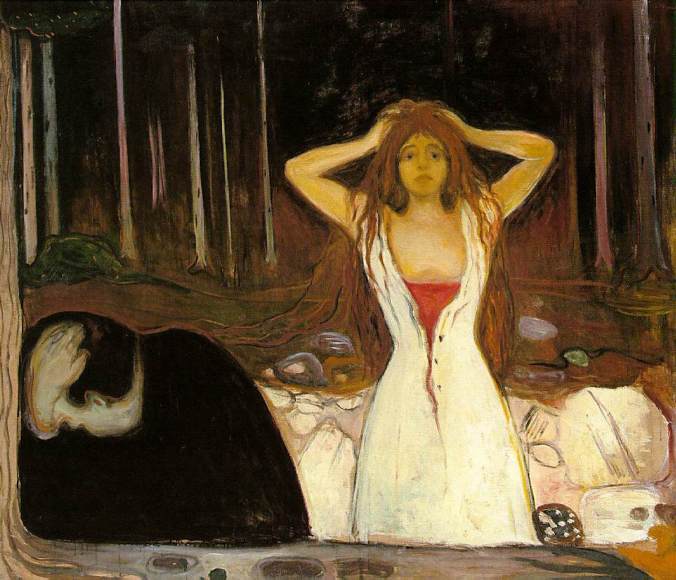
ashes-1894-edvard-munch_wikiart

Edvard Munch: “Ashes”

Has there ever been an unrequited love that’s paid more poetic dividends than WB Yeats’s decades long pursuit of unyielding Maud Gonne?*

[cue Robert Johnson: “All my love’s in vain.”]

Here’s a slight sampling:


She bid me take life easy, as the grass grows on the weirs;

But I was young and foolish, and now am full of tears.

“Down by the Salley Gardens”


How many loved your moments of glad grace,

And loved your beauty with love false or true,

But one man loved the pilgrim soul in you,

And loved the sorrows of your changing face;


And bending down beside the glowing bars,

Murmur, a little sadly, how Love fled

And paced upon the mountains overhead

And hid his face amid a crowd of stars.

“When You Are Old”


Half close your eyelids, loosen your hair,

And dream about the great and their pride;

They have spoken against you everywhere,

But weigh this song with the great and their pride;

I made it out of a mouthful of air,

Their children’s children shall say they have lied.

“He Thinks of Those Who Have Spoken Evil of His Beloved”


O  Heart! O Heart, if she’d but turn her head

You’d know the folly of being comforted.

“The Folly of Being Comforted”


Never give all the heart, for love

Will hardly seem worth thinking of

To passionate women if it seem

Certain, and they never dream

That it fades out from kiss to kiss;

For everything that’s lovely is

But a brief, dreamy, kind delight.

O never give the heart outright,

For they, for all smooth lips can say,

Have given their hearts up to the play.

And who could play it well enough

If deaf and dumb and blind with love?

He that made this knows all the cost,

For he gave all his heart and lost.

“Never Give All the Heart”


I could go on and on, but allow me just one more:

We sat grown quiet at the name of love;

We saw the last embers of daylight die,

And in the trembling blue-green of the sky

A moon, worn as if it had been a shell

Washed by time’s waters as they rose and fell

About the stars and broke in days and years.


I had a thought for no one’s but your ears:

That you were beautiful, and that I strove

To love you in the old high way of love;

That it had all seemed happy, and yet we’d grown

As weary-hearted as that hollow moon.

“Adam’s Curse”


Given this inspiration, perhaps I should lament I’ve never suffered unrequited love.

I have, on the other hand, suffered numerous unrequited crushes, but compared to the unstaunched  hemorrhaging of Yeats’s heart, my rejections add up to so many mosquito bites scratched to the point of bleeding but fairly soon forgotten.

Not very inspiring, not the stuff of poetry, merely the stuff of doggerel.


The Lazy Muse of Unrequited Crushes


She sleeps till one each afternoon,

The lazy muse of unrequited crushes.

Never gazes at the waning moon,

Stomps around my brain on crutches,


Lisping doggerel with an interrogative lilt,

Ransacking my drafty garret,

Looking for an obscure line to lift

From Mrs. Elizabeth Barrett


Browning. Womp, womp.


gonne

*When Yeats told Gonne he wasn’t happy without her, she replied, “Oh yes, you are, because you make beautiful poetry out of what you call your unhappiness and are happy in that. Marriage would be such a dull affair. Poets should never marry. The world should thank me for not marrying you.” Norman A. Jeffares, W.B. Yeats, a New Biography.


Pet Peeve of the Month

640px-Poster_for_Quo_Vadis_(1913_silent_film)

I’ve decided to designate the 20th of each month as the day I’ll publish a recurring post called “Pet Peeve of the Month.”

Yes, I’m aware that the Republic is burning, that Bill Barr is making John Mitchell look like Atticus Finch, that police throughout the nation are reprising the Chicago Democratic Convention of ’68 while idiotic anarchists topple and deface statues of Ulysses S Grant because they hate the Confederacy. Not to mention a global pandemic dispatching hundreds of thousands of human beings and laying waste to world economies. Given all this, my carping about minutiae might strike some as self-indulgent, Nero picking up his Stratocaster to lay down some riffs as flames devour the nation.

Well, what do you expect?  I’m a boomer, born in the waning days of the Truman Administration, the beneficiary of parents striving to provide a better life than the ones they suffered during their Depression Era childhoods when dressed in rags they scoured the Dickensian streets of their sepia-tinted cities looking for coppers, someone just a bit too young to go to Nam, someone pampered by indulgent college professors who inflated grades to the proportion of Macy Thanksgiving Parade cartoon balloons, someone who spent his working years at an posh independent school where the only fight he ever witnessed ended abruptly when a bell signaling the end of lunch rang. Of course, with a bio like that, I’m bound to be self-indulgent.

Anyway, let’s get to the main feature, the petty thing that this month irks the hell out of me.

June’s Pet Peeve

It really, really bugs me when I’m watching a PBS nature series and the narrator says stuff like the panther chameleon’s eyes have been engineered by nature to rotate independently as they stalk their prey.

Panther chameleon, in red + yellow stress colors

Panther Chameleon (photo by Robbie Labanowski)

Really?  Engineered?  Does the creature depicted above seem to you to be the product of a drawing board?

Note to the science writers at Nature: check out Charles Darwin’s The Origin of the Species.  Natural Selection ≠ Engineering.  Natural Selection is a horrifically random process that includes genetic mutations, asteroids colliding with the Earth, etc.  Your use of the word engineering suggests the decrepit teleological intelligent-design argument (as if having an asteroid smack into the planet is a nifty way for an engineer to facilitate the rise of mammals).

I’ll give Robert Frost the last word on this topic:

Design

I found a dimpled spider, fat and white,
On a white heal-all, holding up a moth
Like a white piece of rigid satin cloth —
Assorted characters of death and blight
Mixed ready to begin the morning right,
Like the ingredients of a witches’ broth —
A snow-drop spider, a flower like a froth,
And dead wings carried like a paper kite.

What had that flower to do with being white,
The wayside blue and innocent heal-all?
What brought the kindred spider to that height,
Then steered the white moth thither in the night?
What but design of darkness to appall?–
If design govern in a thing so small.


Now, that’s what I call engineering: a Petrarchan sonnet that through pattern debunks the argument from design.


Infectus


Infectus

With apologies to William Ernest Henley


Behind the mask that covers me

As I wander from store to store,

I mutter a curse to the gods that be

For this panicky pandemic bore.


In the fell clutch of quarantine

I’ve winced and whined and moaned.

Stuffed my face with fattening cuisine

And spent my days and nights dead-stoned.


In the paper towel aisle,

An empty shelf stretches forth.

Looks like it’s going to be a while

Before the Bounty comes to port.


I can’t go see the Rolling Stones

Or watch the Braves on Fox Sports South.

Nothing but Twitter on the ol’ iPhone

Where you-know-who is running his mouth.


All the Disconnected Connected People

Do you know the TS Eliot poem “Preludes?”  It’s one of those early 20th century extended sighs where the sum of disjointed parts equals alienation. Walking through smoky London, we encounter a progression of fragmented images: “grimy scraps of withered leaves,” “broken blinds and chimney pots,” “faint stale smells of beer from the sawdust-trampled street.”  

At one point, Eliot writes

One thinks of all the hands

That are raising dingy shades

In a thousand furnished rooms

Oddly enough, Eliot’s lines came wafting up from the mental basement I had stashed them in as I was scrolling through my Twitter feed yesterday. 

Before I wax unkind, let me say that I find Twitter a useful tool in information gathering. On election nights, it’s invaluable, providing returns much faster and more eclectically than broadcast television. 

I follow mostly journalists and writers I admire, who hook me up (as we heroin addicts say) with links to The GuardianThe EconomistMother Jones, etc. 

And some of the personal stuff is cool. Yesterday, Emily Nussbaum and her husband Clive were drunk on Scotch wondering if they could pay people not to do podcasts.

On the other hand, some of the people I follow retweet “fellow resistors,” as they call themselves, seem needy as they plead for more followers (“I only need 650 more to hit 10K”) or whine about their lack of a birthday party during the quarantine or announce to the world that their parent or spouse or Pekinese has just died and that they are devastated.  What they want, I assume, is an astronomical number of hearts illuminating their posts, equating quantity with quality. What do you say to a stranger who’s grieving?  There’s, in fact, little you can say to a loved one. Hugs help, but I doubt that virtual hugs do much good. 

Still others cultivate a cult following, young cynical clever know-it-alls who consider not wearing a mask the equivalent of assault and battery, the flip side of those who consider wearing a mask an act of ovine cowardice. You rarely meet anyone in the middle who might wear a mask indoors but eschews one sitting on a park bench by himself. 

Anyway, it seems that many of these people spend the majority of their days and nights on Twitter, which to me conjures the lines above, though I should probably update them:

One thinks of all the thumbs

Keying internet messages

In ten-thousand domestic settings.


In Living Memory

Patchwork_Face_1997_Oil_pastel_75_x_55_cm


In memory of Judy, on the anniversary of her death, a villanelle about Everyday Use and the grafting of new life, in which she has the last word ~  Caroline Tigner Moore


In Living Memory
a villanelle

There hangs a patchwork quilt above our bed
A stained and storied past in pastoral,
Skylit purple, indian summer red;

Clary, sea glass stitched with auburn thread.
Tuck to rimple, soft in autumn’s thrall,
A damocletian quilt above our heads.

Aboard the river bark where we were wed,
The innocents stood by in quiet pall
As each we swore to share our daily bread.

And like a bruise that first appears bright red
Then blue and green and ochre in its sprawl
We lay this patchwork quilt across our bed.

So stitch together prints of all our dead,
In orisons, from labyrinthine walls.
Her face was viridescent while she bled,

But now at peace… and lovely overhead,
A Pride of India[1] shades her, green and tall.
Here lies a patchwork quilt across our bed.
“What you see is what you get,” she said.

Caroline Tigner Moore


[1] “Pride of India” is an alternate name for a crepe myrtle.

If Richard Wilbur Were Alive and a Much Less Talented Poet, He Might Write Something Like This about This Latest Quarantine


Greenblatt-Shakespeare


If Richard Wilbur Were Alive and a Much Less Talented Poet, He Might Write Something Like This about This Latest Quarantine


Master Will didn’t waste his time,

When the authorities shut down the Globe.

Stuck at home, he wrote King Lear.

Deep into the dark he dove.


Sixty years later, when the plague returned,

Sir Isaac, too, avoided idleness.

Sitting beneath an apple tree,

He invented calculus.


No obsessive tweeting for those two,

No staring all day at computer screens.

They found much better things to do

Than reposting the latest kitty memes.


201712_Why-Poetry-Matters_Article


Sunday Evening Blues

Melancholy_ Wes (1894)

“Monday, Monday, just can’t trust that day,” sing the Mama and Papas, but T Bone Walker in “Stormy Monday” argues Tuesday is just as bad.

Not so for Steve Wright of the Easy Beats, who feels better on Tuesdays, claiming that “even my old man looks good.”

It’s Wednesday morning at five o’clock when that Beatles girl slips away from her parents to meet “a man from the Motortrade.”

Tripping on acid, Donovan claims “the gulls go willing spinning on Jersey Thursday,” referring not to the scavenger gulls of Asbury Park but to the ones of the isle between England and Normandy.

Again, the Easy Beats: “On Monday, I got Friday on my mind.”

Twenty-four hours later, Tom Waits is gassing her up, hand on the wheel, arm around his sweet one in his Oldsmobile, looking for the heart of a Saturday night.

That leaves the Christian sabbath, Sunday, Bloody, Sunday. Lucinda Williams and I can’t seem to make it through Sunday. [sigh]


Sunday Evening Blues


On Sunday nights

I remember

lying on the bottom bunk

in my pajamas,

wishing I’d done my homework,

listening to the stampeding notes

of Bonanza’s theme song

echoing from the den as I dreaded tomorrow.


In the stasis of quarantine,

it seems I should be able to shake

this chronic case

of the Sunday blues.


After all, Monday mornings don’t matter anymore.

I don’t need machines to measure minutes,

yet that childhood sadness endures,

indelible, resistant to erosion,

carved into the tombstones

of so many Sabbaths. [1]


[1] Yes, dammit, the shortening of each successive line of the last stanza is intentional.

Emily Dickinson, Queen of the Quarantine

Emily 2


Emily Dickinson, Queen of the Quarantine


“Soul selects her own Society.”


When it comes to social distancing,

Emily is the prototype.

On her solitude insisting,

Forsaking FaceTime, Zoom, and Skype.


Allow me to wax anachronistic –

She out-garbos Garbo –

Transliterating Nature’s hieroglyphics,

Her isolation self-imposed.


Warren Zevon’s on auto-replay,

“Splendid Isolation,” she don’t need no one,

Like Georgia O’Keefe, all alone in the desert,

But basking in moonlight instead of the sun.


Last Rites


keeper


Last Rites

a poem for Richard O’Prey

The rocky wastes of Connemara

Possess a beauty all their own,

Treeless expanses with whispering grass,

random heaps of scattered stones.


When my lungs have ceased to breathe

And my body returned to dust,

Spread my ashes in Connemara

After the day has turned to dusk,


And when the dusk has turned to night,

Look up at the myriads overhead;

Then seek the warmth of a convivial pub

And raise your cup to the countless dead.

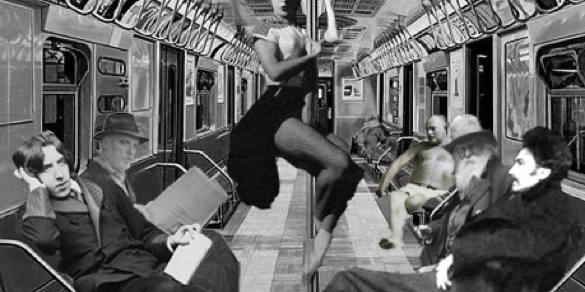
The Z Train to the Insomniacs’ Ball

z train


As when an old film jumps in the projector,

        You will be wading a dun hallway, rounding

        A newel . . .

                             Richard Wilbur :   “Walking to Sleep”


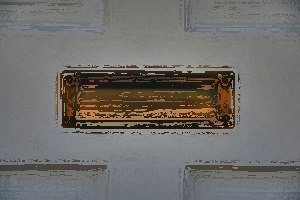
mail slot 2


1

The tick tock clanging of a mail slot

is followed by a thud.  At this ungodly hour?

A typewriter-written invitation lies at your feet.


The Insomniac’s Ball.  Wednesday morning, one to five,

entertainment provided by Stan Kenton’s Big Band

reproduced mono on hi-fi.  Regrets Only.


How do they know that you are one of them,

whoever they are?  How do they know that at three a.m.

you tend to be tapping out trochees on a headboard?


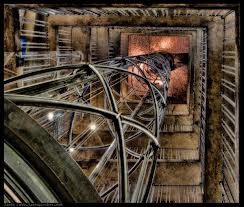
elevator


2

The building isn’t as nice as you’d hoped.  You rise to the third floor

caged in an elevator, the only passenger.  The hall’s

somewhat seedy, the carpet worn, its roses faded.


You have been given the coded knock.  The first six notes of the 2nd movement

of Beethoven’s Ninth.  KNOCK knock, KNOCK knock, KNOCK knock.

The creaking door opening sounds like Bela Lugosi’s coffin


as your eyes adjust to a mazelike apartment, crowded but eerily quiet.

The Stan Kenton LP is scratched, the other guests preoccupied,

unfriendly, drifting through the rented rooms.


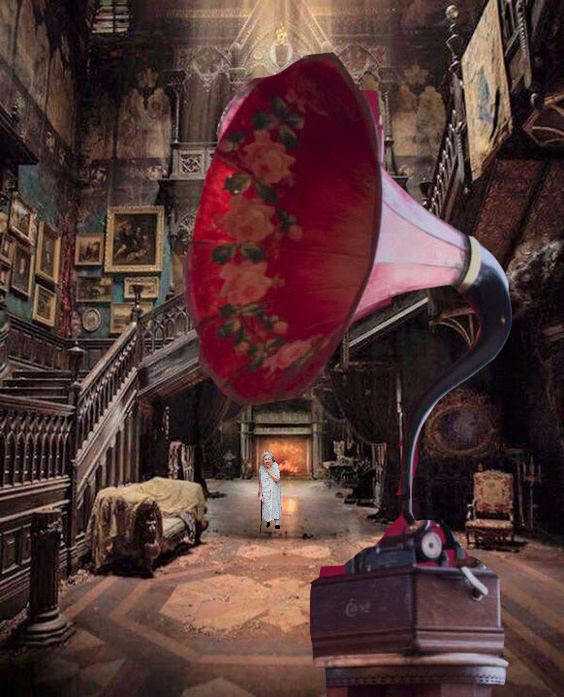
creepy parlor


3

You peek through a door down the hall

and meet the stare of your dead grandfather,

the one whose room you used to tiptoe past,


a medicinal darkness reeking

of the Great Depression.  As you escape, his memories

trail you like a shadow down the hall darkening


the passing stream of old folks, great aunts and former teachers,

rouged and wrinkled, mumbling to themselves,

some in bedroom slippers, others in stilettos.


library10


4

The library’s quite impressive. A ladder runs along a rail

to reach the volumes way over your head: a textbook

in Sanskrit on Chinese mathematics you must master


to pass that class you’ve completely forgotten about!

a course you need for graduation!

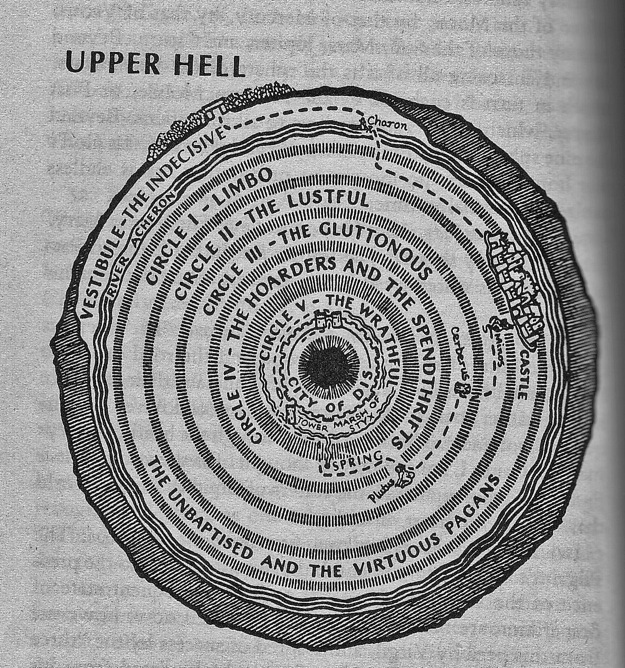
You climb to the top reaching, but then look down


dizzyingly into a snakepit, concentric circles

spiraling with antlike companions from your youth,

descending, swirling, like bloody water down a drain . . .


upper-hell


5

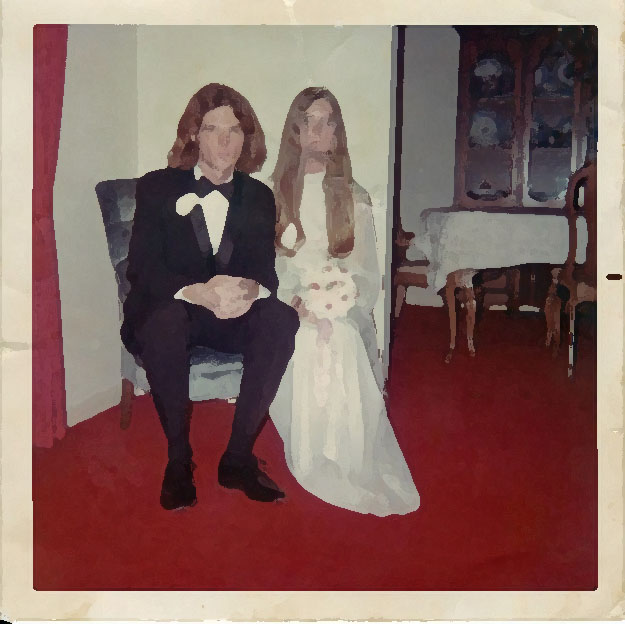
There is a shrine for your departed lovers.  On display

the beds where you once slept preserve the imprint of bodies.

Perhaps a long golden hair lies on the dented pillow,


but you’re not allowed to go beyond the red velvet ropes.

Where are they now – you wonder – what are they doing,

are they even alive, were they ever alive? You’re so


sleepy anything seems possible –

slants of light, cathedral tunes, leaden feet, riveted lips.

Couples waltz by mouthing one-two-three; one-two-three; one-two-three.


rusty and debbie oaint daubs


6

The oncoming day stretches out like a desert,

like the Bataan Death March, like life plus forty.

Thoughts of daytime responsibilities start to ricochet like billiard balls


without transition cold sheets, institutional whiteness, the ICU –

physicians and nurses whispering about your condition:

BEEP beep, BEEP  beep,  BEEP  beep . . .


You ride the rented hearse of sleep home

to twisted sheets, to creeping light, to the bedside’s time bomb’s

tick tock tick tock tick