In my youth, parents, principals, teachers, den mothers, filmstrips, and preachers taught that every action was a reflection of your character.
In fact, it probably went deeper than that: your very thoughts needed to remain pure, ideally never straying from avenues of indoctrination, but at the very worst, if you found yourself hankering to do bad, tempted to wander across the tracks to the dark side of town, that thought had to be doused, snuffed, strangled, eliminated.
Reputation was a commodity of immeasurable worth, more precious that bullion. One misstep could obliterate a lifetime of probity, sullying forever your once good name and by association tarring your otherwise innocent family with the pitch of ignominy.
The public elementary school I attended that taught these lessons blithely ignored the separation of church and state. We prayed to Jesus every morning, were served fish sticks in the cafeteria every Friday. However, the teachers weren’t so much saying that your eternal life was on the line, but that bad habits metastasize like cancers, and the progression downward could be precipitous, a lie begetting a theft, a theft begetting a life of crime, and the next thing you know, you’re wearing stripes in Sing Sing, or in my case, at the Columbia Correctional Institute.
Well, as Mr. Dylan predicted, the times have changed.
Half a century later, at the Episcopal School where I teach, we don’t condemn students’ misdeeds as character flaws but refer to them as “bad choices.” Just because you cheat on a test and get caught doesn’t necessarily mean you’ll cheat one day on your taxes. Impulsiveness is no longer the prompting of Satan but, more plausibly, the product of pubescent chemical imbalances, and even premeditated malfeasance can be attributed to immature brains still in the process of growing, a process that science now claims is not completed for most people until the age of 25.
Although I disapprove of the cliché the phrase “making bad choices” has become, I do think it wise not to declare someone ultimately a bad person for making even a serious moral mistake. If someone thinks he’s inherently bad, like Cal Trask in Elia Kazan’s film of Steinbeck’s East of Eden, he might conclude that fighting his immoral inclinations is a lost cause and use his self-assessment as an excuse to do whatever the hell he wants.
Poor Cal had adopted the persona of a self-romanticizing narcissist, a very bad choice indeed.
How did Orwell and Huxley not predict this dystopian commonplace of Late Empire America – a generation of highly gifted, hypersensitive students in higher education who jolt into Viet Nam vet flashback mode at the mere mirroring in fiction of a situation that once traumatized them? We’re talking situations as insignificant as garden variety bullying, students who police speech the way the KGB policed Solzhenitsyn.
It’s gotten so bad Chris Rock and Jerry Seinfeld won’t play college campuses anymore.
It only takes two generations. The progeny of grandparents who heaved across the Pacific in malodorous, un-air-conditioned steerage take grand mal umbrage if you assume they’re good at math. According to Greg Lukianoff and Jonathan Haidt, “a student group at UCLA staged a sit-in” during a class of an education professor and “read a letter aloud ‘expressing their concerns about the campus’s hostility toward students of color’” because the professor “had noted that a student had wrongly capitalized the first letter of the word indigenous” and “[l]owercasing the capital I was an insult to the student and her ideology.”
I wrote about one instance of this hypersensitivity last February [The Delicate, Censorious Damsels of Wellesley] after reading that outraged students had gotten up a petition to remove a statue that they found offensive (a pasty, slightly overweight bald man sleepwalking in his briefs) because of its “triggering thoughts regarding sexual assault for many[1] members of our campus community.” The key word here is triggering – you see the statue, it flips on a memory of a sexual assault you suffered, so your personal trauma demands that public artwork be censored.
Nagasaki c. 1946
Okay, I’ll go ahead and admit my prejudice. My old man was a tough guy. He was stationed at Nagasaki right after the bomb blast when he was 17. He didn’t talk about it at all, but he did tell me one story when I was in college and he was drunk [trigger warning: depravity] involving a prostitute, a chest of drawers, and a baby’s corpse. I suspect this incident didn’t contribute to the mental health of a seventeen year old, but it didn’t prevent him from watching WW2 movies nor did he demand the world make accommodations for that mischance.
On the other hand, I don’t disagree with Kate Manne’s contention in her Times’ editorial that a voluntary “heads-up” to students on potentially shocking content makes sense — it seems like good manners to me. On the other hand, mandatory warnings on novels like The Great Gatsby are worthy of Swiftean scorn. The reactionary Scots-Irish-English mongrel me says, “If college’s so scary, why not join the army?”
Wallace Steven wrote in “A High-Toned All Christian Woman,” “This will make widows wince. But fictive things/Wink as they will. Wink most when widows wince.”[2]
Nowadays, it’s the most elite of the younger generation doing the wincing. Doesn’t bode well. A wave of fresh immigrants just might do us a world of good.
Is it just I-and-I, or does it seem as if the first Republican Debate took place months ago?
You may remember that spectacle, the game show set, Meghan Kelly grilling the Donald, who hammed his way through the night’s entertainment like Don Rickles at a celebrity roast.
Horse-race-wise, much has happened since early August with Jeb Bush and Scott Walker falling back and Carly Florina and Ben Carson advancing in pursuit of a frontrunner who has put some distance between himself and the rest of the pack.
In fact, three-term Texas governor Rick Perry has pulled up lame, and to put a merciful end to this old nag of a metaphor, it’s hard to imagine donors ponying up much more money for the likes of Graham, Pataki, and Santorum.
If I were a Republican – and praise Darwin I’m not — I’d be hoping to shed a few more of the side show performers because, as we saw last night, eleven is about six or seven too many.
Last Night’s Debate
The good news: the set seemed less like Family Feud; the bad news: even though Ronald Reagan’s Air Force One provided an appropriately phallic backdrop for a debate featuring foreign policy, it was not the Gipper but Richard Nixon who came to mind as sweat beaded on the debaters’ upper lips and brows.
It reminded me of those old movies when cops/bad guys shove a detainee “on the hot seat.” Sweating makes people look uncomfortable, as if they’re lying.
Kudos, though, to whoever runs maintenance at the Reagan Library for saving energy in beleaguered California by keeping the thermostat at a planet-saving 78 F.
Jerry Brown, no doubt, approved.
Did Debate 2 Derail the Donald?
This race has befuddled the pundits, made them gun shy. Conventional wisdom says Trump should have faded by now a la Michelle Bachman or Herman Cain last time around. However, because Trump has thrived after tarring POW war hero senator John McCain, smearing Megan Kelly, etc., pundits are equivocating when gauging Trump’s performance last night, speculating that “maybe the air’s coming out of Trump’s balloon” but then quickly adding “you never know.”
One thing’s for certain, however. The candidates have embraced the Trump meme that America is in decline and that each of them is the man or woman who can restore us to greatness.
Oh, for the halcyon days of the second Bush Administration when the economy was in free-fall, financial institutions failing, and ISIS was in utero!
So far, I’ve seen two episodes of the Late Show with Stephen Colbert, Thursday’s and Friday’s broadcasts, and I thought that the Thursday interview with Joe Biden was captivating television. From the time Biden walked out, despite the mega-wattage of his smile, you could see in his eyes he was grieving, and Colbert dove right into the subject of Biden’s son Beau’s recent death, segued to Biden’s losing his first wife and his eighteen-month-old daughter in an automobile accident in 1972.
It was as if Colbert, a devout Catholic, who lost his father and two brothers in a plane crash in 1974, were holding a mirror up to himself when he asked Biden, a devout Catholic, about the role his faith had played throughout his travails. Furthermore, Colbert scored an enormous scoop by coaxing from Biden that he was not emotionally strong enough to run for president. It was uncomfortable to watch Biden in pain, but also life-affirming to witness his courage, and it was authentic, Colbert and Biden both speaking sincerely. I can’t imagine either of the Jimmys pulling off the Biden interview (Kimmell maybe, Fallon no way, and certainly Colbert’s alter ego from the Report would have had a hard time as well). Authenticity in late night television is as rare as a pro golfer without logos.
Lennon and Snyder
That interview reminded me of poor old long forgotten Tom Snyder and his Tomorrow Show where you could witness Snyder interviewing, sometimes grilling, the likes of John Lennon or Ayn Rand.
Dick Cavett also comes to mind. Cavett’s reruns are still entertaining today (unlike, say, old Carson interviews or watching 30 years from now Colbert’s Friday night interview with Amy Schumer). Although I’m fairly certain 62-year-old snobbish males who eschew Hollywood’s focus-group-tested movies isn’t the demographic CBS is dying to win over, I wish that Colbert would shoot for something more substantial than that Schumer interview.
It was even more boring than the Stephen King interview that followed. In fact, the Schumer conversation reeked of narcissism as she and Colbert gushed about hanging together at so-and-sos not all that long ago and then gushed about other celebrities they hang with, and then we got to see Amy drunk eating a cake in a home video and to hear both of them boast about being slackers in high school and then apologizing on air to two of their former teachers.[1] The self-congratulation meter was registering way up there at the danger level, like Dr. No’s underwater compound about to blow.
Of course, it might take some time for Colbert to shed his former persona and don a new one, and the show hasn’t had time to iron out its kinks, but Stephen’s entrance where he party dances with his bandleader Jon Batiste needs to be dialed down, and the audience itself comes off like a bunch of trained seals who have been injected with ALKS 5461. Also, I wish they’d hire someone to do the voiceovers announcing the line-up instead of Colbert’s doing it.
Enough carping. Not only is Stephen Colbert brilliant (his fast-draw witticisms during interviews rank right up there with Groucho’s) and charming, but he’s probably the only late night host working who has read Kierkegaard. I wish him the very best in a medium whose repetitious format gets really old really fast. As brilliant as the John Stewart’s Daily Show was, I eventually quit watching it because of the same ‘ol, same ‘ol.
Still, if Colbert can pull in interesting people (Phillip Roth instead of King, say, Björk instead of Schumer), then who knows?
[1] I actually teach at Colbert’s high school alma mater, and the teachers who taught him didn’t consider him a slacker but a quiet, polite kid who had been through hell, starred in the musical, and was into Dungeons and Dragons.
Kim, Davis, the Rowan County Kentucky functionary who refuses to issue marriage licenses to homosexuals because doing so violates her Christian values, has been married four times.
Jesus on homosexuality:
Jesus on divorce: “I tell you that anyone who divorces his wife, except for sexual immorality, and marries another woman commits adultery.” Matthew 19:9.
I’m assuming the reverse must be true, that anyone who divorces her husband . . .
True, St. Paul was not a fan of “the love that dare not speak its name,” and his garden variety homophobic First Century proclamations against what we now know is hardwired genetics made it into the Canon, but then again, as St. Stephen might have said to pre-conversion Paul, he who is without sin . . .
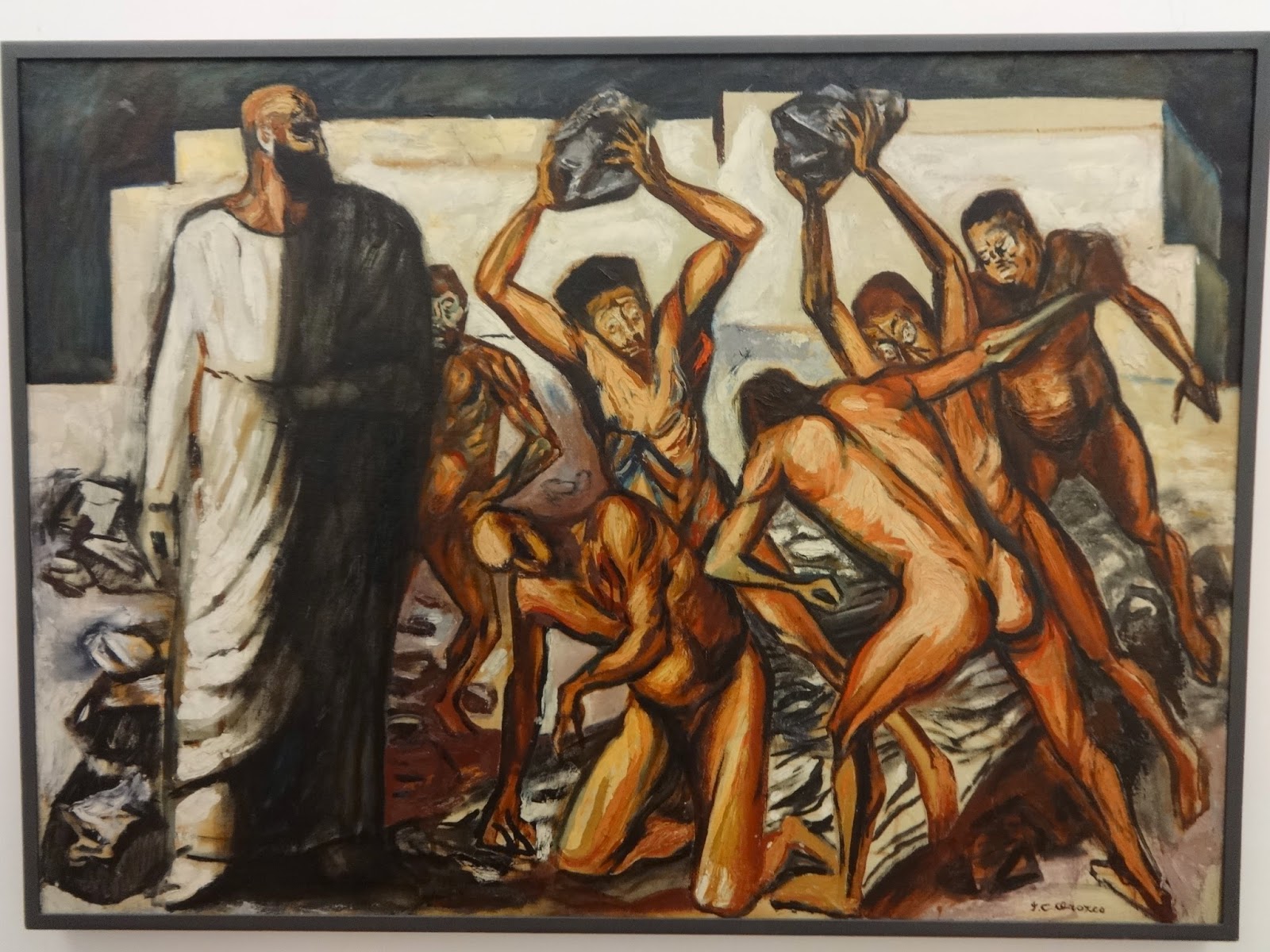
The Martyrdom of Saint Stephen, by José Clemente Orozco
But I’m not here to cast stones (despite the above pebble flinging) but to offer common sensical solutions to the problem.
I think the worst possible scenario (not involving AK-15s) is Mrs. Davis’s getting fined and relenting and then issuing licenses to “sodomites” and therefore demonstrating to the wired world that her religious convictions have a price, never mind that she gets to cherry pick her religious convictions as far as the New Testament and homosexuality and divorce are concerned.
If I were believer, I’d take Jesus’s proclamations more seriously than Paul’s, but obviously Mrs. Davis doesn’t.
She could become a 21st Century martyr in the Age of Hyperbole by resigning or getting fired but would be immediately forgotten and jobless in a state that brings to mind coal mines rather than lilies, fields.
I have a better idea. How about transferring Mrs. Davis to another department in the county? Firing even po-dunk governmental lowlings is tedious and, like almost everything else in government, non-expeditious. We are, fortunately, a nation of laws, and drawing out this lawlessness for the entire world to see is counterproductive (not to mention embarrassing).
Transferring her to a clerical position not involving issuing marriage licenses might facilitate “a happy issue out of all our afflictions.”
I guess I was one of the last English majors to be trained to look at literature through the supposedly un-tinted lens of what used to be called New Criticism.
New Criticism demanded we look at and judge a poem, play, story, or novel according to its architectonics and organic synthesis. In other words, it was the imposition of the scientific method upon the creative product, a detached analysis of how parts fit into a whole to highlight some sort of significant statement about what it means to be human. Call me hidebound, but I prefer New Criticism, which now goes by the moniker of “formalism,” to reader-response criticism, semiotics, new historicism, etc.
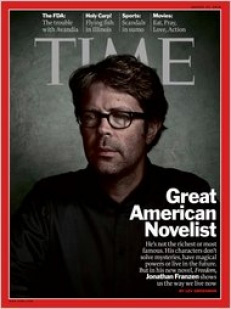
So I’m not much interested in Jonathan Franzen’s biography, his Midwestern roots, his literary heroes, his divorce, his love of birds and disdain for predatory house cats. I’m not interested in judging him as a human being; I am, though, interested in his art, his novels’ architectonics, character development, and entertainment value – not necessarily in that order. Even if Franzen himself in an essay on Edith Wharton claims that “a fiction writer’s oeuvre is a mirror of the writer’s character,” I’m not interested in writers’ characters or personalities; I’m interested in their books.
Why Creative Artists Frequently Hold Critics in Disdain
I’ve started to write I don’t know how many novels but only finished two, both of which were comic and featured adolescent protagonists, so I didn’t have to wrestle with the complexities of adulthood nor fear the consequences of failing at trying to create a serious work of art. Nevertheless, even in the construction of those piddly narratives, I suffered a bit in that I ended up spending hour after hour locked in the sordid little garret of my own unconscious, not a very pleasant or healthy place.
Writing a novel is hard. Faulkner, who cranked out As I Lay Dying in 6 weeks, said writing a novel is like “trying to nail together a henhouse in a hurricane.” Of course, the English form has its roots in the 18th Century and especially flourished in the 19th when middle class people needed something to do during those long, gaslit but wirelesses nights. Back then, many considered novels unhealthy, the way my father thought my reading comic books was unhealthy, the way some parents think playing video games is unhealthy. Another oft-employed metaphor in this context is junk food. Think of Paradise Lost as a banquet and Monk Lewis’s The Monk as a big bag of licorice jellybeans.
According to Marc McGurl’s The Novel Art: Elevations of American Fiction after Henry James, before James no one thought of a novel as a work of art, and, of course, James Joyce’s Ulysses demonstrated not only that a novel could be a work of art, but it could also be high art. So I say J. Joyce and H. James have made the serious novelist’s work more difficult because now this genre that has its origins in entertainment and costs a lot to produce and market needs to be ideally both high art and entertaining, and when’s the last time you’ve seen someone on the subway reading a paperback edition of Absalom, Absalom?
When critics do their jobs and judge books and find them lacking, so-called creative writers sometimes mock the critics as functionaries (muse-less hacks), or worse, vampires (parasites living off of someone else’s creativity).
Not surprisingly, Yeats has expressed these sentiments as well as anybody:
Don’t get me wrong. Lorentzen’s review is in many ways brilliant and unequivocally very entertaining. The cat is a superb stylist and, as we say on Folly Beach, knows his shit. In fact, I laughed out loud in the bar where I was reading the review when I read this sentence:
Franzen proves adept at telling an old-fashioned murder story, even if he pounds the notes of guilt and shame a little too hard with his Victorian hammer.
However, despite his protests otherwise, you can’t help get the impression that Lorentzen really dislikes Franzen the man. I’ve added the italics:
Prisoner of a too-early, too-idealistic marriage premised on mutual artistic success, a taste of which he got and she didn’t. En route to a divorce colored by his wife’s failure to sell a book, confusing the end of love with rage against environmental devastation, trying in vain to sell out with a dud of a screenplay that sublimated his marital crack-up. Depressed and penniless divorcé, coping with writer’s block and his own competitive instincts in the face of his friend’s magnum opus, Infinite Jest, by trying to figure out what it means to be a reader. Resurgent literary champion, reaping the rewards of a decade’s struggle but always prone to media gaffes. Advocate and lover of birds, even if it sometimes seemed the ornithologist-novelist was copping a move from the lepidopterist Nabokov. Time cover boy with a net worth reported to be in the eight figures, but always generous to younger writers as well as select literary forebears. Failed television writer (when HBO preemptively canceled a series adapted from The Corrections) and pained bystander to his brilliant friend’s suicide, an awful thing to endure, however muddled Franzen’s public response (“suicide as career move”?) has sounded. Scourge of online culture, an endearingly Sisyphean self-appointment. I confess I find Franzen the man sympathetic at every turn. I only wish that next time he returns with a novel that isn’t a bad date.
Only 6 of the 21 paragraphs of the review deal with Purity, and given the above, it’s not surprising that Lorentzen finds the novel lacking. Its “execution is shoddier” than that of TheCorrections and Freedom, its “[b]its of sociology break the spell of a convincing present.”
Franzen in 1977
For whatever reason, lots of people seem to have it out for Franzen, people like Matt Yglesias, whose writing I dig. They tend to develop a real animus for Franzen. Do they find him smug, too contemporary, too ambitious? Was Franzen that kid in school whom everyone picked on?
All I know is that I find his novels entertaining, and I care about his characters. From The Corrections I know what having Alzheimer’s feels like, and I also know that creating realistic characters and placing them in three-dimensional spaces is really, really difficult, like, um, “nailing up a henhouse in a hurricane,” so I’m inclined to give novelists more slack.
I know, I know, creative and analytical intelligences are very different (I suspect that Mrs. Harold Bloom isn’t packing heat, even in her purse), and critics must do their jobs, but every once in a while, before they start gathering their stones, they ought to at least sit down and try to write a sonnet.
Anyone who regularly reads this blog knows that it’s rife with typos, misspellings, and undiscovered auto-corrects.
Who’s Whose fault is this you ask?
Not mine, damn it. I proofread several times.
Why then all the errors?
It’s because I’m almost as auditory as Ray Charles (minus the musical talent). I don’t see words, I hear them, and after a couple proof-readings, they completely disappear.
So you possess visual detail perceptual differences?
Yes, I’m a ducking imbecilic moronic retread when it comes to detecting typographic details, and I blame my father for this.
So you’re blaming your dead father for your own inability to focus on the arrangement of the Roman alphabet to insure its sequencing conforms to standard usage? Genetics are to blame then?
No, not genetics. By rocking me to sleep each night until I was pushing three, my father rewired my brain so that auditory images have stunted my capacity to process visual imagery. I’m a throwback to the Homeric ages, to the Skops of the Anglo-Saxons. I can recite poetry from memory like an iTunes playlist but can’t manage sometimes to find words like “initiatives” in a dictionary.
You poor man.
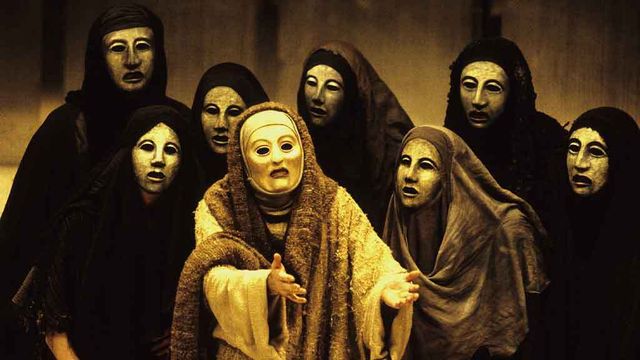
There’s more. Not only did my father stunt my ability to process visual keys, his choice of lullabies created in me a tragic view of the world. We’re talking a heavy dose of Stephen Foster and a host of cowboy songs that are about as upbeat as your typical Greek chorus.
Here are few examples of Daddy’s standards.
He might start off with something like Stephen Foster’s “Hard Times Come Again No More”:
There’s a pale drooping maiden who toils her life away,
With a worn heart whose better days are o’er:
Though her voice would be merry, ’tis sighing all the day,
Oh! Hard times come again no more.
‘Tis a sigh that is wafted across the troubled wave,
‘Tis a wail that is heard upon the shore
‘Tis a dirge that is murmured around the lowly grave
Oh! Hard times come again no more.
At least we don’t know the “pale, drooping maiden’s name” or the color of her hair, unlike in the plaintive “I Dream of Jeannie.”
Her smiles have vanished and her sweet songs flown,
Flitting like the dreams that have cheered us and gone.
Now the nodding wild flowers may wither on the shore
While her gentle fingers will cull them not more:
Oh! I sigh for Jeanie with the light brown hair,
Floating like a vapor, on the soft summer air.
Then there was the “Streets of Laredo”
“Then swing your rope slowly and rattle your spurs lowly,
And give a wild whoop as you carry me along;
And in the grave throw me and roll the sod o’er me.
For I’m a young cowboy and I know I’ve done wrong.”
“Go bring me a cup, a cup of cold water.
To cool my parched lips”, the cowboy then said.
Before I returned, his soul had departed,
And gone to the round up – the cowboy was dead.
We beat the drum slowly and played the fife lowly,
And bitterly wept as we bore him along.
For we loved our comrade, so brave, young and handsome,
We all loved our comrade, although he’d done wrong.
However, the song I remember that most haunted me was the pathetic and cruel “Bury Me Not on the Lone Prairie.”
“I’ve always wished to be laid when I died
In a little churchyard on the green hillside
By my father’s grave, there let me be,
O bury me not on the lone prairie.”
“I wish to lie where a mother’s prayer
And a sister’s tear will mingle there.
Where friends can come and weep o’er me.
O bury me not on the lone prairie.”
“For there’s another whose tears will shed.
For the one who lies in a prairie bed.
It breaks my heart to think of her now,
She has curled these locks, she has kissed this brow.”
“O bury me not…” And his voice failed there.
But they took no heed to his dying prayer.
In a narrow grave, just six by three
They buried him there on the lone prairie.
And the cowboys now as they roam the plain,
For they marked the spot where his bones were lain[1],
Fling a handful o’ roses o’er his grave
With a prayer to God his soul to save.
By the way, any idea how you spell yippy-i-ti-aya?
Pangloss Academy is a non-profit independent school dedicated to providing affluent children with the self-confidence they’ll need to navigate an increasingly stressful world. Study after study has shown that self-confidence trumps intelligence in most everyday situations — like those fraternity and sorority rushes of college, the cocktail parties of young adulthood, and the parent/teacher conferences of middle age. Who’s more likely to get her way in an exclusive retirement facility, a wizened mathematician or confident, forceful Pangloss alum?
We believe that success breeds success. Our curriculum has been engineered to insure every one of our students graduates with a 4.0 GPA. While the children of your friends and neighbors are developing negative self-images as they struggle with high stakes Common Core exit tests, your sons and daughters will be accumulating confidence as they ace test after test.
For example, let’s take a peek at Pangloss’s exit exam for juniors.
* * *
PLEASE, PLEASE, PLEASE DO NOT OPEN TEST BOOKLET UNTIL INSTRUCTED BY YOUR PROCTOR.
The following test will determine how much common sense you possess, and you know and I know you’re going to ace this test because you’ve aced every single other test you’ve taken. This sequence of success is called a pattern, and being able to recognize patterns is what success is all about.
Although the test is short and sweet, you have up to four hours to complete it, and don’t forget that if for some unheard of reason you don’t make a 100, you can retake the test as many times as you like until you’ve mastered the material.
Each of you has been provided with a sharpened number 2 pencil with an excellent eraser. If you find that you do make a mistake and need to erase, please raise your hand, and one of the proctors will come by and erase it for you to insure that the answer sheet is not smudged and the Scantron picks up the correct bubble.
Okay, ready. Please open your booklet.
Like every single test you’ve taken at Pangloss, this test consists of multiple choice and short answer questions. Please darken the appropriate bubbles in the multiple-choice section and write your responses to the short-answer questions in the blue books with the smiley faces you’ve been given.
Okay, let’s try the practice question. Darken the bubble of the letter that best answers the following question.
What is the second letter of the alphabet?
A. A
B. B
C. C
D. D
Yes, B’s the correct answer.
When you complete the exam, raise your hand, and one of the proctors will take it up and give you a coupon for a free ice cream cone at Ben and Jerry’s.
Turn the page and begin.
Multiple Choice
1 -4. Place the following historical events in the correct chronology. Place the letter of the answer that occurred first for number one, the letter of the event that occurred second in number two etc.
A. The 2016 presidential election
B. The extinction of the dinosaurs
C. World War II (2)
D. The building of the Egyptian Pyramids
5. Who wrote Beethoven’s Fifth Symphony?
A. Amadeus Wolfgang Mozart
B. The Mamas and the Papas
C. Ludwig von Beethoven
D. Johannes Kepler
6. Beethoven wrote nine symphonies. What symphony did he write after his Fifth?
A. Sixth
B. Second
C. Ninth
D. A Concerto for Violence
7. Who is the main character of Shakespeare’s famous tragedy Hamlet?
A. Hamlet
B. Gertrude
C. Clown (gravedigger)
D. William Faulkner
8- 11 Place the following in ascending order from smallest to largest in relation to its size with the smallest going in number 7, the next larger in number 8, etc.
A. an atom
B. a swimming pool
C. Lake Erie
D. The Indian Ocean
You’ve now competed the multiple-choice section. Remember to write the answers for the following questions in the blue book with the smiley face on its cover. You don’t have to write in complete sentences, but if you want to, that’s okay, too.
Short Answer Questions
Do you own a dog?
What do you call either your grandmother or grandfather, you know, Paw Paw, Nana, etc. If you don’t have any grandparents, what do you call your mom and dad?
This year you’ve studied American literature. Name one author you’ve studied. (If you draw a blank, see number seven of the multiple-choice section).
In math we learned about pi, π, a mathematical constant, the ratio of a circle’s circumference to its diameter. This ratio is commonly approximated as 3.14159.
Draw a circle.
Pi has a homonym spelled p-i-e. Homonyms are words that sound alike but have different meanings. From the perspective of looking straight down from above, draw a picture of a pie. What do the two drawings you have made have in common? What is the approximate ratio of their circumference to their diameter. Carry the decimal point to five places. (See number 4).
What reward to you get when you finish this test?
You’re done. Now raise your hand to receive that coupon for a free ice cream cone!
I’m not at all shocked that Atticus Finch, the “saintly” father of the narrator of To Kill a Mockingbird, ends up a racist in its just published sequel Go Set a Watchman.
As a matter of fact, Atticus is a racist in Mockingbird as well, albeit a benign racist who won’t allow his children to use the n-word but who does nothing to change the status quo of segregation in the tiny Alabama town where the novel is set.
In fact, I dare say that it would be very difficult to find a native Southerner born around 1900 who was not in some degree a racist.* Although I was born half-a-century later, the doctor offices of my hometown had both “white” and “colored” waiting rooms. I never heard a soul complain, yet our townspeople weren’t monsters, merely benighted.
Being a racist didn’t necessarily mean you were overtly cruel or weren’t compassionate but that you held blacks to be inherently inferior and believed that the races should be segregated.
No one better exemplified the paradox of compassionate racism than my father.
*Perhaps we could make this charge to the nation in general. Though no Southerner, Ernest Hemingway was certainly a racist, as his letters make abundantly clear.
* * *
One Easter Sunday as we pulled up to my grandmother’s house after church, a ten-year-old black boy approached our car and asked for some money to buy a pair of shoes because he had none to wear to his brother’s funeral. My father not only gave the boy, whose name was John-L, the money but also a ride home, and when Daddy discovered the utter squalor John-L lived in and that both his mother and her lover were “drunk as skunks,” he took John-L home with us where he lived for the next two weeks. However, despite this act of compassion, which made us very unpopular with our neighbors and me the target of racial taunts, my parents didn’t allow John-L to bathe in our tub.
It’s mind-boggling but true.
* * *
An admission: I’ve never been a fan of To Kill a Mockingbird, probably because I didn’t first read it as child but as a 32-year-old preparing to teach it to Reagan Era 9th graders.
It’s interesting that all the folks that are buying [To Kill a Mockingbird] don’t know they are buying a children’s book.
Flannery O’Connor
Although the novel effectively portrays the day-to-day lives of Depression-era smalltown Alabamans, the plot is episodic and the characters one-dimensional. For example, Mockingbird’s antagonist Robert E Lee “Bob” Ewell makes Simon Legree of Uncle Tom’s Cabin look like a saint in comparison. On the plus side, as Michiko Kakutani points out in her front page New York Times review of the new novel, in Mockingbird Lee masterfully manipulates Scout’s point-of-view, “managing the stereoscopic feat of capturing both the point of view of a forthright, wicked-smart girl (who is almost 6 when “Mockingbird” begins) and the retrospective wisdom of an adult.” This rendering of life through the eyes of a six-year-old no doubt influences the reader’s assessment of Atticus and somewhat masks his racism (and also explains why no one in the entire town seems to engage in sexual intercourse).
Coincidentally, yesterday Kakutani’s review shared space with a story about the removal of the Confederate battle flag from the South Carolina’s State House grounds. Perhaps Shakespeare’s Marc Anthony’s observation that “The evil that men do lives after them;/The good is often interred with their bones” holds true. At least Atticus got to enjoy 55 years of being considered “wise, honorable, an avatar of integrity,” words that very well might in some ways describe Bob Ewell’s namesake, the slave owner Robert E Lee.
The situation in the South was and is more complicated than the unsubtle strokes of black and white that Lee depicted in Mockingbird; it sounds as if her “new” novel reflects a more complex world, but then again, maybe not. Perhaps in Watchman Atticus is all-ogre all the time.
This summer I’m compiling a “Reader” for the British Literature survey I teach. We figure since we have a millennium-and-a-half of material in the public domain, why not compile our own texts and give them to students “for keeps” so they can annotate passages and eventually carry the books with them to college (if any be so foolish as to major in English).
My man G. Chaucer by far is the most time-consuming to download and format because of footnotes and marginal glosses, but I’ve had fun adding archaic words to my vocabulary, and I’ve started including some Chaucerian locutions in casual conversations.
For example, “How was Chico Feo, Ned?”
“Great. Greg was there, but he was really drunk.”
“Fordrunken, was he?”
Here’s another: Shamefastness. Any idea of what that might mean?[1]
Lee Bright as Bottom
Anyway, I took a break yesterday to take in a bit of the televised flag debate, and, of course, the stealer of the show — the thef of the feste – was Lee Bright, whose surname strikes me as inapt, given as a thinker he seems so [forgive me] inept. I suspect poor Lee is all too familiar with sardonic puns on his name, and only a churl like I-and-I would stoop to such.
Chaucer might say of Senator Bright, “He [knows] not Cato, for his wit [is] rude,” or to put it much more crudely, we might borrow Thersistes’s description of Agamemnon from Shakespeare’s Troilus and Cressida: Bright “has not so much brain as ear-wax.”
It appears that Bright’s education is limited to Dorman High School, from which he received a diploma in 1988, but this lack of learning didn’t disqualify him from serving on the school board or being on the Board of Visitors at the Southeastern Baptist Theological Seminary or from thinking he knows what a high school biology curriculum ought to look like. Not that a college degree insures success or demonstrates intellectual curiosity. Yeats and Faulkner lacked one, and George W Bush sported two, one from Yale, the other from Harvard. Nantheless, as Chaucer might say, based on yesterday’s speech, Bright makes W look like Cicero.
Although the speech was supposed to address whether the Confederate flag should continue to fly on the State House grounds, it ended up an inchoate rant, a poisonous, disjointed catalogue of disparate issues expressed in hopelessly entangled syntax. He began by saying he heard President Obama singing “a religious hymn” then bemoaned in an emotion-choked voice that he had seen the White House “lit in the abomination colors.” He urged the “Church to rise up.” Claimed that our nation was founded on “Judeo-Christian principles” and “was under assault by men in black robes who were not elected by you.” He then sputtered that he “would like to see the folks working as, in the positions of dealing with, the marriage certificates not to have to betray their faith or compromise their faith in order to subject themselves to the tyranny of five judges.” He admitted that the Governor had called the special session to deal with “the flag that sits out front” but urged the body instead “to deal with the national sin that we face today.”
“And to sanctify deviant behavior from five judges,” he continued, but left the phrases airborne (and me wondering just what deviant behavior the judges had been engaging in) to shift to the exhortation that “it’s time we made our stand in church.” Then in a voice choked with emotion, in a sort of half sob he said, “We can rally together and talk about a flag all we want, but the Devil is taking over this land, and we’re not stopping him.” Then he warned, “If the state’s got to get out of the business of marriage, then let’s get out of the business of marriage because we cannot succumb to what’s being done to the future of this nation.” He offered a concession by admitting that Christ has taught us to “love the homosexual” but that he also “teaches us to stand in the gap against sin” and that “we cannot respect this sin in South Carolina.” He ended the oration by describing the government of the United States of America “a tyrannical government.”
Perhaps some might agree with John, the cuckolded carpenter and champion of anti-intellectualism in the “Miller’s Tale”:
 In my youth, parents, principals, teachers, den mothers, filmstrips, and preachers taught that every action was a reflection of your character.
 Although I disapprove of the cliché the phrase “making bad choices” has become, I do think it wise not to declare someone ultimately a bad person for making even a serious moral mistake. If someone thinks he’s inherently bad, like Cal Trask in Elia Kazan’s film of Steinbeck’s East of Eden, he might conclude that fighting his immoral inclinations is a lost cause and use his self-assessment as an excuse to do whatever the hell he wants.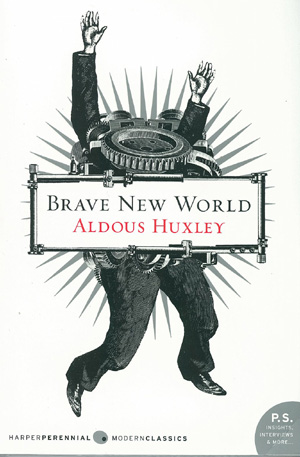













 You Do Hoodoo