Shadow Boxing Earlier in the Day: Clay vs. Ali

cassius_clayIn my boyhood, before adolescence, I began each day by retrieving the newspaper from what we called the front porch, though, in truth, it was more like an elevated stoop, a 6 x 6 concrete slab. If there were a big story, like the suicide of Marilyn Monroe, I’d read it right there, or if there were an untelevised sporting event I cared about, I’d rip open the sports section to discover the outcome. That was the case on 25 February 1964 when Cassius Clay, as he was called in those days, upset Sonny Liston for the Heavyweight Championship of the World. It was the outcome I had fervently hoped for, and it had happened, despite 7 to 1 odds. I remember sitting on the steps of the stoop, reading the account that included the accusation that Liston had thrown some type of blinding powder in Clay’s eyes.

My father had been an amateur boxer in his youth, a welterweight who developed his skills on the sidewalks of Spring Street in Charleston, SC, during the Depression. Every Friday night he’d watch the fights broadcast on the Gillette Cavalcade of Sports as he sat on the sofa smoking cigarette after cigarette, leaning into the television, screaming suggestions to the combatants even though they were hundreds of miles away at Madison Square Garden. He had bought my brother and me boxing gloves and roped off the living room and taught us how to box, to crouch, to throw punches with our “hips” instead of our “arms.” I hated it, being at once weak, blinky, and adverse to pain.

My father in his Spring Street Days, aged 15

My father in his Spring Street Days, aged 15

But I did enjoy watching the matches, and we liked “Cassius Clay,” because he was funny, brash, clever, a rhymer, and, I’m sorry to say, perhaps because he was “light-skinned,” unlike Sonny Liston and Joe Frazier.   Clay, and later, Ali, was also too aware of this distinction in skin tones. Here’s a snippet from Robert Lipsyte’s superb obituary from the Times:

But Ali had his hypocrisies, or at least inconsistencies. How could he consider himself a “race man” yet mock the skin color, hair and features of other African-Americans, most notably Joe Frazier his rival and opponent in three classic matches? Ali called him “the gorilla,” and long afterward Frazier continued to express hurt and bitterness.

Ali would also play upon racial and ethnic stereotypes. Here is a joke he told at a fundraiser in Louisville in 2005:

“If a black man, a Mexican and a Puerto Rican are sitting in the back of a car, who’s driving? Give up? The po-lice.”

And here he is explaining to a Soviet reporter in 1960 why he’s proud to be an American citizen.

“It may be hard to get something to eat sometimes, but anyhow I ain’t fighting alligators and living in a mud hut.”

In some ways, like my father, he was a man of his times.

However, even though these quips might have gotten Ali dis-invited from a speaking engagement at Oberlin, in the course of his life, he displayed more courage than any other athlete I can think of. Ali was a man of his convictions, willing to make unpopular brand-tarnishing decisions like converting to the Nation of Islam and facing the prospect of prison for refusing to be drafted into the Viet Nam War. “I ain’t got nothing against them Vietcong,” he said, adding, “They ain’t never called me no [racial expletive].”

And Ali sacrificed three prime years when boxing commissions around the country stripped him of his titles, and although the backlash was fierce and many journalists refused to call him by his new name, he earned the respect over time for his principled stands, and, even my father, not exactly a devotee of Malcolm X, continued to pull for Ali upon his return to the ring.

Perhaps it was because Ali was such a beautiful, graceful fighter, poetry –not doggerel — in motion or because he was so witty, possessed such a generous spirit, and these attributes transcended by father’s homegrown prejudices.  Later in life Ali said, “Color doesn’t make a man a devil. It’s the heart and soul and mind that count. What’s on the outside is only decoration.”

At any rate, it says something positive about our nation that at his death Muhammad Ali was virtually universally admired by his fellow citizens, even, it would seem, Donald Trump.

All leave you with this ditty from the great Bob Dylan:


I was shadow-boxing earlier in the day

I figured I was ready for Cassius Clay

I said “Fee, fie, fo, fum, Cassius Clay, here I come

26, 27, 28, 29, I’m gonna make your face look just like mine

Five, four, three, two, one, Cassius Clay you’d better run

99, 100, 101, 102, your ma won’t even recognize you

14, 15, 16, 17, 18, 19, gonna knock him clean right out of his spleen”


dylan-ali-2-300x201

The Whatness-of-the-Right Now

06_10_018861Chapter 1: Losses and Gains

I’m a 47-year-old man who’s lost a portion of my left leg to diabetes, my erstwhile wife to — and I’m not making this up — a yoga teacher ten years her junior.

I would like to think, however, that through these two rather major subtractions, I have gained a greater appreciation for what I’ve come to call the Whatness-of-the-Right Now (WORN), Now I pay heed to the slow softshoe of the keyboard’s clicking, note the redness of the Bic lighter lying next to my empty coffee cup, the grain of the walnut of this desk that once was a tree, the steady samba sway of the branches of magnolia outside my study’s smudged window panes.

As that master of the Whatness-of-the-Right-Now, Van Morrison, once scatted, “It ain’t why why why why why; it just is.”

So I’ve tried to jettison the dichotomy of wise and unwise and replace it with interesting versus uninteresting, which, of course, is inviting Old Man Trouble to crash on your couch. Also, I guess I should mention I have a 17-year-old daughter Bronwyn whom I’m attempting to nudge in the right direction, i.e., a path that leads to happiness. Of course, at her point in life, WORN and opting for what’s-interesting over what’s-not-interesting is as foolish as encouraging her to read The Sound and the Fury in the dad/daughter book club we’ve formed. [1]

Dad, I’ve decided to go to the all-night rave in a club downtown instead of the Drama Club production of Annie. The rave sounds more interesting. Yes, I have my fake ID! Jeez, Dad!

The thing is, though, when WORN kicks in, everything is interesting – even the logo of the Allstate bill that lies next to the empty coffee cup.


images

Why blue?

Are the hands about to receive a communion wafer?

Are we the communion wafer?

Are they the Hands of God?

How come the A is listing to the right?

How much was the creator of the logo paid?


Hang Outs

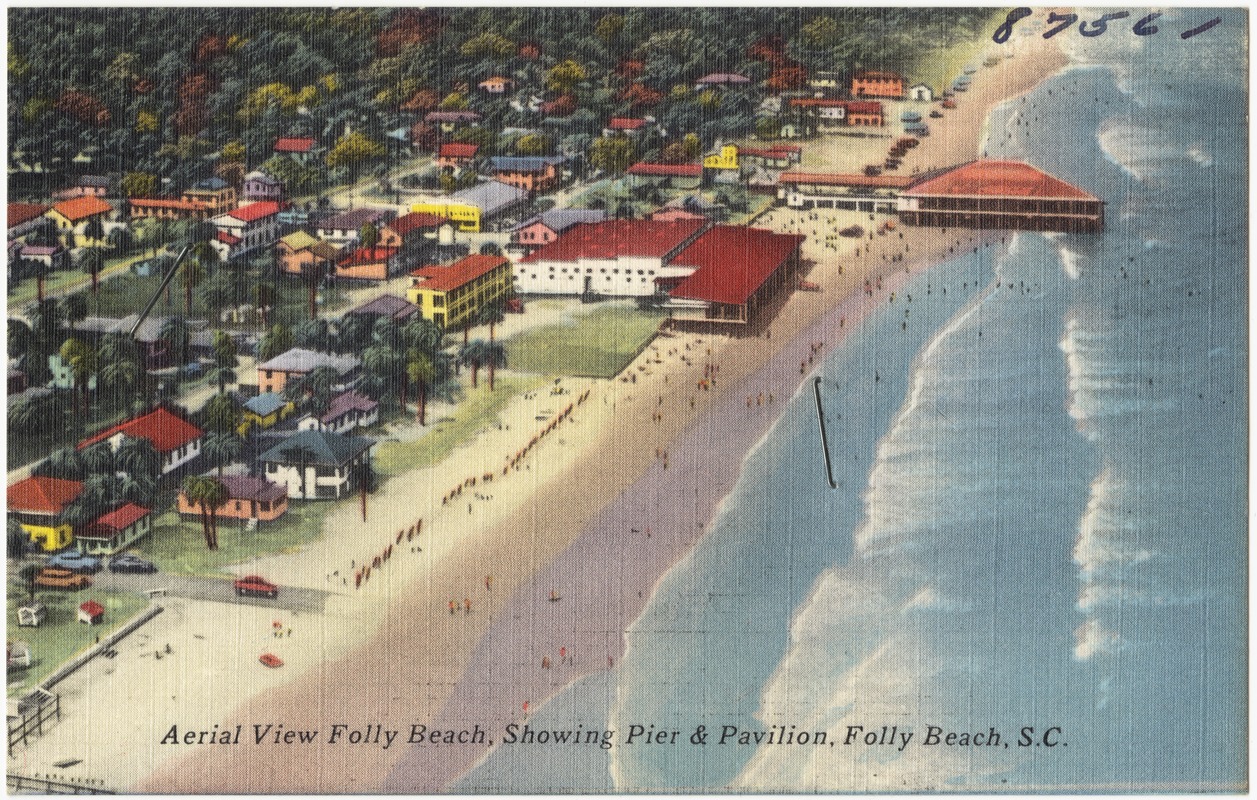
After our divorce, Gwen and I sold our house on Limehouse Street in Charleston, SC, and I moved to a barrier island called Folly Beach, the most bohemian of Charleston’s beaches. I live on the backside facing the Folly River in a small one-story, two-bedroom bungalow propped on pilings, but my study faces the front of the house because I don’t want the constant Darwinian dissonance of pelican plummet – splash – or the baby-butchering sounds of raccoon sex — or the insect-like buzz of  jet skis to distract me as I try to put into words what is happening.

After the amputation, which I prefer to call dismemberment, I retired from my job as the arts editor at the paper and became a househusband, which drove both Gwen and Bronwyn crazy. Did I mention I am a smoker? An occupational hazard in journalism and a must-not for diabetics. Of course, I smoked outside on the verandas (there were two, one upstairs, one downstairs) running along the front the house (whose side faced the street in typical Charleston fashion), but even my smoking on the porches irritated spouse and daughter. Also, I had erectile issues, not-exercising issues, Jameson whiskey issues (another diabetic no-no); nevertheless, Gwen’s affair with the vapid spike-haired Brandon I could have not imagined; her moving out on me and in with him after 22 years of marriage seemed almost goddamned cartoonish. In this case life imitates unimaginative romantic comedies.

Milton’s Satan, one of my boyhood heroes, says that “sometimes solitude is best society,” and I get plenty of it now, but I do every afternoon, depending on my mood and/or the weather, visit one of two Folly Bars, Chico Feo or The Jack of Cups. 


Chico Feo is right across Second Street East from Berts, a small grocery store that’s been in operation for 60 years. I guess you could call Chico Feo an alfresco dining experience featuring Caribbean cuisine or a funky drinking establishment without a roof. It’s in the backyard of an old un-air-conditioned two-story house where they prepare the food, goat curry, beans and rice, tacos.  The bar forms a barrier to the back door of the house where the kitchen is located. Beers are retrieved from coolers, or rather, large ice-filled tubs. Throughout the day whatever bartender’s on duty — Charlie, Tyler, Paul, or Greg — makes the trek across the street to Bert’s to procure more ice.

Chico Feo is only six blocks from my house, so I ride my bike, adding to the island’s quirky charm, a one-legged man with a notebook in his hand peddling a mountain bike on a flat barrier island. By the way, prosthetic legs have come a long way since Flannery O’Connor’s Hulga stumped her way up into the hayloft and into the arms of Manly Pointer. I opted for functionality rather than cosmetics in choosing mine, which I have rather pompously christened “Ahab,” though if you check out this link on eBay, you can find some pretty tempting vintage models, advertised with élan: http://www.ebay.com/bhp/prosthetic-leg

From my private collection :

Rare german steampunk vintage pre WW1 (about 1900 – 1910)  leather wooden foot with metal spring!

Very rare steampunk collectible – stay like this or do some restoation work on it for art design, museum collection or just an outstanding weird item for home design

outside leather is in very good condition for it’s (sic) age, rust on metal braces , inside of socket worn out and very used .

an unique item!

of course not for medical use !!!

mNAsu-ycUT4gj6RTrjTmBCw

Anyway, I usually wear long pants, unless temperature tops 90 or so, and though I admire those who flaunt their prosthetics, like Paul McCartney’s ex-wife, I’m also a great admirer of Ray Charles, whose dark glasses shielded children from at least one awful truth.

The Jack of Cups, my other hang out, is a small brew pub that features kickass Thai-like cuisine, though the owners/chefs are very white people from Santa Monica, as nice as they can be, and very talented when it comes to cooking.

I’m there right now, talking to one of the bartenders, Fiona, an articulate, culturally aware young woman with gorgeous wavy red hair, very pale freckled skin, and prominent hazel eyes that chameleon like change colors from light brown to green. She’s originally from Savannah, and although I wouldn’t quite yet call her Rubenesque, she’s headed in that direction. She actually edited the literary magazine at Bowdoin, has published poetry in on-line journals. We end up talking about Devon, an aspiring fiction writer who works at Berts.

“So, what you working on, Jake?” she says as I turn the page of a manuscript.

“It’s not mine. It belongs to Devon. It’s his latest novel.

Fiona rolls her eyes, adds a theatrical sneer.

Devon is a very upbeat young African American in his early twenties with excellent facial features but who is uncomfortably overweight. If one day Fiona might be Rubenesque, Richard is already giving Sydney Greenstreet a run for his money. Apparently, he spends every moment off work writing (and eating). When he talks about his latest project, he goes manic, as if you might be as interested in his made-up world as he is, which makes him a very poor conversationalist for a practitioner of WORN. He’s not interested in anything else but his “art,”  not sports, not politics.  I don’t think he’s ever asked me a personal question like “how did you happen to lose that leg?”

Sydney Greenstreet

Sydney Greenstreet

“You poor, stiff,” Fiona says. “You should’ve just said no. Let me be your role model, pal. When he asked me, I said, ‘no way, amigo, no can do,’ and believe me, he can take no for an answer.”

“Well, I am a man of some leisure, and I told him I’d be brutally honest, which I intend to be.”

“Yeah, and you don’t have to worry about any potential romantic delusions he might harbor  Anyway, What’s it about?”

“It’s sort of hard to explain. I just started it. Two paragraphs in. But according to him, it’s actually a video game, the plot of the novel is a video game, and like those choose-your-adventure books, you – the reader – can opt where to go, to skip 50 pages ahead if you decide to go to a movie, or instead of that, drop some LSD and jump 150 pages ahead.  He fantasizes that they’ll make it into a movie and then ultimately into a video game.”

“Sounds fucked-up. Delusional. Unpublishable.”

“It’s not the plot but the prose I’m dreading.”

“Well, sweetheart, I’ll let you get back to your reading,” she says wiping off the bar. Fiona’s writing a dissertation on film noir and has started to parrot the lingo of Sam Spade and Philip Marlowe.

“Thanks,” I say, and start over reading the manuscript.


[1] Actually, we’re reading Houseman’s A Shropshire Lad, which, though a tad bit sing-songy and cloyingly melancholy, is age appropriate for both of us:


         Loveliest of trees, the cherry now

         Is hung with bloom along the bough,

         And stands about the woodland ride

          Wearing white for Eastertide.


         Now, of my threescore years and ten,

         Twenty will not come again,

         And take from seventy springs a score,

         It only leaves me fifty more.


         And since to look at things in bloom

         Fifty springs are little room,

         About the woodlands I will go

         To see the cherry hung with snow.

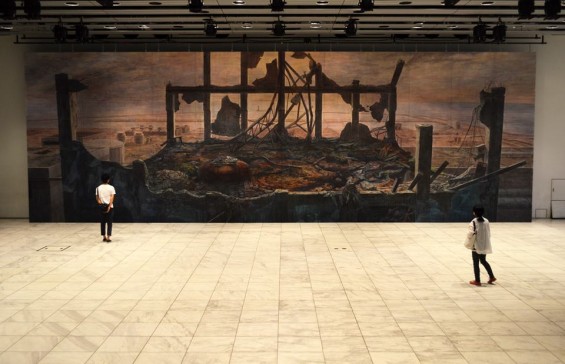
Don DeLillo’s Twilight World

image found at Beautiful Decay

image found at Beautiful Decay Website painting by Hiroshige Kagawa

Don DeLillo is one of the few writers whose books I buy in hardback when they first come out. The rap on him is that he can’t do dialogue, or rather, chooses to have his characters speak in polished packed paragraphs that defy believability, like this exchange between college professors in White Noise:

“How is your car crash seminar progressing?”

“We’ve looked at hundreds of crash sequences. Cars with cars. Cars with trucks. Trucks with buses. Motorcycles with cars. Cars with helicopters. Trucks with trucks. My students think these movies are prophetic. They mark the suicide wish of technology. The drive to suicide, the hurtling rush to suicide.”

“What do you say to them?”

“These are mainly B-movies, TV movies, rural drive-in movies. I tell my students not to look for apocalypse in such places. I see these car crashes as part of a long tradition of American optimism. They are positive events, full of the old ‘can-do’ spirit. Each car crash is meant to be better than the last. There is a constant upgrading of tools and skills, a meeting of challenges. A director says, ‘I need this flatbed truck to do a midair double somersault that produces an orange ball of fire with a thirty-six-foot diameter, which the cinematographer will use to light the scene.’ I tell my students if they want to bring technology into it, they have to take this into account, this tendency toward grandiose deeds, toward pursuing a dream.”

Although there is some truth in the criticism in of the believability of the dialogue, I happen to hang with cats like JT Williams and colleagues like EC who do talk in packed, polished paragraphs that feature words like “metacognition” and “sturm und drang,” so my suspension of disbelief remains airborne when Sister Hermann Marie, a nun in the same novel, responds to the accusation that her belief is a pretense by laying this rap on her accuser: “We surrender our lives to make your nonbelief possible. You are sure that you are right but you don’t want everyone to think as you do. There is no truth without fools. We are your fools, your madwomen, rising at dawn to pray, lighting candles, asking statues for good health, long life.”

No only does my disbelief remain airborne, but I absolutely relish these verbal exchanges.

Edward Hopper: "Morning Sun"

Edward Hopper: “Morning Sun”

Anyway, although I consider DeLillo a superb stylist, it’s not his prose that has me plopping down thirty bills when his books come out, but his ideas, his subject matter, his detached observational perspective as he turns his binoculars from the lonely woman sitting on a bed in an Edward Hopper painting to the bleak, soulless but sunny American landscape that lies beyond that lonely room. DeLillo’s novels are exercises in cultural anthropology, case studies in the integration and synthesis of cultural components. Here’s Murray Suskind riffing on advertising, again in White Noise:

Look at the wealth of data concealed in the grid, in the bright packaging, the jingles, the slice-of-life commercials, the products hurtling out of the darkness, the coded messages and endless repetitions, like chants, like mantras. “Coke is it, Coke is it, Coke is it.” The medium practically overflows with sacred formulas if we can remember how to respond innocently and get past our irritation, weariness and disgust.

DeLillo’s latest, Zero K, is set in Central Asia in what the dust jacket calls “a secret compound where death is exquisitely controlled and bodies are preserved until a future time when biomedical advances and new technologies can return them to a life of transcendent promise.”   This compound is a mazelike campus that is part hospital and art installation, a sort of conflation of Kafka’s Kastle and The Ministry of Love from 1984. Here is the narrator, Jeff Lockhart, whose billionaire father is an investor in the project and a “patient” in the process, describing what I would call residence halls:

The halls were nearly empty, three people, at intervals, and I nodded to each, receiving only a single grudging glance. The walls were shades of green. Down one broad hall, turn into another. Blank walls, no windows, doors widely spaced, all doors shut. These were doors of related colors, subdued, and I wondered if there was meaning to be found in these slivers of the spectrum.

Sometimes the walls turn into movies, throwing the pedestrian into a sort of unwilled virtual reality of interconnected disaster, and these passages swoop into cinematic writing that brilliantly captures moving images and places the reader into the mix as participant:

Fires were burning onscreen and a fleet of air tankers hung a thick haze of chemicals over the scorched treetops.

Then a single figure walking through a town’s empty streets with homes imploded by heat and flame and lawn ornaments shriveled to a crisp . . .

Elsewhere now people wearing facemasks, hundreds moving at camera level, walking or being carried by others, and was this a disease, a virus, long ranks of slow moving men and women . . .

Then a woman seated on the roof of her car, head in hands, flames – the fire again – moving down the foothills in the near distance.

Then grass fires sweeping across the flatlands and a herd of bison, silhouetted in bright flame, going at a gallop parallel to barbed-wire fencing and out of the frame.

There was a quick cut to enormous ocean waves approaching and then water surging over seawalls and sets of imagery merging, skillfully edited by hard to absorb, towers shaking, a bridge collapsing . . .

You get the picture.

The narrator Jeff is there to bid his debilitated stepmother goodbye as she prepares for the big freeze; however, to complicate matters, his perfectly healthy and supremely wealthy father Ross has decided he too wants to end this phase of his life because he doesn’t want to live without his spouse and he is confident that one day they will be awakened into a brave new world. Jeff, not surprisingly, hates this idea of pie-in-the-sky surrender, given that even if it were possible, reawakening in that world may not be as self-affirming as you might imagine.

Given that he was born in 1936, it’s not surprising that DeLillo has turned to a meditation on death, but death-obsession is also a major theme in White Noise. His world is God-vacated, like the paintings of Edward Hopper, a fascinating world, both beautiful and terrible, an exhilarating world to explore, a world very much alive.

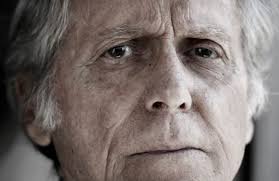
Don DeLillo

Don DeLillo


Dialectics

Let’s face it, nuance went out with the rise of cable news.  Not only do politicians not reach across the aisle to seek compromises, but they essentially don’t associate with members of the other parties.  Gone are the days when polar politicians like Orrin Hatch and Teddy Kennedy could become bosom friends, when Ronald Reagan and Tip O’Neil could “after six o’clock” be friends.


No, nowadays, middle ground is no man’s land.

Yesterday, as I was showing my tenth graders a clip from Apocalypse Now in conjunction with teaching Heart of Darkness, it occurred to me that the photojournalist’s speech to Willard as Kurtz reads from TS Eliot’s “The Hollow Men” is a superb commentary on contemporary American politics.  I offer it without comment except for the tidbit that one of the epigraphs for “The Hollow Men” is “Mistuh Kurtz – he dead,” so essentially Kurtz is reading a poem in which he appears.


The Hollow Men

Mistah Kurtz-he dead
A penny for the Old Guy

I

We are the hollow men
We are the stuffed men
Leaning together
Headpiece filled with straw. Alas!
Our dried voices, when
We whisper together
Are quiet and meaningless
As wind in dry grass
Or rats’ feet over broken glass
In our dry cellar

Shape without form, shade without colour,
Paralysed force, gesture without motion;

Those who have crossed
With direct eyes, to death’s other Kingdom
Remember us-if at all-not as lost
Violent souls, but only
As the hollow men
The stuffed men.

II

Eyes I dare not meet in dreams
In death’s dream kingdom
These do not appear:
There, the eyes are
Sunlight on a broken column
There, is a tree swinging
And voices are
In the wind’s singing
More distant and more solemn
Than a fading star.

Let me be no nearer
In death’s dream kingdom
Let me also wear
Such deliberate disguises
Rat’s coat, crowskin, crossed staves
In a field
Behaving as the wind behaves
No nearer-

Not that final meeting
In the twilight kingdom

III

This is the dead land
This is cactus land
Here the stone images
Are raised, here they receive
The supplication of a dead man’s hand
Under the twinkle of a fading star.

Is it like this
In death’s other kingdom
Waking alone
At the hour when we are
Trembling with tenderness
Lips that would kiss
Form prayers to broken stone.

IV

The eyes are not here
There are no eyes here
In this valley of dying stars
In this hollow valley
This broken jaw of our lost kingdoms

In this last of meeting places
We grope together
And avoid speech
Gathered on this beach of the tumid river

Sightless, unless
The eyes reappear
As the perpetual star
Multifoliate rose
Of death’s twilight kingdom
The hope only
Of empty men.

V

Here we go round the prickly pear
Prickly pear prickly pear
Here we go round the prickly pear
At five o’clock in the morning.

Between the idea
And the reality
Between the motion
And the act
Falls the Shadow
For Thine is the Kingdom

Between the conception
And the creation
Between the emotion
And the response
Falls the Shadow
Life is very long

Between the desire
And the spasm
Between the potency
And the existence
Between the essence
And the descent
Falls the Shadow
For Thine is the Kingdom

For Thine is
Life is
For Thine is the

This is the way the world ends
Not with a bang but a whimper.

art by Claire Lambe

art by Claire Lambe


The Art of the Political Insult

Mountrushmore


In her recent column, Gail Collins reminds us that Trump’s crude political discourse is not unprecedented in this hard-to-govern, rambunctious nation that consists essentially of cast-offs from other continents:

People, [she writes] this is the point at which I’m supposed to make you feel better by pointing to all the terrible presidential campaigns of the past. I could remind you that the first Republican presidential candidate, John Charles Frémont, was accused of being a cannibal. Or that poor Grover Cleveland was tortured by newspaper stories claiming he was “a boon companion to Buffalo harlots, a drunken, fighting, roistering roué.”

What great phrasing — “a boon companion to Buffalo harlots, a drunken, fighting, roistering roué” — it rolls off your tongue like an ee cummings poem, topping even the great HL Mencken’s depiction of Cleveland: He sailed through American history like a steel ship loaded with monoliths of granite.

Slightly less musical but imagistically more powerful is Samantha Bee’s (or one of her writer’s) description of Donald Trump as “a tangerine tinted trash can fire.”

Or dig this dig from a true master, James Wolcott:

An orange Elvis squirted from a can of Cheez Whiz, the Trump of The Apprentice bent the distortion field of Reality TV until it fit him like a girdle.

As far as exuberant insulting prose goes, it’s difficult to top Cintra Wilson:

If Marilyn Monroe and Princess Diana were “candles in the wind,” and Anna Nicole Smith was a bonfire in a hailstorm, and Lindsay Lohan is an electric toaster thrown intentionally into a Jacuzzi, then Paris Hilton s a strobe light in an epilepsy ward.

Compare those well-crafted quips to Trump’s insults culled from The Hill:

“[George W] Bush didn’t have the IQ [to be president].”

On Lindsay Graham: A total lightweight. In the private sector, he couldn’t get a job. Believe me. Couldn’t get a job. He couldn’t do what you people did. You’re retired as hell and rich. He wouldn’t be rich; he’d be poor.”

On former Texas Governor Rick Perry: He should be forced to take an IQ test before being allowed to enter the GOP debate.”

“I hear that sleepy eyes [Chuck Todd] will be fired like a dog from ratings starved Meet The Press?

It reminds me of that scene from Cyrano de Bergerac when the Viscount De Valvert insults Cyrano by saying, “ir, your nose is. . .hmm. . .it is. . .very big!”

And Cyrano responds

Ah no! young blade! That was a trifle short!

You might have said at least a hundred things

By varying the tone. . .like this, . .

Truculent: ‘When you smoke your pipe. . .[I] suppose

That the tobacco-smoke spouts from your nose–

Do not the neighbors, as the fumes rise higher,

Cry terror-struck: “The chimney is afire”?’

So come on, Donald, you can do better. Hire someone like PJ O’Rourke to come up with something a bit more barbed like “George W Bush has more belly button lint than brains” or “Rick Perry makes George from Of Mice and Men sound like Cicero” or “Hillary is as crooked as Lombard Street.”

We, as a nation, deserve better.

Happiness

shapeimage_2

Above and beyond the computer screen outside the closed window of my study, palmetto fronds and magnolia boughs shimmer in a sunny morning breeze. Seemingly, inside my computer, Robert Plant (and to a lesser degree Allison Krauss) is pleading for someone somewhere to “please read the letter [he/she] wrote.”

Some algorithm created by Steve Job’s brain trust has selected this song from a mix called Singer/Songwriter that shuffles music I have purchased. I happen not to like the song, nor that album. Critics convinced me to fork out ten bucks to buy it, so I did.  It’s not a big deal, but it has not made me happy. Perhaps the next song will better suit me, and as it turns out, it does, Joni Mitchell’s “Car on a Hill” from Court and Spark, an album I first purchased in 1974.

I think back to the Joni Mitchell concert I attended that year with Debbie Kellam with whom I was madly in love. Now Andrew Marvell is whispering in my ear: deserts of vast eternity.

 photograph by Kaisern Chen

photograph by Kaisern Chen

In his History of Happiness, Darrin McMahon informs us:

Language reveals ancient definitions of happiness. It is a striking fact that in every Indo-European language, without exception, going all the way back to ancient Greek, the word for happiness is a cognate with the word for luck. Hap is the Old Norse and Old English root of happiness, and it just means luck or chance, as did the Old French heur, giving us bonheur, good fortune or happiness. German gives us the word Gluck, which to this day means both happiness and chance.

In other words, etymologically, happiness is happenstance, the luck of the draw, whether it it be a full house or the inherited brain chemistry that creates a naturally sunny disposition.

rw_19-1

McMahon notes that the classical philosophers came to believe that happiness could be attained, not as feeling, but as a state earned through living a virtuous life, “measured,” as McMahon says, “in lifetimes, not moments.” Hence, happiness must be earned through the cultivation of virtues, which Malcolm catalogues for us in Macbeth:

[. . .] justice, verity, temperance, stableness,

Bounty, perseverance, mercy, lowliness,

Devotion, patience, courage, fortitude (4.1, 92-4

In desert-born religions, the world becomes a vale of tears and ultimate happiness only possible in some exalted state, e.g., in prelapsarian Eden, i.e., the past, or in some future state, i.e., at the return of Christ in the millennium or in one of the many mansions of heaven.

Massah ain’t treating you right. Keep working. The low swinging chariot will be here any minute.

Swing Low, Sweet Chariot by Richard Bennett

Swing Low, Sweet Chariot by Richard Bennett

Now, coincidently, Paul Simons is singing “Slip Sliding Away”:

We work at our jobs
Collect our pay
Believe we’re gliding down the highway
When in fact we’re slip sliding away.

Slip sliding away,
Slip sliding away,
You know the nearer your destination
The more you’re slip sliding away.

The Christian view described above provides a theoretical escape hatch for Simon’s paradox, but left-brained Enlightened philosophers and Founding Fathers supplanted that view and argued that happiness was, again in McMahon’s words, “more than a divine gift, less fortuitous than fortune, less exalted than a millenarian dream.” In fact, it is an American right to pursue it, and God knows we do.

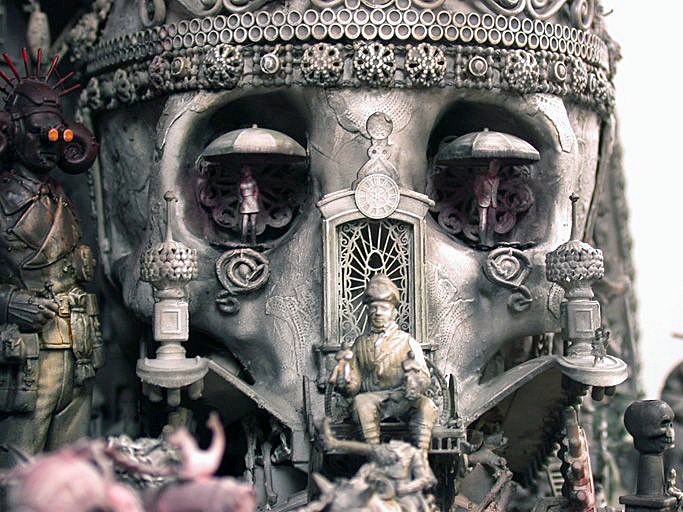
detail from The Palace of Hedonism by Kris Kuksi

detail from The Palace of Hedonism by Kris Kuksi

God bless the Enlightenment! It has taught us that sensuality is not sin, that we deserve happiness because we are, and rather than donning hair shirts and spending our winter nights barefooted in the snow self-flagellating, we should make the best out of a sure thing, the here and now, for, yes, death is just around the corner. In fact, Lucretius, following the wisdom of Epicurus, argued 1600 earlier essentially the same concept.

However, happiness as a constant state is unsustainable in the flux of day-to-day occurrences, medications, moods, adrenal secretions. The classic philosophers and stoics were correct: True happiness is impossible without a foundation of compassion that directs one’s thoughts from the self to others.

In other words, lasting happiness is impossible outside the context of a virtuous life, but, of course, a virtuous life doesn’t guarantee “lasting happiness.”

Hap
BY THOMAS HARDY
If but some vengeful god would call to me
From up the sky, and laugh: “Thou suffering thing,
Know that thy sorrow is my ecstasy,
That thy love’s loss is my hate’s profiting!”

Then would I bear it, clench myself, and die,
Steeled by the sense of ire unmerited;
Half-eased in that a Powerfuller than I
Had willed and meted me the tears I shed.

But not so. How arrives it joy lies slain,
And why unblooms the best hope ever sown?
—Crass Casualty obstructs the sun and rain,
And dicing Time for gladness casts a moan. . . .
These purblind Doomsters had as readily strown
Blisses about my pilgrimage as pain.

Nevertheless, let’s give Epicurus the last word:

It is impossible to live a pleasant life without living wisely and well and justly.  And it is impossible to live wisely and well and justly without living a pleasant life.

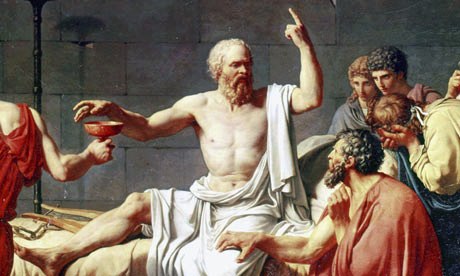
detail from David's The Death of Socrates

detail from David’s The Death of Socrates


The Fog of Recollection: What We Half Perceive and Half Create


 detail from Aydin Aghdashloo, Memories of Ice & Fire III

detail from Aydin Aghdashloo, Memories of Ice & Fire III

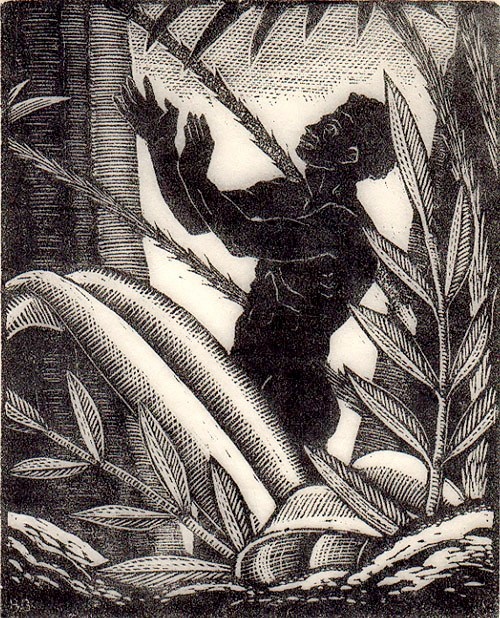
Even as a very young child, I sought escape through books, movies, television, and imagination.  Unlike my first best friend Bert Pearce, nature held no magic for me.   To Bert, a frog was a creature of wonder, something to stare at for fun even though it just sat there like a stone.  From him I learned that they arose from tadpoles, which was cool,  because it was mysterious with intimations of procreation.

I remember dreaming of a pond in kindergarten and being able to breathe while I swam underwater.

The window sill of the kitchen of Bert’s rambling clapboard house on Laurel Street served as a sort of laboratory, lined with prison jars of lizards and frogs and caterpillars, but to me, a frog was a creature likely to pee on you, a creature whose skin or hide or whatever you called it would feel bumpy or slimy or both.  In a word, yucky.

March 2011 018

This would have been 1957.  We were only five, but I remember that Bert, not his mother, made our lunches, always peanut and jelly sandwiches, and when he poured milk in glasses, he poured a bit in one, then the same amount in the other, repeating the process, carefully eyeing the levels, making sure they were absolutely even until they reached the top of the glass.

But with memories, especially distant memories, you never know.  Like dreams, they’re aery, unsubstantial, slippery, unreliable, dubious mental constructs that may bear very little resemblance of what transpired.

For example, maybe he only had one frog in one jar and only made lunch once.droppedImage

My family stared not at frogs or butterflies but at movie and television screens.  Before my youngest brother and sister were born, Mama and Daddy took my brother David and me to drive-in movies, the Magnolia and North-52, where I could experience the first half of adult movies like Cat on a Hot Tin Roof, Butterfield 8, and Vertigo before falling asleep from boredom.  Brother David and I also got to enjoy Winstons, which tasted good like cigarettes should, as we breathed in prodigious quantities of secondhand smoke, which no doubt provided better protection than the Pic insect coil repellent burning away on the dashboard.

0

I recall one vivid memory of going to the concession stand during Vertigo and not being able to find the car on the way back because as Jimmy Stewart suffered his nightmare amid strobing colors on the distant screen, the projection/reflection kept changing the colors of the parked cars like a clicking kaleidoscope, a frightening Kafkaesque experience for a seven-year-old laden with Coca-Colas and popcorn

I’m much more confident of this memory, however, because it has been reinforced by many retellings.

The television stayed on at my house from the time we were up until the Star Spangled Banner signaled that Big Chief Test Pattern was about to appear with his high-pitched warning before the upcoming six-hour blizzard of snow on the screen.  I watched Elvis swivel on Sullivan and later the mop-headed Beatles in skinny pants stand stiffly and play music amid screams.  Watching Ed Sullivan was a sabbath ritual much more practiced than the two-minute drive to church.

Also, every Wednesday for a time my mother took me to Poppleton’s Five and Dime where she bought me cardboard bound reprints of classic novels that cost 59 cents. I can almost still smell the fresh, slightly burnt odor of the pages as I hung with the Swiss Family Robinson or watched Tom hoodwink his pals into whitewashing the fence.

So, unlike my friend Bert, who had left my life and moved to Mt. Pleasant, no doubt collecting samples in the backyard of his new brick home, I became a sedentary soul and traded the beauty of the outside world and its paragon of animals for the inner world of Alice’s Wonderland where playing cards could talk and falling down didn’t hurt.

Illustration by Pedro Campea

Illustration by Pedro Campea

Nature versus nurture?  Chicken or egg?  Was Bert’s fascination with flora and fauna innate or did his mother Carlotta instill his interest?  If Daddy had taken me hunting every Saturday, would I now have antlers holding camo-colored hats in my study rather than shelves stuffed with books?

William Wordsworth addresses this mystery in “Tintern Abbey” when he writes

. . . Therefore am I still

A lover of the meadows and the woods,

And mountains; and of all that we behold

From this green earth; of all the mighty world

Of eye, and ear,–both what they half create,

And what perceive . . .

102-7

Half-create . . . what perceive.  Do we essentially construct our own worlds, our malleable minds morphing like tadpoles into frogs – or, perhaps to employ a more pleasing image, caterpillars into a butterflies?  Do our predilections and experiences constantly reconstruct our minds to conform to their blueprints?

And does the Protean mind we possess at this instant reconstruct memories to adhere to its present decor, replacing the portrait of boring old Gertrude with glamorous, chain-smoking Aunt Sarah, who shot herself in the head with the door cracked open for her first cousin to see?

Get on it, neuroscientists.  I want to know.

Ordinary Objects in the artist creative mind 1887 John Peto paintings

Ordinary Objects in the artist creative mind 1887
John Peto paintings

My TS Eliot Spring Break

illustration by Wesley Moore

illustration by Wesley Moore

Twit twit twit
Jug jug jug jug jug jug
So rudely forc’d.
Tereu

TS Eliot, “The Waste Land”

Although Yeats gets quoted a lot in these traumatic days – things fall apart, the center cannot hold, etc. – TS Eliot was no slouch himself when it came to apocalyptic naysaying. For example, dig this ditty from “The Waste Land”:

What is that sound high in the air
Murmur of maternal lamentation
Who are those hooded hordes swarming
Over endless plains, stumbling in cracked earth
Ringed by the flat horizon only
What is the city over the mountains
Cracks and reforms and bursts in the violet air
Falling towers
Jerusalem Athens Alexandria
Vienna London
Unreal

Because most of us Americans are consumed with the 24/7 Jerry Springer extravaganza that is the current presidential campaign, I doubt if your casual consumer of the news is aware that Europe’s political turmoil makes ours seem rather bland by comparison.

For example, on New Years Eve in Cologne, Germany, gangs of young males assaulted scores of females celebrating the holiday. Some blame newly arrived Muslim immigrants for the outrages while others suggest caution before jumping to conclusions.

Here’s a snippet from the conservative British paper the Spectator:

The German police made a similar point: they are used to handling drunks. But gangs of young men encircling and then groping women at large public gatherings: who has ever heard of such a thing?

In the Arab world, it’s something of a phenomenon. It has a name: ‘Taharrush gamea’. Sometimes the girls are teased and have their veils torn off by gangs of young men; sometimes it escalates into rape. Five years ago, this form of attack was the subject of an award-winning Egyptian film, 678. Instances of young men surrounding and attacking girls were reported throughout the Arab Spring protests in Cairo in 2011 and 2012. Lara Logan, a CNN journalist covering the fall of Hosni Mubarak, was raped in Tahrir Square. Taharrush gamea is a modern evil, and it’s being imported into Europe. Our authorities ought to be aware of it

On the other hand, here is Ishaan Tharoor from the Washington Post:

To be sure, there are legitimate security concerns posed both by the surge in new arrivals as well as the continuing instability and conflicts in the Middle East. The attacks in Cologne, writes the Algerian novelist Kamel Daoud, were a reminder to the West of the Muslim world’s “sick relationship with women” — a product both of patriarchal and religious norms as well as the stifling legacy of authoritarian rule.

But perverse, misogynist behavior is not the province of just one culture or society. And much of Europe’s anti-refugee hysteria, as my colleague Adam Taylor charted this week, has been overblown and fueled by often misleading innuendo and rumor circulating on social media.

Very few of the identified culprits in the Cologne attacks were themselves refugees. And countries like Poland and Hungary, while leading the conservative charge against E.U. policies that would allow in desperate Middle Eastern asylum seekers, still have minuscule Muslim populations of their own. The risk of a cultural invasion somehow contaminating their societies is, frankly, a phantasm conjured by fear-mongers.

Of course, this week, we Americans were treated to some man-on-woman physicality when police charged Donald Trump’s campaign manager Corey Lewandowski with battery after an encounter with “former Breitbart reporter Michelle Fields.”

In this case, we have video, so you can make up your mind yourself.*


*My personal view is that by the standards of Summerville High School that encounter doesn’t approach “battery.”

The bottom line is that the big blinding, buzzing cacophony of computerized existence obliterates contemplation. The blitzkrieg of information, much of it contradictory, is harmful for a species who has spent most of its existence sitting in small groups on a savannah among birdsong and rustling leaves.

The ruling class – the Koch Bros, etc. – should know that oligarchies lead to revolutions, that the Occupy Movement was a Shakespearian comet of foreboding, but who has time to contemplate history or to think beyond tomorrow’s Dow Jones closing averages?

Then there’s Hillary trying to thread the needle between big business and young debt-ridden would-be socialists as she attempts to be all things to all people.

Meanwhile, followers of Bernard Sanders engage in magical thinking imaging 30+ redneck gerrymandered districts somehow going blue so that he’ll be able to break up the banks, overhaul our healthcare system, make college free while by creating the largest middle class tax hike in the history of our republic.

What we see here in the Republican Party – factionalism – is also playing out in Europe. Things are falling apart – perhaps most alarmingly, glaciers!

Oh, by the way, it’s my spring break, and we all know that April is the cruelest month, so I’ve been having a sort of TS Eliot holiday, riding around with the radio/cd player off, popping Ativans like M&Ms, reciting poetry out loud to myself:

After such knowledge, what forgiveness? Think now
History has many cunning passages, contrived corridors
And issues, deceives with whispering ambitions,
Guides us by vanities. Think now
She gives when our attention is distracted
And what she gives, gives with such supple confusions
That the giving famishes the craving. Gives too late
What’s not believed in, or is still believed,
In memory only, reconsidered passion. Gives too soon
Into weak hands, what’s thought can be dispensed with
Till the refusal propagates a fear. Think
Neither fear nor courage saves us. Unnatural vices
Are fathered by our heroism. Virtues
Are forced upon us by our impudent crimes.

As the Lone Ranger used to say, “Adios!”


Good Friday

Today’s the day they nail him to a cross.

I wonder if arriving at Golgotha was actually a relief after being run through the stony streets barefooted and bearing a heavy, rough-hewn cross. Those streets lined with howling citizens mocking, spitting, guffawing.

Jheronimus_Bosch_or_follower_001

Despite the excruciating pain, as the cross was raised to its upright position, at least he could suffer in solitude as he looked out over the waste of the world.

Jesus-Crucifixion

For a few years my mother forced us to attend a Good Friday vigil at St. Paul’s Episcopal Church in Summerville, SC. At the vigil the seven last words on the cross were spoken over a period of time, maybe three hours. We didn’t stay for the entire service, but dropped in for an hour or so and then left.

I recall in 1969 on Good Friday standing beneath a tree in our front yard in a coat and tie listening on a transistor radio to Jose Feliciano’s cover of “Light My Fire” hoping against hope that Mama would relent, but to no avail.

No time to wallow in the mire.

If I remember correctly (and it’s been over half a century), the ritual consisted of kneeling in silence in a darkened black-draped sanctuary – everything was black; even the cross was sheathed in black crepe. Occasionally, a bell would ring, and Father Skardon would say one of the seven last words, which were, strictly speaking, phrases like “I thirst” and “My God, my God, why have thou forsaken me?”

For me, it was impossible to think of anything but Jesus’s suffering. Of course, I wanted to leave, but there was something aesthetically powerful about the ritual that transcended the mundane. In other words, I was alive in there.

Eventually, Mama would look over and nod, and we would get up, reposition the kneeling bench, bow to the cross, and head out the door. Exiting through those doors from that darkened sanctuary into the bright sunshine of springtime was not unlike you were exiting a tomb yourself — happy, happy — not realizing that down the road somewhere that sorrow, grief, and suffering would be your lot as well.

ST Paul's Episcopal Church, Summerville, SC

ST Paul’s Episcopal Church, Summerville, SC