Miles Davis’s Restless Musical Journey

lead_720_405

Illustration by Oliver Barrett of The Atlantic

Although I’m not a musician, I seem to find myself hanging with them an awful lot.  For example, in college I roomed with Warren Moise and accompanied him and his band Wormwood on many a gig.  When Warren decided to drop out and make a go at being a professional musician, he invited me to join Wormwood as soundman or light man or something or another, but I stuck to the unglamorous academic life of a sophomore living in Tenement 9 in the so-called Horseshoe of the University of South Carolina.[1]  Later Warren later returned to school, became a lawyer, but still writes songs, like this one recorded by the Band of Oz.

the-band-of-oz-super-summer-surfside

The next year I moved off campus with another musician, Stan Gibbons, who played bass for a rock cover band called Buddy Roe. After Buddy Roe broke up, Stan got into jazz, and it was he who turned me on to the Miles Davis album Bitches Brew, which I didn’t dig, and believe me, I got to hear it on numerous occasions, like non-stop for a couple of months. I still don’t dig it, but now that I’ve finished Ian Carr’s two-inch thick (658 pages) Miles Davis, The Definitive Biography, I have come to appreciate why Davis became such a restless innovator and to see his refusal to settle for the profitable status quo as a mark of heroic artistry.

Born to upper middle class parents, Miles Dewey Davis III grew up in East St. Louis where his father practiced dentistry.  Although he grew up in a household awash in music, it was classical music that his African American family embraced. His sister played the piano and his mother the violin.  As Carr puts it in the biography, “After Emancipation, it was the professional men and ministers of the church who were the heads of the new black society, and they were at pains to get rid of any customs that were too ‘negroid’ or which harked back to slavery.  It often happened that leading black citizens became the most fanatical imitators of white society. ”

However, that great corrupter of youth in those days, the radio, turned Miles onto Louis Armstrong, Buddy Bolden, and Roy Eldridge, so he took up the trumpet, played in the school band, but also at social clubs.  By the time he was sixteen and still in high school, he had joined a music union and came under the tutelage of Clark Terry.  This was in the 40’s.  Once he graduated, he talked his parents into letting him go the Juilliard instead of Fisk University.  At the Juilliard, he lived what Carr calls “a Jekell and Hyde” existence, trafficking with classical music by day and jazz, particularly bebop, by night.

Bebop was the first jazz innovative movement Davis got into.  Soon, he found himself attending Charlie Parker gigs, and in 1945 he joined Charlie Parker’s group. During this period, he shared the stage with such greats as Dizzy Gillespie and John Coltrane.

Unknown

Trane and Dizzy

So began his career, a career that featured a series of departures that usually irked the mainstream jazz community.

Weary of bebop, Davis and cronies Gil Evans and Jerry Mulligan among others started experimenting with the idea of having their instruments imitate human voices, creating  more melodic jazz than bebop.  After this so-called “birth of the cool” phase, Davis, now hooked on heroin, played what is called “hard bop.”  He signed with Prestige records and locked in a room by himself kicked his H habit cold turkey, .  Next came modal jazz, and in 1959 Davis released Kind of Blue, which is the best selling jazz album of all time.  In the 60s as rock replaced jazz as the cool pop music, Miles embraced the sound of the guitar, and “went electric,” much to the chagrin of jazz purists, and hence Bitches Brew.

 After Wynton Marsalis publically criticized Miles for abandoning “real jazz,” Miles responded:

What’s [Marsalis] doin’ messin’ with the past?  A player of his caliber should just wise up and realize it’s over . . . Some people, whatever is happening now, either they can’t handle it or they don’t want to know. They’ll be messed up on that bogus ‘nostalgia’ thing. Nostalgia shit!  That’s a pitiful concept.  Because it’s dead, it’s safe – that’s what that shit is about!  Hell, no one wanted to hear us when we were playing jazz. Those days with Bird, Diz, Trane – some were good, some were miserable . . . People didn’t like that stuff then. Hell, why do you think we was playing clubs?  No one wanted us on prime-time TV.  The music wasn’t getting across, you dig!  Jazz is dead![2]

Point taken: innovation is often frowned upon, misunderstood. Why, after all the success of Born in the USA, did Springsteen follow that up with Nebraska?  Why did Dylan abandon acoustic folk for the electric guitar, and why does he constantly reconfigure his songs so that at a concert he might be halfway through “Blowin’ in the Wind” before you recognize it?

Maybe because for them it has gotten old, stale.  You don’t have to like the new product; I much prefer Kind of Blue to Bitches Brew.  However, unless you’re a great musician, you probably should keep your mouth shut and let the masters do their thing.

It’s your thang, do what you wanna do.

I can’t tell you, who to sock it to.


[1]You can read about my travails with my roomies here, a situation that had me literally threatening to hang myself to university officials.

[2]I suspect Miles used a different mode of expression at Juilliard.


The Rattle of Bones and Chuckle from Ear to Ear: A Tribute to Tom Waits

Editor’s Note: My old blog Late Empire Ruminations is coming down soon, so I’m curating pieces from there that are not so topical. This post comes from September 2010.

Independence is for the very few; it is a privilege for the strong. Nietzsche, Beyond Good and Evil (Trans. Walter Kaufmann)

The phrase that gives this blog its name – ragwater, bitters, and blue ruin – comes from the Tom Waits song “9th and Hennipen” where

All the doughnuts have names that sound like prostitutes

And the moon’s teeth marks are on the sky.

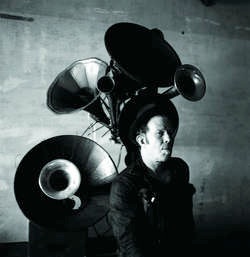
Tom Waits, the man, I think, could be Frederick Nietzsche’s poster boy for Beyond Good and Evil.  TW is a man who has created and recreated himself, always pushing into the future, ignoring the insect buzz of the masses to remain absolutely true to himself.  Although not quite [cue Dusty Springfield] the son of a preacher man (like Nietzsche himself, Jung, and Hesse), Waits is pretty damned close, the son of two California school teachers, who by profession had to preach the status quo, part of what Yeats dismissed as “the noisy set/Of bankers, schoolmasters, and clergyman/The martyrs call the world.”

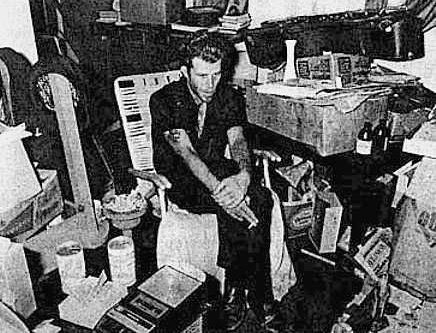
This pigeonholing may be unfair to Waits’ parents who perhaps on the first day of school each year refused to hold their hands to their hearts and pledge alliance to the flag of the United States of America, but I kind of doubt it.  After his parents divorced, Waits lived with his mother in Richard Nixon’s hometown of Whittier, California.  Once he had a record contract in hand, TW moved to the Tropicana Motel in LA.  Living the nightmare you might say.

Waits Lounging in his room at the Tropicana c. 1976

More and more it seems to me that the philosopher, being of necessity a man of tomorrow, has always found himself, and had to find himself, in contradiction to his today: his enemy was always the ideal of today.” Nietzsche, Beyond Good and Evil

What went right here?  How did this middle class product come to eschew 1) the comforts and security of carpeted dens for seedy decadence 2) the prevalent hippie zeitgeist of the 60’s for the retro Beatnikism of Cassidy and Kerouac 3) rock-n-roll for jazz, later jazz for polka?  

Always restless, TW has never settled on one groove, no matter how lucrative.  Only perhaps the German language is equipped to produce a label for his music: Volktingedbluejazzindustrocabaretmusick.

In the course of the 38 years since TW signed his first recording contract, he has produced a body of high quality popular music that deserves inclusion in the pantheon that houses Bob Dylan, Cole Porter, and Johnny Mercer.  As the Wall Street Journal’s (the very mouthpiece of hipdom) pop critic Jim Fusilli raves: 

Interestingly enough, in later years, TW’s has shifted from the streets of New Orleans and piano jazz eastward to the cabarets of Weimar Berlin and accordion-laced rumbas.  Among the many influences on Waits’s body of work – Stephen Foster, Louis Armstrong, Hoagy Carmichael – stand Kurt Weill and Bertolt Brecht, late practitioners of German Expressionism, working their dark magic in the black shadows of Nietzsche’s colossal influence.  How appropriate that Wait’s first musical Frank’s Lost Years debuted at Chicago’s Steppenwolf Theater and that his collaboration with William S. Burrows, The Black Rider: The Casting of the Magic Bulletsopened in 1991 in Hamburg.  In his most recent incarnations, he seems German, a sort of Chaplinesque figure, part Kafka, part Brecht, a sort of skid row ubermensch who by heroically forsaking the comforts of mediocrity descended into an underworld of gothic grotesqueries and emerged triumphant, the master of his own fate, a hero armed with the secret knowledge of suffering.

She has that razor sadness that only gets worse

With the clang and the thunder of the Southern Pacific going by

And the clock ticks out like a dripping faucet

til you’re full of rag water and bitters and blue ruin

And you spill out over the side to anyone who will listen…

And I’ve seen it all, I’ve seen it all

Through the window of the evening train.

Weekday Road Trip, Featuring Live: Steve Earle, Beto O’Rourke, and the Mighty Dukes

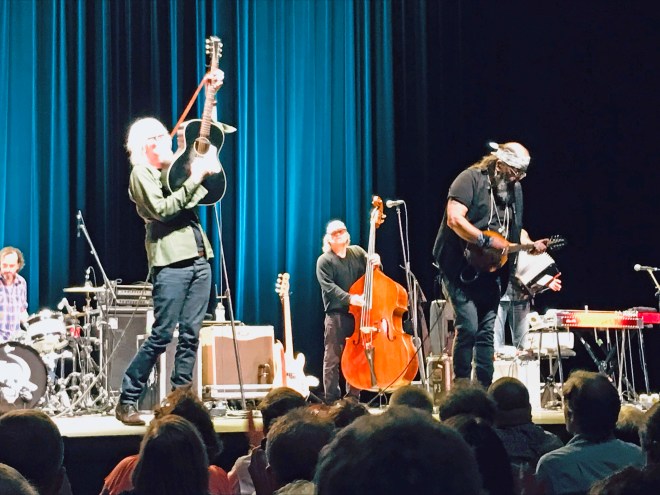
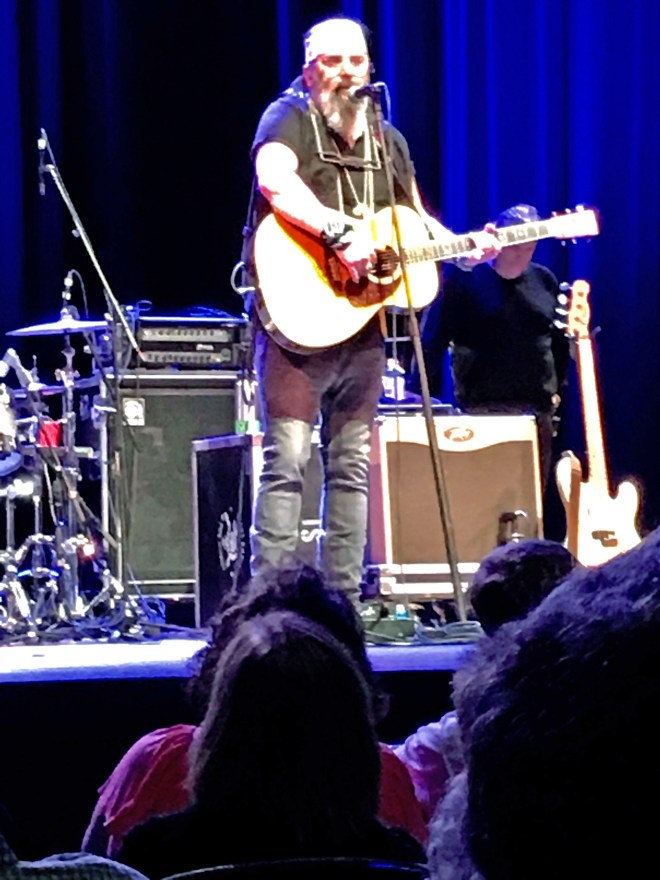
Steve Earle and the Dukes At Francis Marion U. Performing Arts Center Tuesday 27 August 2019

BBQ and Alt American Heroes

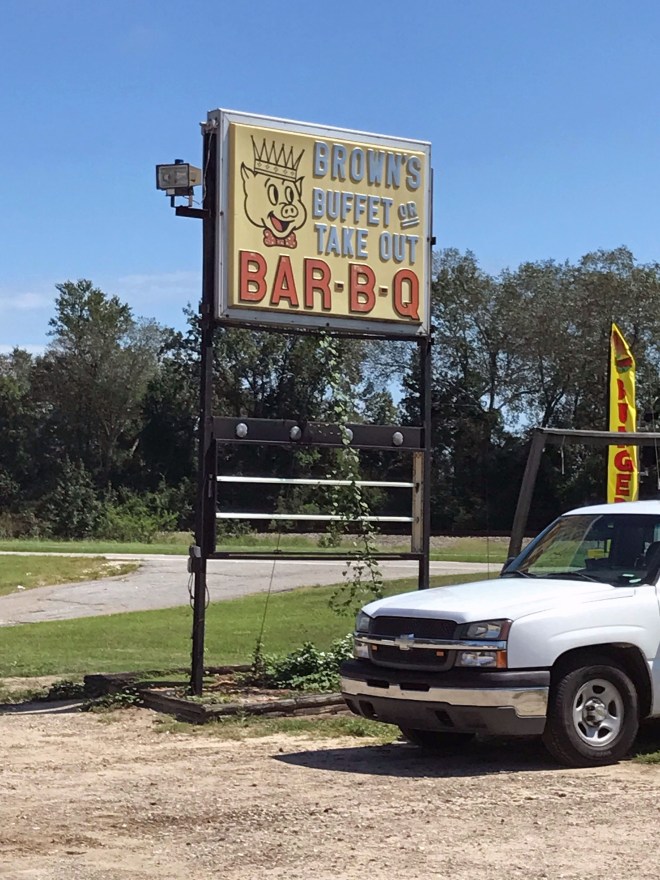
For the last couple of decades, on a weekday around 11:30, you’d likely find me at the cafeteria sneaking an early bite in hopes of avoiding the crush of famished adolescents who descend upon the regular lunch period.  But last Tuesday at 11:30, I was pulling into what my father-in-law Lee Tigner calls the omphalos of the barbeque world, Brown’s Bar-B-Que, right outside of Kingstree on North Hwy 52.

For our first anniversary, my wife Caroline bought us tickets[1]to a Steve Earle concert in Florence, South Carolina, a city on the move in an otherwise non-prosperous region of the Palmetto State.  On a whim, we decided to take the back roads and have lunch on the way.  The obvious choice was Brown’s.

If I should ever find myself on death row, I’m ordering Browns’ buffet for my last meal.[2]

Rice, roast beef stew, delicious tiny fried creek shrimp, fried catfish, mac and cheese, vinegary pepper barbeque (lean and clean), pork brusque, potato salad, coleslaw, desserts galore, including banana pudding, any condiment you could hope to have.[3]

Overstuffed but satisfied, we continued our journey racing graffiti-covered boxcars as they rumbled along parallel to us on 52.

As the outskirts of Florence became center city, we slowed down in anticipation of making a right turn when we saw on the sidewalk coming towards us this quirky bespectacled man sporting red knee-length shorts, a ZZ-Top-like beard, and long shoulder length hair.

Yes, it was the man himself, Steve Earle, American treasure, brilliant songwriter, and eclectic producer of a various strains of Americana music – blues, country, bluegrass, rockabilly, Celtic hybrids.  He’s also a published short story writer, novelist, and playwright. Probably, he was on his way to the Francis Marion Performing Arts Center, which was walking distance from our hotel and the Hyatt.  I’m embarrassed to say it, but it was sort of thrilling seeing him as a civilian, sporting what my pal Jake would call a dgaf [4]outfit.

Checking In and Out

The Hotel Florence is lovely and well staffed, and I don’t know why this happens, but when Caroline checked us in, they bumped us up to a two-bedroom suite with a full kitchen and two full baths, shades of our honeymoon when we were bumped up to the Presidential Suite at the Grove Park Inn.  In both cases it was too much, appreciated, but under-utilized.

Despite the swanky digs, we weren’t in the mood to lounge around in our rooms.  We needed a drink, so I googled “bars in Florence,” and the most interesting name that came up was “Downtown Southern Funk,” located eight minutes away in the warehouse of Seminar Brewery, Florence’s oldest.

While we were in that cavernous space, the Manager asked if we wanted a free ticket to the concert that night.  We told him we were set, but he insisted we take the ticket and try to give it away at the venue.  So we took the ticket, and as we were chatting with a bartender, I said,” Hey, man, you really ought to take the ticket and go.”  He insisted he couldn’t because with Beto being there in a couple of hours, they’d need all the bartenders they could muster.

“Beto O’Rourke?”

“Yeah, he’s giving a town hall meeting here at six.”

We ended up giving the ticket to another patron, whom we saw later at the show and who picked up our tab.

 To Go or Not to Go

Back at the hotel, we contemplated.  The town hall started at 6, the concert at 7:30, which would mean an Uber to and fro, but ultimately, we opted for the rough and tumble of American democracy instead of the serenity of the hotel bar.

We arrived at about a quarter to six, and the lack of security surprised me: no metal detectors, no riffling through handbags.  I’d call it a modest crowd, mostly white.  We grabbed a couple of beers and chatted with Beto’s South Carolina chair, a lovely, articulate woman in her late twenties.

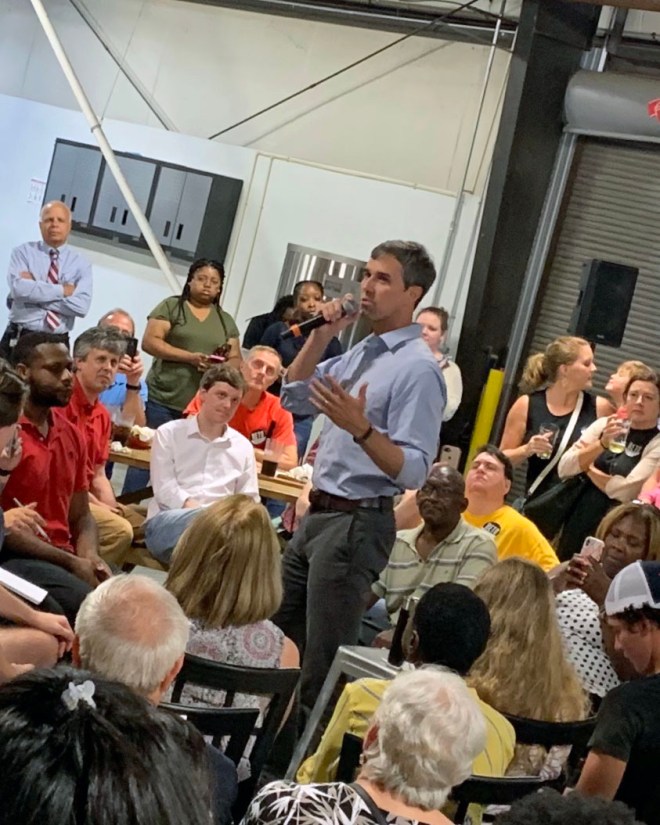
After a brief introduction from a state representative, Beto took the microphone and delivered his stump speech, which focused on guns and immigration.   Of course, he hails from El Paso, site of recent carnage, and I was somewhat surprised when he said the word “shit.”  “We need to quit selling that shit,” he said, referring to assault weapons. Indeed, how absurd that it’s legal to buy weaponry not intended for hunting or self-defense but for rapidly killing human beings, whether they be elementary school children, patrons of movies or gay bars, or Walmart shoppers.

Some smug, ramrod-erect old man interrupted Beto, who goofed by handing him the microphone. [5]The man launched into a screed claiming it was cellphones, not guns, that were to blame for the spate of American bloodbaths. No, these massacres are a by-product of educational dereliction, a consequence, he claimed, of society’s and government’s rejection of Yahweh and His Only Begotten Son.  Aides attempted to get the mike from him and finally succeeded.  Once Beto was able to speak, looking directly into the man’s face, he calmly mentioned that European countries also had high cellphone usage and were much less religious than the USA but rarely were the the scenes of mass shootings.

Once questions began, a young man with a baseball cap flipped backwards claimed that Trump was not a racist among a shower of boos as Caroline and I sidled outside to catch our Uber and hit the concert.

Beto at Seminary Brewing Tuesday 27 August 2019


The Francis Marion Performing Arts Center

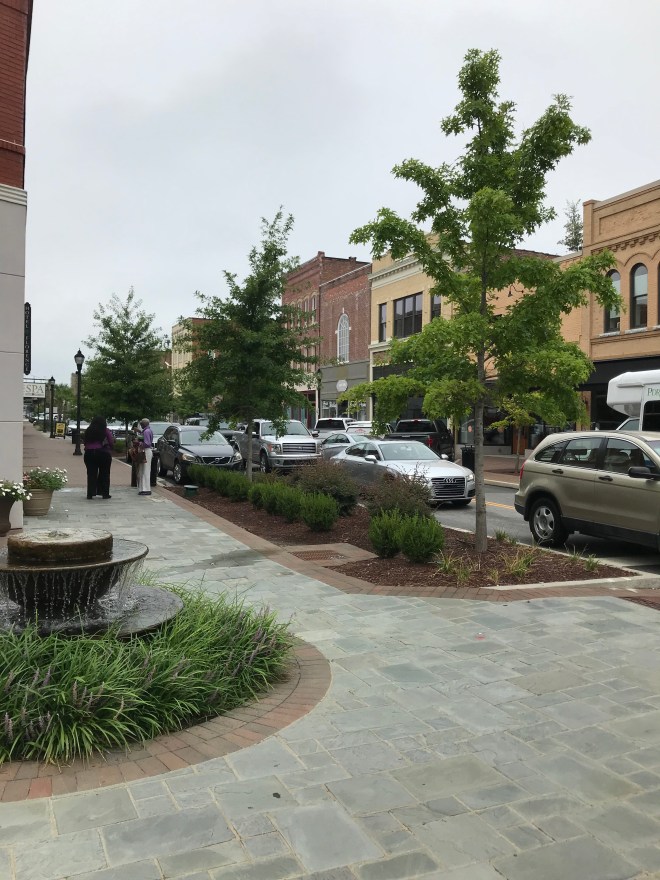
Florence, or FloTown as the hipsters call it, is enjoying urban renewal, and you could sense a genuine pride in several of the residents we talked to about the transformation. They said that before the Performing Arts Center, you wouldn’t want to be in this section of town at night.  One actually compared it to Detroit. Now, it’s very peaceful, laidback, verdant.

Anyway, the area is now quite nice, and I agree with brochure we were handed when we entered  the Performing Arts Center that “the unique facility offers patrons an unusual level of intimacy, paired with sophisticated acoustics.”

The Concert

Steve came out and introduced the first act, the Mastersons, a husband-and-wife team consisting of superb guitarist Chris and exquisite fiddler Eleanor Whitmore, masters of technique and vocal harmony.

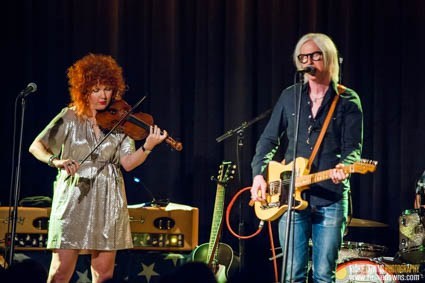
Alexandria, VA – July 18, 2017 – Steve Earle and The Dukes perform at The Birchmere. (Photo by Richie Downs)

They also accompanied Steve and the Dukes throughout the concert, which featured several covers of Guy Clark songs and a generous sampling of Steve’s greatest hits, which, as I have already said, cover the gamut of various Americana subgenres.

I can’t provide a complete set list but songs included Clark covers “Desperados Waiting for a Train,” “Dublin Blues,” and “LA Freeway.”

Among Earle’s hits, we heard “Guitar Town,”  “Galway Girl,”  “Fort Worth Blues,”  “Copperhead Road,” and many others, including a car medley featuring Springsteen’s “Racing in the Streets,”  “Sweet Little 66,” and “Pink Cadillac.”[6]

The Dukes sounded great, whether harmonizing a bluegrass number, plucking an Irish melody, or fuzzing dissonantly on one of his rockers.

A+

At the Francis Marion Performing Arts Center Tuesday 27 August 2019

The Dispensary

We walked home after the show, and instead of going back to the hotel, we hit the rooftop bar at the Dispensary.

It’s fairly dark up there and seating consists of sofa sets and coffee tables.  When we arrived, a couple of females nestled at a corner table, but that was it.  About a half an hour later, a college couple arrived, and the male gave his date a sort of a mini tour of the skyline before snuggling down on a sofa across the bar from us.

As we got up to leave, in stepped the Dukes: the above-mentioned Chris Masterson and Eleanor Whitmore, Ricky Ray Jackson, and Brad Pemberton (sans bassist Kelly Looney).  We told them how much we enjoyed the show, and Chris thanked us. I apologized for being intrusive, and he said, “Oh no, thanks for coming to the show.”

We hauled our glasses downstairs, the bartender thanked us, and that was that: a memorable post-retirement weekday, to say the least.

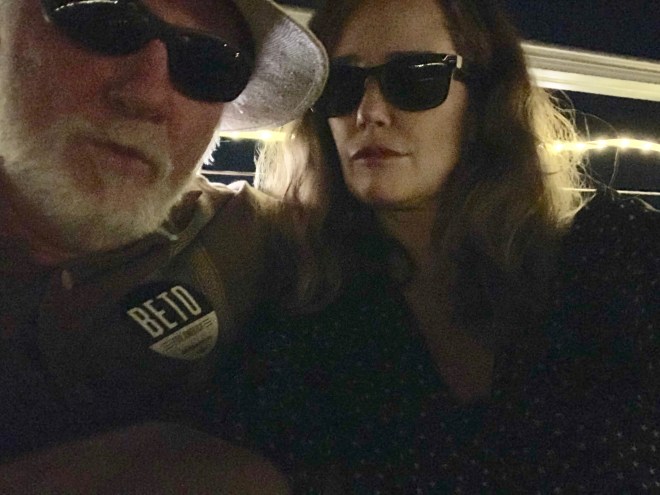
Selfie at the Dispensary Rooftop Bat Tuesday 27 August 2019


[1] Of course, the traditional gift for the first anniversary is paper.

[2]BTW, Mr. Earle has two dramatic monologue songs sung by death row denizens, “Bill Austin” and “Jonathan’s Song.”

[3] Or would it make more psychological sense to order a pack of saltines and a Carling Black Label beer?

[4] an acronym for “don’t give a fuck fig.”

[5]At these town halls, aides carry a separate microphone to field questions.

[6] Steve’s hero, Townes Van Zandt also covered “Racing in the Streets” on one of his live albums.

The Omission of Blue Cheer

In my last two years at Porter-Gaud, I taught a class called “America in the Sixties,” a history elective I felt unqualified to teach.  Sure I came of age in the Late Sixties and Early Seventies, yes, I was suspended from school for wearing a black armband on Moratorium Day[1], and, um, sure, I could offer firsthand insight of what it is like to ingest lysergic acid diethylamide. On the other hand, my knowledge of the Freedom Riders, the Gulf of Tonkin Resolution, and the Great Society agenda was on par with Mike Pence‘s knowledge of the poetry of Charles Bukowski.

The one topic we covered I felt confident about was music.  Thanks to the sophistication of the latest technology, I could embed short videos into Keynote slide shows that covered the roots of rock, Early Sixties music, Mo Town, Stax, the British invasion, and finally the San Francisco sound.

But even here I was somewhat derelict because in the San Francisco piece I failed to mention the seminal acid blues rock band Blue Cheer, whom some identify as the very first heavy metal band.[2]

My pal, the late Gordon Wilson, turned me on to Blue Cheer in ’69.  The band, which borrowed their name from a variety of LSD, had released a really arresting album, Vincebus Eruptum, the year before.   Its most successful single, a cover of Eddie Cochran’s “Summertime Blues,” actually peaked at #14 on Billboard, though I don’t remember ever hearing it on the radio. Also featured on the album was the blues standard “Rock Me, baby,” made famous earlier by Muddy Waters and BB King.

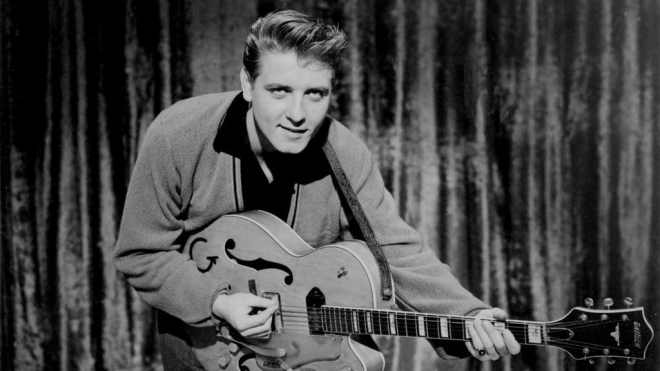
Eddie Cochran

So what you got was the blues all hepped up on goofballs.

Here’s a video.  Note the relentless drumming and wailing guitar.


Anyway, I think “Summertime Blues” holds up fairly well, though I doubt if many of my students in the Sixties course would have dug it.  When I first started teaching at PG in the mid-Eighties, students were obsessed by Sixties music.  In fact, I dubbed them “the re-generation.” However, nowadays hip hop and country have replaced rock as the most popular genres, and most of those students of mine last year would prefer to hear Beyoncé over Janis Joplin.


[1]15 October 1969

[2]Maybe, but isn’t the Kinks’ “You Really Got Me” at least a heavy metal song, even if you wouldn’t call the Kinks a “heavy metal band?”

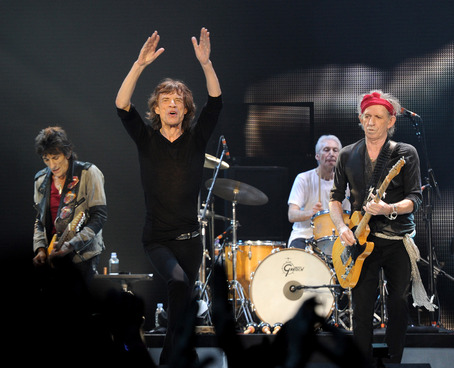
The Gathering No Moss Rolling Stones Tour of 2019

That Was Then

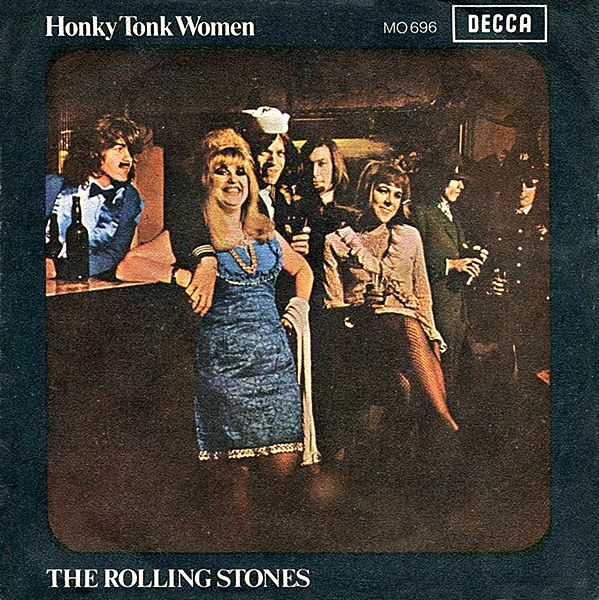
I had always liked the Stones, but it in 1969, I fell head-over-heals when I heard “Honky Tonk Women” for the first time, that opening clang-clang of a cow bell followed by those guitar riffs rattling the tiny speakers of my tenth-grade transistor radio.  The Stones’ previous LP, The Satanic Majesties Request, had abandoned the R&B bass and rhythmic guitar play that provided the propulsion for such classics as “Get Off My Cloud” and “Under My Thumb.”[1] Not surprisingly, the Stones weren’t very good at psychedelic music.  It didn’t suit them.  Imagine Keith Richards sitting in a half lotus next to the Maharishi. Un-uh.

However, the next LP after Satanic Majesties, Let It Bleed, is my favorite album all time, and the opening song of Side 2, “Midnight Rambler,” my favorite song.[2]  Its violent lyrics leavened by a John-Lee-Hooker-like boogie produce sonic cognitive dissonance as Jagger threatens to stick his “knife right down your throat” while the rest of the band lays down the jauntiest of grooves. I remember sitting in the Summerville High School library fantasizing about taking over the campus and blasting “Midnight Rambler” over the intercom after we had secured the office area.

Did I mention that I was an angry young mannish-boy?

Anyway, my newly acquired infatuation with the Stones led me to explore in depth their earlier albums and to check out some the original artists the Stones had covered – Howlin’ Wolf, Slim Harpo, and Robert Johnson, to name only three.  Of course, I was ravenous to see the Stones, but ’69 was the year of Altamont, that disaster of a festival that some claim sounded the death knell of the Sixties. No way the Stones ever would come down South, or so I thought.  However, in ’72, they did do Charlotte, and the late David Williams and I drove up there in his notorious blue VW Bug and copped a couple of scalped tickets for $25 each.  I remember someone chiding me for paying that much to see a concert (a beer cost 25 cents back then). By the way, Stevie Wonder was the opening act.

I saw them again in ’75 in Greensboro and again in ’94 in Columbia, but my interest in the Stones had waned by the 90s.  Except for their recent blues cover album Blue and Lonesome released in 2016, Tattoo You of 1981 is the last original Stones’ record I’ve purchased.

This Is Now

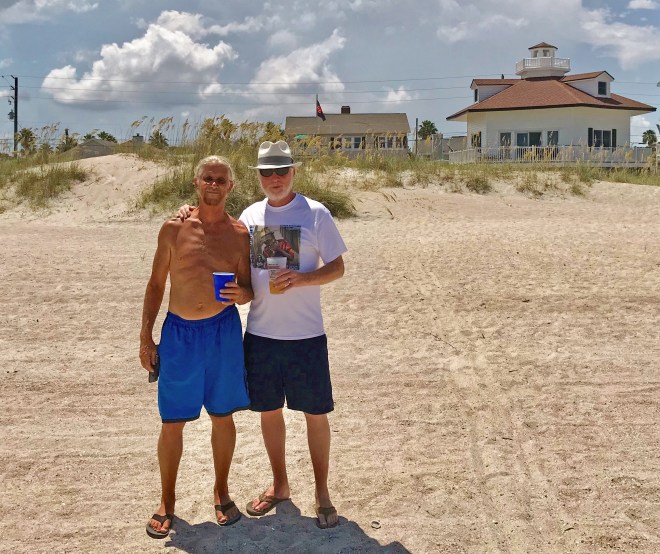
My wife Caroline and I love New Orleans, and when I saw the Stones were playing at Jazz Fest, I foolishly bought tickets from a third-party vendor for a lot more than $25 a pop.  Of course, the tour was delayed because of Mick Jagger’s heart valve replacement operation, but we did manage to get our money back.  In the rescheduled dates, I saw that they were playing in Jacksonville just south of where my Dionysian advisor Furman lives, Fernandina Beach. (You can read about our anthological adventures here).

Furman and I-and-I

To break up the trip, Caroline and I spent Wednesday night on St. Simon’s Island with my late wife Judy Birdsong’s brother Mike and his lovely wife Patti and Mike’s son Matt.  We dined at the Crab Trap where Mike’s older son Michael works as manager.  Talking about delicious fried flounder. Oh my God, as the kids say.  It was a good wholesome warm-up for the festivities to follow – that is, if you consider drinking high end Irish whisky and more beers than AMA recommends wholesome.

Caroline had booked a room at The Schoolhouse Inn on Amelia Island about two miles from Furman’s beach compound.  A converted schoolhouse, the Inn features spacious rooms with old-fashioned educational touches, like vintage photographs of principals ass-thrashing young miscreants with sticks.  I meant to take a picture but didn’t.

The Sweltering Chill

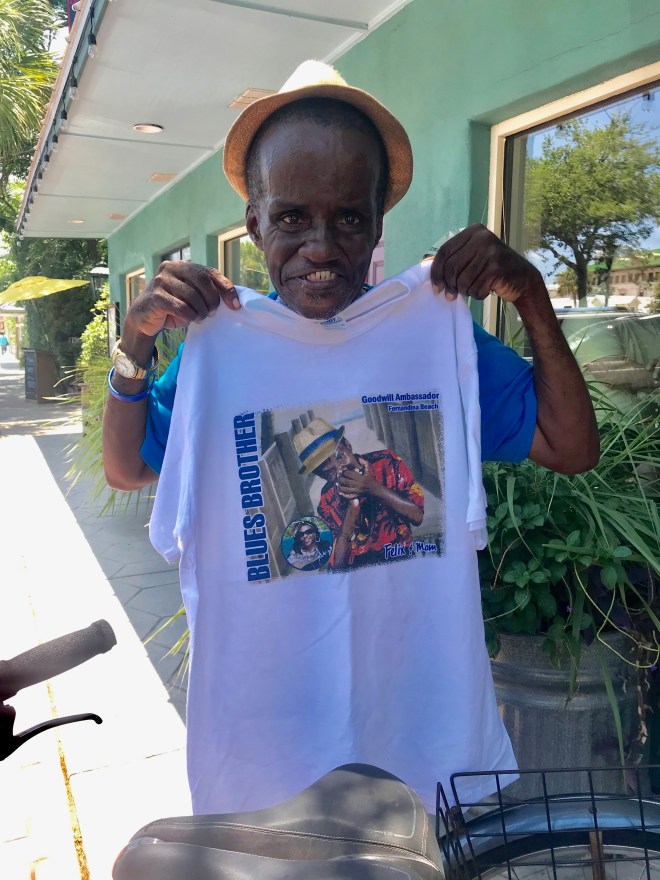
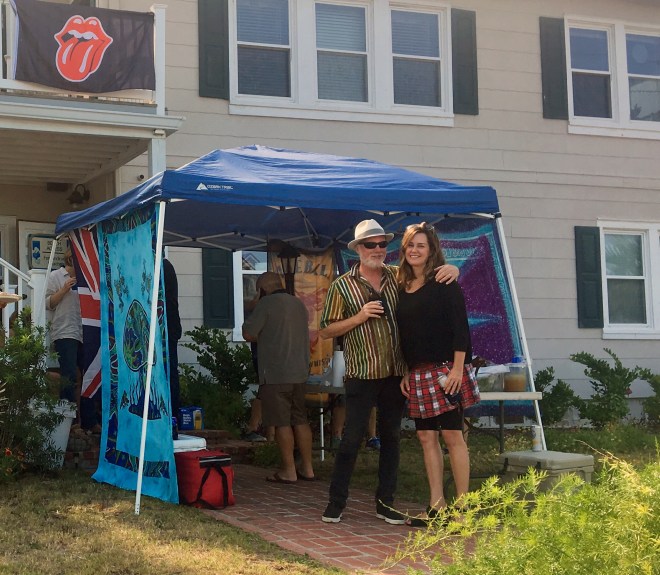
In a way, we were doing a college reunion.  In addition to Furman and his wife Jeanie, our entourage included old party mates Joe and Kathy, Steve and his wife Christi, Cheryl and Chris, Bill and Dana, Furman’s brother Bill and his wife Veronica (who had already seen four previous shows on this tour), plus various offspring and friends of Furman and Jeanie. We spent Thursday night on Amelia Island drinking at the Green Turtle Tavern, where Jagger supposedly ended up later that night, though I’m always skeptical of rumors like that.  The next day at lunch, we met Amelia’s legendary harmonica-blowing street musician Felix from whom I bought a tee shirt/sartorial business card.

Felix

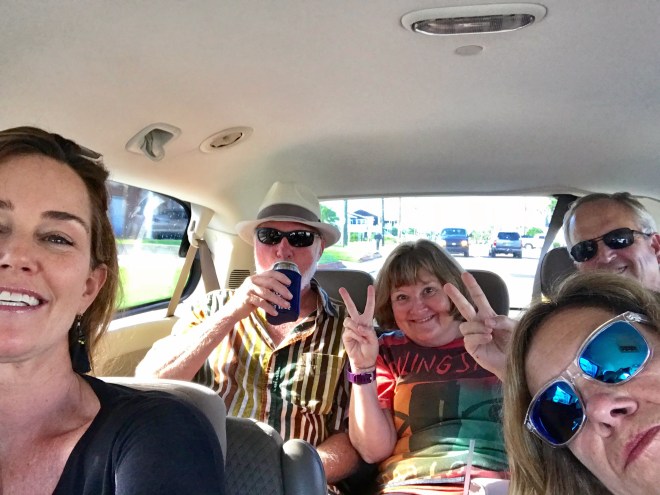
So we turned in rather early, awoke the day of the concert, lounged around the pool, did lunch at an old-fashioned seafood restaurant, and headed over to Furman’s.  He had hired three vans to deposit us at TIAA field in time to catch the opening act, The Revivalists.

From left to right, Caroline, I-and-I, Cheryl, Chris, Kathy (photo credit Joe Brown)

The Concert

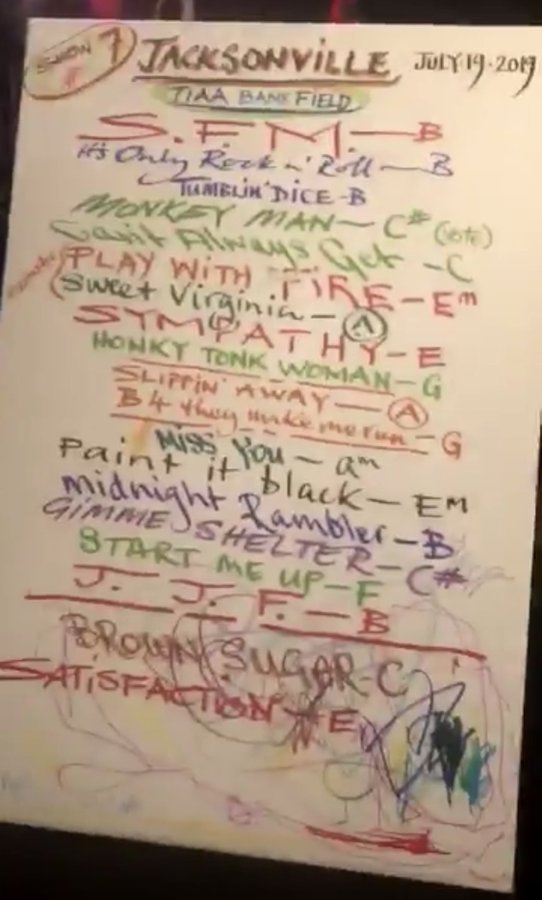
 Here’s the set list, provided by Ronnie Wood himself.

Here they are doing “Street Fighting Man,” courtesy of First Coast News:


First and most importantly, the sound was fantastic, unreal, more like music you would hear in a studio than in a football stadium.

Highlights – and there were many – included Darryl Jones’ bass solo on “Miss You”; a killer rendition of “Midnight Rambler”; one of my favorites, “Monkey Man”; and the last song played, the second song of the encore, “Satisfaction.”

Here’s a rendition of Darryl’s solo from Rio in 2016 via João Paulo Moreira Lima.


Aftermath

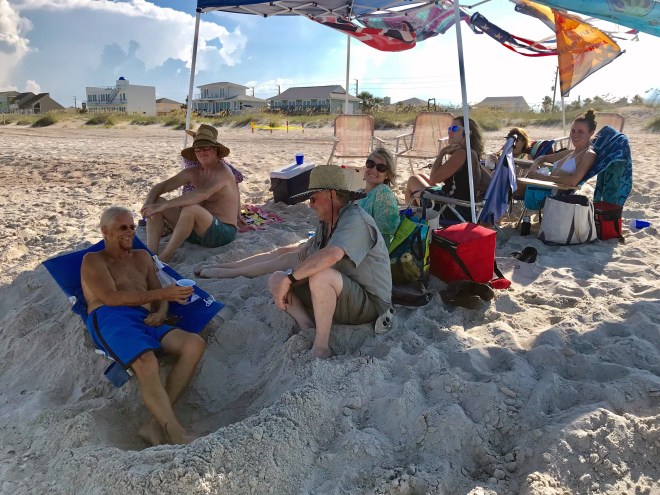
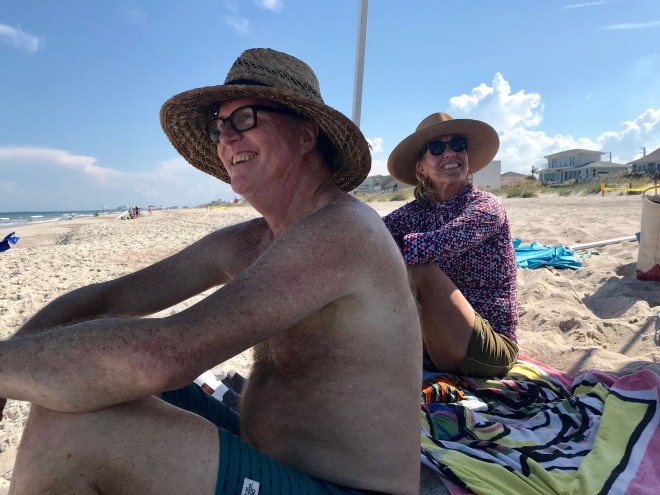
O my brothers and sisters, I have had in the course of my 66 years many a day of mighty fun, and let me tell you, Saturday, the day after the concert, ranks right up there at the apex.  We all gathered at Furman’s and reviewed the show, shared memories from bygone days, and after the “raising of the flag” ceremony, we went swimming in the ocean on a perfect sunny day that featured some of the coolest clouds ever.

From left to right, Furman, Bill (and behind him Dana) Steve, Christi, Kathy, Cheryl, and Lauren (photo credit Caroline Moore)

Bill and Dana


All Good Things Must Come to an End

Caroline and I left Furman’s and Jeanie’s around ten-thirty and made our way back to the Inn for a final nightcap of Jameson’s before we hit the way.

The next morning, we bid good-bye to the excellent staff at the Schoolhouse and took the back roads back to our own little barrier island on the Edge of America.

Thursday afternoon


[1]“Honky Tonk Women” and “Jumpin’ Jack Flash” were released as 45s and didn’t appear on an album until the greatest hits compilation Through the Past Darkly.

[2]Rolling Stonemagazine ranks it 32 on its 500 greatest list, one below Dylan’s Bringing It All Back Home.Exile on Main Streetis the 7thgreatest, according to the list.

Goodnight, Dr. John, May Flights of Brass Bands Blow Thee to Thy Rest


dr john keeper

Okay, Mac Rebennack’s dead, which means so is Dr. John, which means no more gumbo music, no more funkificated word coinages, no more “mos’ scociouses,” no more “desitively bonnaroos.”

Unique is too weak a word.  Dig this from his Nite Tripper days:

Although Dr. John put on great shows right up until recently (I’ve seen him three times over the last twenty years), I think his best album is 1974’s Desitively Bonnaroo.  Music critic Nick Deriso: “Even today, there’s really no roadmap for the crazy-eyed co-mingling of R&B, jazz, island beats, blues, boogie funk and hoodoo whackadoo splashed across this LP, recorded alongside fellow New Orleans legends Allen Toussaint and the Meters more than 35 years ago.”

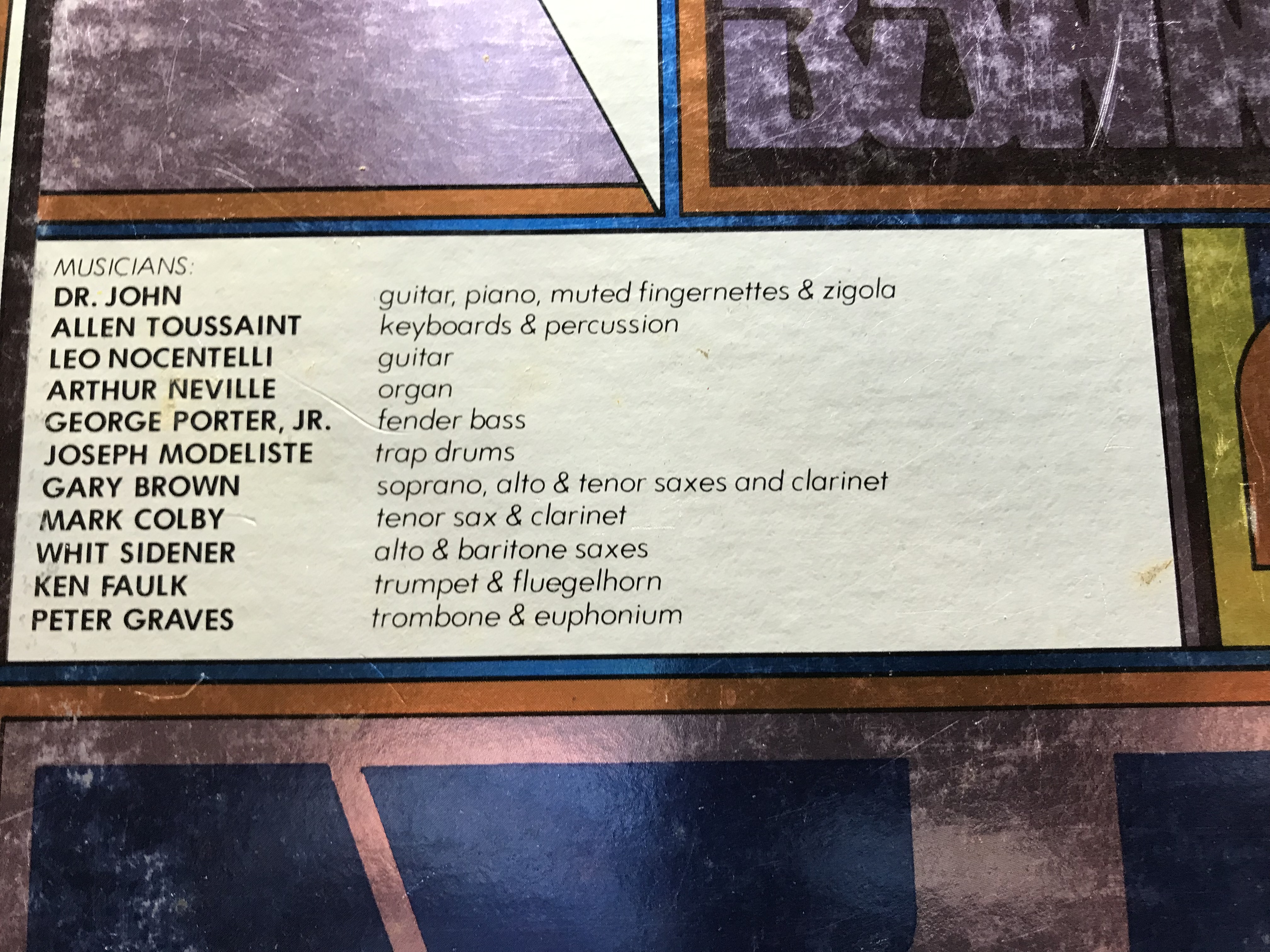
I still got the copy I copped from a sidewalk record sale in ’76.  Take a peek at the musicians, if you’re interested, while you listen to a snippet of the title song.

The first time I saw Dr. John live was at an outdoor street festival, again in Columbia, and I’ll never forget his entrance, sporting canary yellow socks, bopping his cane on the sidewalk, strut-dancing his way up the piano to play and croak and banter.

After Katrina, my friends Jake, Keith, and my late wife Judy Birdsong saw him at the Newberry Opera house.  You could see Katrina had taken a toll, and he kept saying throughout the show, “They put me on psych meds.”  That was back in his way-over-weight days, and he occasionally got up from the piano and do these gyrations that didn’t quite qualify as a dance.

In 2013, I saw him for the last time at the Leaf Festival where he played the guitar. He had started out as a guitarist until he got a finger shot in a scuffle and turned to the piano.

dr on guitar

photo by Wesley Moore

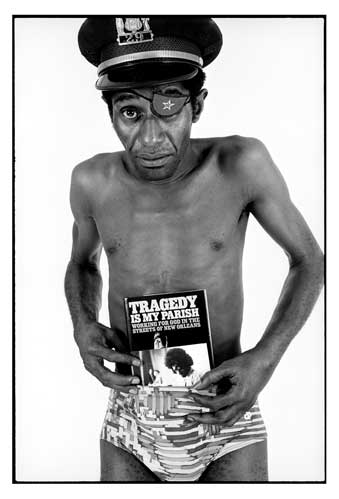
Given his hanging out in smokey bars and strip clubs since his teens, his three-decade heroin addiction, his doing some time in prison, I doubt that Mac would ever dream he’d make it to 77, a lucky number.  At any rate, he follows Professor Longhair, Earl King, and James Booker, whom Dr. John once described as “the best black, gay, one-eyed junkie piano genius New Orleans has ever produced.”

So long, old friend. Gonna miss your music, gonna miss your rap.

jb_tragedy

James Booker


The Considerable Talents of Danielle Howle

photo credit: Fleming Moore


In November of 2014, I published a post entitled South Carolina’s Musical Heritage where I imagined The Oxford American had chosen me to curate a cd of songs produced by natives of the Palmetto State.  I complained that a few of the songs in the Oxford Southern Music series were “a bit too archive-y” and that my cd would not suffer from that preciousness.  You could listen to my compilation without reaching for the fast forward button to skip some pocket-comb-and-tissue band from the 1930s inserted into the mix to establish the curator’s erudition.

Here’s what I came up with:

Maurice Williams and the Zodiacs’  “Stay”

The Swinging Medallions’ “Double Shot of My Baby’s Love”

The Marshall Tucker Band’s “Can’t You See”

Eartha Kitt’s “C’est Bon”

Dizzy Gillespie’s “Salt Peanuts “

James Brown’s “Doing It to Death”

The Drifters’ “There Goes My Baby”

Chubby Checker’s “Let’s Twist Again”

The Brotherhood Gospel Singers’ “Mary, Don’t Cry”

The Reverend Gary Davis’s “Prodigal Sun”

Hootie and the Blowfish[1]“Only Want to Be with You”

Julius Cobb’s “Great Big Change in Me”

Uncle Walt’s Band’s “Gimme Some Skin”

Alphonse Mouzon’s “Funky Snakefoot”

Blue Dogs’ “Walter”

Danielle Howle’s “Oh Swear”

Well, last night, I finally got to meet the last name on that list – not last because least but last because youngest.  Danielle Howle is truly a treasure.  She’s blessed with incredible chops; a gift for melody; a soul capable of alchemizing suffering into poignant but not sentimental art; a sharp, dry wit that makes her stage banter funnier than most of the stand-up acts I’ve seen recently.  Oh, yeah, and charisma.  Obviously, you can’t learn charisma, you can’t will charisma, you can’t ask the Lord Almighty to grant thee charisma.  You either got it or you don’t.  And she gots it in containership loads.

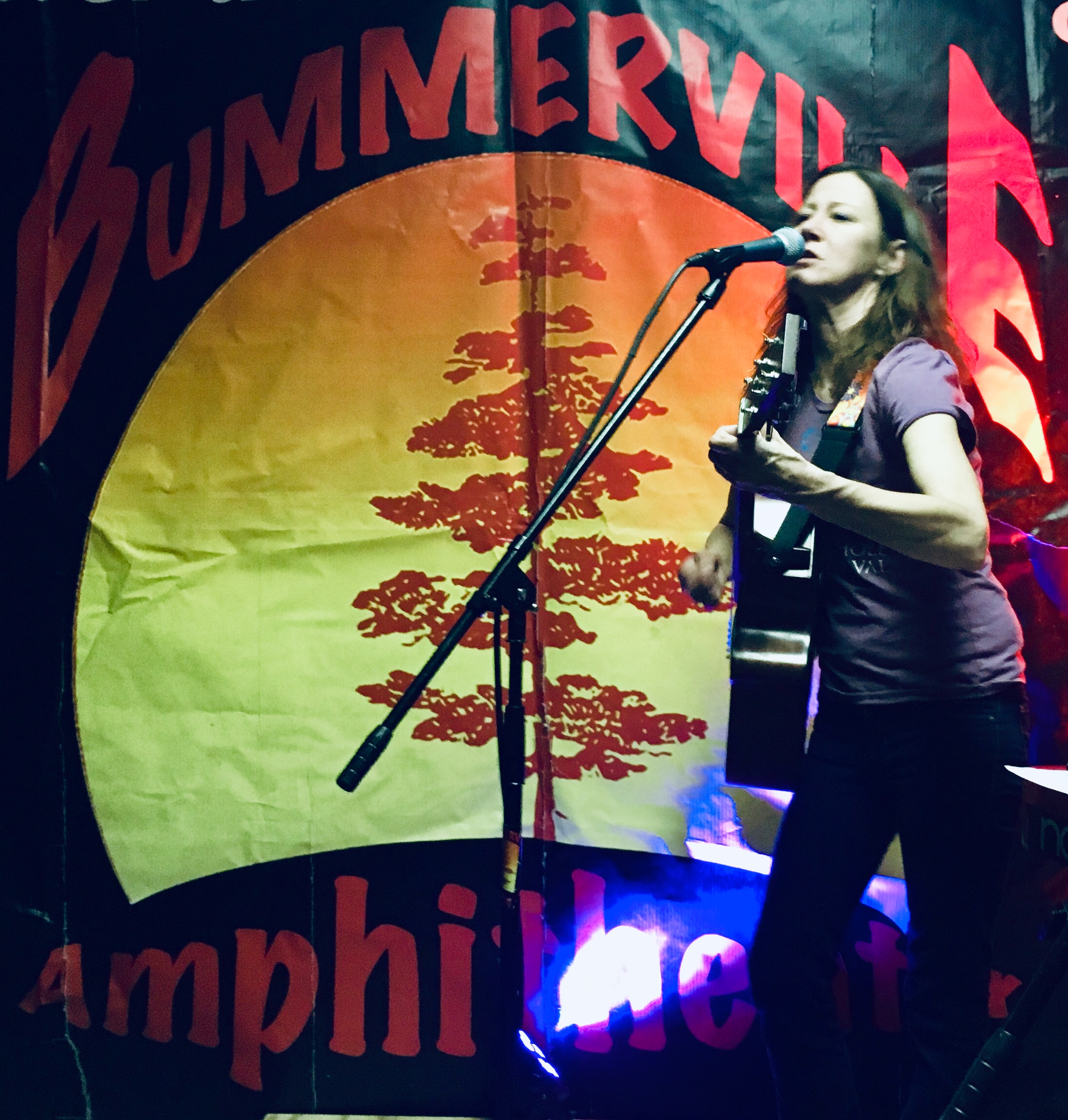
See for yourself as she and keyboardist Alex Goyette playing at the Listening Room at Summerville’s Homegrown Brewhouse:


To say I’m a fan is obviously an understatement.  Check her out whenever you can,  Also, her opening act George Alan Fox and Jesse Pritchard were also  killer.


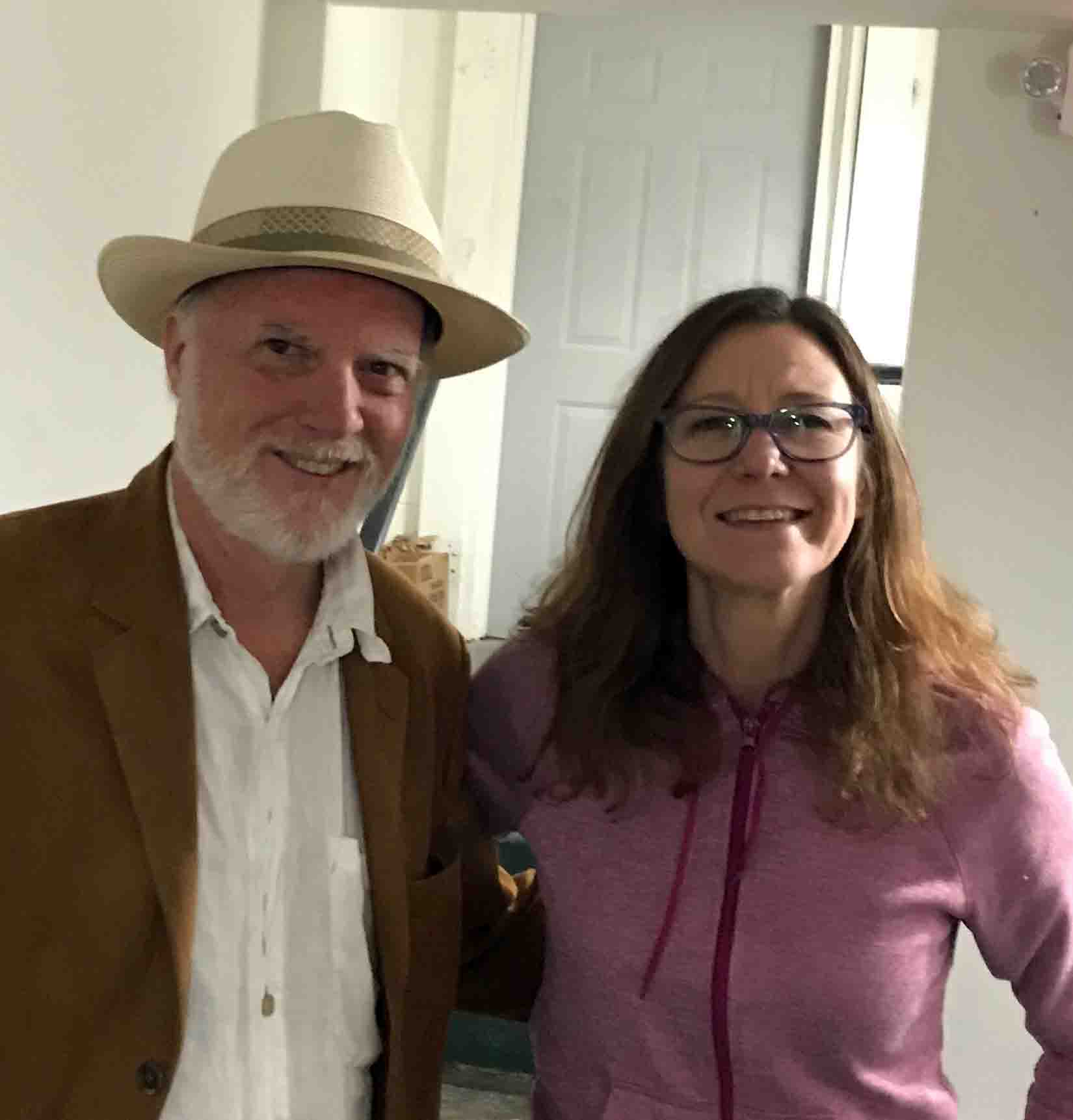
I-and-I backstage with Danielle Photo Credit: Fleming Moore

[1]Not a big fan, but it would be churlish not to include them.

Someone’s Son


My father had some admirable qualities, but equanimity wasn’t one of them.  For example, once, during my teenaged years, when the phone rang once too often to his liking, he ripped its wires from the socket and hurled the entire apparatus against the wall.  Although incidents like this were rare, they occurred often enough to put us on edge. Unfortunately, after I left for college and his business started to go under, financial pressure exacerbated his anger.  When my younger brother Fleming and sister Sue Ellen entered their adolescence, the household became more and more turbulent.

Not too surprisingly, Fleming started to get into trouble.  Anger is contagious – or at least it was for us.  While I was up in Columbia playing the role of angry young man, Fleming was back in Summerville mouthing off, experimenting with drugs, and getting arrested for this and that.  Eventually, he was expelled from Summerville High School.

Nevertheless, he earned a GED and later a BA in mathematics and got a job teaching high school for Berkeley County.

Thanks to a fairly robust his drug habit, his teaching career was short-lived, and Fleming spent years in and out of rehab, ultimately getting hooked on crack.  Oh yeah, before that, he suffered a couple of strokes and had a heart valve replaced while still in his twenties.

Young Fleming

Although I do not believe in a personal god, I know that Jesus can save lost souls, because he saved Fleming, who has been sober/straight now for going on a decade.

During this time, he has been writing and playing music.  Just recently, reverb.com invited him to Brooklyn for a recording session.

My hope is that some established star records one of his songs because they’re really good, both melodically and lyric-wise.

Here’s a clip from a recent gig at Bowties in James Island.

The song is entitled “In the Holy City,” a tribute to the love offering of the relatives of  the victims of the Charleston massacre.

Anyway, never give up on someone.  If you’re in the Charleston area, you can catch Fleming and his band at Bowties Thursday 18 October at 7.  I’ll certainly be there.

A Tribute to David Bromberg

I discovered David Bromberg late, in ’76, during my farcical impersonation of a graduate school student. Instead of [forgive the vulgar patriarchal terminology] boning up on feminist theory, I was tending bar with a broken heart until about midnight, and as you bartenders know (right Charlie?), you don’t get off and go straight home.  You go to some early morning alcohol dispensary to wind down, which makes showing up an eight o’clock class on 18th Century English journalism seem as unlikely as Jackie Collins winning the Nobel Prize for Literature.

From left to right, Bob Dylan, Leon Redbone, and David Bromberg

But I digress.  This post is about David Bromberg, whom I consider a woefully underappreciated American treasure.  The first record of his I copped was this one: David Bromberg Songs (1972).  Two tunes that really caught by attention were “Delia,” an obscure yet widely covered (if that’s possible) murder narrative and “Sammy’s Song,” a Hemingwayesque tale about a sixteen-year-old’s uncle-sponsored trip to a brothel.

Take a listen to this snippet from “Delia.”


And here’s “Sammy’s Song.”


Although most noted for his superb guitar playing, whether he’s laying down blues licks on a Son House cover or finger picking bluegrass at breakneck velocity, it’s Bromberg’s distinctive narrow ranged voice that slays me.  Rather than trying to imitate African Americans or white Southerners, Bromberg employs his very own Tarrytown baritone to great effect.  In addition to the acoustic, electric, and pedal steel guitars, he also plays fiddle and dobro in an eclectic array of genres: bluegrass, blues, folk, jazz, country and western, and rock-n-roll.

I finally got to see him live last March at the Pour House.  His quintet featured Nate Grower on fiddle, Mark Cosgrove on guitar and mandolin, Josh Kanusky on drums, and Butch Amiot on bass.  They ran through a fifteen song set whose highlights included his great cover of Ian and Sylvia’s “Summer Wages,” an acapella rendition of “Will You Still Love Me Tomorrow,” and his signature version of  “New Lee Highway Blues.”

David Bromberg at the Pour House, photo by Wesley Moore

And, oh yeah, and “Delia.” He provided a more complete history of the song’s origin, which is absolutely fascinating. Delia Green was a 14-year-old girl shot on Christmas Day in 1900 in Savannah. For whatever reason, her murder inspired several songs, the two most famous by Blind Willie McTell and Blake Alphonso Higgs.  In addition to Bromberg, Bob Dylan, Josh White, Pete Seeger, Harry Bellafonte, Burl Ives, the Kingtson Trio, Bobby Bare, Waylon Jennings, and Johnny Cash have all covered the song.  Of yeah, one more, Pat Boone.

Pat Boone? WTF?

Anyway, do yourself a favor and go out and buy a couple of his records, and if you ever get the chance to see him live, jump at it.

I’ll leave you with this.