Open-Eyed, Laughing: In Memory of Pat Conroy

patAlthough I didn’t know Pat Conroy well at all – maybe five close encounters (including one at our house on Folly Beach) – I was, however, privy to his condition during his last days because while Pat received treatment at MUSC, I met his daughters Megan and Jessica Sunday night for a drink downtown, and they ended up staying with us Monday night at the beach before heading back to Beaufort on Tuesday where Pat passed away.

Even though I only hung with Pat a view times, I could detect the hurt beneath his quick smile and alert eyes. Like many who have suffered bleak childhoods, he viewed life through the blackest of shades and attempted to illuminate that darkness through flashes of sardonic humor. If he hadn’t been a novelist, he could have made a fortune doing stand-up. I certainly hope somebody somewhere has recorded his story about not taking Barbra Streisand’s calls because he thought she was his pal Bernie playing a practical joke.

Pat remembered and cared about you. A year and a half ago when we were visiting Megan at his house at Fripp, Pat told me that I had a good life, that teaching English was a good life. A couple of weeks ago at his house in Beaufort, the first time I’d seen him since, he again asked me about my teaching, if I had retired. He insisted on getting up as Judy and I were leaving.

He knew he was a goner but was stoic and flashed that quick smile throughout our conversation. Monday night, Megan told me that he had said good-bye to her and her sisters at ICU, and as they were leaving in tears, he added, “Damn, I’m going to be so embarrassed if I don’t die tonight.”

Bingo.

Yeats wrote in his poem “Vacillation” that he tested “everything his [own] hands [had] wrought” according to whether or not it was “suited for such men as come/ Proud, open-eyed, and laughing to the tomb.”

Pat Conroy was such a man.

May he rest in peace and the family he has left behind thrive.

Not So Fabulous Pick-Up Lines from Master English Poets

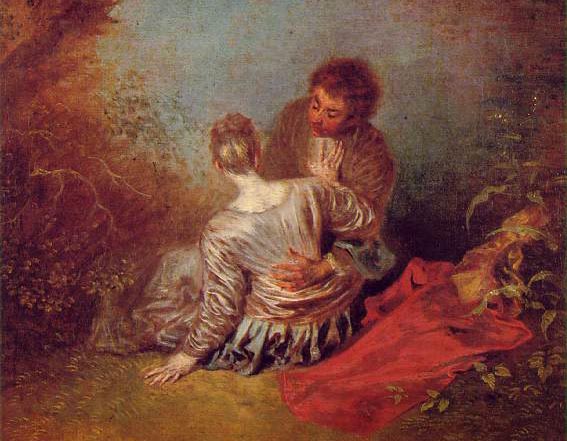
coy

Is poetry really the way into a lover’s heart? Here’s the Swan of Avon, Mr. William Shakespeare himself, having a go at it:

But no roses see I in her cheeks,

And in some perfumes there is more delight,

Than in the breath that from my mistress reeks.

Here, Master Will is attempting to flatter his dark-skinned mistress by underscoring how she doesn’t conform to pale-faced Elizabethan standards of beauty while mocking poets who overstate their lovers’ charms. However, judging by the limited number of women I have courted, I don’t see this strategy working well at all.

For example, I would not have attempted to flatter my late beloved wife with these lines:

My mistress’s breasts are fairly flat

And her hair a sort of mousey brown,

Yet she makes my heart go rat-a-tat-tat

Whenever I take her out on the town.

Nor do I think John Donne’s “The Flea” would work with most women. Sure, his comparing flea bites to sexual intercourse is “imaginative” and his “a-ha” comeback at the end of the poem clever, but, really, do you think this argument has even a Casper-the-Friendly-Ghost of a chance:

It sucked me first, and now sucks thee,

And in this flea our two bloods mingled be.

Thou knowst this cannot be said

A sin, nor shame, nor loss of maidenhead.

Then there’s Andrew Marvell’s “To His Coy Mistress,” which at least starts off on the right foot with some extravagant praise.

An hundred years should go to praise

Thine eyes and on thine forehead gaze;

Two hundred to adore each breast,

But thirty thousand to the rest;

An age at least to every part,

And the last age should show your heart.

For, lady, you deserve this state,

Nor would I love at lower rate.

But then gets all morbid on us:

Thy beauty shall no more be found;

Nor, in thy marble vault, shall sound

My echoing song; then worms shall try

That long preserved virginity . . .

As one of my students once said when I told her that faculty members often lie around unclothed in the faculty lounge:

BAD MENTAL PICTURE!

Sir John Suckling, he of the unfortunate name, creates this sure-not-to-please image:

Her feet beneath her petticoat

Like little mice stole in and out,

As if they feared the light;

But oh, she dances such a way!

No sun upon an Easter-day

Is half so fine a sight.

Maybe chicks back then thought vermin cute, foot-fetishes adorable?

Here’s another from Sir John:

Her lips were red, and one was thin;

Compared with that was next her chin,—

Some bee had stung it newly.

Jacobean Botox!

No, boys and girls, I doubt seriously that poetry is capable of melting hearts. After all, the greatest of poets, William Butler Yeats, devoted god knows how many iambs in his lifelong but vain attempt to win the love of Maud Gonne.

He leaves us with this good advice:

Never give all the heart, for love
Will hardly seem worth thinking of
To passionate women if it seem
Certain, and they never dream
That it fades out from kiss to kiss;
For everything that’s lovely is
But a brief, dreamy, kind delight.
O never give the heart outright,
For they, for all smooth lips can say,
Have given their hearts up to the play.
And who could play it well enough
If deaf and dumb and blind with love?
He that made this knows all the cost,
For he gave all his heart and lost.

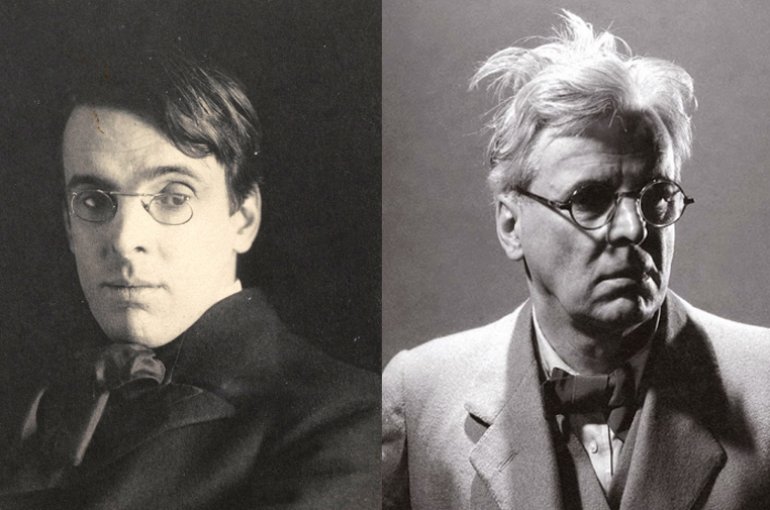
WB Yeats

David Foster Wallace and Samuel Johnson

posterAt one point in The End of the Tour, the David Foster Wallace character (Jason Segal) introduces the David Lipsky character (Jessie Eisenberg) as “Mr. Boswell.”

It’s what we used to call a “cut” when I was a kid, a playful little knife nick to the ego’s epidermis. As future biographer Thomas Boswell followed the Great Samuel Johnson around the salons of 18th Century London scribbling down his every word so Rolling Stone reporter David Lipsky follows the Great David Foster Wallace around the fast food joints of Bloomington and Minneapolis scribbling down (and recording) his every word.

A major difference, though, is that Boswell worshipped Johnson, and being 30 years younger, looked up to him as you might an adored father. True, Lipsky recognizes that Wallace is a genius (and he was) and that he Lipsky is not (and he’s not); unfortunately, though, Lipsky suffers from that common young male testosteronic compulsion to see any contemporary as a rival. In his head he knows when it comes to Foster and him, it’s the literary equivalent of Bogey versus Barney Fife, but in his heart – or at least in his testes – he wants to be considered Wallace’s equal.

So the Lipsky character is both an ardent admirer and a resentful rival, and this tension provides the slight dramatic arc of the movie. Frankly, if I were you, I’d wait until the film comes out on Netflix.

Not that the film’s not well crafted and superbly acted (Segal might deserve an Oscar). However, this little movie with its appropriately washed out colors straining in winter light to render those undistinguishable commercial corridors that lead to every city in the US as soulless as possible ain’t exactly crying out to be seen on “the big screen.” The movie’s sort of claustrophobic. Our characters don’t talk about fiction, much less Infinite Jest, which could be a multi-generational novel set in Alaska for all we know. They migrate from emblematic soulless room to emblematic soulless room talking mostly about themselves, and the Wallace character’s social awkwardness doesn’t make you wish you could trade places with Lipsky.

What would have made the movie more interesting (and let me assure any Hollywood moguls out there reading this that I am available) is if we could have peeked inside of Wallace’s head on occasion. For example, when Lipsky asks Wallace why Wallace wears a head bandanna, we could have been treated to a montage from Wallace works – surreal scenes – for example, rapidly edited shots of wheelchair bound terrorists . . . a father strapping a Raquel Welch mask to his daughter before abusing her . . . a rollercoaster ride at the Indianapolis State Fair . . . dinner on a cruise ship with its Felliniesque diners, etc. etc. – all of these quick cut images gaining momentum until DFW’s head literally explodes.

The good and bad news is that this movie is very stage adaptable.

Dave and SamBut here’s why I’m glad I went. A cartoon light bulb went off over my head as I was watching. The DFW character as Segal plays him is a lot like the Great Samuel Johnson. He’s straggly-haired, overweight, disheveled, stooped, ursine, shambling, prone to a soul’s darkest nights, pitifully self-absorbed, and, despite his genius, someone who strives as hard as he can to be a good man.

I love Boswell’s Johnson, and in my way, I love David Foster Wallace, but not Lipsky’s Wallace. In fact, in this movie, he’s not as clever or fun or witty as at least three friends I can think of – Furman Langley, Jake Williams, and Melissa DeMayo Reiss.

I’d much rather spend a couple of hours with them on a rainy Sunday.

A Buddhistic Approach to Kafka’s Metamorphosis

K-buddah_jpgA professor friend of mine at the College of Charleston who teaches a freshman course entitled The Nature of Solitude: Sacred & Secular, Voluntary & Involuntary invited me to come and cover Kafka’s “Metamorphosis,” so I thought I’d share with any instructors out there the approach I took. Since the course is philosophical, not literary, rather than discussing the structure or aesthetics of the work or taking a Freudian or Marxist approach to the narrative, I’ve opted to approach the work more practically.

I decided to begin the hour-and-fifteen minute class with a keynote presentation that highlights the remarkable unlikelihood that any of the students sitting in the class actually have come into being (see “Slide 4” for further explanation) to underscore the horrible tragedy of the stunted life of the Metamorphosis’s protagonist, Gregor Samsa.  In addition, the presentation also suggests that mythology and its talented stepsister literature offer interesting ways to cop insight into, not only our lives, but science as well.  In fact, the presentation suggests that science itself is a myth, albeit a self-correcting one. Finally, I wanted to alert students to the human propensity of projecting our biology onto the cosmos as a way of explaining mysteries outside of ourselves. Of course, you can view the presentation all at once, but I have provided how I deal with each slide below the presentation.

Slide 1

As you can see, the first slide, the title slide, consists of two images, the first a sperm cell crashing into an ovum, the second, an artist’s rendering of a comet or meteor crashing into earth, which is science’s current best guess as to what engendered the chemical reactions that led to life.  I do the ol’ Socratic method, asking the students to identify what’s going on in each slide.

Slide 2

Slide 2 consists of Wordsworth’s famous sonnet “The World Is Too Much with Us,”  as in the work-a-day world overwhelms me with its mind-numbing responsibilities and anxieties, which, of course, relates to “The Metamorphosis.”  As you recall, Gregor who has awakened in the form of a gigantic beetle seems more worried about getting to work on time than he does about horrible fact that he has been transformed from a mammal to an insect who still possesses a human consciousness.

The poem offers a plethora of potential Socratic questions as you relate the sonnet to the novella.  I actually talk about the structure of the sonnet, its volta in line 9, but the main focus is what the speaker of Wordsworth’s sonnet and Gregor Samsa have in common and what the sonnet and Dylan’s lyrics have in common.

Slide 3

Slide 3 quotes a stanza from Dylan’s “Subterranean Homesick Blues,”  which offers a beautifully truncated catalogue of childhood.  Note the anxiety inherent in Dylan’s ditty. (By the way, you can read my argument why Dylan deserves a Nobel Prize in literature HERE).

Slide 4

The fourth slide is an excerpt from the movie Adaptation, which didn’t successfully make the trip from my hard drive to the Internet, but you can view it here: 

Obviously, ultimately, Nicolas Cage’s character’s question how did I get here has a very complicated answer.  For him to exist on this tiny planet swirling around a run-of-the-mill star much has had to happen, much of which from my perspective seems random, the first meteor which brings life, the second meteor that brings death to the dinosaurs and their displacement by mammals; then you have to factor in the long odds of that particular sperm hitting that particular egg through the long line of his ancestors culminating with his parent’s coupling on that particular day of his conception, a day when his mother didn’t have a headache, a coupling that led to one of 250,000 sperm cells in what I call the most important-race-of one’s-life reaching the finish line of one of mother’s 300 or so ova, a process that resulted in him, and by extension, you, C of C freshman, or you, blog reader.

Slides 5 & 6

These slides underscore the long odds of existence, emphasizing just what a shame it is for poor Gregor to live such a stunted life given the enormous odds of existence.  Here, I sneak in Buddhist doctrine, and talk about the Samsa family dynamic, the office manager, etc.

Slide 7

I talk about myth here, not as untruths, but in the Joseph Campbell mode as symbolic structures that embody profound truths.

Slide 8

This slide suggests that science is often wrong about details (not theories).  If I had written “quark” instead of “electron” in my 1970 chemistry test, I would have been correct but had my answer marked wrong.  By the way, I’ve photoshopped my 1970 self into this slide (the redheaded one leaning over the desk) to show the freshmen what I looked like 45 years ago and to horrify them with the realization that they too one day will look like me now [cue maniacal laughter]

Slide 9

The discoverer of the quark, Murray Gell-Mann named it after a word from James Joyce’s novel Finnegan’s Wake, suggesting that scientists like literature, that disciplines are all interrelated.

Slide 10

A reprise of Slide 8

Slide 11

In Slide 11, I ask if anyone recalls the Greek creation myth of Uranus and Gaia.  If no one does, I retell it, which is essentially, the sky Uranus had sex with the earth Gaia and life began, which, brings us back to the first slide.  The current scientific theory and the Greek myth are essentially the same.

For the rest of the period, I let the students talk about “The Metamorphosis” and give them wide range.  Of course, given the title of the course, Gregor Samsa’s involuntary solitude should be brought up.

It’s Story Time – Measure for Measure Edition

In 1951 in a letter to Harold Adam Innis, Marshall McLuhan claimed that “[t]he young today cannot follow narrative, but they are alert to drama. They cannot bear description, but they love landscape and action.“ It is perhaps foolish for a pedestrian blogger to dare to contradict such a colossus as McLuhan, but I beg to differ. High school students still love to hear a story told out loud, or at least my students do.

I don’t know whether their delight in hearing oral narratives stems from nostalgia for those less complicated days of kindergarten when they sat in circles on carpeted floors, or if it stems from even more profound depths, from some deep-rooted inclination that made keen listeners around ancestral fires more likely to pick up on life-enhancing lore. Whatever the case, whenever I announce to one of my classes, “It’s story time,” they slap shut their laptops and lean towards me in eager anticipation. Of course, I don a mask, assume a postmodern irony-laden patronizing narrative voice, supply dialogue in various tonalities, and gesticulate when appropriate.

For example, last Thursday, I announced it was story time, and told them a tale which I informed them is called “Measure for Measure.”

* * *
Measure for measure by by Hannah Tompkins

Measure for measure by by Hannah Tompkins

Boys and girls, once upon a time in the city of Vienna, there was a Duke named Vincentio who was sort of like a Dean of Students and Principal wrapped up in one, and because Vincentio was a kindly man, he sometimes didn’t enforce the letter of the law, or even some of the laws themselves. Human nature being what it is, the citizens of Vienna started taking advantage of this laxity, the way you do by violating the dress code with your short skirts and contraband hoodies, you know, because we teachers are too lazy or pusillanimous to enforce the dress code.

Plus, some of the Vienna’s laws were ridiculously old-fashioned and inhumanely severe. For example, boys and girls, [cue Pentecostal preacher’s voice] forn-i-CA-tion was a capital crime. If an unmarried man and an unmarried woman engaged in [cue effete professorial voice] coitus and were caught, the state beheaded the man (but let the woman live much to the chagrin of some feminist critics).

But the thing is. because laws against sex were being ignored, Vienna had become – pardon the pun – a hotbed of lechery and had been overrun by strumpets (what your hiphop heroes call hos), bawds (what your hiphop heroes call pimps), and pox (what your heath teacher calls STDs).

Well, Duke Vincentio decides enough is enough, but he doesn’t want to seem like the bad guy, so he claims to be running off to Hungary and puts his Deputy Angelo in charge to do the dirty work of cleansing Vienna of riffraff and sexual escapades. Only the Duke doesn’t really leave Vienna but disguises himself as a friar so he can keep tabs on how Angelo handles things.

The Duke chose Angelo because like his name implies, he seems to be without sin. You see, this Angelo is a rule-follower extraordinaire. He would never like you, Ashley, wear a baseball cap indoors, or you, Mason, jaywalk on King Street. And not only that, not only has he never engaged in any kind of sexual activity, he has never even had the desire to. His blood, as one of the minor characters puts it, is “like snow broth.”

So Angelo gets to work pulling down bordellos (i.e. whorehouses) in the suburbs and enforcing all of the other laws pertaining to sexual misconduct.

As it turns out, the first person to get busted for intercourse is a twenty-year-old named Claudio who impregnated his finance Juliet. Even though it has been years since anyone has been arrested, much less beheaded for this crime, Angelo not only has Claudio shackled but insists he be perp-walked through the streets to advertise that the times they are a-changing.

Claudio and Juliet are a nice couple from nice familes and were engaged at the time when weak-willed they made what our guidance counsellors call “a bad decision.”

“Claudio and Isabella” by William Holman Hunt:

Everyone else in the government is sympathetic to their plight, and luckily, for Claudio, he has a beautiful and eloquent sister named Isabella who is in the process of jumping through the hoops young women jumped through in those days to become nuns. After she visits Claudio in prison,  one of Claudio’s pals Luciano accompanies Isabella to Angelo’s house to have her plead for mercy. If anyone has the power to change anyone’s mind, it’s Isabella, who like I said, is not only beautiful but is so articulate that she makes your own modest storyteller sound by comparison like Lenny in Of Mice and Men.

And Isabella succeeds, all too well. Yes, she melts that snow broth of Angelo’s blood, all right, but raises its temperature so high it turns into a hot volcanic eruption of lust. That’s right, for the first time in his entire life, Angelo suffers what Patti Smith calls “the arrows of desire,” and even though Angelo knows it’s wrong, even though he fully understands the base hypocrisy of what he proposes, he tells Isabella that he will let her brother go if she will sleep with him, i.e., Angelo.

Isabella storms out in rage confident that her brother Claudio would prefer to die a thousand deaths rather than have her commit such an act of ignominy.

When she arrives at the prison to give Claudio the bad news, the Duke is there disguised as a friar trying to console Claudio with this killer contemptus mundi speech, cataloging all the slings and arrows that flesh is heir to, like growing old and ugly while your children “do curse the gout serpigo, and the rheum,/For ending thee no sooner.”

The Duke retreats and eavesdrops on Claudio and Isabella’s conversation, which goes like this.

“What’s the scoop, Isabella?”

“Good news. Lord Angelo has some business in heaven. He’s sending you there as his ambassador. You’ll be shipping off tomorrow.”

“You call that good news! That’s not good news!”

“Claudio, I hesitate to tell you this because it’s really going to infuriate you, but Angelo actually did say he’d let you go if I did something for him.”

Really! What is it? Tell me!”

“It will make you furious.”

“Why? C’mon tell me. What is it he wants you to do for him!”

“He said he’d let you go if I slept with him.”

“Really!?!?! What did you say?”

“Of course, I said what you would want me to say, of course not!”

“Wait, Isabella, you said no? Oh, sister, come on! If by committing such a sin you save a life, that sin becomes a virtue. You gotta do this for me. Dying sucks, it’s scary, please-please-please!”

Isabella’s not having any of it. She storms out furious but is approached by the Duke-in-Friar’s-Clothing who shares with her a plan.

“Marianna” by Małgorzata Maj

The Friar tells Isabella that Angelo has a fiancée of his own, a woebegone woman named Mariana who pines away in a “moated grange”; that’s a “farm with a ditch around it” for you lazy students who haven’t found time yet to memorize the Oxford English Dictionary. Anyway, Angelo has refused to marry Mariana because the ship carrying her brother who was transporting riches for her dowry sank drowning her brother and losing the riches.

“No way, Jose” (or the Italian equivalent) Angelo says, “I’m not marrying you because you’re no longer rich.”

This Angelo is a piece of work, don’t you think? He makes pre-conversion Ebenezer Scrooge look charitable.

Anyway, the Duke shares the plan: “Go back and tell Angelo, yes, you’ll sleep with him, but only at this certain moated grange, and in complete silence and darkness.”

So she does so, and Angelo arrives at the moated grange, enters the bedroom, and in utter darkness does the deed with – can you guess who – that’s right, Mariana!

So Angelo returns to Vienna and demands that Claudio be put death anyway because he’s afraid Claudio will find out he’s had sex with his sister and seek revenge. He demands that Claudio’s head be brought to him for proof. What a, as Sugar-Boy says in All the King’s Men, b-b-b-b-astard!

Well, there’s another prisoner to be beheaded named Bernardine, so the Duke says behead him and bring Angelo that head, but Bernardine refuses to be put to death because he’s too hungover and is so persistent that they give up. Anyway, as luck would have it, a pirate who looks more like Claudio anyway died in prison that night, so they cut off his head and take it to Angelo.

The Friar lets Isabella think, though, that her brother is dead. It seems that friars back in those days —- remember Friar Laurence from Romeo and Juliet — had no qualms having loved ones think their kinfolk were dead.

Anyway, news arrives that the Duke is returning to Vienna. He sheds his disguise and arrives at the gates where he’s met by virtually everyone in the story who’s not in jail. Isabella tells the Duke her story, and Angelo denies it, relying on the universal common knowledge that he’s never broken a rule, much less a [no, I didn’t go there].

The Duke pretends to think that Isabella is mad because what she claims is so wildly out of whack with Angelo’s reputation. How could Angelo be, as she claims, a “virgin-violater?” But again, her speech is so articulate it seems to defy the charge of insanity.

Isabella then tells what some might call a lie, others a fib. She claims she’s slept with Angelo.

No, way, Jose (or it’s Italian equivalent) the Duke says. There’s no way Angelo would put to death a man for something he himself has done unlawfully. No one could possibly be such a vile hypocrite, much less such a noble outstanding non-jaywalking citizen like Angelo!

The Duke demands his underlings to cart Isabella to jail for lying, and she moans, “Only if the Friar were here.”

The Duke calls for the Friar, but is told by another priest that he’s sick and cannot come.

They haul Isabella off, and Marianna enters hidden by a black veil. She says Isabella was lying, that it was she — Mariana — who had slept with Angelo. She takes off her veil.

Angelo admits he used to be engaged to but has never slept with Mariana. The Duke pretends to lose patience and tells the Provost to settle matters.

The Duke splits but then reenters wearing his Friar disguise.

All the while this man named Lucio has been lying to the Duke-as-Duke telling him that the Friar had been speaking out against the Duke, calling the Duke a fishmonger [what your hiphop heroes call a pimp], etc., which of course is ironic given the Duke and Friar are one in the same. He claims the Friar has put up Mariana and Isabella to slander Angelo. A Provost tells the guards to go fetch, Isabella, which they do.

Abusing the friar, Lucio yanks off his hood to discover to his horror that – uh-oh!
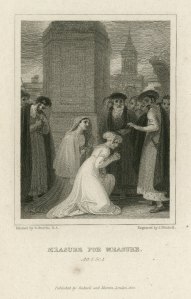
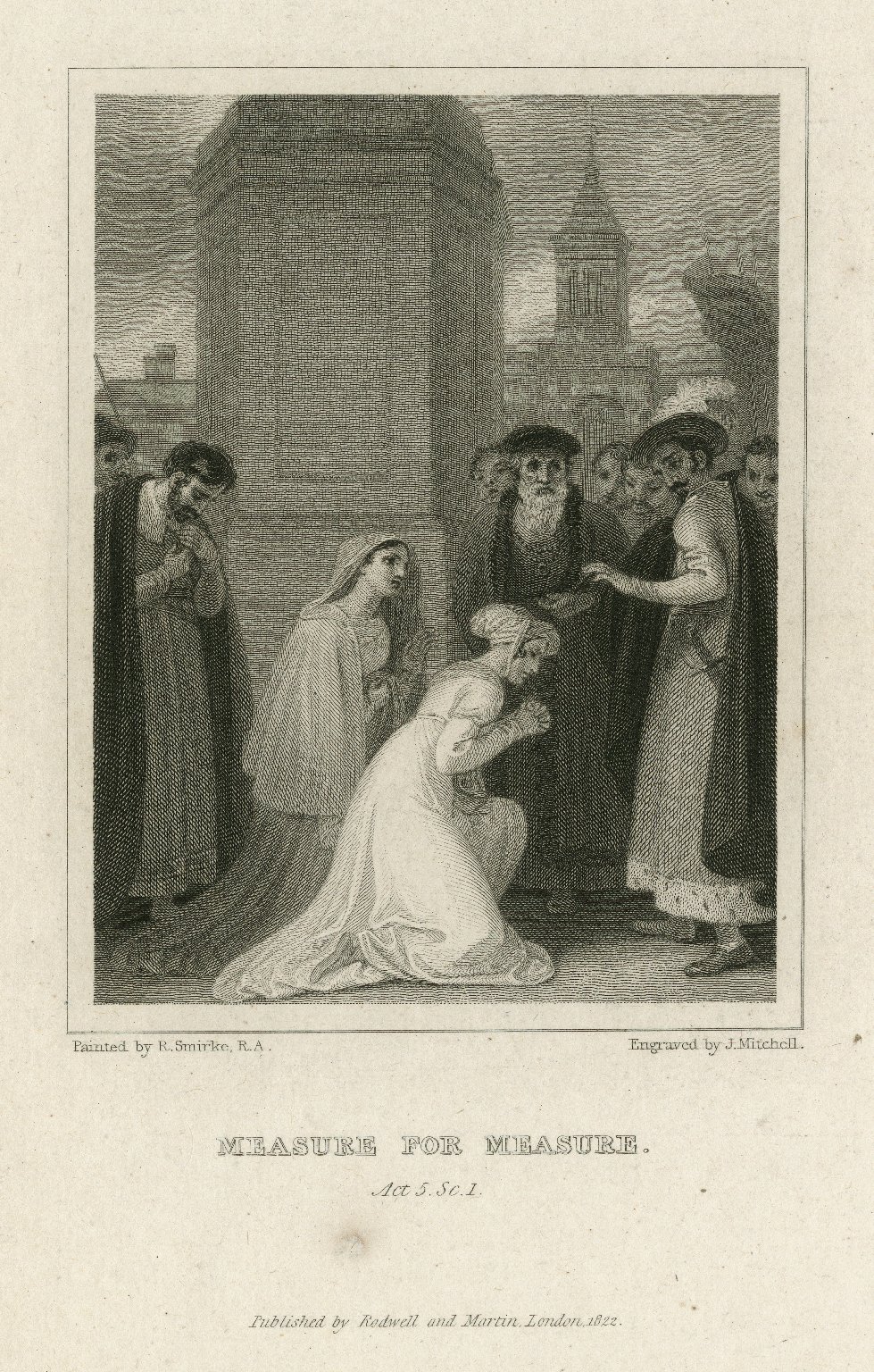
026635Time to wrap things up? Angelo confesses, begs to be executed, but the Duke makes him marry Mariana. Then he says the must execute Angelo because Claudio has been executed. Mariana pleads with Isabella to help save Angelo’s life, which she does on her knees in a reprise of her original pleading for Claudio’s life.

The Duke ain’t no Angelo; he pardons him, then pretends to fire the Provost who returns with — drumroll — symbol clash !!! – Claudio!!!. TA DA!

The Duke asks Isabella to marry him, but she doesn’t answer. The Duke says he’s gonna have Lucio beaten and then hanged but instead makes him marry a prostitute he had “known in the biblical sense. “ Ha Ha! Even though Lucio would rather be beaten and hanged, the Duke makes him marry anyway.

Just for a little icing, the Duke pardons Bernadine, who may be the original model for Otis Campbell in Andy of Mayberry.

So the story ends with four marriages  and a pardon — though happily ever after isn’t exactly the vibe we get when the story concludes.

And that’s, boys and girls, story time for today!

* * *

Of course, this written rendition lacks the dynamics of listening to oral stories – voices, gestures, eye-contact, the dynamic energy between audience and tale-teller, questions that the students ask, etc.

I promise, though, they virtually all pay attention and often ask when are we going to have another story time.

My reason for providing them Measure for Measure’s plot is this: we’re studying that saddest of sad sacks, Alfred, Lord Tennyson, whose poem “Marianna” the students had read for homework the night before.

The epigraph of the poem, as you can see below, is “Marianna of the moated grange.” Of course, epigraphs are supposed to provide readers with a cross-reference, some insight into the meaning of the poem. After “hearing” the story of Measure for Measure what might you think the poem might be about? Justice? Hypocrisy? What Alex calls in A Clockwork Orange the “ol’ in-and-out.”

We’ll see for yourself, and if you’re not the poetry-reading type, at least check out the first and last stanzas:

Mariana

“Mariana in the Moated Grange” 
(Shakespeare, Measure for Measure)

With blackest moss the flower-plots
Were thickly crusted, one and all:
The rusted nails fell from the knots
That held the pear to the gable-wall.
The broken sheds look’d sad and strange:
Unlifted was the clinking latch;
Weeded and worn the ancient thatch
Upon the lonely moated grange.
She only said, “My life is dreary,
He cometh not,” she said;
She said, “I am aweary, aweary,
I would that I were dead!”

Her tears fell with the dews at even;
Her tears fell ere the dews were dried;
She could not look on the sweet heaven,
Either at morn or eventide.
After the flitting of the bats,
When thickest dark did trance the sky,
She drew her casement-curtain by,
And glanced athwart the glooming flats.
She only said, “The night is dreary,
He cometh not,” she said;
She said, “I am aweary, aweary,
I would that I were dead!”

Upon the middle of the night,
Waking she heard the night-fowl crow:
The cock sung out an hour ere light:
From the dark fen the oxen’s low
Came to her: without hope of change,
In sleep she seem’d to walk forlorn,
Till cold winds woke the gray-eyed morn
About the lonely moated grange.
She only said, “The day is dreary,
He cometh not,” she said;
She said, “I am aweary, aweary,
I would that I were dead!”

About a stone-cast from the wall
A sluice with blacken’d waters slept,
And o’er it many, round and small,
The cluster’d marish-mosses crept.
Hard by a poplar shook alway,
All silver-green with gnarled bark:
For leagues no other tree did mark
The level waste, the rounding gray.
She only said, “My life is dreary,
He cometh not,” she said;
She said “I am aweary, aweary
I would that I were dead!”

And ever when the moon was low,
And the shrill winds were up and away,
In the white curtain, to and fro,
She saw the gusty shadow sway.
But when the moon was very low
And wild winds bound within their cell,
The shadow of the poplar fell
Upon her bed, across her brow.
She only said, “The night is dreary,
He cometh not,” she said;
She said “I am aweary, aweary,
I would that I were dead!”

All day within the dreamy house,
The doors upon their hinges creak’d;
The blue fly sung in the pane; the mouse
Behind the mouldering wainscot shriek’d,
Or from the crevice peer’d about.
Old faces glimmer’d thro’ the doors
Old footsteps trod the upper floors,
Old voices called her from without.
She only said, “My life is dreary,
He cometh not,” she said;
She said, “I am aweary, aweary,
I would that I were dead!”

The sparrow’s chirrup on the roof,
The slow clock ticking, and the sound
Which to the wooing wind aloof
The poplar made, did all confound
Her sense; but most she loathed the hour
When the thick-moted sunbeam lay
Athwart the chambers, and the day
Was sloping toward his western bower.
Then said she, “I am very dreary,
He will not come,” she said;
She wept, “I am aweary, aweary,
Oh God, that I were dead!”

I declare this poem to be musically brilliant – a slow, dirge-like symphony of monotony – of fined-tuned repetitions. Of course, the danger lies in that this poem about monotony can itself become monotonous, but my students, who for the most part are conscientious, do read it, and through Socratic questioning, they ferret out imagistic patterns of dilapidation and stagnation, sonic patterns, repetitious sentence structure, etc.

But the exercise also provides another example of existentialism for them to ponder, how each individual can see the world differently. Tennyson’s melancholy cast of mind focused on the sadness of a character who engages in a bed-trick to entrap her fiancé. You have to wonder if Tennyson ever even smiled while reading the play.

In other words, for Tennyson Measure for Measure is not a comedy but a tragedy, which it very well could be if not for the contrived ending. Let’s face it, the first four acts of Romeo and Juliet with its rhyming and comical Nurse seems less like a tragedy than a comedy.

Anyway, like Hamlet says, “Nothing is neither good nor bad but thinking makes it so. Or funny or not. Or as Robert Walpole said, “Life is a comedy for those who think, a tragedy for those who feel.”

Adieu.

Ten Literary Riddles

Hoodoo Headquarters

Hoodoo Headquarters

Back in the late 80’s, when academics were more demanding where I teach, I included a section on my exam called “Association.” Students had to match a character or work they had read that semester with an enigmatic phrase I provided — only there was nothing to match the phrase to, no list of possible choices. When they complained, I told them all they needed to do was to read my mind.

Of course, no way I get away with something like that nowadays. Parent-piloted Blackhawks would be raining rockets on my drafty garret, Hoodoo Headquarters.

Just for fun, though, I thought I’d recreate “Association” for this post. See if you can identify these novels, plays, or long poems.  Of course, it’s going to be harder for you since your choices aren’t confined to a limited number of works you’ve read in the last five months.

1. Libidinous Lydia’s Lucky Elopement

2. Doing Dublin in a Day from St Stephen’s to the Quay

3. Idiot Tale, Tick-Tock-Not, Red Neck Rambles, House in Shambles

4.  Loon River, Longer Than a Mile, Portal Through Time, Jungle Fever

5.  Un-Moored, Senator’s Daughter Couldn’t Be Any Poorer, According to O’Connor

6.  Mama’s Boy Outwits Catty Riddler, Wins Crown, Then Goes Down, Down, Down

7.  Echo Chamber: April showers, Tarot readings, Demobbed Husbands, and Neurotic Pleadings.

8.  Jake Lost His Snake in a Trench So He Drinks.

9.  The Black Cat in This Story Is, like, a HG Wells No Show.

10.  Ch-Ch-Changes: Model Son Turns Out to Be a Pest.

Hints: Two plays, five novels, two novellas, one poem. Authors’ home turfs:

Ireland, Germany, USA, Greece, England.

Answers

1.  Pride and Prejudice:  15-year-old Lydia’s elopement with Wickham provides Darcy the opportunity to save the Bennet family from ignominy and bring about the twin marriages that bow ties the novel with the very happiest of endings.

2.  Ulysses: On 16 June 1904 Joyce covers all of Dublin, from St. Stephen’s Green to the quays.

3.  The Sound and the Fury:  Part One is literally narrated by an the idiot, Maury/Benjy; Part Two features Quentin’s yanking the hands off of his great-grandfather’s pocket watch; Part 3 is a tale told by a Southern bigot; Part Four completes the Fall of the House of Compson.

4.  Heart of Darkness.

5.  Othello:  Note Moor is capitalized. Othello’s wife Desdemona is the daughter of a Senator, and Flannery O’Connor perhaps not-so-famiously said, “You can’t be any poorer than dead,”  which Othello and Desdemona are at the end of the play.

6.  Oedipus Rex:  After killing  the king his daddy in a fit of road rage, Poor Eddie answers the Sphinx’s riddle, becomes the king of Thebes, marries his mama, and goes down, down, down.

7.  The Waste Land:  It’s an echo chamber of allusions. Here are specific references in the riddle: The first line of TWL is “April is the cruelest month.”  There’s a Tarot reading in “The Burial of the Dead” section.  From “The Game of Chess:” we get “When Lil’s husband got demobbed, I said.”  Also, finally there are several  lines spoken by a hysterical woman.  E.g.,   “What are you thinking,  What thinking?  Think.”.

8.  The Sun Also Rises.  Jake Barnes loses unspecified parts of his reproductive system during WWI and spends the course of the novel easing his pain via alcohol.

9.  Ralph Ellison’s The Invisible Man shares the same title of HG Well’s novel, only the protagonist of Ellison’s novel is black and not literally invisible.

10.  The Metamorphosis:  Gregor Samsa, a dutiful son, metamorphoses into an noxious insect (and not because he had received vaccinations),


Six Most Exquisite Literary Suicides

One concept I attempt to convey to students when I teach tragedy is that when tragedy works, it exhilarates rather than depresses the audience. Much depends on the protagonist; he or she must outstrip us in stature, or as my translation of Aristotle puts it, be “better” than we are, i.e., more profoundly human, capable of greater deeds (and greater misdeeds).

However, Aristotle is not my man when it comes to tragedy. My man is Richard Sewell whose The Tragic Vision offers a brilliant description and analysis of the tragic landscape, that bleak Darwinian plain of pre-Christian darkness, an elemental shriek-filled darkness that hearkens to that time in human history before we had mastered fire.

Or, as Yeats puts it, when

The night can sweat with terror as before
We pieced our thoughts into philosophy.

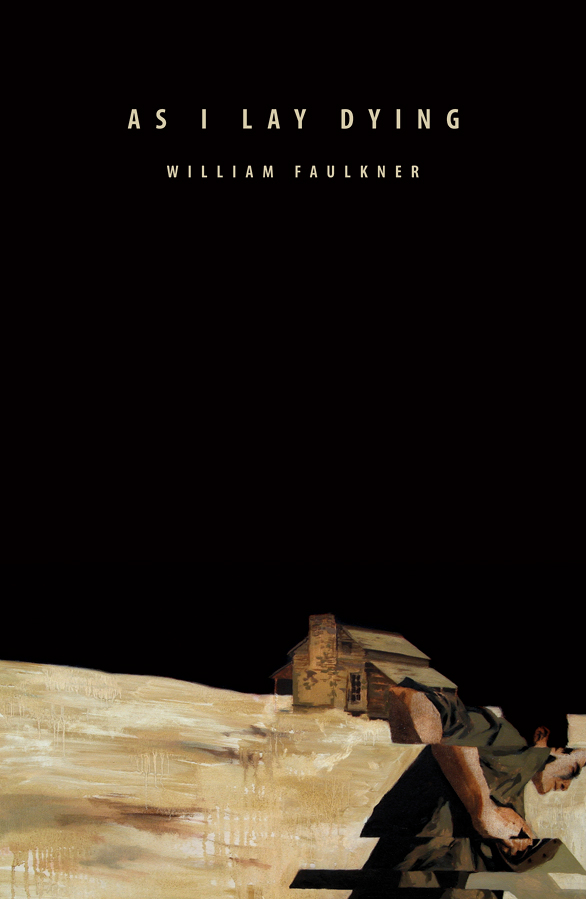
Faulkner possessed this tragic vision, and Addie Bundren in As I Lay Dying beautifully articulates it:

And then [husband Anse] died. He did not know that he was dead. I would lie by him in the dark, hearing the dark land talking of God’s love and His beauty and His sin: hearing the dark voicelessness in which the words are the deeds, and the other words that are not the deeds, that are just the gaps in people’s lacks, coming down like the cries of the geese out of the wild darkness in the old terrible nights.

asilay_0What has set my mind to such dark contemplations is the penultimate episode of Season 1 of the HBO series Treme, and in the unlikely event if, like me, you’re four years behind and still on Season 1, you might not want to read any further, but then again, a careful viewer would already have noted the not-very-subtle foreshadowings of the character Creighton Bernette’s impending suicide.

Bernette, played by John Goodman, is an English professor at Tulane struggling with his beloved New Orlean’s destruction after Katrina and with the paralysis of writer’s block. Even though he has a loving wife, an early teen-aged daughter, and an intact, lovely house in the city, he pulls a Harte Crane and jumps off a ferry into the Mississippi River and drowns himself. Notably, he had just finished teaching Kate Chopin’s The Awakening, whose protagonist Edna Pontellier, also a New Orleans citizen, drowns herself over a failed extra-marital affair and in essence because marriage and motherhood don’t offer her enough satisfaction — despite the fact she has servants to do housework for her.

These two, Creighton and Edna, fail the tragedy test — they’re merely pathetic, i.e., worthy of pity — but there’s nothing exhilarating about their copping out over problems that pale compared to those of the wretches who follow below — my top six literary suicides, which I catalog in chronological order.

Jocasta

Sophocles oedipus_photopresents us with a perverse and terrible vision of life. The drama takes place in a universe governed by malevolent deities who rain horror upon the otherwise innocent offspring of evil doers (Yes, Oedipus suffers from hubris but is the epitome of integrity and about as well-meaning as any tragic hero out there. He, his wife/mother, half-sisters/daughters and half-brother/sons don’t deserve their fates).

Near the close of the play, his wife and mother Jocasta stands on the stage mutely listening as Oedipus bullies an old shepherd in telling him the truth of Oedipus’s origins.

As he undergoes his anagnorisis, the agonizing recognition of his horrible situation, Jocasta runs off stage to hang herself.

Someone called “Second Messenger” fills us in in Dudley Fitts’ and Robert Fitzgerald’s translation:

When she had left us,
In passionate silence, passing through the court,
She ran to her apartment in the house,
Her hair clutched by the fingers of both hands.
She closed the doors behind her; then, by that bed
Where long ago the fatal son was conceived—
That son who should bring about his father’s death–
We heard her call upon [Oedipus’s father]Laius, dead so many years,
And heard her wail for the double fruit of her marriage,
A husband by her husband, children by her child [. . .]

[. . .] For with a dreadful cry
[Oedipus] hurled his weight, as though wrenched out of himself,
At the twin doors: the bolts gave, and he rushed in.
And there we saw her hanging, her body swaying
From the cruel cord she had noosed about her neck.
A great sob broke from him, heartbreaking to hear,
As he loosed the rope and lowered her to the ground.

I would blot out from my mind what happened next!
For the King ripped from her gown the golden brooches
That were her ornament, and raised them, and
plunged them down
Straight into his own eyeballs, crying, “No more.
No more shall you look on the misery about me,
The horrors of my own doing! Too long you have known
The faces of those whom I should never have seen,
Too long been blind to those whom I was searching!
From this hour, go in darkness!” And as he spoke.
He struck at his eyes—not once, but many times;
And the blood spattered his beard.
Bursting from his ruined sockets like red hail.

Othello

Of course, in Shakespeare we have several suicides from which to choose — Romeo and Juliet, Ophelia, Cleopatra — but I opt for Othello, who has just strangled to death his innocent bride Desdemona after having been cruelly convinced by the sociopath Iago that Desdemona had been unfaithful with Othello’s friend and confidant Cassio.

Here’s Othello’s great suicide speech.

Soft you; a word or two before you go.
I have done the state some service, and they know’t.
No more of that. I pray you, in your letters,
When you shall these unlucky deeds relate,
Speak of me as I am; nothing extenuate,
Nor set down aught in malice: then must you speak
Of one that loved not wisely but too well;
Of one not easily jealous, but being wrought
Perplex’d in the extreme; of one whose hand,
Like the base Indian, threw a pearl away
Richer than all his tribe; of one whose subdued eyes,
Albeit unused to the melting mood,
Drop tears as fast as the Arabian trees
Their medicinal gum. Set you down this;
And say besides, that in Aleppo once,
Where a malignant and a turban’d Turk
Beat a Venetian and traduced the state,
I took by the throat the circumcised dog,
And smote him, thus.
[Stabs himself].

Madame Bovary and Anna Karenina

mqdefaultEmma Bovary and Anna Karenina might be considered the great-great grandmothers of Edna Pontellier, but they’re so much more alive, so much richer creations that their suicides, the first by poisoning herself, the second by throwing herself in front of a train, move us more — and they are certainly more terrible.

Here’s Emma’s in Paul De Man’s translation:

Suddenly from the pavement outside came the loud noise of wooden shoes and the clattering of a stick; and a voice rose — a raucous voice — that sang

Often the heat of a summer’s day
Makes a young girl dream her heart away.

Emma raised herself like a galvanized corpse, her hair streaming, her eyes fixed staring.

To gather up all the new-cut stalks
Of wheat left by the scythe’s cold swing.
Nanette bends over as she walks
Toward the furrows from whence they spring.

“The blind man!” she cried.

And Emma began to laugh, an atrocious, frantic, desperate laugh, thinking she saw the hideous face of the poor wretch loom out of the eternal darkness like a menace.

The wind blew very hard that day
It blew her petticoat away.

A final spasm threw her back on the mattress. They all drew near. She had ceased to exist.

Arkady Ivanovich Svidrigailov

drawing by Yakov Petrovich Golyadkin

drawing by Yakov Petrovich Golyadkin

Of course, with its happy ending, Fyodor Dostoyevsky’s Crime and Punishment is not a tragedy. However, its supposed villain Svidrigailov’s suicide near the end of the narrative is so incredibly cool it makes my top six.

Svidrigailov has reached hedonism’s dead end, has been rejected by Dounia, the protagonist’s sister, and finds himself in a mouse-infested flop house suffering through one of the greatest nightmares ever conceived and rendered.(Here, Henry James’s admonition, “Tell a dream, lose a reader,” is proven false).

A description of Svidrigailov’s last few minutes from Constance Garnet’s translation:

“I’ve had nightmare all night!” He got up angrily, feeling utterly shattered; his bones ached. There was a thick mist outside and he could see nothing. It was nearly five. He had overslept himself! He got up, put on his still damp jacket and overcoat. Feeling the revolver in his pocket, he took it out and then he sat down, took a notebook out of his pocket and in the most conspicuous place on the title page wrote a few lines in large letters. Reading them over, he sank into thought with his elbows on the table. The revolver and the notebook lay beside him. Some flies woke up and settled on the untouched veal, which was still on the table. He stared at them and at last with his free right hand began trying to catch one. He tried till he was tired, but could not catch it. At last, realising that he was engaged in this interesting pursuit, he started, got up and walked resolutely out of the room. A minute later he was in the street.

“What do you want here?” [a soldier] said, without moving or changing his position.
“Nothing, brother, good morning,” answered Svidrigailov.
“This isn’t the place.”
“I am going to foreign parts, brother.”
“To foreign parts?”
“To America.”
“America.”
Svidrigailov took out the revolver and cocked it. Achilles raised his eyebrows.
“I say, this is not the place for such jokes!”
“Why shouldn’t it be the place?”
“Because it isn’t.”
“Well, brother, I don’t mind that. It’s a good place. When you are asked, you just say he was going, he said, to America.”
He put the revolver to his right temple.
“You can’t do it here, it’s not the place,” cried Achilles, rousing himself, his eyes growing bigger and bigger.
Svidrigailov pulled the trigger.

Quentin Compson

Too bad Treme’s Creighton Bernette wasn’t teaching The Sound and the Fury instead of The Awakening because pathetic, doomed Quentin Compson’s self-drowning would add some literary heft to Bernette’s own pathetic situation. Interestingly enough, although fictional, Quentin has a commemorative plaque on the Anderson Bridge over the Charles River that reads

186868_m“QUENTIN COMPSON
Drowned in the odour of honeysuckle.
1891-1910”

Here’s the first paragraph of the Quentin Section:

When the shadow of the sash appeared on the curtains it was between seven and eight oclock and then I was in time again, hearing the watch. It was Grandfather’s and when Father gave it to me he said I give you the mausoleum of all hope and desire; it’s rather excruciatingly apt that you will use it to gain the reducto absurdum of all human experience which can fit your individual needs no better than it fitted his or his father’s. I give it to you not that you may remember time, but that you might forget it now and then for a moment and not spend all your breath trying to conquer it. Because no battle is ever won he said. They are not even fought. The field only reveals to man his own folly and despair, and victory is an illusion of philosophers and fools.

This is Quentin’s last day. He wrenches the hands from this watch that once belonged to General Compson, CSA, but the watch keeps ticking.

Here is the last paragraph:

The last note sounded. At last it stopped vibrating and the darkness was still again. I entered the sitting room and turned on the light. I put my vest on. The gasoline was faint now, barely noticeable, and in the mirror the stain didn’t show. Not like my eye did, anyway. I put on my coat. Shreve’s letter crackled through the cloth and I took it out and examined the address, and put it in my side pocket. Then I carried the watch into Shreve’s room and put it in his drawer and went to my room and got a fresh handkerchief and went to the door and put my hand on the light switch. Then I remembered I hadn’t brushed my teeth, so I had to open the bag again. I found my toothbrush and got some of Shreve’s paste and went out and brushed my teeth. I squeezed the brush as dry as I could and put it back in the bag and shut it, and went to the door again. Before I snapped the light out I looked around to see if there was anything else, then I saw that I had forgotten my hat. I’d have to go by the postoffice and I’d be sure to meet some of them, and they’d think I was a Harvard Square student making like he was a senior. I had forgotten to brush it too, but Shreve had a brush, so I didn’t have to open the bag any more.

Lots of, if not most, people try to avoid tragic works because of the reasonable idea that the world is so full of woe — ISIS, Ebola, tornadoes, head-on collisions, etc. However, in great tragedies like Oedipus and Lear we can take solace in our shared humanity with these great figures, our shared woe. Antigone is my sister and Hamlet my brother. After hanging out with them, I can agree with Hamlet:

What a piece of work is a man, how noble in reason, how
infinite in faculties, in form and moving how express and
admirable, in action how like an angel, in apprehension how like
a god!


Reading Fiction as a Utilitarian Exercise in Self-Improvement

I’ve always been contemptuous of commercial self-improvement because it so smacks of the time clock — protestant fear of predestined damnation meets hedonism lite.

On the one hand, who but a churl would be against sharing good advice?

On the other hand, who but a charlatan — a snake oil salesman — would seek pecuniary profit from enlightening the masses?

buddhaAndJesusAnswer to above question (in chronological order): not Siddhartha, not Jesus.

After all, in the age of the Internet, good advice can be disseminated at no cost. No longer is it necessary to decimate acres of loblollies to inform the huddling masses of the magic steps/habits/protocols that successful/happy/thoughtful people take/inculcate/follow to achieve a less fucked-up state that they have been muddling through.

So in the spirit of altruism, here’s the title of my unwritten masterpiece in the genre:

7 Steps That Sentiment Beings Sick with Desire and Fastened to Dying Animals Take to Get the Most out of the Ever-Foreshortening Days Left to Them.

Climb aboard!

Here are the 7 Steps in chapters:

MetamorphosesOvidChapter 1: Step 1: Sunday

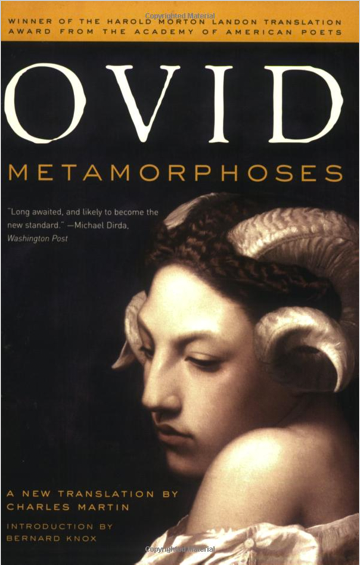
Sequester yourself for an hour — especially you non-church/temple types — and read from various myths — good translations of Ovid’s Metamorphosis, Native American trickster tales, Irish folklore, e.g. — and think about how what you’re reading relates to the universal human condition.

Chapter 2: Step 2: Monday

Take a half-hour off after having done something you have dreaded but have completed –e.g. gone to work, to court, to hell in a hand basket — and then listen to thirty minutes of the Blues, and by listen, I mean not only to the instruments, but also to the lyrics.

 Delia, Delia.

Poor girl, she’s gone.

With all I hate, she done left me all alone.

She’s all I got; it’s gone.

Blind Willie McTell by R Crumb.

Blind Willie McTell by R Crumb.

Chapter 3: Step 3: Tuesday

Put down for at least an hour your cell phone, joystick, remote control, and unhand that mouse.

Get into a non-escapist novel. When’s the last time you’ve read Huck Finn? If you’re reading this blog, I goddamn guarantee you’ll enjoy Huck (not to mention it’s time better spent than reading any blog).

Chapter 3: Step 3: Wednesday

Read slowly, carefully and out loud a ballad, which shouldn’t take up any more than 15 minutes.

I’d start early with folk ballads like “Lord Randall” and steadily work my way up chronologically to literary ballads like XJ Kennedy’s “Down in Dallas.”

Down in Dallas, down in Dallas,

where the wind has to cringe tonight,

Lee Oswald nailed Jack Kennedy up

on the cross of a rifle sight.

Chapter 4: Step 4: Thursday

Spend 45-minutes to following up on something you’ve discovered so far in your reading.

Chapter 5: Step 5: Friday/Saturday

Watch a universally acclaimed motion picture or attend local theater (and by that I mean see a play).

* * *

If you were to so regulate your animal spirits, it would cost you ~6 hours of time you otherwise squander lost in social media, trapped in the repetitive sturm und drang of video games, or seated in front of the flat screen.

Of course, I’m being facetious by suggesting this regimen. This regulation of dabbling in the arts would be destined to fail for the same reason diets fail. After a while, the spirit rebels against the assembly line sameness of eating healthy vegetables or reading outloud every Wednesday quatrains of tetrameter.

However, I can tell you this, reading good fiction can provide invaluable vicarious experience because it creates characters true to life. Cynical Mr. Bennett in Pride and Prejudice, despite his delightful wit and clever putdowns, suffers mightily for his detached parenting and refusal to listen to good advice, and his suffering certainly could have been catastrophic if not for Mr. Darcy.

This ARTICLE my friend Ed Burrows sent me scientifically supports the idea that good fiction can also increase your “moral intelligence.”

Dig this:

A 2013 study by the psychologists David Comer Kidd and Emanuele Castano explored the causal relationship between reading high-quality literary fiction and the ability to take the perspective of others, as measured by one of several well-tested tools, such as judging others’ emotions and eye-gaze directionality for interpreting what someone is thinking. The researchers found that participants who were assigned to read literary fiction performed significantly better on these “mind reading” tests that measured where subjects were looking and how they judged the emotions of others than did participants assigned to the other experimental groups, which did not differ from one another.

Think of reading good fiction and poetry as discovery, not escape.

Jim Crow, Treme, Iago, Dr. John, and I-and-I

James T Crow, Spiritual Advisor

James T Crow, Spiritual Advisor

Last night the shamanic JT Crow, one of my spiritual advisors, came over for pizza, and we started yapping about the HBO series Treme, which chronicles the travails of (perhaps too many) characters trying to get their lives together in those wretched days just after Katrina wasted New Orleans.

Although Mr. Crow, who goes by Jim (and, by the way, voted for Obama), and I agree that New Orleans itself is the protagonist of the narrative and that the music [cue James Brown] is bam BAM BAM BAM BAM! – OUT-OF-SIGHT!!!! – we mildly disagree about the overall quality of the production.

For one thing,, I think some of the acting sucks — the Hindenburg of my disbelief has crashed a few times.  For example, the Davis McAlary character’s parents don’t seem like the decadent uptown parents of a wastrel son but like actors playing the decadent uptown parents of a wastrel son. I start wondering where they’re really from, if they get along off the set, etc.

Even Declan MacManus doesn’t do a very good job of playing Elvis Costello.

Davis McAlary played by Steve Zahn

Davis McAlary played by Steve Zahn

Anyway, the most interesting difference of opinion between Crow and me concerns the above-mentioned character Davis McAlary, whom Jim likes but whom I’d like to see sporting orange overalls and a leg shackles while gigging trash amid swarms of mosquitoes on the side of a desolate Louisiana road.*

Do I need mention that Jim’s nicer than I am**?

Jim considers Davis a good person at heart, but to me his picture should appear next to asshole in the American Heritage Dictionary of Vulgarity.*** Because of some sort of megalomaniac disorder, Davis feels entitled to ignore the playlist of the radio station where he works because the playlist isn’t authentic enough, never mind that it’s during a Beg-O-Rama (aka Pledge Drive) and the station is teetering on the edge of financial collapse.   Davis feels entitled to steal a bottle of $200 wine from a lover’s restaurant even though it’s teetering on the edge of financial collapse (though he does leave her as compensation some vintage out-of-print music he looted from a record store). He also aims his speakers outwards from his windows towards his neighbors’ house and blasts them with New Orleans’ hip hop. Working as a concierge, he sends young Mormon volunteers to authentic but dangerously located clubs so they can experience the real New Orleans, etc.

The would-be cat ain’t got no clue about existentialism. He’s about as tolerant as Boko Haram.


 *Obviously, Zahn is going a terrific job of acting if I’ve developed such an animus towards his character.
** E.g., I was sitting on Jim’s couch one evening getting machine-gun blasted with hate tweets from a disgruntled former colleague, and when I started punching in a retaliation, Jim stopped me and said, “Don’t do that.  The poor man is suffering.”
Also, Jim has seen two seasons as opposed to my two episodes.  Maybe Davis changes as the narrative progresses (but it seems to me to be dramatically viable it would take a road-to-Damascus Jesus-hurled thunderbolt).
***Aaron James’s definition from Assholes, A Theory: n., a person who “allows himself to enjoy special advantages and does so systematically” because of “an entrenched sense of entitlement,” and who “is immunized by his sense of entitlement against the complaints of other people.”

But then, sitting there with Crow, I had to concede that if Davis lived on Folly Beach, my little slice of purgatory, it would be fun to hang with him on a casual basis, given his passion, knowledge, and exquisite taste in music. That got me to thinking about some less than noble characters I hung with in my troubled youth, which, of course, got me thinking about Shakespeare’s Othello.

[Feared reader response: WTF! Huh? Time to click out of this joint].

Sample Page from Shakespeare Insult Generator

Sample Page from Shakespeare Insult Generator

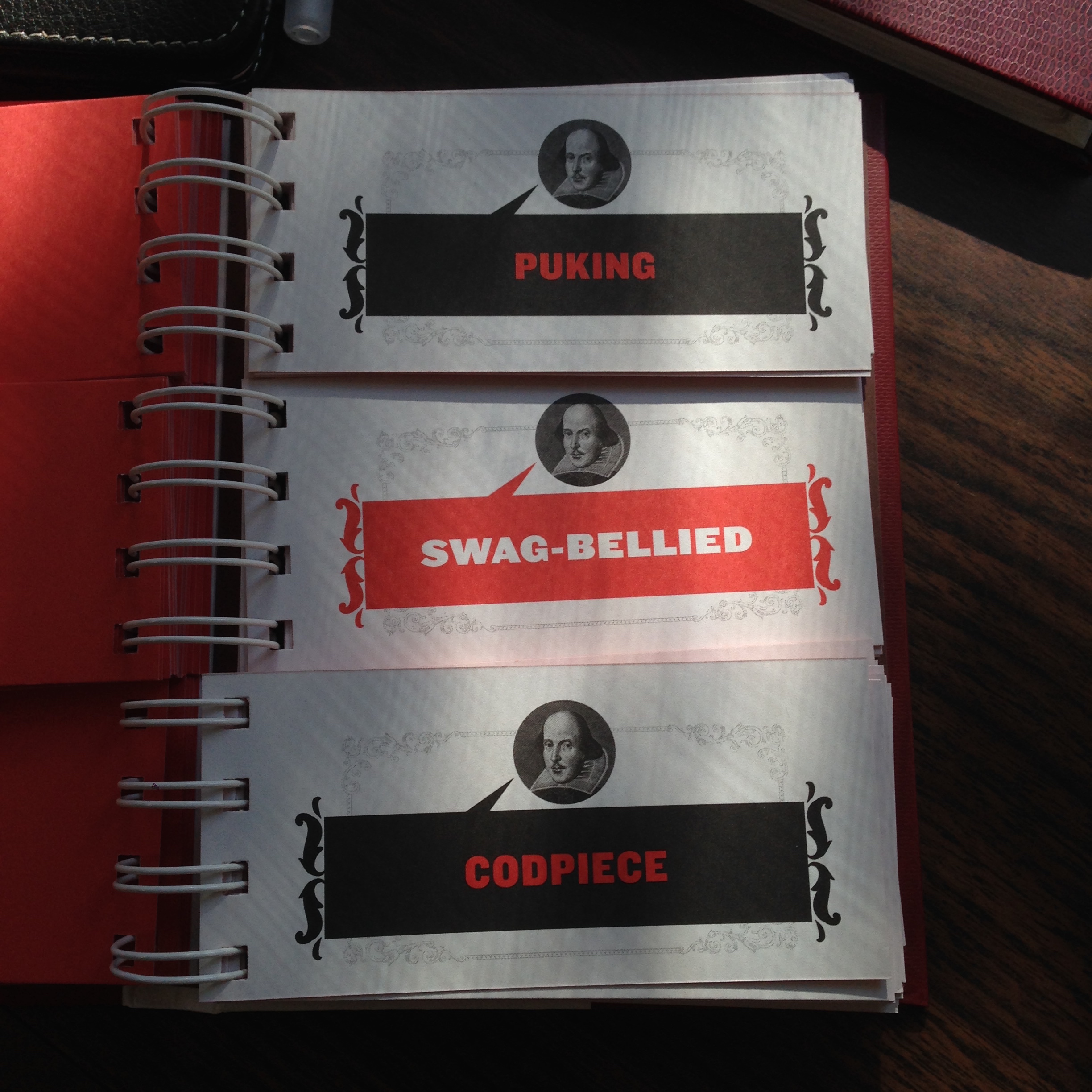
As it happened, Jim’s Xmas present to me, a Shakespeare Insult Generator, was on the table next to us, and it got me to thinking.

A SIG allows you to randomly select two adjectives from any play in the canon and affix them to a Shakespearean noun to create curses for, as PEE WEE GASKINS might say, “them what we love to hate.” For example, flipping through the kit with my left hand as I type, I see I could call Davis a “churlish, beef-witted braggart” or a “mammering, hollowed geck.”

One of the adjectives in the kit is “swag-bellied,” which I actually recognize from 2.3 of Othello. In the scene, Iago, as sociopathic a character in all of literature, is regaling his comrades with descriptions of the English’s domination in the consumption of alcohol over formidable but lesser rivals:

Cassio: Fore God, an excellent song!

Iago: I learned it in England, where indeed they are most potent in potting. Your Dane, your German, and your swag-bellied Hollander – drink, ho! – are nothing to your English.

Cassio: Is your Englishman so exquisite in his drinking?

Iago: Why he drinks with facility your Dane dead drunk; he sweats not to overthrow your Almain; he gives your Hollander a vomit ere the next pottle can be filled.

Let’s face it, if you were on Iago’s good side, i.e., if he’s not robbing you blind or plotting to bring about your total destruction, he’d be an entertaining drinking buddy, much more clever than pretty boy Cassio.

Ah, but here’s the rub. Shakespeare inserts this true-to-life comic skit in the infernal machinery of a tragedy, the skit underscoring dimensions of character, e.g., Cassio’s naivety and Iago’s verbal cleverness.

Shit, then, why am I watching Treme when I could be watching Henry IV, Episodes 1 and 2?

Because, for one thing, Falstaff can’t rip up a piano and sing like Dr. John.

Oh yeah, Mac Rebennak does an Emmy-deserving job of playing Dr. John in Treme.


Half a Sin

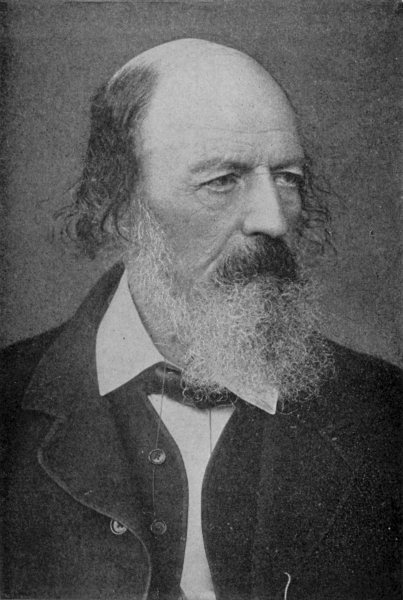
Bells toll inside my head as I reach for my Alfred Lord Tennyson outfit. It’s Victorian black with matching cravat, mourning cape, matching hat. There’s even a beard, luxuriant and curling, that came with the costume, but I can’t find the whiskers anywhere. Been three years since I’ve donned this get-up, a Halloween present from sweet deceased Adelaide, who passed away in a Hampton’s Inn all alone in the not-so-new millennium.  Actually, she made the costume and bought the beard from Hocus Pocus.

I’m getting into character, reading “In Memoriam”:

I sometimes hold it half a sin

To put in words the grief I feel;

For words, like Nature, half reveal

And half conceal the Soul within.

I’ve taken to panhandling.

No, it’s not a lifestyle choice, but part of my thesis, a paper I’m writing on selling-and-psychology, a study in which I report on my experimentation with different modes of panhandling, comparing the hourly wage of me playing a wheel-chair bound Iraqi war veteran ($12.34) with the hourly wage of me playing a shyster hipster holding a sign that reads “Haven’t been high in two days ($4.56).[1]  I’m hoping to shed some light on what makes people part with their money in situations of charity, combining my love of acting, my interest in marketing, and my curiosity about how the human mind works.  So today I’m going out begging in the guise of Alfred Lord Tennyson.  It’s a dreary, leaden day, very Tennysonian.

I consider brain chemistry to be sort of like weather – sunny, rainy, partly cloudy, partly sunny.  Part of it, of course, is genetics — look at the Hemingways — but life events can affect brain weather, too.  Maybe if Tennyson’s best friend Arthur Henry Hallam hadn’t dropped dead Tennyson might have been a cheerier poet, like EE Cummings or Maya Angelou.  Who knows?

happyperson copy wilburlowell1 copy


I’ve decided to set up shop, so to speak, North of Calhoun in the bar district, which you might think is unsafe, but I’ve never had a problem, and anyway, I’m packing a Smith & Wesson. 22 LR Rimfire, not gun enough to kill someone but big enough to chase off a knife wielder or unarmed thug.

alfred-tennyson

The one thing that’s bothering me, though, is the lack of a beard. I’m only 26 years old, and a beard would help. Of course, I wear make-up. Thanks to the College’s Theater Department’s make-up department, I’ll be sporting a gray complexion and those woeful looking, sympathy-spawning bags under my eyes that made Tennyson look like the saddest creature that ever crawled across the face of the earth:

The sparrow’s chirrup on the roof,
The slow clock ticking, and the sound
Which to the wooing wind aloof
The poplar made, did all confound
Her sense; but most she loathed the hour
When the thick-moted sunbeam lay
Athwart the chambers, and the day
Was sloping toward his western bower.
Then said she, “I am very dreary,
He will not come,” she said;
She wept, “I am aweary, aweary,
Oh God, that I were dead!”


[1] The minimum wage in South Carolina is $7.25


It was through theater I first met Adelaide, a student production of Chekov’s Three Sisters.  She played Irina, I Vassily Vasilyevich Solyony.  It wasn’t bad as student productions go.  The only problem, though, is I had this thing for Adelaide/Irina, but she had a boyfriend, a spoiled preppy entitled piece of shit, so I didn’t make it verbally known to Adelaide that I had this thing for her, though from what others tell

Chuck Norris

Chuck Norris

me it was as obvious as Cyrano’s nose or Chuck Norris’s toupee. I kept waiting for her to make the first move, but she never did.  It goes without saying neither did I.

Kristopher my make-up man has done his magic, including providing me with a real enough looking beard, so I’m walking rather self-consciously from the parking garage to King with a folding lawn chair strapped to my back, a bucket for the proceeds, a book of Tennyson’s poems, and a sign that simply says “alms.”

I find a spot on the corner of King and Morris, put my sign out and start to read Tennyson, finding snatches of verse ripe for memorization, little ditties like

Me rather all that bowery loneliness,
The brooks of Eden mazily murmuring,

and try to ignore the occasional rude comment about beggars and street performers.  Of course, I could whip out the Rimfire and cap one of them, taking my performance art to a new level, but that’s not, as Adelaide used to say, the Buddha way.

Finally, after 4 minutes and 32 seconds, I get my first score, two single dollar bills dropped.  I say,

And if ever I should forget

That I owe this debt to you

And I for your sweet sake to yours,

O, then, what shall I say? —

If ever I should forget,

May God make me more wretched

Than ever I have been yet!

At the one hour mark, I start reciting Tennyson as I see people approaching, though I avoid eye contact.

Doors, where my heart was used to beat

So quickly, not as one that weeps

I come once more: the city sleeps;

I smell the meadow in the street.

At the two hour mark, I start making eye contact before chanting the quote, straining to counterfeit that stare dogs give when they think you might have a treat for them.

Since we deserved the name of friends

And thine effect so lives in me,

A part of mine may live in thee

And move thee on the noble ends.

So here I sit in this Halloween costume, chanting Tennyson in the name of soft science.  My thoughts return to that Halloween party three years ago.  Adelaide dressed up like Emily Dickinson, hair parted in the middle, a white dress, for she was the Empress of Calvary.  No one got the joke, two depressive poets on a non-date.  Perhaps she should have worn black because that’s what people picture when they imagine Emily Dickinson.

I felt a Funeral, in my Brain,
And Mourners to and fro
Kept treading – treading – till it seemed
That Sense was breaking through –

Ring out the old and all that jazz.  Adelaide OD-ed in a Hampton Inn in Conyers, Georgia, and that’s about as unromantic as it gets.

It’s time for me to move on, I guess.

Good, God, now I’m even starting to think in slant rhymes.  I get up, abandoning the role, take off the itchy beard, and look for some ragged someone I can pass the cash off to.

$14. 75.

Alfred_Tennyson,_1st_Baron_Tennyson_-_Project_Gutenberg_eText_17768