Originally Eliot wanted Mistah Kurtz’s last words “the horror, the horror” to serve as the epigraph, but know-it-all il miglior fabbro Ezra nixed Kurtz’s utterance as “not weighty enough” and suggested this admittedly weightier snippet from Petronius’s Satyricon to serve the purpose of cross reference point.
Trigger warning: This clip is not for the squeamish; two mammals are hacked to death.
Amphetaminetic Synopsis of “The Waste Land”
Part 1: The Burial of the Dead
Chaucer’s Whan that Aprille with his shoures soote becomes
April is the cruellest month, breeding
Lilacs out of the dead land, mixing
Memory and desire, stirring
Dull roots with spring rain.
This is Eliot’s MO – picking up post WW1 shards of Western Civilization’s shattered stained glass window and collagificating [copyright pending] them back together in ironic juxtapositioning. In Chaucer’s day, spring was a blessed rebirth, in Eliot’s god-vacated poem, a dreaded reoccurrence.
You see, winter is preferable to resurrection when we can keep warm beneath forget snow.
ZAP!
We’re in a Biblical desert among stony rubbish where Isaiah shows us
[. . . ] something different from either
Your shadow at morning striding behind you
Or your shadow at evening rising to meet you;
I will show you fear in a handful of dust.
The Sibyl!
ZAP!
A tarot reading where Madame Sosostris, famous clairvoyante doesn’t find The Hanged Man, i.e., a god to be resurrected, not only a harbinger of spring, but what engenders the spring.
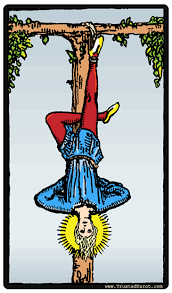
But there he is – the Hanged Man — at Colonel Kurtz’s compound in Apocalypse, Now.

image from Apocalypse, Now
ZAP!
We’re in Danteville, headed to Hades/Hell/Work:
A crowd flowed over London Bridge, so many
I had not thought death had undone so many.
Jacobean echoing, a corpse “planted,” dogs digging up that corpse, which is beginning to sprout.
There I saw one I knew, and stopped him, crying: “Stetson!
“You who were with me in the ships at Mylae!
“That corpse you planted last year in your garden,
“Has it begun to sprout? Will it bloom this year?
“Or has the sudden frost disturbed its bed?
“Oh keep the Dog far hence, that’s friend to men,
“Or with his nails he’ll dig it up again!
Baudelaire: “You! hypocrite lecteur!—mon semblable,—mon frère!”
Part 2: A Game of Chess
Cleopatra hanging at the equivalent of Dorian Gray’s where a golden Cupidon peep[s] out among sevenbranched candelabra.
Among the ornate decorations
Above the antique mantel was displayed
As though a window gave upon the sylvan scene
The change of Philomel, by the barbarous king
So rudely forced; yet there the nightingale
Filled all the desert with inviolable voice
And still she cried, and still the world pursues,
“Jug Jug” to dirty ears.
ZAP!
Neurotic banter:
“My nerves are bad tonight. Yes, bad. Stay with me.
“Speak to me. Why do you never speak. Speak.
“What are you thinking of? What thinking? What?
“I never know what you are thinking. Think.”
ZAP!
Those are pearls that were his eyes.
ZAP!
O O O O that Shakespeherian Rag—
It’s so elegant
So intelligent
So mechanical, so not Shakespeare, so-so-so civilization-in-decline.
ZAP!
We’re eavesdropping in on working class abortion gossip in a pub as the barkeep trumpets England’s equivalent to “last call for alcohol”:
HURRY UP PLEASE ITS TIME
HURRY UP PLEASE ITS TIME
Goonight Bill. Goonight Lou. Goonight May. Goonight.
Ta ta. Goonight. Goonight.
Speaking of death by water, enter Ophelia:
Good night, ladies, good night, sweet ladies, good night, good night.[2]
Part 3: The Fire Sermon
Spenser: Sweet Thames, run softly, till I end my song.
Not so sweet the Thames in the 1920s.
empty bottles, sandwich papers,
Silk handkerchiefs, cardboard boxes, cigarette ends
But wait! The river bears no empty bottles, sandwich papers,
Silk handkerchiefs, cardboard boxes, cigarette ends.
The city is empty.
ZAP!
The Fisher King:
While I was fishing in the dull canal
On a winter evening round behind the gashouse
Musing upon the king my brother’s wreck
And on the king my father’s death before him.
Human sacrifice, the king must die to generate the spring, like Jesus does every spring — dead, buried, resurrected — like those Neolithic god-kings Frazer writes about in The Golden Bough whose health and sickness are associated with fertility and famine. They must be sacrificed and replaced, i.e. must die and be resurrected, to insure healthy crops, like Osiris, Attis, Adonis.
White bodies naked on the low damp ground
And bones cast in a little low dry garret,
Rattled by the rat’s foot only, year to year.
ZAP!
Gay hotel assignation, barren sex as far as procreation goes.
Under the brown fog of a winter noon
Mr. Eugenides, the Smyrna merchant
Unshaven, with a pocket full of currants
C.i.f. London: documents at sight,
Asked me in demotic French
To luncheon at the Cannon Street Hotel
Followed by a weekend at the Metropole.
ZAP!
Enter voyeuristic but blind double-sexed Tiresias who witnesses arid copulation in interlocking sonnets:
At the violet hour, when the eyes and back
Turn upward from the desk, when the human engine waits
Like a taxi throbbing waiting,
I Tiresias, though blind, throbbing between two lives,
Old man with wrinkled female breasts, can see
At the violet hour, the evening hour that strives
Homeward, and brings the sailor home from sea,
The typist home at teatime, clears her breakfast, lights
Her stove, and lays out food in tins.
Out of the window perilously spread
Her drying combinations touched by the sun’s last rays,
On the divan are piled (at night her bed)
Stockings, slippers, camisoles, and stays.
I Tiresias, old man with wrinkled dugs
Perceived the scene, and foretold the rest—
I too awaited the expected guest.
He, the young man carbuncular, arrives,
A small house agent’s clerk, with one bold stare,
One of the low on whom assurance sits
As a silk hat on a Bradford millionaire.
The time is now propitious, as he guesses,
The meal is ended, she is bored and tired,
Endeavours to engage her in caresses
Which still are unreproved, if undesired.
Flushed and decided, he assaults at once;
Exploring hands encounter no defence;
His vanity requires no response,
And makes a welcome of indifference.
(And I Tiresias have foresuffered all
Enacted on this same divan or bed;
I who have sat by Thebes below the wall
And walked among the lowest of the dead.)
Bestows one final patronising kiss,
And gropes his way, finding the stairs unlit . . .
She turns and looks a moment in the glass,
Hardly aware of her departed lover;
Her brain allows one half-formed thought to pass:
“Well now that’s done: and I’m glad it’s over.”
When lovely woman stoops to folly and
Paces about her room again, alone,
She smoothes her hair with automatic hand,
And puts a record on the gramophone
ZAP!
Wagnerian canoe coitus:
Trams and dusty trees.
Highbury bore me. Richmond and Kew
Undid me. By Richmond I raised my knees
Supine on the floor of a narrow canoe.
la la
Part 4: Death by Water
Here’s the whole shebang:
Phlebas the Phoenician, a fortnight dead,
Forgot the cry of gulls, and the deep sea swell
And the profit and loss.
A current under sea
Picked his bones in whispers. As he rose and fell
He passed the stages of his age and youth
Entering the whirlpool.
Gentile or Jew
O you who turn the wheel and look to windward,
Consider Phlebas, who was once handsome and tall as you.
Part 5: What the Thunder Said
We’re thirsty!
If there were only water amongst the rock
Dead mountain mouth of carious teeth that cannot spit
Here one can neither stand nor lie nor sit
There is not even silence in the mountains
But dry sterile thunder without rain
There is not even solitude in the mountains
But red sullen faces sneer and snarl
From doors of mudcracked houses
Things fallin’ apart:
Falling towers
Jerusalem Athens Alexandria
Vienna London
Unreal
ZAP!
I have heard the key
Turn in the door once and turn once only
We think of the key, each in his prison
Thinking of the key, each confirms a prison
We’re talking Holy Grail gone missing:
I sat upon the shore
Fishing, with the arid plain behind me
Shall I at least set my lands in order?
London Bridge is falling down falling down falling down
Poi s’ascose nel foco che gli affina
Quando fiam uti chelidon—O swallow swallow
Le Prince d’Aquitaine à la tour abolie
These fragments I have shored against my ruins
Why then Ile fit you. Hieronymo’s mad againe.
Datta. Dayadhvam. Damyata.
Shantih shantih shantih
The End!
When Willard kills Kurtz, he’s the new god, yet he gives up that honor to return to Babylon, so to speak. I’ve read that Coppola filmed two different endings, one in which Willard goes home and one in which he stays in the jungle. The studio viewer-tested the ending, and, of course, the rabble wanted Willard to return to home-not-so-sweet home, to the cinema in the strip shopping center off Sam Rittenberg Boulevard where he would have a roof over his head.
I’ll give Conrad’s Marlow the last word.
 Joyce would call it an epiphany – I’d call it a cartoon light bulb flashing above my head — me slouching in a seat of a movie theater located in a strip shopping center off Sam Rittenberg Boulevard. Apocalypse, Now had just come to town, and I was catching it at the first matinee I could.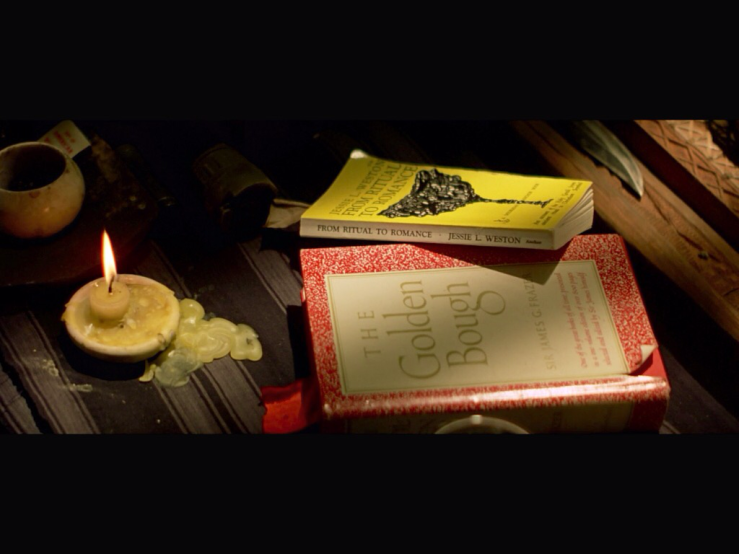




 You Do Hoodoo