School’s Out for the Summer

helicopter helicopter

Cue Alice Cooper’s “School’s Out for the Summer,” or, if you prefer, that older ditty, “No more pencils, no more books, no more teacher’s nasty looks,“ which might be updated from my perspective to “no more laptops, no more iPads, no more helicopter moms and dads.”

In case you older readers don’t know, parents can now go on line to keep track of their darlings’ academic progress via an app called “net classroom.” We teachers must post grades from pop quizzes, written homework assignments, vocabulary quizzes, essays, and oral presentations to a site that parents can log onto to mark the progress (or lack there of) of their progeny.

In my 30 years teaching at a prestigious Independent School, I’ve noticed a significant change in parental ambitions for their sons and daughters, which may reflect a national shift from legacy to meritocracy. Back in ’85, before the curse of instantaneous messaging, back when we wrote progress reports by hand, bearing Bic ballpoints down to insure our “good jobs” made it through the carbons onto the yellow and pink sub-copies, parents, many of them laidback lifelong Charlestonians, took more or less a hands-off approach to their children’s education. They seemed to trust that we knew what we were doing. A “C-” here or a “C+” there wasn’t going to keep Drayton Rhett Ball Rutledge Manigault out of Sewanee.

In fact, in the ‘80s, I can only remember one unpleasant encounter with a parent, and I didn’t even teach her son. She was angry because they had missed a deadline for a trip we were taking to the Soviet Union, an unrectifiable problem given deadlines for procuring visas. The conversation seemed to go on for hours.   It was like breaking up with a lover. We kept saying the same things over and over. My wife kept looking over and giving me the index-finger-across- the-neck slice, the universal sign of cut her off now.

The other parental interaction I remember was much more positive. A father, in fact a board member, came up to me and said, “I saw where you failed the boy on that Moby Dick test. Thank you! I caught him with those goddamned CliffNotes. Good job!”

(By the way, that rapscallion student, despite failing a major test that term, did manage to get accepted to Harvard, go to Northwestern for Medical School, and complete a post-doc at Yale).

Over the years, some parents have lost perspective on the weighting of grades. They seem to think that the tiniest assessment might make the difference between their replicated DNA’s attending Stanford or having to slum it at some state university. They seem to have forgotten that we can learn a great deal from our failures. (For example, you’ll never catch me again climbing an extension ladder with a couple of high-gravity IPAs sloshing around in my bloodstream). Anyway, these overweening parents squander their peace of mind by checking grades every hour (I’m not exaggerating) and probably blanch all of the joy of learning from their children who refuse to take intellectual risks because missing one question might make the difference between a distinguished medical career versus 60-hour shifts as an assistant manager at a suburban Sam’s Club.

When a student complains to me about such a parent, I suggest that she demand to see her parent’s high school report cards, which must be preserved given they had studded with A-pluses. Obviously, this suggestion doesn’t endear me to those parents.

But, hey, like I say, school’s out for the summer, so what the hell? Think I’ll put the top down, lay some rubber as I’m leaving the parking lot, crank up Alice Cooper’s anthem and gun it down Folly Road on my way home to the Edge of America.

tumblr_nbwd89geEb1rluzljo1_500

Time’s Winged Educational Chariot

tumblr_m5hcfaWVuu1qbyk5qo1_500This marks the fourth year of my teaching second-generation students – the sons and daughters of students I taught the in 1980’s.

It’s somewhat surreal – I was 32 when I stumbled into my first class of high school students, never having taught adolescents before. My teaching experience came from Trident Technical College, a community college that offers vocational training and some associate degree programs. There, many of my students were my age and older, some of them Viet Nam vets who certainly knew much more than I did about certain facts of life.

Classroom management was never a problem, except for that one night in a Developmental Studies class when a young blonde-haired man showed up drunk and red-eyed and started hitting on women in the back of the classroom. At the break, I mentioned to him he couldn’t come to class stoned, and he assured me that the red glazed look in his eyes came from welding all day. Nevertheless, he agreed to quit hitting on the woman.

No, classroom management wasn’t a problem at Tech; the problem there lay in that many students lacked basic academic skills, and I became a decent developmental studies teacher because I came up with some mechanical steps that students could follow in constructing sentences so that their writing wouldn’t mirror their speech.

If a student wrote, “My sister eat at her boyfriend house,” I’d have him find the verb.

“Who eat?” I’d ask.

“Sister.”

Then I’d have him plug in a pronoun for the subject. If the pronoun was “he,” “she,” or, “it,” the verb needed an “s”; if the pronoun was “they,” no “s.” Getting him to add an apostrophe “s” for the possessive was a more difficult task, but that was merely a 2-point error versus the 10-point subject/verb disagreement deduction. The final exam consisted of writing a 150-word paragraph with fewer than 30 points of grammatical or mechanical errors. If he passed, he could go on to enter the small engine repair or welding certificate program or take classes for an associate degree.

The vast majority of these students wanted to better themselves, many were receiving GI bill checks, so getting them to pay attention wasn’t a problem. Although the job wasn’t intellectually stimulating, it was rewarding. I felt as if the Dalai Lama would approve.

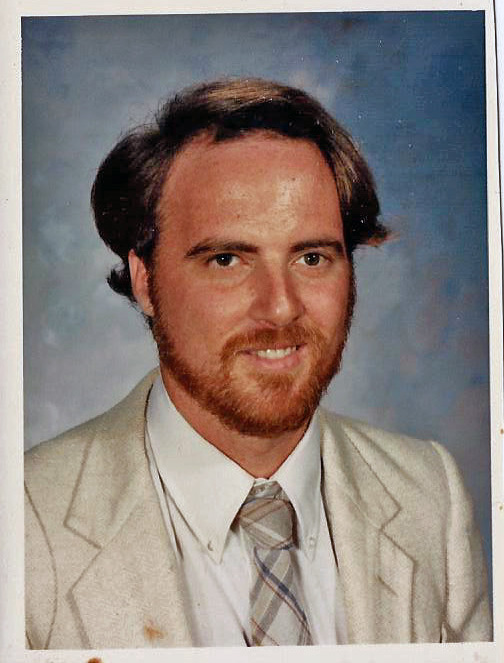
I-and-I in my 1985 annual photo

I-and-I in my 1985 annual photo

Fastforward to 1985, my first class of seniors at Porter-Gaud. I asked each on that first day to introduce herself and tell me a little about herself and discovered that among these young scholars sat a “cocaine dealer,” a “Soviet spy,” etc. Whenever one of them offered one of these puerile bits of misinformation, the class erupted in gales of laughter as if Robin Williams stood before them performing a monologue.

The good news is that I was able to rein them in fairly quickly with a couple of scathing, sarcastic counterpunches. No, my problem here was not a lack of academic ability but roiling hormones and the unsettling fact that many of these students were much more intelligent than I when it came to brain circuitry.

The good news is that I was profoundly hipper and knew my stuff when it came to literature and writing. By the end of the year, I hated to see them go.

Next year will mark the 30th year since they graduated from high school, and to me, as I tumble faster and faster down the Great Hour Glass’s avalanche, it seems as if just last month my mother was preparing to go to her 30th high school reunion!

So here I am at the same school teaching the second generation, who are taller and better behaved (but less worldly and mature) than their progenitors, and it’s really eerie how much they can look alike, virtual doppelgängers in some cases.

I do my best not to show them favoritism, but it’s hard.

And to be truthful, I’m feeling the tug of time, feel like Yeats that old age has been tied to me “as a dog’s tail.” I get the feeling that some of the students think of me as ancient, the way they once thought of Blackburn Hughes, a colleague who was the age I am now when I first started teaching, and that it might be easy to pull something on me, the old coot. Even a couple of colleagues occasionally make playful cracks about my age, facetiously asking if I would like to join the faculty track team to challenge the students.

I-and-I at graduation in 2014

I-and-I at graduation in 2014

The good news is that I’m still hipper than these 30-something whippersnappers (where were they when I saw Sonny Terry and Brownie McGhee perform in the bar where I worked, the Sonny Terry who played with Woody Guthrie on such songs as “Hard Traveling” “Bow Weevil Blues,” and “We Shall Be Free?) and I still know my lit and writing shit, so why not keep on another year or two despite the great demoralization of the bureaucratic technocracy that rules 21st century education, despite the irritating intrusion of a few arrogant fathers and snippy mothers, whom I certainly could teach a thing or two.

What shall I do with this absurdity—
O heart, O troubled heart—this caricature,
Decrepit age that has been tied to me
As to a dog’s tail?

Yeats, “The Tower”

Indolence: An Apology to All the Seniors I’ve Taught

. . others in Elysian valleys dwell,
Resting weary limbs at last on beds of asphodel 

A lovely word, with its three vowel-laden syllables, indolence: the Latin word for grieving – dolor – sandwiched between a negative prefix and a noun suffix.

It originally denoted a state of not grieving, of avoiding trouble, but lapsed in time to mean laziness, what Ozzie and Harriet would call not giving a “hoot,” what the Bellamy Brothers would call not giving a “rip,” what Johnny Depp would call not giving a “shit.”

In other words, high school seniors after spring break.

The path to graduation leads through fields of poppies past the prom into the prison block of final exams.

Meanwhile, they sit with their heads on their desks, their glazed eyes like marbles staring vacantly as a boring old baldheaded shuffling jackass reads out loud lines of poetry

That young men, tossing on their beds,
Rhymed out in love’s despair
To flatter beauty’s ignorant ear.

A Buddhistic Approach to Kafka’s Metamorphosis

K-buddah_jpgA professor friend of mine at the College of Charleston who teaches a freshman course entitled The Nature of Solitude: Sacred & Secular, Voluntary & Involuntary invited me to come and cover Kafka’s “Metamorphosis,” so I thought I’d share with any instructors out there the approach I took. Since the course is philosophical, not literary, rather than discussing the structure or aesthetics of the work or taking a Freudian or Marxist approach to the narrative, I’ve opted to approach the work more practically.

I decided to begin the hour-and-fifteen minute class with a keynote presentation that highlights the remarkable unlikelihood that any of the students sitting in the class actually have come into being (see “Slide 4” for further explanation) to underscore the horrible tragedy of the stunted life of the Metamorphosis’s protagonist, Gregor Samsa.  In addition, the presentation also suggests that mythology and its talented stepsister literature offer interesting ways to cop insight into, not only our lives, but science as well.  In fact, the presentation suggests that science itself is a myth, albeit a self-correcting one. Finally, I wanted to alert students to the human propensity of projecting our biology onto the cosmos as a way of explaining mysteries outside of ourselves. Of course, you can view the presentation all at once, but I have provided how I deal with each slide below the presentation.

Slide 1

As you can see, the first slide, the title slide, consists of two images, the first a sperm cell crashing into an ovum, the second, an artist’s rendering of a comet or meteor crashing into earth, which is science’s current best guess as to what engendered the chemical reactions that led to life.  I do the ol’ Socratic method, asking the students to identify what’s going on in each slide.

Slide 2

Slide 2 consists of Wordsworth’s famous sonnet “The World Is Too Much with Us,”  as in the work-a-day world overwhelms me with its mind-numbing responsibilities and anxieties, which, of course, relates to “The Metamorphosis.”  As you recall, Gregor who has awakened in the form of a gigantic beetle seems more worried about getting to work on time than he does about horrible fact that he has been transformed from a mammal to an insect who still possesses a human consciousness.

The poem offers a plethora of potential Socratic questions as you relate the sonnet to the novella.  I actually talk about the structure of the sonnet, its volta in line 9, but the main focus is what the speaker of Wordsworth’s sonnet and Gregor Samsa have in common and what the sonnet and Dylan’s lyrics have in common.

Slide 3

Slide 3 quotes a stanza from Dylan’s “Subterranean Homesick Blues,”  which offers a beautifully truncated catalogue of childhood.  Note the anxiety inherent in Dylan’s ditty. (By the way, you can read my argument why Dylan deserves a Nobel Prize in literature HERE).

Slide 4

The fourth slide is an excerpt from the movie Adaptation, which didn’t successfully make the trip from my hard drive to the Internet, but you can view it here: 

Obviously, ultimately, Nicolas Cage’s character’s question how did I get here has a very complicated answer.  For him to exist on this tiny planet swirling around a run-of-the-mill star much has had to happen, much of which from my perspective seems random, the first meteor which brings life, the second meteor that brings death to the dinosaurs and their displacement by mammals; then you have to factor in the long odds of that particular sperm hitting that particular egg through the long line of his ancestors culminating with his parent’s coupling on that particular day of his conception, a day when his mother didn’t have a headache, a coupling that led to one of 250,000 sperm cells in what I call the most important-race-of one’s-life reaching the finish line of one of mother’s 300 or so ova, a process that resulted in him, and by extension, you, C of C freshman, or you, blog reader.

Slides 5 & 6

These slides underscore the long odds of existence, emphasizing just what a shame it is for poor Gregor to live such a stunted life given the enormous odds of existence.  Here, I sneak in Buddhist doctrine, and talk about the Samsa family dynamic, the office manager, etc.

Slide 7

I talk about myth here, not as untruths, but in the Joseph Campbell mode as symbolic structures that embody profound truths.

Slide 8

This slide suggests that science is often wrong about details (not theories).  If I had written “quark” instead of “electron” in my 1970 chemistry test, I would have been correct but had my answer marked wrong.  By the way, I’ve photoshopped my 1970 self into this slide (the redheaded one leaning over the desk) to show the freshmen what I looked like 45 years ago and to horrify them with the realization that they too one day will look like me now [cue maniacal laughter]

Slide 9

The discoverer of the quark, Murray Gell-Mann named it after a word from James Joyce’s novel Finnegan’s Wake, suggesting that scientists like literature, that disciplines are all interrelated.

Slide 10

A reprise of Slide 8

Slide 11

In Slide 11, I ask if anyone recalls the Greek creation myth of Uranus and Gaia.  If no one does, I retell it, which is essentially, the sky Uranus had sex with the earth Gaia and life began, which, brings us back to the first slide.  The current scientific theory and the Greek myth are essentially the same.

For the rest of the period, I let the students talk about “The Metamorphosis” and give them wide range.  Of course, given the title of the course, Gregor Samsa’s involuntary solitude should be brought up.

Undergraduate Existentialism Circa 1973

Rick Borstelman 2003

Rick Borstelman 2003

Existentialism was all the rage in the 60’s and ‘70’s when I intermittently attended classes in high school and college. The philosophy of Kierkegaard, Nietzsche, Sartre and Camus must have hit its peak then, because the authorities allowed students to smoke — in high school in certain outdoor designated areas, and in college, right there in class. If existentialism is about anything, it’s about the rights of the individual, as we shall see.

kierkSøren Kierkegaard

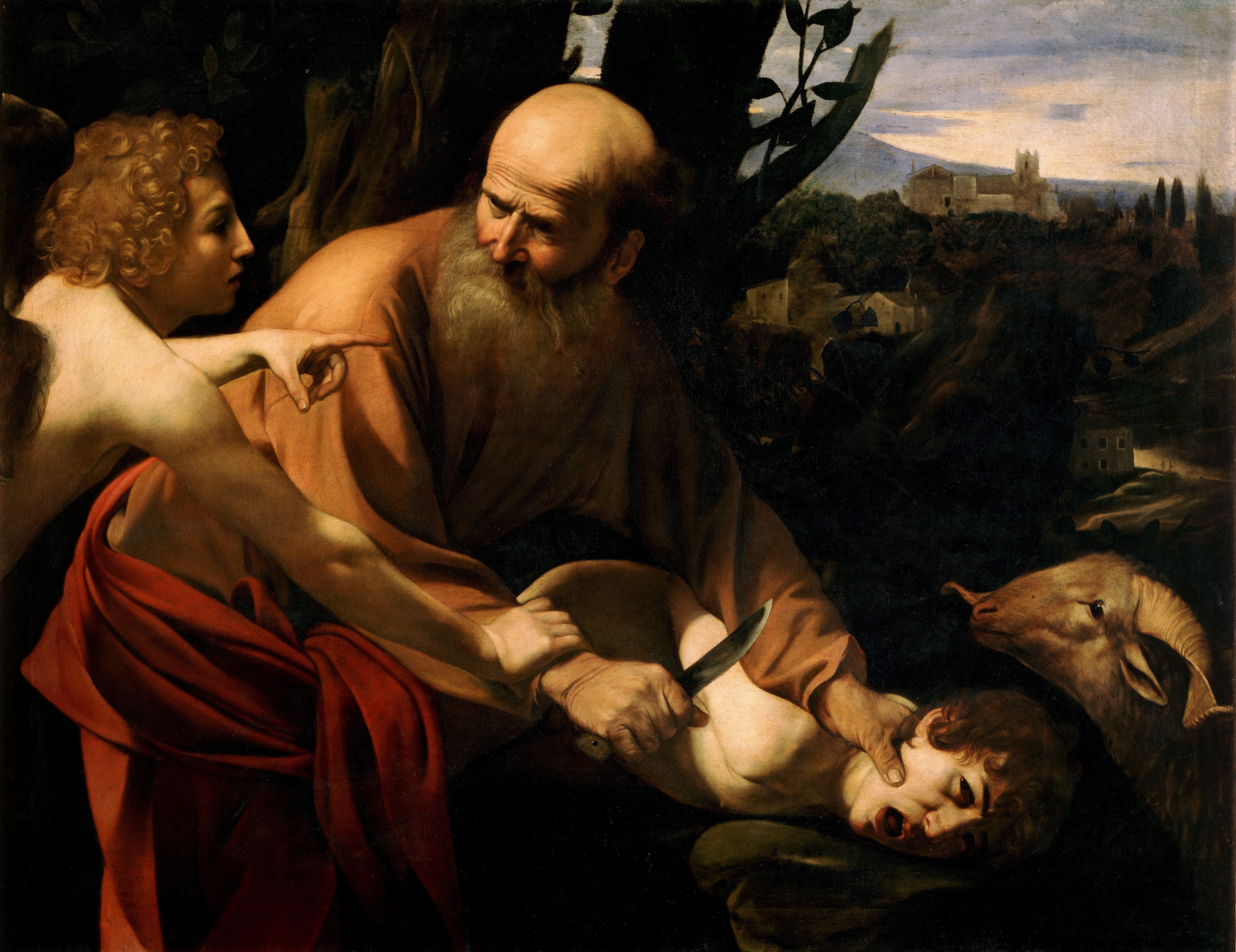
Where I went to college each desk in the Humanities Building had a disposable cardboard ashtray. Students bogarted their Marlboros as they took notes, scrawling as best they could the professor’s explanation of Kierkegaard’s exegesis of the Abraham and Isaac story, scrawling (in my case, illegibly) observations like

Faith is precisely the paradox that the single individual as the single individual is higher than the universal, is justified before it, not as inferior to it but superior—yet in such a way, please note, that it is the single individual who, after being subordinate as the single individual to the universal, now by means of the universal becomes the single individual who as the single individual is superior, that the single individual as the single individual stands in an absolute relation to the absolute. This position cannot be mediated, for all mediation takes place only by virtue of the universal; it is and remains for all eternity a paradox, impervious to thought. And yet faith is this paradox…

The fact that you couldn’t follow the argument, that you couldn’t figure out what the fuck the subject of the third “is” was wasn’t* important because professors didn’t test you on the material; they had you write essays just as unintelligible as the texts you couldn’t understand, which represented a triumph of subjectivity over objectivity because who has the authority to tell an individual that his reading of the text is incorrect. That would have been so fascistic.

For example, here might be my undergraduate explanation of the passage I quoted above:

See, the individual smoker who is superior to the rest of the class who doesn’t smoke gets to smoke because the smoker’s subjective universe is paradoxically the only universe because if it weren’t for him, the individual smoker, there would be no universe, the way there was no universe as far as he was concerned in 1492 because he was not as yet a sentient being who possessed the autonomy to light up a Marlboro, despite that the individual who sits behind him, who, once again, would not exist for him if not for his being able to perceive her, or, in this case not perceive her, as she suffers an asthma attack because of the smoke that would not exist except for him.

You got A’s for this type of shit — at least I did.

Meanwhile, next door, in the poetry class you might have students reading this poem by Emily Dickinson:

Abraham to kill him
Was distinctly told—
Isaac was an Urchin—
Abraham was old—

Not a hesitation—
Abraham complied—
Flattered by Obeisance
Tyranny demurred—

Isaac—to his children
Lived to tell the tale—
Moral—with a mastiff
Manners may prevail.

Sacrifice_of_Isaac-Caravaggio_(Uffizi)Now, this poem, despite its implicit criticism of the All Mighty, poses dangers for the existentialist because it doesn’t exactly offer a multitude of defensible readings. The poem rather obviously suggests that Abraham agreed to kill his beloved son Isaac because Abraham was afraid God was going to sic a big ferocious dog on his ass.

These were the types of classes existentialists should avoid because the professors tended to dismiss the right of the individual to spell words whichever way he wanted. These fascist bastards took off points when you spelled “p-a-i-d” “p-a-y-ed.”

*Verbs of being rule in existentialism; the fact that I strung three in a row suggests I get it.

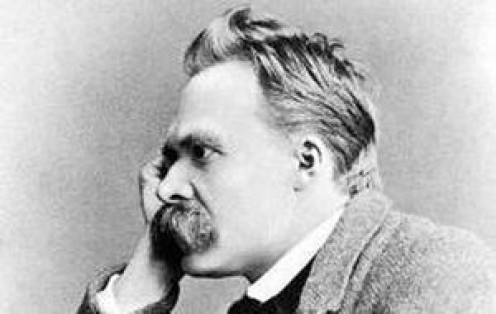
new-nietzscheFredrich Nietzsche

In the progression of existential philosophers, Nietzsche comes next chronologically, and back in 1973, he was a lot easier and more fun to read than Kierkegaard. Plus, Nietzsche was quotable, the king of the aphorism. You’d even heard of some of his sayings before, like

And if you gaze long enough into an abyss, the abyss will gaze back into you.

All things are subject to interpretation.

That which does not kill us makes us stronger.

God is dead.

The problem with Nietzsche, though, is that these killer quotable quotes are imbedded in long, rambling essays that lack structure and sometimes seem to contradict themselves, so by the time you get to the end, you’re not sure what his main point is.

Once you got to Nietzsche in your 1973 existential survey, all that was necessary is that you kept your mouth shut if you were a Christian and not try to exercise your first amendment freedom-of-speech right because chances are your professor was an atheist who would rip you to shreds because, after all, the universe would not exist except for him.

In other words, he’d sic his rhetorical Mastiff on you.

Jean Paul Sartre

sartre-jp-728x485Although Sartre’s masterpiece On Being and Nothingness makes Kierkegaard’s Fear and Trembling read like a Hemingway story in comparison, the ideas themselves are not that hard to understand.

What you got is a consciousness and whatever the consciousness is perceiving, and because this consciousness has a negative power of nothingness that can create a lack of self-identity, you, the individual, need to exercise your freedom by bringing into being and acting upon your individual spontaneous choices, and if you fail to do so, if, say, you decide not to run off to Best Buy and purchase a TV monitor the size of a drive-in movie screen and instead grade those sophomore essays, you have committed “bad faith,” which leads to “nausea,” which is really stupid of you because life is meaningless, and you’ll be dead in no time and therefore kiss good-bye the universe that only exists because you perceive it be.

On on that happy note, it’s DVD time.

Reading Fiction as a Utilitarian Exercise in Self-Improvement

I’ve always been contemptuous of commercial self-improvement because it so smacks of the time clock — protestant fear of predestined damnation meets hedonism lite.

On the one hand, who but a churl would be against sharing good advice?

On the other hand, who but a charlatan — a snake oil salesman — would seek pecuniary profit from enlightening the masses?

buddhaAndJesusAnswer to above question (in chronological order): not Siddhartha, not Jesus.

After all, in the age of the Internet, good advice can be disseminated at no cost. No longer is it necessary to decimate acres of loblollies to inform the huddling masses of the magic steps/habits/protocols that successful/happy/thoughtful people take/inculcate/follow to achieve a less fucked-up state that they have been muddling through.

So in the spirit of altruism, here’s the title of my unwritten masterpiece in the genre:

7 Steps That Sentiment Beings Sick with Desire and Fastened to Dying Animals Take to Get the Most out of the Ever-Foreshortening Days Left to Them.

Climb aboard!

Here are the 7 Steps in chapters:

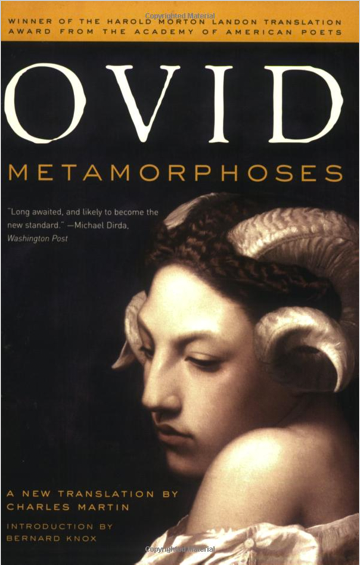
MetamorphosesOvidChapter 1: Step 1: Sunday

Sequester yourself for an hour — especially you non-church/temple types — and read from various myths — good translations of Ovid’s Metamorphosis, Native American trickster tales, Irish folklore, e.g. — and think about how what you’re reading relates to the universal human condition.

Chapter 2: Step 2: Monday

Take a half-hour off after having done something you have dreaded but have completed –e.g. gone to work, to court, to hell in a hand basket — and then listen to thirty minutes of the Blues, and by listen, I mean not only to the instruments, but also to the lyrics.

 Delia, Delia.

Poor girl, she’s gone.

With all I hate, she done left me all alone.

She’s all I got; it’s gone.

Blind Willie McTell by R Crumb.

Blind Willie McTell by R Crumb.

Chapter 3: Step 3: Tuesday

Put down for at least an hour your cell phone, joystick, remote control, and unhand that mouse.

Get into a non-escapist novel. When’s the last time you’ve read Huck Finn? If you’re reading this blog, I goddamn guarantee you’ll enjoy Huck (not to mention it’s time better spent than reading any blog).

Chapter 3: Step 3: Wednesday

Read slowly, carefully and out loud a ballad, which shouldn’t take up any more than 15 minutes.

I’d start early with folk ballads like “Lord Randall” and steadily work my way up chronologically to literary ballads like XJ Kennedy’s “Down in Dallas.”

Down in Dallas, down in Dallas,

where the wind has to cringe tonight,

Lee Oswald nailed Jack Kennedy up

on the cross of a rifle sight.

Chapter 4: Step 4: Thursday

Spend 45-minutes to following up on something you’ve discovered so far in your reading.

Chapter 5: Step 5: Friday/Saturday

Watch a universally acclaimed motion picture or attend local theater (and by that I mean see a play).

* * *

If you were to so regulate your animal spirits, it would cost you ~6 hours of time you otherwise squander lost in social media, trapped in the repetitive sturm und drang of video games, or seated in front of the flat screen.

Of course, I’m being facetious by suggesting this regimen. This regulation of dabbling in the arts would be destined to fail for the same reason diets fail. After a while, the spirit rebels against the assembly line sameness of eating healthy vegetables or reading outloud every Wednesday quatrains of tetrameter.

However, I can tell you this, reading good fiction can provide invaluable vicarious experience because it creates characters true to life. Cynical Mr. Bennett in Pride and Prejudice, despite his delightful wit and clever putdowns, suffers mightily for his detached parenting and refusal to listen to good advice, and his suffering certainly could have been catastrophic if not for Mr. Darcy.

This ARTICLE my friend Ed Burrows sent me scientifically supports the idea that good fiction can also increase your “moral intelligence.”

Dig this:

A 2013 study by the psychologists David Comer Kidd and Emanuele Castano explored the causal relationship between reading high-quality literary fiction and the ability to take the perspective of others, as measured by one of several well-tested tools, such as judging others’ emotions and eye-gaze directionality for interpreting what someone is thinking. The researchers found that participants who were assigned to read literary fiction performed significantly better on these “mind reading” tests that measured where subjects were looking and how they judged the emotions of others than did participants assigned to the other experimental groups, which did not differ from one another.

Think of reading good fiction and poetry as discovery, not escape.

Oh Boy, Oh Boy, It’s the 21st Century!

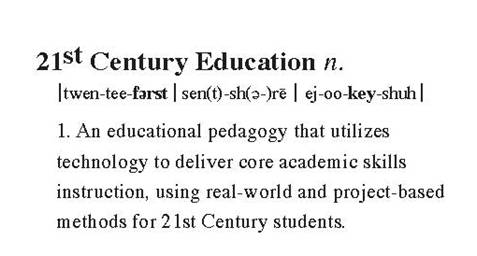
After listening to the SOTU address the other night, I’ve decided that If I had the dictatorial power to outlaw any adjective in contemporary English usage, it would be 21st Century – as in 21st-century economy, 21st-century technology, 21st century classroom.

After all, we’re a decade and a half into the century, so, c’mon, let’s drop the term and simply say current economy, current technology, etc., or future economy, future technology. I’m certain no one will think you’re talking about the 5th century BCE when the conversation turns to contemporary pedagogical practices.

definitionAs a teacher, I hear the phrase 21st Century education or 21st century classroom virtually every day, thanks, I suspect, to Thomas Friedman,* whose bestseller The World Is Flat spawned scores of educational entrepreneurs seeking fortunes by informing parents and teachers in books and lectures that books and lectures are relics of the past.

21st education, they say, demands “new building blocks for learning in a complex world,” and for students “to survive and thrive” in “[this] complex and connected world,” teachers must ditch abaci, slide rules, TRS-80s, and equip classrooms with state of the art technology. We need to abandon lectures and tests and embrace project-based, collaborative learning so we can produce technologically literate capitalists who, though they might think the Ottoman Empire is an HBO mini-series, know how to collaborate and find answers to their questions in a rapidly changing, increasingly interdependent world.

You see, I got the rap down myself.

my classroom

my classroom

Don’t get me wrong, I’m not against technology. For example, in the accompanying photo of my classroom, you can see I use a table and chairs.

(Technology is, after all, defined as “the embodiment of a technique,” so strictly speaking chalk, slate blackboards, bobby pins, and bongs all fall under the category of technology).

Tables, invented by the Egyptians circa 3300 BCE, are not common in contemporary classrooms, unlike puzzle-like individual desks that interlock in threes for group work; nevertheless, I find that having students sitting in an oval facing one another facilitates polite discussions, as King Arthur himself realized, he being on the cutting edge of 6th century CE innovation.

Around the table we can tackle a subject in depth, learn from each other, disagree, counter argue, explain, and question without the distraction of open laptops and cell phone notifications. And, by the way, how do you efficiently provide students with all the information they need to fully understand a comprehensive subject without lecturing? How am I going to provide them with an overview of 18th Century British culture unless I explain empiricism, deism, coffeehouses, etc?  And by lecture, I mean Socratic lecturing, asking questions, soliciting opinions, not merely standing there behind a lecturn droning on about Juvenalian satire or neoclassic architecture.

As far as introducing students to technology, it seems to me that the authors of these books must not hang around many 21st century children. Whenever I have problem with hard or software, I can count a student coming quickly to my aid, and it has been my experience that sometimes they are even more adept than our IT department (which is excellent) in quickly finding a solution.

On the other hand, their vocabularies have shrunk appreciably since I started this gig in 1985, as have their attention spans, which I blame on quick-editing on Sesame Street and ear buds. (Click HERE on my invaluable guide to childrearing).

10.25-6Of course, this minor irritation of people echoing the 21st century cliché is bound to abate as we get further and further into the century. I suspect that the denizens of the American dystopia of 2075 will have stopped using 21st-century as an adjective, as they scrounge around the depleted planet exercising their 2nd Amendment rights because their grandparents voted for politicians who didn’t believe in science, but, alas, I won’t be around to enjoy not hearing it.


*The same Tom Friedman who from the Op-ed pages of the NY Times urged us to invade Iraq and depose Saddam because it would engender the spread of democracy across the Middle East. So much for his soothsaying.

Free Lesson Plan: Teaching Jung Via Borges (Machete Edition)

Background

One question teachers abhor is “Did I miss anything in class yesterday?”

Seniors, what follows is what you missed in class Tuesday. Teachers, if you’re looking for a lesson plan in teaching Jungian literary criticism, scroll down to “More Background.”

Although I don’t consider Jung’s theory of the Collective Unconscious scientifically valid, I do think it offers a compelling example of how humans tend to project their biology onto Nature/the Cosmos in the conjuration/production of myth/scientific theory.

To oversimplify, Jung believed that each human inherits through her genes a vast network of unconscious latent symbols – what he called archetypes – and that this inherited, universal set of unconscious preconceptions answers the question: Why do religions and myths parallel one another? These preconceptions take root and bloom in the context of various climates but maintain many similar, basic characteristics despite being products of unique cultures.

According to Jung, both Taos tribesmen and Tibetan monks possess the self-same archetypes – the same building blocks of mythology – and, though separated by 12,458 kilometers and profound cultural differences, both produce medicine wheels/mandalas out of sand that – well, see for yourself:


navajo_sand_painter original_1345070734


Joseph Campbell popularized this idea of the universality of mythic motifs with his book The Hero with a Thousand Faces. In it he charted the prototypical hero(ine)’s journey. Often, the hero is the product a miraculous birth (Moses, bulrushes) and is called upon to begin a quest (God, Moses), but sometimes he ain’t too keen on it (Moses, stuttering).
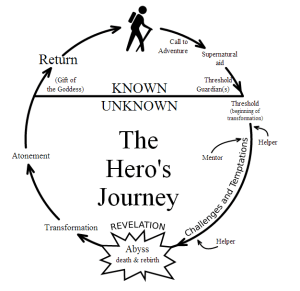
2013-02-28-HeroesjourneyThe journey starts with a Departure from the Homeland and a passage across a Mystical Threshold into a strange Other World. There the hero(ine) undergoes trials, receives supernatural aid, visits the Underworld (e.g., Hades/the belly of a whale), and finally returns with special knowledge to become Master/Mistress of Both Worlds. Variations abound, but the basic motifs are universal.

Campbell supports his universalist argument with an epic catalogue of examples from a broad range of “primitive, Oriental, and Occidental” hero myths.   Once again, to oversimplify, the circular journey of the hero(ine) is in essence the journey of maturation from childhood and adolescence into adulthood — through mid-life crisis — and finally into the realm of wisdom.

In other words, the trials of the mythic hero are an outward projection of an individual’s inward journey into his unconscious where the individual unearths archetypes, brings them to the surface, and harnesses their energy.

Jung called this process of bringing archetypes to light individualization.

Individualization

If you’ve read Herman Hesse’s Steppenwolf, you’ve vicariously undergone individualization.

Here’s an amphetametic synopsis of Steppenwolf with Jungian archetypes in bold:

steppenwolf-001Harry Heller’s has confused his ego with his persona (public mask), which reduces him to a mere intellectual, a self-important bore who c/rudely criticizes the household art of a former colleague who has invited him to dinner. Haller attributes his gauche behavior to an inner beast, his shadow (instinctual territorial/sexual badness), which he calls the Steppenwolf. (Think Jekyll/Hyde, Bruce Banner/Incredible Hulk).

Haller’s ego has decided to cut his/its throat, but in a bar meets Hermine, his anima/doppelganger (inner female/twin), who teaches him how to dance, arranges for him to get laid, and blows his mind in a trippy Magic Theater where he discovers his two-dimensional view of himself as intellectual/wolf is over simplistic bullshit. *

Unfortunately, Haller never quite comes to understand that it’s his narcissism that makes his so wretchedly unhappy. Haller can’t, as Pablo, the Self archetype (inner Buddha/Jesus) points out, laugh at himself.

Okay, here’s how Jung claims individualization ideally works: Your ego recognizes that your public face (persona) isn’t the real you, that there’s something lurking beneath, the shadow. You tend to project your dark side, your shadow, on individuals who outwardly exhibit repressed negative aspects of your psyche that you don’t want to face (e.g., I hate the comedian Dennis Miller because he’s an arrogant, pompous, vocabulary-brandishing, ideologically opinionated asshole).

The anim/a/us* (the opposite sexed component of your psyche) plays the role of mediator by introducing your ego to its shadow. The ego knowingly incorporates the shadow’s negative but powerful instinctual wisdom into your waking consciousness, and presto, the ego has incorporated three submerged archetypes – the persona, the anima, and the shadow — into conscious recognition, which deepens and cultivates its/your humanity.

*Choosing “bullshit” instead of “hogwash” suggests I have successfully incorporated my shadow.


More Background

I teach a course called “Psychoanalytical Criticism, Modernism, and Paris in the 20’s.” Here’s what we did in class Tuesday, which I’m going to present as if it’s a lesson plan for teachers surfing the web for ideas about how to introduce students to the Jungian concepts of ego, persona, shadow, and doppelganger (mysterious twin).

Free Lesson Plan
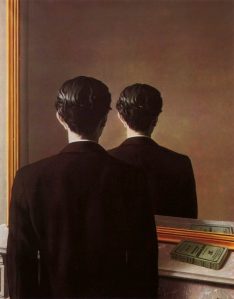
Rene Magritte : Not to be Reproduced.

Rene Magritte : Not to be Reproduced.

This lesson occurred in an 85-minute block class, but, of course, can be divided into two or even three 40-45 minutes classes (i.e., if you incorporate the previous day’s lesson).

On the day before this lesson, Monday, I gave a lecture on the hero’s journey, socratically eliciting from students examples of heroic magical births from popular culture. E.g., Me: “You know of any heroes who had miraculous births?” Student: Yeah, Superman. Me: Explain, etc. We followed Campbell’s designated steps (see above) full circle with students citing parallel situations from other stories they’ve read.

For Tuesday’s homework, they read John Galsworthy’s “The Japanese Quince,” a freebie from the Public Domain you can download HERE.

Amphetametic synopsis of “The Japanese Quince”:

Mr. Nilson, “well known in the city,” with “firm, well-coloured cheeks” and “neat brown moustaches” and “round, well-opened, clear grey eyes” is troubled by a strange sensation in his throat and “a feeling of emptiness just under his fifth rib.”

Uncharacteristically, he walks outside to “take a turn in the Gardens” and hears a “blackbird burst into song.” The blackbird is “perched in the heart” of a tree in bloom. Mr. Nilson smiles and pauses: “the little tree was so alive and pretty! And Instead of passing on, he started there smiling at the tree.”

Feeling smug that he’s all alone there exclusively to enjoy the tree, he discovers that a “stranger” is standing next to him. He recognizes the stranger as his next-door neighbor Mr. Tandram, “well-known in the city” and who is “of about Mr. Nilson’s own height, with firm well-coloured cheeks, neat brown moustaches, and round, well-opened, clear grey eyes.” Both wear identical outfits and have newspapers clasped behind their backs.

The two engage in an awkward conversation about the tree, which they discover is a Japanese Quince because it is labeled.

It suddenly strikes Mr. Nilson that “Mr. Tandram looked a little foolish,” so he says “good morning” and retreats back into his house as does Mr. Tandram in the identical fashion.

The story ends with this sentence: “Unaccountably upset, Mr. Nilson turned abruptly into house and opened his morning paper.”


Amphetametic new critical reading of “The Japanese Quince”:

The protagonist, whose name can be transposed as “Son-of-Nothing” is a flat, static character who isn’t conscious of the story’s central conflict: that he leads a static, loveless life (note he feels an emptiness beneath his fifth rib where his heart should be).

In his adventure outside he encounters organic nature, the glories of spring, beautiful birdsong, but his encounter with his alter ego/antagonist Mr. Tandram, whose name can be transposed as “drop of boredom,” drives him back inside the sterile confines of his constricted existence.

The fact that protagonist and antagonist are both flat static characters beautifully meshes with the story’s theme of soulless materialism and the difficulty of overcoming entrenched routine.

Amphetametic Jungian reading of “The Japanese Quince”:

An ego who has confused its persona with itself is confronted by the doppleganger archetype who attempts to have the ego to see the absurdity of its persona in a mirror..  The story also can be read as a non-hero’s journey: he leaves home, crosses the threshold into a mysterious land, only to be frightened and to retreat home without having gained the secret to existence.


Before we discuss “The Japanese Quince,” I ask my students answer the following questions on paper in 100 words or fewer: Who am I? Where am I headed? Why? I assure them that I’m not going to take up their writing nor have them read their responses outloud unless they want to.

I then hand them this short piece by Borges:

Borges and I

The other one, the one called Borges, is the one things happen to. I walk through the streets of Buenos Aires and stop for a moment, perhaps mechanically now, to look at the arch of an entrance hall and the grillwork on the gate; I know of Borges from the mail and see his name on a list of professors or in a biographical dictionary. I like hourglasses, maps, eighteenth-century typography, the taste of coffee and the prose of Stevenson; he shares these preferences, but in a vain way that turns them into the attributes of an actor. It would be an exaggeration to say that ours is a hostile relationship; I live, let myself go on living, so that Borges may contrive his literature, and this literature justifies me. It is no effort for me to confess that he has achieved some valid pages, but those pages cannot save me, perhaps because what is good belongs to no one, not even to him, but rather to the language and to tradition. Besides, I am destined to perish, definitively, and only some instant of myself can survive in him. Little by little, I am giving over everything to him, though I am quite aware of his perverse custom of falsifying and magnifying things.

Spinoza knew that all things long to persist in their being; the stone eternally wants to be a stone and the tiger a tiger. I shall remain in Borges, not in myself (if it is true that I am someone), but I recognize myself less in his books than in many others or in the laborious strumming of a guitar. Years ago I tried to free myself from him and went from the mythologies of the suburbs to the games with time and infinity, but those games belong to Borges now and I shall have to imagine other things. Thus my life is a flight and I lose everything and everything belongs to oblivion, or to him.

I do not know which of us has written this page.

Obviously, once again we have here a conflict between an ego and persona. Elicit Socratic responses from the students so they understand the nature of the conflict.

We then discuss “The Japanese Quince.”

I then have them read another piece by Borges called “El Etnógrafo.” I’m indebted here to William Rowlandson’s essay ” Confronting the shadow: the hero’s journey in Borges’ ‘El Etnógrafo,'” which you can purchase for $32.95 + tax HERE. If I weren’t teaching an 85 minute class I would have assigned the story for homework.

Here it is in English:

The ethnographer

Jorge Luis Borges

Translated by Andrew Hurley

I was told about the case in Texas, but it had happened in another state. It has a single protagonist (though in every story there are thousands of protagonists, visible and invisible, alive and dead). The man’s name, I believe, was Fred Murdock. He was tall, as Americans are; his hair was neither blond nor dark, his features were sharp, and he spoke very little. There was nothing singular about him, not even that feigned singularity that young men affect. He was naturally respectful, and he distrusted neither books nor the men and women who write them. He was at that age when a man doesn’t yet know who he is, and so is ready to throw himself into whatever chance puts in his way — Persian mysticism or the unknown origins of Hungarian, the hazards of war or algebra, Puritanism or orgy. At the university, an adviser had interested him in Amerindian languages. Certain esoteric rites still survived in certain tribes out West; one of his professors, an older man, suggested that he go live on a reservation, observe the rites, and discover the secret revealed by the medicine men to the initiates. When he came back, he would have his dissertation, and the university authorities would see that it was published. Murdock leaped at the suggestion. One of his ancestors had died in the frontier wars; that bygone conflict of his race was now a link. He must have foreseen the difficulties that lay ahead for him; he would have to convince the red men to accept him as one of their own. He set out upon the long adventure. He lived for more than two years on the prairie, sometimes sheltered by adobe walls and sometimes in the open. He rose before dawn, went to bed at sundown, and came to dream in a language that was not that of his fathers. He conditioned his palate to harsh flavors, he covered himself with strange clothing, he forgot his friends and the city, he came to think in a fashion that the logic of his mind rejected. During the first few months of his new education he secretly took notes; later, he tore the notes up — perhaps to avoid drawing suspicion upon himself, perhaps because he no longer needed them. After a period of time (determined upon in advance by certain practices, both spiritual and physical), the priest instructed Murdock to start remembering his dreams, and to recount them to him at daybreak each morning. The young man found that on nights of the full moon he dreamed of buffalo. He reported these recurrent dreams to his teacher; the teacher at last revealed to him the tribe’s secret doctrine. One morning, without saying a word to anyone, Murdock left.

In the city, he was homesick for those first evenings on the prairie when, long ago, he had been homesick for the city. He made his way to his professor’s office and told him that he knew the secret, but had resolved not to reveal it.

“Are you bound by your oath?” the professor asked.

“That’s not the reason,” Murdock replied. “I learned something out there that I can’t express.”

“The English language may not be able to communicate it,” the professor suggested.

“That’s not it, sir. Now that I possess the secret, I could tell it in a hundred different and even contradictory ways. I don’t know how to tell you this, but the secret is beautiful, and science, our science, seems mere frivolity to me now.”

After a pause he added: “And anyway, the secret is not as important as the paths that led me to it. Each person has to walk those paths himself.”

The professor spoke coldly: “I will inform the committee of your decision. Are you planning to live among the Indians?”

“No,” Murdock answered. “I may not even go back to the prairie. What the men of the prairie taught me is good anywhere and for any circumstances.”

That was the essence of their conversation.

Fred married, divorced, and is now one of the librarians at Yale.
8465_originalHere, as Rowlandson points out, we have the journey of the hero, Murdock, a “respectful” and trusting young man, i.e., uninitiated, who leaves his university to live with Native Americans who represent Jung’s shadow.  Through his initiation Murdock learns “to dream in a language that was not that of his fathers.” As Rowlandson points out, one of Murdock’s ancestors had been killed by “Indians” who in Western culture have been traditionally denigrated as “savages.” After a series of trials, the shaman of the tribe gives Murdock “the tribe’s secret doctrine.” He then returns home an utterly changed human being.

Note the difference from him and Mr. Nilson/Tandram

I end the class by having volunteers read their answers of who they are, where they are headed, and why.

So, yes, absentee, you did miss something Tuesday. You should borrow someone’s notes.

A Teachable Moment Botched

Time is the school in which we learn — John Didion, The Year of Magical Thinking

Yesterday before class, a petite, clear-eyed fifteen year-old announced that she has decided that she doesn’t want to grow old, that she wants to make great contributions to the world, and then die at 60. She added, “Mr. Moore, that means that if that happens, then 25% of my life is over!”

This is what we call in the my business[1] a “teachable” moment, and I botched it. I should have called on Alexander Pope, that four-foot, six-inch[2] colossus:

In fearless Youth we tempt the Heights of Arts,

While from the bounded Level of our Mind,

Short Views we take, nor see the lengths behind,

But more advanc’d, behold with strange Surprize

New, distant Scenes of endless Science rise!

So pleas’d at first, the towring Alps we try,

Mount o’er the Vales, and seem to tread the Sky;

Th’ Eternal Snows appear already past,

And the first Clouds and Mountains seem the last:

But those attain’d, we tremble to survey

The growing Labours of the lengthen’d Way,

Th’ increasing Prospect tires our wandering Eyes,

Hills peep o’er Hills, and Alps on Alps arise!

Although our flowers fade (I too had pretty plumage once!), the world becomes increasingly more interesting as we gain perspective, and as the social preoccupations of adolescence dissipate, the “cool people,” if given the choice, would rather hang with Charles Bukowski than Wink Martindale, with Joan Didion rather than Kim Kardashian.

Kim Kardashian

Kim Kardashian

Joan Ddidion

Joan Didion

But, like I said, I botched it. I turned to of all people Marcus Aurelius and paraphrased the following:

Were you to live a thousand years, or even thirty thousand, remember that the sole life which a man can lose is that which he is living at the moment; and furthermore, that he can have no other life except the one he loses. This means that the longest life and the shortest life amount to the same thing. For the passing minute is every man’s equal possession, but what has gone by is not ours. Our loss, therefore, is limited to that one fleeting instant, since no one can lose what is already past, not yet what is still to come — for how can he be deprived of what he does not possess?

Like, I said, I botched it. I told her and the rest of the students to think lineally only so far ahead that they can salvage more of the present for their enjoyment, in other words, to get that rough draft out of the way early Saturday morning so it won’t be squeaking like a wobbling wheel in the back of your mind all day. But I told them not to think too far into the future, not to dream about their freshman year at Duke or their wedding day or their future contributions to humanity.

I write this as my beloved is receiving a blood transfusion and have come myself to live the advice I gave those students yesterday. It’s always now. The future is not ours. The past is kaput. I hear a bird’s staccato chirp outside my open window on this gorgeous Saturday and wish him or her the best.


[1] Schools, alas, have taken on the corporate model, though they still give lip service to the “family” metaphor.

[2] 1.37 meters for my European readers

The Robotics of Pledging Allegiance

The K-12 independent Episcopal/African Anglican institution* where I teach celebrates the beginning of each school year with an outdoor all-school assembly.

It’s quite a confluence – Lower School teachers shepherd their little ones in lines, the Middle School bursts from Tyler Hall in a hormonal scrum, Upper School students meander down the steps to join the other two divisions beneath canopies of shade-providing oaks. Faculty members should, I suppose, hang with the grades they teach, but these well-behaved, considerate boys and girls need little supervision. I generally roam among each division until the show actually commences when I reposition myself as far back as discretion allows.

In Episcopal/African Anglican fashion, the ceremony begins with a processional led by a cross-bearing acolyte followed by the Chaplin, the Head of School, the Head of Admissions, sixteen flag-bearing students, and a bag-piping Latin-teaching devotee of Lucretius bringing up the rear.

Then follows a prayer, words of welcome, and introductions of the flag-bearers, natives or citizens of the countries of the flags they awkwardly wield. The last introduced is a US citizen, and one of the aforementioned dignitaries leads the assembled in the Pledge of Allegiance, words I haven’t recited since Lyndon Johnson was president.

kids-saying-pledge1To me, pledging allegiance to anything, especially when you’re too young and too ignorant historically to understand the words smacks of insecurity, if not paranoia, and is in a sense insulting. The Moore/Birdsong son-producing combine never demanded that Harrison and Ned and Mother and Father place their hands upon their hearts and swear fealty to the clan — it was a given that we all loved one another and wouldn’t endanger the family unit in any kind of serious malfeasance.

a cartoon from a '50's edition of Highlights for Children magazine

a cartoon from a ’50’s edition of Highlights for Children magazine

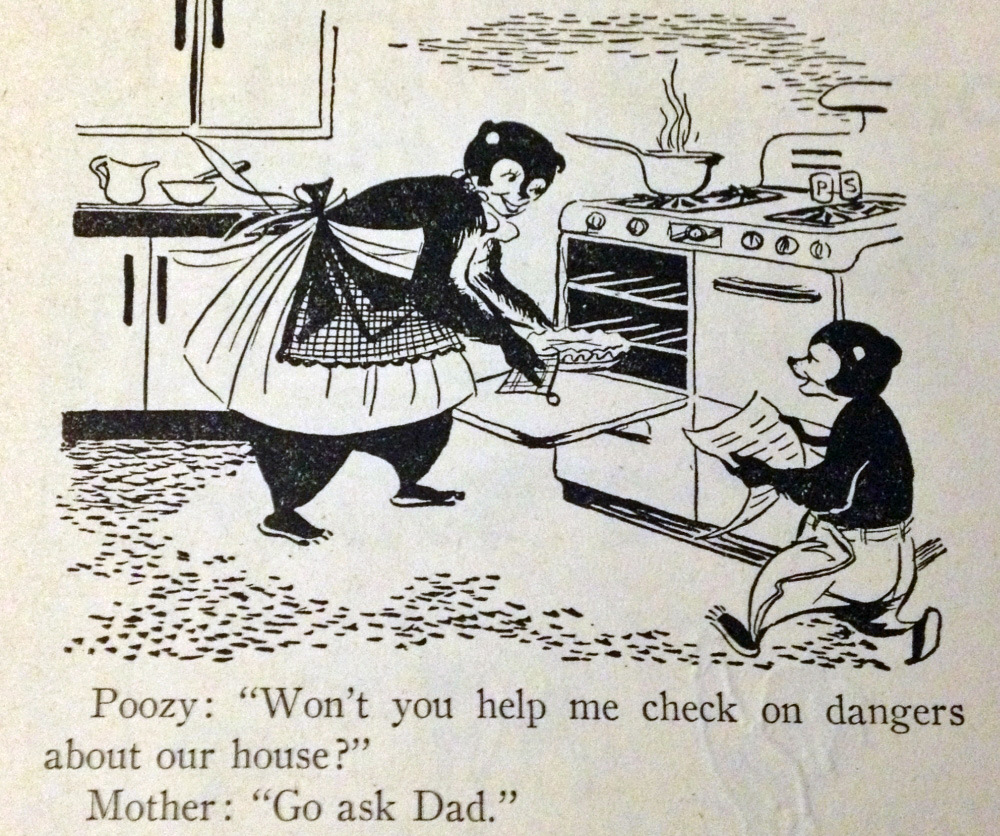
Furthermore, the words of the Pledge simply aren’t true. For example, I first recited them in a segregated school, and when I went for my smallpox vaccination, I flipped through Highlights magazines in an all-white waiting room (blacks had their own waiting rooms in the fashion of veterinarian clinics that separate dogs and cats).

So much for liberty and justice for all.

Not to mention that the Pledge itself violates the separation of church and state that the Constitution decrees — one nation under God, indivisible. I can also argue, as some Texans do in spasms of Obama-hating frenzy, that damn right it’s divisible, like in 1860’s, for example.

Having children place their hands on their hearts to solemnly swear to bullshit is unhealthy.

How about a compromise? How about changing a word here and there to make the Pledge less paranoid, less mendacious? Here’s a immodest proposal:

I pay homage to the ideals of the Constitution of the United States of America — liberty and justice. We are one nation of melded immigrants who treasure our freedoms of speech, religion, and assembly and will remain mindful of them as we live our lives in this great nation of ours.

Just an idea.

Wanna hear a really creepy idea?  What if they made you pledge allegiance to the flag of the state of South Carolina?


*Not unlike some of our parents, the Episcopal Church in South Carolina and some of its parishes are going through an ugly divorce.