Why Donald Trump Is an Orwellian Nightmare for English Teachers


yakov_guminer_-_arithmetic_of_a_counter-plan_poster_1931

You know I hate, detest, and can’t bear a lie, not because I am straighter than the rest of us, but simply because it appalls me. There is a taint of death, a flavour of mortality in lies – which is exactly what I hate and detest in the world – what I want to forget. It makes me miserable and sick, like biting something rotten would do.

Charlie Marlow to his shipmates in Joseph Conrad’s Heart of Darkness

No, Donald Trump isn’t a nightmare for English teachers because he uses bigly as an adverb. Nor is it that when it comes to oratory, Trump’s speeches make George W Bush seem practically Churchillian in comparison. No, the reason that Donald Trump is a nightmare for English teachers is that words to him are meaningless.

Why bother teaching someone the difference in shades of meaning between the words venial and abominable when 2 + 2 = 5?[1]

To Trump, words are just things, commodities to be manipulated for bargaining or seduction or braggadocio. We English teachers, on the other hand, tend to see words as sacred, as vessels of meaning, and we try to teach our students to choose them carefully so that their descriptions are as clear and accurate as possible, whether they are writing about their grandmothers or analyzing Lear’s betrayal by his daughters Regan and Goneril.

Of course, most if not virtually all politicians occasionally lie, but generally with subtlety and rarely when the lie can be easily refuted.  This is not the case with Trump who seems to be a pathological liar. His lies are legion.  He lies when it’s not necessary, seemingly for the sake of lying.  To me, this lying is a very big deal, and I believe it is both my patriotic and moral duty to point out to my students why his lies are lies when they are applicable to the literature we are studying, the way I would like to think I would with Hitler’s lies if I had been teaching in Germany in the 1930’s.

Our school prayer begins with these words.

May our words be full of truth and kindness . . .

Not only are Trump’s words essentially devoid of truth and kindness, his kleptocratic tendencies as evidenced by his violation of the emolument clause, his packing the cabinet with sycophantic billionaires, and his admiration of Putin as soulmate put our very republic in danger. Nor does it help that it seems as if most Republicans in Congress don’t care about the rule of law now that one of their own can aid them in dismantling health care and cutting taxes for the 1%.

Remember Whitewater? All those Clinton investigations?  Those were different people and different times.

* * *

To see what I’m getting at, allow me just one recent example of Trump’s misuse of a phrase (see italics below) and how it can distort reality to his favor.

Yesterday, on hearing that the Electoral College had made it official he would be our next president, Trump crowed, “Today marks a historic electoral landslide victory in our nation’s democracy.”

Never mind that he lost the popular vote by nearly 3 million; here’s a handy chart mapping Electoral College margins of victory from Washington to Trump:

screen-shot-2016-12-19-at-6-35-55-am


Politfact quotes Larry Sabato, the director of the Center of Politics at the University of Virginia: “Calling a 306 electoral-vote victory a ‘landslide’ is ridiculous. Trump’s Electoral College majority is actually similar to John F. Kennedy’s 303 in 1960 and Jimmy Carter’s 297 in 1976. Has either of those victories ever been called a landslide? Of course not — and JFK and Carter actually won the popular vote narrowly.”

Of course, by declaring his historically comfortable but by no means overwhelming victory a landslide, Trump gets to have the words “historic electoral landslide” plastered in headlines and on screens across the planet. If he’s won by a landslide, the vast majority of people want whatever he wants, so that means that most people want the wealthiest Americans to receive enormous tax cuts.  If this election has taught us anything, it is that a majority of voters in 30 states aren’t all that discriminating. If some hear it was a landslide on Fox News, that’s good enough for them. Here’s a quote from today’s Washington Post: 

An editor at Breitbart, formerly run by senior Trump adviser Steve Bannon, said that fear [of reprisal from Trump and his minions] is well-founded [among lawmakers].

“If any politician in either party veers from what the voters clearly voted for in a landslide election … we stand at the ready to call them out on it and hold them accountable,” the person said.

In fact, if those who attend Trump rallies hear him say  2+2=5, they very well might believe him, even without having to go through the torture that O’Brian puts poor Winston Smith through in Orwell’s 1984.

How chilling to read these passages from 1984 in light of Trump’s “historic electoral landslide”:

There will be no laughter, except the laugh of triumph over a defeated enemy. There will be no art, no literature, no science. When we are omnipotent we shall have no more need of science. There will be no distinction between beauty and ugliness. There will be no curiosity, no enjoyment of the process of life. All competing pleasures will be destroyed. But always — do not forget this, Winston — always there will be the intoxication of power, constantly increasing and constantly growing subtler. Always, at every moment, there will be the thrill of victory, the sensation of trampling on an enemy who is helpless. If you want a picture of the future, imagine a boot stamping on a human face — for ever.

[. . . ]

We control life, Winston, at all its levels. You are imagining that there is something called human nature which (sic) will be outraged by what we do and will turn against us. But we create human nature. Men are infinitely malleable. Or perhaps you have returned to your old idea that the proletarians or the slaves will arise and overthrow us. Put it out of your mind. They are helpless, like the animals. Humanity is the Party. The others are outside — irrelevant.’

Will I be teaching 1984 in the spring?[2] Yes. Will Trump’s name come up? You betcha!  Will I be teaching “Heart of Darkness” this spring?  Yes sir, of course.

599bd4e393673bf37d243e7cc32b614c


[1] The latter word in this case being a much more accurate descriptor of Trump, a known swindler and self-professed sexual assaulter.

[2] By the way, click here for an extensive Pre-Trumpian lesson plans for teaching 1984.
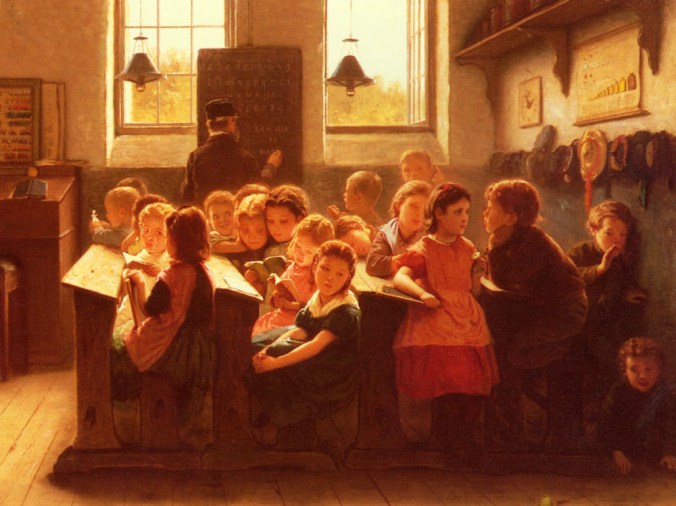
Blitzkrieg Report Card Comment Seminar

taamann_jacob_when_teachers_back_is_turned

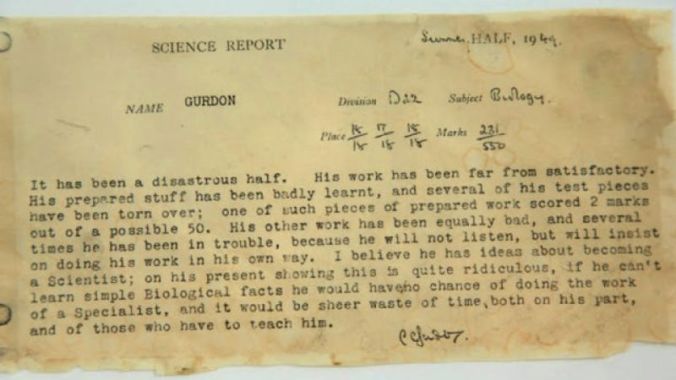
One of my least favorite activities as a teacher is writing report card comments. It used to be worse, though. In my former incarnation as Department Chair, I actually had to read every comment each Upper School teacher wrote to ensure that some slip of the finger, unwanted auto correction, or careless cutting and pasting didn’t send the wrong message:

Harold’s prose feces[1] strong verb selection, but he needs to vary sentence structure. Looking ahead, in preparation for the research papers due November 1st, she should make sure to update her working biography as she adds new sources.

Remember how in the lower grades, you’d pack your book reports with unnecessary prepositional phrases to jack up the word count? Well, some teachers lard their comments with detailed synopses of the course curriculum. Sure, it fills up space but fails to provide any insight into how adept young Anastasia is in synthesizing the various components that led to the Russian Revolution. As a parent, I found these descriptions of the courses’ content boring and skipped down to see how sons Ned and Harrison were handling the material, which reminds me of my favorite report card comment ever.

In the 6th grade, my younger son Ned had taken Jesus for his Spanish name. His end of the year report card started with this not very promising topic sentence: “I’m so disappointed in Jesus.” [2]

Anyhow, here’s my method. First, I break down their averages into components:

Daily 58 Essays 84 Tests 60 Independent Reading 90[3]

A parent should infer from this information that young Livingston hasn’t been doing his homework. Ideally, the parent would understand the correlation of Livingston’s not doing his homework with his paltry test average. On the other hand, he’s not a bad writer.

Here’s what I might write below the averages on Livingston’s report card:

Livingston needs to make sure that he reads each of his homework assignments slowly and carefully. He should consider, not only the content of the pieces, but also the authors’ techniques.

Livingston’s writing is solid, though he relies too heavily on linking verbs and occasionally mistakes phrases and subordinate clauses for sentences. I encourage him to proofread his essays backwards, i.e., the last sentence first, the second to last sentence second, etc. This method slows students down and helps them to focus on each individual sentence.

Although the administration would probably prefer that I end the comment with something positive like “Livingston is very bright, and I encourage him to cultivate his native talents,” I generally don’t.  I’m a busy man.  I’ve demonstrated I’m very familiar with their son’s work (or lack thereof) and provided  practical suggestions (which of course I’ve already mentioned to Livingston in person several times).

Donald Trump was up this morning at 3 a.m. tweeting. Maybe I could farm out some comments to him.

Lazy Livingston can’t be bothered to read his assignments. He keeps this up and he’ll be flunking out of mediocre UMass next year. That is, if he  gets in. Pathetic!

181uy69xylwpujpg


[1] A very unfortunate auto correction of the intended “features.”

[2] Which brings to mind a stanza from the Ezra Pound poem “Ballad of the Goodly Frere”:

When they came wi’ a host to take Our Man

His smile was good to see,

“First let these go!” quo’ our Goodly Fere,

Or I’ll see ye damned,” says he. (my emphasis)

[3] Which would result in a 75 for the quarter.

A Masterful History Lesson as Reported by Henry James Foster Wallace

125970515-u6oulgzq-singaporenov09208


Whenever anyone who discovers I’m a teacher starts in on the familiar refrain about how underpaid we are, I assure my well-meaning new acquaintance that some of us are not underpaid. For example, take my high school Spanish teacher, Senora Equis, that dour, unimaginative functionary. Her only lesson plan was punching play on a tape recorder and having us repeat parrot-like what we thought we heard. The voices on the recording were not quite human, too cheerful, the words overly annunciated, as if directed at a hard-of-hearing octogenarian in a nursing home located in Disney World.

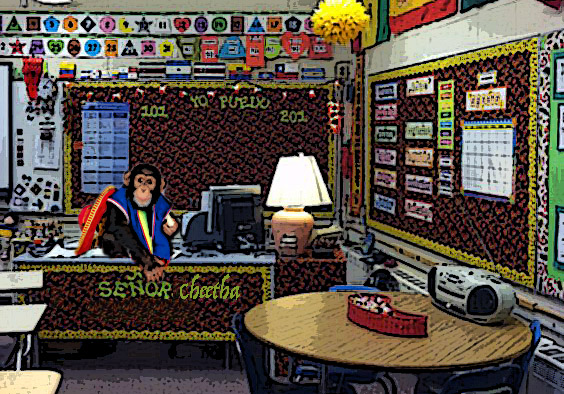
I remember remarking to mis amiga Sharon Mallard that a trained chimp could replace Senora Equis and very little would be lost. Dress Cheetah in a poncho, have him knuckle his way into the room, hop on the metal desk, click play, and plop down as we intoned in unison, “Que lastima, lo siento” or “Tengo catarro” or “Las putas estan muy bonita” and you wouldn’t be losing a thing.

cheetah

On the other hand, if you paid teachers according to how hard they worked, the difficulty of the task, and on the quality and worth of their product, my former colleague Natalie Herford should be making more money than Jadeveon Clowney.

Since I’d given up being Department Chair a couple of years ago, I decided it was high time to discard some of my unnecessary electronic files when I ran across a narrative of an observation I had made of one of Natalie’s history classes. She had been new to the school, and the word was out that she was spectacular. I asked her if she’d mind if I hopped on the train of colleagues who had sat in on one of her classes, and she, said, “Of course. I’d love to have you.”

Part of my duties as Department Chair was observing my colleagues. Rather than using the official form for observations, I wrote narratives of what I observed, trying the best I could to render the action from the objective point-of-view, as if I were video recorder. Let the teacher and principal decide for themselves what is effective and what is not.

Natalie was in the history department, in fact, its chair, so I was not required to document my observation. However, I told her I would compose one of my narratives and share it with her and Sarah, our principal, if she liked. This time, however, for my own amusement, I created a persona I called Henry James Foster Wallace to report what happened during the class.


Henry James Foster Wallace’s Observations of Mrs. Natalie Herford’s AP World History Class on 6 February 2009


When your Semi-Omniscient Narrator (henceforth SON) arrived at Room 204 a couple of minutes before class time, it surprised him to see the students sitting upright and engaged in a group conversation with Mrs. Herford who stood before them in the center of the room.   Glancing up at the so-called atomic clock, SON was relieved to see that, no, he wasn’t (at least officially) interrupting class.

Acknowledging his presence, Mrs. Herford in her somewhat patrician precisely annunciated, but indeterminate accent welcomed him to sit anywhere.   She added, “Feel free to participate as much as you like.” Demurring, SON bombastically announced that like the novelist Flaubert he would be invisible but omnipresent, hovering like a god. Mrs. Herford offered an indulgent smile at his pomposity and addressed him henceforth as “O Invisible God.” This incident, however silly, was the first instance of a pattern SON would later discern: Mrs. Herford adroitly picks up idiosyncratic comments in the class and later echoes them to create humorous motifs that provide a sort of dramatic structure to the proceedings. Her mental agility, her profound mastery of the subject matter, combined with a brilliant, almost ballerina-like ability to embody abstractions in physical movement, make Mrs. Herford an incredibly dynamic and effective teacher. [1]

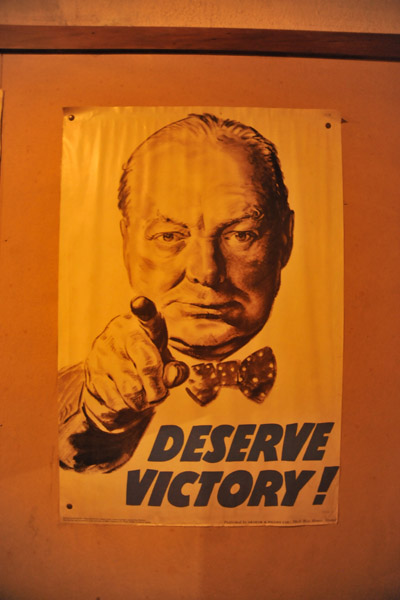
Room 204 is a bright, orderly space with yellow dominating the color scheme. A black and white photograph of the three Camelot-era Kennedy brothers counterbalances on the opposite wall a reproduction of a WW2 poster of Churchill jabbing an index finger Uncle-Sam style. On the back wall hang two large maps of the Western and Eastern hemispheres. Most interesting, however, is a series of typed sayings on 8 1/2 x 11 white paper that create a sort of intellectual wainscoting running across three walls of the room. Alas, being only a semi-omniscient narrator, SON was able to make out the content of only one of these literary ornaments, a colloquial pugilistic quote from Marx about getting kicked and kicking back. The room’s arrangement, its tidiness, suggests that this is a serious place, a place of business.

Which it is. About 30 seconds before class was to start, Chad Livingston[2], looking a bit frazzled, hurried into class, and Mrs. Herford said, “And here is Chad arriving just in time not to be counted tardy,” which SON took to be a subtle corrective, a suggestion to Mr. Livingston that he should arrive earlier so that the show can get on the road promptly the instant the second hand of the atomic clock reaches its zenith denoting 8:10 A.M. Eastern Standard Time. As it happened, Mr. Livingston probably had been rummaging in his locker searching for some lost document, a précis or AP application perhaps[3], because Mrs. Herford asked if he had said document, and Mr. Livingston asked for another.   Amusedly disgruntled, Mrs. Herford chided, “This does not bode well, does it, Chad,” and he reversed field, grinning and saying that he was hadn’t lost whatever it was he couldn’t produce, a performance that your SON found unconvincing.

As Mr. Livingston took his seat, instruction commenced. Arranged in a rectangular “semicircle,” two-desks deep, the students maintained excellent posture through the next forty minutes, an impressive feat for high-achieving, over-involved scholars, athletes, and amateur thespians, especially so early on a frigid Friday morning. In fact, throughout the entire class, the students maintained an impressive level of attentiveness, and eight of the nine scholars contributed at some point to Mrs. Herford’s Socratic questioning. The one student who didn’t contribute, the ever-taciturn Pamela Blanton[4], sat directly in front of SON preventing his being able to gauge her level of attentiveness. However, Miss Blanton not only sits on the front row, but also sits closest to the stool upon which Mrs. Herford sometimes perches[5], so it seems extremely unlikely that the bashful Miss Blanton wasn’t mentally engaged in the academic content of the lesson. Throughout the class, on at least three occasions, Mrs. Herford referred to the students as “ladies and gentlemen,” appellations that corresponded aptly to their behavior.

Mrs. Herford began by providing a rough road map of what lay ahead, a revisitation of Russia in light of the previous night’s reading. Mrs. Herford began by asking the students what had been going on the last time they visited Russia. A chorus of contradictory responses rang out, with Hendrik Kohlman harkening back to the Mongols and Angela Nielson remembering something about the Ivan tsars. Mr. Kohlman, who is 15-going-on-65, speaks with such an oddly anachronistic formality that you wouldn’t be surprised to look over and see that he’s sporting knickers and an Eton collar. He immediately recognized his error, and complained, “It’s Friday morning.”

Then, with extraordinary dexterity, Mrs. Herford in a Socratic cross-examination elicited from the students a remarkable distillation of half-a-millennium of Russian history, taking us from Mongols and princes to tsars and serfdom. In forcing the students themselves to provide the correct answers, Mrs. Herford engages in an animated artform that combines ballet and charades. When she asks a question, her face is quizzical, as if she has momentarily forgotten the answer, and when a student comes up with the correct response, her face lights up. Students want to generate that smile, so they take intellectual risks in perhaps being wrong. If they are incorrect, Mrs. Herford asks qualifying questions. To coax the answers from them, she gracefully uses her hands, pushing her palms out towards the students to suggest exile, say, or interlacing her fingers to suggest the combining of forces. Because she’s perpetually in motion and the class is so small, students don’t have the luxury to wander off into the lurid klieg-lit rooms of their imaginations.

Once Mrs. Herford had navigated her students through the ages, from the steppes of the Mongols to the marshes of St. Petersburg, she began the central focus of the day, a demonstration of a succession of Russian rulers who in subsequent administrations oscillated from reformation to reaction, a rather disheartening pingponging between liberalization and repression. To capture visually this historical movement, Mrs. Herford drew a crossgraph on her white board with “reform” and “reaction” as the twin headings. As she was hurriedly constructing her graph, Mr. Kohlman announced that “this is a little off topic” but that he reckoned, somewhat egocentrically perhaps, that there might be a fortune to be made in manufacturing loose leaf paper with vertical rather than horizontal lines, paper that would be well-suited to accommodate the graph Mrs. Herford was creating. Showing a surprising ignorance of product creation and promotion, Stephen Paddington pooh-poohed this idea by saying that you would need special binders if you manufactured vertically lined paper. Some other unidentified voice reasonably suggested that you could in fact turn your binders sideways and accomplish Mr. Kohlman’s objective. Rather than launching into a side trip to enlighten Mr. Paddington about the nefarious practices of the Lords of Capitalism and how creating products that won’t accommodate older products’ plug-ins is one of their dastardly techniques[6], Mrs. Herford, perhaps thinking of the centuries and various cultures stretching before her in the three-and-a-half months before the AP exam, quickly shut down the conjecture by assuring Mr. Gadsden that indeed if there were a market for vertically lined paper, surely some enterprising entrepreneur would have created it by now. Later in the class Mr. Kohlman– who otherwise proved a valuable contributor to providing correct answers to Mrs. Herford’s questions – tried to interject another distraction, which Mrs. Herford ignored, as she talked through his interruption. She did, later on, say that she thought it was a good idea for students to copy the graph in the notebooks, “whether on paper vertically lined, or otherwise,’’ a deft allusion to Mr. Kohlman’s original observation.

As the ping pong ball bounced from tsar to tsar, from Nicholas I to Alexander II to Alexander III, Mrs. Herford scrawled information in the Reaction column or the Reform column, switching alternatively, depending on whether the adjacent rulers were purging dissenters or liberalizing education. Whether consciously or not, she was creating a visual Hegelian historical dialectic that was particularly apropos given that Marx stood waiting just outside the present scope of the day’s lesson. In addition, as Mrs. Herford discussed the concept of Russianization, she successfully encouraged students to synthesize other similar movements in different cultures they had studied such as Sinofication in China and the persecution of Huguenots under Louis XIV. As a side note, Mrs. Hereford’s arrangement of cross-referencing various cultures during similar times (the alternating method) rather than starting with medieval China and taking it to the 2Oth century and then going to India and doing likewise (the block method) mirrors these students’ most recent essay assignment in English, a comparison-and-contrast composition in which their instructors encourage them to use the alternating method rather than the block method.

With energy that never flagged, Mrs. Herford guided her charges to the very end, stating at 9:43 that she had two minutes, “and you know that I am going to use them.” She mentioned a précis that was due Monday and some pivotal, important question that she had hoped to ask today but that would have to wait until Tuesday. Her “marketing” of this question successfully spurred the interest of SON who would have liked to be there to discover what the mysterious question entailed and how the students might respond to it. Unfortunately, however, time was up, because another set of students was filing in for their turn to learn under this extraordinary teacher.

Natalie possesses the same quality that my very best teacher Dr. Jack Ashley possessed, the ability to make students want to please him, so they do their best, revising those essays, trying to make them even better so that the teacher will be proud of them.

And talking about a role model!

Mrs. Natalie Herdford

Mrs. Natalie Herdford


[1] Mrs. Herford’s command of Russian history is phenomenal. Without so much as a note, she effortlessly rattled dates, names, movements, etc.

[2] I have changed the students’ names.

[3] cf. the modifier of “omniscient” in the author’s acronymic nom de plume.

[4] For the sake of full disclosure, it should be noted that Miss Blanton is a far-distant cousin of the author’s.

[5] Actually, all told, Mrs. Herford spent ~ 8 seconds on that stool.

[6] As your SON would be tempted to do.

Let Chaucer Be

TCOD-Bodleian-Library
The latest controversy roiling the breasts of English majors at Yale is their being required to take a survey course called “Major English Poets,” a course of study that forces them to become familiar with the works of Chaucer, Spenser, Shakespeare, Donne in the first semester and Milton, Pope, Wordsworth, Eliot, and one other modern poet in the spring. Their beef, according the petition that they’ve delivered to the Department is that “a year spent around a seminar table where the literary contributions of women, people of color, and queer folk are absent actively harms all students, regardless of their identity.” [1]

I heartily disagree, and I’m going to quote at length one of the white men listed above, TS Eliot, from his essay “Tradition and the Individual Talent.”

To proceed to a more intelligible exposition of the relation of the poet to the past: he can neither take the past as a lump, an indiscriminate bolus, nor can he form himself wholly on one or two private admirations, nor can he form himself wholly upon one preferred period. The first course is inadmissible, the second is an important experience of youth, and the third is a pleasant and highly desirable supplement. The poet must be very conscious of the main current, which does not at all flow invariably through the most distinguished reputations. He must be quite aware of the obvious fact that art never improves, but that the material of art is never quite the same. He must be aware that the mind of Europe—the mind of his own country—a mind which he learns in time to be much more important than his own private mind—is a mind which changes, and that this change is a development which abandons nothing en route, which does not superannuate either Shakespeare, or Homer, or the rock drawing of the Magdalenian draughtsmen. That this development, refinement perhaps, complication certainly, is not, from the point of view of the artist, any improvement. Perhaps not even an improvement from the point of view of the psychologist or not to the extent which we imagine; perhaps only in the end based upon a complication in economics and machinery. But the difference between the present and the past is that the conscious present is an awareness of the past in a way and to an extent which the past’s awareness of itself cannot show.

And, yes, and that includes Alexander Pope, who may not be “fun” to read but who provides a nearly flawless mirror to the intellectual world of his century.

For people of color, “queer folk,” and women to have an understanding of the works of great artists and the historical contexts of those works strikes me as the opposite of harmful, especially given that I’m fairly sure Yale offers elective courses that feature other great poets like Derek Wolcott, Elizabeth Bishop, Langston Hughes, and Hart Crane.  Chaucer, Spenser, Shakespeare, and Donne in a sense established the traditions of English poetry, the colloquial, rough-hewn verse of Chaucer and Donne pointing the way for the great Walt Whitman, the smoothness of Spenser no doubt influencing the verse of Christina Rossetti.

One student, Ariana Miele, in an op-ed piece for the Yale Daily News wrote, “We read Chaucer, but we are told to view his misogyny with an ‘objective’ lens.”

Certainly, the Middle Ages were misogynistic, and perhaps Chaucer was typical of his age, but he has also given us the Wife of Bath who offers this bit of wisdom to her fellow pilgrims:

By God, if women ever wrote some stories

As clerks have done in all their oratories,

They would have told of men more wickedness

Than all the sons of Adam could redress.

In other words, women in Medieval Europe did not have their voices heard.

Or this from Iago’s wife Emila from Othello explaining to chaste Desdemona why some women betray their husbands:

But I do think it is their husbands’ faults

If wives do fall: say that they slack their duties,

And pour our treasures into foreign laps,

Or else break out in peevish jealousies,

Throwing restraint upon us; or say they strike us,

Or scant our former having in despite;

Why, we have galls, and though we have some grace,

Yet have we some revenge. Let husbands know

Their wives have sense like them: they see and smell

And have their palates both for sweet and sour,

As husbands have. What is it that they do

When they change us for others? Is it sport?

I think it is: and doth affection breed it?

I think it doth: is’t frailty that thus errs?

It is so too: and have not we affections,

Desires for sport, and frailty, as men have?

Then let them use us well: else let them know,

The ills we do, their ills instruct us so.


I’ve often said that when parents start running a school, that school’s in trouble. When students start running a university, especially when they’re undergraduates, that university’s in big trouble.


[1] Is it possible to study post-colonialism without understanding colonialism? Might knowledge of pre-colonial and colonial art help students better understand colonialism and post-colonialism?

An Approach to Teaching 1984

1984 email imageHaving just finished teaching Orwell’s 1984 for the first time in twenty years, I thought I’d share my approach with anyone out there interested in tackling the novel. I find covering novels during a school year very challenging because of the time involved, and limited reading assignments make coming up with lessons difficult because students don’t know the complete arc of the narrative. In this case, my victims are high-achieving 9th graders.

What struck me when rereading the novel is its high artistic achievement.   For whatever reason, I remembered it as being more polemical than artistic; however, I now consider 1984 as a beautifully synthesized work in which setting, character, plot, symbolism all reinforce one another to create a devastatingly powerful whole.

But where in the hell to begin? There’s so much there: the geographic dynamics of the three superstates, the concept of doublethink, the linguistics of Newspeak, the pervasiveness of totalitarianism, the structure of the novel — not to mention characterization and symbolism.

Part One

I begin with characterization, with Winston, the protagonist. The first reading assignment is short, the first seven pages of the Signet Classic edition, the assignment ending when Winston writes the date April 4, 1984 in his diary.[1]

In our close reading, we focus on Winston’s fragility, how his overalls symbolically swallow him, much as his dystopian world has swallowed him. We discuss the setting and especially the tone.

The second assignment is to finish “Section 1.” In the subsequent class, we focus on O’Brien, who, of course, takes over the narrative at the end of the novel. I especially note the initial description of O’Brien’s person:

O’Brien was a large, burly man with a thick neck and a course, humorous, brutal face. In spite of his formidable appearance, he had a certain charm of manner [. . .]. Winston had seen O’Brien perhaps a dozen times in almost as many years. He felt deeply drawn to him, and not solely because he was intrigued by the contrast between O’Brien’s urbane manner and his prizefighter’s physique.

Note that prevalence of negativity in that ambiguous description and how O’Brien’s very appearance calls to mind doublethink, the paradoxical juxtapositioning of antithetical elements.   WAR IS PEACE. O’BRIEN’S UGLY MUG IS ATTRACTIVE. During Winston’s interrogation near the end of the book, we return to this passage. Obviously, Winston “misread” O’Brien.

In the passages describing “the flicks” and the Two Minutes of Hate, we explore how the violence involved in the movies and the “two minutes” might negatively condition even intelligent contrarians like Winston, which sets up later revelations like his regret over not killing his wife when he had the opportunity or his blithely promising to throw sulfuric acid into the face of a child. Of course, contemporary phenomena like violent video games offer correlations students can relate to.

Sections 3 and 4 provide elaboration and an opportunity to discuss the modus operandi of the State, the barbarism of the children, the undermining of basic human instincts like filial love. We also discuss the ubiquitous surveillance of Outer Party members and how telescreens and hidden microphones create paranoia and why a paranoid populace would be less inclined to rebel.

In Sections 4 and 5, we tackle Newspeak. I encourage students to record Newspeak vocabulary in their notebooks, and on our once-a-week block day (85 minutes as opposed to 45), I have them translate the first sentence of A Tale of Two Cities into Newspeak.

What a wonderful opportunity to discuss language and how the specificity of vocabulary sharpens perception. We talk about the role that language plays in shaping what we call reality. I ask them to visualize an oleander. If they don’t know the word, I tell them an oleander is a bush. Then I compare descriptions between a student who knows what an oleander is and a student who describes a bush. (Or you could have one student sketch an oleander and another a bush). We discuss how eliminating words and simplifying vocabulary help to restrict thought in Oceania.

Section 8, the last section of Part One, is particularly important as Winston enters the prole ghetto, visits a pub, and discusses the past with a senile old man. We debate the pros and cons of being a prole versus a party member. Here also is a chance to question the relationship between human cognition and our understanding of history.

At the end of Part 1, I show the movie trailer for the 1984 version starring John Hurt.

Part 2

Part 2 deals with Winston’s and Julia’s love affair. Here we have the dichotomy of thoughts versus feelings highlighted by Winston’s inner proclamation at the very end of “section 7”:

They could not alter your feelings; for that matter you couldn’t alter them yourself, even if you wanted to. They could not lay bare in the utmost detail everything you had done or said or thought; but the inner heart, whose workings were mysterious even to yourself, remained impregnable.

Obviously, a comparison and contrast between Winston and Julia is a potential subject for discussion or a paper.

Although I’m a frequent quizzer, I don’t quiz them on the contents of “The Theory and Practice of Oligarchical Collectivism,” the treatise written by Inner Party Members but attributed to the fictitious Emmanuel Goldstein. This part of novel is not nearly as popular with the students and difficult for many of them to comprehend.

We do discuss the geopolitical configuration of the planet, but spend most of our time exploring how the ubiquitous slogans (IGNORANCE IS STRENGTH, etc.) work as paradoxes that can contain some elements of truth.

orwell-1984-propaganda

At this point, on Block Day, I divide students into groups and have them discuss the following topics and to record in writing their conclusions:

  1. It is vitally important to the Inner Party that the people of Oceania be kept in a perpetual state of paranoia. Discuss how this is achieved and, most importantly, why it is so important to the party’s system of control.
  1. Discuss the use of technology to control public and private behavior in 1984.
  1. How does Newspeak enable the Party to control thought and limit emotion?    How important is Newspeak in the plan for perpetual Party power?
  1. Would you rather be a prole or a Party member in 1984? Why or why not? Provide examples from the novel to support your argument.

I allow students to choose whatever topic interests them the most, and at least this year, the groups broke down remarkably well into units of three and four. These topics end up being the basis of a writing assignment, which I’ll reproduce at the end of the post.

Part 3

In Part 3, I introduce students to the three elements Aristotle’s rhetoric: ethos, logos, and pathos and argue that O’Brien’s interrogation is an act of persuasion that utilizes these three elements. Here, I’m indebted to Emele Brax’s dissertation “A Rhetorical Reading of George Orwell’s 1984,” which you can find here.

We discuss how O’Brien establishes his credibility and Winston’s ambiguous feelings toward him (ethos), how O’Brien manipulates logic to convince Winston that Winston is wrong (logos), and how appeals to pathos, i.e., comfort, protection, and family[2] help to convert Winston into a believer.

We also talk about O’Brien’s contention that reality only exists in the minds of right-thinking Party members. I introduce them to the concept of existentialism.

Wrap Up

Once we have finished the novel, I go subversive and claim that it has a happy ending, that the protagonist’s conflict is successfully resolved in a way that makes him happy. After all, “two gin-scented tears of joy” are “trickling down” his cheeks as we learn that Winston “had won the victory over himself.”

Of course, the students disagree, so I take on O’Brien’s persona, hold four fingers up and ask how many they see, explain to them they’ve been brainwashed by Western humanism.  I ask them to imagine that they’re North Koreans and how might their interpretations differ if that were the case. This play acting leads to a summing up discussion, so all that’s left is the paper.

1984 Essay Assignment (based on the 4 topics listed above)

Your first sentence should mention the title and author and convey that 1984 is an important dystopian work about totalitarianism.

The next three or four sentences should provide a short summary of the culture of Oceania.

Then depending on your topic, you should pivot towards your thesis.

For example, for topic number 1, you might say something to the effect that because of constant surveillance and the tendency for neighbors and children to inform on their parents and friends, paranoia runs rampant among Party members.

The thesis comes next.

For number 2, you might say something to the effect that being under constant surveillance controls both public and private behavior, which makes rebellion next to impossible.

The thesis comes next.

For number 3, you’d mention Newspeak as a major factor in limiting Party members ability to reason and experience emotions before stating your thesis.

For number 4, your pivot should mention the distribution of the prole and Party population and how they’re treated by the Inner Party before stating your thesis.

Each body paragraph’s topic sentence should reflect an idea in your thesis and should be debatable (in other words not a statement of fact). You need to demonstrate that the topic sentences are true by providing examples from the novel via direct quotations.

  1. When incorporating quotes, provide context (where and when the quote appears, and if it comes from a character, tell us who says it).
  1. Fluidly incorporate quotes into your own prose.

You don’t want long quotes but to break quotes into small segments and “sandwich” them into your analytical sentences.

For example, rather than writing, “Party members have it better than proles. ‘They were born, they grew up in the gutters, they went to work at twelve, they passed through a brief blossoming period of beauty and sexual desire, they married at twenty, they were middle-aged at thirty, they died, for the most part, at sixty,’” it’s better to slice the quote into more digestible bites like this:

All Winston seems to know about proles is that they grow “up in the gutters” and go “to work at twelve.” Even though they enjoy “a brief blooming period of beauty,” they end up “middle-aged at thirty” and “dying for the most part, at sixty.”

End your paper with a conclusion that doesn’t merely summarize your argument but pivots to another related aspect of the novel. For example, if you argue that being a Party Member is better than being a prole, you might end the paper by discussing what a terrible choice it is because Party members lead wretched lives given that . . .

[1] 4 April was coincidentally the day the reading assignment was due.

[2] Both O’Brien and Big Brother are father figures.

Keats to the Rescue

Portrait of English Poet John Keats

Years ago, I invited my former student, Paul Edward O’Brien, to introduce a unit on poetry to jaded high school seniors. It was springtime, and they were sick of school — sick of their childhoods. To most of them poetry was the language arts equivalent of a math problem.

Paul, an oncologist by profession and actor by avocation, majored in English at Harvard, taught freshman composition there during a sabbatical from med school, so he is a man of science and of letters. The old-fashioned word “dashing” does him justice, so I thought a swashbuckling evangelist for poetry might at least hold their attention. Maybe even convert one.

He began by quoting “Who Goes with Fergus” and explained how he fell in love with the poem without even having any idea what it meant. He told the students at one point that “Poetry can be your friend, your companion, help you in times of need.”

Indeed.

* * *

Last Monday, with about three-and-a-half hours of sleep and feeling something very close to despair, I stumbled into my first period class of sophomores to discuss John Keats’s “Ode to a Nightingale.” The poem had been slated for this day on my syllabus before I had received some very disturbing news, and it’s not necessarily a poem I would choose to teach right now given what is going on in my life.

I started the class by asking students to close their eyes and for three minutes and attempt to remember vividly a time when they’d been blown away by nature – overawed by a breath-taking vista or a ferocious thunderstorm or an encounter with a wild animal. I asked them to try to conjure images – sights, sounds, smells and then to capture those images with words.

Once I saw that all their eyes were shut, I closed mine as well and thought of last summer when my wife Judy and I sat at a picnic table on top of Mount Mansfield in Vermont.

. . . behind us clouds rush over the summit, revealing a patch of blue sky. A waterfall of light pours through the opening and cascades down the side of the summit, progressively devouring shadows. Actually, the light’s more like lava because a waterfall is always pouring forth, but this light is creeping, shimmering its way down, illuminating boulders and green growth . , ,

Instead of reading their responses, they shared them orally. One, nighttime in Oxford, England, green-green-green night grass and a profusion of stars. Another, atop a mountain with fog blanketing below, except for a rectangular opening, like a window, through which he could see the sloping vegetation below. A third, the sound of water rushing over river rocks during a night of utter solitude.

I asked them to articulate their emotional responses. Virtually everyone agreed egos tended to disappear in the face of their experiences. No one thought, “How cool that I’m experiencing these wonders,” but the wonders themselves took precedence over the perceiver.

I tied their experiences to Romanticism and explained in the ode Keats is trying to escape his anguish via nature and imagination.

We then turned to the poem itself, that beautiful meditation on death, suffering, attempted escape, the failure of the imagination, among other things.

I’ve given up having students read poems out loud in class; I read them myself for the sake of fluidity.

So I started the first stanza, and as I did, sunlight flickered across the page underscoring, as it were, the delicacy of the verse, the ephemera of poor Keats’s rapidly disappearing days. I tried to keep my voice steady.

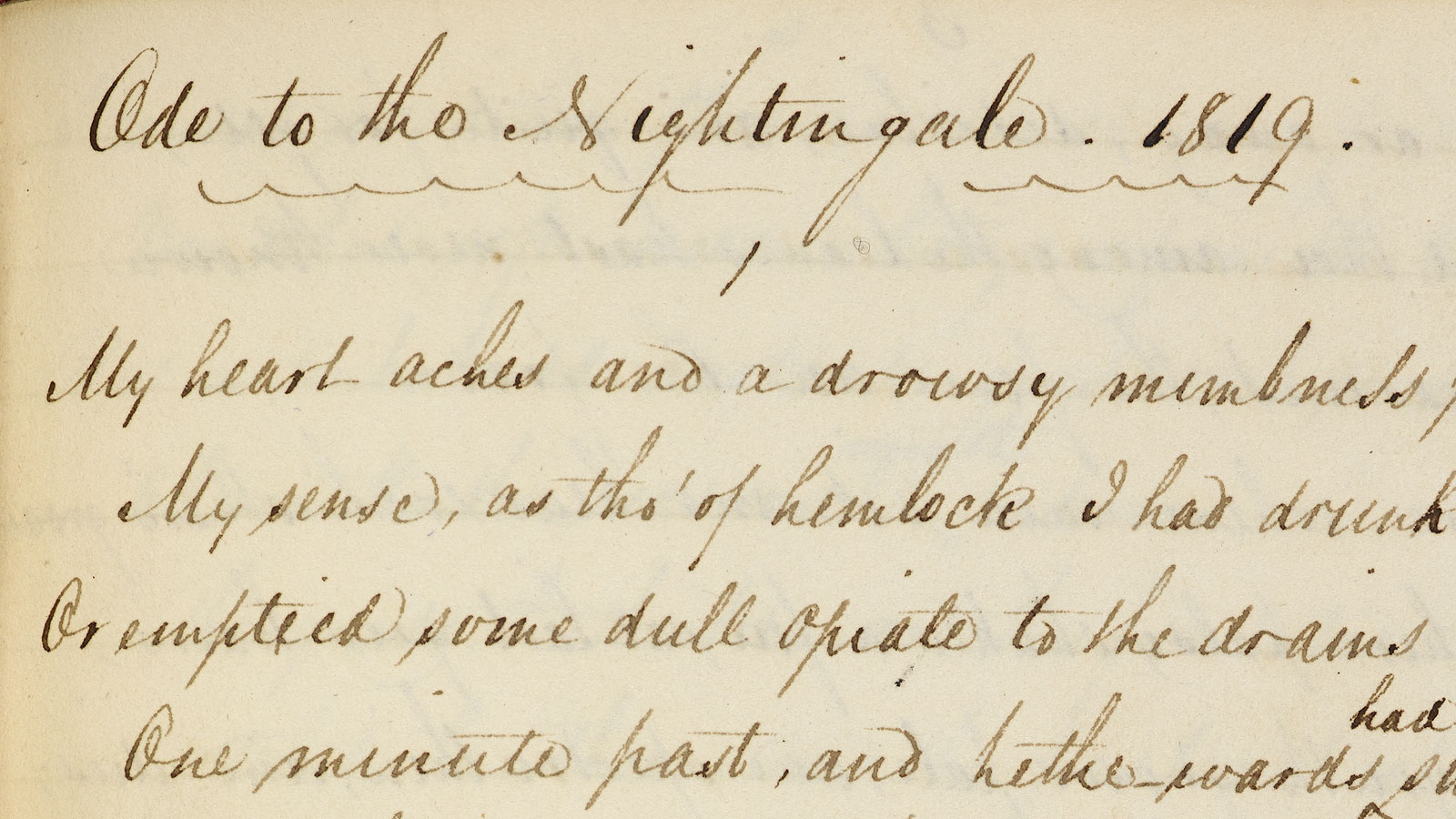
My heart aches, and a drowsy numbness pains

My sense, as though of hemlock I had drunk,

Or emptied some dull opiate to the drains

One minute past, and Lethe-wards had sunk:

‘Tis not through envy of thy happy lot,

But being too happy in thine happiness,—

That thou, light-winged Dryad of the trees

In some melodious plot

Of beechen green, and shadows numberless,

Singest of summer in full-throated ease.

Keats was suffering from depression. His beloved brother Tom had died of TB the summer before, and TB’s first symptoms were beginning to manifest themselves in him.

I asked the students to identify the tone using the first line: “aches” “numbness,” “pain.”

“What is hemlock? I asked. “Opiate?”   “Lethe?” “Dryad?”

I had trouble with the third stanza in that I feared if I might start to weep.

Fade far away, dissolve, and quite forget

What thou among the leaves hast never known,

The weariness, the fever, and the fret

Here, where men sit and hear each other groan;

Where palsy shakes a few, sad, last gray hairs,

Where youth grows pale, and spectre-thin, and dies;

Where but to think is to be full of sorrow

And leaden-eyed despairs,

Where Beauty cannot keep her lustrous eyes,

Or new Love pine at them beyond to-morrow.

The sunlight flickering shadows from the trees outside the window upon the words of the poem was quite beautiful.

John Austen's Hamlet
John Austen’s Hamlet

“Dissolve.” I recited Hamlet’s first soliloquy. “O would this too too solid flesh melt/And dissolve itself into a dew. . .” I explained Hamlet’s sad situation, his father’s death his mother’s marrying his uncle within a month.

This is true misery, I said; Hamlet and Keats long for vaporization, demolecularization, surcease of sorrow, absolute disappearance.

We discussed the slowness of the lines – the caesuras – how those commas make the reader hesitate, to limp along with “the weariness, the fever, and the fret” . . . where palsy shakes a few, sad, last gray hairs.”

The sunlight flickering on the page. The sound of my own voice reading the words.

I was not alone. I had the students, of course, but also Hamlet, Keats, those old immortal friends, to help me get through those miserable moments. No, not alone, and paradoxically, I felt keenly alive, felt something like joy by the time it was time to let them go.

crop-keats-ode-to-a-nightingale

Embracing Curmudgeonry

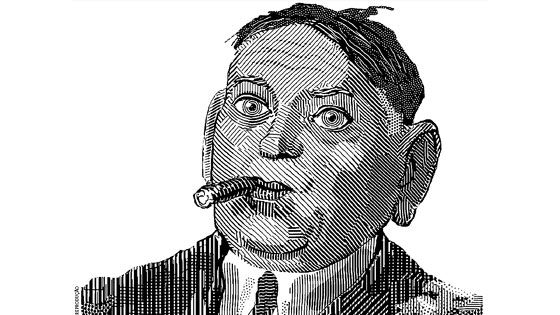
HL Mencken

HL Mencken

There’s nothing that irritates me more as a teacher than a 9th grader offering unsolicited pedagogical advice. For example, today a freshman suggested that I not make my vocabulary quizzes cumulative, or if I felt I had to dip into previous lessons, I only go back one or two. “That way,” she said, “we’d do better on the quizzes.”

In situations like this, rather than seguing into a “best practices” mode and patiently explaining that the goal is for students to remember the word for life, not merely for a week, and that resurrecting words from earlier lists should prompt them to review words from previous lessons, I reminded the student that she merely has an 8th grade education and therefore is about as qualified to offer pedagogical advice to a 30-year veteran teacher as I am to command a nuclear submarine.

Another student countered, “But that’s her opinion, and she should be able to state it freely.”

“Well,” I said, “I think that given that I just responded to it suggests that she stated it freely. My point is merely that in the area of teaching vocabulary Euthanasia [(cough) not her real name] doesn’t know the findings of the latest studies on cognitive retention or really understands that ensuring students make high marks on vocabulary quizzes isn’t my primary goal.[1] Therefore, her offering advice in an area in which she doesn’t possess expertise might be seen by some – I-and-I for example – as arrogant.

Of course, everyone who can read and write thinks he’s capable of teaching English. Believe me, as a former Department Chair, I’ve read many a cover letter from literature lovers in mid-life funks wanting to switch careers from real estate sales to teaching Hemingway.

However, despite HL Mencken’s contention that “[t]he worst idiots, even among pedagogues, are the teachers of English,” I submit it ain’t as easy as it looks in the movies, and it gets old getting professional and philosophical advice from novices.

Perhaps next time, I’ll ask the irritant to diagram on the board one of Faulkner’s sentences from Absalom, Absalom .

Or, better yet, just go into the best practices mode.

Advice for First Year Teachers on Parents Night

back to schoolTomorrow night I’ll participate in my 30th Parents Night at the independent school where I teach English. I remember my first fairly well, being really nervous addressing these older people putting down some serious jack to have me, an imposter — someone who had never taught high school — in charge of teaching their precious replicated DNA. In the two weeks I’d been teaching them, I had learned that many of my students — as far as well-wired cerebral cortexes go — were more intelligent than I, so I assumed their parents would be the same.

Like I said, I was nervous. I remember sweating profusely and my hand shaking in my pocket as I improvised my way through an overview of the course, fielded a couple of questions, and bid them a fond farewell. Several wanted to shake my hand as they left and told me how much Leland or Penelope enjoyed my class. Generally speaking, if your students like you, their parents like you.

Of course, much has changed since then, back then when Ronald Reagan was president and it was morning in America. For one thing, the mothers of my students have gone from seeming matronly to looking like jailbait. I myself have gone from svelte redheaded virility to portly bald-headed senescence.

There is recompense, however. In the classroom, I now know what I’m doing. On Parents Night, with my professorial persona in place, I no longer sweat, and my hands are out of my pockets sawing the air for emphasis. Essentially, I attempt to convince parents to take the long view, to look at that not-so-great essay grade as a snapshot in time, not as a colossal failure that kills Mason’s chances of ever getting into Harvard. I try to convince them to see that less-than-stellar essay as an opportunity to show Mason[1] that proofreading is important (i.e., unless you publish a blog).

The last thing you want to do is make learning an exercise in anxiousness.

Sometimes parents show up drunk, especially in Charleston. I guarantee you no new teacher tomorrow night will face a question as awkward as this one I faced about a dozen years ago.

“Mr. Moore, is it true that you’re a lesbian trapped in a man’s body?”

She was an acquaintance. Maybe my first word of advice is don’t get too chummy with your students’ parents.

I don’t remember what I said, but if someone were to ask me that tomorrow night, I’d say, “a black lesbian trapped in a white man’s body.”

Okay, the promised advice.

First, these people are bored stiff. Sitting in high school desks rekindles their high school insecurities. Entertain them rather than trying to inform them, though avoid icebreakers featuring a rabbi, a priest, and an imam.

Second, I suggest two weakish bloody marys a half hour before the festivities. This WC Fields-approved strategy will take the edge off without impairing your speech; in fact, it might even facilitate better communication. Note, I said weak bloody marys, which are odorless. You definitely don’t want to do two high gravity craft beers, not to mention two lines of coke or even one tab of LSD.   I mean, c’mon, duh.

Otherwise, just be you. Obviously, you must interview well, or you wouldn’t have gotten the job in the first place. Try to have fun. Time flies. The next thing you know you’ll be on the cusp of retirement, your pretty plumage molted, your first parents night a distant memory.


[1] Mason’s a great gender-neutral name that allows you to avoid gender pronouns.

“America’s Culture of Hyperachievement among the Affluent”

helicopter-parents 2I copped this post’s title from Julie Scelfo’s front-page Sunday NY Times article “Campus Suicide and the Pressure of Perfection.” Interestingly enough, on the same Sunday the Washington Post also ran a front-page article on the plight of over-stressed students, which is much more lurid than Ms Scelfo’s piece, and features, not only self-inflicted razor blade cuts, but forged transcripts and hit men. The Post copped their article from a piece in Toronto Life magazine entitled “Jennifer Pan’s Revenge: the inside story of a golden child, the killers she hired, and the parents she wanted dead.”

Less sensational but more typical, the Times story chronicles the psychic collapse of a Penn freshman named Kathryn DeWitt who “has understood since kindergarten that she was expected to attend an elite college” and whose mother checked “[e]very day at 5 p.m. test scores and updated grades” to monitor Kathryn’s progress.

Long article short, Kathryn gets into Penn, discovers her relative mediocrity, makes a 60 on a midterm calculus exam, and whips out razor blades and begins “cutting herself to ‘prepare’ for the pain” of suicide.

In fact, in a thirteen month stretch, six Penn students killed themselves, presumably like Kathryn, the victims of overweening parents and “carefully curated depictions” from social media, — you know, those Facebook pix of propped feet in Acapulco and those Gourmet Magazine cover shots of the meals your “friends” are devouring while you slowly turn the key of the metal container that houses the Spam you’re frying for supper.

Back to Kathryn: thanks to the intervention of her roommate, who found “pink rose-adorned” suicide notes stacked neatly on Kathryn’s desk, she ended up in a hospital, is now on the road to recovery, and has made it through her first year at Penn (with an A- in Calculus to boot). The revenge she’s exacting on her parents, portraying them as helicopter parents, is certainly less severe than Ms Pan’s of the Post story, but it can’t be fun to read about your daughter’s wearing a “lime green watch” that “covers up where she had cut herself.”

Cut (I know, I know) to this morning’s Post and Courier.  We have another helicopter parent, Melanie MacDonald, who with her daughter downloaded one of West Ashley’s freshman summer reading choices Some Girls Are “in hopes of tackling the summer reading assignment together.”

Although she assures us she’s “no prude,” Mrs. MacDonald considers the novel “smut” and has had it successfully yanked on August Eve from the summer reading list, which is not good enough for her because “she’s still waiting for ‘an explanation’ and “an apology.'”

Although I haven’t read the book, I can offer an explanation. The West Ashley English Department no doubt chose the book because they believe that it vivifies negative high school culture, especially the so-called mean-girl syndrome, which means its characters say “fuck” and give “blow jobs” but that the novel also demonstrates how hurtful bullying can be.

Here’s Jaime, the author of a blog called The Perpetual Page-Turner’s take:

It was such an interesting experience to watch [the protagonist] Regina fall from grace because you feel so conflicted. On the one hand, you can tell she is a mega biotch who has been a HUGE bully and so you kind of hate her from the start. But early on you have sympathy pangs for her because something terrible happens to her and it all gets twisted into an AWFUL rumor by someone in her group. But then you think, (about the rumor aspect… NOT about what happened to her), “pshh girl got what is coming to her with all HER nasty rumors she’s started.” But then as the bullying gets worse from everyone in school you feel for the girl. Having a heart…it’s a bitch sometimes! I can’t stand to see anyone get bullied and what happens to her is TERRIBLE and nobody deserves it. I felt really emotional and sick about it because it felt so real. I’ve never been bullied before but I’ve heard about terrible things and seen stories about kids being bullied to the point of suicide and it angers me. Courtney Summer made sure your heart would flip flop over whether to like/dislike Regina but you could agree she didn’t deserve THAT.

In other words, the novel fosters empathy.

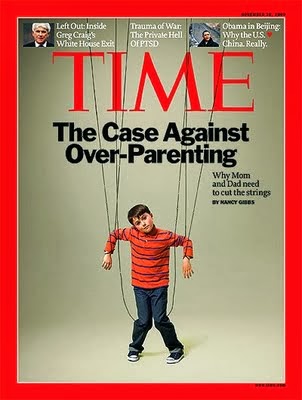
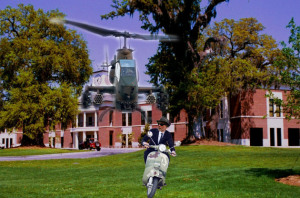
Anyway, parents, back off. There are a slew of books coming out about the damage you’re causing. What I find with helicopter parents is that they destroy the joy of learning, that Hamlet is reduced to “data’ to be mastered for “the test.”

School is reduced to a job and with it childhood is tossed.

helicopter-helicopter

The Havisham Syndrome: Why Children Haters Become Teachers

art  by Steve Messa

art by Steve Messa

Don’t know about you, but whenever I see a colon in a title, I think, okay, this essay’s not likely to be all that whiz-bang exciting, but it’s probably well researched and well developed. If I’m interested in the subject matter — e.g., the elopement of Robert and Elizabeth Barrett Browning, vintage Bengalese pornography, or the psychology behind wives of professional golfers wearing skinny jeans with factory-installed rips — I’ll check it out. What I expect from a title with a colon is serious, academic exegesis.

In the case of this essay, however, despite the title’s colon, my conclusions of what factors impel child-haters to enter the teaching profession rely on intuition, not research, so, strictly speaking, it’s about as scientific as a Discovery Channel documentary on the search for Noah’s ark. Nevertheless, intuition is a powerful mental force, a subconscious storehouse of forgotten events. Intuition is like a precocious child tugging at the sleeve of your consciousness, trying to get your attention to point out something important you’re too tall to notice.

One more caveat: the following theory is based only on one incredibly callous individual who made two years of my early adolescence the educational equivalent of the Bataan Death March. But I suspect that if my theory is true for her, it must be true for others as well. So bear with me as unveil my explanation of a phenomenon I have dubbed “the Havisham Syndrome,” which answers the question: why would a child hater choose to spend the working years of her life surrounded by children.

Choosing the Teaching Profession

Perhaps because I considered each school day a prison sentence and spent as much time glancing up at clocks as I did down at my work, I always shake my head in wonderment when someone tells me she knew she wanted to be a teacher for as long as she can remember, so obviously, for some, certain aspects of the profession override its promise of poor pay, tons of take home work, and low social status.

Many teachers, for example, go into teaching because they love children. They find very young human beings adorable, so they don’t mind spending their days herding miniature but toweringly egocentric bipeds to and from art class or to the dining hall where the teachers’ lunches go cold while they clean up spills, break up arguments, or try to cajole the little Brittany to take at least one bite of something nutritious.

Other teachers, believe it or not, love middle school students. They find seventh and eighth graders endearing and early adolescence ripe — and I don’t mean ripe in the olfactory sense — I mean ripe as in propitious, a time conducive for instilling life-long habits that will produce solid citizens.

Others are drawn to teaching because they love their subject matter and think it’s important, that a knowledge of history, math, or art is life enriching.

Still others, like me, stumble into teaching through a combination of happenstance and incompetence.

And then there are those who choose teaching because it’s an undemanding major with fairly good job prospects (i.e., if you don’t mind teaching in an impoverished school district with sub-Saharan murder rates). Whatever the case, the motivations of most teachers are neutral at worst and very positive in most cases.

However, in my career both as a student in Summerville schools and as a teacher elsewhere, I’ve encountered hateful, sometimes cruel people[1] who seem to have been drawn to the classroom to make young people’s lives miserable. There’s a sadistic streak in some teachers, teachers who make out multiple-choice questions like this:

Which of the following doesn’t fit?

A. mobsters                       B. gangsters

C. hipsters                         D. bankers

I bet you chose D, right? You idiot. The answer is C. Hipsters aren’t obsessed with money.

Even if these teachers are obviously wrong, they can’t admit a mistake. They have favorites, usually popular, brilliant, or rich kids, but treat the average or slow student with undisguised contempt.

Take my 7th and 8th grade English teacher, for example.

A Case Study

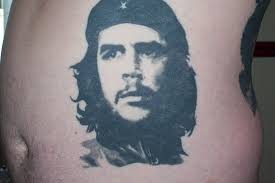
ted's tattooEven though the chances of this woman’s still being alive or her one offspring’s running across this post are about as remote as Ted Cruz’s opting for a Che Guevara tattoo next time he gets smashed on tequila in a South Texas Barrio, for the sake of discretion, I’m going to refer to her as Mrs. Choakumchild, after M’Choakumchild from Charles Dickens’ biting satire on Utilitarianism, Hard Times.)

It’s my belief that Mrs. Choakumchild entered teaching because of deeply rooted psychological problems, problems arising from her own experiences as child in the classroom. Let’s face it, children have an inherent pack mentality that prompts them to single out weird, unattractive, and/or socially clueless kids and turn them into the class pariah. Young Mrs. Choakumchild – let’s say her maiden name was Gradgrind — no doubt hit the hat trick here.

Of course, when I had her as a seventh and eighth grader, I couldn’t have told you how old she was. She did have a daughter a year older than I.  In any case, Mrs. Choakumchild was significantly overweight, had stringy, poorly dyed orange hair and a withered right arm that dangled at her side. Her sharpening a pencil in the wall-mounted pencil sharpener was a terrifying experience. She would claw-like grasp the pencil in her right hand, cross over with her left hand, and vigorously crank the handle as if grinding meat.

She had absolutely no friends, ate her lunches alone in her room. I never remember her smiling once during the two years she taught me. Nor do I remember her ever saying something positive about my work. I was in the advanced section, and once she informed me in front of the entire class that I was “an error in classification,” that is, I didn’t belong in the class. Later, in my senior year, when I had won a school wide award for a piece of fiction, my mother, who was a substitute teacher, showed it to Mrs. Choakumchild, perhaps wanting to show her how well she had taught me. After reading it, her only comment was, “He still can’t spell ‘government.’”

My Theory

Obviously, Mrs. Choakumchild was not a people person, nor did she seem at all fond of children. So we can rule benevolence out as a motivation for her becoming a teacher. She may have during college developed a great love for sentence diagraming (it seems that’s what we mostly did), but part of that love for a subject entails wanting to share it with students, not cram it down their mental feeding tubes. On the other hand, it is possible she went into teaching for the reason that women had much fewer job opportunities in those days, and I can’t rule that out.

I think, however, that it’s possible that she went into teaching for the same reason Miss Havisham adopted Estella in Great Expectations, to exact revenge. You’ll recall that being jilted at the altar, Miss Havisham decided all men were evil and reared Estella to be cruel so she could punish boys who fell in love with her. Likewise, Mrs. Choakumchild came to the conclusion that all children are inherently cruel, so decided to gain control over groups of them and to get her revenge. Of course, if true, this behavior would fall under the category of sadomasochism, because it she hated children, being around them couldn’t be pleasurable.

Could this be true of other teachers as well?

Of course not. The theory is preposterous. (Note the post is classified under satire). However, teachers do possess an enormous amount of power, and they need to be extremely careful in what they say. Obviously, I remember all too well Choakumchild’s comments on my intelligence, and she really did make me think I was stupid. Also, I know that over the years that I certainly have said things to hurt students’ feelings, and the thought of that makes me sick.


[1] Once one of my PE teachers yelled out as at obese boy was running the hundred yard dash, “Hold your arms up, X, so I can tell if you’re running or rolling.”