The Green Pastures of Retirement

Although I often whine about my chronic insomnia, in reality, it’s not a big deal because I’m retired.  Rarely do I have to be at a certain place at a designated time, so I can nap whenever I want, sometimes snatching a snooze as early as ten a.m., so it’s not like stumble about zombie-like all day, sleep deprived. 

In fact, it doesn’t make much evolutionary sense to be unconscious eight straight hours. I’ve read that our spear-toting pre-agrarian savannah-dwelling ancestors didn’t necessarily sleep through the predatory night, and during the Middle Ages, people engaged in a routine called “two sleeps,” turning in around nine or ten, slumbering for two or three hours, then awakening around one for what was known as “the watch,” a period in which they’d tend to tasks, socialize, and/or procreate.[1] Around two or three they’d again hit the literal hay (or if wealthy, a feather-stuffed mattress) and sleep until dawn or a bit later. 

However, I don’t want to give the impression that now that I no longer have to battle Folly Road traffic in the a.m. that I dawdle away the day doing crosswords, binging Netflix, or wasting time on the internet. This week, in fact, I’ve been especially busy going through the second proofs of my next book, engaging in a political protest, and most vexing of all, jumping through the electronic hoops of TurboTax. Being retired makes performing these acts much more convenient.

Excuse me; I need to vent. Correcting the proofs on Long Ago Last Summer was much more difficult than it had been with my first book, Today, Oh Boy.  This time around, rather than having a human being perform the copy editing phase, the publisher shoved the manuscript’s 62, 327 words through the woodchipper of AI.

The book is a compilation of short fiction, poetry, and personal essays that features a medley of Southern voices. Each piece can stand alone; however, collectively, they form a sort of mosaic with one of the major patterns being Southern Gothic, that literary subgenre that features “incestuous aristocrats, necrophiliac halfwits, sadistic Alabama sheriffs [. . .] the suicide hanging in the attic, the alcoholic great aunt who gave birth to the idiot child buried in the backyard.”[2]

You know, the human byproducts of the post-Reconstruction South, the folks I grew up with. 

Alas, AI wasn’t up to the task of dealing with the book’s cacophony of styles and voices.  Not only did it remove double negatives from the foul mouth of serial killer Donald “Pee Wee” Gaskins (who picked me up hitchhiking in 1970) and replace them with grammatically correct utterances, but it also altered direct quotes from the poetry of Emily Dickinson. Anyway, on Monday I completed the weeklong task of correcting the corrections. If I were teaching full time, I would not have had the leisure to pick through the rumble and piece back together my original tiles.

Nor could I have attended Tuesday’s anti-Trump demonstration at Hampton Park without having to take a personal day. I had planned on Tuesday to do our taxes, but it ended up being one of those rare days when I had to be somewhere at a specific time. The protest occurred on the very day of Trump’s state of the union address in which he stupidly misconstrued the words “transgender” and “transgenic.”

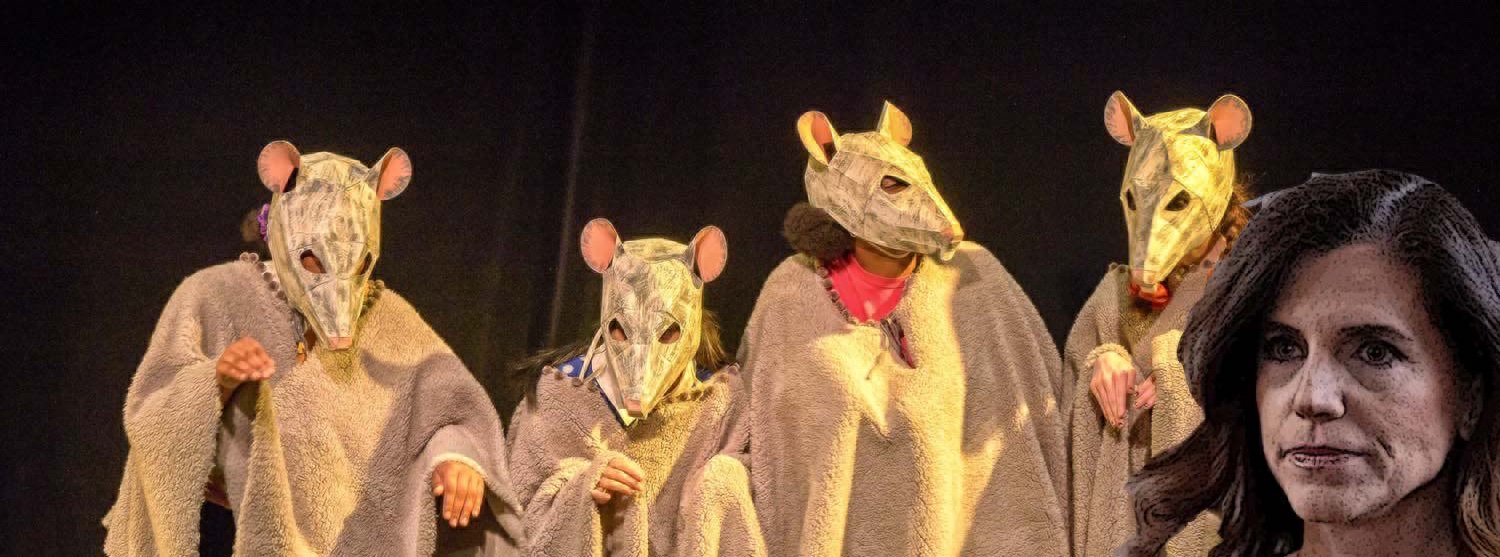
Trump: Eight million dollars for making mice transgender. This is real.

Jeff Tiedrich: No, no, no, no. Nobody is spending government money to make mice transgender. You low-wattage dolt. The word is transgenic.

Let’s say you’re a cancer researcher, and you implant some human genetic material into mice, in order to better study how cells mutate. boom! — you’ve just created transgenic mice

Nobody is doing sex-change operations on mice and setting them loose in Nancy Mace’s bathroom.

But I digress. I hadn’t engaged in a public protest since the fall of 1971, and I it looked like many of the protestors in attendance were alive and kicking during the Viet Nam era, which makes sense, given they are past retirement age and free to go wherever they choose midday on a Tuesday in March. I used to tell my students that if the governor told my generation that we couldn’t drink until we were 21, there would have been 300,000 of us on the lawn of the Governor’s mansion every day of the week. 

The protest, though somewhat limited in its attendance[3] and no doubt in swaying public opinion or sending shivers up the spines of Republican representatives, did provide an outlet for our outrage at Trump’s destroying our democracy and cruelly wreaking havoc upon the lives of so many of our citizens, not to mention his abandoning of Ukraine and the rest of our European allies. 

It was somewhat comforting to rub elbows with like minded people whose intelligence and commitment was apparent in the signs that they carried.

photo credit Joan Perry

photo credit Caroline Tigner Moore

photo credit Linda Bell

Okay, don’t worry about this 5-paragraph essay set up. I’m not going to give you a blow by blow account of my doing taxes, which thanks to my late wife’s assets is complicated by K-I limited partnerships, etc. Nevertheless, I do them myself because nowadays accountants essentially have you enter your financial information into their computer software instead of TurboTax. It ends up being the same amount of work. Using an accountant might save us some money, but what the hay. 

Ah, with my daily labors completed, here I sit sipping a Westbrook IPA at Lowlife Bar on a Wednesday afternoon scribbling this down in a composition notebook, happy to have completed the taxes and survived the tornados that never showed up on a day when Charleston County schools were called off.

Cheers! Thanks for reading until the end.

PS. Uh-oh! I just saw on LinkedIn that I appeared in 12 searches, two of which were the State Department and USAID. Yipes.

photo credit Joan Perry


[1] Since families usually slept in communal beds, having sex could be problematic.

[2] from the preface of Long Ago Last Summer, 38-9. 

[3] The Post and Courier estimated around 500,

Our Farcical Phase

Our Farcical Phase

“History repeats itself, first as tragedy, then as farce.”

Karl Marx

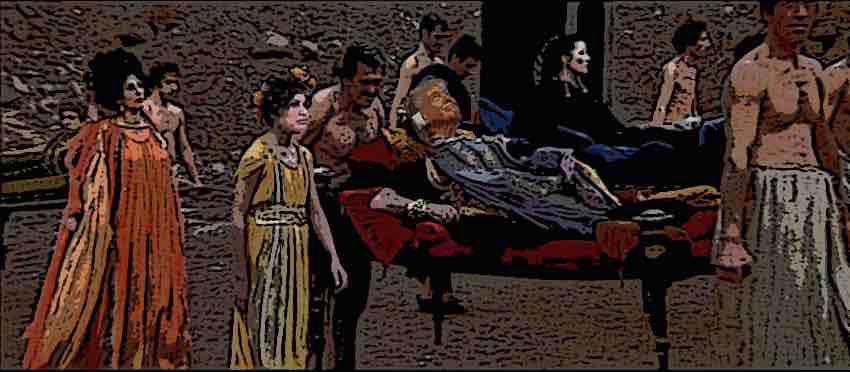
Let me begin this scholarly screed by introducing you to some of the lovelies who frequent the Felliniesque get-togethers at Mar-a-Lago.

I mean, we’re in John Waters territory here, in the land of farce, grotesque exaggeration, caricature.

From John Water’s “Female Trouble”

Speaking of which, Thursday a week ago (18 July 2024) on the stage of the Republican National Convention, Hulk Hogan endorsed Donald Trump, “the quadrice-indicted twice-impeached once-convicted popular-vote-losing adderall-huffing insurrection-leading ear-diapering testimony-ducking judge-threatening lawyer-ignoring witness-tampering day-one-dictatoring disabled-veteran-dishonoring inheritance-squandering rube-fleecing clown-makeup-smearing language-mangling serial-sexual-predating draft-dodging casino-bankrupting butler-bullying daughter-perving hush-money-paying real-estate-scamming bone-spur-faking ketchup-hurling justice-obstructing classified-war-plan-thieving golf-cheating weather-map-defacing horse-paste-promoting paper-towel-flinging race-baiting tax-evading evidence-destroying charity-defrauding money-laundering diaper-filling 88-count 78-year-old fluorescent tangerine felony factory.”[1]

At the end of his speech, Hogan ripped off his shirt to reveal a tee emblazoned with 

TRUMP

VANCE

MAKE AMERICA GREAT AGAIN!

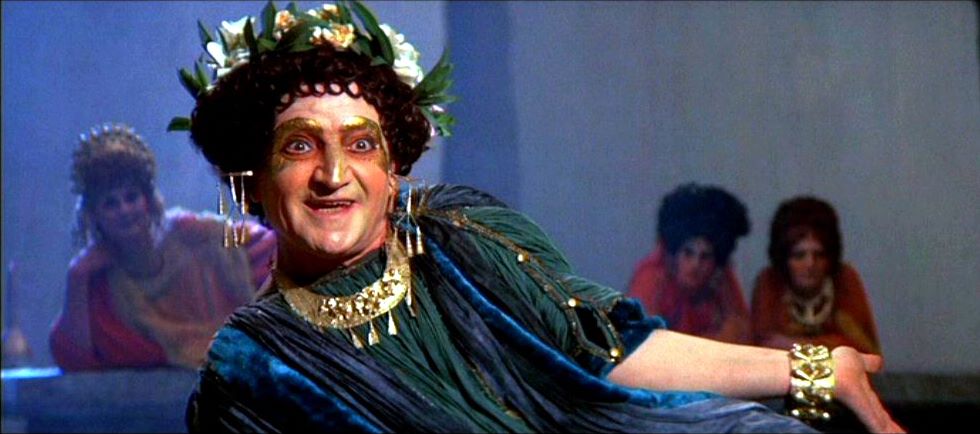
Not surprisingly, the literature of Nero’s Rome provides us with an ancient parallel to our current farcical state of affairs. Check out in your ample spare time The Satyricon by Petronius the Arbiter.[2] Here’s a still from Fellini’s cinematic treatment of Petronius’s classic, from the chapter known as “Trimalchio’s Dinner.”[3]

In his famous statement, “history repeats itself, first as tragedy, then as farce,” Marx was riffing on the Hegelian idea that history repeats patterns but in different ways, e.g., the French Revolution leading to Napoleon I (tragedy) and then to rise and fall of Napoleon III (farce).

Or, to draw a North American Parallel, the American Revolution is followed by the Civil War (tragedy) and then by the MAGA revolution (farce).

However, the thing is that when melodrama is exaggerated it becomes comic a la Reefer Madness, but when farce is overly exaggerated, it can become terrifying in a creepy clown sort of way.

I mean, imagine being trapped in an elevator with Don, Jr.’s fiancé Kimberly Guilfoyle! Imagine the future White House wedding. 

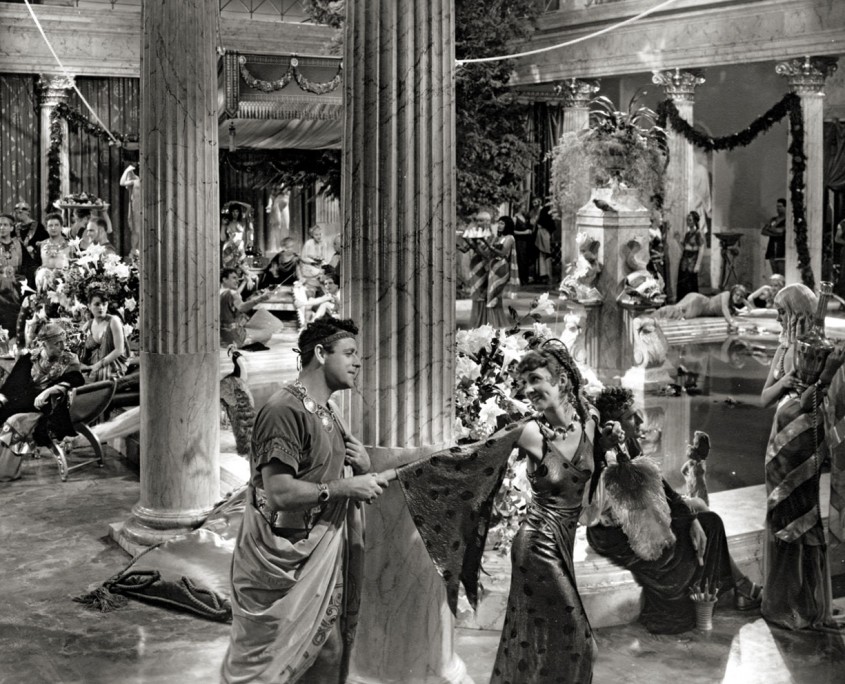
Bring in some pillars and Cecile B DeMille.


[1] from the poison keyboard of Jeff Tiedrich. 

[2] Which also provided TS Eliot with his epigraph for “The Waste Land.”

[3] More fun facts to know and share. Fitzgerald’s working title for The Great Gatsby was Trimalchio.

Episode 3 of “My Boys Were Back in Town, Backroads Edition Featuring Joel Chandler Harris

Episode 3 – Eatonton’s Rural Literary Legacy

[In episode 2, My ex-pat son Ned and I wended our way through backroads headed to Reynolds, formally known as Reynolds Plantation, just outside of Greensboro, Georgia, to reunite with his Aunt Becky at Uncle Dave].

Around four-thirty on Thursday, Ned and I arrived at Reynolds where we negotiated the security gate rigamarole. At the house, Becky and Dave greeted us warmly, plied us with drinks after our long (well, six hour) journey, and we did some catching up. It turns out that Becky and Dave had recently suffered a hair-raising flight from New Jersey to Atlanta, the inside of the plane perpetually rocked by turbulence for the entire time they were airborne. As she was exiting the plane, Becky found it especially disconcerting to see the pilot and copilot exchanging high fives. She informed Ned if she were going to visit him in Nuremberg, she was likely to take an ocean liner.

On Friday, Dave, who is overseeing the construction of one of the houses his son Scott is building in Reynolds, headed off to work, and Becky drove Ned and me to Eatonton so we could check out the Georgia Writer’s Museum, home of the Georgia Writer’s Hall of Fame. 

Eatonton is a lovely, sleepy verdant town that reminds me of the Summerville of my youth. It seems like a pleasant place to retire, that is, if you’re not a Folly Beach hedonist hellbent on cha-cha-cha-ing yourself to death.

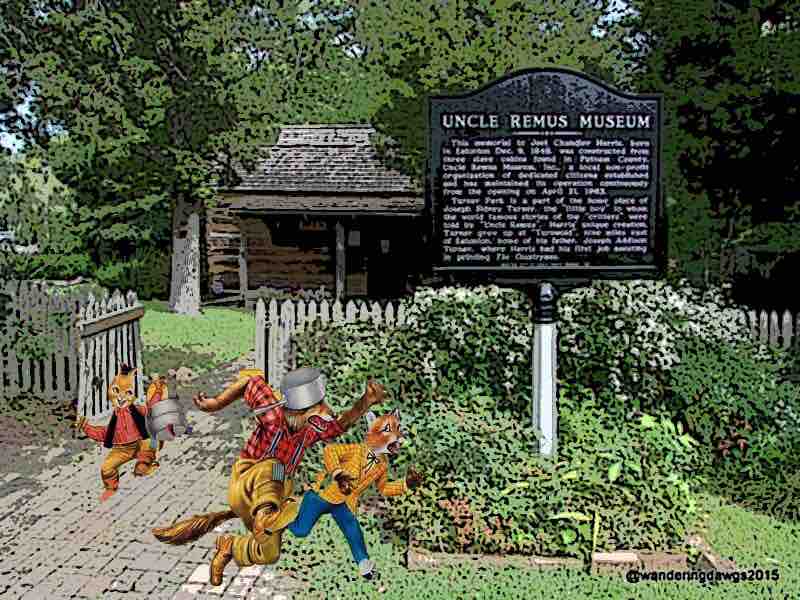
The museum itself, located in a coffeeshop, struck me as the literary equivalent of a science fair, consisted of tables lined up with poster board information. Eatonton and its environs have produced a remarkable number of noteworthy writers including Alice Walker, Jean Toomer of Harlem Renaissance fame, and Joel Chandler Harris, who adapted African folk tales in book form, creating the Uncle Remus stories. Milledgeville, the home of Flannery O’Connor, is a mere twenty miles south.

The museum houses both Joel Chandler Harris’s and Flannery O’Connor’s typewriters, plus an exhibit delineating the evolution of machines of writing, starting with primitive typewriters and ending with a progression of computers getting smaller and sleeker through the decades.

As I slowly strolled along the exhibits, The fact that Joel Chandler Harris had been born in the Barnes Inn and Tavern caught my eye. Being born in a tavern seemed odd, colorful, so I read on. 

Here’s a short version of his life:

The year of his birth is uncertain, either 1845 or 1848. His mother Mary, an Irish immigrant who worked at the inn, was impregnated by a cad who abandoned his infant son and Mary.  She named the baby Joel Chandler Harris after her attending physician.

Of course, illegitimacy, as it was called in my youth, was especially problematic in the antebellum South.[1] In addition to that disadvantage, Joel was redheaded and stammered, which made him a target for bullies.[2]  The stigma of his “lowly” birth haunted him throughout his youth and early adulthood.

Fortunately, Dr. Andrew Reid, a prominent Eatonton physician, provided Mary and Joel with a small house behind his mansion. He also paid for Joel’s tuition (in those days public education didn’t exist in the South). Mother Mary fostered Joel’s future literary prowess by reading to him out loud, which helped him to develop the remarkable memory he would utilize in assembling the Uncle Remus tales. She read him Goldsmith’s The Vicar of Wakefield so often that he could recite lengthy passages by heart.

At fourteen, Harris dropped out of school and went to work for a newspaper, Joseph Addison Turner’s The Countrymanwith a circulation around 2,000. There Harris mastered the basics, including typesetting. Addison allowed Harris to publish his own stories and poems. Eventually, Harris moved into Turnwold Plantation, Addison’s home, located nine miles outside of Eatonton. Here Harris had access to a voluminous library and where he began devouring the classics and contemporary authors such as Dickens, Thackery, and Poe.

At Turnwold, Harris spent hundreds of hours in the slave quarters. Wikipedia claims that Harris’s “humble background as an illegitimate, red-headed son of an Irish immigrant helped foster an intimate connection with the slaves. He absorbed the stories, language, and inflections of people like Uncle George Terrell, Old Harbert, and Aunt Crissy,” who in amalgam became the narrator of the Brer Rabbit Tales, Uncle Remus.

I was unfamiliar with Harris’s biography, but what strikes me as truly remarkable is that he replicated these stories in dialect without any written sources. He essentially gave voice to and preserved these tales that had been stored in the brains of Africans, transported across the Atlantic in slave ships, and told and retold in slave cabins throughout dark nights of captivity.

Because of the Disney movie, Song of the South, Harris has been tarred (pun intended) as being a racist, which is unfortunate. What Harris did was preserve a rich trove of folklore featuring an African trickster who used his wiles to outfox foxes, tales where the underdog prevails. Of course, you can accuse Harris of cultural appropriation, but to my mind, the dialect enriches the tales, making them much more linguistically interesting. 

After the war, Harris moved up in the world of journalism, working at the Atlanta Constitution for nearly a quarter century, and addition to the Remus tales, he published novels, short stories, and humorous pieces. Luminaries such as Theodore Roosevelt and Mark Twain were among his admirers. Alas, he was an alcoholic, and died from complications from cirrhosis of the liver at 59.

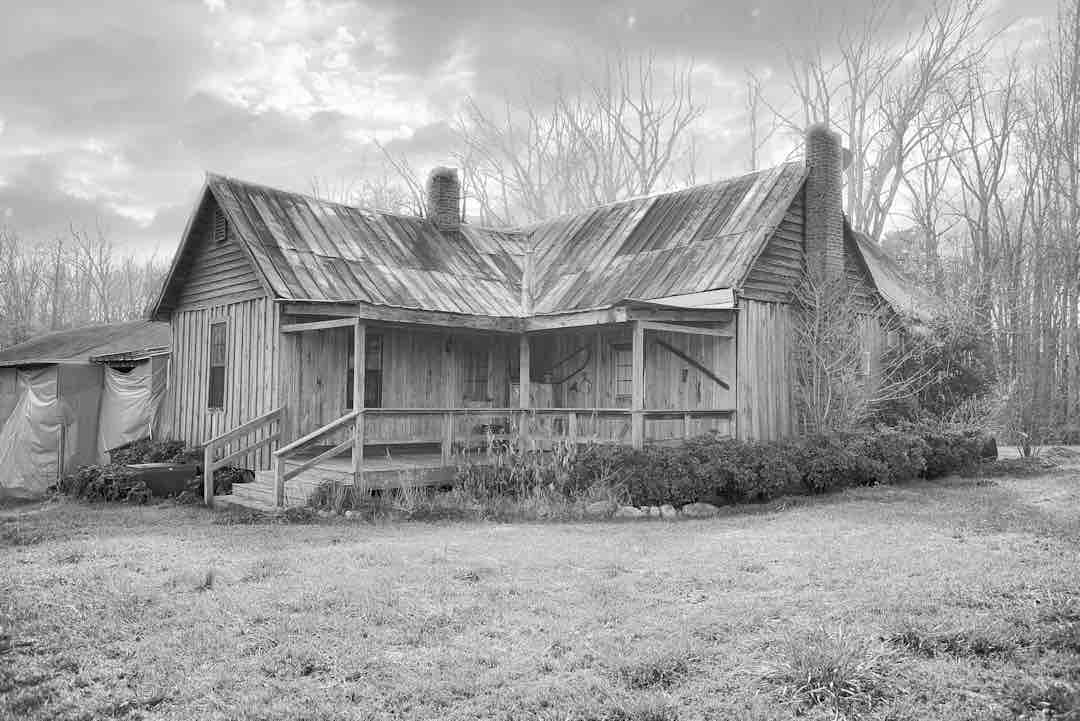
After our visit to the museum, Becky gave us a driving tour of the area, which includes a dilapidated chapel where Alice Walker’s ancestors are buried. We arrived back at Reynolds in the early afternoon, looking forward to Cousin Scott’s arrival the next day. At the museum, Ned had bought me Jean Toomer’s Cane, a literary mosaic of poems and short stories that brings to life a subculture, which reminds me of my work-in-progress Long Ago Last Summer, an up close and personal exploration of real life Sothern Gothic.

In short, it was a very meaningful morning and afternoon for Ned and me. 

Alice Walker’s Childhood Home around 1910


[1] Of course, “bastard” was the preferred 19th Century nomenclature. 

[2] As a former redhead, I can emphasize. If interested, check this LINK out.