
From Painter to Filmmaker
The death of the brilliant film director David Lynch has spurred my wife Caroline and me to revisit his oeuvre.[1]
We started with the Jon Nguyen’s 2016 Lynch documentary The Art of Life, the culmination of four-year’s worth of conversations, twenty in all, recorded at Lynch’s home in LA. I had not been aware that Lynch was a painter, a highly skilled and prolific one at that.
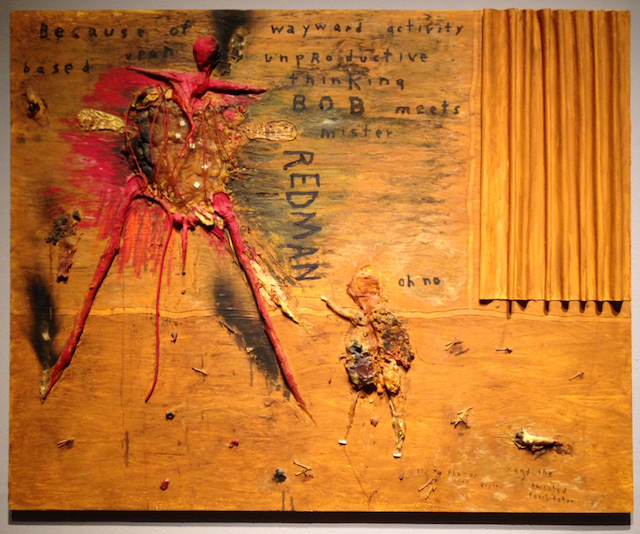
Throughout the documentary, we listen to Lynch narrate his life story while watching him in the act of creating paintings and sculptures. Interspersed are 8mm home movies of him and his family from the ’50s and ’60s. If you love Lynch, you’ll love this film, enjoy its leisurely pace and artful presentation.
What struck me most was Lynch’s revelation that “moving pictures” could be “moving paintings.”
So post epiphany off Lynch went to the American Film Institute where he resided in stables owned by the institute, and there he made his first feature film Eraserhead, transforming the narrow halls and small rooms of the stables into movie sets.
By the way, I first saw Eraserhead in 1989 as a refugee from Hurricane Hugo, a dozen years after its original release, the again in the mid-’90s, and for the third time last night with Caroline.[2]
Dr. Caligari’s Great-Great Grandchild
In the fall of 1973 or 4, at the University of South Carolina, I had the great fortune to enroll in a multi-departmental course on German Expressionism, the prominent artistic movement of the Wiemer Republic. This class really broadened my intellectual horizons. We read Hesse, Kafka, and Bertolt Brecht; analyzed the paintings of Ernst Ludwig Kirchner, Karl Schmidt-Rottluff, and Emil Nolde; listened to the music of Schoenberg and Alban Berg; and watched each week in the student union’s theater an expressionistic Wiemer film. We began with the Cabinet of Dr. Caligari and ended with Fritz Lang’s Metropolis. Murnau’s original Nosferatu was also among the films we saw and analyzed. It was, by far, the most interesting and rewarding course I’ve ever taken.
Obviously, Caligari heavily influenced Eraserhead in its set designs, dark themes, and murky black-and-white lighting. Also, Eraserhead is essentially a silent movie with only four minutes of dialogue in its 89-minute running time. The protagonist Henry, played by Jack Nance, waddles Chaplin-like throughout the film in what amounts to a Kafka nightmare. Though Eraserhead’s billed as a surrealistic horror movie, both Caroline and I found it to be hilariously funny. I can’t remember the last time I saw a film that produced so many out-loud laughs.
On the other hand, one significant way in which Eraserhead doesn’t resemble a silent movie is in its soundtrack. Unlike a silent movie whose soundtrack is more or less pasted on afterward, the soundtrack of Eraserhead consists of irritating sounds arising from the action, sounds like rain hissing, a radiator hissing, the mewling and crying of that abomination of a baby whose arrival marks the turning point of the plot. Caroline aptly described these background noises as “a plaid of sounds,” which provides a sort of underlying mechanical, menacing buzzing.
Caroline also suggested that the central theme lay in Lynch’s hatred of fatherhood, though I saw it more as a strangely puritanical parable about the dangers of premarital sex. Ends up Caroline was correct. Lynch’s daughter Jennifer was born with severally clubbed feet and had to undergo several corrective surgeries as an infant, and she considers her birth defects as the major inspiration for the infant of the film.
At any rate, we had a fun night and look forward to checking out Lynch’s next film The Elephant Man, which, although more mainstream, shares with Eraserhead a very malformed human being at the center of the action.
[1] Why do I feel guilty using “oeuvre” when EB White would applaud its economical aptness? Perhaps because American anti-intellectualism lurks in the shadowy shotgun shack of my subconscious mocking me like the bully it is?
[2] Caroline, who minored in art history and has a master’s in psychoanalytical criticism, is the perfect companion and provides a wealth of cogent observations that would have escaped me otherwise.

 You Do Hoodoo