Shape Without Form, Shade Without Color

Certainly, as several cultural critics have pointed out, Yeats’s magnificent poem “The Second Coming” expresses powerfully and concretely our current situation, what TS Eliot abstractly described as “the immense panorama of futility and anarchy that is contemporary history.”

Yeat’s poem is brief; therefore, I’ll quote it in its entirety:

Turning and turning in the widening gyre   

The falcon cannot hear the falconer;

Things fall apart; the centre cannot hold;

Mere anarchy is loosed upon the world,

The blood-dimmed tide is loosed, and everywhere   

The ceremony of innocence is drowned;

The best lack all conviction, while the worst   

Are full of passionate intensity.

***

Surely some revelation is at hand;

Surely the Second Coming is at hand.   

The Second Coming! Hardly are those words out   

When a vast image out of Spiritus Mundi

Troubles my sight: somewhere in sands of the desert   

A shape with lion body and the head of a man,   

A gaze blank and pitiless as the sun,   

Is moving its slow thighs, while all about it   

Reel shadows of the indignant desert birds.   

The darkness drops again; but now I know   

That twenty centuries of stony sleep

Were vexed to nightmare by a rocking cradle,   

And what rough beast, its hour come round at last,   

Slouches towards Bethlehem to be born?

Does the description “a gaze as blank and pitiless as the sun” remind you of anyone?

Of course, the Founding Fathers feared the rise of an American despot, so they counterbalanced the executive with Congress and the courts. Unfortunately, the lines “[t]he best lack all conviction, while the worst/ [a]re full of passionate intensity” aptly describe the Republican controlled House and Senate, Nancy Mace, full of passionate intensity, Lindsey Graham lacking all conviction.[1]

The Republican Senate certainly abandoned their responsibility of advising and consenting when they confirmed a vaccine-denying former heroin addict who literally has had worms eating his brain as Director of Health and Human Services and an alcoholic sexual predator who has absolutely no experience running a large enterprise as Secretary of Defense.

This idea of citizens lacking conviction is also powerfully rendered in TS Eliot’s “The Hollow Men” whose final lines have become almost a cliche:

This is the way the world ends 
Not with a bang but a whimper.

The hollow men of Eliot’s poem are scarecrows, heartless, “behaving as the wind behaves,” going with the flow, their “dried voices [. . .] quiet and meaningless.” 

Like Senator Susan Collins, for example. 

At any rate, in both poems we see Christianity breaking down, as the Antichrist slouches towards Bethlehem and in Eliot’s poem when the “Lord’s Prayer” breaks down into gibberish.

Between the idea  
And the reality  
Between the motion  
And the act  
Falls the Shadow 

                                  For Thine is the Kingdom

Between the conception  
And the creation 
Between the emotion  
And the response  
Falls the Shadow 

                                  Life is very long

Between the desire  


And the spasm  
Between the potency  
And the existence  
Between the essence  
And the descent  
Falls the Shadow 

                                  For Thine is the Kingdom

For Thine is  
Life is 
For Thine is the 

This is the way the world ends 
Not with a bang but a whimper.


[1] Both hail from a state “too small to be a country, too big to be an insane asylum.” – James Petigru on South Carolina.
Wesley’s Weave: Dark Musings on Election Eve

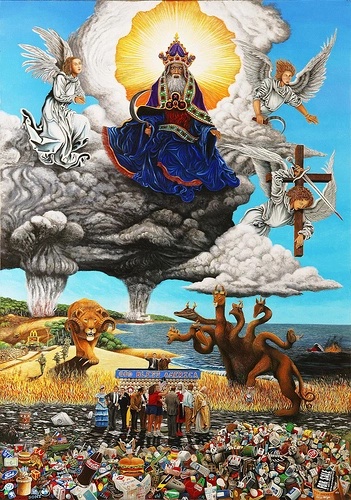
Apocalypse by Adrian Kenyon

Donald Trump has dubbed his rambling speeches “the weave,” claiming that if you connect the dots of his zigzags, a unified picture appears. So I thought I’d give it a try myself.

Here goes.

The other night, after suffering through a self-righteous, ill-informed screed from a Facebook follower, I found myself listening to Bob Dylan’s masterful protest song “Hurricane,” a cinematic narrative recounting the arrest and trial of Rubin Hurricane Carter, a boxer wrongly convicted of a triple homicide in 1966 in Patterson, New Jersey.

Meanwhile, far away in another part of town
Rubin Carter and a couple of friends are drivin’ around
Number one contender for the middleweight crown
Had no idea what kinda shit was about to go down

When a cop pulled him over to the side of the road
Just like the time before and the time before that
In Paterson that’s just the way things go
If you’re black you might as well not show up on the street
‘Less you want to draw the heat

Near the end of the song Dylan sings,

How can the life of such a man
Be in the palm of some fool’s hand?
To see him obviously framed
Couldn’t help but make me feel ashamed to live in a land

Where justice is a game

Now all the criminals in their coats and their ties
Are free to drink martinis and watch the sun rise
While Rubin sits like Buddha in a ten-foot cell
An innocent man in a living hell

As I was listening, the long gone idealism of the 60s came to mind. Dylan himself — and Joan Baez –performed at the March on Washington, sharing the stage with Martin Luther King. They heard firsthand the “I Have a Dream Speech.”  They’re both still alive sixty-one years later.

In 1963, the American people considered communism the greatest threat to the nation’s sovereignty, and the Soviet Union was our greatest enemy whose spy agency the KGB eventually became the employer and training ground for Vladimir Putin, whom Donald Trump so idolizes, along with Kim Jong Un, the North Korean dictator. 

According to Trump, outside forces like Russia and North Korea aren’t the greatest threat to American sovereignty; no, it’s “the enemy within,” American citizens, news organizations, and celebrities tarred with the paradoxical disapprobation “woke.”  It’s Joe McCarthy redux, and McCarthy’s corrupt lawyer Roy Cohn was Donald Trump’s mentor.

Trump and his followers bring to mind WB Yeats’s lines from “The Second Coming”:

The best lack all conviction, while the worst

Are full of passionate intensity.

Fueled by the fifth deadly sin wrath, these resentful white supremist faux Christian cultists seem to prefer a dictatorship of oligarchs to the teachings of their would-be Savoir who famously preached

Blessed are the meek, for they shall inherit the earth.

Blessed are the merciful, for they shall obtain mercy.

Meanwhile,  

The blood-dimmed tide is loosed, and everywhere

The ceremony of innocence is drowned.

Connect these dots and what do you get?

[a] rough beast, its hour come round at last,

Slouch[ing] towards Bethlehem to be born.

Recitation of “Adam’s Fall” on Yeats’ 159th Birthday

A year or so ago, Buxton Books invited me to recite a favorite poem for their on-line series, “The Power of Poetry” as part of the promotion for my novel Today, Oh Boy. However, I don’t think the clip was ever posted, so in honor of Yeats’ 159th birthday, I’m posting it here. The text of poem itself is below the video.

We sat together at one summer’s end,
That beautiful mild woman, your close friend,
And you and I, and talked of poetry.
I said, ‘A line will take us hours maybe;
Yet if it does not seem a moment’s thought,
Our stitching and unstitching has been naught.
Better go down upon your marrow-bones
And scrub a kitchen pavement, or break stones
Like an old pauper, in all kinds of weather;
For to articulate sweet sounds together
Is to work harder than all these, and yet
Be thought an idler by the noisy set
Of bankers, schoolmasters, and clergymen
The martyrs call the world.’
And thereupon
That beautiful mild woman for whose sake
There’s many a one shall find out all heartache
On finding that her voice is sweet and low
Replied, ‘To be born woman is to know—
Although they do not talk of it at school—
That we must labour to be beautiful.’
I said, ‘It’s certain there is no fine thing
Since Adam’s fall but needs much labouring.
There have been lovers who thought love should be
So much compounded of high courtesy
That they would sigh and quote with learned looks
Precedents out of beautiful old books;
Yet now it seems an idle trade enough.’

We sat grown quiet at the name of love;
We saw the last embers of daylight die,
And in the trembling blue-green of the sky
A moon, worn as if it had been a shell
Washed by time’s waters as they rose and fell
About the stars and broke in days and years.

I had a thought for no one’s but your ears:
That you were beautiful, and that I strove
To love you in the old high way of love;
That it had all seemed happy, and yet we’d grown
As weary-hearted as that hollow moon.

You Can’t be Any More Out of It Than Dead

Cotswold cottages with hollyhocks and roses at sunset, Mickleton near Chipping Campden, Gloucestershire, England.

You Can’t be Any More Out of It Than Dead

Nor dread nor hope attend
A dying animal;
A man awaits his end
Dreading and hoping all.

WB Yeats

Perhaps the only people who die happy are James Dean types who, defying speed limits, enjoy an intense adrenaline rush right before a fiery crash instantaneously switches off the lights. Dean died young as did F Scott Fitzgerald, who legend has it, suffered a massive heart attack at 44 while making love to Sheilah Graham, a gossip columnist. Nevertheless, I doubt that he died happy. One of the symptoms of a heart attack is a feeling of impending doom.

Of course, the opposite of dying young is enjoying an extended lifespan, but you don’t want to overdo it. Chances are that if you succumb at the way overripe age of 97, you’ve outlived your spouse – maybe two – and perhaps one or two of your children. Chances are you’re sick and tired of wheelchairs, sick and tired of constant confusion, or simply sick and tired. 

Even if you’re happy right before your death, after the event, you’re simply dead, so nothing matters to you anymore anyway. You don’t pick up on those Happy Heavenly Father’s Day Facebook posts, nor, on the plus side, does the Braves’ bullpen blowing a save bother you. Fact is that you can’t be any poorer than dead, or, as Flannery O’Connor’s Francis Marion Tarwater puts it, “The dead don’t bother about particulars.”

It would be nice, though, to die in a relatively serene era of history, puttering around a cottage in the Cotswolds’ in the 1870s, say, not fixating on the Franco-Russian war, but tending to your roses, having time enough to notice the lovely russet sunset beyond the hedgerows. Wouldn’t it be nice to die in a place of peace and quiet surrounded by loved ones who realize that death is the mother of beauty? 

That’s the way to go. 

Copyright: Copyright © 2013 Tom Bartel

Cha-Cha-Cha-ing Towards Bethlehem

[Cue Alice Cooper] Now that for me school’s out forever, I have ditched academics, abandoned trying to explain sprung rhythm[1], deep-sixed Victorian bric-a-brac, and turned my attention to my first love, my av-av-av-ocation, anthropology. 

For the last two weeks, between book signings and interviews,[2] I’ve been hanging out with Oscar Wilde, the great-great grandfather of Diana Ross/Lady Gaga, while pondering the relationship among peace, prosperity and decadence.

Wilde embraced the dark velvet decadence of Poe and Baudelaire, cocooning himself in aromatic rooms with lily-stuffed vases, handcrafted furniture, and arrases.  His conversation, to quote Lucinda Williams, “was like a drug,” and he somehow managed to produce two minor masterpieces The Portrait of Dorian Gray and The Importance of Being Earnest in his downtime between partying and lecturing. 

The Great British Empire had enjoyed peace and prosperity for so long that it seemed, as Oscar’s pal Willy B put it, “it would outlive all future days.”  Far from the horrorshow in Africa and India and elsewhere, one lolling on a divan in Chelsea could focus one’s attention on decor even while mocking decorum. 

However, World War I eventually turned people’s attention away from wallpaper design to spiritualism, as widows attempted to contact via seance their dead husbands and sons.  In fact, Wilde’s own son Cyril would die in the trenches at the age of 29, fifteen years after his father’s checking out of this Vale of Tears Days Inn of Woe.

Hit it, Willy B:

We too had many pretty toys when young:

A law indifferent to blame or praise,

To bribe or threat; habits that made old wrong

Melt down, as it were wax in the sun’s rays;

Public opinion ripening for so long

We thought it would outlive all future days.

O what fine thought we had because we thought

That the worst rogues and rascals had died out.


All teeth were drawn, all ancient tricks unlearned,

And a great army but a showy thing;

What matter that no cannon had been turned

Into a ploughshare? Parliament and king

Thought that unless a little powder burned

The trumpeters might burst with trumpeting

And yet it lack all glory; and perchance

The guardsmen’s drowsy chargers would not prance.


Now days are dragon-ridden, the nightmare

Rides upon sleep:  a drunken soldiery

Can leave the mother, murdered at her door,

To crawl in her own blood, and go scot-free;

The night can sweat with terror as before

We pieced our thoughts into philosophy,

And planned to bring the world under a rule,

Who are but weasels fighting in a hole.

                                           WB Yeats “Nineteen-Hundred-and-Nineteen”                   

It was not an enemy’s bullet but the Book of Leviticus what eventually done Oscar in.

“If a man also lie with mankind, as he lieth with a woman, both of them have committed an abomination: they shall surely be put to death; their blood shall be upon them.”

                                                                                                                              20:13

Although increasingly, we outside the MAGA cult resemble the Greeks more than Victorians in our attitudes towards same sex relationships, we, like British Victorians, live in a homeland that has not been invaded by foreign armies for hundreds of years.  Our wars are fought abroad, and not necessarily by our best and brightest.[3]  We can choose not to enlist and focus our attention elsewhere, which in Late Empire America means pursuing the good life, a life of hedonism, of epicureanism, which is all fine and dandy (I confess having stashed away behind a custom-made maple cabinet one bottle of the limited Malt Master’s Edition of a Glenfiddich, a single malt double-cured in oak and sherry casks).

However, if my 1500+ acquaintances on Facebook provide an accurate sample of the bourgeoise, there seems to be a sort of insecure compulsion to woo-hoo about how wonderful their lives are, to snap photographs of luscious dishes (whether prepared at home or eaten out) or inviting beach vistas (perhaps with propped-up bare feet peeking up from the bottom of the photo).  Typical captions read “not too shabby” or “life is good.”   And every coed in America seems to have adopted the preening, narcissistic pose of Kim Kardashian.

This preening worries me because it smacks of pride, and if Oscar were given the second chances that our politicians claim as their due, he certainly might have embraced that other profound pleasure-seeker’s advice, Sir John Falstaff’s, about discretion’s being the better part of valor.  Flaunting, which can create resentment and contempt, tempts fate. Some envious psychotic Trump cultist reads this post, finds out where I live, breaks into my house, takes an ax to my custom-made maple cabinet, and pours out my Glenfiddich before being taken down by our ninja dog KitKat.

By all means, let’s enjoy life but try not to be so smug about it, for O, my brothers and sisters, trouble’s brewing everywhere, in the Atlantic as glaciers melt and hurricanes incubate, in sub-Saharan Africa as bacteria mutate, in Russia where Putin is rattling nukes, in the Far East as Kim Jong II preens into the not-so-funhouse mirror of megalomania.

Happy summer, everyone!


[1] Sprung rhythm is associated with the poet Gerard Manley Hopkins: E.g.

 O the mind, mind has mountains; cliffs of fall 

Frightful, sheer, no-man-fathomed.

[2] I’ve been promoting my novel Today, Oh Boy, which you can buy HERE!

[3] Beau Biden was the first presidential offspring to serve in combat since Ike’s son John Eisenhower.

Lost Youth, or “I Had Pretty Plumage Once”

Me in 1973 (all photos by James Huff)

Lost Youth, or “I Had Pretty Plumage Once”

And I though never of Ledaean kind

Had pretty plumage once—enough of that,

Better to smile on all that smile, and show

There is a comfortable kind of old scarecrow.

                                                                        WB Yeats, “Among School Children”

Poverty is not all that terrible if you’re in college. After all, most students live in dormitories, and for my first two years of undergraduate school, the dorms I lived in were officially known as “The Tenements,” the oldest dorms on campus, picturesque but Spartan. And when I say Spartan, I mean tres austère –  no air-conditioning in the summer; hand-searing radiators in the winter; merely two telephones in the hall, one for on campus communication, the other a pay phone you had to feed quarters during long distance calls. And perhaps the worst indignity of all, there were no stalls around the three toilets lined up in the flashback-inducing black-and-white diamond-tiled bathroom. Whenever nature called, the residents of Tenement 9 shielded themselves with open newspapers to create a modicum of privacy. No one, conversed, i.e., no one shot the shit while shitting.

OMG! TMI!

Even though I couldn’t afford it, I moved off-campus my junior year, and after a couple of nightmare rentals in the fall and winter of my senior year, my housemate Warren Moise, along with a host of other impoverished students, moved into the once genteel abode of 1830 Greene Street conveniently located on campus.[1] I’m fairly certain than none of us owned an automobile. SLED paid a visit our first week, and half the residents were carted off to jail for simple possession. Luckily, Warren, Jim, and I were off when police came a calling.

1830 Greene Street

Interestingly enough – and least for me – I had lunch with my Greene-Street housemate Warren Thursday and then encountered another Greene-Street housemate that afternoon when I was signing copies of my novel Today, Oh Boy in Summerville.[2] I hadn’t seen Jim Huff or his wife Jane in this century – in fact, not since the late 80s or early 90s. Jim had been lease-signer of 1830 Greene and therefore collected our $20 rent each month (there were eight of us) and utility money and money to buy kerosine for the enormous furnace that consumed fuel as rapidly as RJ McCarthy downed his 24-ounce cans of “the Bull,” aka Schlitz Malt Liquor. Every room except for the kitchen and the two bathrooms was utilized as a bedroom, including the living room and the conservatory where I slept, only assessable through Mr. McCarthy’s room. 

Hail, affordable housing; farewell, privacy.

Jim Huff circa 1975

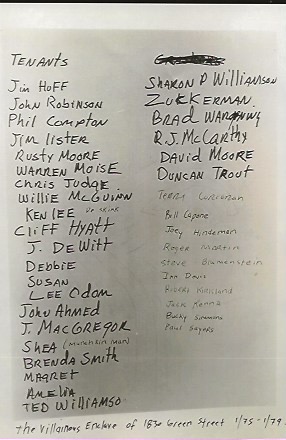
Here’s a list Jim compiled of the house’s residents, including girlfriends who spent multiple nights.

At the signing in Summerville, Jim gave me some photographs he had taken back in the day, which I so much appreciate. They demonstrate quite eloquently that whatever I may have gained in monetary wealth, I have equaled in girth, but lost in hair.

Anyway, it was great seeing Warren, Jim, and Jane, though I must admit that the photos have engendered a wee bit of melancholy.

Ah, no; the years O!

And the rotten rose is ript from the wall.[3]


[1] If you’re in the mood for some Night of the Hunter noir, click HERE and read about a couple of harrowing experiences we suffered before moving to Greene Street.

[2] Get ’em while they’re hot. LINK.

[3] You can read the rest of the poem here. LINK.

Ain’t Got You

A aged man is but a paltry thing, a tattered coat upon a stick, so what shall I do with this absurdity, O Heart, O Troubled heart, decrepit age that has been tied to me as to a dog’s tail? What am I gonna do? Make a fool out of myself, that’s what. Here’s exhibit A. The Old Scarecrow Boogie.

Ain’t Got You

I’m sixty-five, got cataracts,
Hump-forming on my back,
A candidate for a heart attack,
But I ain’t got you . . .

Got nurses to the left of me,
Nurses to the right of me,
Nurses all around me,
But I ain’t got you.

Got a wheelchair, a walk-in tub,
Teeth ground down into little nubs,
Got a membership to the Rotary Club
And you lookin’ good in your hot pink scrubs!

Got a closet full of robes,
And no matter where I go
Got hair in my nose.
But I ain’t got you.

But I ain’t got you.
No, I ain’t got you.

Ah-One, Ah-Two

Ah-One, Ah-Two

How can we know the dancer from the dance?

WB Yeats, “Among School Children”

What is it, this incessant need,
to dribble ink upon a page
in musty old forms best abandoned,
better suited to an earlier age?

Yet – [sigh] – here I am once again,
cranking up the old gramophone,
herding trochees two by two,
like a cotillion chaperone

attempting to teach the Cha Cha Cha
to kids who think they know it all,
who vamp in front of mirrors at home
pretending brooms are microphones.

The Ravages That Time Had Wrought

The Wesley Moore at Yeats’s Tower 1979

What shall I do with this absurdity —
O heart, O troubled heart — this caricature,
Decrepit age that has been tied to me
As to a dog’s tail?
WB Yeats, “The Tower”

While Webster was much obsessed with death
And saw the skull beneath the skin,
Yeats was obsessed with the aging process,
The hollow cheek that drank the wind.

Fastened to a dying animal, his soul
Sought solace in a Martello tower
Where he climbed its winding stair
To compose swan songs in his waning hours.

Retrospective poems, autobiographical,
That rehashed old loves and battles fought.
Attempting to come to terms at last
With the ravages that time had wrought.

On the Utility of Memorizing Poetry

illustration by David Rowe from "Financial Review" website

illustration by David Rowe from “Financial Review” website

Each year, our English Department requires all students to memorize a poem of at least fourteen lines and recite it in front of their classes.

Students choose the poems they recite, so the first step in the process is for them to read poems in search of a ditty or two that strike their fancy. Obviously, it forces them to read poetry.  Of course, every year a student asks if he can recite song lyrics instead, and I say no.

I explain that very few song lyrics can stand alone on the naked page without musical accompaniment. I recite these lyrics from Dylan’s “To Ramona (which, of course, I’ve memorized):

From fixtures and forces and friends

Your sorrow does stem

That hype you and type you

Making you feel

That you gotta be exactly like them

I’d forever talk to you

But soon my words

Would turn into a meaningless ring

For deep in my heart

I know there is no help I can bring

Everything passes

Everything changes

Just do what you think you should do

And someday maybe

Who knows, baby

I’ll come and be cryin’ to you.

And then I recite these lines from Yeats, which, again I know “by heart.”

Now all the truth is out,

Be secret and take defeat

From any brazen throat,

For how can you compete,

Being honor bred, with one

Who were it proved he lies

Were neither shamed in his own

Nor in his neighbors’ eyes;

Bred to a harder thing

Than Triumph, turn away

And like a laughing string

Whereon mad fingers play

Amid a place of stone,

Be secret and exult,

Because of all things known

That is most difficult.

The difference is palpbable.


Of course, the question of why memorize comes up. What’s the purpose? You’ll just forget it anyway, etc. I explain that in times of despair that poetry can provide solace by articulating powerfully the human condition, which has remained essentially the same over the course of centuries.

Ben Jonson’s dead son is my brother-in-law’s dead son.

My sin was too much hope of thee, loved boy.

Seven years thou wert lent to me, and I thee pay,

Exacted by thy fate, on the just day.

Oh, could I lose all father now!

I tell them that possessing a storehouse of poetry in the record collection of their minds can also come in handy at cocktail parities. Why rely on your own feeble wit when you can conjure TS Eliot?

On November the 9th, one of my colleagues asked me what I thought, and I said,

“I think we are in rats’ alley

Where the dead men lost their bones.”

If he’d asked me how I felt, I would have said, “like ragwater, bitters, and blue ruin.”

Anyway, this year, I’ve decided to memorize a poem myself, and I have chosen Wallace Stevens’ “The Emperor of Ice Cream.”

Call the roller of big cigars,

The muscular one, and bid him whip

In kitchen cups concupiscent curds.

Let the wenches dawdle in such dress

As they are used to wear, and let the boys

Bring flowers in last month’s newspapers.

Let be be finale of seem.

The only emperor is the emperor of ice-cream.


Take from the dresser of deal,

Lacking the three glass knobs, that sheet

On which she embroidered fantails once

And spread it so as to cover her face.

If her horny feet protrude, they come

To show how cold she is, and dumb.

Let the lamp affix its beam.

The only emperor is the emperor of ice-cream.

What in the hell does that mean? Here’s one cool, jazzy take from Kenneth Lincoln:

So a wench is dead, stretched out cold at the ice cream party. The dresser deal “knobs” transpose to “horny” bunions, glass to skin calluses. No empty jar lies here, rounding the wild, but a woman’s body in its cool opaque skin, thickened from walking the earth. Her “horny feet” index a prosaic, if bewitching reality, bunioned and “dumb” as the “slovenly wilderness”: feet are the earthen root, nonetheless, the vulgate “base” of a poetic meter iambically shamanic. She embroidered “fantails” on her bedsheet, her tail-end art. Those curlicues may rover her face, if they cannot mask her feet, which grounded her in reality, finally in death. So, for a fourth and final call, “Let the lamp” of nature “affix its beam,” the sun its sundown flame, as the seeing eye celebrates an inner light in mortal darkness, a comeback optics of imagining sunrise reborn at sunset.

[snip]

With rhyming comic finality (come/dumb/beam/cream), the refrain rides on a boisterous iambic pentameter, “The only emperor is the emperor of ice-cream.” The fourteen syllables curdle in a spondee (as with the twelve-syllable, shaggy last line of “The Snow Man”). There’s a youthful break in the pace, a jump-rope skip completing the Falstaffian form. From bunioned foot to embroidered fantail, earthly base to fanciful end, this elegy resists loss by making art of what seems to be, seeing what is, delightfully. It is an act of the imagination at a wake; the final test, to return to childhood joy in “cream” made of “ice” (Carolina “aspic nipples” sweetened). A concupiscent summer is whipped up from winter’s absence, the snow man’s “nothing” curdled by sweet belief.

So, fast-forward to that future cocktail party where some jackass is plastering lipstick on some political or theological or philosophical pig.

Simply say, “Let be be the finale of seem/The only emperor is the emperor of ice cream.”

Chances are his rejoinder won’t be in “boisterous iambic pentameter.”

emperor-illustration