Nothing Orange Can Stay

Although spring offers rebirth, for example, dollar weeds resurrecting, azaleas ablaze, etc., it also has its downsides.

Nature’s first green is gold,

Her hardest hue to hold.

Her early leaf’s a flower;

But only so an hour.

Then leaf subsides to leaf.

So Eden sank to grief,

So dawn goes down to day.

Nothing gold can stay.

                                                Robert Frost “Nothing Gold Can Stay”

OMG! My life is slipping through my fingers! Nothing good ever lasts for long!

April is the cruelest month, breeding

Lilacs out of the dead land, mixing

Memory and desire, stirring

Dull roots with spring rain.

                                                Thomas Sterns Eliot “The Waste Land”

Same ol’ same ol’, death and resurrection, death and resurrection, death and resurrection . . . 

Here on Folly Beach, springtime attracts sybarites of all stripes, like those 25 cent beer nights in the 1900s, those days of yore. 

Today at Lowlife, on my side of the bar, a crew of northern males in their early sixties sported expensive haircuts, retro bowling-like shirts, and satiric lanyards celebrating impending inebriation. Maybe it was a college alum get-together. Who knows?  I asked one of them what was up, but he was not forthcoming. 

Meanwhile, inside the restaurant, across the bar from where I sat, a bushel of bachelorettes were doing something similar in the team party department, dressing alike, engaging in one last bacchanalia before the sacred vows.

Hubba hubba hubba, shish boom bah! “Do you?” “I do.” “I now pronounce you.”

Elsewhere (all over the world, in fact) more serious folks were amassing to protest the hare-brained economic and geopolitical executive orders of a leader who always wins golf tournaments held on courses he owns. 

Here’s the White House’s official announcement: “The President won his second round matchup of the Senior Club Championship today in Jupiter, FL, and advances to the Championship Round tomorrow,” 

To quote Bob Dylan, 

I couldn’t help but feel ashamed

to live in a land

where justice is just a game.

But here’s the good news (and the bad news). Trump and his cabinet are too slapdash careless to topple our democracy. Their idiotic unprovoked trade war is sure to produce a blue tsunami in the midterms next year.

Pity the poor Nancy Maces who’ll have to choose between getting primaried a year from now or continuing to vote for destruction.

Trump’s insanity will lead to failure. People will pretend they didn’t vote for him. 

So don’t despair. Nothing orange can stay. Spring leads to summer, summer autumn, fall winter.

Around and around we go, and where we end up is in the rat’s alley where the dead men lost their bones. so I say, to quote the late great Warren Zevon, “Enjoy every sandwich.”

Shape Without Form, Shade Without Color

Certainly, as several cultural critics have pointed out, Yeats’s magnificent poem “The Second Coming” expresses powerfully and concretely our current situation, what TS Eliot abstractly described as “the immense panorama of futility and anarchy that is contemporary history.”

Yeat’s poem is brief; therefore, I’ll quote it in its entirety:

Turning and turning in the widening gyre   

The falcon cannot hear the falconer;

Things fall apart; the centre cannot hold;

Mere anarchy is loosed upon the world,

The blood-dimmed tide is loosed, and everywhere   

The ceremony of innocence is drowned;

The best lack all conviction, while the worst   

Are full of passionate intensity.

***

Surely some revelation is at hand;

Surely the Second Coming is at hand.   

The Second Coming! Hardly are those words out   

When a vast image out of Spiritus Mundi

Troubles my sight: somewhere in sands of the desert   

A shape with lion body and the head of a man,   

A gaze blank and pitiless as the sun,   

Is moving its slow thighs, while all about it   

Reel shadows of the indignant desert birds.   

The darkness drops again; but now I know   

That twenty centuries of stony sleep

Were vexed to nightmare by a rocking cradle,   

And what rough beast, its hour come round at last,   

Slouches towards Bethlehem to be born?

Does the description “a gaze as blank and pitiless as the sun” remind you of anyone?

Of course, the Founding Fathers feared the rise of an American despot, so they counterbalanced the executive with Congress and the courts. Unfortunately, the lines “[t]he best lack all conviction, while the worst/ [a]re full of passionate intensity” aptly describe the Republican controlled House and Senate, Nancy Mace, full of passionate intensity, Lindsey Graham lacking all conviction.[1]

The Republican Senate certainly abandoned their responsibility of advising and consenting when they confirmed a vaccine-denying former heroin addict who literally has had worms eating his brain as Director of Health and Human Services and an alcoholic sexual predator who has absolutely no experience running a large enterprise as Secretary of Defense.

This idea of citizens lacking conviction is also powerfully rendered in TS Eliot’s “The Hollow Men” whose final lines have become almost a cliche:

This is the way the world ends 
Not with a bang but a whimper.

The hollow men of Eliot’s poem are scarecrows, heartless, “behaving as the wind behaves,” going with the flow, their “dried voices [. . .] quiet and meaningless.” 

Like Senator Susan Collins, for example. 

At any rate, in both poems we see Christianity breaking down, as the Antichrist slouches towards Bethlehem and in Eliot’s poem when the “Lord’s Prayer” breaks down into gibberish.

Between the idea  
And the reality  
Between the motion  
And the act  
Falls the Shadow 

                                  For Thine is the Kingdom

Between the conception  
And the creation 
Between the emotion  
And the response  
Falls the Shadow 

                                  Life is very long

Between the desire  


And the spasm  
Between the potency  
And the existence  
Between the essence  
And the descent  
Falls the Shadow 

                                  For Thine is the Kingdom

For Thine is  
Life is 
For Thine is the 

This is the way the world ends 
Not with a bang but a whimper.


[1] Both hail from a state “too small to be a country, too big to be an insane asylum.” – James Petigru on South Carolina.

A Late Night Lament

A Late Night Lament

Drip drop, drip drop, drop, drop, drop.

TS Eliot. “The Waste Land”

Our planet suffers from too much sorrow/too many troubles–– fluorocarbons, cows, prequels, Subarus, homo sapiens, ads, tin pot dictators, lone gunmen, South African billionaires, etc., etc. etc. 

Earth Mama Gaia seems to be doing all she can to shake off these fleas of infestation. 

To wit, in the last four years, we’ve had a plague, Biblical-scale floods in Appalachia, and now these Southern California fires whose widespread devastation makes the great conflagrations of London 1666, Charleston 1861, and Chicago 1871 seem like pep rally bonfires in comparison, at least when it comes to total square miles of smoldering rubble and the billions of dollars of property loss. 

Alas, elitists like I-and-I can’t bother to

[…] bear witness

To what each morning brings again to light:

Gold crosses, cornices, astonishment

Of panes, the turbine-vent which natural law

Spins on the grill-end of the diner’s roof[1]

because we’re too distracted squinting at tiny screens informing us of the latest sorrows/horrors from practically every square inch of the Planet Earth. Hey, our synapses evolved back in those non-agrarian days of yore on savannas rich in birdsong but devoid of the blare of leaf blowers, so our brains are ill-equipped to deal with all this over-stimulation, the incessant din of our ailing empire–– honk, honk, bang, bang, ahooga, ahooga––  and the never ending volcanic avalanche of distressing news.

No wonder so many of us is gone cruzy and taken to self-medication. 

Envy the nuns and monks of cloisters and monasteries, Mother Teressa and Thich Nhat Hahn, but come to think of it, they’re dead, and to quote Mary Flannery O’Connor, “you can’t be any poorer than dead.”

Here’s another quote, this one from a poem by my wife Caroline Tigner Moore –– “The Earth will outlive this human plague.”So on that note, “Good night ladies, goodnight, sweet ladies, goodnight, 


[1] Richard Wilbur, “Lying”

Our Farcical Phase

Our Farcical Phase

“History repeats itself, first as tragedy, then as farce.”

Karl Marx

Let me begin this scholarly screed by introducing you to some of the lovelies who frequent the Felliniesque get-togethers at Mar-a-Lago.

I mean, we’re in John Waters territory here, in the land of farce, grotesque exaggeration, caricature.

From John Water’s “Female Trouble”

Speaking of which, Thursday a week ago (18 July 2024) on the stage of the Republican National Convention, Hulk Hogan endorsed Donald Trump, “the quadrice-indicted twice-impeached once-convicted popular-vote-losing adderall-huffing insurrection-leading ear-diapering testimony-ducking judge-threatening lawyer-ignoring witness-tampering day-one-dictatoring disabled-veteran-dishonoring inheritance-squandering rube-fleecing clown-makeup-smearing language-mangling serial-sexual-predating draft-dodging casino-bankrupting butler-bullying daughter-perving hush-money-paying real-estate-scamming bone-spur-faking ketchup-hurling justice-obstructing classified-war-plan-thieving golf-cheating weather-map-defacing horse-paste-promoting paper-towel-flinging race-baiting tax-evading evidence-destroying charity-defrauding money-laundering diaper-filling 88-count 78-year-old fluorescent tangerine felony factory.”[1]

At the end of his speech, Hogan ripped off his shirt to reveal a tee emblazoned with 

TRUMP

VANCE

MAKE AMERICA GREAT AGAIN!

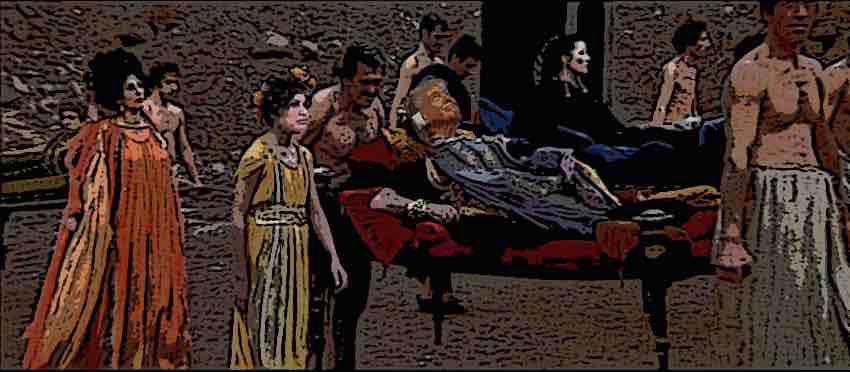
Not surprisingly, the literature of Nero’s Rome provides us with an ancient parallel to our current farcical state of affairs. Check out in your ample spare time The Satyricon by Petronius the Arbiter.[2] Here’s a still from Fellini’s cinematic treatment of Petronius’s classic, from the chapter known as “Trimalchio’s Dinner.”[3]

In his famous statement, “history repeats itself, first as tragedy, then as farce,” Marx was riffing on the Hegelian idea that history repeats patterns but in different ways, e.g., the French Revolution leading to Napoleon I (tragedy) and then to rise and fall of Napoleon III (farce).

Or, to draw a North American Parallel, the American Revolution is followed by the Civil War (tragedy) and then by the MAGA revolution (farce).

However, the thing is that when melodrama is exaggerated it becomes comic a la Reefer Madness, but when farce is overly exaggerated, it can become terrifying in a creepy clown sort of way.

I mean, imagine being trapped in an elevator with Don, Jr.’s fiancé Kimberly Guilfoyle! Imagine the future White House wedding. 

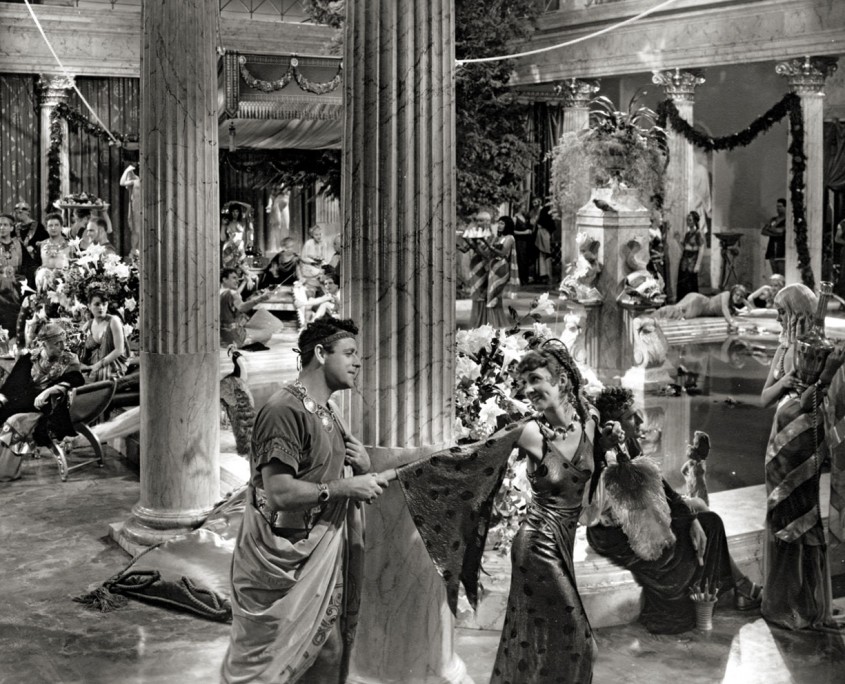
Bring in some pillars and Cecile B DeMille.


[1] from the poison keyboard of Jeff Tiedrich. 

[2] Which also provided TS Eliot with his epigraph for “The Waste Land.”

[3] More fun facts to know and share. Fitzgerald’s working title for The Great Gatsby was Trimalchio.

Random Thoughts from a Dry Brain in a Dry Season

Random Thoughts from a Dry Brain in a Dry Season

“Vacant shuttles/Weave the wind.”  – TS Eliot, “Gerontion”

One of the many positive aspects of retirement is that I am no longer bound by industrialization’s time clock. If I awaken at three a.m.– what Gerard Manley Hopkins called “the fell of dark, not day” – instead of trying to grunt myself back to sleep, I tiptoe out of the bedroom, fire up the ol’ iMac and play Spelling Bee, a word game on the NYT crossword page. To attain the designation of “Genius” takes me anywhere from five to forty minutes. Generally, I fall asleep again around four or so and reawaken around six. I sometimes take two naps a day, one in the morning and one in the afternoon.

A man of leisure at last.

In my previous life as an English teacher, I would spend those awakened hours brooding about my working life and/or what TS Eliot called “the immense panorama of futility and anarchy that is contemporary history.”

By the way, that most quotable of quotes comes from Eliot’s essay “Ulysses, Order, and Myth.” Here’s another far less quotable snippet from that same essay: “Mr. Aldington treated Mr. Joyce as a prophet of chaos; and wailed at the flood of Dadaism which his prescient eye saw bursting forth at the tap of the magician’s rod.”

You win some; you lose some.

Speaking of losing, I just received this very minute this message via What’s App:

Hi, I’m Ivana. Nice to meet you.

I am looking for the other half of my life, someone who can accompany me throughout my life.

I am 36 years old and single. I like polite men. If you are very similar to me, please leave me a WhatsApp message now. I believe we can be each other’s life partners.

We can share each other’s lives and understand each other better.

WTF, as the young people say. 

Then last Friday, at Chico Feo, Harlan, the bartender, told me that a young woman, an investigative reporter, wanted to interview me. I said, “Uh, okay,” so she, an attractive, twenty-something, sat on the stool next to me and asked if I were a writer. I had assumed she had known that, so I said yes, and she asked what I had written, so I told her about Today, Oh Boy,” a novel set in Summerville, South Carolina, which coincidentally is where she’s from. To cut to the chase, she’s doing an in depth investigation on the serial killer Richard Valenti, who murdered two teenaged girls on Folly Beach in 1973. I have a close friend who was also kidnapped by Valenti but who escaped along with two of her friends, which led to his arrest.

She asked if I minded being recorded, and I said no, so she pinned a mic on my lapel and started asking questions. She was impressively articulate, explained her interest in the case, and while we were talking, my wife Caroline arrived, so I invited her to join the conversation because Caroline is much smarter than I am. The reporter is also friends with one of the teens who escaped and is hesitant to ask her about it because “she might not want to reopen that door,” as she put it. Caroline jumped in and talked about how the patriarchy deals with women who have been sexually assaulted.  By the way, this was two days after Trump’s 83 million dollar fine.

So anyway, I got 99 problems but worrying about grading essays ain’t one of them.

You, T.S. Eliot

Ronald William Fordham Searle: Sick and Dying: Cholera, Tarso Camp, 15 September 1943, Two Months After Illness. Copyright: © IWM. Original Source: http://www.iwm.org.uk/collections/item/object/24373

Note: Words in bold provide passageways to complete texts alluded to in the poem, which was also influenced by the John Prine song “Hello, in There.” By clicking on the audio file at the very bottom of the post, you can listen to the song in its entirety. 

a reading of the poem

You, TS Eliot[1]

Thoughts of a dry brain in a dry season.

TS Eliot, “Gerontion

He died alone in a hospice house
Hallucinating for a day and a half,
Surrounded by a swirl of phantoms,
A misremembrance of things past.

His funeral, too, was poorly attended,
Empty pews here and there,
The eulogy, merely perfunctory.
No one shed a single tear.

Too long a life ¬– calamitous.
No fun being one-hundred-and-one,
Outliving every single peer,
His wife, his daughter, and his son.


[1] The title echoes Archibald MacLeish’s “You, Andrew Marvell,” a very different type of meditation on death. 

“Hello in There” John Prine

Roaring Twenties Redux

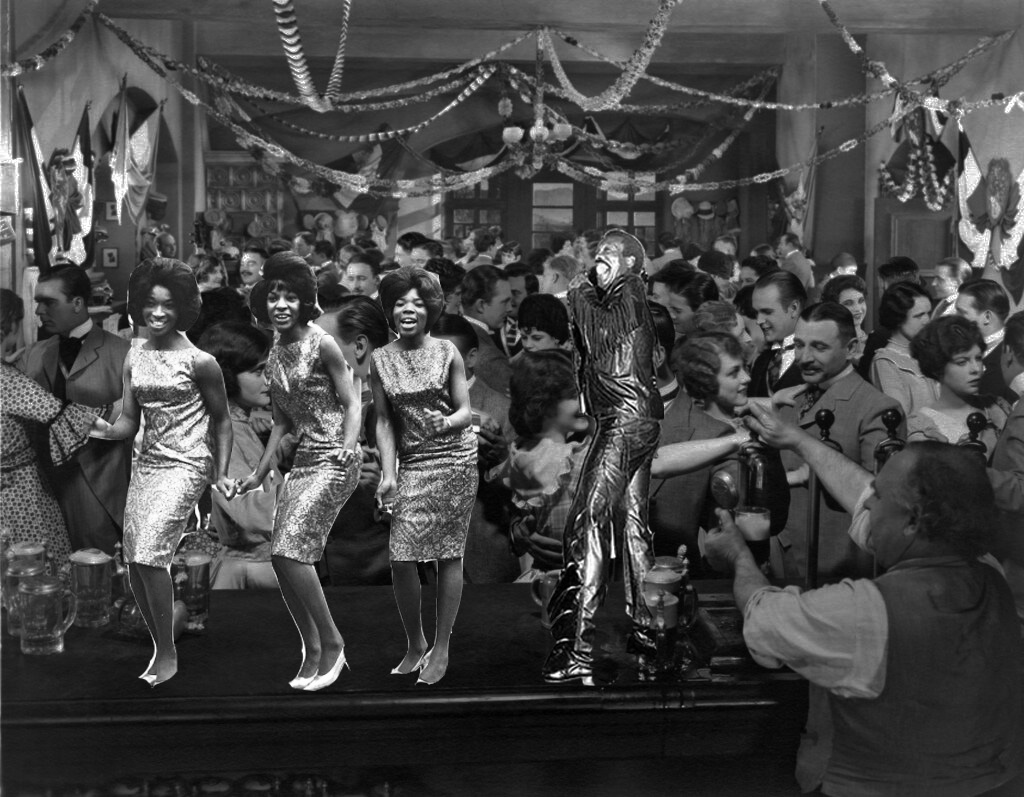
Photoshopped by I-and-I

Roaring Twenties Redux

O O O O that Shakespeherian Rag—

It’s so elegant

So intelligent

TS Eliot, “The Waste Land”

One-two-three, one-two-three, ow, uh, alright, uh!

Wilson Pickett, “Land of a Thousand Dances”

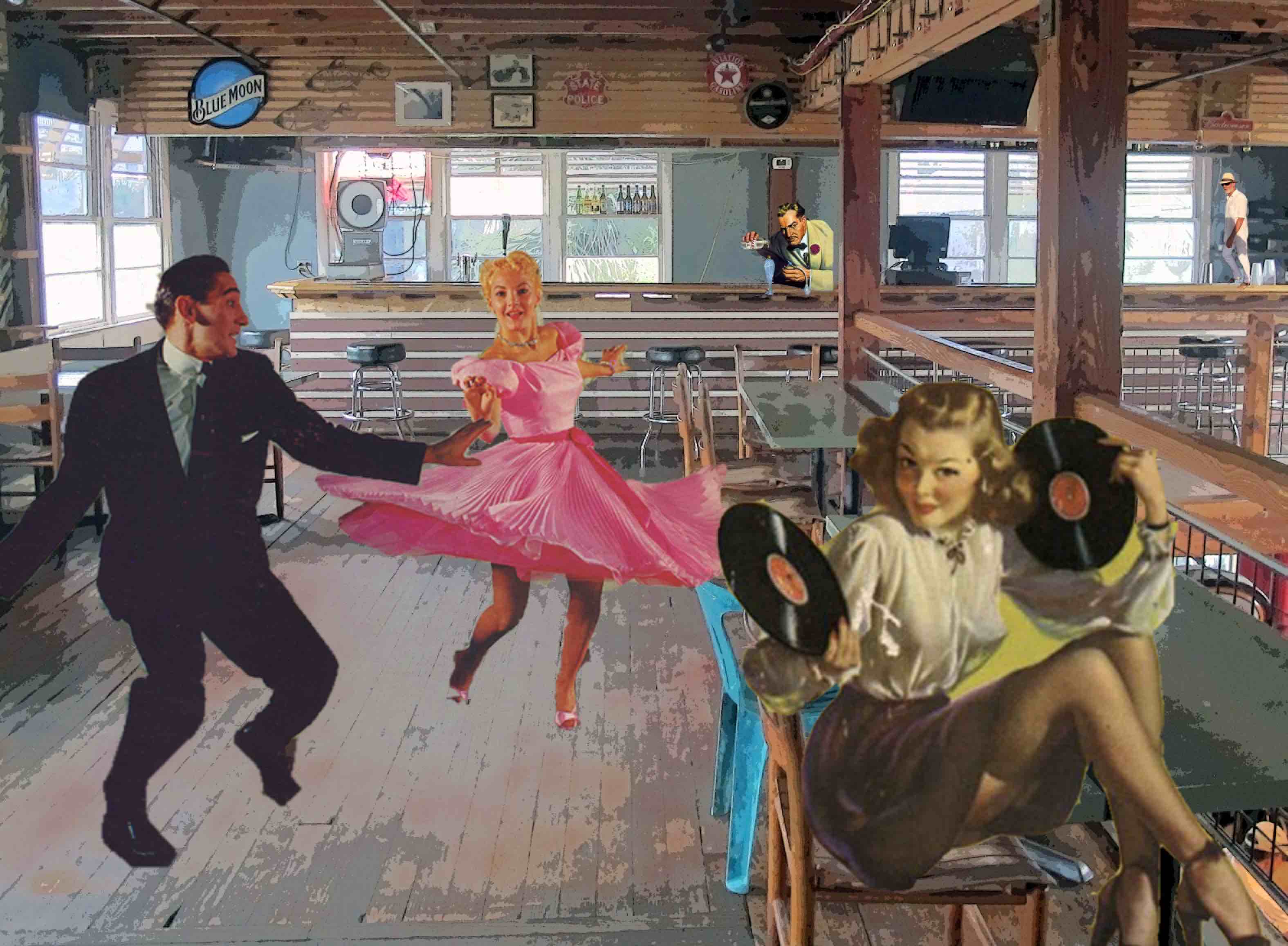
Once this pandemic is done, y’all, people gonna be hollering siss-boom-bah, packing the tattoo parlors, barbershops and bars, macro-dosing, doing the Hedonism like it’s wa-wa-tusi, dancing on tables, dancing in the streets, there’ll be swingin’ and swayin’ and records playin’, live bands blasting covers past curfew, PO-lice sirens wailing and blue lights swirling, sweatpants discarded, shimmering gowns flowin’, flasks flashin’ in the comet light of the apocalyptic party, alack and alas and all that jazz!

The Ravages That Time Had Wrought

The Wesley Moore at Yeats’s Tower 1979

What shall I do with this absurdity —
O heart, O troubled heart — this caricature,
Decrepit age that has been tied to me
As to a dog’s tail?
WB Yeats, “The Tower”

While Webster was much obsessed with death
And saw the skull beneath the skin,
Yeats was obsessed with the aging process,
The hollow cheek that drank the wind.

Fastened to a dying animal, his soul
Sought solace in a Martello tower
Where he climbed its winding stair
To compose swan songs in his waning hours.

Retrospective poems, autobiographical,
That rehashed old loves and battles fought.
Attempting to come to terms at last
With the ravages that time had wrought.

All the Disconnected Connected People

Do you know the TS Eliot poem “Preludes?”  It’s one of those early 20th century extended sighs where the sum of disjointed parts equals alienation. Walking through smoky London, we encounter a progression of fragmented images: “grimy scraps of withered leaves,” “broken blinds and chimney pots,” “faint stale smells of beer from the sawdust-trampled street.”  

At one point, Eliot writes

One thinks of all the hands

That are raising dingy shades

In a thousand furnished rooms

Oddly enough, Eliot’s lines came wafting up from the mental basement I had stashed them in as I was scrolling through my Twitter feed yesterday. 

Before I wax unkind, let me say that I find Twitter a useful tool in information gathering. On election nights, it’s invaluable, providing returns much faster and more eclectically than broadcast television. 

I follow mostly journalists and writers I admire, who hook me up (as we heroin addicts say) with links to The GuardianThe EconomistMother Jones, etc. 

And some of the personal stuff is cool. Yesterday, Emily Nussbaum and her husband Clive were drunk on Scotch wondering if they could pay people not to do podcasts.

On the other hand, some of the people I follow retweet “fellow resistors,” as they call themselves, seem needy as they plead for more followers (“I only need 650 more to hit 10K”) or whine about their lack of a birthday party during the quarantine or announce to the world that their parent or spouse or Pekinese has just died and that they are devastated.  What they want, I assume, is an astronomical number of hearts illuminating their posts, equating quantity with quality. What do you say to a stranger who’s grieving?  There’s, in fact, little you can say to a loved one. Hugs help, but I doubt that virtual hugs do much good. 

Still others cultivate a cult following, young cynical clever know-it-alls who consider not wearing a mask the equivalent of assault and battery, the flip side of those who consider wearing a mask an act of ovine cowardice. You rarely meet anyone in the middle who might wear a mask indoors but eschews one sitting on a park bench by himself. 

Anyway, it seems that many of these people spend the majority of their days and nights on Twitter, which to me conjures the lines above, though I should probably update them:

One thinks of all the thumbs

Keying internet messages

In ten-thousand domestic settings.


On the Utility of Memorizing Poetry

illustration by David Rowe from "Financial Review" website

illustration by David Rowe from “Financial Review” website

Each year, our English Department requires all students to memorize a poem of at least fourteen lines and recite it in front of their classes.

Students choose the poems they recite, so the first step in the process is for them to read poems in search of a ditty or two that strike their fancy. Obviously, it forces them to read poetry.  Of course, every year a student asks if he can recite song lyrics instead, and I say no.

I explain that very few song lyrics can stand alone on the naked page without musical accompaniment. I recite these lyrics from Dylan’s “To Ramona (which, of course, I’ve memorized):

From fixtures and forces and friends

Your sorrow does stem

That hype you and type you

Making you feel

That you gotta be exactly like them

I’d forever talk to you

But soon my words

Would turn into a meaningless ring

For deep in my heart

I know there is no help I can bring

Everything passes

Everything changes

Just do what you think you should do

And someday maybe

Who knows, baby

I’ll come and be cryin’ to you.

And then I recite these lines from Yeats, which, again I know “by heart.”

Now all the truth is out,

Be secret and take defeat

From any brazen throat,

For how can you compete,

Being honor bred, with one

Who were it proved he lies

Were neither shamed in his own

Nor in his neighbors’ eyes;

Bred to a harder thing

Than Triumph, turn away

And like a laughing string

Whereon mad fingers play

Amid a place of stone,

Be secret and exult,

Because of all things known

That is most difficult.

The difference is palpbable.


Of course, the question of why memorize comes up. What’s the purpose? You’ll just forget it anyway, etc. I explain that in times of despair that poetry can provide solace by articulating powerfully the human condition, which has remained essentially the same over the course of centuries.

Ben Jonson’s dead son is my brother-in-law’s dead son.

My sin was too much hope of thee, loved boy.

Seven years thou wert lent to me, and I thee pay,

Exacted by thy fate, on the just day.

Oh, could I lose all father now!

I tell them that possessing a storehouse of poetry in the record collection of their minds can also come in handy at cocktail parities. Why rely on your own feeble wit when you can conjure TS Eliot?

On November the 9th, one of my colleagues asked me what I thought, and I said,

“I think we are in rats’ alley

Where the dead men lost their bones.”

If he’d asked me how I felt, I would have said, “like ragwater, bitters, and blue ruin.”

Anyway, this year, I’ve decided to memorize a poem myself, and I have chosen Wallace Stevens’ “The Emperor of Ice Cream.”

Call the roller of big cigars,

The muscular one, and bid him whip

In kitchen cups concupiscent curds.

Let the wenches dawdle in such dress

As they are used to wear, and let the boys

Bring flowers in last month’s newspapers.

Let be be finale of seem.

The only emperor is the emperor of ice-cream.


Take from the dresser of deal,

Lacking the three glass knobs, that sheet

On which she embroidered fantails once

And spread it so as to cover her face.

If her horny feet protrude, they come

To show how cold she is, and dumb.

Let the lamp affix its beam.

The only emperor is the emperor of ice-cream.

What in the hell does that mean? Here’s one cool, jazzy take from Kenneth Lincoln:

So a wench is dead, stretched out cold at the ice cream party. The dresser deal “knobs” transpose to “horny” bunions, glass to skin calluses. No empty jar lies here, rounding the wild, but a woman’s body in its cool opaque skin, thickened from walking the earth. Her “horny feet” index a prosaic, if bewitching reality, bunioned and “dumb” as the “slovenly wilderness”: feet are the earthen root, nonetheless, the vulgate “base” of a poetic meter iambically shamanic. She embroidered “fantails” on her bedsheet, her tail-end art. Those curlicues may rover her face, if they cannot mask her feet, which grounded her in reality, finally in death. So, for a fourth and final call, “Let the lamp” of nature “affix its beam,” the sun its sundown flame, as the seeing eye celebrates an inner light in mortal darkness, a comeback optics of imagining sunrise reborn at sunset.

[snip]

With rhyming comic finality (come/dumb/beam/cream), the refrain rides on a boisterous iambic pentameter, “The only emperor is the emperor of ice-cream.” The fourteen syllables curdle in a spondee (as with the twelve-syllable, shaggy last line of “The Snow Man”). There’s a youthful break in the pace, a jump-rope skip completing the Falstaffian form. From bunioned foot to embroidered fantail, earthly base to fanciful end, this elegy resists loss by making art of what seems to be, seeing what is, delightfully. It is an act of the imagination at a wake; the final test, to return to childhood joy in “cream” made of “ice” (Carolina “aspic nipples” sweetened). A concupiscent summer is whipped up from winter’s absence, the snow man’s “nothing” curdled by sweet belief.

So, fast-forward to that future cocktail party where some jackass is plastering lipstick on some political or theological or philosophical pig.

Simply say, “Let be be the finale of seem/The only emperor is the emperor of ice cream.”

Chances are his rejoinder won’t be in “boisterous iambic pentameter.”

emperor-illustration