The Unlikely Story of How I Became an English Teacher

Sleep Walking on High by Pauline Lim

I left for college as a journalism major, but I quit before ever taking even one introductory journalism class.  All of the journalism professors I met at the freshman orientation were chain-smokers who seemed to have a mild case of the heebie-jeebies.  Also, you had to pass a typing test, and not only didn’t I know how to type, but I also possessed –– and still do –– the fine motor skills of a platypus.[1]

So I gave up on being a newspaper scribe, and without declaring a major, took whatever classes seemed interesting ––  German Expressionism in the Weimar Republic, Film Studies, Shakespeare’s comedies, etc.

Because I was dream-ridden, impractical and enjoyed reading, when forced in my junior year to choose a major, I opted for English without giving future employment a nanosecond’s consideration. No way did I ever envision myself as a future high or middle school teacher. I recalled my highschool days, not with nostalgia, but with a feeling of good riddance, like Japanese Californians might look back on their internment during WW2.

Yet somehow I ended up teaching highschool for 34 years, and how I got that job is not unlike that Popeye cartoon where Olive Oyl sleepwalks her way across crane-hoisted girders swaying several stories above sidewalks far below during the construction of a skyscraper. 

She’s unconscious but amazingly lucky as she blindly makes her way


[1] In fact, believe it or not, I’m still a hunter and pecker.

In 1977, I was engaged to be married but unemployed.  I had only taken one education course as an undergraduate, so teaching high or middle school was out of the question.  Not only that, but I had dropped out of graduate school after earning the requisite 30 hours.  

In late August or early September of that year, I ran across an ad in the Post and Courier seeking an adjunct instructor at Trident Technical College.  The ad directed the applicant contact the Dean of English, Ed Bush.

So the next day, I drove to the North Charleston campus seeking Dr. Bush, although I was supposed to apply at the central office, a detail that I had somehow overlooked.  After asking around, someone directed me to Dr. Bush’s office.  Obviously, I didn’t have an appointment, but there was a line outside his office, so I got in the queue and awaited my turn.  When I approached his desk, he asked what class I wanted to drop or add.  I informed him I was there to apply for the job advertised in the paper.  After asking a few questions –– did I have a Master’s –– “no but I have the hours.”

“But you do have experience teaching, right? 

 “Um, yes” (after all, I had occasionally presented papers to fellow grad students in classes). 

So he hired me on the spot without checking any of my credentials. After all, classes were about to begin, and they needed someone to teach English 102, Technical Report Writing, and Business Communications.

So at 24, I became a podunk adjunct professor who grew to really enjoy teaching, even continuing to teach at night when I had a full time job keeping books and training for management of a company that sold safety equipment. 

Professor Rusty

My wife Judy ended up also teaching at Trident as well, but full time, and she eventually became the head of the psychology department.  After being one of 12 writers selected to study under Blanche McCrary Boyd in a SC Arts Commission workshop, I quit my daytime job, wrote short fiction by day, and taught by night.[2]  

However, once we had our first child, Harrison Moore, Ruler of the Third Planet, Judy wanted to be a stay-at-home mom.  I took care of Harrison in the day, then drove him and handed him off to Judy before teaching my night classes.  It was the worst of both worlds, sort of like being two single parents living under the same roof.

In that first autumn of being a father, I received a call from the chair of Porter-Gaud’s English Department, George Whitaker.  Ed Bush, my former boss at Trident, had given George my name.  Some teacher had been fired mid-year, and Porter-Gaud needed someone ASAP.  I told him I couldn’t, given my child-rearing responsibilities, but that I would love to teach at Porter in the following year.

As it turned out, the fellow they hired midyear also had to be fired that spring.  In addition, an older teacher, Mr. Hubbard, was retiring, and George himself was leaving to pursue writing.

So I interviewed for the job, and despite my not stellar credentials, the new chair, Sue Chanson, the greatest high school English teacher I’ve ever known, hired me, because she later told me, Ed Bush had given me such a stellar recommendation.

So perhaps there is some truth in the old adage “It’s better to be lucky than good.”

Right Olive?


[2] Other writers selected included Josephine Humphreys, Billy Baldwin, Lee Robinson, Harland Greene, Steve Hoffius, Rebecca Parke, and Greg Williams, to name a few.

Time’s Winged Educational Chariot

tumblr_m5hcfaWVuu1qbyk5qo1_500This marks the fourth year of my teaching second-generation students – the sons and daughters of students I taught the in 1980’s.

It’s somewhat surreal – I was 32 when I stumbled into my first class of high school students, never having taught adolescents before. My teaching experience came from Trident Technical College, a community college that offers vocational training and some associate degree programs. There, many of my students were my age and older, some of them Viet Nam vets who certainly knew much more than I did about certain facts of life.

Classroom management was never a problem, except for that one night in a Developmental Studies class when a young blonde-haired man showed up drunk and red-eyed and started hitting on women in the back of the classroom. At the break, I mentioned to him he couldn’t come to class stoned, and he assured me that the red glazed look in his eyes came from welding all day. Nevertheless, he agreed to quit hitting on the woman.

No, classroom management wasn’t a problem at Tech; the problem there lay in that many students lacked basic academic skills, and I became a decent developmental studies teacher because I came up with some mechanical steps that students could follow in constructing sentences so that their writing wouldn’t mirror their speech.

If a student wrote, “My sister eat at her boyfriend house,” I’d have him find the verb.

“Who eat?” I’d ask.

“Sister.”

Then I’d have him plug in a pronoun for the subject. If the pronoun was “he,” “she,” or, “it,” the verb needed an “s”; if the pronoun was “they,” no “s.” Getting him to add an apostrophe “s” for the possessive was a more difficult task, but that was merely a 2-point error versus the 10-point subject/verb disagreement deduction. The final exam consisted of writing a 150-word paragraph with fewer than 30 points of grammatical or mechanical errors. If he passed, he could go on to enter the small engine repair or welding certificate program or take classes for an associate degree.

The vast majority of these students wanted to better themselves, many were receiving GI bill checks, so getting them to pay attention wasn’t a problem. Although the job wasn’t intellectually stimulating, it was rewarding. I felt as if the Dalai Lama would approve.

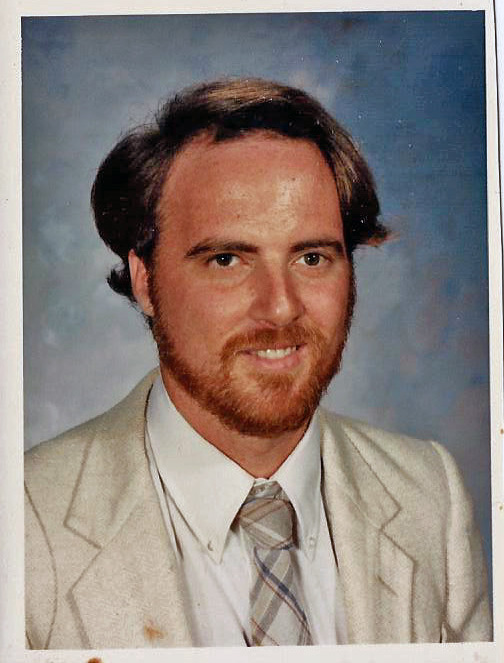
I-and-I in my 1985 annual photo

I-and-I in my 1985 annual photo

Fastforward to 1985, my first class of seniors at Porter-Gaud. I asked each on that first day to introduce herself and tell me a little about herself and discovered that among these young scholars sat a “cocaine dealer,” a “Soviet spy,” etc. Whenever one of them offered one of these puerile bits of misinformation, the class erupted in gales of laughter as if Robin Williams stood before them performing a monologue.

The good news is that I was able to rein them in fairly quickly with a couple of scathing, sarcastic counterpunches. No, my problem here was not a lack of academic ability but roiling hormones and the unsettling fact that many of these students were much more intelligent than I when it came to brain circuitry.

The good news is that I was profoundly hipper and knew my stuff when it came to literature and writing. By the end of the year, I hated to see them go.

Next year will mark the 30th year since they graduated from high school, and to me, as I tumble faster and faster down the Great Hour Glass’s avalanche, it seems as if just last month my mother was preparing to go to her 30th high school reunion!

So here I am at the same school teaching the second generation, who are taller and better behaved (but less worldly and mature) than their progenitors, and it’s really eerie how much they can look alike, virtual doppelgängers in some cases.

I do my best not to show them favoritism, but it’s hard.

And to be truthful, I’m feeling the tug of time, feel like Yeats that old age has been tied to me “as a dog’s tail.” I get the feeling that some of the students think of me as ancient, the way they once thought of Blackburn Hughes, a colleague who was the age I am now when I first started teaching, and that it might be easy to pull something on me, the old coot. Even a couple of colleagues occasionally make playful cracks about my age, facetiously asking if I would like to join the faculty track team to challenge the students.

I-and-I at graduation in 2014

I-and-I at graduation in 2014

The good news is that I’m still hipper than these 30-something whippersnappers (where were they when I saw Sonny Terry and Brownie McGhee perform in the bar where I worked, the Sonny Terry who played with Woody Guthrie on such songs as “Hard Traveling” “Bow Weevil Blues,” and “We Shall Be Free?) and I still know my lit and writing shit, so why not keep on another year or two despite the great demoralization of the bureaucratic technocracy that rules 21st century education, despite the irritating intrusion of a few arrogant fathers and snippy mothers, whom I certainly could teach a thing or two.

What shall I do with this absurdity—
O heart, O troubled heart—this caricature,
Decrepit age that has been tied to me
As to a dog’s tail?

Yeats, “The Tower”