AI Has Its Place But It Ain’t Above My Mantle

The other day on Facebook, every septuagenarian’s favorite social media platform, I posted this confession:

“I’ve just come to the terrible realization that I’m a professional dilettante!”

I meant the quip, of course, to be humorous given the oxymoronic pairing of professional, denoting lucrative compensation for someone who can claim to be an expert, and dilettante, which describes a poser, an amateur who dabbles in the arts.[1]

A few kind responders begged to differ, claiming that I was the real deal, which I appreciate, but don’t buy, especially when it comes to what I have come to call my “fake paintings,” which are essentially photocollages filtered to look like paintings and printed on canvases. Not that they’re not eye-catching in a good way. My friend the painter and filmmaker David Boatwright ­ — the antithesis of a dilletante — finds them amusing.[2] So even though I call them “fake,” I do think they qualify as “art,” but it’s amateur art. When in a groove, I can crank one out in a couple of hours.[3] David, on the other hand, toils over his canvases and murals for months, not ceasing until every last miniscule detail is right.

Which brings me to the central subject of these ramblings — AI generated illustrations. 

A while back a Facebook friend lamented that AI-generated “art” was going to put people like me out of business, but I begged to differ. “AI hasn’t listened to Tom Waits while smoking Thai sticks,” I responded. It can’t, by its very essence, be original. It ain’t got soul. 
Last night my wife Caroline and I were looking at my two latest canvases, and I said, “There’s no way AI could come up with either one of these.”

“Let’s do a little experiment and see what AI comes up with,” she said. 

So we did, prompting the software to create something similar. 

Before we begin the comparison, I’ll explain briefly how I go about making a fake painting. 

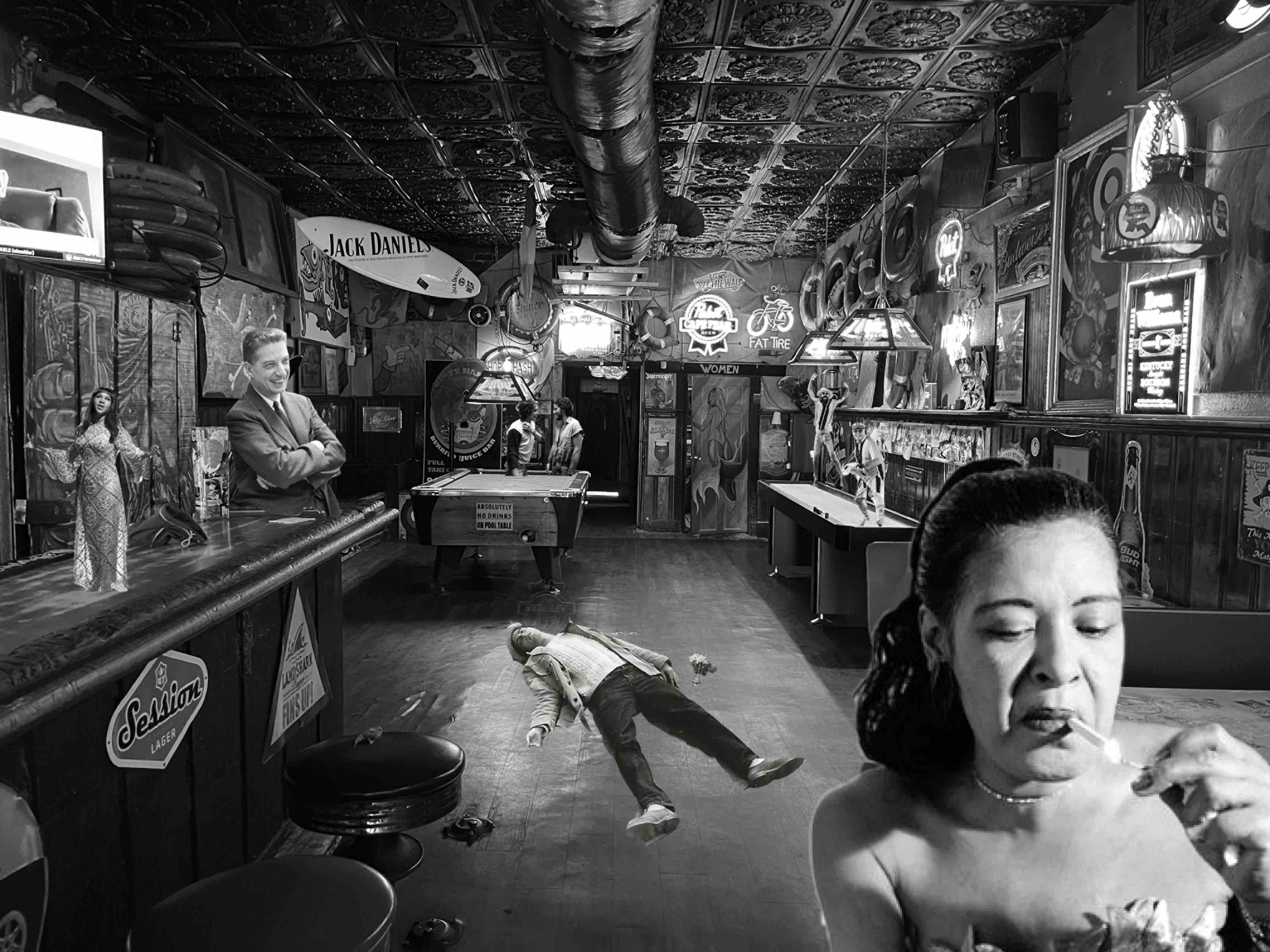
I start with a high resolution photograph. In my latest (see below) TGIF Chico Feo, I took a photo of the bar area when I was the only customer in the establishment. 

I upload the photograph to Photoshop and add an artistic filter, in this case, the “Dry Brush” filter.

Almost always, I have no preconceived notions about what I’m looking to create. In this case, I googled “pulp cover paperbacks bar scenes” and scored the couple kissing from a novel entitled Divorce. Of course, the man wasn’t leaning over a bar to kiss his lover, but I determined I might be able to cut the couple out and paste them into the photo, and, damn, it worked. Next, I found the woman sitting to the couple’s left and did likewise, and once again, I was successful.

I thought it might be amusing to have an organ grinder in the foreground, but I couldn’t find any illustrations that suited; however, I did find the begging monkey with the cup and tried him in various locations until I hit upon placing him on the bar, interrupting the passionate kiss. 

I decided to place a large figure in the foreground and went Screaming-Jay-Hawkins hunting. I experimented with various Hawkins iterations, but the vibe wasn’t right, and then the proverbial cartoon light bulb went off above my fedora. Louis Armstrong, Satchmo!

And boom![4]

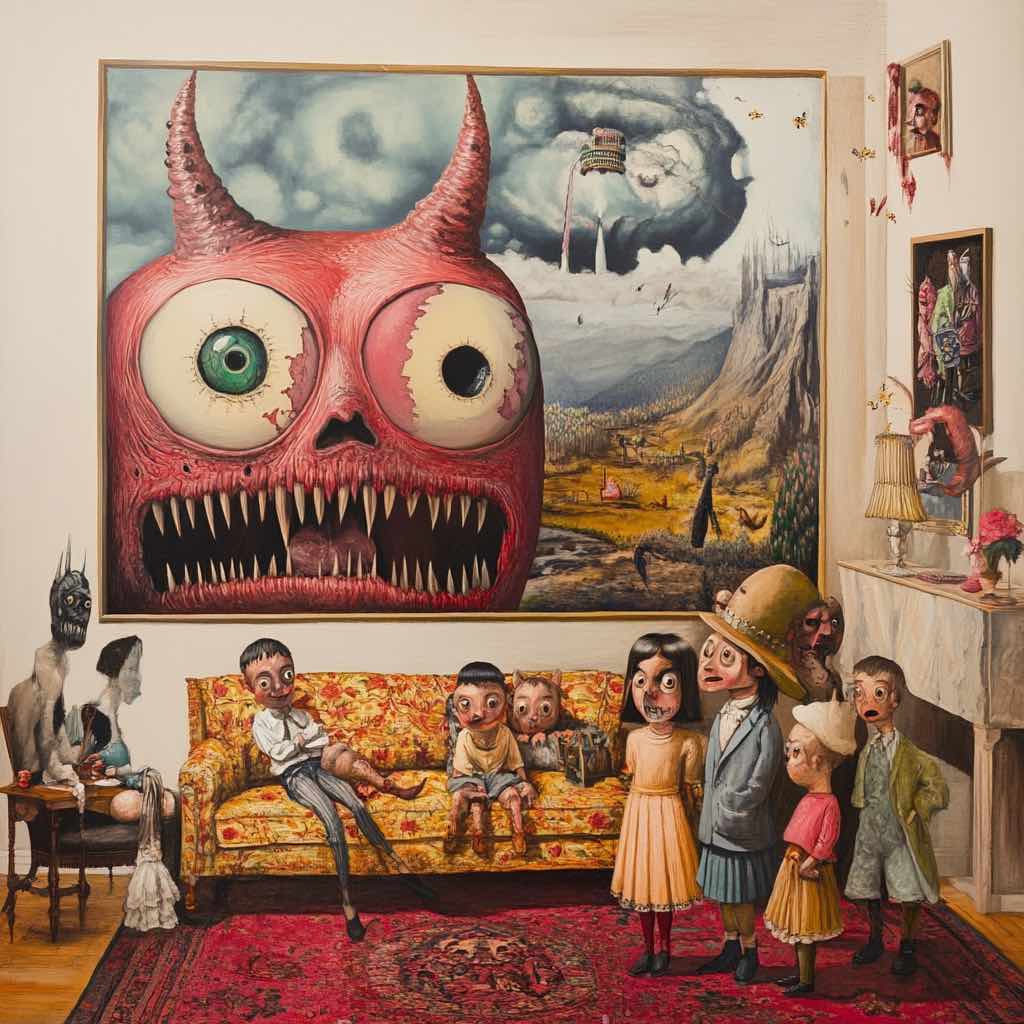
So here are my TGIF Chico Feo and AI’s response to the prompt “create a picture of Louis Armstrong playing at a beach bar.”

See what I mean.

One more example. 

Two of my favorite artists are Bruegel the Elder and Hironimus Bosch. 

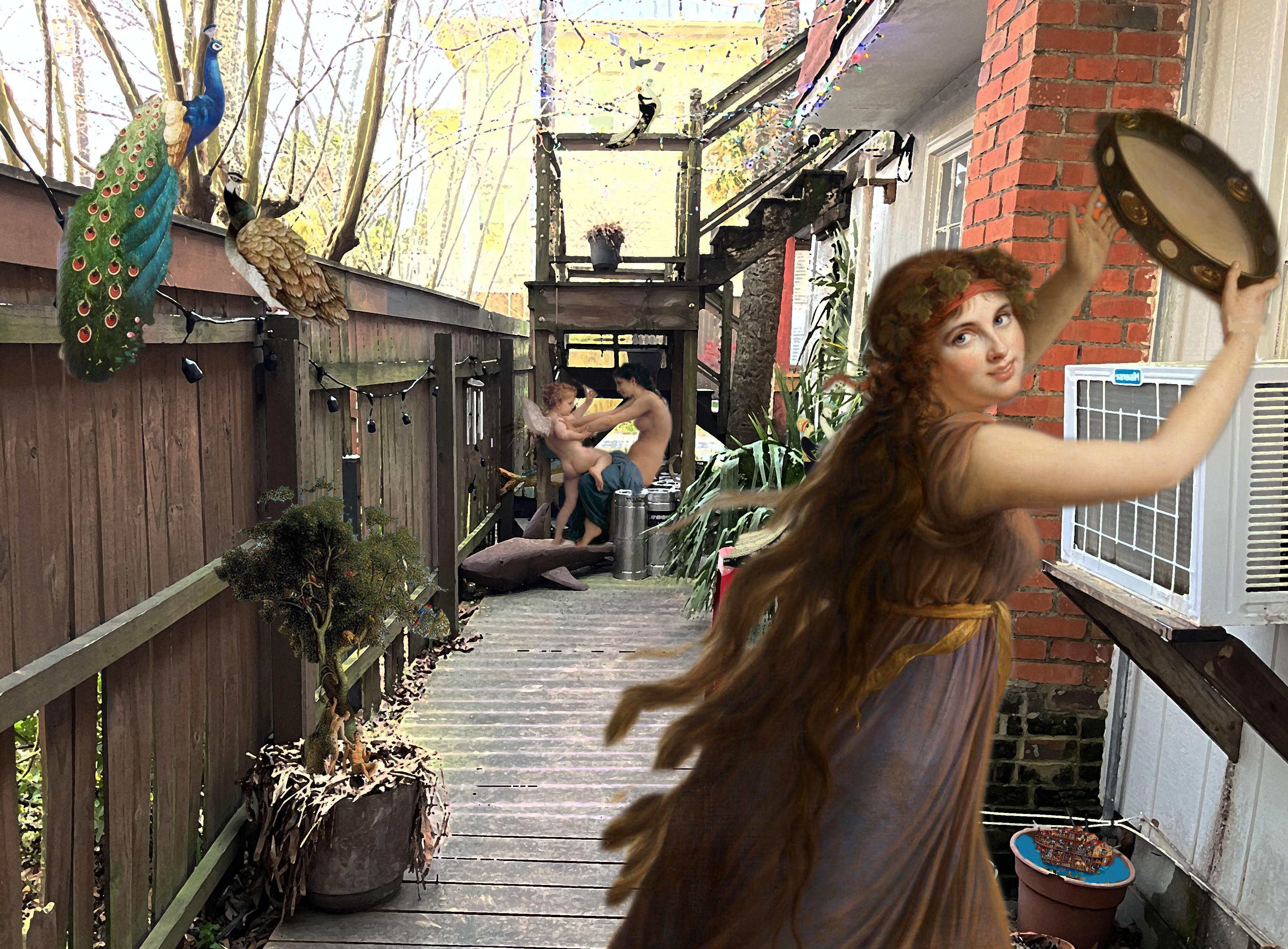
I took a photo of our living room, which struck me as sort of Flemish-looking so I peopled it with Bosch figures, being in a mocking post-election funk. 

Here’s the final product.
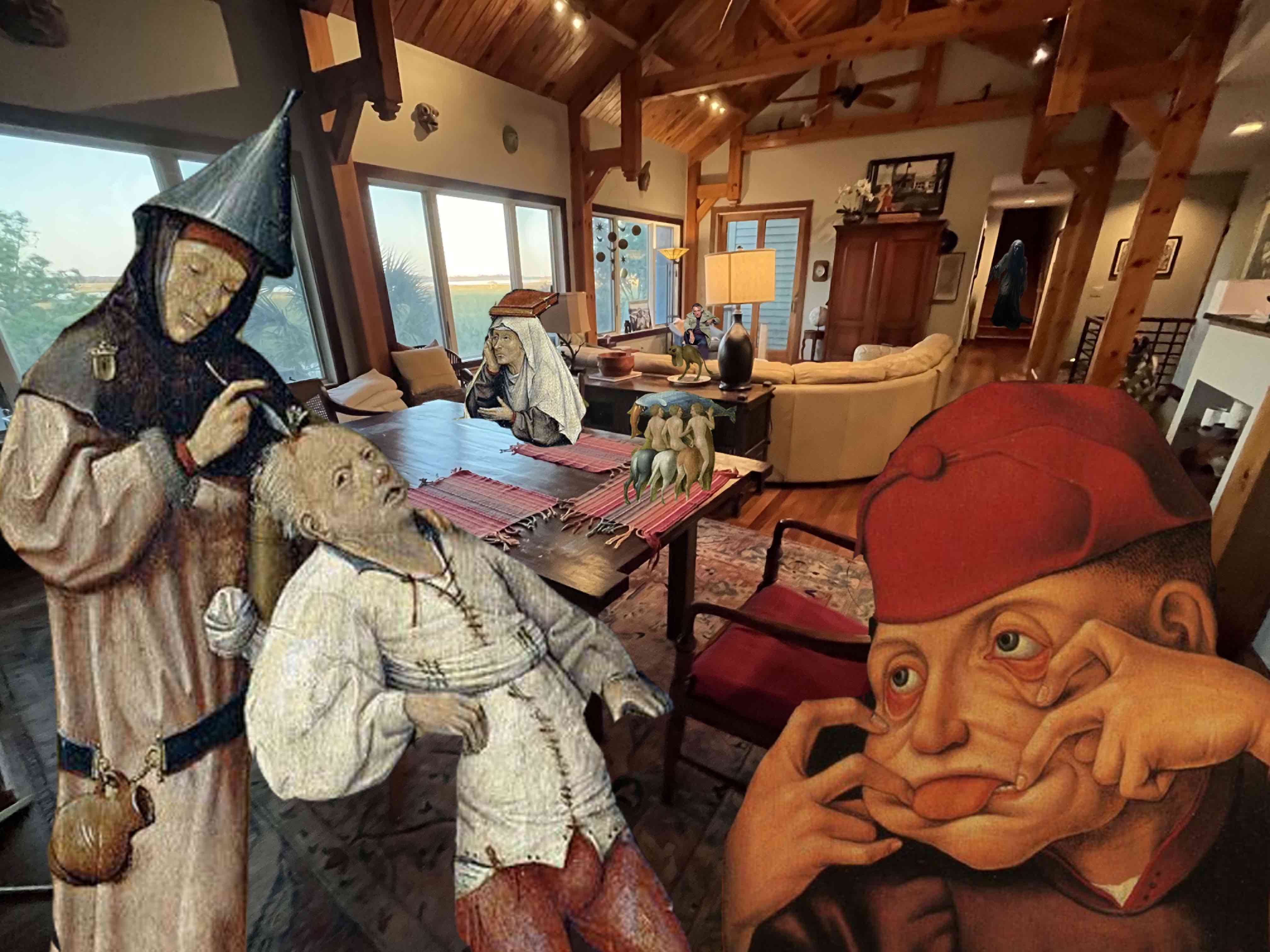
And here’s what AI came up with when prompted “Boschian style weird people and one Boschian monster in a regular modern beach house living room.”

Of course, AI is likely to put some illustrators out of business. In fact, because Caroline subscribes to AI software, I might ask her to provide me images to illustrate some of my blog posts. However, for book covers, I always prefer scruffy over slick. 
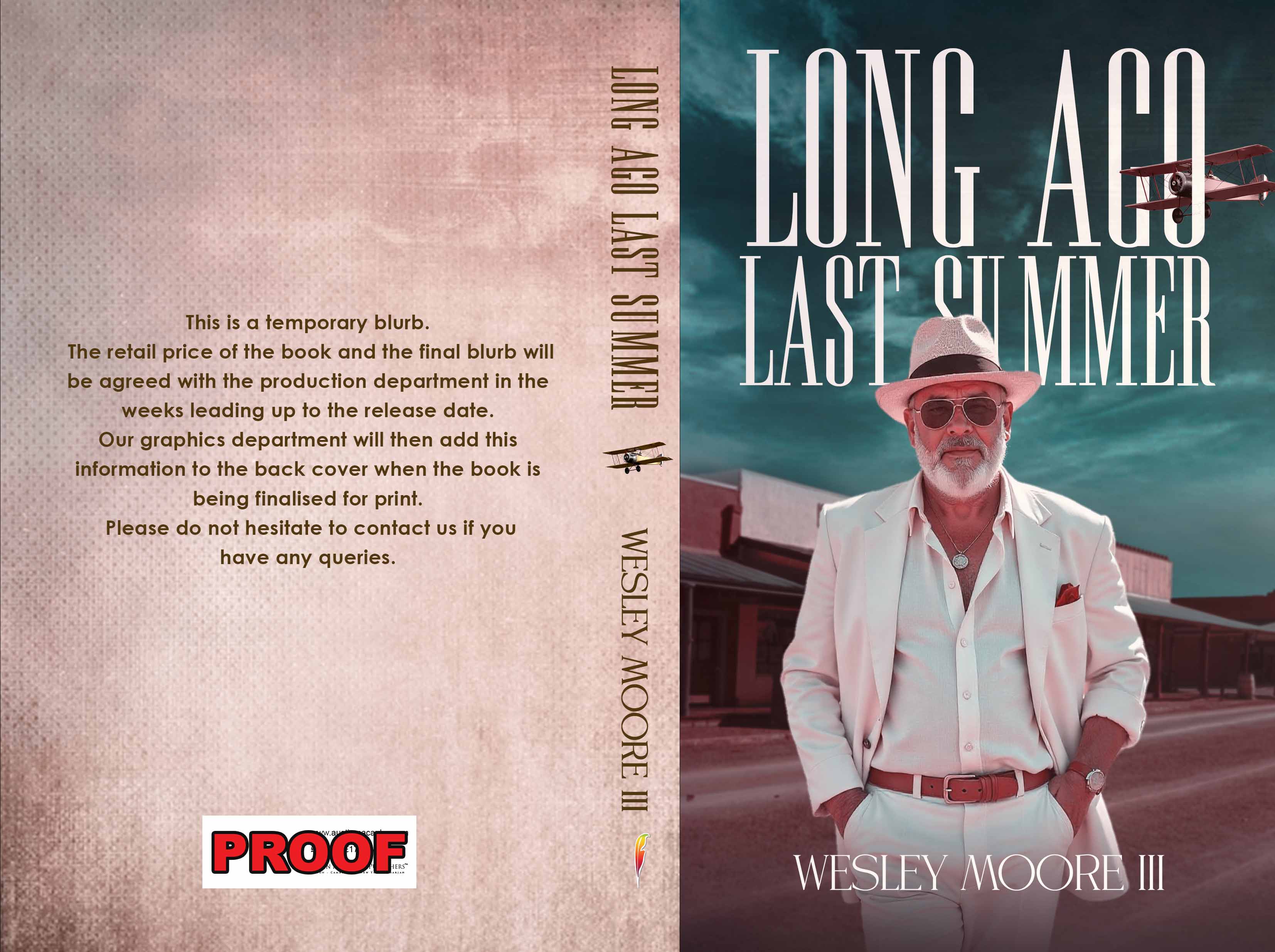
Which cover would you guess Caroline and I chose?


[1] The awkwardly phrased sentence this footnote references is proof in and of itself of my dilettantism. A professional, a true wordsmith, would devote time to express these ideas in a more cogent fashion, spending perhaps an hour or so insuring that every word was in its proper place and that the clauses melded in pleasant fluidity. but [cue Bob Dylan]. “[That] ain’t me, babe. 

[2] BTW, David has written a screenplay for a 15-minute film based on the poolroom chapter of my novel Today, Oh Boy and is just 50K short of having the funds to start production, so if you happen to be wealthy and want to be an art patron and contribute to making a really cool indie film, contact me, and I’ll forward your info to David. 

[3] I have had a one-man show at Studio Open and have sold a couple of dozen, two of which went for $500, so there’s that.

[4] I also Hitchcock like, try to make a cameo appearance in the “paintings.” In this case, it’s the cover photo of my next book Long Ago Last Summer. Can you find it?

Random Thoughts: Late Empire/Peggy Lee/ Bette Midler/ Tom Waits Edition

Today in Manhattan in a dingy 14th floor courthouse with inadequate heating, lawyers will present their opening arguments in Donald Trump’s first trial of 2024. He’s accused, of course, of falsifying business records to hide $130,000 paid to a porn actress so that the American people would not find out that he and she had engaged in adulterous sex during his first run for the presidency. 

Pundits speculate that the prosecution’s first witness will be David Pecker.

David Pecker was then the publisher of the National Enquirer. When I was a child, I used to peek at the Enquirer at the magazine rack at Kramer’s Pharmacy in segregated Summerville, South Carolina. Back then, it published photographs of splattered suicides who had leapt from high rise windows and other violent images. I confess I’ve always had a morbid imagination.

This dark memory has engaged in the jukebox of my subconscious Peggy Lee’s rendition of “Is That All There Is,” a sad, decadent tune that sounds as if originated in a cabaret in Berlin during the Weimer Republic. I suspect that Tom Waits loves this song. 

To exorcise the tune, I’ve gone to YouTube and discovered this wonderful video of Bette Midler covering the song.  Here it is.

And also dig this: Tom and Bette doing a duet in which virtually every line of the song is a cliche.

I’d call this a successful exorcism.

AI Don’t Scare Me (Yet)

Blind Girl Walking by Wesley Moore III

As my regular readers know, I entertain myself by creating what I facetiously call “fake paintings,” which others have described as “photo collages.”  I guess that’s more accurate, or at least more precise; however, when I think of a collage, I imagine a proliferation of cutouts that create sort of visual mosaic whereas my “pieces” attempt to blend the cutouts into a dramatic scene so that the viewer isn’t aware that images have been swiped from somewhere else and inserted into the “painting.”

Here are four examples in order of their compositions from oldest to latest.[1]:

I occasionally post some of these on Facebook, and recently someone commented that AI was going to put me out of business to which I replied, “AI ain’t never listened to a Tom Waits song or changed a flat tire. It ain’t know.”

Of course, AI has probably already put traditional illustrators out of business, but to me, the visuals all look alike, smacking of early Soviet propaganda.

The same goes for AI generated prose. I can identify it fairly easily because it reads like Strunk and White on steroids with all those active verbs “clambering” to “propel” well-varied clauses that are the equivalent of the Trump Kim poster above. 

It’s soulless.

Of course, AI is no doubt going to become more sophisticated, but I’d like to think it could never come up with this:

Well, it’s Ninth and Hennepin
All the doughnuts have names that sound like prostitutes
And the moon’s teeth marks are on the sky
Like a tarp thrown all over this
And the broken umbrellas like dead birds
And the steam comes out of the grill like the whole goddamn town’s ready to blow
And the bricks are all scarred with jailhouse tattoos
And everyone is behaving like dogs
And the horses are coming down Violin Road and Dutch is dead on his feet
And all the rooms they smell like diesel
And you take on the dreams of the ones who have slept here
And I’m lost in the window, and I hide in the stairway
And I hang in the curtain, and I sleep in your hat
And no one brings anything small into a bar around here
They all started out with bad directions
And the girl behind the counter has a tattooed tear
One for every year he’s away, she said
Such a crumbling beauty
Ah, there’s nothing wrong with her that a hundred dollars won’t fix
She has that razor sadness that only gets worse
With the clang and the thunder of the Southern Pacific going by
And the clock ticks out like a dripping faucet
Till you’re full of rag water and bitters and blue ruin
And you spill out over the side to anyone who will listen
And I’ve seen it all
I’ve seen it all through the yellow windows of the evening train


[1] These are printed on canvas so to the careless eye they appear to be “paintings.”

Andrew Hickey Explains Swing, Boogie Woogie, Backbeats, and All That Jazz

From left to right Aretha Franklin, John Hammond, Bob Dylan, Bruce Springsteen, Rusty Moore, Kip Vino, Erich Huber, Billie Holiday

Thanks to my pal Erich Hubner, the guitarist of the killer cover band Pleasure Chest, I’m getting schooled by the ridiculously erudite musicologist Andrew Hickey, whose podcast The History of Rock Music in 500 Songs traces the evolution of rock-n-roll from its earliest influences up until 1990. 

Sometimes the best things in life are free, if you have access to a computer, that is.

Recently, Erich and Pleasure Chest’s front man Kip Veno and I-and-I wandered uptown to Leon’s to slurp down some oysters, and Erich asked me if I were familiar with the Hickey’s podcast, and since I’ve only listened to one podcast ever, the answer was, um, no. Erich convinced me that I’d find it interesting, and man oh man was he ever right.

BTW, if you wanna see Pleasure Chest in action, click HERE.

I’m only two episodes in, but already I’ve learned so so much. I thought I was hip when it came to John Hammond minutia.  John Hammond, a scion of the Vanderbilt clan, went rogue, became a 20th century champion of civil rights and the most influential record producer in history.[1] He’s also the father of John Hammond, Jr, a bluesman whose cover album of Tom Waits tunes is to my mind a classic. Waits actually plays on the album. 

Oh where was I?  Oh yeah, here’s one thing I didn’t know about Hammond: he introduced Fletcher Henderson to Benny Goodman, Hammond’s brother-in-law, and Henderson integrated Goodman’s band, along with the great vibraphonist Lionel Hampton, who wittily observed that you needed both black and white keys to play a piano. The Goodman band was the first band to feature both black and white musicians, and Hammond was the catalyst. 

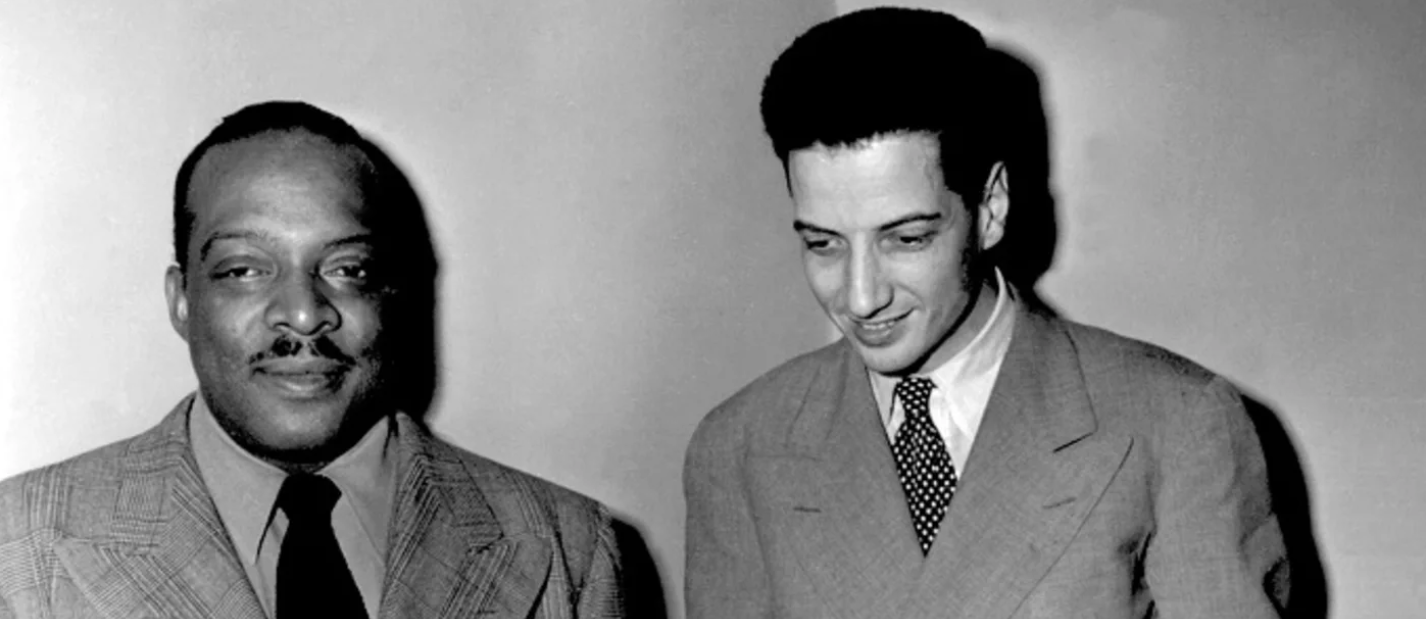
Count Basie and John Hammond

Henderson went on to lead his own big band that featured the likes of Louis Armstrong, Red Allen, and Coleman Hawkins. Excuse me for all this tangentification.[2]

Anyway, Andrew Hickey is not only encyclopedic in his knowledge of popular music, but he’s also a trained musician who can demonstrate sonically the differences among the big band’s swing beat, boogie woogie, and rock-n-roll’s backbeat. He does this with vocalizations along with clips from recordings.

He begins “Episode 1” by exploring early influences on rock, starting with Benny Goodman’s sextet that featured Charlie Christian, an early electric guitarist who way back in the 30s was playing proto rock-a-billy riffs, which Hinckley illustrates in the featured song of the episode “Flying Home.” Anyway, I’m nerding out on y’all, zigzagging all over the place. My main purpose here is to have you check out the podcast and Hickey.  If you’re into popular American music, it’s more than worth your while.

Here’s a link to his website: https://500songs.com

Andrew Hickey


[1] Here’s a partial catalogue of musicians he discovered and recorded: Bennie Goodman, Count Basie, Billie Holiday, Bessie Smith Aretha Franklin, Bob Dylan, Leonard Cohen, Bruce Springsteen, and Stevie Ray Vaughan.

[2]  Fedora tip to Dr. John.

Oh, Those Old Southern Barbershops of Yore

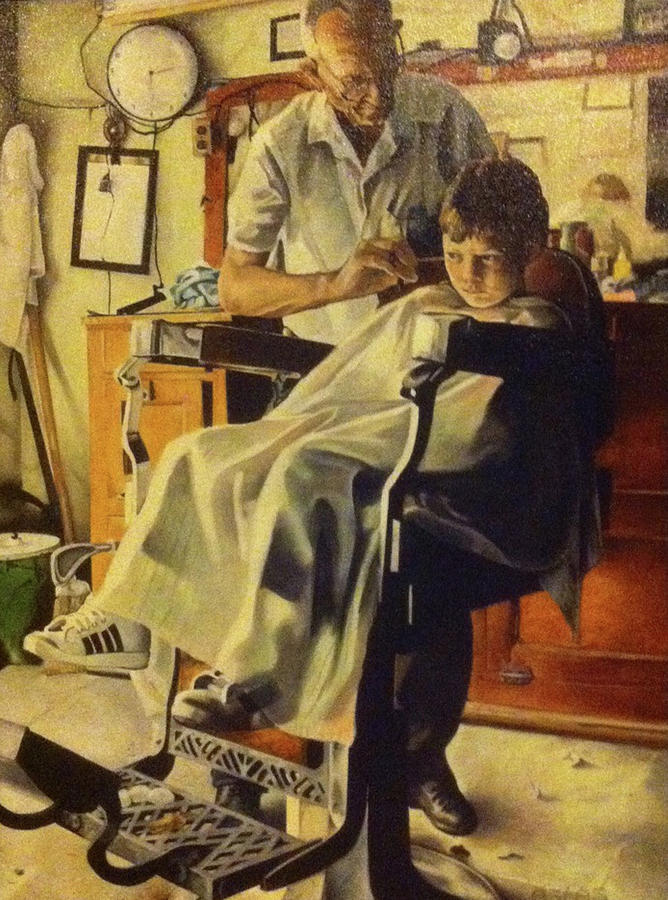
Barbershop by Joan Estes

One of my favorite Tom Waits songs is “Barber Shop” from the 1977 album Foreign Affairs. It’s a jazzy, Beat poet-like monologue propelled by stand-up bass and drums. The song condenses a cascade of rhyming cliches into an archetypical visit to a Mid-20th Century barbershop.[1]

He sets the scene with one ass-kicking couplet:

Bay rum lucky tiger butch wax cracker jacks

Shoeshine jawbreaker magazine racks.

Then he treats us to typical idle barbershop chatter:

Morning Mr. Ferguson, what’s the good word with you?

[snip][2]

You lost a little round the middle and you’re looking real good.

[snip]

What’s the low-down Mr. Brown? I heard your boy’s leaving town.

[snip]

Throw me over the sports page, Cincinnati looking good.

[snip]


The hair’s getting longer, you know the skirts are getting shorter,
And don’t you know that you can get a cheaper haircut
If you wanna cross the border.

If your mama saw you smoking, well, she’d kick your ass.
Now you put it out you juvenile and put it out fast.

Well, if I had a million dollars what would I do?
I’d probably be a barber not a bum like you.

Still got your paper route now that’s just fine.
And you can pay me double because you gypped me last ti
me.

In Summerville, South Carolina, my hometown, going to the barbershop was not one of my favorite activities, right up there with visiting the dentist. In pre-adolescence, we patronized Homer’s, which conformed almost perfectly to Waits’s depiction. My father took me in those days because he thought women didn’t belong in barbershops – the way men didn’t belong in “beauty parlors” – because their presence would curtail free expression, whether it be an off-color joke by the males or juicy lady gossip by the females. 

At Homer’s you could get a shoeshine and a shave. I remember watching the barbers sharpen their razors on strops after they’d lathered the reclining recipients with soft-bristled brushes. To me, it looked scary. 

Mr. Homer, as we called him, employed another barber, Ben, a robust, heavy-set Filipino proficient but not fluent in English. Whenever someone came in with flipflops, he’d bellow, “How ‘bout a shoeshine?” and then laugh loudly at his own joke.[3]

At barber colleges, they must have a course in how to engage in small talk. Truth be known, I’ve never enjoyed Q and A small talk from service providers, whether they be barbers, dental hygienists, or the Porter-Gaud dad who peppered me with questions while performing my vasectomy. 

Also, sometimes small talk can seem like lying. 

“Don’t you think Gone with the Wind is the greatest movie of all time?”

“Uh, maybe.”

Anyway, in adolescence, I ditched Homer’s for a barbershop I think was called Bryant’s, which was owned and operated by African Americans, though think they only cut White people’s hair. It was located a couple of doors down from. Dr. Melfi’s Pharmacy, my go-to source for Mad Magazines

Bryant’s didn’t conform at all to Waits’s Homer’s-like barbershop. It had a New Orleans vibe with ornate shrines set up to honor JFK and MLK, Jr. with other photographs of less famous civil rights icons along with Hubert Horatio Humphry campaign buttons. It also seemed not as glaringly well-lit as Homer’s. On the other hand, I don’t think they offered comic books or magazines to flip through while you waited.

The barbers at Bryant’s weren’t all that big on small talk either, which suited me just fine. I think the last time I had my hair cut there was in August right before my junior year of high school. After that, I started cultivating a “freak flag” do and would get slight trims from girls I knew, just enough snipped so I wouldn’t get thrown out of school. Hair couldn’t touch your collar, and sideburns could only come down halfway down your ear. I had a friend named Gray who actually wore a short-haired wig to school.

The last old-fashioned barbershop I patronized was Gloria’s on Center Street at Folly Beach not long after we moved there in the very late Nineties. Like my ol’ man, I took my boys to the shop to get their hair cut. Gloria’s cat had full range of the joint, and although it didn’t seem all that hygienic, it was picturesque, and she only charged me five bucks because I’m bald. A proud lesbian, her small talk wasn’t all that small.

Now, of course, the building has been converted into a tourist bar. 

Ah, no; the years, the years; 

Down their carved names the rain-drop ploughs.

On a brighter note, I’ll leave you with Waits’s song. Enjoy.


[1] In fact, when I taught the Beats in my American Lit class, I played the song for my students on a Porter-Gaud phonograph, a relic that nevertheless produced high quality sound, albeit not stereophonic.

[2] [snip] designates I’m omitting lines; though, I’ll confess, it’s an onomatopoetic play on the action of the song. 

[3] Interestingly enough, we children called him Ben, not Mr. Ben, the way we called our maids Lucille or Alice while they called us Mr. Rusty or Mr. David. 

The Rattle of Bones and Chuckle from Ear to Ear: A Tribute to Tom Waits

Editor’s Note: My old blog Late Empire Ruminations is coming down soon, so I’m curating pieces from there that are not so topical. This post comes from September 2010.

Independence is for the very few; it is a privilege for the strong. Nietzsche, Beyond Good and Evil (Trans. Walter Kaufmann)

The phrase that gives this blog its name – ragwater, bitters, and blue ruin – comes from the Tom Waits song “9th and Hennipen” where

All the doughnuts have names that sound like prostitutes

And the moon’s teeth marks are on the sky.

Tom Waits, the man, I think, could be Frederick Nietzsche’s poster boy for Beyond Good and Evil.  TW is a man who has created and recreated himself, always pushing into the future, ignoring the insect buzz of the masses to remain absolutely true to himself.  Although not quite [cue Dusty Springfield] the son of a preacher man (like Nietzsche himself, Jung, and Hesse), Waits is pretty damned close, the son of two California school teachers, who by profession had to preach the status quo, part of what Yeats dismissed as “the noisy set/Of bankers, schoolmasters, and clergyman/The martyrs call the world.”

This pigeonholing may be unfair to Waits’ parents who perhaps on the first day of school each year refused to hold their hands to their hearts and pledge alliance to the flag of the United States of America, but I kind of doubt it.  After his parents divorced, Waits lived with his mother in Richard Nixon’s hometown of Whittier, California.  Once he had a record contract in hand, TW moved to the Tropicana Motel in LA.  Living the nightmare you might say.

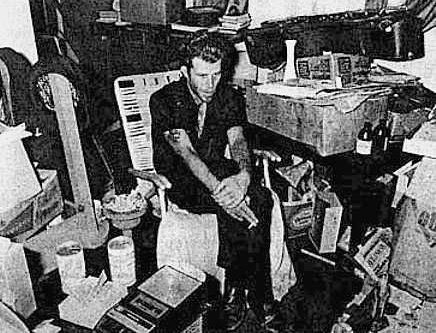
Waits Lounging in his room at the Tropicana c. 1976

More and more it seems to me that the philosopher, being of necessity a man of tomorrow, has always found himself, and had to find himself, in contradiction to his today: his enemy was always the ideal of today.” Nietzsche, Beyond Good and Evil

What went right here?  How did this middle class product come to eschew 1) the comforts and security of carpeted dens for seedy decadence 2) the prevalent hippie zeitgeist of the 60’s for the retro Beatnikism of Cassidy and Kerouac 3) rock-n-roll for jazz, later jazz for polka?  

Always restless, TW has never settled on one groove, no matter how lucrative.  Only perhaps the German language is equipped to produce a label for his music: Volktingedbluejazzindustrocabaretmusick.

In the course of the 38 years since TW signed his first recording contract, he has produced a body of high quality popular music that deserves inclusion in the pantheon that houses Bob Dylan, Cole Porter, and Johnny Mercer.  As the Wall Street Journal’s (the very mouthpiece of hipdom) pop critic Jim Fusilli raves: 

Interestingly enough, in later years, TW’s has shifted from the streets of New Orleans and piano jazz eastward to the cabarets of Weimar Berlin and accordion-laced rumbas.  Among the many influences on Waits’s body of work – Stephen Foster, Louis Armstrong, Hoagy Carmichael – stand Kurt Weill and Bertolt Brecht, late practitioners of German Expressionism, working their dark magic in the black shadows of Nietzsche’s colossal influence.  How appropriate that Wait’s first musical Frank’s Lost Years debuted at Chicago’s Steppenwolf Theater and that his collaboration with William S. Burrows, The Black Rider: The Casting of the Magic Bulletsopened in 1991 in Hamburg.  In his most recent incarnations, he seems German, a sort of Chaplinesque figure, part Kafka, part Brecht, a sort of skid row ubermensch who by heroically forsaking the comforts of mediocrity descended into an underworld of gothic grotesqueries and emerged triumphant, the master of his own fate, a hero armed with the secret knowledge of suffering.

She has that razor sadness that only gets worse

With the clang and the thunder of the Southern Pacific going by

And the clock ticks out like a dripping faucet

til you’re full of rag water and bitters and blue ruin

And you spill out over the side to anyone who will listen…

And I’ve seen it all, I’ve seen it all

Through the window of the evening train.

Cruel and Unusual Punishments

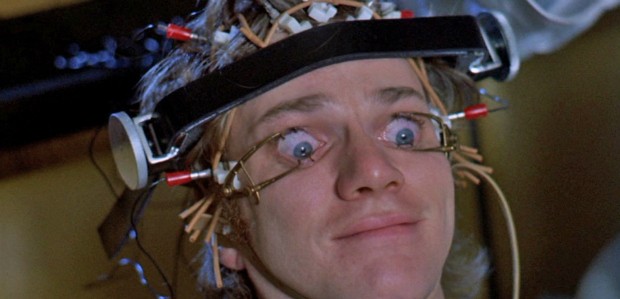
a-clockwork-orange-puremovies-620x299

[H]owever unlimited the power of the court may seem, it is far from being wholly arbitrary; but its discretion is regulated by law. For the bill of rights has particularly declared, that excessive fines ought not to be imposed, nor cruel and unusual punishments inflicted . . .

from the Eighth Amendment of the US Constitution

I have always loved the sound of the phrase “cruel and unusual punishment.” Sonically, you get all four of the basic metrical feet in four words, a trochee, an anapest, an iamb, and a dactyl, in that order. Plus the delicious elongation of the long U sounds of cruel and unusual, not mention the internal rhyme of “un” and “pun.”

Mr. Tom Waits, would you please indulge us with a recitation?


Something so horrid shouldn’t sound so enticing.

chair

To me, it’s amazing that some state approved punishments aren’t considered cruel and unusual. Take death by the electric chair, for example.


For execution by the electric chair, the person is usually shaved and strapped to a chair with belts that cross his chest, groin, legs, and arms. A metal skullcap-shaped electrode is attached to the scalp and forehead over a sponge moistened with saline. The sponge must not be too wet or the saline short-circuits the electric current, and not too dry, as it would then have a very high resistance. An additional electrode is moistened with conductive jelly (Electro-Creme) and attached to a portion of the prisoner’s leg that has been shaved to reduce resistance to electricity. The prisoner is then blindfolded. (Hillman, 1992 and Weisberg, 1991) After the execution team has withdrawn to the observation room, the warden signals the executioner, who pulls a handle to connect the power supply. A jolt of between 500 and 2000 volts, which lasts for about 30 seconds, is given. The current surges and is then turned off, at which time the body is seen to relax. The doctors wait a few seconds for the body to cool down and then check to see if the inmate’s heart is still beating. If it is, another jolt is applied. This process continues until the prisoner is dead.  (Wikipedia).

Here’s a link to a more thorough explanation via video.

Although only 9 of the 45 executed in the US in the last 15 years have gone to the electric chair, it is still used, and, therefore, not all that “unusual.” The rest of the state-sponsored offings were rendered via lethal injection, but now that drug companies are balking at providing lethal drugs, the good ol’ electric chair might make a comeback.

To me a truly cruel and unusual punishment would be something like this, not lethal, more like an “enhanced timeout.”

Let’s say some miscreant has mocked someone with a physical disability.

You strap him into an electric chair, inject him with an amphetamine, and force him to watch ten consecutive episodes of Little House on the Prairie.

I guarantee you he’ll never do it again. In fact, he might prefer the actual electric chair and its 2000 volts.

living-room-modern-brown-living-room-theater-wall-unit-with-tv-entertainment-center-set-in-modern-living-room-entertainment-centers


Just Can’t Cut That Juice a Loose: KILLER ROCK LYRICS ABOUT SUBSTANCE ABUSE!!!

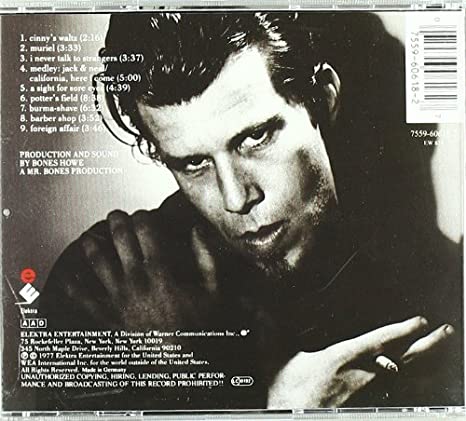
Foreign_Affairs_Tom_WaitsI-and-I, that’s right, Mr. Hoodoo Man he-self, boon companion and devoted supporter of Mr. John Jameson, lover of hoppy craft beer concoctions, not to mention spicy Sunday morning bloody marys, has voluntarily climbed aboard that proverbial wagon that refuses to stop at taverns, bodegas, juke joints, and roof top bars.

Or to put it more succinctly, he’s quit drinking alcohol.

Why, you ask? Has Mr. Moore been stumbling in at 3 a.m. and slapping around his beloved consort Judy Birdsong?

Of course not.

Has he found that drinking has adversely affected his social life?

To the contrary.

Okay, is he chronically late, a no-show sometimes? Does he hire barmates to grade his essays? Does he put himself in risky situations? Is he a frequent visitor to emergency rooms?   Has he gotten a DUI? Recently made a complete and utter ass out of himself?

No, no, no, no, no, and “not that he is aware of.”

Why then?

The answer is vanity. Recently, he saw photographs of himself at his son’s wedding and realized that his once David-Niven-like svelteness had ballooned into a girth approaching Hitchcockian proportions. And even though he now possesses a Falstaffian paunch, his arms and legs have maintained the emaciation of his 97-pound-weakling adolescence.

John Falstaff by Eduard Von Grutzner

John Falstaff by Eduard Von Grutzner

He’s too vain to post a photograph, but picture a four-month pregnant Mick Jagger and you get the picture.

Why not cut out those empty calories? Why not give it a try?

So how has he been spending those hours not spent in drinking establishments?

Listening to songs about substance abuse, that’s how, and he’s come up with a list a few killer song lyrics devoted to over-indulgence, like this classic from Willie Nelson:

The night life ain’t no good life, but it’s my life.

Not only that, he’s going to provide sound samples to go along with a few of his favs. So sit back and enjoy

THESE KILLER ROCK LYRICS ABOUT SUBSTANCE ABUSE!!!

(I know it lacks that Buzzfeed allure of botched plastic surgeries).

Okay, we’re going to start with John Hiatt’s “Paper Thin,” whose first sentence has the panache of the opening of a well-crafted short story. Listen.


Here’s how the song ends:


(Saw John about a year ago in concert.  Here’s the REVIEW).


Okay, for our next lyric on substance abuse, let’s go way back to my tenth grade year of 1968 and the Butterfield Blues Band’s “Drunk Again.”  The song’s by Elvin Bishop and features the domestic trauma drinking can cause.  Here’s a snippet:


Of course, as Bob Dylan famously tells us in “Just Like Tom Thumb’s Blues” — “I started off on burgundy but soon hit the harder stuff” — alcohol is the ultimate gateway drug.  I betcha ain’t nobody ever shot up heroin who hadn’t started out on the road to perdition with wine or beer. You start off seemingly innocuously with a PBR and the next thing you know your rolling up bills and snorting cocaine or worse.  Here’s John Hammond, Jr’s superb cover of the Tom Wait’s classic “Heart Attack and Vine”:


That’s right:

Boney’s high on china white;

Shorty’s found a punk

You know there ain’t no devil;

that’s just god when he’s drunk.

Well, this stuff will probably kill you;

let’s do another line.

What you say you meet me

down on Heart Attack and Vine.

Love can be a drug, they say.  Wasn’t Robert Palmer “addicted to love?”  Here’s the great Lucinda Williams making the analogy:


C’mon, Lucinda.  You know what Willie B Yeats sez:  “Never give all the heart for love . . .

Okay, let’s end this thing on a positive note.  The resurrection of Tim Finnegan via Irish whiskey.  Here, the Clancy Brothers describe how dead Tim’s corpse is brought back to life during a drunken brawl at his wake, which is the song that gave rise to James Joyce’s last novel.


:


Mickey Maloney ducked his head
when a bucket of whiskey flew at him
It missed, and falling on the bed,
the liquor scattered over Tim
Now the spirits new life gave the corpse, my joy!
Tim jumped like a Trojan from the bed
Cryin will ye walup each girl and boy,
t’underin’ Jaysus, do ye think I’m dead?”

Come to think of it, quitting drinking altogether seems anti-Buddhist.  Maybe the middle way would be better.  Lose weight by exercising, eating healthily, and limiting one’s intake to a couple a day?

Sounds like a plan.