Lines Stolen on a Gloomy Sabbath after Being Led Astray
Do you know the New York Times game Connections?
If not, in the game, you’re presented each morning with a square consisting of sixteen boxes, four up and four down. The object is to discover an affinity of four of the words/terms that appear in the boxes, in other words., to find a common thread. Essentially, if you correctly identify three groups, you win because the final four you didn’t choose, will form the last group.
Here’s today’s puzzle:
Frost Beach Pump Pope
Race Bishop Pet Shop Pound
Hardy Beat Prior Bake
Throb Bad Preheat Pastor
The first category that came to my mind was poets’ surnames.
(Robert) Frost
(Alexander) Pope
(Elizabeth) Bishop
(Ezra) Pound
(Thomas) Hardy
This seemed unfair because there are five obvious choices, but not to worry, poets weren’t a category, and I almost botched my 48-day streak, missing my first three guesses but somehow managed to get the blue category (the second to the hardest), then the green (the second easiest), and finally, the yellow, the easiest, third, which left the purples, the hardest, now a gimme.
So I decided in protest to construct a poem by lifting lines from the poets that appeared in the puzzle. Here it is:
Lines Stolen on a Gloomy Sabbath
Back out of all this now too much for us,
Down their carved names the rain drop ploughs.
One tear, like the bee’s sting, slips.
The paired butterflies are already yellow with August
And sport and flutter in the fields of air.
Sources:
Robert Frost, “Directive”
Thomas Hardy, “During Wind and Rain”
Elizabeth Bishop, “The Man Moth”
Ezra Pound, “The River Merchant’s Wife: A Letter”
Alexander Pope, “The Rape of the Lock, Canto 1”
So thank you, whoever, constructs Connections, for leading me astray.
Poverty is not all that terrible if you’re in college. After all, most students live in dormitories, and for my first two years of undergraduate school, the dorms I lived in were officially known as “The Tenements,” the oldest dorms on campus, picturesque but Spartan. And when I say Spartan, I mean tres austère – no air-conditioning in the summer; hand-searing radiators in the winter; merely two telephones in the hall, one for on campus communication, the other a pay phone you had to feed quarters during long distance calls. And perhaps the worst indignity of all, there were no stalls around the three toilets lined up in the flashback-inducing black-and-white diamond-tiled bathroom. Whenever nature called, the residents of Tenement 9 shielded themselves with open newspapers to create a modicum of privacy. No one, conversed, i.e., no one shot the shit while shitting.
OMG! TMI!
Even though I couldn’t afford it, I moved off-campus my junior year, and after a couple of nightmare rentals in the fall and winter of my senior year, my housemate Warren Moise, along with a host of other impoverished students, moved into the once genteel abode of 1830 Greene Street conveniently located on campus.[1] I’m fairly certain than none of us owned an automobile. SLED paid a visit our first week, and half the residents were carted off to jail for simple possession. Luckily, Warren, Jim, and I were off when police came a calling.
1830 Greene Street
Interestingly enough – and least for me – I had lunch with my Greene-Street housemate Warren Thursday and then encountered another Greene-Street housemate that afternoon when I was signing copies of my novel Today, Oh Boy in Summerville.[2] I hadn’t seen Jim Huff or his wife Jane in this century – in fact, not since the late 80s or early 90s. Jim had been lease-signer of 1830 Greene and therefore collected our $20 rent each month (there were eight of us) and utility money and money to buy kerosine for the enormous furnace that consumed fuel as rapidly as RJ McCarthy downed his 24-ounce cans of “the Bull,” aka Schlitz Malt Liquor. Every room except for the kitchen and the two bathrooms was utilized as a bedroom, including the living room and the conservatory where I slept, only assessable through Mr. McCarthy’s room.
Hail, affordable housing; farewell, privacy.
Jim Huff circa 1975
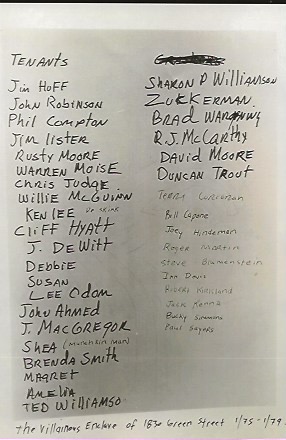
Here’s a list Jim compiled of the house’s residents, including girlfriends who spent multiple nights.
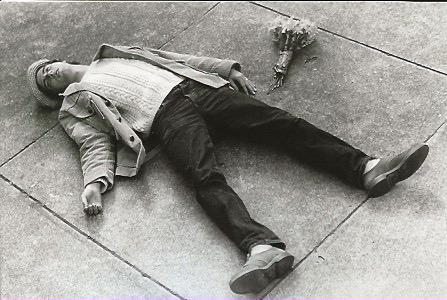
At the signing in Summerville, Jim gave me some photographs he had taken back in the day, which I so much appreciate. They demonstrate quite eloquently that whatever I may have gained in monetary wealth, I have equaled in girth, but lost in hair.
Anyway, it was great seeing Warren, Jim, and Jane, though I must admit that the photos have engendered a wee bit of melancholy.
[1] If you’re in the mood for some Night of the Hunternoir, click HERE and read about a couple of harrowing experiences we suffered before moving to Greene Street.
On a clear March afternoon in 1977 after we had decided to get married, I remember riding shotgun in Judy Birdsong’s gold-flecked Camaro headed over the Gervais Street Bridge in Columbia, South Carolina, and thinking to myself as I watched her hair fluttering in the open window wind, “Oh no, in twenty-five years she very well may be dead.”[1]
A fairly morbid thought for a twenty-four-year-old, but it runs in the family.
And, um, duh, every organism, whether it be goldfish, hamster, kitty cat, or puppy dog– not to mention house plants and patches of Saint Augustine – is doomed to die. Healthy people repress the thought or look forward to an afterlife or rationalize that there could be no genetic diversity without death or like Wallace Stevens hail death “the mother of beauty.”
Not Thomas Hardy. For him, death is ever-present, lurking in even the most pleasant of settings. Here’s a poem he wrote shortly after his first wife Emma’s death.
During Wind and Rain
They sing their dearest songs—
He, she, all of them—yea,
Treble and tenor and bass,
And one to play;
With the candles mooning each face. . . .
Ah, no; the years O!
How the sick leaves reel down in throngs!
They clear the creeping moss—
Elders and juniors—aye,
Making the pathways neat
And the garden gay;
And they build a shady seat. . . .
Ah, no; the years, the years,
See, the white storm-birds wing across.
They are blithely breakfasting all—
Men and maidens—yea,
Under the summer tree,
With a glimpse of the bay,
While pet fowl come to the knee. . . .
Ah, no; the years O!
And the rotten rose is ript from the wall.
They change to a high new house,
He, she, all of them—aye,
Clocks and carpets and chairs
On the lawn all day,
And brightest things that are theirs. . . .
Ah, no; the years, the years;
Down their carved names the rain-drop ploughs.
These lives aren’t “solitary, nasty, brutish and short” but rather pleasant. In fact, the first five lines of each stanza are positive, describe harmonious family gatherings. However, each stanza ends in a refrain that foreshadows what Andrew Marvel called “deserts of vast eternity.”
The critic John Foy describes the poem’s structure as “double-looking,” pointing “to both life and oblivion.”
“This rhetorical pattern, replicated in all four stanzas, contains two thematic perspectives, where the first five lines point one way and the last two point another. It acknowledges Hardy’s understanding of the terrible duality inherent in the nature of things. We are here for a while, and then we are gone. In his stanza, the heedlessness and the impending dissolution don’t cancel each other out. They exist together in tragic equipoise, five lines to life, two lines to dissolution, bound together by the structure”.
John Foy, “Form as Moral Content in Thomas Hardy’s ‘During Wind and Rain’”
To love a poem doesn’t mean you have to embrace the poem’s theme. For example, although I’m not a Christian, I’d haul Paradise Lost with me to the proverbial desert island (or on a spacecraft headed to Mars). Despite that sudden morbid thought in 1977, I haven’t spent my life brooding over its inevitable end. In fact, I’m fine with oblivion, didn’t mind at all my pre-existence, yet I really love Hardy’s poem, especially its last line, the music of it, the three accented final words and the image of a raindrop like a tear running down a name carved in stone.
And, as it turned out, Hardy remarried a woman named Florence Dugdale who wrote to a friend, “Perhaps you have read, if you have the English papers, that I am now the proud and very happy wife of the greatest living English writer – Thomas Hardy. Although he is much older than myself it is a genuine love match – on my part, at least, for I suppose I ought not to speak for him. At any rate I know I have for a husband one of the kindest, most humane men in the world.”
A happy ending of sorts for Hardy, a rarity in his works.
[1] Actually, it was 40 years later that she died.
The novel opens with a mini mystery– Philip Marlowe and Colonel Kurtz speculate on the owner of an alligator wallet left in their office by an unknown visitor. Wowing Kurtz with his extraordinary common sense, Marlowe opens the wallet and looks at the drivers license to discover that the wallet belongs to DH Lawrence, which provides a convenient entree into the history of British pornography.
Entering the office and opening a laptop, Lawrence plays for Marlowe and Kurtz an 18 1/2 minute porno film that features an unknown actor portraying Richard Nixon. Playing the role of Rosemary Woods in the film is the tragically beautiful porn star Tess Baskervilles, who mysteriously disappeared without a trace four years ago.
Lawrence maintains the film was shot within the last year because the director has carelessly left on the bedside table an anachronistic copy of Hillary Clinton’s recently published memoir Hard Choices. Slowing down and stopping the action, Lawrence zooms in to Tess’s right ear, which because of a childhood dog attack, has a jagged lobe. “See, it is she,” he stiltedly says. Oddly enough, throughout the film the only stitch of clothing the actress wears in one red Chuck Taylor Converse All-Star hightop.
Agreeing to take the case, Marlowe and Kurtz quickly discover that Charles G Koch and David H Koch, the billionaire Republican political operatives, were the producers of the film and the screenplay was written by Peggy Noonan, the first Bush’s head speechwriter, the author of the famous “ten-thousand points of light” slogan and the less famous line “Oh, Dickie, lick me,” from the Nixon/Woods porno vehicle starring Baskervilles and the mystery actor portraying Nixon.
Once in Washington, DC, where the film was shot, Kurtz discovers a state of emergency as someone has released scores of filthy pigeons in Battery Kemble Park. Kurtz meets potential suspects of the release in the park, two aides of Senator Ted Cruz, and decapitates them, placing their heads on stakes to demonstrate that he is “beyond their petty, lying morality.”
A series of mysteries transpire in rapid fire succession. Condoleezza Rice is seen skulking around the grounds of 3067 Whitehaven St NW, the home of Bill and Hillary Clinton; Kurtz spies a lonely figure keeping watch on the Clinton mansion; and after being threatened with blackmail by Marlowe, Robert Koch reveals that the porn film was directed by David Mamet.
Doing his best to unravel these threads of the mystery, Kurtz dispatches a camera drone to discover the lonely figure is none other than Marlowe himself.
Marlowe has discovered through his observations a mysterious woman being secreted in and out of the Clinton’s house, whom he suspects is none other than Lady Gaga, nee Tess Baskervilles. The Kochs, Cruzes, Mamets, and Noonans have only been pawns in the Clintons’ machinations — both Bill and Hillary have been Tess’s lovers, and unknown to the right-wingers, it was Slick Willie himself disguised by his eerily accurate Nixon make-up who played Rosemary Woods’s lover in the 18 1/2 minute porno film.
In a dramatic final scene, Kurtz and Watson use the Obama’s dog Sunny to track down Tess/Gaga using the scent of the sister shoe of the red Converse sneaker worn in the film.
Despite state-of-the-art burglar alarms and secret service agents, Marlowe and Kurtz gain entrance into the Clintons’ house where they discover Tess Baskerville/Gaga in bed with Condoleezza Rice.
They snap photos and threaten to sell them to the tabloids unless Condoleezza apologizes for her role in the Iraq debacle, which she hesitantly does by admitting “mistakes were made.” They then confront the Clintons who are upstairs scrutinizing poll data. Bill and Hillary brush off the two detectives maintaining the whole fiasco was a vast rightwing conspiracy and rattle off the names Koch, Mamet, Cruz, Noonan to prove their point.
Back in LA, Marlowe ties up a few loose ends with DH Lawrence while Kurtz writes a high-strung novelization of the porno film, an account that throbs with eloquence.
fin
If you enjoyed this write-up, be on the lookout for the next exciting product from Mash-up Lit, The Hound of the D’Urbervilles.







 You Do Hoodoo