Nothing Orange Can Stay

Although spring offers rebirth, for example, dollar weeds resurrecting, azaleas ablaze, etc., it also has its downsides.

Nature’s first green is gold,

Her hardest hue to hold.

Her early leaf’s a flower;

But only so an hour.

Then leaf subsides to leaf.

So Eden sank to grief,

So dawn goes down to day.

Nothing gold can stay.

                                                Robert Frost “Nothing Gold Can Stay”

OMG! My life is slipping through my fingers! Nothing good ever lasts for long!

April is the cruelest month, breeding

Lilacs out of the dead land, mixing

Memory and desire, stirring

Dull roots with spring rain.

                                                Thomas Sterns Eliot “The Waste Land”

Same ol’ same ol’, death and resurrection, death and resurrection, death and resurrection . . . 
Here on Folly Beach, springtime attracts sybarites of all stripes, like those 25 cent beer nights in the 1900s, those days of yore. 

Today at Lowlife, on my side of the bar, a crew of northern males in their early sixties sported expensive haircuts, retro bowling-like shirts, and satiric lanyards celebrating impending inebriation. Maybe it was a college alum get-together. Who knows?  I asked one of them what was up, but he was not forthcoming. 

Meanwhile, inside the restaurant, across the bar from where I sat, a bushel of bachelorettes were doing something similar in the team party department, dressing alike, engaging in one last bacchanalia before the sacred vows.

Hubba hubba hubba, shish boom bah! “Do you?” “I do.” “I now pronounce you.”

Elsewhere (all over the world, in fact) more serious folks were amassing to protest the hare-brained economic and geopolitical executive orders of a leader who always wins golf tournaments held on courses he owns. 

Here’s the White House’s official announcement: “The President won his second round matchup of the Senior Club Championship today in Jupiter, FL, and advances to the Championship Round tomorrow,” 

To quote Bob Dylan, 

I couldn’t help but feel ashamed

to live in a land

where justice is just a game.

But here’s the good news (and the bad news). Trump and his cabinet are too slapdash careless to topple our democracy. Their idiotic unprovoked trade war is sure to produce a blue tsunami in the midterms next year.

Pity the poor Nancy Maces who’ll have to choose between getting primaried a year from now or continuing to vote for destruction.

Trump’s insanity will lead to failure. People will pretend they didn’t vote for him. 

So don’t despair. Nothing orange can stay. Spring leads to summer, summer autumn, fall winter.

Around and around we go, and where we end up is in the rat’s alley where the dead men lost their bones. so I say, to quote the late great Warren Zevon, “Enjoy every sandwich.”
Jasper Johns, Owen Lee, and I-and-I

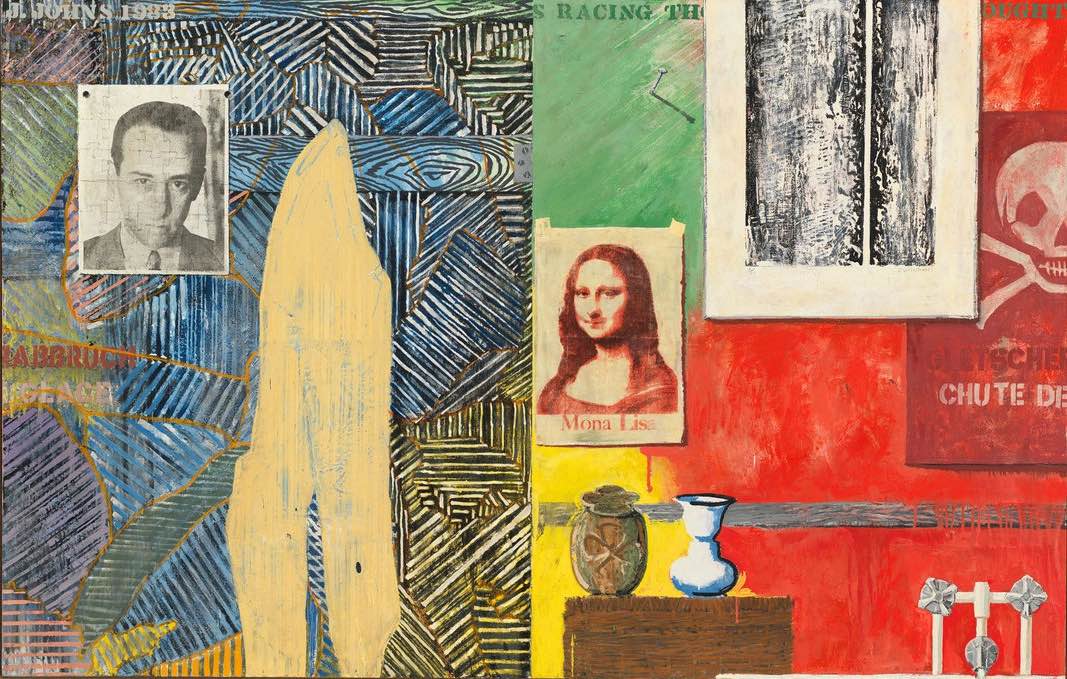
Racing Thoughts by Jasper Johns, 1983

Jasper Johns’ half-sister, Owen Lee, and I were acquaintances, not quite friends, in the very late 70s or very early 80s. We both taught Developmental Studies English[1] at Trident Technical College in North Charleston, South Carolina. Between classes, we’d yuk it up and trade cynical witticisms like a couple of podunk Dorothy Parkers and HL Menckens.  

One night after classes, she invited me to join her at the Garden and Gun, a gay bar that had recently opened to cater to the Spoleto crowd. Weeks earlier, she had dropped her famous semi-sibling’s name, but the sad truth is all I knew of Johns’ work were the targets and flags, and in keeping with my late-twenties ignorance, I was not overly impressed. [2]Anyway, Owen invited me to her place for a nightcap and showed me some original Johns works hanging in her apartment. After the drink, I headed home to Limehouse Street.

Fastforward thirty-five years. The week of my son Harrison’s marriage in DC, the Hirshhorn was staging an exhibition of Johns’ work, so we hopped the Metro to check it out. Now, I was duly impressed. Of course, we saw the iconic flags, targets, and maps, but also large arresting canvases with strings and flatware and shadows, works that I found emotionally moving.

However, it wasn’t until last week until I really came to appreciate Johns more fully after taking in his current exhibition (October 2021 through February 2022) at the Whitney. Thanks to my brand-new hearing aids paired with my iPhone, a website dedicated to the exhibition guided me through eleven gallery rooms. Chief curator Scott Rothkopf and others talked about the paintings and sculptures. John Cage read Jasper’s words excerpted from a documentary. He said early in his career he attempted to create impersonal works but that ultimately “was a losing battle.”[3] Nevertheless, he remains reticent about his art because he believes that the viewer must bring his or her own life experiences into the mix.

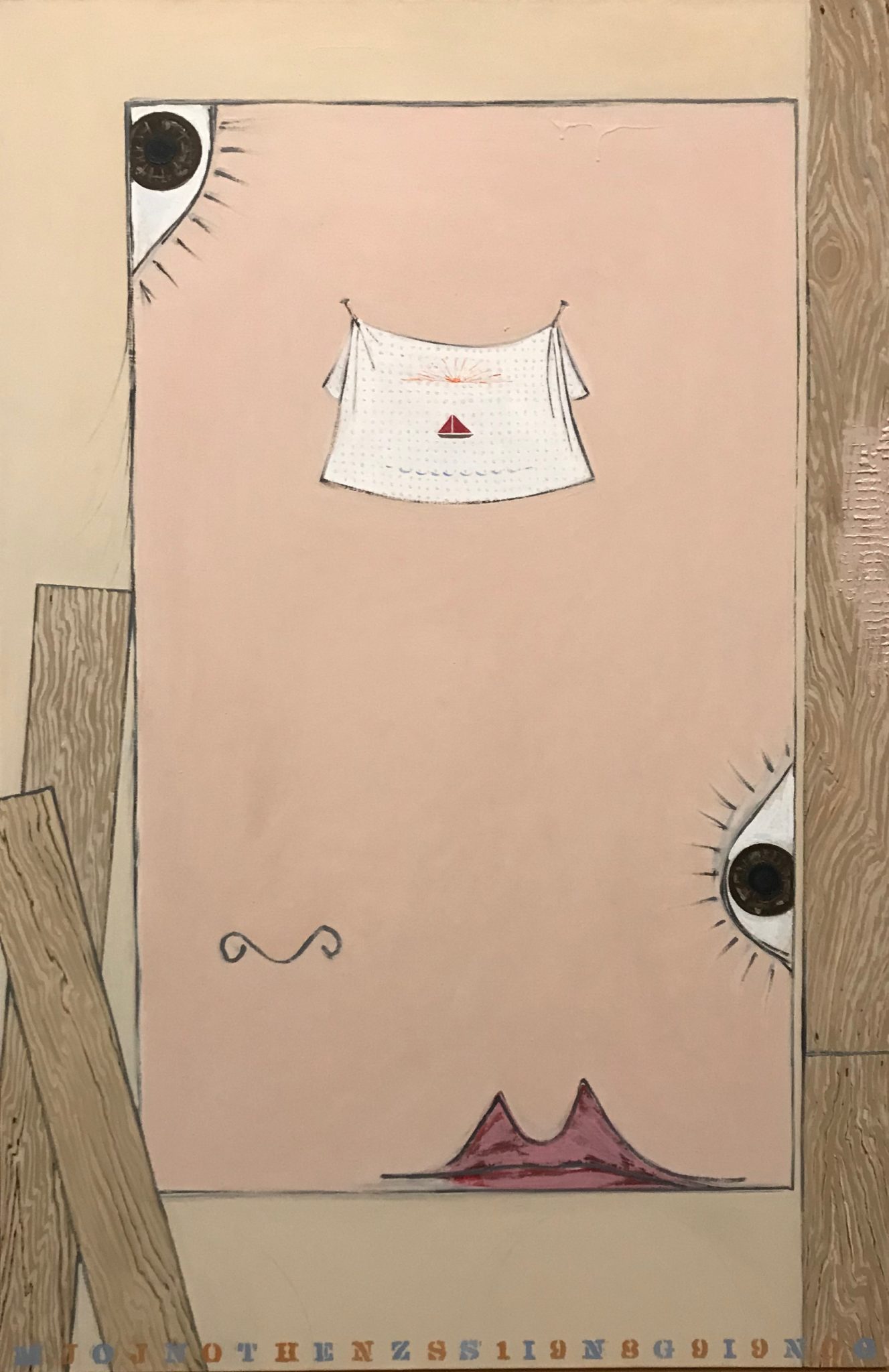
The thematic division entitled South Carolina particularly interested me. Johns, like Truman Capote, spent much of his childhood being shuttled off to various aunts and cousins. How disorienting it must be to be passed around without a permanent home. Here’s a painting based on his childhood called Montez Singing.

Montez was Johns’ step grandmother, and the song she sings is entitled “Red Sails.” The web-based tour guide notes the red ship and offers interpretations on the Picasso-like cubist body parts.

Another of my favorites is “Spring” where we encounter Johns’ shadow and the rigid arm that appears in many of his paintings. Also note the child’s shadow, below the adult’s shadow. How remarkable to produce such stunning objective correlatives to your vaporous memories.

The Seasons (Spring) 1987 Jasper Johns born 1930 Presented by the American Fund for the Tate Gallery, courtesy of Judy and Kenneth Dayton 2004 http://www.tate.org.uk/art/work/P12997

Owen Lee ended up moving away after a stint in Edisto.[4]  Around the turn of the century, out of nowhere, I received a message on my voice mail on my landline. She had moved back in Charleston to a downtown apartment and suggested we get together, which never came about. I did see her one last time at our friend Ted Phillips’ funeral. We sat together in a back pew, and because she had walked to the service, I gave her a ride to her apartment when it was over. She poured me a scotch and reminisced about a period when she worked for Jasper and Andy Warhol. This apartment had originals as well, and I worried a bit because Owen repeated stories, lost her way in conversation a couple of times, and explained these lapses by claiming that she had received a blow to the head as a child. 

She was still a lovely person, fascinating to listen to, despite having entered an early stage of dementia. 

Here’s a link to her obituary: Owen Riley Lee.


[1] Known as “remedial English” in a previous, less sensitive era.

[2] I wouldn’t go so far as call myself a philistine. For example, unlike the babysitter in Flannery O’Connor’s “The River,” I wouldn’t say, “I wouldn’t have paid for that,” [the babysitter] said, nodding at the painting, “I would have drew it myself.” 

[3] Actually, it was John Cage reading Johns’ words.

[4] The voice on the guided tour pronounces it ed-DEES-toe