Pee Wee’s Here, Pee Wee’s There, Pee Wee’s Everywhere, Pee Wee’s Dead, But Be Aware

Probably my favorite and most oft-repeated personal anecdote is my half-hour ride to Folly Beach chauffeured by none other than that legendary folk hero and serial killing cut-up Donald “Pee Wee Gaskins,” nee Donald Parrot, AKA Junior Parrot.[1]

In fact, the Kirkus review of my memoir Long Ago Last Summer highlights the Pee Wee incident:

One of the standout pieces involves the author hitchhiking to Folly Beach as a teenager—he and his brother survived an encounter with someone who was likely the serial killer Donald “Pee Wee” Gaskins. Even though the hitchhiking story is only four pages long, it fits a lot of frightening intrigue into a short space; the reader not only learns who Gaskins was, but gets to see the monster in action, doing things like casually burning a boy with a cigarette. [2]

Of course, during that harrowing hitch-hiking experience, Pee Wee didn’t formally introduce himself or the beer-swilling, cigarette smoking ten-year-olds accompanying him, but twenty years later when I read his autobiography Final Truth, I put two-and-two together when he mentioned that he’d take nephews on beach excursions to Folly.

By the way, the memoir also boasts an original poem entitled “Pee Wee Gaskins Stopping at a Lake House on a Summer Evening.”  Because of its macabre content and abject vulgarity, I dare not post it here in its entirety, but I will share its first stanza:

Whose corpse this is I ought to know

Cause I’m the one what killed it so.

I hope no one comes by here

To watch me in the lake it throw.

So you can imagine how delighted I was last week to receive unsolicited through the mail a pre-publication copy of Dick Harpootlian’s upcoming book Dig Me a Grave: The Inside Story of the Serial Killer Who Seduced the South.

I’ve not quite finished it, but when I do, I’ll post a review here. For now, I’ll just say it’s a real page turner written in noirish prose as Harpootlian, who prosecuted Pee Wee, weaves the narrative of Pee Wee’s life with his own.  Exposure to cold blooded killers transforms Harpootlian from an underground newspaper publisher[3] into a prosecutor of murderers and from an anti-capital punishment advocate into a diehard (forgive the pun) proponent.

And as luck would have it, just last night I was privileged to hear my pal David Boatwright and his band Minimum Wage perform David’s song “Pee Wee Gaskins” at art reception at Redux Contemporary Art Center where Buff Ross is showing some of David’s murals that have lost their original homes in Charleston’s real estate shuffles.

The murals are so great.  My favorite is a street scene in which Fredick Douglas is operating a Trolly Car that runs from White Point to the Neck.

Cool ass art is displayed throughout the building, which is located at 1054 King Street.

It’s not every day you see an ad for a James Brown inflatable sex machine sex toy.

Anyway, here’s a snippet of Minimum Wage performing “Pee Wee”Gaskins.”  The iPhone video doesn’t do it justice.


[1] He’s also the namesake of an Indonesian punk rock band. 

[2] It’s floundering at number 1,125,593 on the Amazon Best Sellers list, so why don’t you do a senior citizen on a fixed income a favor and order yourself one.

[3] The Osceola, which I read as an undergrad at USC
A Hit from Elvis Costello’s Radio Soul! Tour

photo credit Wesley Moore

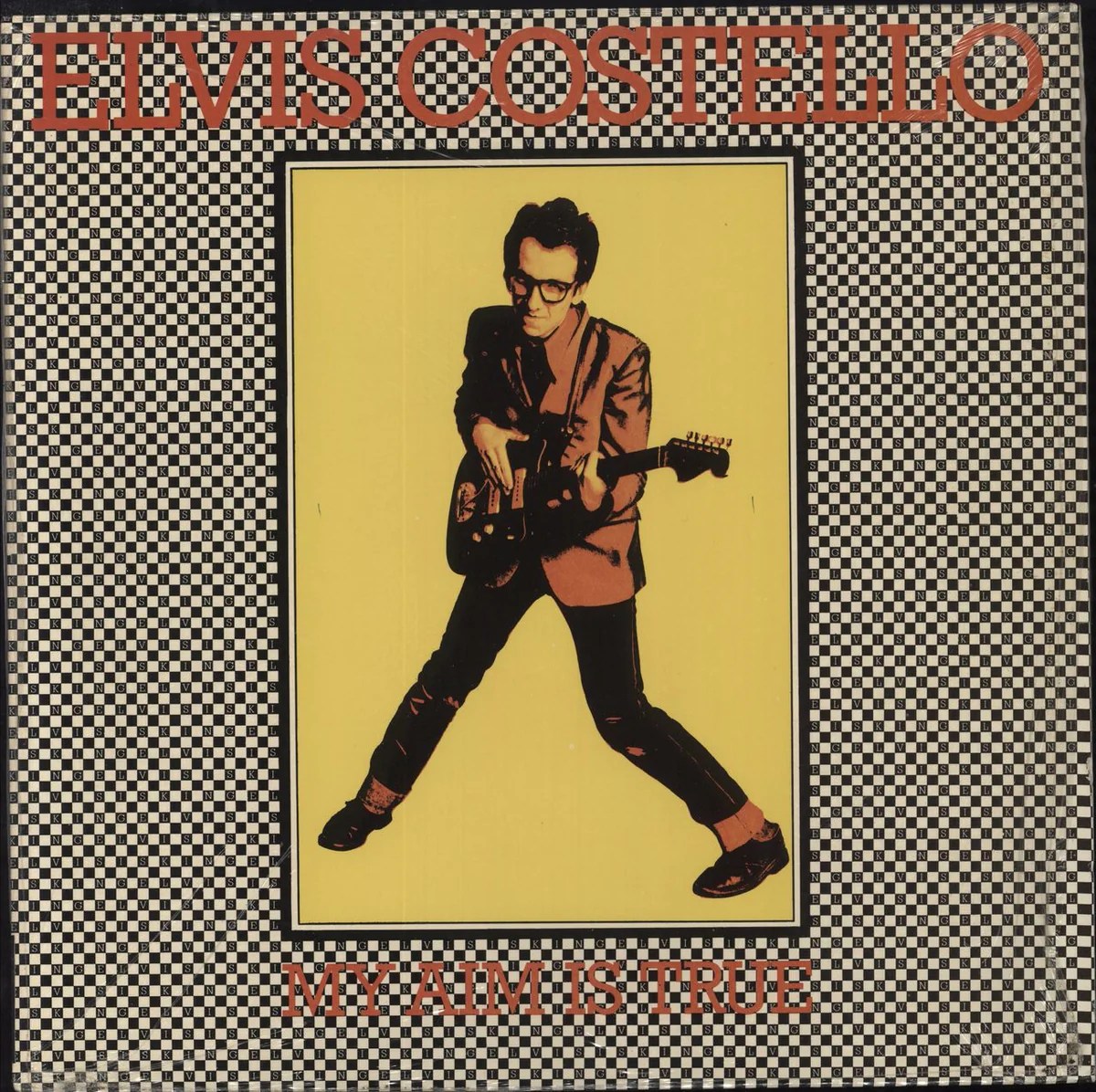
In the mid-to-late ’70’s when disco hip-bumped rock-n-roll off the dance floor, I was not a happy bugaloo-er.  My musical sensibilities are more in tune with “Wild Thing” than “Stayin’ Alive.”  so when my pal Jake Williams turned me on to Elvis Costello’s first album My Aim Is True circa 1978 I was delighted. 

Jake handed me the record cover. “What do you make of this?”

The cat on the cover looked like a cross between Buddy Holly (from the neck up) and a ’50’s Elvis Presley (from the neck down).  

“Let’s listen,” I said, and Jake slipped the vinyl from its sheath, dropped the needle, and pow.

My favorite track on that album is “Watching the Detectives,” a rock noir whose lyrics sometimes sound like a screenplay.

Long shot at that jumping sign
Invisible shivers running down my spine

Cut to baby taking off her clothes
Close-up of the sign that says, “We never close”

Lyrics with sophisticated word play embedded in catchy tunes – that’s Elvis Costello.

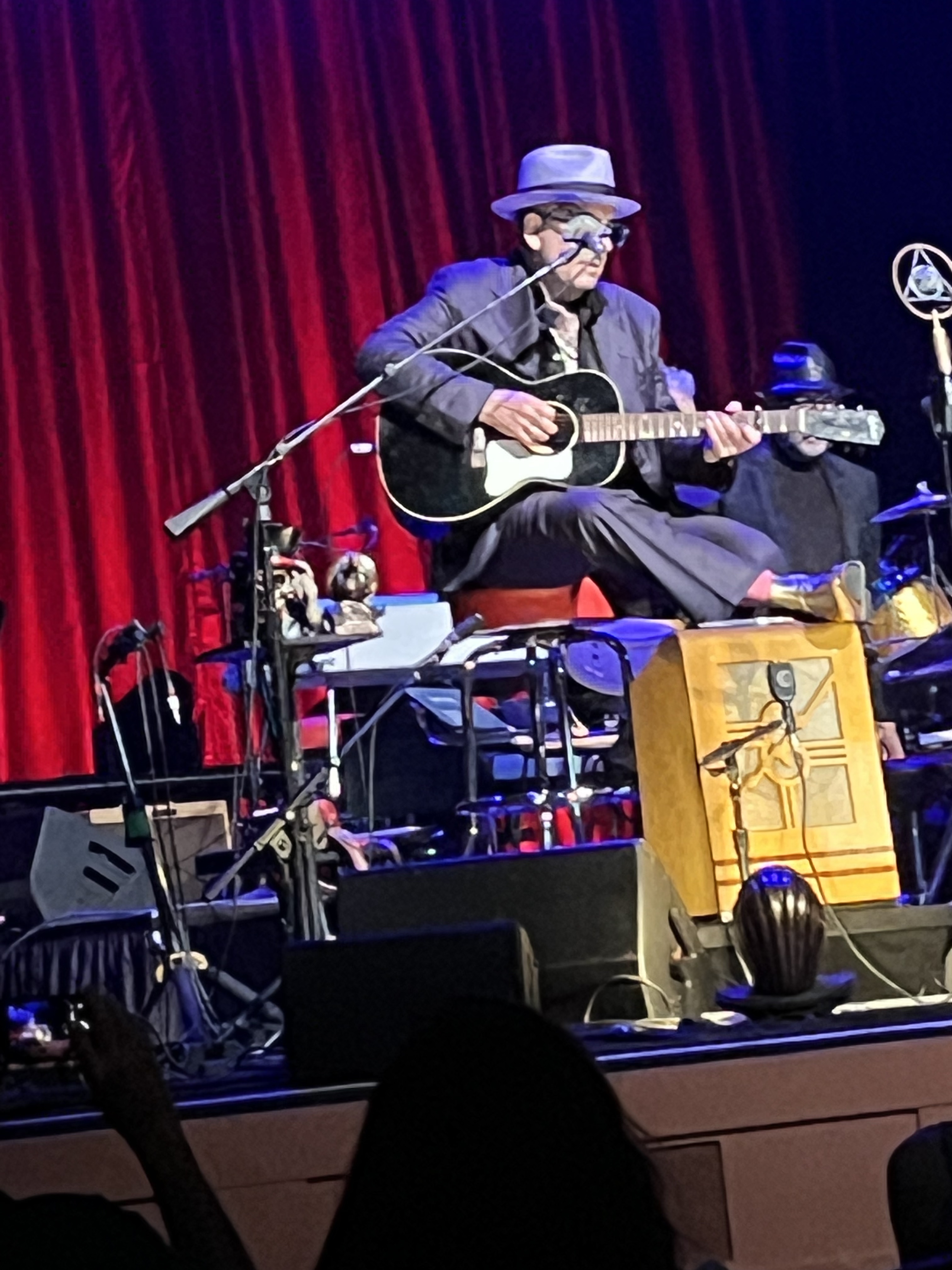
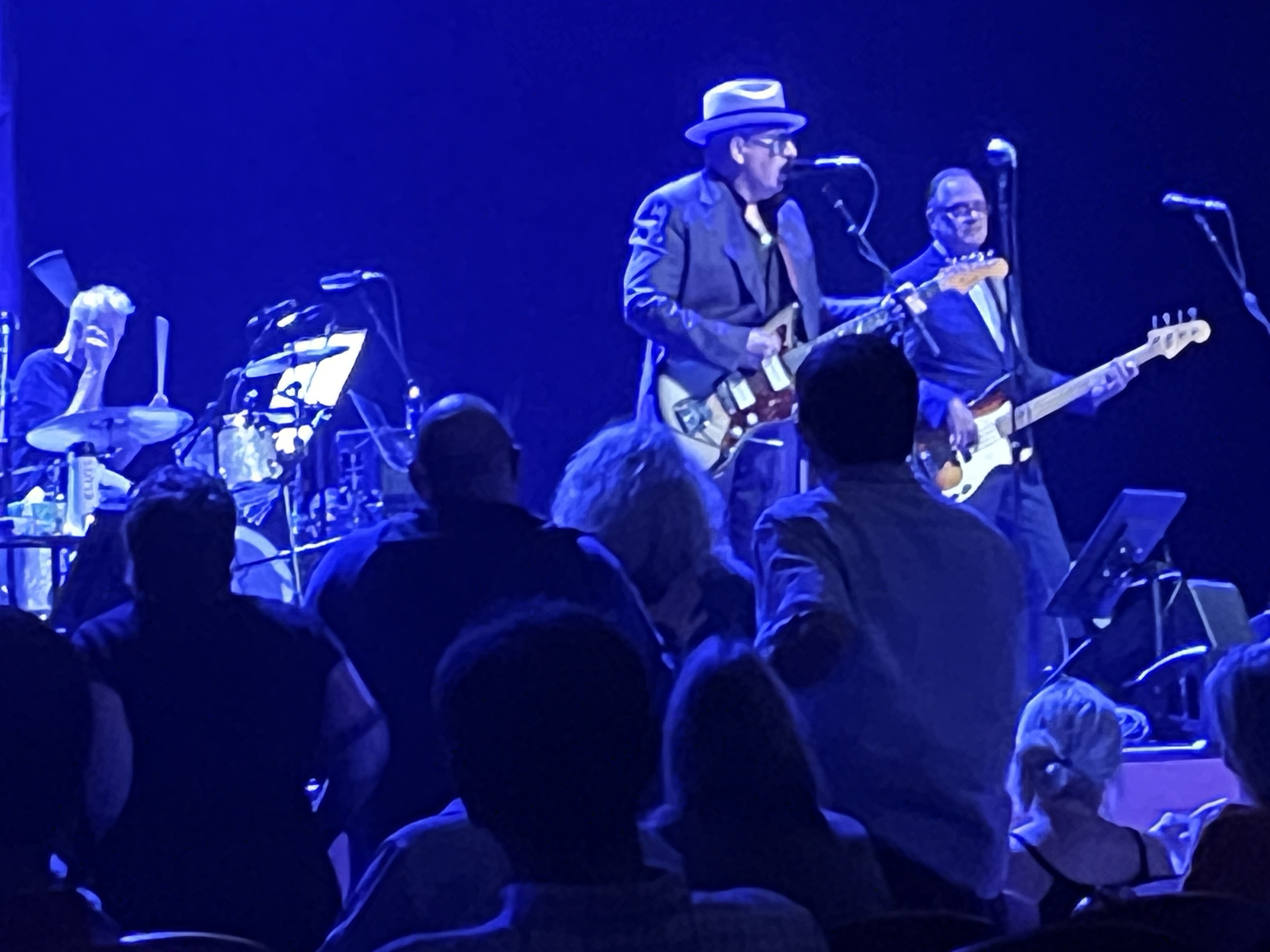
Nearly fifty years later, I got to hear him perform “Watching the Detectives” last night at the Gaillard in Charleston as part of a two-and-a-half hour concert featuring Charlie Sexton on guitar. The tour’s called “Elvis Costello and the Imposters – Radio Soul!: The Early Songs of Elvis Costello.” It’s only a three-week tour, so I don’t know how Charleston was lucky enough to get in the mix, but I ain’t complaining.

It occurred to me before the show that a Costello concert entailing even a carefully curated sample of his career might seem scattershot. After all, Elvis has explored an assload of genres throughout his half-century of stardom: new wave rock, country, (Almost Blue), New Orleans soul (with Allen Toussaint), pop standards (with Burt Bacharach), and collaborations with the Roots and the Brodsky Quartet. 

So I was grateful that last night he stuck to the old stuff – “Mystery Dance,” “Welcome to the Working Week,” “Every Day I Write the Book,” “Accidents Will Happen,” “No Dancing,” “Alison,” Radio, Radio,” “Pump it Up,” and “What’s So Funny ‘Bout) Peace, Love, and Understanding,” among others.

photo credit Wesley Moore

The band sounded great, especially Sexton’s searing guitar solos, and Elvis’s voice was strong and supple.  He was friendly and upbeat, roamed around the stage to various outposts, bantering as he got into position.

My only complaint is that occasionally I didn’t recognize a few songs right away (see also: Dylan), but my piss poor hearing might be to blame.  Also, I would love to have heard him do “Oliver’s Army,” but as Elvis’s fellow English rocker has pointed out, “you can’t always get what you want.”

My Take on Summerville 1970, an Adaptation of My Novel Today, Oh Boy

poster designed by Gil Shuler

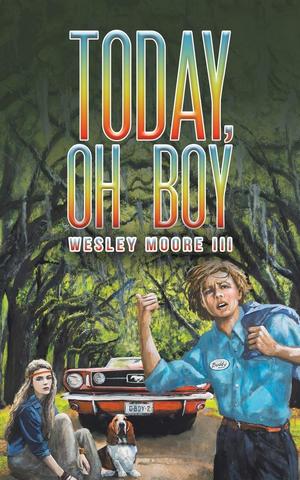
Given that my novel Today, Oh Boy inspired David Boatwright’s and Paul Brown’s short film Summerville 1970, I won’t pretend that my critical assessment of their movie possesses the clear-eyed detachment that disinterest fosters.  

On the other hand, the number of authors who hated film adaptations of their work is legion.  For example, Gore Vidal considered the adaptation of his novel Myra Breckenridge “not just a bad movie [but also] an awful joke” and Donn Pearce, the author of the novel Cool Hand Luke, hated its screen adaptation. “They did a lousy job,” he said, “and I disliked it intensely.”  Other unhappy authors include Ken Kesey, Stephen King, and PL Travers.  Like I say, a lot of authors have hated films based on their works. 

Therefore, my admiration of the project was by no means guaranteed.

That said, I loved Summerville 1970.  

photo credit Joan Perry

Shortly after David Lynch’s death, Caroline and I watched a documentary about Lynch’s transition from painting to movie making.  In the documentary, he described a revelation he experienced at film school: it suddenly occurred to him that he could make “moving paintings” rather than merely “moving pictures.”  

In other words, Lynch attempted to render each scene of his movies so visually interesting that each still could be frozen and stand alone as a painting.  

Like Lynch, Boatwright is also a painter, and like Lynch, studied at the American Film Institute in LA. Summerville 1970 is a “painterly film,” rich in color and artistic in layout.

For example, check out this photograph Caroline took of my cameo appearance during the premiere Friday night.

When Caroline showed the shot to me, she said, “It looks like a painting.”  

“Wow, yeah, that looks like it could have been painted by Hopper,” I said.

 “Or [Thomas Hart] Benton,” she replied, which indeed is more accurate.

One of the most vexing problems a short story writer and short film creator faces is having to constrict action within a confined space and time. David does a terrific job of compressing the events of poolroom chapter of the novel into a fluid narrative that doesn’t have one second of down time.  The movie has, as all good stories must, a beginning, a middle, and end. Crisply edited, the plot unfolds efficiently with a disquieting subtle sense of foreboding.  Of course, any work of fiction requires conflict, and in addition to the central physical conflict of rednecks attacking a hippie, we have other conflicts as well: a developing high school crush, the vet’s anguish, and the lost basset hounds’ wandering.[1]

To simplify matters, David took four of my characters – Rusty Boykin and Ollie Wyborn, the co-protagonists, and Jill Birdsong and Sandy Welch, the female leads – and fused them into two characters, i.e., into a single male and a single female.   In the film, the character Rusty is actually more Ollie than Rusty. For example, in Summerville 1970, Rusty, like Ollie, hails from Minnesota and knows karate.  On the other hand, like the Rusty of the novel, cinematic Rusty has embraced the counterculture of the late ’60s and early ’70s.  In the novel, Ollie is a conformist who wants to attend the Air Force Academy. Because the film is limited to fifteen minutes, these changes make a lot of sense. 

The Jill Birdsong character of the movie closely resembles Jill of the novel, only she’s less straightlaced and less shy, though the character does maintain a quiet shyness, nevertheless.

Olivia Brooks, the actress who portrays her, is superb, as is Thomas Williams, who plays Rusty.

Not only do the main characters shine, but the minor characters do as well. Patrick Basquill’s Bobby Ray Bossheen exudes mindless menace, and his two redneck cohorts, the twin brothers Andre and Remy Levesque, come off as authentically belligerent, not-too-bright country boys. In addition, David Mandell is a stabilizing force as the compassionate bartender who attempts to maintain peace. Jill’s wisecracking friend Nanci played by Sara Rudeseal is spot-on as well. 

My favorite character of all is David Boatwright’s invention, a Viet Nam vet who tells a horrific war story to the bartender and later breaks up the fight outside the tackle shop. The actor, Logan Marshall Green, makes the vet’s PTSD seem all too real as he draws heavily on his cigarette with shaking hands, knocking back whiskey after whiskey as he shares his horrible memory of a situation that brings to mind My Lai.

In addition, the costumes, sound, and editing are all superb.  It’s truly a pleasure to watch, and I hope you get a chance to see it.

BTW, here’s a LINK to a review of Today, Oh Boy that provides a link to its Amazon and Barnes and Noble pages. .  Rumor has it that it might be screened again at the Terrace for the general public.  Fingers crossed. 

[1] I got the idea of writing Today, Oh Boy after listening an audio book of Joyce’s Ulysses.  The basset’s actual name is Hambone Odysseus Macy, but the kids who find him on the side of the road dub him Mr. Peabody.  He is the Ulysses character in the novel who wanders all over Summerville to finally making his way home safely to his family.

Novels Vis-a-Vis Screenplays

Novels Vis-a-Vis Screenplays

At the request of an actor who’s interested in pitching my novel Today, Oh Boy to producers he’s worked with, I’ve written an adaptation of the novel for the screen.[1] It’s not an official screenplay per se, but a roadmap for the actor to determine what scenes he will use to produce a short “teaser” reel consisting of would-be shots from the would-be movie. I have no idea how this is done. Via AI I suspect.  Anyway, with the final proofs from the novel to the right of my iMac’s screen and a blank Word document on the left, I began writing and cutting and pasting.

The good news is that originally, using present tense and employing crisp visual imagery, I consciously composed Today, Oh Boy to read like a movie progressing. For example, here’s the opening of the novel.

A mango-hued, pockmarked bulletin board hangs on a classroom wall of pale lime green concrete blocks, the bulletin board pencil-stabbed and compass point-gouged. Among the graffiti are the names of the star-crossed lovers: Sandy + Tripp. Tragic Tripp, whose body was found last week tangled in blackberry bushes along the banks of the Ashley River, his skull smashed after falling off Bacons Bridge.

S-A-N-D-Y + T-R-I-P-P.

Rusty Boykin, a skinny, freckled redhead sitting on the bulletin board row in Mrs. Laban’s homeroom, traces his index finger in the depression of Sandy’s name. He supposes it’s Tripp’s work – the letters inartistic, juvenile. Sandy hasn’t been to school since Tripp’s death, four class days ago, and now it’s Monday, and she’s still not here. She should be sitting right in front of Rusty, her honey-colored hair hanging like a curtain to her waist. 

How to adapt this for the screen?  One way, you could have Rusty tracing his finger in Sandy’s name and then suddenly cut to Tripp falling off the bridge, or you could begin with Tripp’s accident. What I did was to begin with Tripp’s last meeting with Sandy, a conversation through her open bedroom window, his leaving in a rage, jumping into his GTO, pealing off, and ultimately driving his car off the road at Bacons Bridge into the Ashley River.

Actually, Tripp’s death is what Hitchcock called a McGuffin, a misleading device that’s irrelevant to the overall narrative.  After all, Today, Oh Boy is a comedy. Its title comes from the Beatles’ song “A Day in the Life.”

I read the news today oh boy

About a lucky man who made the grade

And though the news was rather sad

Well I just had to laugh 

So, by having Tripp drive off the bridge rather than falling off the bridge, what I gain in cinematic excitement, I lose in the comic pairing of his first and last names. As it turns out, Tripp was a bully, a high school version of Trump.  At one point in the book, Alex Jensen, a junior at Summerville high, says to a friend Will, “Your last name is Trotter, you name your son Tripp, and he falls off a bridge to his death. What a surprise.”

In addition, the novel employs a great deal of what critics call “indirect discourse,” a device that allows a narrator to report what someone is thinking without using his exact words. For example, in the above excerpt, the sentence, “She should be sitting right in front of Rusty, her honey-colored hair hanging like a curtain to her waist” is rendered second-hand through Rusty’s consciousness. In a screenplay, you have to “show” rather than tell “tell,” which can lead to really awkward exposition, like you find in bad fiction like “The Most Dangerous Game”:

You’ve good eyes,” said Whitney, with a laugh,” and I’ve seen you pick off a moose moving in the brown fall bush at four hundred yards, but even you can’t see four miles or so through a moonless Caribbean night.”

That I couldn’t use direct narration or indirect discourse meant I had to omit some characters, like Camilla Creel, the impoverished girl who lives in an abandoned school bus with her mother and sister, and Weeza Waring, Will’s mother, who added several comic touches throughout the narrative.

So, overall, the script is much tidier than the novel, much more streamlined, yet not as rich in my attempt to capture the zeitgeist of Summerville, South Carolina in 1970, during integration, the beginning of the counterculture, and during an influx of Northerners moving to what at the time was a staid, conservative community.

Then again, I’m sure a professional screenwriter could do a much better job.


[1] By the way, it’s on sale at Amazon for a mere $10.