My Take on Summerville 1970, an Adaptation of My Novel Today, Oh Boy

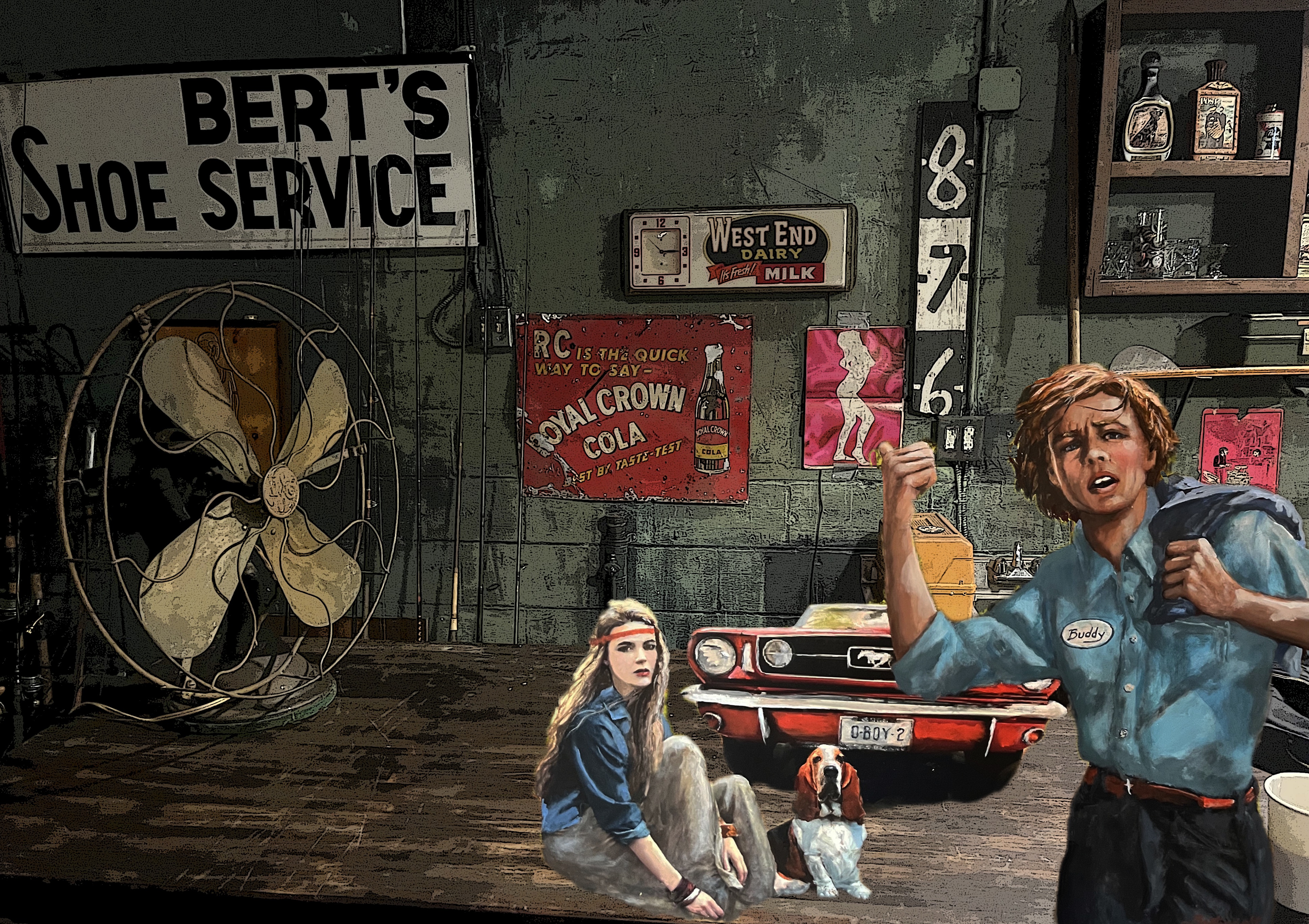
poster designed by Gil Shuler

Given that my novel Today, Oh Boy inspired David Boatwright’s and Paul Brown’s short film Summerville 1970, I won’t pretend that my critical assessment of their movie possesses the clear-eyed detachment that disinterest fosters.  

On the other hand, the number of authors who hated film adaptations of their work is legion.  For example, Gore Vidal considered the adaptation of his novel Myra Breckenridge “not just a bad movie [but also] an awful joke” and Donn Pearce, the author of the novel Cool Hand Luke, hated its screen adaptation. “They did a lousy job,” he said, “and I disliked it intensely.”  Other unhappy authors include Ken Kesey, Stephen King, and PL Travers.  Like I say, a lot of authors have hated films based on their works. 

Therefore, my admiration of the project was by no means guaranteed.

That said, I loved Summerville 1970.  

photo credit Joan Perry

Shortly after David Lynch’s death, Caroline and I watched a documentary about Lynch’s transition from painting to movie making.  In the documentary, he described a revelation he experienced at film school: it suddenly occurred to him that he could make “moving paintings” rather than merely “moving pictures.”  

In other words, Lynch attempted to render each scene of his movies so visually interesting that each still could be frozen and stand alone as a painting.  

Like Lynch, Boatwright is also a painter, and like Lynch, studied at the American Film Institute in LA. Summerville 1970 is a “painterly film,” rich in color and artistic in layout.

For example, check out this photograph Caroline took of my cameo appearance during the premiere Friday night.

When Caroline showed the shot to me, she said, “It looks like a painting.”  

“Wow, yeah, that looks like it could have been painted by Hopper,” I said.

 “Or [Thomas Hart] Benton,” she replied, which indeed is more accurate.

One of the most vexing problems a short story writer and short film creator faces is having to constrict action within a confined space and time. David does a terrific job of compressing the events of poolroom chapter of the novel into a fluid narrative that doesn’t have one second of down time.  The movie has, as all good stories must, a beginning, a middle, and end. Crisply edited, the plot unfolds efficiently with a disquieting subtle sense of foreboding.  Of course, any work of fiction requires conflict, and in addition to the central physical conflict of rednecks attacking a hippie, we have other conflicts as well: a developing high school crush, the vet’s anguish, and the lost basset hounds’ wandering.[1]

To simplify matters, David took four of my characters – Rusty Boykin and Ollie Wyborn, the co-protagonists, and Jill Birdsong and Sandy Welch, the female leads – and fused them into two characters, i.e., into a single male and a single female.   In the film, the character Rusty is actually more Ollie than Rusty. For example, in Summerville 1970, Rusty, like Ollie, hails from Minnesota and knows karate.  On the other hand, like the Rusty of the novel, cinematic Rusty has embraced the counterculture of the late ’60s and early ’70s.  In the novel, Ollie is a conformist who wants to attend the Air Force Academy. Because the film is limited to fifteen minutes, these changes make a lot of sense. 

The Jill Birdsong character of the movie closely resembles Jill of the novel, only she’s less straightlaced and less shy, though the character does maintain a quiet shyness, nevertheless.

Olivia Brooks, the actress who portrays her, is superb, as is Thomas Williams, who plays Rusty.

Not only do the main characters shine, but the minor characters do as well. Patrick Basquill’s Bobby Ray Bossheen exudes mindless menace, and his two redneck cohorts, the twin brothers Andre and Remy Levesque, come off as authentically belligerent, not-too-bright country boys. In addition, David Mandell is a stabilizing force as the compassionate bartender who attempts to maintain peace. Jill’s wisecracking friend Nanci played by Sara Rudeseal is spot-on as well. 

My favorite character of all is David Boatwright’s invention, a Viet Nam vet who tells a horrific war story to the bartender and later breaks up the fight outside the tackle shop. The actor, Logan Marshall Green, makes the vet’s PTSD seem all too real as he draws heavily on his cigarette with shaking hands, knocking back whiskey after whiskey as he shares his horrible memory of a situation that brings to mind My Lai.

In addition, the costumes, sound, and editing are all superb.  It’s truly a pleasure to watch, and I hope you get a chance to see it.

BTW, here’s a LINK to a review of Today, Oh Boy that provides a link to its Amazon and Barnes and Noble pages. .  Rumor has it that it might be screened again at the Terrace for the general public.  Fingers crossed. 

[1] I got the idea of writing Today, Oh Boy after listening an audio book of Joyce’s Ulysses.  The basset’s actual name is Hambone Odysseus Macy, but the kids who find him on the side of the road dub him Mr. Peabody.  He is the Ulysses character in the novel who wanders all over Summerville to finally making his way home safely to his family.
Yesterday, Oh Boy

Yesterday, Oh Boy

When my friend David Boatwright, who produced the cover of Today, Oh Boy, approached me about adapting the poolroom chapter from the novel into a fifteen-minute film, I jumped at the chance.  David whipped out a script, which I approved, then later made some significant changes. 

Near the end of the novel, which is set in 1970, Rusty Boykin, an ADD-riddled hippie-wanna-be from Summerville, South Carolina, and Ollie Wyborn, a straightlaced, straight-A transplant from St. Paul, Minnesota, join forces in thwarting an attack from a pair of rednecks whose favorite pastime is, to use the Lowcountry lingo of the day, “cutting ass,” i.e., beating up people they don’t cotton to.  

David’s major change in the second draft of the script was fusing Rusty and Ollie into one character, which I again approved, given I had complete confidence in his intelligence and talent, and because as a practical matter, there’s virtually no room for character development in a fifteen-minute movie.  Another significant change, which added gravitas to the film, David created a new character, a Viet Nam vet who relates a harrowing account of wartime mayhem to the bartender, played my former student, David Mandell. 

So anyway, David Boatwright and his producer Paul Brown raised the needed money and assembled a crew of costume designers, cinematographers, assistant directors, sound people, make-up artists, art directors, property managers, actors, a stunt coordinator, a basset hound, etc. and shot the film in four days. 

The exterior shots, which included fisticuffs and car chase, were filmed on bucolic Wadmalaw Island and the interior shots at the defunct West Ashley restaurant Bearcat, which has been transformed into a ’70s era bait and tackle shop/bar complete with pinball machines and a functioning jukebox on loan from my friend Thom Piragnoli.

I asked David if I could have a cameo, and he said, of course, so yesterday I spent twelve amazing hours on the set being part of an incredibly complicated matrix of moving parts. 

When I arrived at seven, an actor was seated having his hair tended to. One of the make-up women said she would do my hair next, and I explained, “But I have no hair,” removing my hat, and she said, “Great!,” meaning, I take it, less work for her.  After I introduced myself, another woman said, “Oh, these young actors can’t wait to meet you. They’re walking around with the book.” 

Indeed, they were incredibly appreciative. Each one sincerely thanked me for writing the novel.  Two actors, twins brothers playing rednecks, asked me why their characters were so angry. When the actor Logan, who played the Viet Nam vet, thanked me for, in his words, “creating all of this,” I told him that, in fact, David had created his character and dialogue. He said yes, but I had created the world around him. To my mind, his performance and speech are the climax of the film. 

I abstractly knew that it would be cool to see characters I had created “come to life,” but had underestimated how gratifying it ended up being.  It was especially moving to see Jill Birdsong, modeled on the high school version of my late wife Judy Birdsong, performing her role, and I especially enjoyed the actor Patrick Basquill, who brought the bully Bobbey Ray Bosheen to life. The creepiness he brought to the role reminded me of William Dafoe’s portrayal of Bobby Peru in David Lynch’s Wild at Heart.

Also, it was really weird to hear the name “Rusty,” my childhood nickname, called out throughout the day. Sometimes, I thought they were referring to me. And Thomas, the actor who plays Rusty, looks a lot like I did in high school, except he has blue eyes, high cheek bones, brown hair, and isn’t riddled with freckles and acne. 

In other words, he’s skinny.

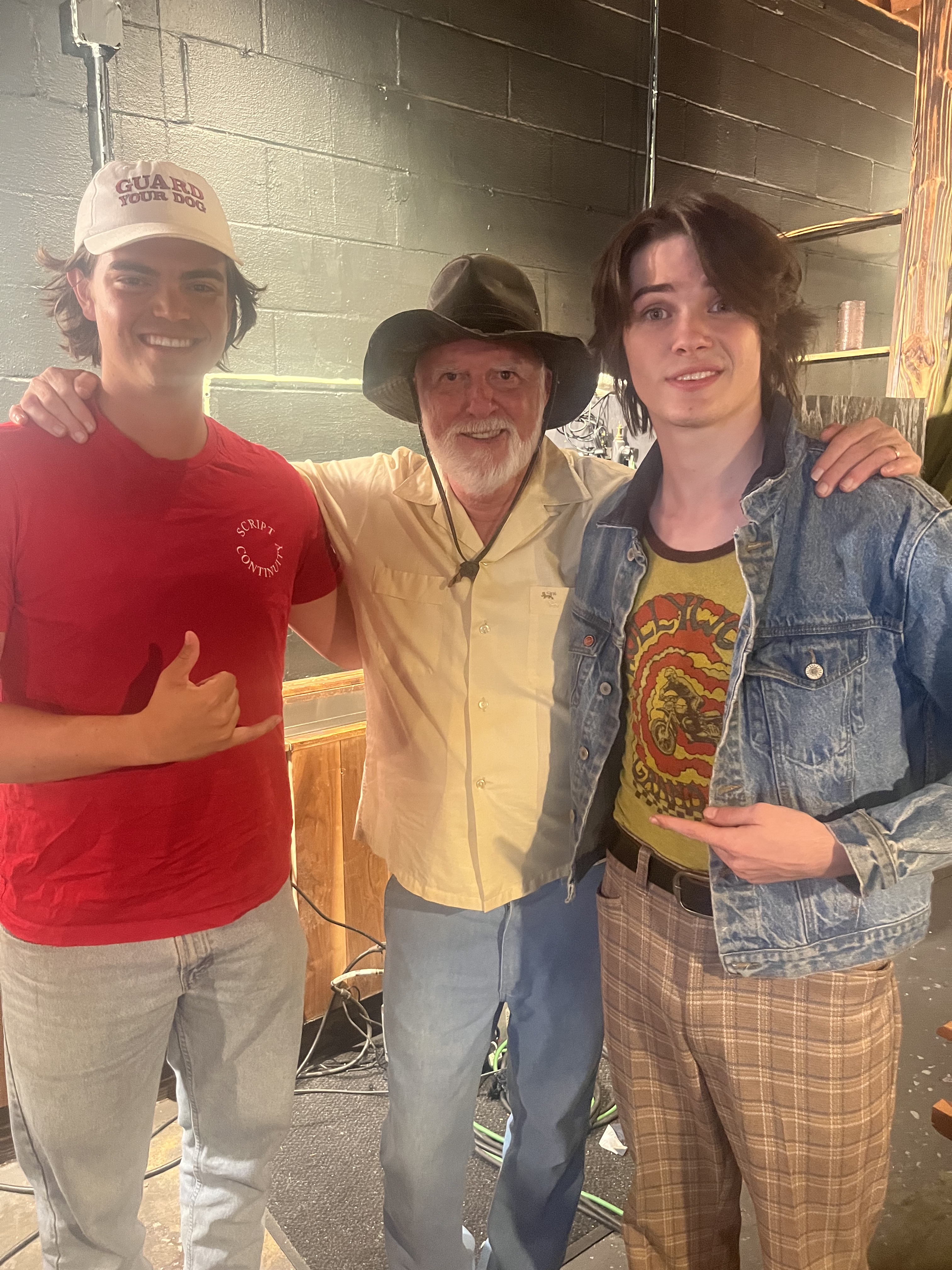
from left to right, Thomas Beck, Rusty Moore, and “Rusty Boykin”

It was such a wonderful day, the best ever in my life as a writer, and I can’t wait to see the finished product, entitled Summerville 1970, which will make the festival circuit and premiere sometime in the fall at the Terrace Theater on James Island.

Before I end this way too egotistical account, I want to acknowledge my wife Caroline Tigner Moore, without whom the manuscript of Today, Oh Boy would have been found in a drawer after my demise, rather than becoming a published novel. 

Caroline has encouraged me throughout but also has bravely said, “Un-uh, that doesn’t work, why don’t you do this instead.” She’s tactfully guided me through the interviews and the whole befuddling process of my post-teaching career, including offering encouragement in my avocation of creating “fake paintings.” 

After my beloved Judy Birdsong died, I imagined the lonely life of a wounded epicurean, but Caroline has enriched my life in ways I could not have imagined, especially in establishing a loving family that includes my wunderkind stepdaughter Brooks, who is as kind as she is brilliant, and a trio of pets, KitKat, the demi-mutt, and our blue-eyed ragdoll cats, Juno and Jasmine.

Love to them and to you!

PS. Here’s a link to the Kirkus review of Today, Oh Boy that includes an interview and links to purchase it via Amazon and Barnes and Noble, or better yet, get it from your local independent book store, which in Charleston is Buxton Books.