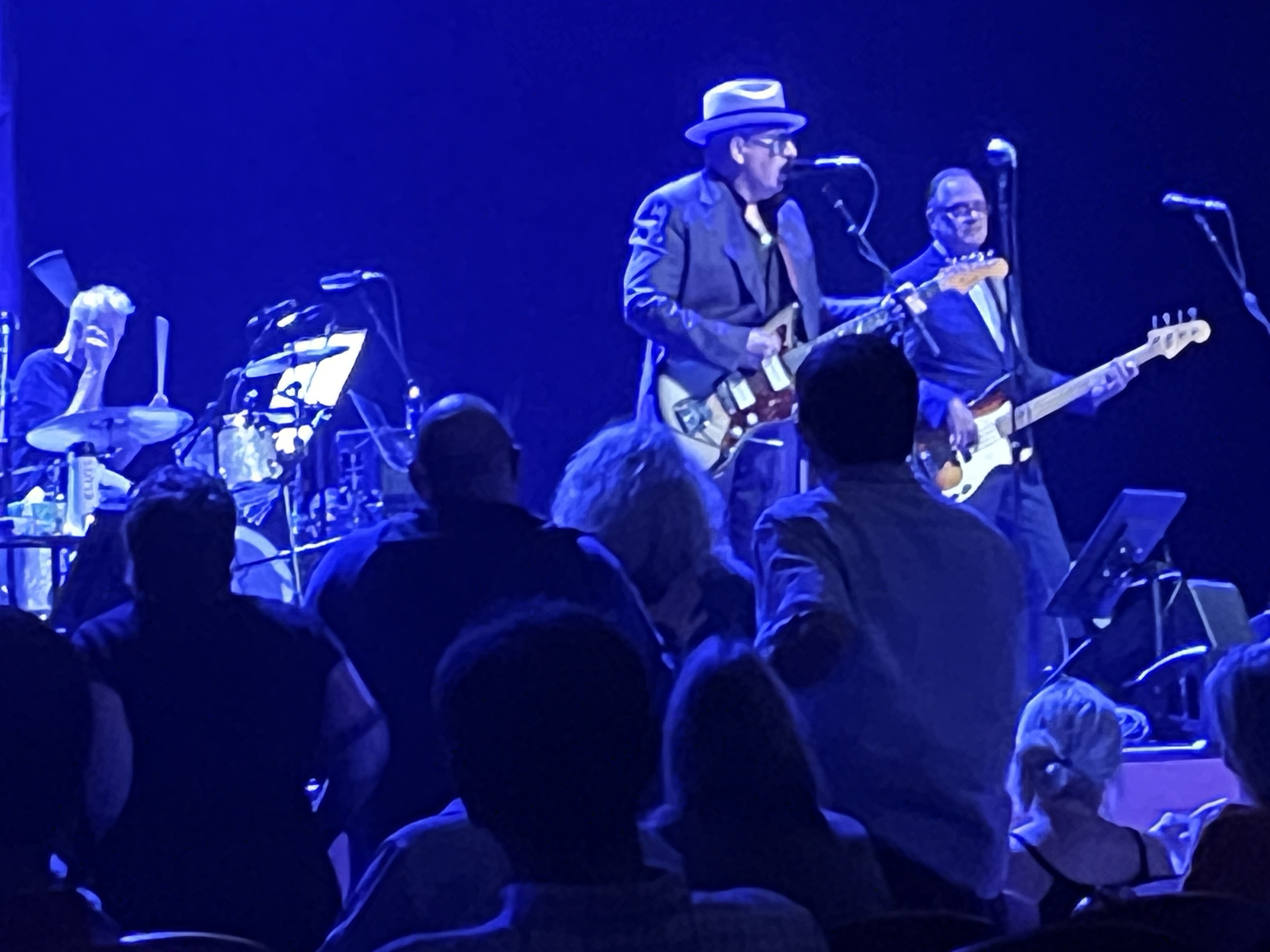
A Hit from Elvis Costello’s Radio Soul! Tour

photo credit Wesley Moore

In the mid-to-late ’70’s when disco hip-bumped rock-n-roll off the dance floor, I was not a happy bugaloo-er.  My musical sensibilities are more in tune with “Wild Thing” than “Stayin’ Alive.”  so when my pal Jake Williams turned me on to Elvis Costello’s first album My Aim Is True circa 1978 I was delighted. 

Jake handed me the record cover. “What do you make of this?”

The cat on the cover looked like a cross between Buddy Holly (from the neck up) and a ’50’s Elvis Presley (from the neck down).  
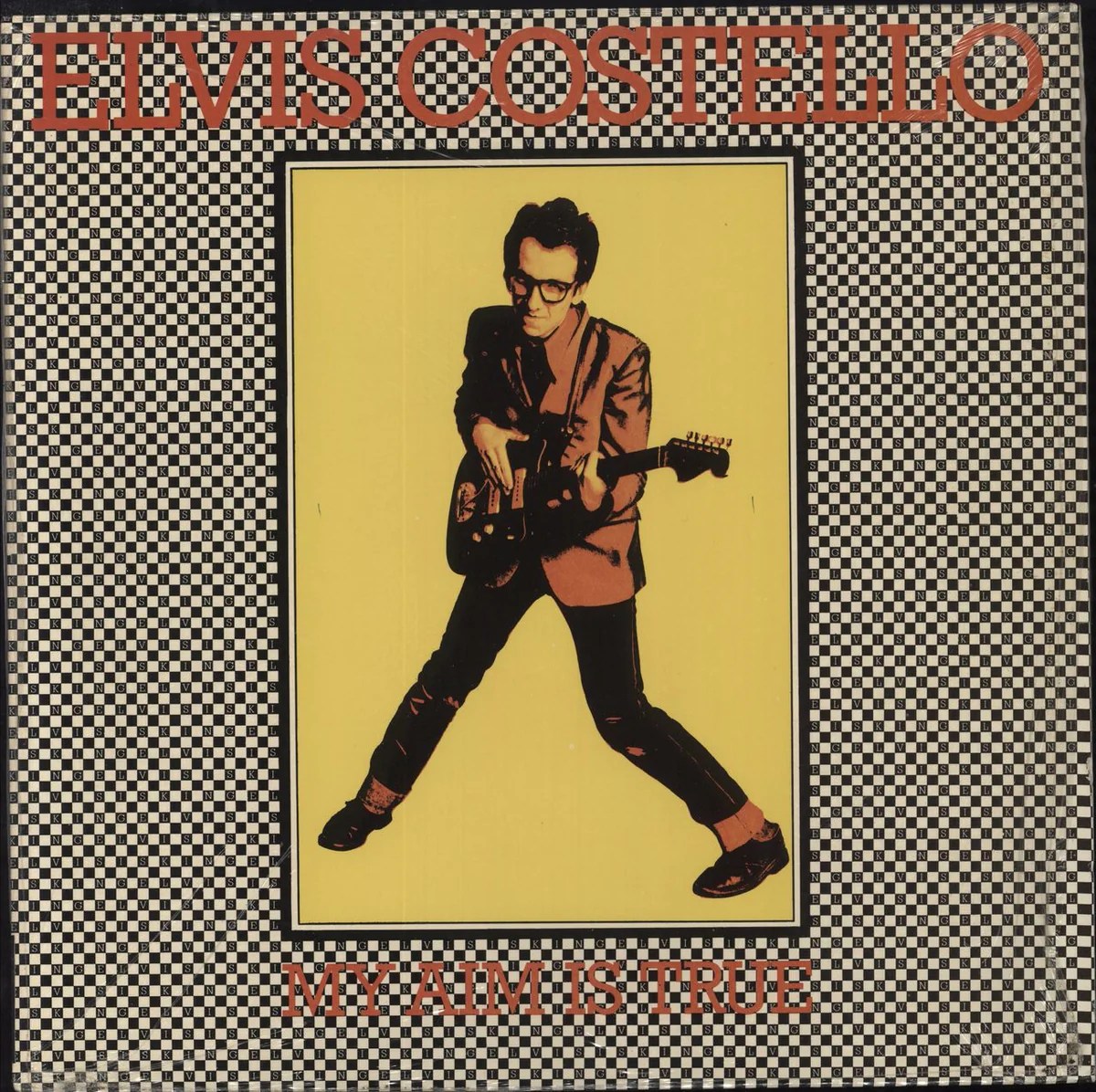
“Let’s listen,” I said, and Jake slipped the vinyl from its sheath, dropped the needle, and pow.

My favorite track on that album is “Watching the Detectives,” a rock noir whose lyrics sometimes sound like a screenplay.

Long shot at that jumping sign
Invisible shivers running down my spine

Cut to baby taking off her clothes
Close-up of the sign that says, “We never close”

Lyrics with sophisticated word play embedded in catchy tunes – that’s Elvis Costello.

Nearly fifty years later, I got to hear him perform “Watching the Detectives” last night at the Gaillard in Charleston as part of a two-and-a-half hour concert featuring Charlie Sexton on guitar. The tour’s called “Elvis Costello and the Imposters – Radio Soul!: The Early Songs of Elvis Costello.” It’s only a three-week tour, so I don’t know how Charleston was lucky enough to get in the mix, but I ain’t complaining.

It occurred to me before the show that a Costello concert entailing even a carefully curated sample of his career might seem scattershot. After all, Elvis has explored an assload of genres throughout his half-century of stardom: new wave rock, country, (Almost Blue), New Orleans soul (with Allen Toussaint), pop standards (with Burt Bacharach), and collaborations with the Roots and the Brodsky Quartet. 

So I was grateful that last night he stuck to the old stuff – “Mystery Dance,” “Welcome to the Working Week,” “Every Day I Write the Book,” “Accidents Will Happen,” “No Dancing,” “Alison,” Radio, Radio,” “Pump it Up,” and “What’s So Funny ‘Bout) Peace, Love, and Understanding,” among others.
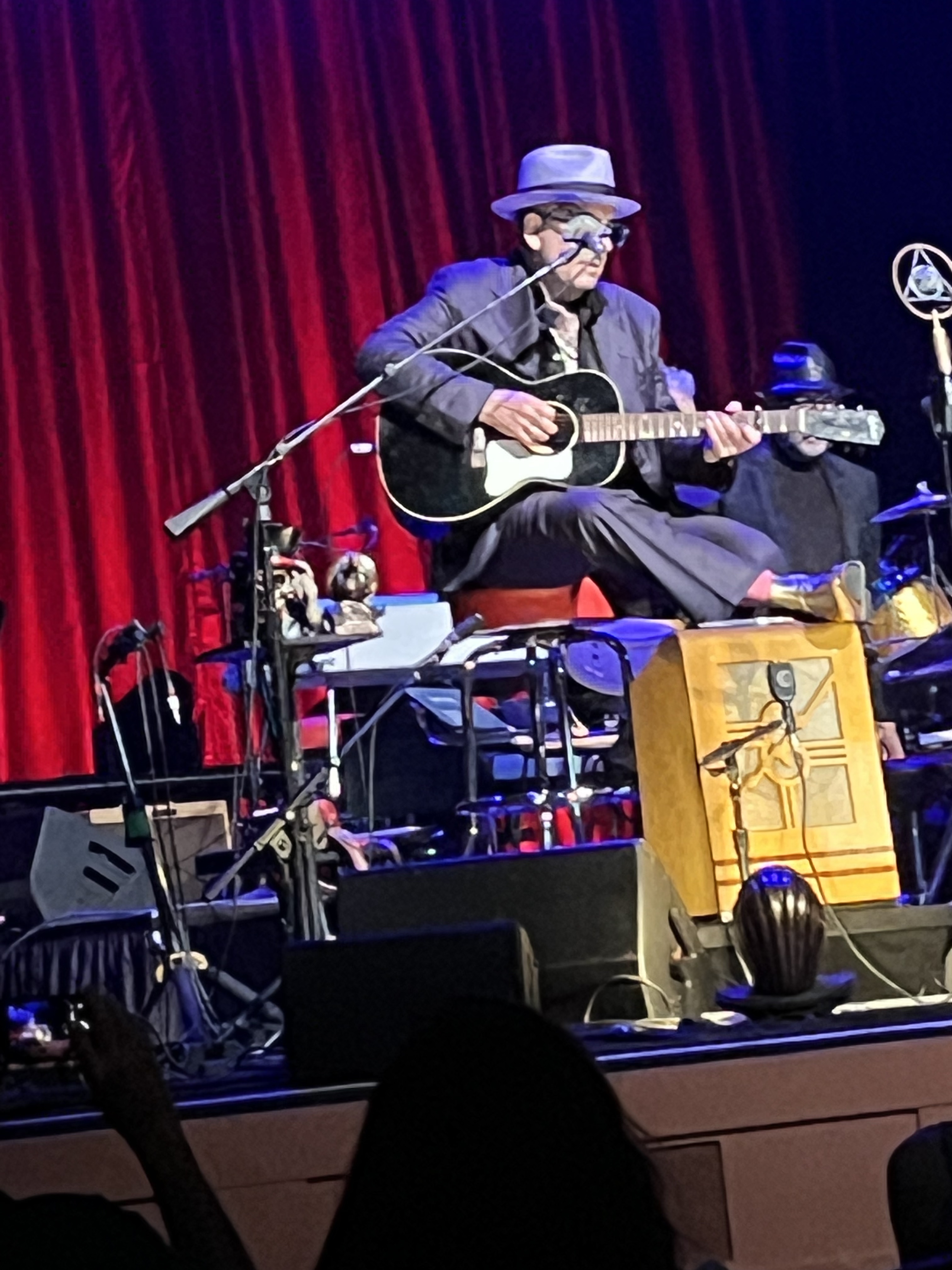
photo credit Wesley Moore

The band sounded great, especially Sexton’s searing guitar solos, and Elvis’s voice was strong and supple.  He was friendly and upbeat, roamed around the stage to various outposts, bantering as he got into position.

My only complaint is that occasionally I didn’t recognize a few songs right away (see also: Dylan), but my piss poor hearing might be to blame.  Also, I would love to have heard him do “Oliver’s Army,” but as Elvis’s fellow English rocker has pointed out, “you can’t always get what you want.”

Do the Mash Potato, Do the Alligator, Do the TS Eliot

This year’s Spoleto Festival features a potentially budget-busting array of popular musical choices. To wit, Mavis Staples, Patti Smith, Jeff Tweedy, Lucinda Williams, MJ Lenderman, Band of Horses, and Yo La Tengo. 

For the sake of solvency, I’ve limited myself to two performances, Patti Smith and Lucinda Williams. 

First up was Patti Smith, who appeared Wednesday at the Cistern, a splendid outdoor venue located on the College of Charleston’s campus.  

I love Patti Smith. Her injecting high art references into three chord rock inspired me back when I was a wastrel grad student in 1975, a mere half century ago.  The album was Horses, its cover photo shot by Robert Mapplethorpe, her housemate.  What I love about that record is its expansive allusiveness, its juxtaposing via a sonic collage high and low art, Rimbaud and Boney Maroney, bats with baby faces doing the Watusi like Bela Lugosi. But, most of all, what I love is that it rocks.[1]

In my old age, I purchase expensive concert tickets that put us way up front.  For Patti, my wife Caroline and I sat on the third row.  I was under the false impression that Patti might perform the songs of Horses in order, but she only sang one song from the album, “Redondo Beach,” a lilting reggae number whose light-hearted melody belies the lyrics’ first person account of a gay lover’s suicide. 

Why try to explain when you can listen to a snippet yourself.

Anyway, the concert was laidback, with Patti filling up deadtime with friendly anecdotes while her band tuned and retuned their instruments in Kingston-Jamaica-grade humidity. 

Caroline was blown away, and so was I, though I really would have loved it if she had included “Gloria,” a mash-up of the Van Morrison/Them classic and some badass self-assertion:

I walk in a room, you know I look so proud
I move in this here atmosphere where anything’s allowed
Then I go to this here party and I just get bored
Until I look out the window, see a sweet young thing
Humping on a parking meter, leaning on the parking meter 


Oh, she looks so good, oh, she looks so fine
And I’ve got this crazy feeling that I’m going to, ah-ah, make her mine.

G-L-O-R-I-A!!!

photo credit I-and-I

So tonight, we’re headed back to the Cistern to see Lucinda, which for me will be the third time.  She’s had a stroke, which she says affects her guitar playing, but I bet it hasn’t diminished that beautiful distinctive Southern vowel-rich hoarse voice of hers.

I certainly hope not.


[1] You can read a tribute to Patti by clicking HERE.

Little Baby Blues: 1953 Edition

Little Baby Blues: 1953 Edition

On 14 December 1952, a rare snowy day in Summerville, South Carolina, Dr. Howard Snyder, aided and abbeted by forceps, yanked me from my mother’s womb into a world of relative woe.  The procedure flattened my head, which resulted in cephalohematoma, a condition in which blood pools under a newborn’s scalp. My father had to leave that afternoon to return to Clemson via a Greyhound bus.  When the lady sitting next to him asked why he looked so sad, he replied, “My wife just gave birth to a seven pound, eight ounce monkey.”  

As a child and teenager, I heard this anecdote on more than one occasion, which would elicit a cackle from my mother, who in so many words agreed that indeed I was a hideous newborn. However, she was quick to assure me that in a couple of weeks I was so beautiful that when she pushed my stroller around Colonial Lake, strangers stopped her to admire my beauty. 

I took solace in my mom’s stroller story as a child, not realizing that praising a baby’s looks is a common practice of adults when they run across almost any infant. On Facebook, I often encounter the red puffy yet wrinkled faces of newborns who are deemed “beautiful” or “adorable” by scores of friends of the parents. 

Meanwhile, elsewhere, Ethel and Julius Rosenberg sat in a courtroom being grilled by Roy Cohn, Donald Trump’s mentor.  My first full year, 1953, marked the feverous height of the Red Scare, back when the Russians were our enemies rather than our friends (or at least our President’s friend).[1] This collective commiephobia spread, appropriately enough, during an epidemic of polio. 

Trump and Cohn

In 1953, R&B had not made it to the mainstream, and rock-n-roll was in utero.  Every artist but one in Billboard’s top 30 singles of 1953 is white, mostly male crooners and female sopranos. Overly orchestrated instrumentals were also popular. The number one hit that year is “The Song from the Moulin Rouge” by Percy Faith and His Orchestra, a song so saccharine sounding that your ears might develop diabetes if you listen to more than twice. 

I’ve never heard of loads of these hitmakers like Pee Wee Hunt, Frank Chacksfield, Richard Hayman, Joni James. By far, the coolest song in that top 30 is from the one Black performer, South Carolina’s own Eartha Kitt, singing and purring “C’est si Bon” en francais.  She later was cast as Cat Woman in the Batman TV series. 

On the other hand, I have not only heard of but seen all of the top movies of ‘53, except for The Naked Spur. I’ve seen From Here to Eternity and Gentlemen Prefer Blondes at least twice, I’ve also watched Roman Holiday and Stalag 17.  Disney’s Peter Pan was one of my favorite movies in childhood, especially because the leader of the Lost Boys was, like me, a red head.

Nevertheless, despite the general awfulness of 1953, being born around then ended up being a propitious time to begin life’s journey. My parents, who had grown up during the Great Depression, wanted my siblings and me to have a better life than they suffered yet didn’t monitor our every move, allowing us to roam freely, unencumbered with water bottles or walkie talkies, the ’60’s equivalent cell phones. 

And by our adolescence in the mid ’60s, the music got ridiculously good, though we feared getting drafted and going to Nam, but by then the war was winding down and a draft lottery was in force. Compared today, college tuitions were dirt cheap. I could earn enough money in the summers to cover tuition.

However, I must say, for me at least, it’s a melancholy situation in my twilight years to witness the spectacle of lawlessness and corruption foisted on the Republic by Roy Cohn’s mentee, who obviously, as far as Machiavellianism is concerned, was an A+ student. 

C’est la vie, as Eartha might sing.

I’ll leave you with the number 1 hit of 1953.


[1] Fun facts to know as share: Roy Cohn, who in addition to being one of the prosecutors at the Rosenberg trial, also served as chief counsel for Joseph McCarthy’s witch hunts, a term Donald Trump appropriated during his first term to describe investigations targeting him for such acts of malfeasance like storing stolen classified documents in bathrooms and paying hush money to porn stars.