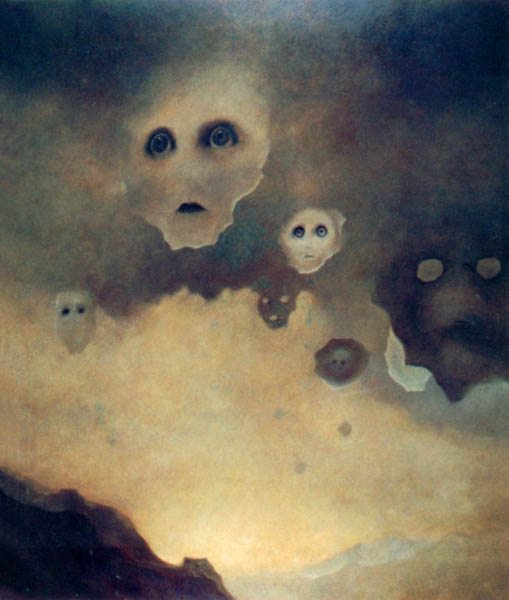
These Terrible Dreams That Shake Us Nightly

Zdzistaw Belinski

These Terrible Dreams That Shake Us Nightly

                                                                                                Macbeth (3.2.18-28)

In the wee hours this morning, I suffered through one of my post-retirement nightmares, a reprise of I’ve Never Been to Class and the Final Exam Is Tomorrow.  However, in this morning’s remake, I’ve transitioned from slack-ass student to unconscientious teacher.

In the dream, I’ve returned to class after a holiday with no lesson plans, no homework assignments, with nothing but empty words, my in-class bantering the equivalent of padding an essay with strings of superfluous phrases that take up space but denote next to nothing.

I hate dreams like this!

Well, I’ve decided rather than squandering thousands of dollars in therapy paying for advice from a virtual stranger who probably hasn’t read Ulysses – not to mention Jung and Freud – I’ll prepare lesson plans for phantom dream classes in the hope that I can short circuit my old-fashioned neurosis by being prepared.

Although I only taught history for four semesters in the last two years of my career, I really enjoyed whupping up assignments for the one-foot-out-of-the-door seniors who signed up for that elective, America in the Sixties.[1]

So, my first vaporous assignment is for a history class.

[Confession: Yes, MAGAs, you’re correct: many teachers (but not all) strive to indoctrinate students, which the following assignment certainly attempts to do].[2]

Assignment: Undoubtedly, in the last fifty years, the two most popular Presidents within the Republican Party were Ronald Reagan and Donald Trump.

Although they shared certain characteristics (species, gender, race, celebrity, divorces, party affiliation, fetishization of the Second Amendment), they also differed in several significant ways (in geopolitical attitudes vis a vis Russia, in their views of free trade vs tariffs, in their demeanors, in their adherence to Constitutional traditions).

In a well-developed essay devoid of superfluous phrases that take up space but denote next to nothing, compare Ronald Reagan and Donald Trump, exploring both similarities and differences. Make sure to address three of the above areas of difference.

In your conclusion, speculate on societal dynamics that explain such a radical shift in Republican ideological viewpoints. Aspects to consider: Fox News, declines in literacy, the prevalence of social media, socio-economic disparities . . .

It’s trickier for an English class because in my nightmare, it’s inevitably my British Lit survey that I’ve not prepared for, which begins with the Anglo-Saxon epic Beowulf and ends with Seamus Heaney.

It’s spring and we haven’t gotten past Chaucer!!!

I’m doomed! There’s no way to prepare. Cue Lady Macbeth’s scream in the Trevor Nunn BBC production.


[1] I suspect that course might be the root of my incompetent teacher nightmares because I felt as if I were shortchanging the students given my lack of knowledge, my ignorance of Chicago style research methodology, and my dearth of experience in organizing and implementing a history course.

[2] E.g., when I taught Old Testament in the 7th grade, I ended the unit by having students write a “character sketch ” of Yahweh. Almost every essay was negative: Yahweh was insecure, a “jealous God,” a belligerent Asshole who drowned innocent puppy dogs and kitty cats because His own Creation sucked. Not to mention, that his chosen one to regenerate the earth, ark-builder Noah, got shit-faced post-deluge and passed out naked in his tent, which freaked out his sons. Couldn’t Yahweh have found a Jimmy Carter equivalent instead? Isn’t he supposed to be omniscient?

Literary Prototypes for Trump

joker

I’ve been rummaging through the dusty book-lined, cobweb-covered garret of my mind trying to find the literary character who most resembles Donald J Trump.

First, we need someone who is not particularly articulate.  Sure, Trump is quick-witted, capable of an occasional laser-guided zinger, but no one would ever mistake him for Macbeth (though the Thane of Glamis and Cawdor does share with the Emperor of Orange a lack of restraint and total unfitness for office).  What Angus said of Macbeth, Lindsey Graham could say of Trump, “Now does he feel his title/ Hang loose about him, like a giant’s robe/ Upon a dwarfish thief.” However, no way does Trump possess the depth and eloquence to mutter, “Life’s but a walking shadow, a poor player/ That struts and frets his hour upon the stage/ And then is heard no more.”  When Macbeth is out for revenge, he says, “I am in blood stepped in so far that should I wade no more,/ Returning were as tedious as go o’er.”  Instead, with Trump we get, “If I win-I am going to instruct my AG to get a special prosecutor to look into your situation bc there’s never been anything like your lies.”

There’s perhaps a closer cousin to be found in Dickens, but the sad truth of the matter is that my moth-ridden mind only houses three volumes — Great Expectations, The Tale of Two Cities, and Hard Times — and I can’t think of anyone from those tomes who really reminds me of the Donald – though when it comes to holding grudges, Mr. Trump could give Mrs. Havisham a run for her pound sterling.

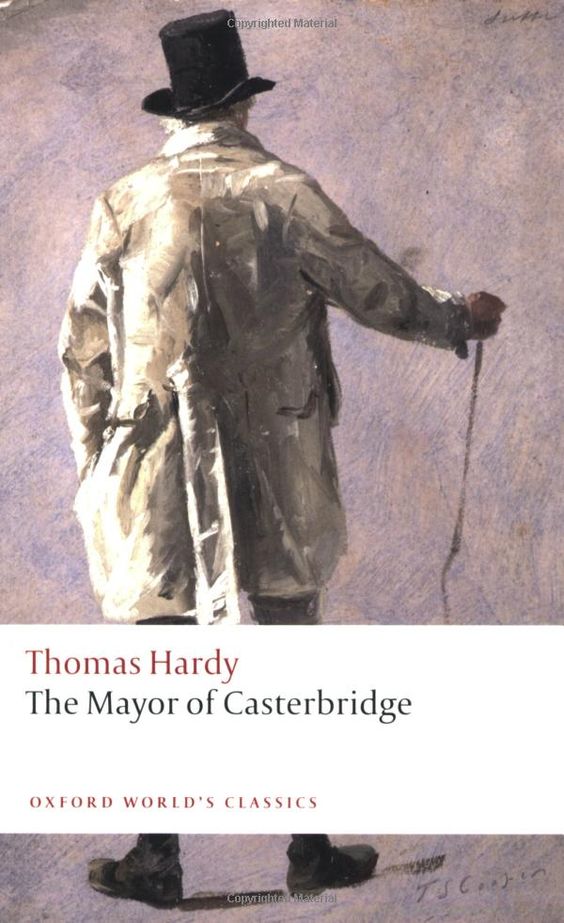
The best I can come up with his Michael Henchard from Thomas Hardy’s The Mayor of Casterbridge.

the-mayor-of-casterbridge

Henchard, in the likely case you haven’t read the novel, gets drunk and sells his wife and daughter to a sailor, awakens the next day, suffers remorse (a very un-Trumpian emotion), swears off hooch, builds a thriving business, goes into politics, and is elected mayor of Casterbridge.

Here’s Wikipedia’s patched together character analysis:

Henchard has a very impulsive temperament, although he also has a tendency to depression. He tends to take a sudden liking, or a sudden dislike, to other people and can be verbally aggressive even when sober. Henchard is respected in Casterbridge, having built up a strong business almost from nothing, but he is not well liked, and when he drinks, he can be abusive. Indeed, one of the reasons he does so well in business is because, after he sells his wife and child, he swears an oath not to touch alcohol for twenty-one years. When he decides Farfrae [a former business partner] is his enemy, he wages an economic war that, at first, is extremely one-sided. A risk-taker, Henchard eventually lets his personal grudge against Farfrae get in the way of his reasoning abilities. He takes too many risks, gambles too aggressively, and loses his credit, his business, and most of his fortune.

Nevertheless, although Henchard is exasperating, you somehow can identify with him.  You – or at least I – was terribly moved when I read Henchard’s last will and testament:

“That Elizabeth-Jane Farfrae be not told of my death, or made to grieve on account of me.

“& that I be not bury’d in consecrated ground.

“& that no sexton be asked to toll the bell.

“& that nobody is wished to see my dead body.

“& that no murners walk behind me at my funeral.

“& that no flours be planted on my grave,

“& that no man remember me.

“To this I put my name.

MICHAEL HENCHARD

To cut to the chase, Trump lacks the stature to be tragic and is too dangerous and mean-spirited to be truly comic.  Perhaps if we’re looking for a literary doppelganger, we’re better off searching comic books.  In fact, with his outrageous hair, orange complexion, and out-sized ego, Trump would make a fairly cool Batman villain.  The terrifying thing, of course, is just how close this Joker has come to being elected President of the United States.

trump_angry