Do the Mash Potato, Do the Alligator, Do the TS Eliot

This year’s Spoleto Festival features a potentially budget-busting array of popular musical choices. To wit, Mavis Staples, Patti Smith, Jeff Tweedy, Lucinda Williams, MJ Lenderman, Band of Horses, and Yo La Tengo. 

For the sake of solvency, I’ve limited myself to two performances, Patti Smith and Lucinda Williams. 

First up was Patti Smith, who appeared Wednesday at the Cistern, a splendid outdoor venue located on the College of Charleston’s campus.  

I love Patti Smith. Her injecting high art references into three chord rock inspired me back when I was a wastrel grad student in 1975, a mere half century ago.  The album was Horses, its cover photo shot by Robert Mapplethorpe, her housemate.  What I love about that record is its expansive allusiveness, its juxtaposing via a sonic collage high and low art, Rimbaud and Boney Maroney, bats with baby faces doing the Watusi like Bela Lugosi. But, most of all, what I love is that it rocks.[1]

In my old age, I purchase expensive concert tickets that put us way up front.  For Patti, my wife Caroline and I sat on the third row.  I was under the false impression that Patti might perform the songs of Horses in order, but she only sang one song from the album, “Redondo Beach,” a lilting reggae number whose light-hearted melody belies the lyrics’ first person account of a gay lover’s suicide. 

Why try to explain when you can listen to a snippet yourself.

Anyway, the concert was laidback, with Patti filling up deadtime with friendly anecdotes while her band tuned and retuned their instruments in Kingston-Jamaica-grade humidity. 

Caroline was blown away, and so was I, though I really would have loved it if she had included “Gloria,” a mash-up of the Van Morrison/Them classic and some badass self-assertion:

I walk in a room, you know I look so proud
I move in this here atmosphere where anything’s allowed
Then I go to this here party and I just get bored
Until I look out the window, see a sweet young thing
Humping on a parking meter, leaning on the parking meter 


Oh, she looks so good, oh, she looks so fine
And I’ve got this crazy feeling that I’m going to, ah-ah, make her mine.

G-L-O-R-I-A!!!

photo credit I-and-I

So tonight, we’re headed back to the Cistern to see Lucinda, which for me will be the third time.  She’s had a stroke, which she says affects her guitar playing, but I bet it hasn’t diminished that beautiful distinctive Southern vowel-rich hoarse voice of hers.

I certainly hope not.


[1] You can read a tribute to Patti by clicking HERE.

Sunday Evening Blues

Melancholy_ Wes (1894)

“Monday, Monday, just can’t trust that day,” sing the Mama and Papas, but T Bone Walker in “Stormy Monday” argues Tuesday is just as bad.

Not so for Steve Wright of the Easy Beats, who feels better on Tuesdays, claiming that “even my old man looks good.”

It’s Wednesday morning at five o’clock when that Beatles girl slips away from her parents to meet “a man from the Motortrade.”

Tripping on acid, Donovan claims “the gulls go willing spinning on Jersey Thursday,” referring not to the scavenger gulls of Asbury Park but to the ones of the isle between England and Normandy.

Again, the Easy Beats: “On Monday, I got Friday on my mind.”

Twenty-four hours later, Tom Waits is gassing her up, hand on the wheel, arm around his sweet one in his Oldsmobile, looking for the heart of a Saturday night.

That leaves the Christian sabbath, Sunday, Bloody, Sunday. Lucinda Williams and I can’t seem to make it through Sunday. [sigh]


Sunday Evening Blues


On Sunday nights

I remember

lying on the bottom bunk

in my pajamas,

wishing I’d done my homework,

listening to the stampeding notes

of Bonanza’s theme song

echoing from the den as I dreaded tomorrow.


In the stasis of quarantine,

it seems I should be able to shake

this chronic case

of the Sunday blues.


After all, Monday mornings don’t matter anymore.

I don’t need machines to measure minutes,

yet that childhood sadness endures,

indelible, resistant to erosion,

carved into the tombstones

of so many Sabbaths. [1]


[1] Yes, dammit, the shortening of each successive line of the last stanza is intentional.

Hank, Cormac, and Daddy

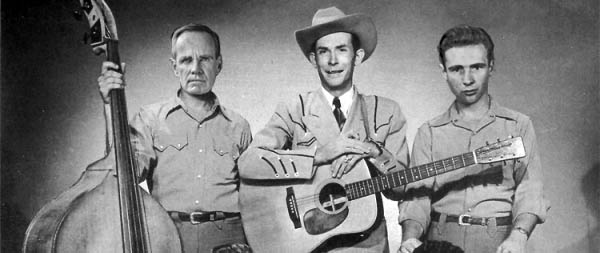
from left to right, Cormac McCarthy, Hank Williams, Sr., Wesley Moore, Jr.

“Scars have the strange power to remind us that our past is real.”

Cormac McCarthy, All the Pretty Horses


I want some old school raspy voiced chain-smoking musician from Alabama or Mississippi to write me a song called “Crushed Out Cigarette in Hank Williams’ Ashtray.”

Hank was high-strung, jittery, an ADD-riddled Cormac McCarthy. The glass ain’t half full with them two, and their assessment of the glass ain’t even as positive as half empty. The glass is half-empty and carcinogenic. [1]

I remember being a kid at The North-52 Drive-in with my parents and seeing the trailer for Your Cheating Heart, a biopic of Hank’s life starring George Hamilton with Hank Jr. providing the soundtrack vocals.[2] In the olden days, I’d have to describe the trailer for you based on my short-circuiting memory, but now you can see for yourself.


At the drive-in some of these scenes hit home a little too familiarly. In other words, I could relate. Like Hank, my daddy could be sweet and generous, but, like Hank, he had a fuse so short static electricity could set him off, especially if he’d been drinking, Nor was my daddy what you would call a feminist.

Like Hank, Daddy felt the urge to create. He rendered in shoe polish on our dining room wall a credible copy of the Elizabeth O’Neill Verner’s The Lesesne Gates, 14 Greene Street. Late in life, he sculpted gnomes, which weren’t nearly as good as the mural. Not only was he creative in the visual arts, he was also scientifically inventive. He received a patent for a sonar-operated weir for sewer treatment plants, but rather than selling the patent, he tried to manufacture the product himself and went broke.

I wish I had a photo of the wall, but I don’t think we ever owned a camera. The wall’s been painted over three or four times. I do have half of a gnome, though, which I keep hidden in the closet of my classroom. Because they were never baked, they eventually fell apart.

Hank’s works, however, survive and will as long as humans are around to strum guitars. His pain lives on in a meaningful way. Listen to Lucinda pass it along to us.


I raise my glass to dissonance, to sweet songs of sorrow, to Hank and Cormac and Daddy.

Wesley Edward Moore, Jr.


[1] To my ear “ain’t” is a lovely word with that mournful diphthong.

[2] Actually Hamilton looks more like Townes Van Zandt than he does Hank.