Emma Bovary Meets the Hardy Boys

Obviously, I’m a huge fan of the novel as a literary genre. Just the other day, I was explaining to someone at Chico Feo how literary novels can be treasure troves of vicarious experience because they feature lifelike characters who behave like real people.  These novels aren’t didactic, but by co-experiencing Emma Bovary’s tragic vanity, you might glean that fabricating a persona through conspicuous consumption is not the way to go. 

In other words, rather than discovering through personal experience that purchasing a vintage Rolls Royce Silver Shadow will likely destroy your credit and leave you destitute, you can witness rabid Emma’s spending sprees, yet not personally suffer the consequences of her foolhardiness.

Of course, part of Emma’s problem is that she mistook the romance novels she misread as real life, the way I misperceived the Long Ranger as real life when as a five year old in Biloxi, Mississippi, I leapt from the top of my chest of drawers onto a rocking horse that catapulted me face first on a wooden floor, a hard lesson (literally) in appreciating the difference between illusion and reality. If I had read about a fool boy doing that in a book, I never would have tried it myself.

As Laurence Perrine states in his wonderful textbook Literature, Sound, Structure, and Sense, “inexperienced readers” [of commercial fiction] want their stories to be mainly pleasant. Evil, danger, and misery may appear in them, but not in such a way that they need be taken really seriously or are felt to be oppressive or permanent.”  A steady diet of happy endings could inculcate in an unsophisticated reader (or movie goer) the misperception that things always work out.  

In other words, evil, danger, and misery need to be taken very seriously.[1]

Of course, the puritans, those “vice crusaders farting through silk,” who have taken over the schoolboards in our budding authoritarian state are aware of the potential for fiction to alter attitudes.  For example, reading a novel that portrays a gay teenager as a decent, sincere person doing her best to navigate the perilous journey of adolescence might suggest to a homophobic sixteen-year-old that gay people are worthy of respect and empathy. 

The vice crusaders certainly don’t want that.

Just for the hell of it, after rereading Jo Humphrey’s brilliant but under-appreciated novel Fireman’s Fair –set in the disorienting wreckage of post Hurricane Hugo Charleston – I switched to escapist fiction, and for the first time since I read it out loud to my sons, ripped through the Hardy Boys series’ first title The Tower Treasure.

Whereas Jo’s book featured an array of well-rounded characters, The Tower Treasure trots out a series of underdeveloped static, one-dimensional mouthpieces: the indulgent dad, ace detective Fenton Hardy, his wife, a homemaker who doesn’t merit a first name because all she does is make sandwiches, and the boys themselves, Joe and Frank, and their various “chums” and female friends.

(A sidenote to budding fiction writers: avoid elaborate dialogue tags like “‘You’re elected,’ the others chorused.'”[2])

Truth be told, I actually enjoyed The Tower Treasure, which, despite its flaws, boasts a fast-moving plot that creates temporary suspense, but I never feared that the one of the two helmetless boy detectives would crash his motorcycle and end up a paraplegic.

And, of course, the novel also offers sociological insights into the attitudes of White people in the early 20th century and how those attitudes changed as the series progressed through the decades, e.g., Mrs. Hardy’s earning a first name –– Laura –– and eventually working outside the home as research librarian.

Someone (but not me) should do a scholarly paper on how the Hardy Boys novels reflect the social mores of their times and how those changing mores are reflected in changes in the novels’ depiction of the white enclave of Bayport, a city in New York in some novels and New Jersey in others.

After all, the ways things are going here in the dumb-downed US, the Hardy Boys may replace Animal Farm as required reading.


[1] Just last week a cook a Chico Feo, Jorge, who had a valid visa and a green card, was apprehended by ICE as he played by the rules by visiting his immigration office. ICE handcuffed him and swept him away to god knows where.  I don’t foresee a series of hairbreadth escapes in his future but, rather, disorienting displacement, maltreatment, in sum, a horrible existence. A novel dramatizing his sad journey could offer insights into the human condition; however, although an action novel depicting his escaping might be fun to read, it would literally be escapism, a means to avoid our everyday humdrum. 

[2] That the six “youths” in the scene all “chorus” the exact phrase “you’re elected” is distracting and Hindenburgs my suspension of disbelief.
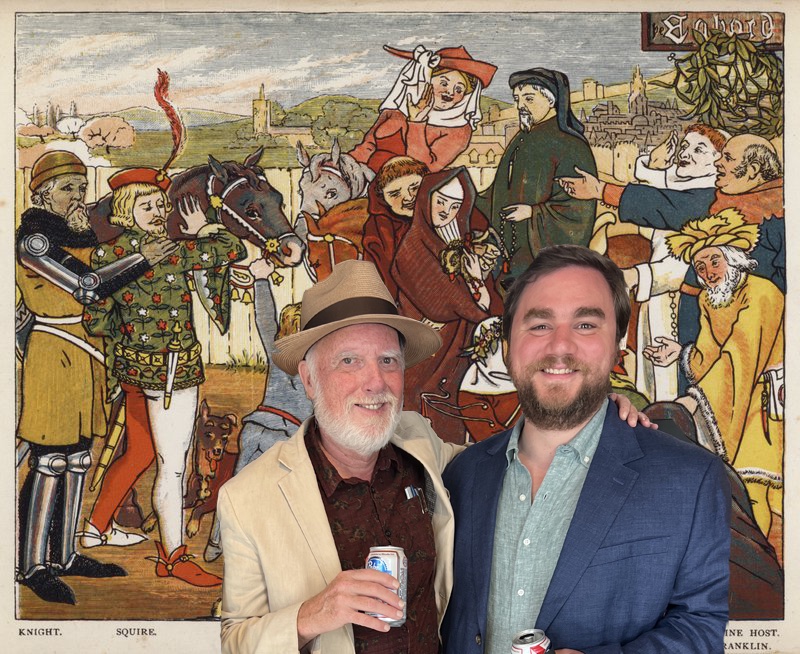

Alex Werrell’s Book Launch Intro for Long Ago Last Summer

My former student and forever friend Alex Werrell has, as my mother used to say, “a way with words.”  I discovered that talent when I taught him in an honors Brit Lit survey several years ago at Porter-Gaud School.  When we were reading Chaucer’s Canterbury Prologue, Alex, an opera buff, turned me on Alessandro Moreschi, “the last castrato.”  Chaucer hints that the Pardoner has been, as we callous pet owners say, “fixed.” 

No berd hadde he, ne nevere sholde have

As smothe it was as it were late y-shave

I trowe he were a geldyng or a mare.[1]

I explained to the horrified students that boys with beautiful voices were sometimes disencumbered of their testosterone-producing testicles to preserve the youthful timbre of their angelic voices, “a small price to pay for art’s sake,” I’d joke.

Playing Moreschi’s recording of “Ave Maria” became a tradition in my British Lit course. Forgive the cliche, but talons raking a blackboard would be a more pleasant sound. What a pleasure to watch the students squirm!

Alex ended up at Yale where he earned a BA and MA in English and became the mentee of the great literary critic Harold Bloom.  After Yale, Alex remained in New Haven, published essays in Salon, and taught, first at the Hopkins School, and now at Taft.

After I heard Alex deliver a masterful eulogy for his grandfather, I selfishly thought that, hey, I could tap him for my memorial service, but fortunately, by having him introduce me at the book launch for Long Ago Last Summer, I was able to hear him sing my praises while among the quick.

Forgive my vainglory in posting Alex’s speech below, but once a jackass, forever, a jackass (me, not Alex).  

After all, it’s not every day that you can applaud being called a “motherfucker.”

Take it away, Alex:

Bearing in mind my grandmother’s suggestion for any speech — all great orators should study Shakespeare, she said, and learn his most important lesson: “All’s Well That Ends” — I won’t catalogue all that Wesley Moore has written, taught, and done.

You’d need a TI-84 to add up the lives he molded, shaped, and changed — and if he were to receive royalties for every lesson plan of his that I’ve copied, this book launch would be in Mallorca. It is a gargantuan and daunting task to try to introduce this Renaissance raconteur, writer, poet, teacher, and philosopher king, so I’ll outsource the job responsibly and sustainably to Cecil Franklin, who was once asked by a reporter to describe his little sister: “Call Aretha a great blues singer and you’re telling the truth. Call her a great gospel singer and no one will argue. Call her a great jazz singer and the greatest jazz artists will agree. Bottom line—she’s all three at once. And in the language of the jazzman, that’s what’s called a motherfucker.”

Wesley Moore is all that and more.

His latest work is a testament to that Long Ago Last Summer transports and transforms, synthesizes and sympathizes; short fiction gives way to essays which inspire poetry and deep, graceful swan dives into memory.

Like a casserole in the Donner Pass, this “Southern Gothic gumbo” has a lot of himself mixed in. Given that, one of the many reasons why Long Ago Last Summer is brilliant is that it is precisely the opposite of that scourge of modern texts, generative AI. And while talking about generative AI at a book launch feels a bit like reading “The Ballad of Hollis Brown” at a baby shower, that menacing technology walks among us now. Like one of the foundational sins coursing through the Southern Gothic, AI perverts creation and devalues the human; the fullness of what it means to be a human does not matter half as much as mere production, production, production. In dramatic contrast, Long Ago Last Summer is a thrillingly human book because Wesley Moore stands for what matters: connection, imagination, integrity.

Searching for the book on Amazon — (And, please, gracious hosts: this was for research purposes only; the only destination wedding I want for Jeff Bezos is at the bottom of the ocean.) — I wanted to see what the heartless algorithm might suggest as “related books.” One was Walter Isaacson’s biography of Einstein which, given Mr. Moore’s excellent lessons on relativity and cultural Modernism, seemed fitting. Then there was Rhinestone Cowboy, Glen Campbell’s autobiography. I don’t have an explanation for that one.

What might the algorithm consider when determining whether to recommend Long Ago Last Summer to a prospective reader? It could be something as simple as geolocation: did this person grow up within twenty miles of a filling station that offers both diesel and barbecue? Or maybe it’s that stray google search for city ordinances concerning the accidental murder of a domestic cat. Maybe it’s looking up sterling silver hallmarks of the Confederacy and then looking up statutes of limitations for stolen Confederate silver. Or maybe it’s trying to find higher resolution images of Pee Wee Gaskins.

While the algorithm is good at pushing polyester blends off of Temu, I have a feeling it would struggle with Wesley Moore’s newest book. In no small part that’s because it’s hard to categorize. As Wesley himself said on television, “It’s really not a novel.” 

In 1925, as she was struggling to write To the Lighthouse, Virginia Woolf found herself frustrated. Writing in her diary that she needed “a new name” for her books “to supplant ‘novel,’” Woolf floundered about trying to find the right word: “A new — — by Virginia Woolf. But what?” she writes.

The word Woolf ends up on is “elegy” — a word that feels fitting for this book. To be clear, this is not because, as Mr. Moore says, he’s retired and living on a fixed income, nor is it even because of biplane rotors and headless fathers and tubercular aunts.

Instead, it feels so fitting to me because Mr. Moore spent so many classes in English 10 on such poems, insisting that we memorize Blackburn Hughes’s list of the four “greatest English elegies.” To help us in that endeavor, Mr. Moore demonstrated the rhythmic swish-swish of Gray’s heroic quatrains with an epee. Doing his best impression of Stevie Wonder’s star role in the John Milton biopic, Mr. Moore recited bits of Lycidas. And, in his Lowcountry baritone, he intoned Tennyson’s In Memoriam.

Elegy is no stranger to anyone who has grown up in the South. An elegy has but one requirement: it must defy the laws of linear temporality, enabling the past to persist. Time becomes fluid; what for Tennessee Williams was Suddenly, Last Summer, unbearably close, is, for Mr. Moore, Long Ago Last Summer, unbearably distant. The reversal that so haunts Flannery O’Connor’s Misfit — Jesus’s setting the world off balance, taking dead Lazarus and making him walk like a natural man — is the foundation of elegy: a reversible alternation between presence and absence. Reflecting on Mrs. Ramsay in To the Lighthouse, Vanessa Bell writes to her sister Virginia how “it is almost painful to have [Mother] so raised from the dead.” Milton ends Lycidas with talk not of yesterday and of death, but of “To-morrow” and “pastures new.” Reading through the night the letters Arthur Henry Hallam wrote him, Tennyson finds himself surprised by dawn — and, in a flash, understands that “East and West” had “mixt their dim lights, like life and death, / to broaden into boundless day.”

The fourth great elegy is “Adonaïs, “written by Percy Shelley for John Keats, who died in an apartment overlooking the Spanish Steps in Rome, hemorrhaging up what little remained of his lungs at only 25.

Mr. Moore’s voice always took on a different timbre when he read to us Keats and Shelley. I cannot read their poems without feeling as if I’m back in his classroom — wind-up nuns, Rashaan, paleological timeline and all. His humanity and his teaching have become grafted to the Young Romantics in my mind’s eye. Throughout their poetry are traces of birdsong, so precious and so vital to both short-lived poets — and so like the traces of Judy Birdsong, so precious and so vital, in this work in front of us.

Shelley, mourning Keats, likens life to a “dome of many-colored glass” that “stains the white radiance of Eternity.” The many pieces of colored glass lovingly assembled here — with Caroline’s steady hand, keen eye, and beautiful verse — are aptly described by the author as a “mosaic” of his life. 

The glue that binds these pieces — the guide for navigating the disparate stories, poems, and essays — is memory. “Memory…ties it all together.”

In the spirit of elegy and memory, I’ll close with some words from Mr. Moore’s former colleague Erica Lesesne, who once defined what it meant to be a hero: “Ethical, competent, non-judgmental, yet communicating high ideals and expectations, thereby influencing others to risk their own best sides in a seethingly adolescent environment.” 

It is a pleasure to introduce one of my heroes, Mr. Moore. As he writes, “Let’s crank up the old Victrola.”


[1] No beard had he, nor was meant to have,

It was smooth as if he’s just shaved;

I think he was a gelding or mare.

Ten Literary Riddles

Hoodoo Headquarters

Hoodoo Headquarters

Back in the late 80’s, when academics were more demanding where I teach, I included a section on my exam called “Association.” Students had to match a character or work they had read that semester with an enigmatic phrase I provided — only there was nothing to match the phrase to, no list of possible choices. When they complained, I told them all they needed to do was to read my mind.

Of course, no way I get away with something like that nowadays. Parent-piloted Blackhawks would be raining rockets on my drafty garret, Hoodoo Headquarters.

Just for fun, though, I thought I’d recreate “Association” for this post. See if you can identify these novels, plays, or long poems.  Of course, it’s going to be harder for you since your choices aren’t confined to a limited number of works you’ve read in the last five months.

1. Libidinous Lydia’s Lucky Elopement

2. Doing Dublin in a Day from St Stephen’s to the Quay

3. Idiot Tale, Tick-Tock-Not, Red Neck Rambles, House in Shambles

4.  Loon River, Longer Than a Mile, Portal Through Time, Jungle Fever

5.  Un-Moored, Senator’s Daughter Couldn’t Be Any Poorer, According to O’Connor

6.  Mama’s Boy Outwits Catty Riddler, Wins Crown, Then Goes Down, Down, Down

7.  Echo Chamber: April showers, Tarot readings, Demobbed Husbands, and Neurotic Pleadings.

8.  Jake Lost His Snake in a Trench So He Drinks.

9.  The Black Cat in This Story Is, like, a HG Wells No Show.

10.  Ch-Ch-Changes: Model Son Turns Out to Be a Pest.

Hints: Two plays, five novels, two novellas, one poem. Authors’ home turfs:

Ireland, Germany, USA, Greece, England.

Answers

1.  Pride and Prejudice:  15-year-old Lydia’s elopement with Wickham provides Darcy the opportunity to save the Bennet family from ignominy and bring about the twin marriages that bow ties the novel with the very happiest of endings.

2.  Ulysses: On 16 June 1904 Joyce covers all of Dublin, from St. Stephen’s Green to the quays.

3.  The Sound and the Fury:  Part One is literally narrated by an the idiot, Maury/Benjy; Part Two features Quentin’s yanking the hands off of his great-grandfather’s pocket watch; Part 3 is a tale told by a Southern bigot; Part Four completes the Fall of the House of Compson.

4.  Heart of Darkness.

5.  Othello:  Note Moor is capitalized. Othello’s wife Desdemona is the daughter of a Senator, and Flannery O’Connor perhaps not-so-famiously said, “You can’t be any poorer than dead,”  which Othello and Desdemona are at the end of the play.

6.  Oedipus Rex:  After killing  the king his daddy in a fit of road rage, Poor Eddie answers the Sphinx’s riddle, becomes the king of Thebes, marries his mama, and goes down, down, down.

7.  The Waste Land:  It’s an echo chamber of allusions. Here are specific references in the riddle: The first line of TWL is “April is the cruelest month.”  There’s a Tarot reading in “The Burial of the Dead” section.  From “The Game of Chess:” we get “When Lil’s husband got demobbed, I said.”  Also, finally there are several  lines spoken by a hysterical woman.  E.g.,   “What are you thinking,  What thinking?  Think.”.

8.  The Sun Also Rises.  Jake Barnes loses unspecified parts of his reproductive system during WWI and spends the course of the novel easing his pain via alcohol.

9.  Ralph Ellison’s The Invisible Man shares the same title of HG Well’s novel, only the protagonist of Ellison’s novel is black and not literally invisible.

10.  The Metamorphosis:  Gregor Samsa, a dutiful son, metamorphoses into an noxious insect (and not because he had received vaccinations),