Heeding Andrew Marvell

Heeding Andrew Marvell

Thus, though we cannot make our sun 

Stand still, yet we will make him run.

                                    Andrew Marvell – from “To His Coy Mistress”

One of the entries in the epic catalog of my character flaws is a lotus-eater-grade tendency towards lassitude, which I’ve written about HERE.

However, in the last two weeks I’ve been on the go-go-go, on a tear – touring Mexico City, hosting family and friends, signing books, reading from Today, Oh Boy at its book launch, attending the reading of an original play in a private home, and dancing to the music of the Krushtones.[1]

Mexico City

Caroline had booked the trip before we discovered that T,OB‘s publication date was to be 31 March, the day before our departure. Buxton Books scheduled the launch for 11 April, so the trip didn’t interfere with promotion.[2] On the other hand, ex-pat son Ned booked a flight to Charleston that arrived on 4 April, three days before my scheduled return, so I came back a day early while Caroline and Brooks stayed on in Mexico City, which is 2000 miles higher than Denver, the Mile High City. Hey, but none of us suffered any altitude sickness, so praise Huitzilopochtli!

We traveled with Celeste Joye and her husband Tom Foster and their daughter Juliette. The short-term rental they had booked was a falsely promoted malodorous, sofa-stained apartment without hot water. The rental is located the floor below at kick-boxing studio where a cousin of Cujo barked ferociously.  

Not succumbing to the languor that would have me holding my nose (literally) and staying there all week, Celeste and Caroline scouted out new digs, called and cancelled, and we ended up staying at the swank Camino Real, which boasts a 007 early-60s vibe.

When I travel, my above-mentioned lassitude demands that I engage in only two tourist activities a day, one mid-morning and one after lunch; however, Celeste, Tom, and Caroline were go-getters, and the days and nights were filled with sight-seeing which featured a guided tour of Aztec ruins and a guided tour of Museo Nacional Antropologia.[3]
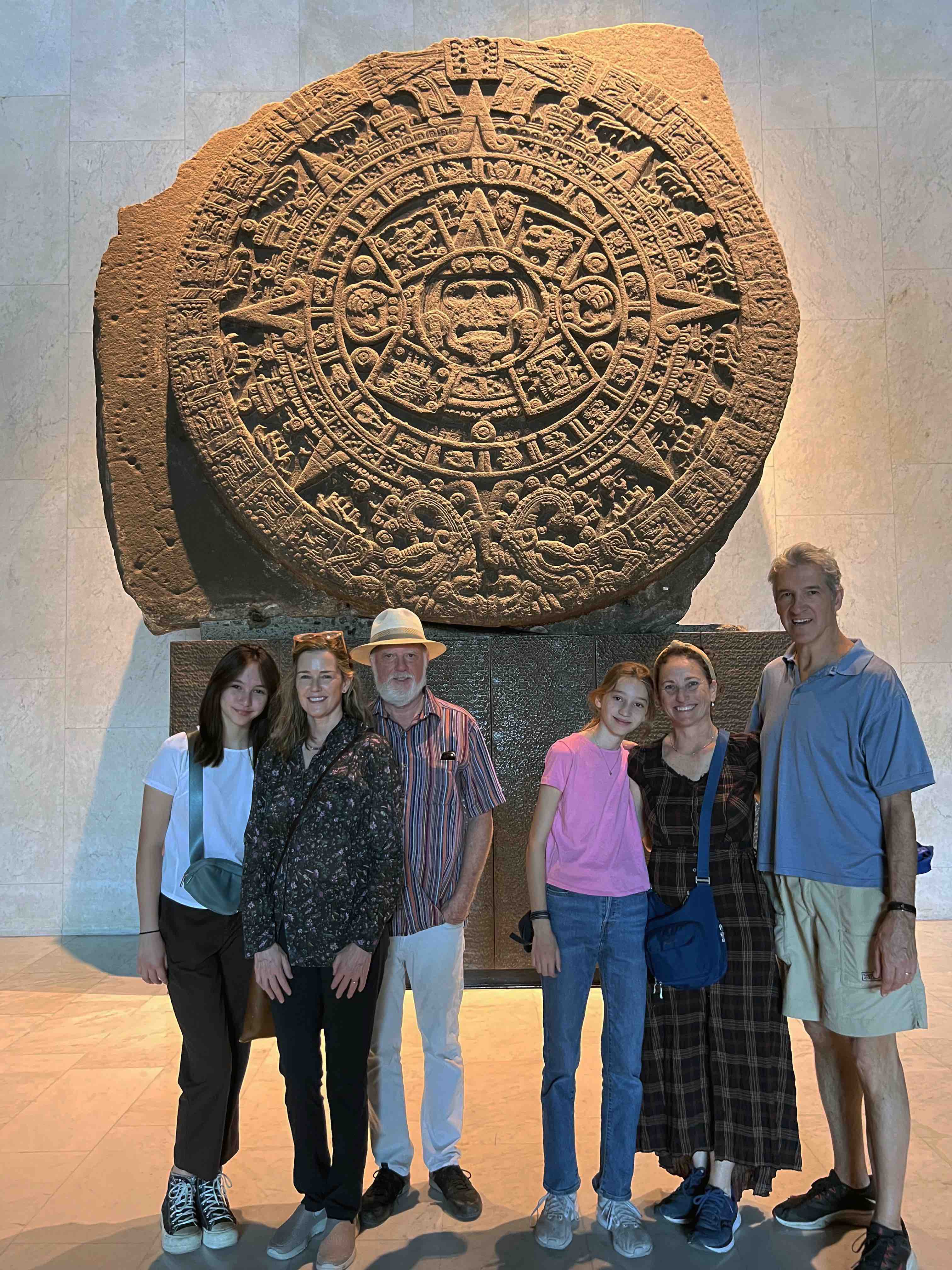
We also ate a various top tier restaurants, had drinks at Tenampa, a mariachi bar, and saw the Ballet Folklórico perform in a beautiful performing arts center.

But, as Andrew Marvell was wont to point out, all good things must end.[4]

Hosting my Family

Last week was the first time that my two sons had been home at the same time since 2018 – Harrison, his wife Taryn, her mother Susan, and grand-toddler Julian rented a house on Folly, and Ned and his love Ina came all the way from Nuremberg and stayed with his at 516 East Huron.

Also, I had the pleasure of having lunch with a childhood friend John Walton whose mother and my mother were best friends growing up and always.

But dammit, but that too had to end with Harrison and crew flying out Wednesday and Ned and Ina Friday.

The Book Launch[5]

I’ve already gone on enough about the launch. The curious can access the reading HERE if they have “world enough and time.”

Seeing Is Believing 

The indefatigable Eugene Platt and his wife Judith hosted a soiree of sorts in which a cast of seven or so readers performed his play-in-progress Seeing Is Believing. Based on the account in the Gospel of John, the play is set post-resurrection and consists largely of Andrew and Thomas walking to a “safe house’ where Jesus appears and puts a screeching halt to Thomas’s skepticism. 

If I were Eugene, I’d produce it as a film instead of trying to get it produced as a play. Staging a fifteen-minute walk would be challenging, but you could really do some interesting things on film.

I bet some religious-minded film student at SCAD would find it interesting.

The Krushtones

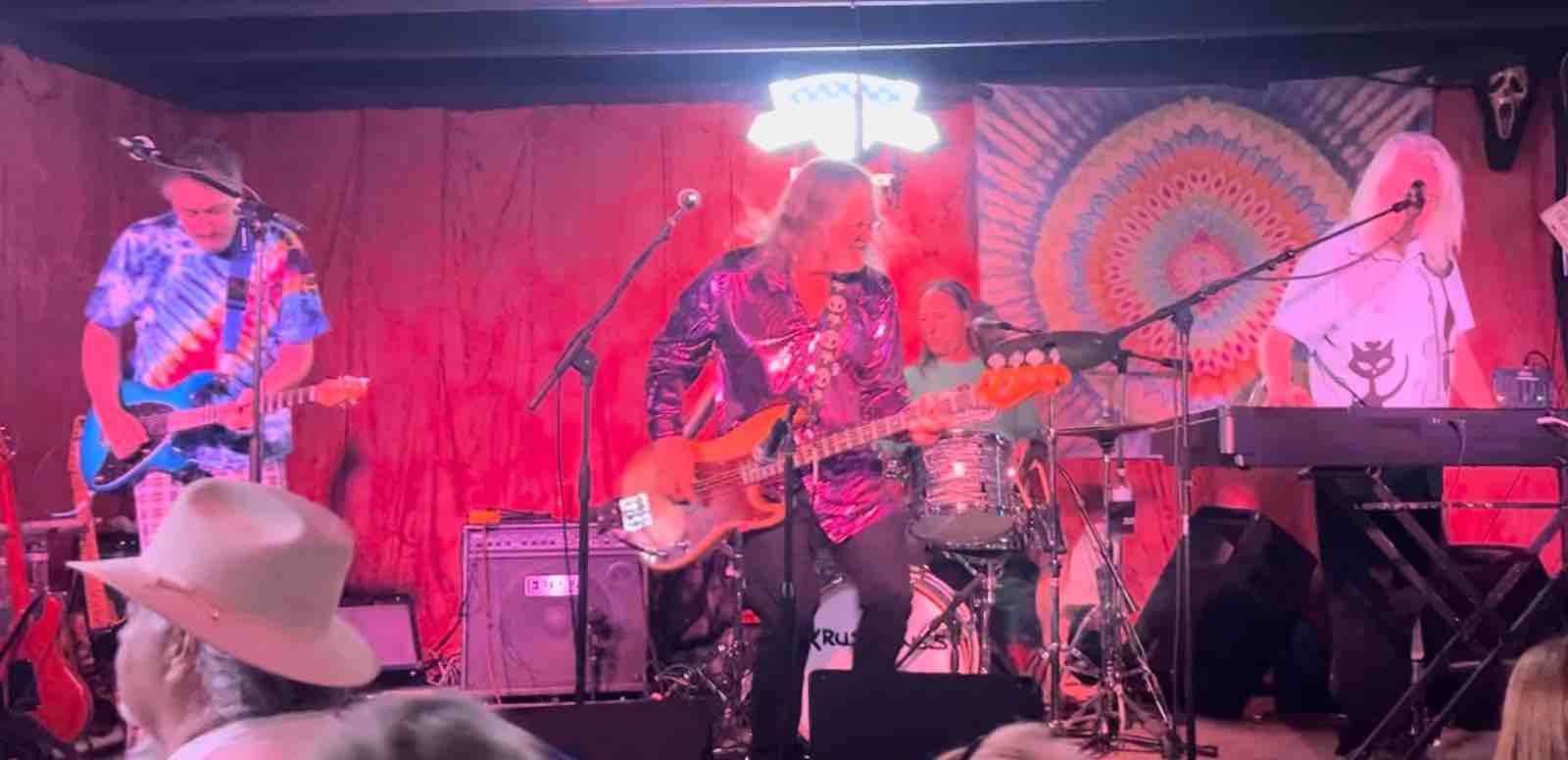
What can I but enumerate old themes? I love me some Krushtones, who play at the Sand Dollar around 15 April every year. I couldn’t believe how fresh and practiced they sounded.

If you’re interested in learning more about this killer cover band and the Sand Dollar Social Club, click HERE.
THE END

Sometimes, Mr. Marvell, endings aren’t all bad. For example, I’ve finished writing the first draft of this blog post, and my dear readers have finished reading it and can get going on something more productive, because, as you have pointed out so eloquently: 

 [. . .] all before us lie/ Deserts of vast eternity.

So, carpe diem, y’all. Hubba-hubba-hubba, swish-boom-ba-ba-ba-ba-Barbara Ann.


[1] Not to mention doing our taxes.

[2] After zooming to number 570 on Amazon’s Young Adult and Teen Historical Fiction category, it’s now dropped into the 900s. C’mon people. I’m a senior citizen on a fixed income!

[3] I’ve been told my Spanish accent isn’t terrific. BTW, I’ve never been much for guided tours, but I must admit you learn a helluva lot more.

[4] E.g., “The grave’s a fine and private place/ But none, I think, do there embrace.”

[5] Thank you, Polly and Julian Buxton!

The Krushtones + The Sand Dollar Social Club = Federico Fellini

The Sound Track

One of the most pleasurable rites of spring celebrated in the Lowcountry each year occurs at the Sand Dollar Social Club on Folly Beach when the Krushtones take the stage for their annual April gig.  

[Cue country preacher]: We’re talking glorification, brothers and sisters, talking bout light!

Krush-tones: (krùsh– tõns)  n. a band that features high-Watt[s] drumming; a bodacious bottom; a searing, eloquent guitar; and  a latter day Jerry Lee Lewis on keyboards.   

Joyous!  

I swear, even if they were a mediocre band, the Krushtones’ taste is so exquisite I’d pay to hear the song sets. Al Green/ Talking Heads, the Beatles, Stones, Chuck Berry.  But mediocre they ain’t.  They exude this palatable vibe of happiness that spreads in concentric circles as if a pearl has been dropped into a pool of sound.  

Make you want to dance and holler hallelujah!

The Sand Dollar itself is difficult to categorize.  As a private social club, it offers all of the exclusiveness of a subway station.  One dollar secures you a year’s membership, but you can’t actually enter the club until 24 hours after your card has been issued.  A typical Friday and Saturday night offers free live music, canned beer for a buck, and and an eclectic clientele that, depending on the vibe the night you happen to be there, ranges from Felliniesque to Lynchian.  

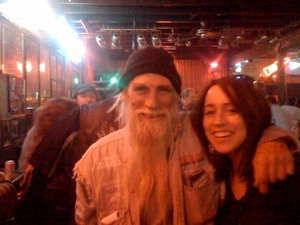
Bikers comprise a large contingent of the revelers, parking their Harleys (I don’t think I’ve ever seen a BMW) perilously close together out front like a chorus line of internally combustive Rockettes.  I dread the day some reeling rummy trips and sets them crashing domino style one after the other. Years ago, before the bikers arrived, I had parked my VW minibus just in front of the designated space.  When JB and I left for home, I was horrified to see at least twenty Harleys lined up about six inches from my back bumper and another car looming about a foot from my front bumper.  Luckily, the fellow pictured below, a regular, helped me successfully to negotiate the scores of gear shifts, wheel turns, and progressions/reversals that liberated me from that straitened space.

Joining the bikers as a discernible group are the long-in-the-tooth dead-end hedonists, who can be subdivided into old hippies and old shaggers.  These sybarites, who hated each other in high school  (the former letting their freak flag[s] fly, the latter sliding sockless feet into their Bass Weejuns) have mellowed over the years and appreciate each other in their shared ethos of self-medication and the never ending but increasingly difficult quest of getting laid.                

A calico combination of others rounds out the squad – attractive, young preppies; South of Broad slummers; working folk shooting pool; the occasional bombastic prophet-of-doom blogger. 

Lynchian vis-a-vis Felliniesque 

What’s the distinction, you may wonder, between these two cinematic adjectives denoting surrealism?  

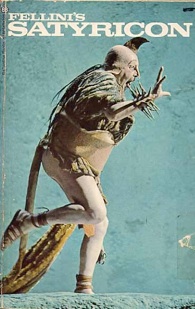
Although baroque, Fellini’s surrealism tends towards the comic/satiric.  His Satyricon, for example, counterbalances sensuous  shots with grotesque images of Late Empire overindulgence.  Carnivalesque might be an appropriate approximation. 

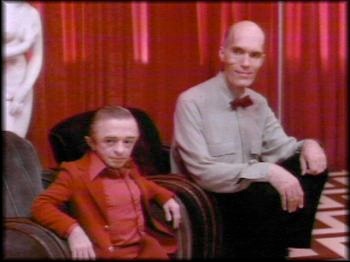
Lynch’s surrealism is darker, a world of evil where the hideous co-mingle with grotesquely bland clichés of Americana, a la the image of above, where the sinister red-clad midget sits beside someone who looks like he may be employed as a hardware store clerk in a Norman Rockwell painting or the son of the couple depicted in Grant Wood’s American Gothic.  Kafkalite-ish.

If I had to choose between the hellish dilemma of spending eternity in a Fellini film or a Lynch film, I’d definitely opt for the former.  Underneath all of the grotesqueness of Fellini lies a positive procreative impulse. Take “The Widow of Ephesus” segment of The Satyricon, for example, where  a woman who has decided to starve herself in her husband’s tomb is seduced by a soldier guarding crucified corpses.  

Now that’s what I call pro life.

Lynch, on the other hand, is anti-life.  Not that his films aren’t hugely enjoyable and laugh- out-loud funny.  Nevertheless, like the parents in Eraserhead, procreation begets monstrosity.  You don’t want to bring a child into David Lynch’s world.

In short, a Felliniesque evening at the Sand Dollar is more pleasurable Lynchian evening, 

Friday, 9 April 2010 

I’m not making this up.  During the Krushtones’ first set, I witnessed the departure of one of Charleston’s wealthiest septuagenarians and his seeing-eye trophy wife.  She, a blonde, a head taller and thirty years younger, held his hand mommy-like as she led him through the throng.  As they were leaving, three female dwarves dressed to the nines flowed past them and took their place at the corner of the stage.  I repeat, I’m not making this up.

Lynchian or Felliniesque?

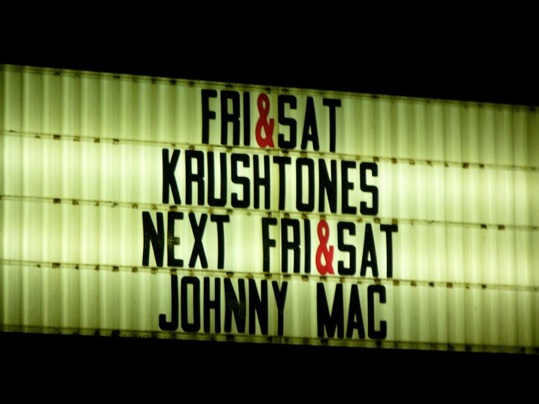
If Johnny Mac had been playing that night, a man deeply in love with the sound of his own guitar, or Jeannie Wiggins, thumping serviceable rock to her adoring groupies, the karma might have darkened the brain chemistry that ultimately determines the existential nature of my world.  However, with the Krushtones on stage, beaming, jumping, singing “Lady Madonna,”  the positive vibration was infectious.  Even the stern-faced bouncer who looks like the promotional US Marine of recruitment commercials cracked a smile.

Too bad the Krushtones were too young to play at Altamont.