James, Huck, and James McBride: A Review of Percival Everett’s “James”

After reading Dwight Garner’s laudatory review of Percival Everett’s James, I was eager to check it out, especially since I’m a huge fan of Huckleberry Finn

Here’s a snippet of Garner’s paean:

Percival Everett’s majestic new novel, James, goes several steps further. Everett flips the perspective on the events in Huckleberry Finn. He gives us the story as a coolly electric first-person narrative in the voice of Jim, the novel’s enslaved runaway. The pair’s adventures on the raft as it twisted down the Mississippi River were largely, from Huck’s perspective, larks. From Jim’s — excuse me, James’s — point of view, nearly every second is deadly serious. We recall that Jim told Huck, in Twain’s novel, that he was quite done with “adventures.”

Garner goes on to say, “This s Everett’s most thrilling novel, but also his most soulful.”

Alas, when reading James, I was never able to suspend my disbelief, to lose myself in the flow of action and forget that the narrative I was reading was a fictive construction. In his retelling of Huckleberry Finn from the perspective of Jim, Everett creates the conceit that the antebellum argot of slaves, the “Else’n they takes you to the post and whips ya[s]” is a linguistic ruse to appease the white population by making them feel superior. The narrator James (aka Jim) speaks (and thinks) in English so standard that he uses “one” instead of “you.”  In short, for me the novel is a contrivance; it’s created in a way that seems artificial and unrealistic.

Everett’s relating the events from James’ perspective in easy-to-decipher prose makes a lot of practical sense; however, the regionless diction of the retelling of Jim and Huck’s escape robs Jim of a breathing individual’s voice –– he could be from 21st Century Dayton, Ohio –– there are no quirks in his phraseology, no flashes of individuality, few regional linguistic markers, which divorces him from time and place and therefore relegates him into the status of a character in a novel rather than a person whom we believe is real. 

That said, Everett does an outstanding job of effectively depicting the horrors of slavery, the never-ending degradation, the perennial fear of having your family disbanded, the horrors of being horsewhipped, the constant verbal abuse. And the novel, especially after James hooks up with a minstrel show, becomes a real page turner, a sort of thriller with cliffhanging chapter endings as he and Huck manage a series of hairbreadth escapes a la The Perils of Pauline. Everett also creates a rich array of colorful characters that you care enough to keep reading, though you might grow a bit weary of the episodic nature of the plot bequeathed by Clemons. 

I couldn’t help unfavorably comparing James to James McBride’s The Good Lord Bird, which is also narrated by a slave, Little Onion, who is “liberated” by the historical abolitionist John Brown.  

Here’s Little Onion describing his liberator:

The old face, crinkled and dented with canals running every which way, pushed and shoved up against itself for a while, till a big old smile busted out from beneath ’em all, and his grey eyes fairly glowed. It was the first time I ever saw him smile free. A true smile. It was like looking at the face of God. And I knowed then, for the first time, that him being the person to lead the colored to freedom weren’t no lunacy. It was something he knowed true inside him. I saw it clear for the first time. I knowed then, too, that he knowed what I was – from the very first.

This is a person talking, not the idea of a person talking, which creates a depth of character that James lacks.

Compare McBride’s description with this: 

I was afraid of the men, but I was considerably more afraid of the dogs I’d heard coming our way. I could only imagine that they were after me, and so I was left confused by the presence of these two white men in our boat. Adding to the absurdity was the fact that they were opposite in nearly every way. The older man was very tall and gaunt, while the younger was nearly as short as Huck and fat. The younger had a head full of dark hair. The older was completely bald.

That’s not what I would call “cooly electric first person narrative.” In fact, when I taught composition, I would not allow my students to use the phrase “was the fact that.”

But, hey, look, as I’ve said elsewhere and often, writing a novel is a very difficult undertaking, and James is well worth reading, even though it falls short of my censorious standards for the high praise it has received.  It’s an audacious effort to reconfigure the novel that Hemingway credited with being the root of “all American literature.”  Also, the idea of seeing Huck’s world from Jim’s perspective is existentially cool, underscoring Hamlet’s observation that “There is nothing either good or bad but thinking makes it so.” 

I’d give it a B+ overall.

Sickroom Notes from a Whiny, Wounded Epicurean

painting by H. James Hoff

Sickroom Notes from a Whiny, Wounded Epicurean[1]

Perhaps boasting non-stop about my superhuman immune system for the last thirty years wasn’t all that judicious. Oh, you should have heard my cock-a-doodle-doing![2].

My immune system makes Arnold Schwarzenegger look like Denver Pyle.

I haven’t been ill since the fall of the Berlin Wall.

An airborne virus does a one-eighty when it sees me bopping down the boulevard, etc. 

And it’s true that in my thirty-four years at Porter-Gaud, I maybe missed ten or so days in total, most often because of laryngitis.[3]

Well, comeuppance has arrived, taken off his mask, and sneezed in my face. For the last four days, when it comes to coughing fits, I’ve been giving tubercular John Keats and DH Lawrence a run for their money. Although doubly vaccinated, I drove the day before yesterday for a Covid test, which unsurprisingly was negative. Afterwards, I retreated to bed, ministered to by nurse Caroline, who throughout my malady has plied me with chicken broth, hot tea, and good advice, like not going the Singer/Soapbox Open Mic the previous Monday[4]

Let’s face it: a summer cold isn’t exactly kidney stones or a case of the shingles (not to mention bone cancer), so the source of this whine festival lies not so much in physical discomfort but in the boredom I’ve experienced, borderline ennui. I felt so drained Wednesday afternoon, I couldn’t read anything longer than a tweet, and scrolling down my feed is disheartening, with all that talk of the decline of democracy coming from the likes of Steve Schmidt and Bill Kristol. And I have two books I’m rarin’ to read, Peter Guralnick’s Looking to Get Lost: Adventures in Music and Writing and James McBride’s The Good Lord Bird, which until today lay on my bedside table like a couple of concrete blocks, heavy, cumbersome. Petite misère but for a second or two, misery nonetheless.

But, hey, I must be on the mend because I’m sitting at my desk and taking this opportunity to roll my right foot over a frozen water bottle to combat a king hell case of plantar fasciitis I’ve developed walking to and from bars on Folly Beach in flip flops.

Like they, say, there’s no fool like an aged, wounded epicurean.

still from WF Murnau’s film The Last Laugh


[1] No one can accuse me of click-baiting with that title.

[2] And no doubt you have if you know me personally.

[3] I also took a couple of personal days along the way, one to see the third game of the ’91 World Series, another to see the Stones in Columbia, and several during my late wife’s last week.

Missing school is a drag. It’s more work to miss than to trudge through (and I never got close enough to students infect, I’d like to think).

[4] I’d made a solemn promise to Kelly West I’d be there for her debut poem, and who would break a solemn vow because of what at that time was merely a scratchy throat?

Rockin’ in the Projects

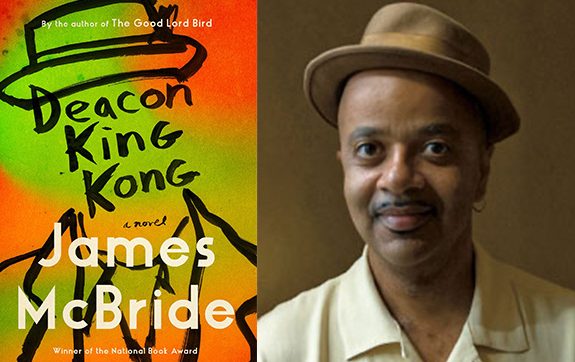
After finishing James McBride’s Deacon King Kong, I’m rechristening the author Zora Neale Samuel Clemens Brer Fox McBride.[1] Not OMG! But Do Lawd! What a blast – jazz riffing Gullah-lite, not indiscriminately slung but fashioned into a plot that, though somewhat improbable in its tidy tying up at the end, delineates a complicated saga populated by characters we care enough about to shed tears. 

Even if the story hadn’t moved me, I would have kept reading for the sheer pleasure of its sentences.

Here are three:

“She was coming off her once-a-year sin jamboree, an all-night, two-fisted- booze-guzzling, swig-faced affair of delicious tongue-in-groove-licking and love-smacking with her sometimes boyfriend, Hot Sausage, until Sausage withdrew from the festivities for lack of endurance.” 

“After practice on lazy summer afternoons, he’d gather the kids around and tell stories about baseball players long dead, players from the old Negro leagues with names that sounded like brands of candy: Cool Papa Bell, Golly Honey Gibson, Smooth Rube Foster, Bullet Rogan, guys who knocked the ball five hundred feet high into the hot August air at some ballpark far away down south someplace, the stories soaring high over their heads, over the harbor, over their dirty baseball field, past the rude, red-hot projects where they lived.”

And then this masterpiece:

“And there they stayed, a sole phenomenon in the Republic of Brooklyn, where cats hollered like people, dogs ate their own feces, aunties chain-smoked and died at 102, a kid named Spike Lee saw God, the ghosts of the departed Dodgers soaked up all possibility of new hope, and penniless desperation ruled the lives of suckers too black or too poor to leave, while in Manhattan the buses ran on time, the lights never went out, the death of a single white child in a traffic accident was a page one story, while phony versions of black and Latino life ruled the Broadway roost, making white writers rich – West Side StoryPorgy & BessPurlie Victorious – and on it went, the whole business of the white man’s reality lumping together like a giant, lopsided snowball, the Great American Myth, the Big Apple, the Big Kahuna, the City That Never Sleeps, while blacks and Latinos who cleaned apartments and dragged out the trash and made the music and filled the jails with sorrow slept the sleep of the invisible and functioned as local color.”[2]

Ultimately, Deacon King Kong is a comic novel, which provides McBride some leeway when it comes to implausibility. Moreover, it takes place among a community of believers, which is a prerequisite for magic realism. Some of the best dialogue comes from the protagonist Deacon Cuffy Jasper Lambkin[3] (aka Sportscoat) and the ghost of his wife Hettie, who naggingly haunts him throughout the novel, despite her having drowned two years before the action begins.

“Well, Hettie, if I weren’t taking that white man’s good hundred dollars on principle, I surely ain’t gonna take no mess from you ‘bout some fourteen dollars and nine pennies you done squirreled up in Christmas Club money and hid someplace.”

You’re not going to find ghosts or a systematic invasion of ants in The Stranger.

***

I suppose some plot summary is in order. Deacon King Kong is set in 1969 in Causeway Housing Projects in South Brooklyn with the majority of the characters members of the Five Ends Baptist Church. Sportscoat, drunk as a coot on a potent moonshine known as King Kong, stumbles into the project courtyard and shoots Deems Clemens[4] with an antiquated .38 pistol. Back in the day, Sportscoat taught Deems Sunday School and coached him in baseball.  Deems had been a bone fide big league prospect before he abandoned that escape route for the easy money of drug trafficking. Smart, strategic, Deems is a force to be reckoned with, compassionate despite the heroin trafficking and its at its attendant horrors.

Damn, this summarizing is way too hard. I’m gonna cop out and quote the back cover.

“McBride brings to vivid life the people affected by the shooting: the victim, the African American and Latinx residents who witnessed it, the local cops assigned to investigate, the members of Five Ends Baptist Church where Sportscoat was deacon, the neighborhood’s Italian mobsters, and Sportscoat himself.”

Ultimately, it’s a novel of redemption, a glorious amalgam of love and violence, greed and generosity, teeming with vibrant characters who do justice to the human race. It’s easily the most enjoyable piece of long fiction I’ve read since Infinite Jest, which means it’s most enjoyable novel I’ve read in a quarter of a century, the most enjoyable novel I’ve read this century.

Do yourself a favor and go check it out.


[1] Kudos to former student Rachel Lauren Wolf for turning me on to this gem she described as “a cross between Flannery O’Connor and Gabriel Garcia Marquez.”

[2] As my wife Caroline is wont to say, “Bartender, I’ll have what he’s having.”

[3] Note the name symbolism. BTW, virtually all of the characters have nicknames.

[4] Ditto above.